Compiled by SEMA News Editors
Custom car builders hailing from all parts of North America entered SEMA’s Battle of the Builders Presented by Mothers Polishes competition for 2022. Legendary industry veterans competed with ambitious first-timers looking to establish themselves in the marketplace. For 2022, the event was modified with the unveiling of new, revised categories to reflect changes in the customization space, and to provide additional opportunities to different vehicle classes. The newly revised categories are: Hot Rod/Hot Rod Truck; Four-Wheel Drive/Off-Road; Sport Compact, Import Performance, Luxury and Exotic; and Young Guns, which is now open to builders up to 29 years of age. (Previously, the age limit was 27.)
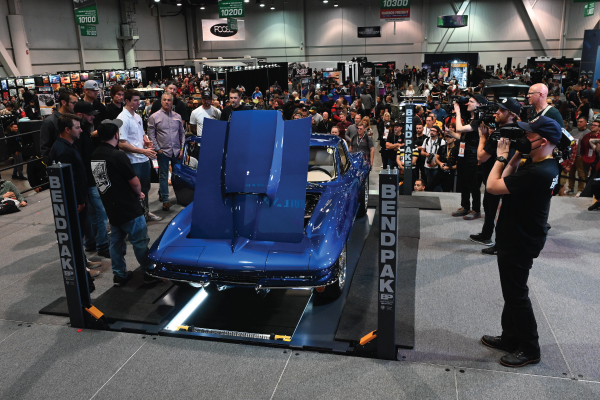
As with past competitions, a panel of industry experts reduced the more than 250 entries to a list of 40 semifinalists within the first couple of days after the deadline for submissions had passed. Those 40 made the trip to Las Vegas for the SEMA Show, where their numbers were subsequently whittled down to a Top 12, three in each category. At that point, the 12 finalists judged each other’s work to determine the winner of each category as well as the overall winner.
In 2022, the winners were Mike Ring (Hot Rod/Hot Rod Truck), Jim Ring (Four-Wheel Drive/Off-Road), TJ Russell (Sport Compact, Import Performance, Luxury and Exotic), and Josh Michels (Young Guns). When the votes were all tabulated, Mike and Jim Ring took top overall honors for their ’48 Chevy Loadmaster pickup.
The four category winners of this year’s competition were highlighted along with other featured builders in a TV special, “SEMA: Battle of the Builders,” which aired on A+E Networks’ FYI and History’s Drive block last month. Check your local listings for repeat broadcasts.
For more information on the competition, visit semashow.com/botb.
Greg Ward
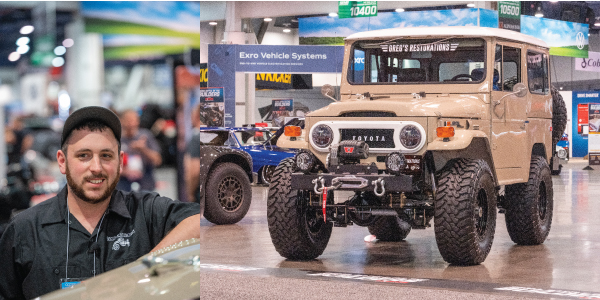 Builder: Greg Ward, Greg’s Restorations, Rutland, MA
Vehicle: ’71 FJ40 Toyota Land Cruiser
Category: Four-Wheel Drive/Off-Road
A 2,000-hour restomod project, Greg Ward’s FJ40 had been previously modified and, in his words, “heavily off-roaded” (i.e., damaged) by previous owners when it was acquired at an online auction. It had also been equipped with a hodgepodge of OE parts from differing FJ model years, and Ward decided to adhere to that formula when undertaking his build, outfitting the bobtail over the course of three years with a variety of rare and refurbished OE components that make the vehicle stand out from other 4x4s—and even other Land Cruisers. To date, the only remaining components from the auctioned-off vehicle are the frame, axles, hood and front grille.
To start, the vehicle was stripped down to the frame, which was sent out for sandblasting along with the axles. Once returned, chassis and axles were coated in Eastwood ceramic black gloss chassis paint “to make the underside look a little nicer.” The existing bodywork was 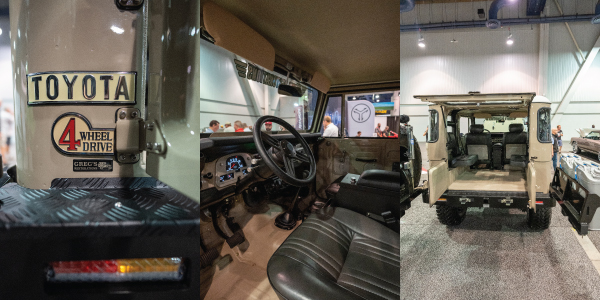 deemed “unrepairable” from previous modifications and was replaced by a Cool Cruisers of Texas (CCOT) reproduction three-quarter tub, which was eventually mated to a ’78 FJ front clip and pre-’74 doors. The body was then coated with OE-spec Toyota Dune Beige paint sourced from Sherwin Williams. Up front, a CCOT front bumper hosts a Warn 8274 winch, and LED KC fog lights supplement the upgraded LED headlights. In the back, a Kaymar integrated rear bumper/spare tire carrier/jerrycan holder is a hard-to-find item: “It took us a year to get it,” Ward says, and the stock OE jerrycans “were the last two we could order.”
Under the hood, a previous owner had swapped in a 350 small-block, which Ward replaced with a Chevrolet Performance LS3 crate V8 that outputs 430 hp. The block is mated to an ’85–’87 FJ60 HF55 five-speed/transfer case combo that utilizes an Advance Adapters conversion kit. As mentioned, the stock FJ axles were retained and now sport a set of 315/70R17 Toyo Open Country tires on custom-machined (for fitment issues) black Rhino rims.
Inside, OE Toyota seats were fully restored with new foam and covers. A Tuffy center console fits between the front buckets, and custom billet switchgear sports original Toyota symbol markings. A Dakota Digital gauge cluster monitors engine functions, and a RetroSound audio system mimics the OE radio in appearance but offers Bluetooth and Sirius XM compatibility.
Shawn Bassett
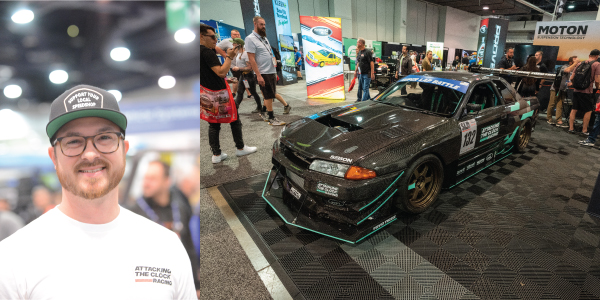 Builder: Shawn Bassett, Attacking the Clock Racing, Tavares, FL
Vehicle: ’91 Nissan Skyline R32 GT-R
Category: Sport Compact,
Import Performance, Luxury & Exotic
“The goal was to make a very modern race car,” Shawn Bassett says of his build, which started its life as a factory NISMO GT. “There’s a tremendous amount you have to do for a ’90s car to compete with modern Porsche GT3s on a road course,” he continues, and to that end, Bassett proceeded to build a dedicated Pikes Peak racer that incorporates myriad custom and one-off components.
Starting under the hood, an RB26 inline six has been bored and stroked to displace 2.8L and outfitted with a dry-sump oiling system. A Motec full engine-management system with PDM optimizes fuel delivery and engine operation, and a Garrett turbocharger lends a power boost. An Antigravity ATX-30 lithium-ion battery provides spark, and a Radium fuel system brings the juice.
 The rest of the original all-wheel-drive drivetrain was ditched in favor of a traditional rear-drive race setup, a move Bassett admits is “something that GT owners will probably hate me for doing.” On the other hand, losing the stock transmission, transfer case and front drive in favor of a BMW dual-clutch paddle transmission (with 200-millisecond shift capability) allowed Bassett to shave 450 lbs. of weight from the vehicle. Now, power is transferred to a quick-change Winters rear diff, which turns a set of special-edition Volk TE37 wheels and 295/35Z 888R Toyo Tires. An AP Pro5000 Big Brake kit brings the Skyline to a halt in tandem with HEL Performance brake lines and fittings. Locating the wheel/tire combo is a custom billet suspension that utilizes one-off Moton three-way coilovers and FDF Fab spherical control arms, and a set of air jacks has been installed to allow for quick tire changes.
The Skyline’s original bodywork has been replaced with a full carbon-fiber exterior, save the doors and rear quarters. A full ATCR Aero Package includes a front splitter and custom splitter rods, a full flat-bottom and rear diffuser. Also onboard is a massive frame-mounted APR Performance 70-in. Dual Element Wing. The setup makes for “serious aero,” in Bassett’s words.
Inside, Sabelt racing seats and Takata six-point harnesses secure driver and co-driver, and a Sabelt steering wheel features a quick-release mount. A Lifeline fire suppression system is onboard, and a custom ATCR “Pikes Peak”-spec rollcage adds an extra measure of safety.
Tyler Nelson
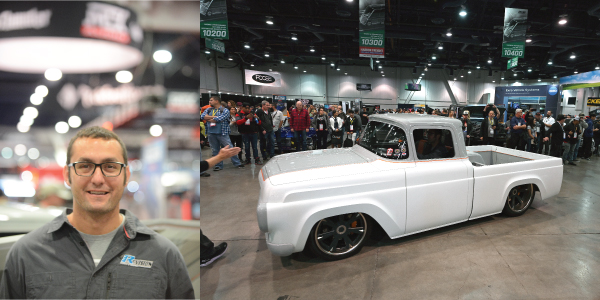 Builder: Tyler Nelson, Revision Rods & Rides, Rapid City, SD
Vehicle: ’58 Ford F-100
Category: Hot Rod/Hot Rod Truck
The ’58 Ford F-100 was “kind of an ugly duckling for Ford trucks of that era,” Tyler Nelson admits, but that didn’t prevent him from building a BOTB-worthy pickup that features more than 100 custom-machined one-off components. A 21/2-year project based on artwork from Eric Brockmeyer Design, “Frigid” was named the 2022 Goodguys Truck of the Year at the 25th Southwest Nationals last November.
Look no further than the exterior to see why. The rocker panels have been extended to more seamlessly integrate with the fenders, and the still-original glasswork has been flush-mounted. The roofline was tweaked, the drip rails and door handles shaved, and the bed widened and gapped to the cab. The hood and front fenders have also been reworked, and the tailgate features a modern-style easy-lift system that’s hidden behind the taillight panels. Billet pieces can be found everywhere from the grille to the headlight bezels to the hood hinges. (“We probably went a little overboard with the machining,” Nelson says.) Completing the exterior is BASF Glasurit Oxford White and Avalanche Gray paint along with custom orange accenting.
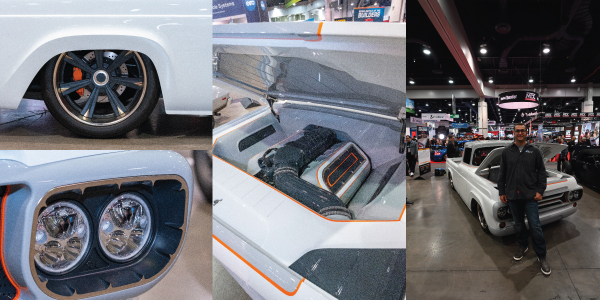 Under the hood in an uncluttered custom engine bay, a 5.0L Coyote V8 resides between the rails of a Scott’s Hotrods ’n Customs chassis, which features a new center section made from 2x6, 3/16-in. tubing to improve structural rigidity. It’s topped by a Whipple 2.9 supercharger, and a set of Ultimate Headers and a custom stainless exhaust expel spent gases. All told, output is an estimated 700 hp, and backed by a Tremec six-speed transmission, “it’s a riot to drive,” in Nelson’s words. The truck rides on a RideTech coilover suspension and rolls on a set of Colorado Customs-fabricated 20x9-in. front and 22x11 rear rims, with additional nickel work applied by Ogden Chrome. Stopping power comes courtesy of 14-in. Wilwood disc brakes sporting six-piston calipers.
The Ford’s interior is awash in two-tone black and orange Hydes Leather with stitchwork applied by Seams Impossible Custom Interiors. A custom-fabricated dash houses a set of one-off Dakota Digital gauges in custom billet housings. A Sparc steering wheel is similarly bespoke, and the custom dash incorporates Vintage Air climate control.
Cameron Cocalis
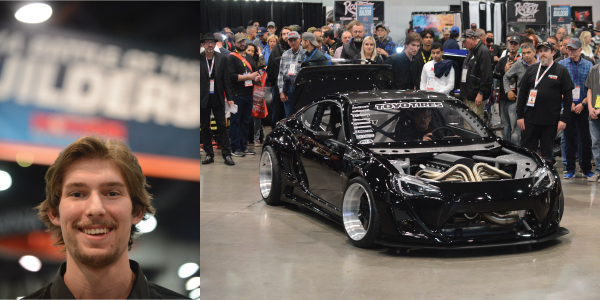 Builder: Cameron Cocalis, Denver, CO
Vehicle: ’15 Scion FR-S
Category: Young Guns
A 2022 SEMA Scholarship honoree, 21-year-old Cameron Cocalis studies engineering at the University of Colorado, Denver. When he’s not in class, he’s ensconced in his workshop, a 900-sq.-ft. storage space, where his Scion drifter was built over a 21/2-year period on a student’s budget, as he explains: “The whole car was done with a Harbor Freight TIG welder.” It’s his first major build, and we imagine after placing in the Top 12, it won’t be his last.
The Pandem Rocket Bunny widebody kit was the first component to be installed “because I liked the look of it,” and subsequent bodywork included a Seibon Carbon hood and roof accompanied by revised rear styling including a spoiler, rear bumper and diffuser extensions. The rear body mods help to accommodate a Trophy Truck-style rear-mounted Mishimoto radiator setup, along with relocated engine ancillaries such as a Radium fuel system, fuel pump and 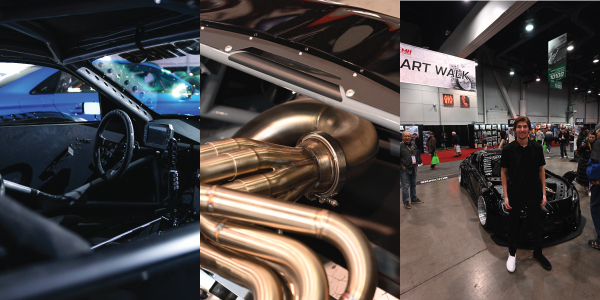 water pump, which Cocalis placed in the back to maintain an optimal 50/50 weight distribution. A peek under the hood explains why.
Resting amid a custom all-tube chassis is a 525hp LS3 376 sporting a reverse-mounted intake and a custom 8-into-1 stainless header. Using Haltech Elite 2500 engine management, power flows to a swapped-in six-speed manual transmission (which Cocalis admits he’d never driven before) and from there to a welded Lexus IS300 rear differential that utilizes 1,000-hp-rated DSS shafts to spin a set of Work S1 3P aluminum alloy wheels shod with low-profile Toyo tires. Wilwood six-piston front and dual four-piston rear brakes provide stoppage. The car rides on a custom wide-angle coilover suspension utilizing parts from Air Lift and FDF Race Shop; the cantilevered pushrod-actuated rear suspension is mounted on a custom subframe.
The interior is relatively Spartan for reasons of weight savings, with all-custom ’cage work, a custom aluminum dash, custom flat paneling and a Haltech digital instrument cluster. Recaro bucket seats and Nightrunner International racing harnesses provide added measures of safety.
Tim Devlin
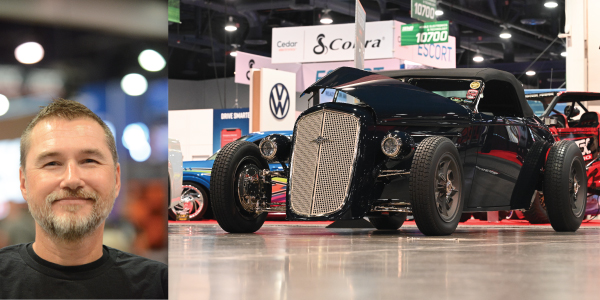 Builder: Tim Devlin, Devlin Rod and Customs, Wichita, KS
Vehicle: ’34 Chevrolet Roadster
Category: Hot Rod/Hot Rod Truck
Tim Devlin’s ’34 roadster came into BOTB on a winning streak, having captured the Amber Award at the 2022 Grand National Roadster Show and winning the title of America’s Most Beautiful Roadster later in the year. With its many custom flourishes and unique features, it’s easy to see why “Lucille” stands out at any car show it enters.
That uniqueness starts with the body, which was built by GM’s Australian subsidiary Holden and is one of only 31 that were ever built for that model year. Utilizing an original rendering from Eric Black, the fenders and running boards were removed, and the bodywork was channeled over the frame. The bumpers and door handles have likewise been removed, but the three-slat side venting has been retained. A massive custom-machined EVOD grille rests up front, and E&J-style custom headlights “have a nice, natural look,” Devlin says. Custom windshield bracing supports the lowered custom cloth top, which retracts into—not onto—the bodywork.
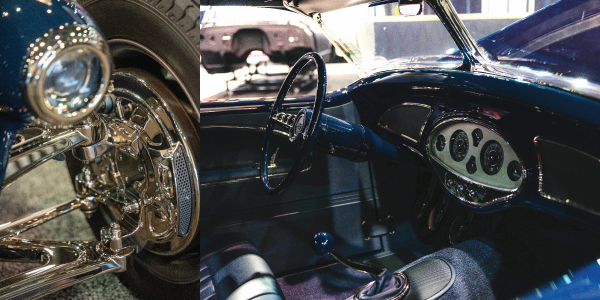 The Chevy rides on a custom Roadster Shop chassis, which Devlin says is the most crucial component of the build. The chassis incorporates a trick IFS suspension, with shocks mounted inboard to the inner frame ails (one of the “many cool things you can’t really see on this build,” Devlin admits.) Rolling stock comprises period-appropriate Coker Excelsior Stahl Sport Radials mounted on machined knockoff rims from Greening Auto Co.
Under the hood is an LS3 from Automotive Specialties that’s been tuned to produce some 640 hp. Johnson’s Hot Rod Shop performed extensive machine work to the valve covers, cylinder heads and intake. The stack-style injection system atop the manifold has its electronics cleverly hidden to mimic quad carbs. Backing the engine is a Bowler-prepped Tremec transmission, which sends power to a Winters quick-change rearend, which in turn is located by a custom four-link. ARP bolts are used throughout the build.
Inside, the Tavis Highlander-designed cockpit was executed by Chuck Rowland Interiors, with blue Relicate leather and an EVOD-machined steering wheel and center-mounted gauge cluster that hosts a sextet of Classic Instruments gauges.
CJ Pullman
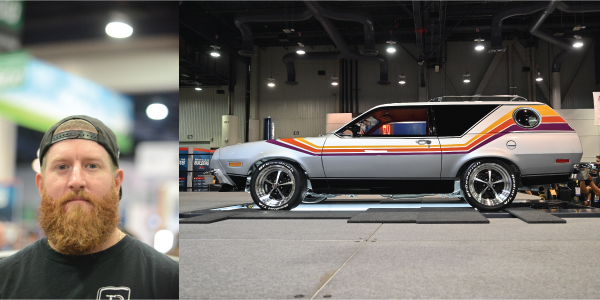 Builder: CJ Pullman, Pullman Fabrication, Walnut Creek, CA
Vehicle: ’77 Ford Pinto Cruising Wagon
Category: Sport Compact,
Import Performance, Luxury & Exotic
“You bring a Pinto anywhere, and it’s kind of a hard sell,” CJ Pullman admits, expressing his surprise at being named to the Top 12 with his ’77 Cruising Wagon. Approached by a client who had seen the car at a Hot August Nights event and “got bit,” Pullman, along with his brother Nick, set out to build “something that had a very classic look but which has all the creature comforts of a new car.” One Top 12 appearance later, it looks as though they’ve succeeded.
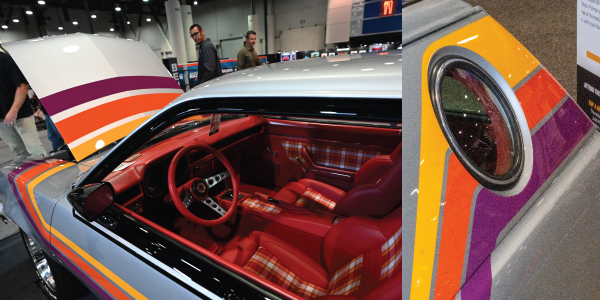 The Cruising Wagon rests upon an Art Morrison chassis, which incorporates a custom-fabricated independent front and rear suspension. Between the framerails rests a drivetrain donated by a late-model Mustang. A swapped-in 2.3L EcoBoost four-
cylinder, which was rated at more than 300 hp in the pony car, is topped by a Precision turbocharger that’s run through a Garrett intercooler. A Mountune dry sump handles oiling duties, and the engine is backed by a six-speed automatic transmission. Power
ultimately flows outbound to a set of white-letter BFGoodrich Radial T/A tires that are brought to a halt by Wilwood brakes sporting four-piston calipers.
Inside, the custom interior’s cutting-edge upholstery was executed by DJ Designs with the aim of creating “a ’70s-theme interior with a modern twist.” Recaro seats provide a comfort upgrade for driver and passenger, and components from Classic Instruments and Vintage Air can be found nestled in the dash. While challenging, “incorporating new technology into the build is fun,” Pullman says, recalling the brothers’ efforts to hack the Ford powertrain to make the six-speed’s paddle shifter function, then concealing the paddles subtly behind the steering wheel to stay faithful to the overall retro look. On the subject, the ’70s-epic PPG exterior paint was applied by Bay Area legend Art Hemisland.
“We keep a low profile,” Pullman says of his fabrication business. Judging by his success at BOTB, that might just change in the not-so-distant future.
Cody Dabney
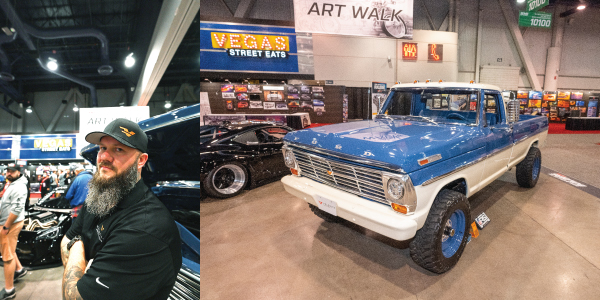 Builder: Cody Dabney, Velocity Modern Classics, Pensacola, FL
Vehicle: ’70 Ford F-250
Category: Four-Wheel Drive/Off-Road
Among Ford enthusiasts in the southeastern United States, Velocity Modern Classics is known as a Bronco specialist, having built more than 100 of them, so this build represents a branching out of sorts—in Cody Dabney’s words, “time to pivot and go where the market’s at.” A genuine modernized classic, the ’70 F-250 Heritage edition was built in an assembly-line fashion over “many late nights and long weekends,” Dabney admits.
First and foremost, a 3/4-ton truck needs big power, so a 345hp Coyote 5.0L was dropped between the rails of a Roadster Shop RS4 chassis and equipped with a bespoke serpentine drive-belt system and a custom exhaust. The V8 is backed by a 4R70 automatic transmission, and power flows via an ultra-stout Atlas II T-case and custom carbon-fiber driveshafts from Panhandle Driveline to Dana 44 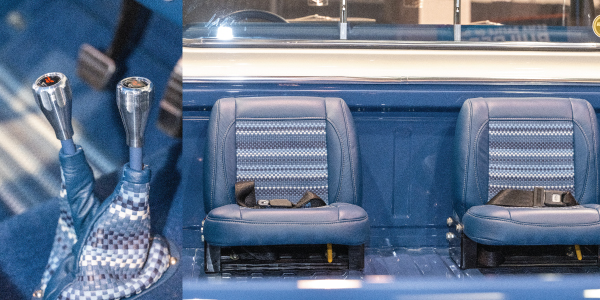 front and Dana 60 rear axles. Eighteen-in. Detroit Steel wheels are equipped with 33-in. BFGoodrich All-Terrain T/A K02s; a set of Baer discs with Hydraboost power assist handle braking duties. The truck’s suspension has been supplemented by the addition of custom-valved Fox shocks for improved off-road performance and on-road ride quality.
The meticulously restored exterior sports numerous custom touches, including custom billet cab lights, center caps, door handles and hood badging, all made in-house. All-new glass and weatherstripping have been added to the build, as have a pair of J.W. Speaker LED headlights. All-new glass and weather seals and California-style side-view mirrors complete the exterior features. Custom Glasurit two-tone paint gives the truck a factory look with a modern flair.
But it’s the interior, Dabney says, that’s “the focal point of the build,” highlighted by a custom bench seat swathed in period-perfect Moore & Giles blue leather. A GT Performance steering wheel and ididit tilt column point the F-250 in the right direction, and a one-off Dakota Digital gauge cluster resides in a custom dash. A Bluetooth-enabled RetroSound Huntington head unit and a Morel audio system combine ’70s styling with modern-age sound. To keep passengers comfy, Vintage Air handles climate control.
Austin Phipps
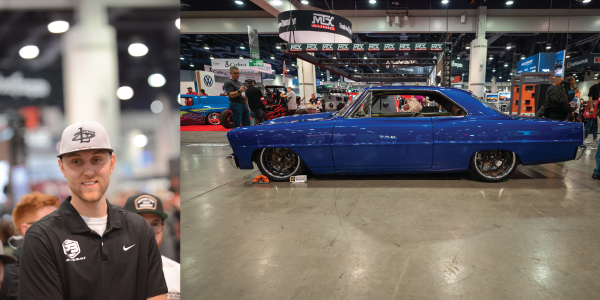 Builder: Austin Phipps, Phipps Built, Hermiston, OR
Vehicle: ’66 Chevrolet Nova
Category: Young Guns
A former Top 12 finalist, Austin Phipps knows how much time, patience and attention to detail are required to crack the Top 12 at BOTB—and for 2022, he returned to the finals with his ’66 Chevy Nova restomod that shows why this builder is a perennial contender.
Start under the hood, where a custom-painted and -polished LS3 engine with rebuilt cylinder heads is topped by a Whipple 2.9 Supercharger in a full-custom engine bay. An ultra-aggressive (.629/.600-in. lift, 235/252-degree duration) Brian Tooley Racing Stage 4 PDS cam resides within the block; a custom titanium dual-filter intake supplies fuel, and Ultimate headers and custom 3-in. Black Widow exhaust with stainless oval tubing handle the exhaust. A Tremec T56 transmission sends power to a narrowed Ford 9-in. rearend that 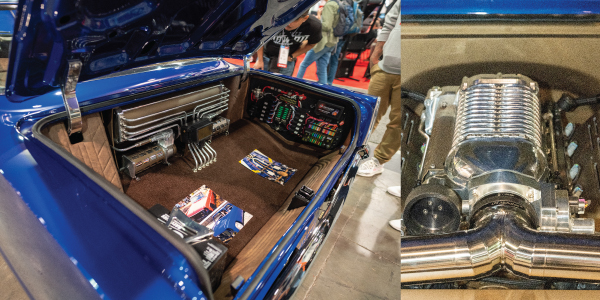 sports a set of Rushforth Prowler wheels with burnt bronze Cerakote centers and Nexen Nfera AU7 tires; four-piston Wilwood four-wheel disc brakes slow down the ride. The Nova runs a hard-lined AccuAir suspension featuring powdercoated componentry, an IFS setup sourced from Scott’s Hotrods ’n Customs in front, and a custom four-link locating the rear.
The Chevy’s bodywork boasts numerous custom touches, including shaved door handles, drip rails and wiper cowl, a custom front clip with custom inner fenders, a one-off firewall, and custom-mixed PPG blue paint applied by Columbia Auto Body & Paint.
Inside, the interior sports a one-off TMI leather treatment, with four bucket seats (with twin rear cupholders) awash in custom leather upholstery, along with one-off door paneling, a custom center console and custom headliner. A ’59 Chevy Impala dash was grafted into the build and hosts a variety of Classic Instruments. Restomod Air provides climate control, a Sparc steering wheel guides the ride, and bespoke pedals and Wilwood pedal arms control acceleration and brake functions.
Josh Michels, Winner, Young Guns
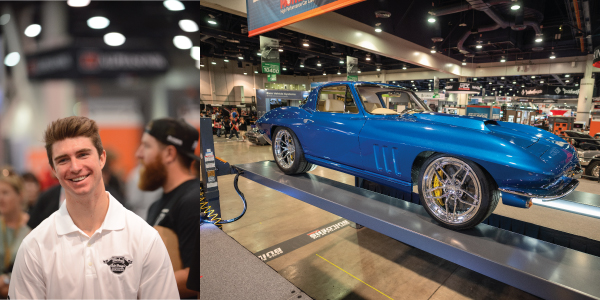 Builder: Josh Michels, Michels Auto Design, Pewaukee, WI
Vehicle: ’66 Chevrolet Corvette
Category: Young Guns
“The idea behind the build was to keep it as stock-looking on the outside as possible while adding all-new modern components inside,” Josh Michels explains. Assembled over 31/2 years in his parents’ garage, “Blu My Mind” is his first major build, and it’s made him, at age 21, the youngest BOTB winner to date.
Michels first discovered the Corvette parked in a neighbor’s yard. It hadn’t moved since 1980 and was sunk in mud to its rocker panels. After shoveling it out by hand, Michels commenced with the build, starting with a Roadster Shop Spec 7 chassis. The chassis allowed him to install front control arms and spindles taken from a donor ’19 C7, and in the rear, a Camaro ZL1 IRS handles back-end suspension details. At each axle end, 15-in. Brembo carbon ceramic binders, 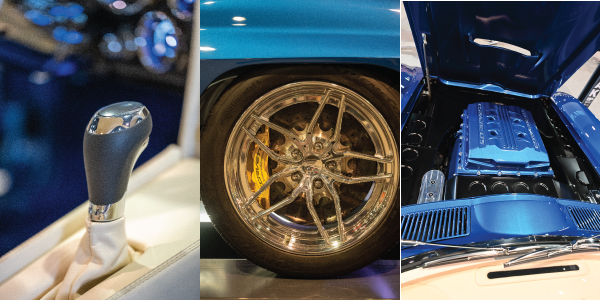 also donated by the C7 and sporting yellow-painted calipers, apply braking force to 19x9.5 front and 19x12 rear Forgeline A304 wheels, which are equipped in turn with 275/30ZR20 front and massive 355/20ZR19 rear Continental Extreme Contact Sport tires.
Under the hood is a supercharged 6.2L LT5 engine, which was also donated by the ’19 C7 and which expels spent gases through a custom TIG-welded dual exhaust. The powertrain produces an estimated 755 hp, and it’s backed by a paddled-shifted GM 8L90 automatic transmission that works in tandem with a McLeod twin-clutch kit. Power flows to a swapped-in ZL1 rear diff spinning 3.73 gears.
The Corvette’s exterior sports numerous custom touches that have been delicately and subtly applied. The front clip, quarter panels and taillight panels have all been reworked, and the tucked bumpers lend a clean, sleek look. The ’Vette’s paint scheme was inspired by a visit Michels made to a GM dealership, where he saw a ’17 Laguna Blue C7 on the showroom floor.
Inside the cab, driver and passenger can ride in comfort courtesy of Lamborghini Creme leather upholstery. The center console is a custom piece, as is the dash, which houses a complement of Dakota Digital gauges and a Vintage Air climate control system. The audio system? “There’s no stereo at all,” Michels explains, “just 755 hp screamin’.”
TJ Russell, Winner, Sport Compact, Import Performance, Luxury & Exotic
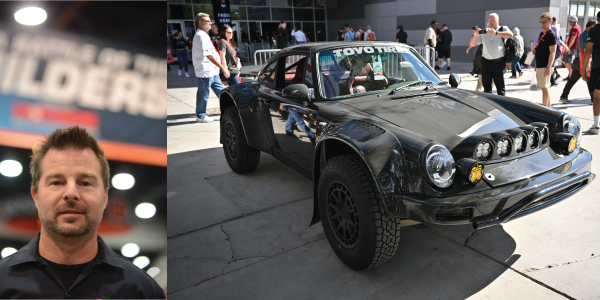 Builder: TJ Russell, Russell Built Fabrication, Sun Valley, CA
Vehicle: ’91 Porsche 911 Baja
Category: Sport Compact,
Import Performance, Luxury & Exotic
“I’m a big fan of thinking outside the box and trying to break the rules,” TJ Russell states, “and an off-road 911 definitely does that.” Starting its life as a convertible Carrera C4, the Porsche was stripped to bare metal, equipped with a tube chassis that was integrated into the existing bodywork, and built to perform as a bonafide Baja racer with a show-quality finish “that you’d expect to find at Pebble Beach.” As the winner of the Sport Compact, Import Performance, Luxury & Exotic competition, you could make a good argument that Russell’s AWD 911 covers all the categories.
Starting with the tube chassis, the Porsche has been widened seven inches and given a 3-in.-longer wheelbase for increased stability in off-road race conditions. Steel body panels were replaced with custom-formed parts made of composite materials including the widebody fenders, rally-style hood, hard top and doors. Combined, the new chassis and bodywork shaves 400 lbs. of weight from the stock 964.
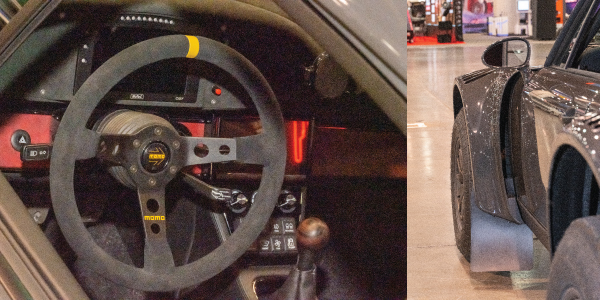 Nestled within the chassis is a rear-engine Rothsport 4.0L flat Six that boasts custom throttle bodies and a custom intake, all of which are controlled by a Motec ECU. The engine’s estimated 385 hp is transferred to a stock 911 five-speed, which drives a set of 15-in. Fifteen52 Integrale wheels shod with Toyo Tires Open Country AT IIs.
Desert racing suspensions take a beating and hence need to be over-engineered, and the 911’s suspension was built with that kind of abuse in mind. The front suspension utilizes shock towers fabricated from 4130 chromoly, spindles and upper A-arms machined from 7075 billet aluminum and three-way adjustable coilover shocks. In the rear, a tunable NASCAR-style rear swaybar aids stability in corners, and a buggy-style box plate and tube trailing arms use the factory pickup points to optimize handling characteristics. The setup is said to provide 12 in. of front wheel travel and 13 in. of rear wheel travel—roughly the same as an F-150 Raptor.
While built for racing, the Porsche is also built for luxury, and that includes a quiet cab, so the entire interior is sprayed with sound-deadening material with a ceramic coating to better insulate the occupants from excess noise. A full 4130 chromoly rollcage provides protection while quilted Alcantara carbon-fiber Recaro SPX seats and quilted leather door inserts lend a touch of comfort and class. Six-point Sparco harnesses optimize safety, a Sparco steering wheel directs the ride, and a Motec digital dash houses switchgear that allows the driver to manipulate performance parameters such as brake bias and torque transfer on the fly.
Mike and Jim Ring, Ringbrothers, Winner, Four-Wheel Drive/Off-Road
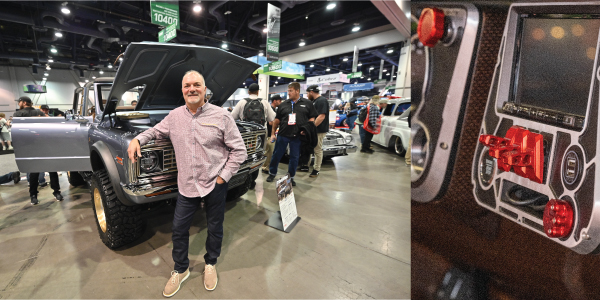 Builders: Mike and Jim Ring, Ringbrothers, Spring Green, WI
Vehicle: ’72 Chevrolet K5 Blazer
Category: Four-Wheel Drive/Off-Road
“The goal was to create a refined yet rough vehicle,” Mike Ring says of his BOTB-winning Blazer build. The truck’s owner wanted a Blazer built on a Roadster Shop chassis, and “that was the platform we decided to work with,” Ring says, adding with a smile that “things kind of got out of control.” Some 8,500 man-hours later, “Bully” the Blazer occupies the winner’s circle at BOTB 2022.
Starting under the hood, the Wagner-built 416ci LS3 V8 was originally topped by a Whipple 4.5 supercharger and built to produce an estimated 1,200 hp. Given the truck’s wheelbase and ride height, a slight detuning was deemed advisable, so the 4.5 was replaced by a 2.9, and the engine now outputs an estimated 800 hp. (“Plenty,” Ring says.) A Holley Dominator EFI system provides aspiration, and spent gases exit through a pair of custom Ringbrothers headers and a Flowmaster 44 stainless exhaust.
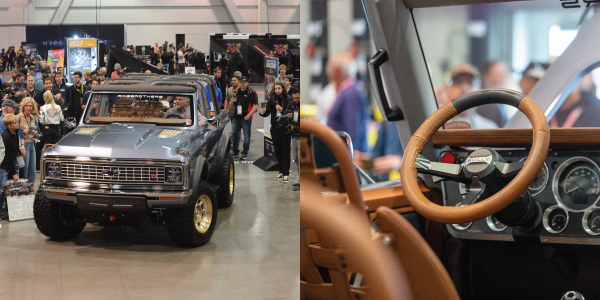 Power is transferred to a Bowler Tru-Street GM 4L80E automatic transmission and from there to Currie-built Dana 44 front and Dana 60 rear axles, which turn a set of HRE one-off 18x12 Ringbrothers Edition wheels wrapped with 265/65R18 (35-in.) Cooper Discoverer STT tires. Braking is handled by a Baer 6P Extreme brake system with 15-in. front and 14-in. rear rotors and six-piston calipers. A custom triangulated four-link suspension with Fox Racing 2.5 coilovers optimize wheel travel off-road while delivering a pleasing on-road ride.
Scarcely an inch of the Blazer’s bodywork was left untouched, and the exterior sports numerous subtle custom touches and Ring-machined billet parts including the reimagined taillights and side marker lights, the notched tailgate, billet hood vents and leather hood straps. Custom 3-D-printed carbon-fiber fender flares make room in the ’wells for those meaty tires, and a carbon-fiber hood sheds weight and eases access to the engine bay. Custom BASF Glasurit Bashful Blue paint adorns the bodywork.
The Blazer’s custom interior was designed to give the occupants the feeling “that you’re outdoors, sitting in a lawn chair and having fun.” The bespoke leather seats feature criss-cross strapping flawlessly executed by Steve Pearson at Upholstery Unlimited, who additionally inserted nylon webbing beneath the straps so the leather wouldn’t stretch out over time. Custom floor pans equipped with rear grating enable the truck to be hosed out after a day on the trail. Dakota Digital instrumentation monitors engine vitals, and Ring-machined parts abound everywhere, from the carbon-fiber leather-wrapped steering wheel to the anodized aluminum switchgear and shifters.
Mike and Jim Ring, Ringbrothers, Winner, Hot Rod/Hot Rod Truck and 2022 BOTB Winner Overall
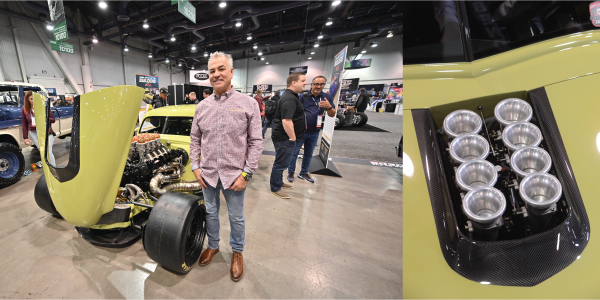 Builders: Jim and Mike Ring, Ringbrothers, Spring Green, WI
Vehicle: ’48 Chevrolet Pickup
Category: Hot Rod/Hot Rod Truck
“It’s always fun to do something different,” Jim Ring says of his one-of-a-kind creation, which was based off a 11/2-ton Chevy Loadmaster pickup reimagined as a Formula 1 racer. And to be fair, to call this truck a ’48 Chevy is a bit misleading since the only thing remaining from the original truck is the cab—and even that’s been chopped four inches from the original. Whatever you call it, “Enyo,” which took some 10,000 hours to design and build, is 2022’s Battle of the Builders Hot Rod category winner and overall best in show.
The brilliancy begins under the hood, where a Todd Goodwin-built 510ci LS race engine rests within an Ahlman Engineering/Roadster Shop chassis. Topped by a Kinsler eight-stack injection system and exhaling through custom stainless headers and titanium side pipes, the V8 produces an estimated 1,000 hp on 110-octane race fuel. All that power flows to the rear wheels via a Bowler 4L80E transmission and Corvette torque-tube transaxle. Bespoke HRE 18x13 front and 18x15 rear wheels are wrapped with 315/30R18 front and 365/35R18 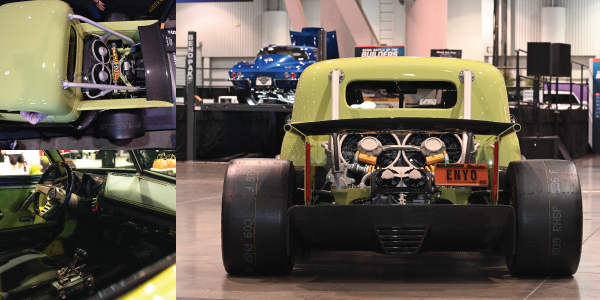 Goodyear Racing Eagle G-19 slicks that are used in the FIA and Trans Am road-racing series. (The Chevy typically runs milder treads on the street, but at BOTB it competed in full race trim.) Six-piston-caliper Brembo GTS M6 brakes bring the ride to a halt.
Underneath the carbon-fiber bodywork, a cantilevered independent suspension setup features tubular A-arms and Ohlins coilovers that are canted slowly towards the center of the chassis to optimize ride and handling. A pair of Nuke Performance air jacks have been integrated into custom buckets to facilitate quick tire changes.
As mentioned, Enyo’s exterior is nearly all formed out of 3-D-printed carbon-fiber components, including the grille, doors, hood, spoiler, rear diffuser, bedsides and full belly pan. Custom side vents accommodate the exhaust piping, and one-off LEDs reside in flush-mount billet housings. The chopped cab required a custom two-piece windshield. The bodywork is coated in BASF Glasurit Mythic Battle Green paint, which was applied via a spray booth from Global Finishing Solutions.
Inside the cab, driver and co-driver will find themselves engulfed in carbon-fiber parts including the dash and headliner. An 18-piece titanium shifter mechanism that connects to the torque tube is “the centerpiece of the interior,” Jim Ring says, and Mythic Battle Green inner door paint and dash stitching mimic the exterior color scheme. The CNC-machined Sparc steering wheel has been covered in carbon fiber, and power windows, leather armrests, one-off Dakota Digital gauges and Vintage Air climate control have all been integrated into the interior build.
To be fair, though, words don’t do this truck justice—it has to be seen to be fully appreciated, and that’s why it’s a worthy winner at 2022 Battle of the Builders.



 VP Racing and IMSA Collaborate on New Renewable Fuel
 Enterprise and Ford Partner to Expand Collision Engineering Program
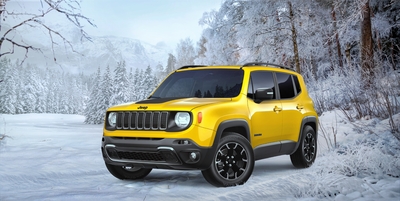 Orders Now Open for New ’23 Jeep Renegade Upland Special Edition