Sat, 10/01/2022 - 14:29

SEMA News—October 2022

BUSINESS

Building Your Business Through Profit Sharing

How Making Sure Your Employees are Happy Leads to Increased Customer Satisfaction

By Eric Colby

Profit Sharing

There is one thing that profit sharing helps avoid. “The chances of having a bad year are less and less because you weren’t pulling it by yourself,” said Dick Erickson of Sun Tire in northern Florida. “The whole group was going to get hurt by a bad year.”

When Dick Erickson was building his business, Sun Tire, in northern Florida, he took a different approach than many other entrepreneurs. Of course, he wanted to be successful, but that wasn’t all about profit margins and moving the most product.

“We prided ourselves on having the best women’s bathroom in town,” said the author of How the Rubber Meets the Road: a Blue-Collar Roadmap to Success for Business Owners and Entrepreneurs, during the SEMA webinar, “Wheel and Tire Industry Insights, Part 3: Building Your Business Through Profit Sharing.”

After growing up in rural North Dakota, Erickson attended North Dakota State University before serving a tour of duty in the United States Marine Corps as a helicopter pilot flying hundreds of rescue missions in Vietnam. After a crash in the demilitarized zone, Erickson hid in a friendly village until he could make his escape. He made it back to the United States and returned to North Dakota to earn a degree.

He got into the tire business in Florida, working at a Big 10 Tires in Panama City and then moved on to set up stores in Albany, Georgia, explained Tyson Boyer, an outgoing chairperson of the Wheel & Tire Council, which co-presented the webinar.

Profit Sharing

At its most basic, sharing profits creates a positive environment within the company.

Starting From Scratch

Striking out on his own in 1981, Erickson started Sun Tire in Orange Park, Florida, and from the beginning, he was always looking at industry leaders to see what they were doing best. “I started reading who was setting the bar higher than most and after about 10 or 15 years, I realized there were some companies who were really getting it done,” he said.

One such company was Les Schwab Tires, which was headquartered in Bend, Oregon,
and had stores throughout the western United States.

“I started visiting them on the West Coast and started observing them,” said Erickson. “They were head and shoulders above everything else I had seen in the industry.”

Like any successful business, the Schwab outlets had good locations and competitive product, but they had one thing that set them apart—profit sharing.

Erickson met Schwab once. “His question to me was, ‘What are you doing for your employees?’” recalled Erickson.

Profit Sharing

Every employee must be included in the profit-sharing plan and they all need to feel like they are going to benefit.

Everyone Counts

While some companies have profit sharing for management and maybe middle-management, Sun Tire’s plan was all-inclusive with even the hourly workers. “Fifty percent of the profits for the owner and 50% for the employees,” said Erickson. “Every person was going to get a piece of the action.”

The managers and assistant managers put up half the assets of the company, excluding the real estate. The store, the receivables, the inventory and the equipment were used to finance future shares of employee bonuses.

“They became part of the program and as the hourly guys were brought on, they became stakeholders,” said Erickson.

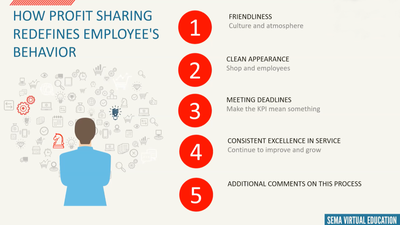
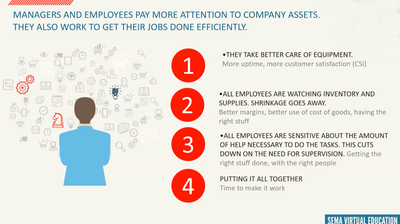
Once that happened, things changed. The stores looked cleaner, the employees became more aware of their appearance and held each other to higher standards. Shrinkage was reduced because the employees knew that having to replace equipment would cut into their profit-sharing bonus. “People don’t steal from themselves,” said Erickson. It may sound weird, but Sun Tire was the first company of its kind to dress employees in white shirts, which helped contribute to that clean, professional image.

There was also a high level of transparency. The hourly employees knew what the manager and the assistants got for a bonus if the store hit a certain dollar threshold, so everyone pulled together toward the same goal.

With a corporation made up of 11 stores, there needs to be some central administration, but Erickson said that profit-sharing helped eliminate middle management. He had a right-hand person who helped oversee a handful of stores and then he had two other regional managers. Early on, Sun Tire was spending about four percent on administration, but by the time Erickson sold, that number was down to 1.75%.

Profit Sharing

If employees feel like they have an ownership share, the equipment is maintained and there’s almost zero threat of theft.

Real-World Approach

Sun Tire did have a call center and when a customer wanted information such as tire and installation prices, Erickson made sure the consumer had the “drive-out” price up front. “We tried to stay away from matching prices, but every week we checked the competition’s pricing in price-sensitive areas,” said Erickson.

Some tire stores list a product price, but then hit the consumer with additional fees when the time comes to pay. “You’d have an upset customer who would say, ‘I’ll take it this time, but I’m not coming back,” said Erickson. “We told our customers, ‘You can write a check now for that amount and bring it to the store with you.’”

And when an issue inevitably did arise, Erickson said, “We were quick to move on any complaint immediately and that sometimes meant that the employee had to move on.”

Because Sun Tire didn’t pay employee commissions, there was no pressure to upsell. “Defining what it did for the employees, they would go overboard on how they interacted with the customer,” said Erickson. “I saw that consistently.”

There was also less downtime and employees became increasingly self-sufficient, taking on more challenges and expanding their abilities. If a store hired someone who wasn’t pulling his/her own weight, the other employees basically sent the message that he/she should move on down the road.

Bonuses were handed out at the end of each month, with 15% being held back for a retirement plan for all the employees. “Most companies forget one of the most important things in our industry, which is a well-defined retirement program,” explained Erickson. Performance incentives also included trips to the SEMA Show.

Profit Sharing

Introduce profit-sharing and you’ll find that employees are more inclined to stick around for the long-term.

The Company Line

When it came to promotions, Erickson said that when he opened a new store or had a management position at a flagship location, it was pretty easy to find the right candidate to take the helm. “If someone was outgoing with a lot of talent, we would put them in a bigger store. It was who was doing the best job with his store,” said Erickson. “But not everybody wanted the pressure of a bigger store.

Along those same lines, a successful company has a formula that it follows and Sun Tire’s employees needed to follow the program. “We had to be very tight on that,” said Erickson, adding that they had to watch “the achievers” as closely as the non-achievers. “We had some pretty hard meetings and the achievers had to be counseled as much as anyone else.”

Finally, there is one thing that profit sharing helps avoid. “The chances of having a bad year are less and less because you weren’t pulling it by yourself,” said Erickson. “The whole group was going to get hurt by a bad year.”

Sat, 10/01/2022 - 14:07

SEMA News—October 2022

INDUSTRY INSIDER

13 Questions for Frances Farnam

By Douglas McColloch

Frances FarnamThis month, a change of pace as we spotlight a newcomer to the world of custom car building. Meet Frances Farnam, age 13, who explains the origins of her upcoming project. “It started with me saving up money for my first car. I picked grapefruit and veggies from our garden and sold them through a local farmer’s market, and I saved up enough money to buy my first car, a ’76 Porsche 914.” Not content to simply build a Porsche from the ground up, she also plans to electrify it and display it at SEMA Electrified during this year’s SEMA Show. While she acknowledges the build won’t be complete by November, she aims to have it finished by the time she can legally drive it, and in the meantime her project can be followed at her You Tube channel, Tinkergineering.

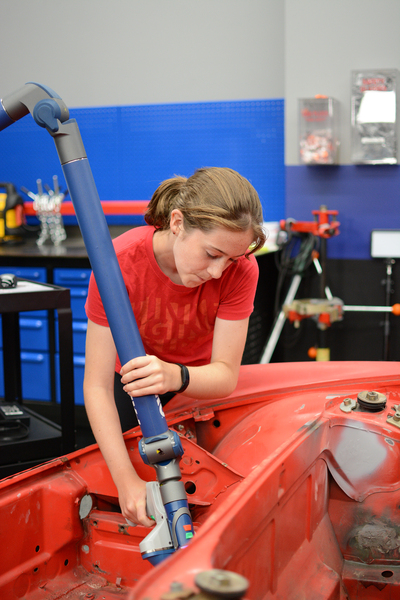
Farnam recently stopped for a visit at the SEMA Garage, where Director of Vehicle Technology Luis Morales gave her a tour of the facility, which included a crash course in CAD design. With only a few minutes of instruction, she got to work creating a digital profile of her 914 using one of the Garage’s FaroArms (pictured left). We chatted with her for a few minutes, to learn more about this build and about this unique individual.

SEMA News: Describe your background. How long have you been working on cars?

Frances Farnam: This is actually the first car I’ve worked on, but I’ve been making things my entire life. I started out with wiring things, and also some craft stuff, so that’s how I got started.

SN: What inspired you to attempt an EV conversion?

FF: I knew that I wanted an electric car because gas is really expensive, and also because the future is obviously going toward EVs.

SN: Why this vehicle?

FF: I really like the 914, particularly the headlights because they pop up and when they do, they look super-funny, and that’s a great part of its appeal. Also, the 914 community is a great group of people. I’ve been lucky to be welcomed into this amazing automotive community.

SN: What do you anticipate being the most challenging part of the build?

FF: Believe it or not, the most challenging part of this is actually having to film it because filming the build will take a lot longer to do the work. When you’re turning wrenches and then you have to narrate an intro about it, the work takes twice as long to do.

SN: Which part of this process are you most looking forward to?

FF: I’m looking forward to installing the interior because it’s going to be fun to actually sit in my car in an actual seat.

SN: What would you like to have completed in time for the 2022 SEMA Show?

FF: By the time of the Show, I intend to have all of the EV components laid out for fitment. Then they’ll be removed so the car can be painted, then reinstalled afterward.

SN: If you could own any other car in the world, what would it be?

FF: The 914 would be my dream car because I think it reflects my personality really well.

SN: Why is this important to you?

FF: I really want to inspire other kids my age to get out there and do what they want to do. That’s why I’m filming the build for Tinkergineering.

SN: Looking ahead, what do you see yourself doing after you’ve graduated from high school?

FF: I’m not completely sure since I’m still so young, but I hope to keep inspiring people, whether it’s through this project or other projects like it.

SN: When you’re not building things, where can we find you?

FF: I love to read, so I’d be at the library from 11:00 a.m. to 5:00 p.m. I love fiction, particularly fantasy fiction.

SN: What are your thoughts on attending the SEMA Show? What do you expect from it?

FF: I’m really excited about it. I’m expecting to meet a lot of people there, so while I’m a little nervous, I’m also looking forward to it.

SN: Who do you follow on social? Got any favorite influencers or mentors you’d like to call out?

FF: I don’t spend much time on social media, but there are a lot of people who have been mentors to me: Matt and Mark from 914 Rubber, the 914World community, Jorge and Jenna at Sierra Madre Collection, Michael Bream from EV West, John at EspoResto, who taught me how to weld, Laurina at Women In Porsche, Eric at PMB, Dave at Coast Airbrush, and Ryno @Rynotmt. All of these people are super-amazing!

SN: What’s on your playlist? What are you listening to these days?

FF: A lot of TV soundtracks. “Stranger Things,” Season 4 just came out, and volume 2 is coming out soon, so I’m very excited about that.

Sat, 10/01/2022 - 13:10

SEMA News—October 2022

LEGISLATIVE AND TECHNICAL AFFAIRS

Law & Order

By Daniel Ingber

FEDERAL UPDATE

Supreme CourtSupreme Court Ruling: In a 6-3 decision, the U.S. Supreme Court held that Congress did not grant the U.S. Environmental Protection Agency (EPA) the authority to devise carbon emissions caps for power plants that would shift the way they generate energy away from coal. The case, West Virginia vs. EPA, is unusual in that it centers around the 2015 Clean Power Plan that never went into effect. The Obama administration plan was blocked in court and the subsequent Trump administration plan struck it down. This decision, while limiting how the EPA can use its authority to reduce carbon-dioxide emissions from power plants, has no effect on current EPA regulation of aftermarket performance products or mobile source emissions. It could have future implications for how much authority government agencies have to enact substantial policy without congressional approval.

RPM Act: With the 2022 mid-term election only weeks away, now is the time to remind your members of Congress that they must pass the Recognizing the Protection of Motorsports Act (RPM Act), H.R. 3281 and S. 2736. The RPM Act clarifies that it is legal to make emissions-related changes to convert a street vehicle into a dedicated race car under the Clean Air Act (CAA). The bill, if enacted into law, would also confirm that producing, marketing, and installing racing equipment on track vehicles does not violate the CAA. The RPM Act enjoys strong bipartisan support in the 2021–2022 session of Congress, including more than 160 co-sponsors, but SEMA members and the racing community must turn up the pressure on lawmakers to pass the bill this Fall.

Below are things you can do right now to help to pass the RPM Act:

  • Invite your members of Congress to visit your business or participate in a virtual meeting with your lawmaker and SEMA staff. Email erics@sema.org for a template and more information.
  • Call and send a letter to your lawmakers at www.saveourracecars.com. A letter has already been drafted. It takes less than a minute.
  • Sign a letter to your lawmakers on company letterhead. Email erics@sema.org for a template and more information.
  • Post about the RPM Act on your company’s social-media accounts using the digital assets toolkit at www.sema.org/rpmtools.
  • Learn more about SEMA’s Political Action Committee (SEMA PAC) at www.SEMApac.com. SEMA PAC allows SEMA members to support the lawmakers that stand up for our industry in Washington, D.C.

NHTSA Black Box Requirements: The National Highway Traffic Safety Administration (NHTSA) issued a proposed rule to require black boxes in vehicles to record more pre-crash data at a higher frequency rate as a way to better understand the actions leading up to a crash. Black boxes, or event data recorders (EDRs), are currently required to collect five seconds of pre-crash data at a rate of two samples per second. The proposed rule would require 20 sec. of pre-crash data at a rate of 10 samples per second. NHTSA has required automakers that install EDRs to collect certain data, including vehicle speed, crash forces at the moment of impact, whether an airbag deployed or if the brakes were applied in the moments before a crash and if seat belts were fastened.

Right to Repair: The Federal Trade Commission (FTC) took action against Harley-Davidson for claims that it was using illegal warranty terms that restricted consumers’ choices, cost consumers money and undercut independent repair shops. The FTC’s complaints charge that the company was imposing illegal warranty terms that voided customers’ warranties if they used aftermarket parts or took their motorcycles to be repaired anywhere other than at an authorized dealer. The FTC has the authority to take action against companies that violate the Magnuson-Moss Warranty Act, which makes it illegal to void a warranty or deny coverage due to the presence of an aftermarket replacement of specialty part, or because a repair or part installation has been performed by an independent shop (unless the original manufacturer provides the service or part for free). The action against Harley-Davidson prohibits further violations, requires language in their warranty that recognizes consumers’ right to repair, and requires dealers to be alerted to compete fairly with independent repair shops.

CanadaCanada—Collector Car Celebration: The provinces of Manitoba, Newfoundland and Labrador, Prince Edward Island and Saskatchewan, each declared the month of July as “Automotive Heritage Month.” This special occasion is held concurrently with the SEMA-supported Collector Car Appreciation Day, an annual holiday which serves to raise awareness of the vital role automotive restoration and collection plays in society.

STATE UPDATE

Arizona—Motorsports: The Arizona legislature failed to advance a SEMA-supported memorial urging the U.S. Congress to pass the Recognizing the Protection of Motorsports (RPM) Act. The proposal was symbolic in nature and unlikely to be considered for passage.

California—Exhaust Noise: The California Assembly Transportation Committee positively amended SEMA-opposed legislation (S.B. 1079) requiring the state to study the effectiveness of noise-detecting cameras to enforce motor-vehicle exhaust noise laws prior to using them to issue violations to motorists. Prior to being amended, the proposal would have allowed six cities to use the technology to issue tickets under a pilot program. The bill now awaits consideration in the Assembly Appropriations Committee.

California—ZEV Conversions: The California Senate Transportation Committee unanimously passed SEMA-sponsored legislation to incentivize the conversion of gas- and diesel-burning vehicles into zero-emissions vehicles. If passed, the bill would provide motorists with a $2,000 voucher for the conversion of eligible vehicles. The bill awaits consideration in the Senate Appropriations Committee.

Pennsylvania—Motorsports: Governor Tom Wolf signed into law SEMA-supported legislation to create an exemption for motor vehicles or a motor-vehicle combination from perceived “commercial” activity provided that the vehicle is being used to transport another vehicle to or from an amateur competitive event, whether or not the owner displays sponsorship markings.

New Jersey—License Plates: The New Jersey Senate has introduced SEMA-supported legislation to allow the display of only a single, rear-mounted license plate for all passenger vehicles. The bill awaits consideration in the Assembly Transportation and Independent Authorities Committee.

Sat, 10/01/2022 - 12:16

SEMA News—October 2022

BUSINESS

Backcountry Business Tips

The Global Popularity of Overlanding Presents Numerous Opportunities for the Aftermarket.

By Douglas McColloch
Overlanding

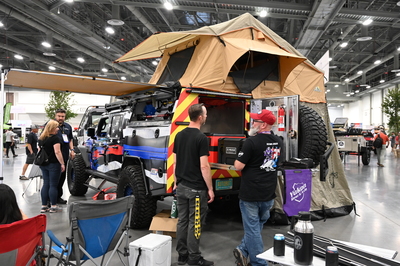
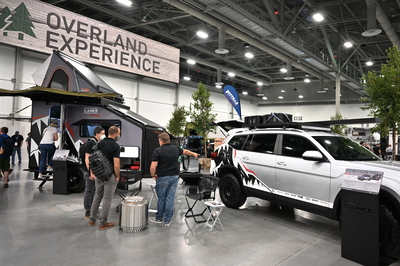
First popularized in Australia and sub-Saharan Africa, overlanding is a growing part of a $112 billion adventure tourism market that is forecast to generate more than $1 trillion annually by the end of the decade, according to a recent study published by Allied Global Insights. The SEMA Show’s annual Overland Experience exhibit provides companies with an in-depth look at what parts, products and build priorities are moving the market.

Once the province of outback adventurers in Australia and southern Africa, overlanding has gone global since the birth of the 21st century. The term may mean many things to many people, but it’s generally a form of vehicular adventure travel where the journey, not the destination, is the ultimate goal. Regardless of definition, it’s a rapidly expanding component of a $112 billion adventure tourism industry that’s projected to surpass $1 trillion by the end of the decade, according to a recent study published by Allied Global Insights.

But capitalizing on the growth of overlanding requires a detailed knowledge of the sector’s consumer base, its lifestyle habits, its purchasing priorities and its preferred marketing channels. A recent SEMA Education webinar, “The Globalization of Overlanding: How Manufacturers and Retailers Can Capitalize on the Worldwide Overlanding Phenomenon,” explored the subject and included practical advice on how companies can leverage this expanding sector to build brand awareness and to drive future sales. Moderated by Lindsay Hubley, managing partner of Lodestone Events, the company that operates Overland Expo, the discussion featured observations and insights from Scott Brady, CEO of Overland International. He is also the co-founder of Overland Journal, publisher of Expedition Portal and a longtime overlander who has circumnavigated the globe by motorized vehicle on three different occasions.
Overlanding

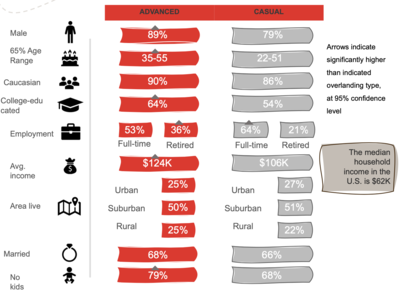
In the aggregate, overlanders tend to skew slightly older, are college educated, reside in the suburbs and are high-income earners. Most have no dependent children living with them, giving them even greater percentages of disposable income to spend on their hobby.

Out of The Pandemic, an Explosion of Growth

“When the pandemic first broke out in 2020, it slowed down international travel,” Hubley opened. “With that slowdown, folks in the States fell in love with the American road trip again, so we’ve seen an explosion of growth—not only in overlanding but in all outdoor recreation. Today, consumers are seeking new adventures, and they seek activities that allow them to social distance—and overlanders love to social distance.”

The effects of the pandemic and its aftermath on consumer behavior have been profound and long-lasting. According to a recent consumer survey from conservation nonprofit LeaveNoTrace, nearly 40% of consumers said they expect COVID to alter their recreational choices for the continued future. Among the changes in behavior cited were an increase in outdoor recreation, including more frequent use of public lands.

The growth in outdoor tourism seems to be impacting nearly every related sector of the industry. According to the Recreational Vehicle Industry Association, RV shipments grew by more than 20% in 2021 from the previous year, and one-third of leisure travelers who had never previously engaged in camping now express an interest in the activity. Related to that, campsite bookings soared in 2021, thanks to online booking sites such as Pitchup and HipCamp. In the overlanding sector, Overland Expo reported event audience growth of 20% year over year in 2021, and the Expo’s digital audience has grown 30% over the past three years. Expedition Portal has seen similar growth.

“We were lucky that a lot of people were at home during the pandemic and seeking out overland and vehicle-based travel,” Brady said. “We saw a total impression over the year 2020 of 40 million individuals. This is a big audience.”

How big? Overland Journal’s online research suggests an overall market of some 12 to 14 million overland enthusiasts in North America alone.

“We have great analytics tools that help us to understand the size of that audience, “Brady said. “These are people who think about the term and who make purchase decisions based on that.”

Major retailers are starting to tap into this increase in demand. In 2021, lifestyle retail giant REI launched REI Adventures, a website that allows users to plan and book all sorts of turnkey adventure trips ranging from easy family day trips to more strenuous, multi-day backcountry outings. The company also launched a division dedicated to car camping on its website “where you can purchase tents and other overland components,” Brady noted. Finally, would-be outfitters can find support at www.overlander.com, a new website specializing in selling overland-related products for the most popular vehicle platforms.
Overlanding

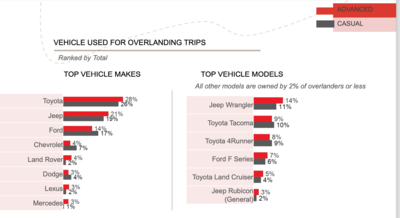
Among vehicle types, Toyotas are the leading choice of platform for overlanders, though Jeeps have gained popularity due to models such as the Gladiator pickup and the four-door Unlimited. Larger trucks and SUVs are gaining cachet as well due to their higher load-carrying capabilities.

Who Overlanders Are and What They Do

As adventure travelers, overlanders incorporate numerous lifestyle activities into their travels. According to a recent reader survey from Overland Journal, more than a quarter of overlanders participate in hiking (28%), followed by exploration of cultural/historic sites (17%), mountain biking (12%) and photography (11%). Fishing, hunting, paddle sports and rock climbing are also enjoyed, and companies that manufacture and/or sell products that supplement those lifestyle activities are well poised to grow their brands via overlanding.

Overlanders also use their vehicles to access some of the most remote locations on the planet.

“Remoteness is a key component,” Brady said. “We look for places that are farther away from the crowds, and we’re often looking for new cultures and new experiences. That often involves crossing borders, either between states or between countries, and camping is a big component of this.”

“Also, when we say ‘remote,’ we don’t mean ‘uncomfortable,’” Brady continued. “That’s why you’ll often see overlanders with fairly comprehensive camping kits—because they intend to be in the backcountry for days or weeks at a time.”

Again, companies that can serve the growing consumer demand for camping-
related products can leverage that demand for future growth.

In general, overlanders break down into two different types: “advanced” overlanders, who venture long distances into the outdoors on a regular basis and for extended periods of time, and “casual” overlanders, who tend to be weekend-warrior types who travel less frequently and over shorter distances.

Perhaps most importantly for companies in the specialty-equipment market, both types of overlanders are high-income earners relative to the U.S. population at large, according to research conducted in 2021 by Overland Expo. Both types of overlanders report annual incomes in excess of $100,000 (the median U.S. household income is slightly more than $60,000), and big majorities of both types have no dependent children living with them, giving them even more disposable income that they can spend on their hobby.

Both types are overwhelmingly male, married, and reside in suburbs. Advanced overlanders (average age 35 to 55) tend to be older than their casual (22 to 51) counterparts and are more likely to be college-educated. Advanced overlanders comprise roughly 60% of the segment, with casuals accounting for some 40%.

Overlanders first get involved in their hobby due to a variety of factors. Advanced overlanders are more likely to have been exposed to the practice as children and “grew up doing it” (40% of respondents). Casual overlanders tend to get involved after hearing about the activity from family and friends (25%) or from influencers on social media (12%).

No matter how people are first introduced to the activity, however, word of mouth can be a valuable tool for manufacturers and retailers to promote overlanding to new hobbyists, as Brady explained: “Peer influencing is really key, because overlanding leads to storytelling. When a friend is telling other friends about an adventure, that sparks their interest. As retailers and manufacturers, learning how to connect people to those stories is important because it increases the interest in wanting to go.”
Overlanding

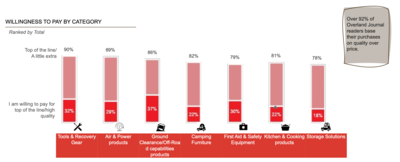
By a wide margin, overlanders say they are willing to pay premium prices for their products, prioritizing quality over economy. Among advanced overlanders, off-road capability is the most immediate build priority, while more casual overlanders opt for camp gear as a first choice.

How They Think and What They Drive

As a rule, overlanders tend to be environmentally minded consumers who are interested in products that use sustainable components and manufacturing methods, that offer products which can be re-used and repurposed, and which avoid waste and single-use applications.

“When we talk about an ‘overlander mentality,’ we’re talking about what makes this consumer tick,” Brady said. “That’s important for manufacturers and retailers to take a look at. [Overlanders] are interested in minimizing their impact to the environment, and the customer who comes into your retail store or who you’re making components for is going to be sensitive to that, so making products that will reduce the impact when we’re out on the trail, such as locking differentials or a good-quality tire that’s appropriate to the terrain, these are good things to suggest to this consumer.”

For companies in the process of formulating branding and marketing strategies aimed at the overland consumer, a handy benchmark is Tread Lightly!, the nonprofit organization dedicated to teaching and promoting responsible vehicle travel over public lands.

“It’s an important organization within both the four-wheel-drive and overland industries,” Brady said. “We encourage aftermarket manufacturers and OEs to make sure their messaging reinforces Tread Lightly! principles, because there’s a consequence for not following them.”

When it comes to choosing a vehicle as a build platform, overlanders look for durability, reliability and global parts availability. For that reason, Toyota has been the prominent brand, Brady observed. But a shift has occurred as overlanding has gained followers in the United States, and Jeep is now a major player—the four-door Wrangler and Gladiator pickup, in particular, having strongly impacted the market.

“When we started Overland Journal, Jeeps were only around 2% of the market,” Brady said. “Now it’s one of the most popular brands in the space.”

The bigger shift for companies to know, though, is toward larger vehicles, he said.

“We’re seeing a lot more fullsize trucks, and that trend is accelerating, so we’ll be seeing more Tundras, F-250s and F-350s because they have the payload to support all the equipment you’re bringing along.”

A related area of growth, in Brady’s estimation, is in integrated camper/habitat systems such as adventure trailers and pop-up truck toppers, which require higher payloads and tow ratings.

Hubley additionally mentioned the growth of the adventure van sector, such as Mercedes Sprinter and Ford Transit conversions, as a promising segment for manufacturers and marketers.

“We saw a big influx of that at Overland Expo in 2021,” she said, “as well as more equipment for vans and an increase in turnkey van builders.”
Overlanding

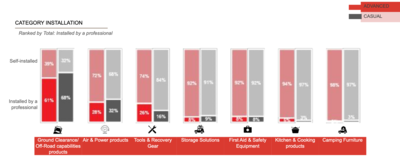
Most overlanding products are owner-installed, with the notable exception of mechanical hard parts that enhance off-roadability, such as gears, lockers, suspension upgrades and tires. For shops specializing in those types of installations, the growth of overlanding represents a potential new revenue stream.

What They Buy and Where They Learn

While there’s a great deal of overlap between the advanced and casual overland demographics, each group has its own unique sets of build priorities. The advanced contingent, being more hardcore in its orientation, gravitates first toward hard parts that can increase ground clearance and off-road capability, such as oversize tires, suspension lifts, lockers, rock sliders, etc.

Casual overlanders, by contrast, prioritize camping gear such as furniture and tents in their shopping preferences.

“It makes sense, given all the new vans and crossovers we’re seeing, and this is important because it represents the growth of new people we’re seeing entering the segment,” Brady said.
Overlanding

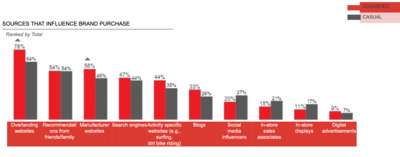
When making purchasing decisions, overlanders tend to rely on fellow members of the overlanding community, such as enthusiast websites, word of mouth, and manufacturer websites. Roughly a quarter of overlanders rely on social media and online influencers for product information, while fewer than one in 10 rely on traditional digital advertising.

Still, both sets of overlanders agree that first aid and safety items are the most essential components they purchase for their vehicles, followed by off-roading parts and camp gear and kitchen items. They also both overwhelmingly favor build quality over price. More than 90% express a willingness to spend either “a little more” or “top dollar” for their builds, and they tend to be rather brand-loyal. More than 90% of overlanders said that specific brands exert an influence on their purchasing decisions.

“It’s something we’ve seen at Overland Journal from the very beginning, and it also reflects the kinds of vehicles that people are buying.” Brady said. “If overlanders are purchasing Land Cruisers and 4Runners and Tacomas, they have a ‘quality and durability’ mindset, and the components they buy for their vehicles reflect that mindset as well.”

Not surprisingly, advanced overlanders make more extensive modifications to their vehicles, but even among the casuals, roughly 85% have performed some kind of modification, so both groups represent a potentially lucrative revenue stream for manufacturers and retailers alike.

While online sales of overlanding products have gained in popularity, retailers still play a major role. Overlanders who are shopping for camp gear such as first-aid equipment, furniture and kitchen/cooking products prefer major brick-and-mortar retail stores such as REI as their go-to parts source.

“People want to see and feel those kinds of products,” Brady said.

On the other hand, online-only retailers are a preferred source for tools and recovery gear as well as air and power products.
Overlanding

Perhaps most importantly for companies in the specialty-equipment market, both types of overlanders are high-income earners relative to the U.S. population at large, according to research conducted in 2021 by Overland Expo.

For information regarding the latest tech, trends and product developments, overlanders are an extremely “wired” demographic, with more than 75% of advanced overlanders and 65% of casuals utilizing the internet (and overlanding websites in particular) as their preferred sources of information. Both also rely heavily on peer-to-peer influencing such as word of mouth as well as manufacturer websites.

Activity-specific websites (dedicated to dirt biking, four wheeling, etc.) are more likely to attract advanced consumers, while social media and in-store displays more strongly impact casuals. Neither group relies much on conventional advertising, with fewer than 10% saying that it influences their purchasing decisions.

Sat, 10/01/2022 - 12:00

SEMA News—October 2022

EVENTS

The 2022 SEMA Awards Gala

A So-Cal “Homecoming” and Focus on Hall of Fame Inductees Highlight the Annual Gathering

Gala

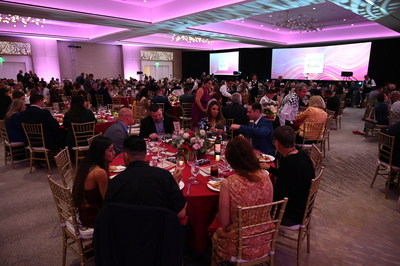
The mood was celebratory at the 2022 SEMA Awards Gala, held July 29, in Anaheim, California. Formerly known as the SEMA Installation Banquet & Gala, the event was renamed this year to refocus on the SEMA Hall of Fame inductees and their industry achievements.

By Mike Imlay

Industry icons, SEMA leadership and volunteers gathered July 29 in Anaheim, California, to honor the association’s new Hall of Fame inductees at the 2022 SEMA Awards Gala. The celebration took place at the Westin Anaheim Resort, not far from the Anaheim Convention Center, a place of historical significance for the association.

“The SEMA Awards Gala is a great opportunity for the industry to come together at mid-year to connect in person and have meaningful conversations in an intimate setting,” said SEMA President and CEO Mike Spagnola. “Our roots extend to the city of Anaheim, so it was exciting to return with friends and colleagues to honor industry leaders.”

Gala

SEMA Chairman of the Board James Lawrence underscored the need for SEMA members to stay engaged and promote the industry’s future. “It’s our responsibility to help give our next generation an opportunity to earn a Hall of Fame spot in the automotive industry,” he said.

Formerly known as the SEMA Installation Banquet & Gala, the SEMA Awards Gala is a long-established tradition where individuals who have made extraordinary contributions to the specialty-equipment industry are recognized. For 46 years the reception and dinner have served as the formal event where new SEMA Hall of Fame inductees are introduced, the incoming Board of Directors is recognized, and outgoing Board members are thanked. SEMA council, network and industry leaders are also applauded during the course of the evening.

“We were excited to have our summer gala return to Southern California, and even more excited at the event’s rebranding as the SEMA Awards Gala to amplify our Hall of Fame celebration,” said SEMA Special Events Director Jamie Ericksen. “This year’s venue, the Westin Anaheim, was a brand-new hotel in the city that recalls the roots of past SEMA events, including early SEMA Shows. It was a homecoming that brought together the industry family.”

Gala

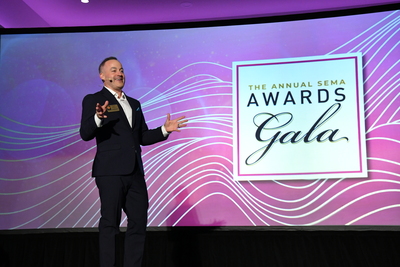
Well-known industry media host Kevin Oeste emcee’d the evening’s festivities which, along with the Hall of Fame awards, included the recognition of new and outgoing SEMA Board members, and accolades to council and network volunteers.

The gala also represented yet another milestone as the industry continues turn a new corner after the recent pandemic. In many ways, it served as a ramp-up for this November’s SEMA Show as industry businesses enter the final stretch for the blockbuster trade event in Las Vegas.

Popular automotive media personality Kevin Oeste served as emcee for the evening. After setting a celebratory tone, Oeste turned the stage over to SEMA Chairman of the Board James Lawrence, whose opening remarks touched on the themes of service, enthusiasm and achievement.

“Tonight, we honor our Hall of Fame Inductees, our new incoming Board of Directors, and thank our outgoing Board members for their service,” said Lawrence. “And to all of our volunteer leaders, our network and councils, chairs and chair elects—we appreciate your hard work and commitment for automotive enthusiasts everywhere.”

Gala

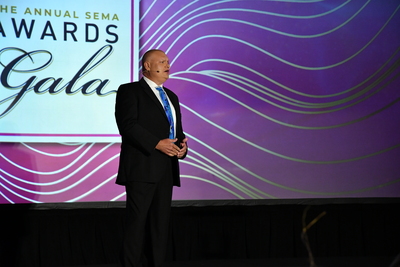
SEMA President and CEO Mike Spagnola outlined the bold initiatives SEMA is taking to meet today’s unprecedented challenges. “We will focus on ensuring the success and prosperity of our members, the automotive aftermarket industry, and the rich and historic automotive culture we all enjoy,” he promised.

Calling the past year a period of transformation requiring grit and effort, Lawrence also thanked the SEMA staff under the leadership of recently named SEMA President and CEO Mike Spagnola for their contributions to the industry.

Turning to the Hall of Fame inductees, Lawrence observed, “When you scroll through the names in the Hall of Fame, you’ll see trailblazers, renegades, leaders and innovators. The legend of tonight’s new inductees—Gene Winfield, Walker Evans and Jack Roush—glows bright for their lifetime achievements.”

“It’s our responsibility to help give our next generation an opportunity to earn a Hall of Fame spot in the automotive industry,” he continued. “It’s our responsibility to give every kid the opportunity to be a trailblazer like just like the Hall of Famers that are here today.”

Gala

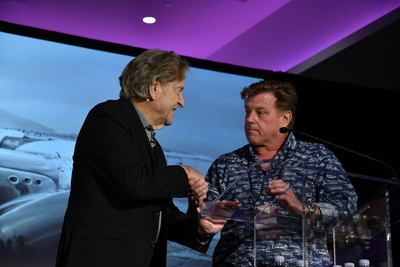
Famed automotive designer Chip Foose congratulated Gene Winfield (left), the first of the evening’s three 2022 Hall of Fame inductees. Winfield’s custom car designs are now legendary, having appeared in popular Hollywood movies while inspiring legions of enthusiasts.

Following on Lawrence’s remarks, Spagnola presented an update on the association’s mission and initiatives to ensure the industry’s health and growth far into the future. Spagnola, who took the helm on an interim basis after the recent retirement of former SEMA President and CEO Chris Kersting, has now been confirmed to the full CEO role by the Board of Directors.

“The last time I was on stage for a SEMA event, I was accepting an award—that was in 2010. Three years later I sold my business, concluded my second term on the Board of Directors and signed a three-year contract with SEMA to develop the first SEMA Garage. Now, nine years into my three-year contract, I’m still here,” he quipped.

Calling himself a “hands-dirty, industry guy,” Spagnola explained, “Those of you who know me know this industry holds a big place in my heart and the hearts of my family.” He went on to reaffirm the association’s goals to produce world-class events that promote meaningful connections, share knowledge and education, provide access to industry-leading product data, advocate for effective legal pathways to enjoy modified vehicles forever, and provide membership opportunities that deliver “real value for all of us who thrive in the automotive culture,” including through a new SEMA Individual Membership program.

“SEMA’s purpose and mission statement are also being held up to the light—we will focus on ensuring the success and prosperity of our members, the automotive aftermarket industry, and the rich and historic automotive culture we all enjoy,” he promised.

With those introductions made, the Gala turned to its main focus: SEMA’s 2022 Hall of Fame inductees. The Hall of Fame awards honor those who built the specialty-equipment market into the $51 billion powerhouse it is today. Since 1969, SEMA has inducted some 170 pioneers. For 2022, it added three more iconic names: Walker Evans, Jack Roush and Gene Winfield.

Walker Evans

Hall of Fame inductee Walker Evans reflected on his career as a racer and successful performance parts maker. His contributions to off-road motorsports—not to mention the truck world in general—have made him a true industry trailblazer.

Walker Evans

If you love trucks, you owe a debt of gratitude to Walker Evans. Before he won the 1979 Baja 1000 in a ’78 Dodge pickup, trucks were largely relegated to towing the buggies and bikes that won the event every year prior. Starting as a driver for famed builder Bill Stroppe, Evans eventually set up his own shop building some of the most competitive trucks in off-road motorsports. At the turn of the millennium, he switched gears to develop and manufacture a line of performance products. Today Walker Evans Racing is a fixture across the off-road spectrum from Jeeps to snowmobiles.

Jack Roush

With Jack Roush unable to attend the Gala dinner, his colleague Raymond Gallagher accepted the Hall of Fame induction on Roush’s behalf. Roush is renowned for his engineering entrepreneurship, which has spanned automobiles to aerospace.

Jack Roush

It’s impossible to describe Jack Roush with any single title. His parent company has three units. Roush Performance develops and sells performance vehicles and aftermarket performance parts. Roush CleanTech develops clean-fuel solutions for fleet vehicle applications. Roush Industries designs, engineers, prototypes, tests and even manufactures across industries the mobility, aerospace, defense and theme-park industries. But it all began with OEM engineering jobs that morphed into a brief stint as a multi-championship drag-racing enterprise. If Jack Roush hasn’t done it, it’s probably not worth doing.

Gene Winfield

Few people have inspired a more diverse array of automotive enthusiasts than Gene Winfield. A customizer of the first order, his career spans more than seven decades to include the golden age of the custom car. Scale-model manufacturers rendered his creations in miniature and, after recognizing his widely ranging talents, ultimately hired him to create full-scale examples. Soon the entertainment industry caught on to Winfield’s magic, giving him yet another career building for Hollywood—a professional arc that culminated in his shop building the automotive props for big-budget productions like Blade Runner and Back to the Future II.

Board Members Congratulated

During the Gala, SEMA Chairman of the Board James Lawrence and SEMA President and CEO Mike Spagnola together took the stage to thank outgoing SEMA Board members Chris Douglas (Edelbrock Group) and Less Rudd (Bob Cook Sales). Rudd now becomes the Board’s treasurer.

Incoming Board members Norris Marshall (BluePrint Engines) and Rich Butler (R&R Marketing Consultants) were congratulated along with re-elected Board members Kathryn Reinhardt (4 Wheel Parts) and Melanie White (Hellwig Products).

The following Board members were also recognized as they continue their current terms in office:

  • SEMA Chairman-Elect Kyle Fickler (Driven Racing Oil)
  • Immediate Past-Chair and Secretary Tim Martin (Aftermarket Advisors)
  • Lindsay Hubley (Lodestone Events)
  • Larry Montante (Keystone Automotive)
  • Kim Pendergast (Magnuson Superchargers)
  • Brian Reese (T-Sportline)
  • Ted Wentz (Quadratec)
  • Steve Whipple (Jegs High Performance)
Pinewood

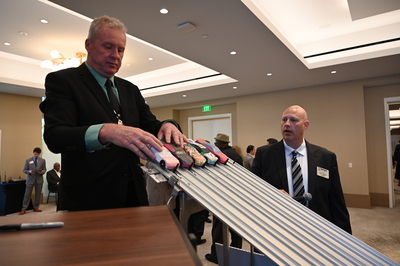
Pinewood race cars get set for a run. The annual Pinewood Drags in support of SEMA Cares children’s charities have become a popular Gala tradition, with stakes running high for the ICC Challenge.

2022 Pinewood Drags Raise Funds for Charity

Each year, the SEMA Cares Pinewood Drags fundraiser takes place in conjunction with the SEMA Awards Gala. The charity event offers participants the chance to sponsor a Pinewood race car or challenge colleagues head-to-head during the pre-banquet reception.

Donations enable SEMA Cares to help significantly improve the lives of children in need through the work done by the Austin Hatcher Foundation for pediatric cancer; Childhelp for the prevention and treatment of child abuse; and the Victory Junction camp for children with serious medical conditions. The following were this year’s top winners.

Industry Cup Challenge (ICC)

  • Keystone Automotive Operations

Manufacturer

  • Hellwig Products

Rep Agency

  • PSKB Inc.

Service Provider

  • LGE-CTS

Warehouse Distributor

  • Keystone Automotive Operations

Media

  • Hemmings

Council Cup

  • Future Leaders Network (FLN)

Build It for Me Class

1st Place

  • Erika Marquez, WARN Industries

2nd Place

  • Wes Mills, Mills Crafts

3rd Place

  • Steve Wolcott, ProMedia LLC

SEMA Board member Kathryn Reinhardt, who serves as the chair of SEMA Cares, commended Gala attendees for their generous support of the races and SEMA Cares in general.

“You may not know this, but these charities have helped save and impact the lives of thousands of children every year,” she said. “Knowing the automotive aftermarket is banding together to be a driving force in making a difference warms my heart. Last year we raised a quarter of a million dollars—our largest fundraising year ever.”

Reinhardt also thanked her fellow SEMA Cares committee members for their tireless dedication to fundraising and serving children in need. Those committee members are:

  • Melanie Barness
  • Will Brown
  • Jenna Jefferies
  • Michelle McGaughy
  • Sara Morosan
  • Lori Ramsey
  • Melanie White
Sat, 10/01/2022 - 11:44

SEMA News—October 2022

MARKET RESEARCH SNAPSHOT

Specialty-Equipment Retail Sales Reached Record $50.9 Billion in 2021

By SEMA Market Research

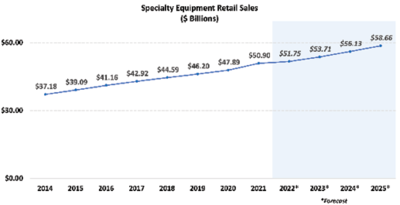
Specialty-Equipment Retail Sales ($ Billions)
Market Research

Overall consumer spending on our industry’s parts and accessories jumped 6.3% in 2021, pushing U.S. retail sales to a record $50.9 billion—its highest level ever.

For the first time ever, specialty-equipment retail sales in the United States have topped $50 billion. Overall consumer spending on parts and accessories jumped 6.3% last year, pushing our industry’s market size to a record $50.9 billion in 2021. Consumers continue to show that they love their cars and accessorizing them. Although there are some economic headwinds on the horizon, our forecast remains optimistic. Sales may slow a bit in 2022, but a drop is not expected. As we get further past the pandemic and resolve supply-chain issues, we expect a return to the growth levels seen over the last decade.

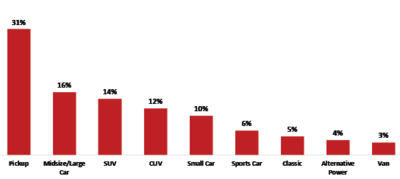
2021 Specialty-Equipment part Sales Share by Vehicle Segment
Market Research

The pickup continues to be a driving force for the industry. Pickup mods accounted for nearly one-third of parts and accessory sales. Pickups are great platforms for accessorization.

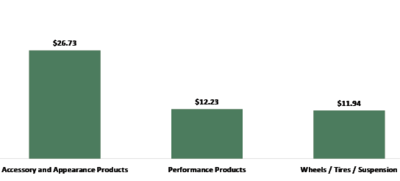
2021 Specialty-Equipment Retail Sales by Product category ($ Billions)
Market Research

The industry saw growth across a wide range of products in 2021. Accessory and appearance products remain strong. Performance mods also saw robust sales.

To learn more, download the new “2022 SEMA Market Report” today at www.sema.org/research.

Sat, 10/01/2022 - 11:26

SEMA News—October 2022

SEMA DATA

By Gigi Ho

SEMA Data Product News

The products featured below are from SEMA Data member companies that have attained Gold- or Platinum-level data, which means that their product data is robust and complete—likely to drive customer purchase decisions. SEMA Data members meeting data scorecard requirements are invited to submit product releases for consideration to enews@semadatacoop.org.

Aldan
Injen
zroadz
Aldan American

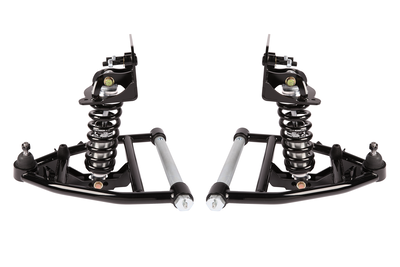
Coilover Conversion Kit–’63 Chevrolet C10

For your ’63 Chevrolet C10, a Coil-Over Conversion Kit,
’63–’70 C10, front, single adjustable, small-block, lower arms only. Includes two Phantom Series–single adjustable coilover shocks, 650 lb. Aldan springs, POL lower, tubular control arms, lower ball joints, brackets and hardware. This kit is designed to work with factory truck crossmembers and will convert front suspensions to fully adjustable coilover shocks with lower tubular control arms. Upper control arms sold separately. Made in the U.S.A.

Information: aldanamerican.com

PN: 300152

INJEN

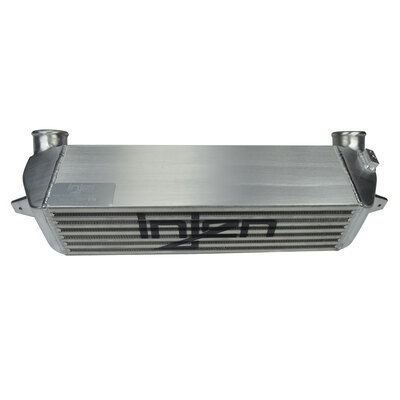
Front Mount Intercooler–FM9200I

The ’15–’18 Mustang 2.3L EcoBoost is a great platform for soaking up highway miles during the weekday and tearing it up at the track on the weekend. The FM9200i intercooler is a direct-fit unit and features a huge increase in core volume while requiring no modification to your Mustang. This cooler is constructed with cast end tanks and precision CNC-machined aluminum flanges for use with the factory intercooler piping or Injen’s aftermarket charge pipes (sold separately). With a one-hour installation time, great power and temperature benefits and a lifetime warranty, the Injen FM9200i intercooler is a must-do upgrade for any stock or modified Mustang 2.3L EcoBoost.

Information: www.injen.com

PN: FM9200i

ZROADZ

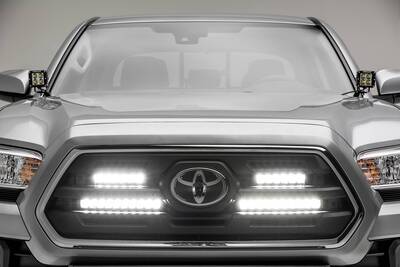
’18–’22 Toyota Tacoma OEM Grille LED Kit with 6-In. and 10-In. LED Straight Single Row Slim Light Bars

ZROADZ OEM Grille LED Mounts are an economical method to add forward-facing lighting to late-model pickups. The clean low-profile installation fits seamlessly into the original vehicle grille and gives the appearance of a factory-installed lighting system. The included standalone wiring harness gives complete control over the light operation and is plug and play for easy installation. Available in kit form only. Designed and made in the U.S.A.

Information: www.zroadz.com

PN: F143871939

Sat, 10/01/2022 - 11:15

SEMA News—October 2022

BUSINESS

Power to the People

EVs Are Charging Forward, But Will the Infrastructure Be There?

By Chris Shelton

EV

The future of charging for many Americans without access to their own chargers may look a little like this. Thanks to services like EVmatch, the public market has access to private, non-networked chargers and outlets, including 110V outlets that exist in every building in the United States.

If we’re not already at it, we’re likely near the cusp of an electric vehicle (EV) tipping point. Two years ago, the state of California mandated 35% EV sales by 2025 and banned all new non-EV sales by 2035; Washington state’s mandate is even more ambitious: by 2030 it will refuse to license any vehicle made that year or later unless it’s electric, a push that resembles the one in several Western European countries.

Even the automakers are putting their eggs in the electric basket. Last year, GM announced it would ditch hydrocarbon power altogether by 2035. Ford hasn’t announced a similar mandate, but it’s pushing EU legislators to commit to all-electric new-car sales by 2035. Stellantis hasn’t set a mandate either, but says it hopes to go all electric by 2028. And perhaps most ambitiously, Volkswagen committed to 100% EV sales by 2026. As far as model-year introductions go, that’s only two years from now.

That’s music to the ears of EV advocates. But is widespread EV adoption possible within those timeframes? As strange as it seems, the answer is one that many EV advocates and adversaries agree on: Probably not. At least it’s not at the rate we’ve been implementing charging options in America, anyway.

EV

Charge hosts can control the access to chargers. St. John’s Episcopal Church in Chicago opens its charger to anyone who books time. But hosts can specify who has access, effectively making a charger available to select users (i.e., residents of multi-unit dwellings). Photo courtesy: Brian Urbazewski

Charging Versus Fueling

The problem lies in the difference between the fueling and charging models. Whereas it takes only minutes to put a tiger in your tank, with current technology it can take hours to just partially charge a battery. That partly explains why more than 80% of EV charging happens overnight at home.

But that’s cold comfort for those living in multi-family dwellings (MFDs) like apartments and condominiums. Most existing MFDs can’t accommodate charging options required for mass EV adoption at the projected rate, at least not economically. And it’s no small problem, either; residents of MFDs make up nearly 30% of all households in America and nearly 50% in California, a state where only 18% of MFDs have access to EV charging. It gets even worse for lower-income drivers, most of whom live in communities dubbed charging deserts, a reference to an area’s lack of public charging options.

That’s changing of course. The Infrastructure Investment and Jobs Act signed into law in November 2021 allocates $7.5 billion to “…accelerate the deployment of a national electric vehicle charging network.” Roughly $5 billion of that goes to build a nationwide network of 500,000 DC fast chargers along major transportation corridors that can charge some EVs to 80% in 20 to 30 min.

To give an idea of the scale of this project, consider that the United States had 177,433 gas stations as of May 2022. Should the program play out as planned, the number of commercial EV charging stations added to the grid by this bill would outnumber gas stations by nearly three to one. And that doesn’t include the 109,307 charging ports already in use.

Problem solved, right?

Well, it certainly helps. The network created by that part of the infrastructure bill facilitates long-distance travel by requiring at least four highway-accessible chargers within 50 mi. of each other. That presents at least two problems: for one, most people can’t or don’t want to stop alongside major transportation corridors for half an hour just to charge their car.

EV

Whether accessed by a smart-device app or by a Web browser on a computer, EVmatch offers an experience like other Software as a Service (SaaS) such as dining, dating, and lodging apps. It compares users’ needs with host offerings to increase charging options in underserved areas.

Cost is another. “The shortcoming of fast charging is expense,” says Joel Levin, executive director of EV advocacy group Plug In America. “If you’re looking at people who live in an apartment that doesn’t have parking, they’re probably going to be somewhat lower income. And now you’re presenting them with the most expensive way to charge; the people who have the least money have the most expensive charging.” That part of the program may prove invaluable for driving long distances but not for daily use.

As Levin put it, the $2.5 billion remainder of the bill “focuses more on equity, underserved areas and charging deserts.” That funding will surely inspire countless solutions, like mounting chargers to existing structures as National Grid did in Melrose, Massachusetts. Seattle City Light made the system even more equitable by installing the pole-mounted chargers where residents request them.

EV

Plug in America’s Executive Director Joel Levin maintains that widespread EV adoption depends on maximizing the potential in existing technology. “We have a survey that we do every year,” he says. “Among people who charge at home, about a quarter of them charge on 110.”

Installing chargers where potential users need them will certainly go a long way to encourage EV adoption. But it’s not likely to blanket the country with charging stations, at least not within the timeframes set by states and automakers. And if you’re even somewhat familiar with parking in major metropolitan areas, you know the frustration of trying to find any parking space. Now imagine trying to find one to charge your car. After a long day at work. And hungry.

It’s a situation that Vanessa Perkins knows well. She drives an EV. She lives in an apartment. And it’s in Chicago. “I noticed that there are a lot of neighborhoods that don’t have public charging,” she said, citing, among others, the one she lives in. “And if they do, it’s in a very expensive parking garage and you have to pay an entry fee.” So, she did some research and found a way to create more accessible and affordable charging. “It’s like a sharing economy,” she says.

What she found is EVmatch, a national peer-to-peer network where owners of private and commercial chargers can make their resources available for others to rent when they’re not using them. “Often we describe ourselves as the Airbnb of EV charging,” says EVmatch Founder and CEO Heather Hochrein.

“We provide a software platform for the web and mobile that allows individuals and businesses and commercial properties to rent out private charging stations to the public,” she continues. And Perkins’ nonprofit organization communitycharging.org, is one of EVmatch’s pilot programs. “It works anywhere a charger owner can open their charger to the public,” Perkins says. She calls the service transformative: Homeowners whose properties can accommodate guest vehicles let their neighbors use their vacant chargers via the service. Organizations like churches and businesses, whose lots go unused for big chunks of a day or overnight, are getting in on the program by building chargers for the communities they serve and offering them on the EVmatch network.

EV

Charge-sharing pioneer Heather Hochrein has spent her career so far in the service of electricity technology. Her work in climate policy, extensive utility and management experience at Pacific Gas and Electric, and a senior leadership role at Rising Sun Energy Center, laid the foundation for EVmatch.

Levin says the challenge with charge sharing is to make the service consistently available. “To have an EV and not constantly be annoyed, you have to have a place where you can go once or twice a week. It’s there, it’s reliable, and it’s not going to be full. It needs to be consistent, not like you have to get on the internet and search for a place to charge every day.”

And that’s what distinguishes charge-sharing programs like EVmatch: potential users can book time on the charger. When the session ends, the user then drives off and opens the charger for the next user. More than giving users a place to charge, these bookable private charging stations give EV drivers a place to park. After a long day at work. When they’re hungry.

EVEV

Access to affordable energy goes a great way to make electric vehicles viable for anyone who wants one. According to Homeguide.com, charging at a commercial station can cost upwards of 450% more than charging at home. Chart courtesy: www.homeguide.com

Elegance in Simplicity

Charge sharing differs from the typical commercial charging services offered by the likes of EVgo and Chargepoint. “Theirs is proprietary and top-down, infrastructure-heavy approach where you build and operate the charging stations,” Hochrein says. “You end up doing a lot of real-estate work like site selection, development and maintenance.”

And that translates to increased charging cost: due to the grid modifications and specialized hardware required to install one, DC fast chargers start at six figures. By contrast, a private Level-2 charger installation may cost only hundreds of dollars (a Level 2 can be as simple as a standard 220V receptacle). And almost every building has a Level 1 in the form of a conventional 110V wall receptacle.

“We have a survey that we do every year,” Levin says. “Among people who charge at home, about a quarter of them charge on 110.” It just takes longer.

Until now, the problem with using those non-networked chargers in a commercial application was the inability to meter and bill the user for the power consumed. Historically speaking, it took a smart charger to gauge how much current an EV consumes while charging and network connectivity to transfer that information for billing purposes. And EVmatch can in fact meter and bill that way. So far it has partnered with smart-charger manufacturers Enel X and Wallbox, and it’s working on other integrations using open-charge-point protocol communication.

But what distinguishes EVmatch is its ability to accurately estimate power consumption in the absence of a smart charger. “We have a tool where we estimate the cost of electricity,” Hochrein says. “It’s sophisticated in that it takes into account the vehicle, the charger power, the time of the day, and the utility-rate structure.” Users—either the general public or those the charger owner grants access—pay in advance for the duration of the charge. “So, they book, let’s say, a two-hour session and we know what car is charging,” she says. “We know the power output of the outlet or the charger. That calculator gets used to estimate the price and the driver pays for the session that they book. We’re using that software tool for the residential host, even if they don’t have a connected smart charger.”

EV

EVmatch can also work with smart chargers to precisely measure current consumed and transmit information via the internet. So far, the company has integrated smart chargers from Wallbox and Enel X (Juice Box shown here). Photo courtesy: Brian Urbazewski

Overcoming the Challenges

The EVmatch model also has the potential to increase charging options in multi-family dwellings. The variables in installing chargers in those applications are numerous and sometimes daunting. Does the facility have spaces for every resident? Is the parking assigned or first-come? If the facility assigns parking, how does it allocate who gets a charger? How many residents drive EVs? Does every space need a charger? How do you bill the appropriate users for the power consumed? And can the structure bear multiple chargers without significant electrical improvements? “[If] every single parking stall has to have a dedicated charger, that massively overloads the infrastructure,” Hochrein says.

But charge sharing gives property managers the capacity to leverage their existing electrical infrastructure, including the load centers. “A lot of those panels can accommodate at least a few chargers as it is,” she says. “And so, with our software, we’re helping those property owners share those chargers more efficiently.”

It goes without saying that we need to build more chargers if we expect to adopt EVs on the massive scale anticipated by legislators and automakers. But no single answer will solve the charging issues that prevent mass EV adoption. As Joel Levin put it, “It’s more silver buckshot than silver bullet.” And as EV development begins to outpace internal-combustion engine development, new ideas and innovations like EVmatch’s charge-sharing program will likely prevail.

“We’ve done surveys among people who drive EVs—what their concerns are with charging, and they certainly have concerns,” Levin continues. But as Plug In America’s results show, those concerns are less about the number of chargers. “It’s the ability to access what’s already there rather than the lack of charging,” he says. “Sure, they’d like to have more charging. But they just want access.”

SOURCE

Community Charging
www.communitycharging.org

EVmatch
www.evmatch.com

Plug In America
www.pluginamerica.org

Sat, 10/01/2022 - 11:09

SEMA News—October 2022

SEMA Member News

Council & Network Leadership

By Ellen McKoy

Nicole Bradle
Nicole Bradle

Getting to Know SEMA’s Council Directors

The SEMA Board of Directors approved the council concept in 1993, elevating the status of three committees: the Automotive Restoration Market Organization (ARMO), the Professional Restylers Organization (PRO) and the Street Rod Market Alliance (SRMA), now the Hot Rod Industry Alliance (HRIA). SEMA then hired its first council director. There are now nine councils and networks and three SEMA council directors.

Denise Waddingham
Denise Waddingham

Each director pursued a different career pathway. Collectively, they bring a wealth of knowledge, experience and passion to their roles. Nicole Bradle has 20-plus years of association management experience. Marcy Yanus, the newest team member, came from the nonprofit sector. Industry veteran Denise Waddingham once served as a SEMA volunteer leader.

What led them to shift gears and join the organization? These are their stories.

The Pull of Volunteers

Nicole Bradle serves as SEMA’s liaison to the Emerging Trends & Technology Network (ETTN), the SEMA Businesswomen’s Network (SBN) and the Wheel & Tire Council (WTC). She’s a certified meeting planner, certified association executive and recipient of the Association Forum’s 40 Under 40 Award. While earning a master’s degree from Eastern Illinois University, she became interested in meeting planning.

“I liked planning events and started out as a conference manager, where I learned about conference and association management,” she said.

She later served as executive director for up to nine subspecialties at the American Society of Anesthesiologists and, more recently, was member relations director for the American Academy of Physical Medicine and Rehabilitation. In spring 2020, Bradle was working from home during the pandemic when Nathan Ridnouer, SEMA vice president of councils and membership, reached out after seeing her association experience online.

“I wasn’t looking for a new job,” she recalled. “Nathan was looking for a new council director and recruited me because of my association background. I know nothing about cars but what pulled me in was working with volunteers. That’s my passion.

“My groups are animated and passionate about helping to make a difference. The SEMA team I work with has great ideas and works hard on solutions to help members. It’s been an amazing two years.”

From Volunteer to Director

Denise Waddingham was chair-elect of SBN when Ridnouer asked for her advice.

“He wanted to know what type of person he should hire as council director,” she recalled. “I jokingly said I could work for him remotely. I didn’t think it would go anywhere.”

It did. She started in May 2020, working with PRO, the Future Leaders Network (FLN) and the Truck & Off-Road Alliance (TORA). Waddingham had worked for Dee Zee for 15 years. She started there after graduating from the University of Northern Iowa and was corporate relations manager, so moving to SEMA wasn’t a snap decision.

“It took some soul searching,” she said. “My entire career has been in the industry. It was an opportunity I couldn’t pass up, but I wouldn’t have had this opportunity if it weren’t for Dee Zee.”

She credits Dee Zee’s Troy Wirtz and Les Rudd of Bob Cook Sales.

“Troy was active in SEMA,” she said. “He and Rose Kawasaki encouraged me to get involved in SBN. Les nominated me for the Custom Automotive Network Board. I ran, was elected, and it was a good experience. I got to see the association side I hadn’t seen as a volunteer. It helped me move into staff with an understanding of how associations work to benefit their members. It also helps that I came from the volunteer side. I can see things from their standpoint and help move projects to fruition. It’s exciting and very gratifying.”

The Perfect Fit

Marcy Yanus grew up around cars. Her dad’s shop restores antique and classic car engines. He’s a former Formula V race-car driver, and she used to time races. Although immersed in car culture, she followed a very different path. After graduating from John Carroll University, Yanus worked for a public relations firm and a TV station.

“I wanted more of a team atmosphere, and I found that in the nonprofit sector,” she said.

She landed her first position as membership director at a Cleveland-area YMCA. Over the years, Yanus held executive positions throughout the United States and worked with YMCA’s international partners. She also led courses on leadership and fundraising. Most recently, she was vice president of operations, managing a group of YMCAs in Columbus, Ohio, but the pandemic gave Yanus time for reflection.

ARMOAutomotive Restoration Market Organization (ARMO)

ARMO Hot Products Showcase Shines at Spring Carlisle

ARMO

Spring Carlisle showgoers browse dozens of ARMO-member products at the Hot Products Showcase.

Overcast skies and the chance of April showers did little to dampen the excitement at this year’s Spring Carlisle Collector Car Swap Meet, where hordes of enthusiasts gathered at the sprawling Carlisle Fairgrounds in Pennsylvania to celebrate car culture.

For the Automotive Restoration Market Organization (ARMO), Spring Carlisle signals the opportunity to present its popular Hot Products Showcase. An exclusive ARMO-member benefit, the Showcase provides a premier platform for members to spotlight their hottest products and vie for awards in five categories.

As in past years, the Showcase tent was situated between the grandstands and the event stage. The high-traffic spot ensured that enthusiasts would pass through during the four-day event to view the displays, vote for favorite products and learn how SEMA and ARMO help to preserve and perpetuate the restoration hobby and the industry.

In the run up to the event, ARMO Chair Ben Tucker said signups were running ahead of prior years, with a goal of securing about 50 companies and 100
products.

“Carlisle is always a huge success for ARMO, and I know it’s going to be a great event,” Tucker said.

On the Legislative Front

“It is absolutely good news,” Tucker said when queried about the recent National Highway Traffic Safety Administration (NHTSA) ruling that allows for small-volume automakers to build and sell turnkey vehicles.

In finalizing the regulation, NHTSA greenlit the SEMA-led Low Volume Motor Vehicle Manufacturers Act. The act, which actually became law in 2015 as part of the Fixing America’s Surface Transportation Act, enables replicar businesses to build and market replicas of vehicles produced at least 25 years ago. Production is limited to 325 vehicles per year.

“SEMA applauds NHTSA’s final rule allowing companies to market classic-themed cars,” said SEMA Vice President of Government Affairs Daniel Ingber. “This is a hard-fought victory for enthusiasts, small-volume manufacturers and all who will be hired to fill new jobs.”

In recalling his experiences at SEMA’s rallies in Washington, D.C., Tucker noted that the replicar issue was a hot topic for ARMO.

“Even though the law had already been passed, it was in limbo so, of course, it was an important issue for our members,” he said. “SEMA did great work in getting it done. Many of the companies we do business with will now have a chance to sell parts to manufacturers that build replicars. It’s a real boon to the restoration industry.”

“The great thing about SEMA’s emissions-compliance program is that it makes it easy to achieve compliance.”

—John Lambert

ETTNEmerging Trends & Technology Network (ETTN)

ETTN Stages Career Fair, Revs Up Tech Symposium

Society of Automotive Engineers students at the SEMA Garage on April 3, in Diamond Bar, California, during a recent Networking Event and Career Fair.

ETTN

The Emerging Trends & Technology Network (ETTN) recently co-hosted the SAE/SEMA Garage Career Fair on April 3. The event, a joint venture between SEMA, ETTN and the Society of Automotive Engineers (SAE), was held in Diamond Bar, California.

The program was designed to connect SEMA members, SAE board members and other industry professionals with university students who are part of formula and Baja SAE competition teams. The competitions challenge students to design, fabricate and compete with formula-style race cars.

Besides networking and a close-up look at resources available through the SEMA Garage, the program included a career fair that allowed companies to recruit future graduates. The students also had a chance to gain feedback from industry professionals on their engineering and business presentations in advance of the forthcoming SAE competitions.

“The event was a collaborative effort between SEMA and SAE,” said ETTN Immediate Past Chair Ian Lehn, who spearheaded the project on behalf of the network. “It was refreshing to see the two organizations focus on the future of the next generation.

“To have an opportunity to interact with people in our industry at this level was invaluable. We want these students to see how cool we are and that we do a lot of cool stuff. Credit goes to Mike Spagnola (SEMA CEO) and Luis Morales (SEMA director of vehicle technology) for making us look as cool as we did at this event. To secure the future of our industry, we need to push the boundaries of technology. We have to cultivate the next generation and let them know that there’s an exciting future with our member companies.”

Tools, Technology and Knowledge to Advance Careers

Calling all automotive engineers, programmers and product developers! ETTN’s inaugural NERD Symposium debuts at the SEMA Garage in Detroit on Tuesday, August 16. The multi-day, multi-faceted event—whose acronym stands for Networking, Education, Resources and Development—consists of three core elements: an educational component, interfacing with service providers and subject-matter experts, and networking.

The event kicks off with a sneak peek at the newest SEMA Garage, followed by a get-acquainted cocktail hour. On Wednesday, education sessions presented will dive into the complexities of advanced driver-assistance systems (ADAS), emissions, diagnostics and simulation.

A series of one-on-one meetings with service providers and subject-matter experts is also on tap, and ETTN members will choose from a list of participants who will share their expertise on the technology behind emissions testing, ADAS calibration, intellectual property, machinery manufacturing, 3-D printing and more.

Networking opportunities will abound throughout. From the opening night cocktail hour to daily breakfasts and lunches to the Garage grand opening on Thursday evening, ETTN attendees will have multiple occasions to share ideas, talk shop and build meaningful, long-lasting connections

“This is truly a high-value event loaded with content and resources to help our members and their companies succeed,” said ETTN Chair Rob Simons. “We are excited to provide our members with exceptional educational, networking and career-growth opportunities.”

FLNFuture Leaders Network (FLN)

FLN Leadership Program Sharpens Skills

FLN

The Future Leaders Network (FLN; formerly the Young Executives Network) is committed to cultivating industry talent through education and networking by providing value-added resources and learning opportunities—which brings to mind the 14th-century English proverb, “Mighty oaks from little acorns grow.”

The saying still has significance in today’s world. How might it apply to FLN? Its members are aspiring young leaders intent on achieving a greater level of success. To help in their career-advancement journeys, the network recently partnered with the world-renowned Dale Carnegie training courses on a new program aimed at improving members’ individual and professional growth and development.

The two-day interactive professional development program was held at the SEMA Garage in Diamond Bar, California, on March 24 and 25. Following a kickoff networking mixer the evening before, the program itself focused on mastering essential skills to nurture and grow personal and business capabilities. Core topics included confidence building, sharpening communication skills, strengthening relationships and building rapport.

“It was one of the most valuable programs I’ve been part of,” said Ian Lehn, founder of BOOSTane and immediate past chair of the Emerging Trends & Technology Network. “It was two-pronged. It not only created camaraderie, which SEMA does well, but we also all walked away with some valuable tools. The course didn’t necessarily give me new tools, but it sharpened the tools I already have and showed me how to use them in different ways. That’s where the real value lies.”

“The program was very successful,” added FLN Chair Nick Caloroso. “We hope that it really catches on and can take place in other locations. We want people to see it as a value add and for SEMA-member businesses that value their employees to invest in their future by sending them to this program. It’s about planting the seeds to help our member achieve greater success.”

Council & Network Leadership–Council Highlights

FLN’s Professional Development Program recently involved a partnership with world-renowned Dale Carnegie, the first of which was recently held at a two-day interactive program on March 24–25 at the SEMA Garage in Diamond Bar, California.

HRIAHot Rod Industry Alliance (HRIA)

HRIA Hails NHTSA Ruling, Champions Education Days

HRIA

The announcement that the National Highway Traffic Safety Administration (NHTSA) had finalized a regulation enabling replicar businesses to produce and market turnkey vehicles was met with enthusiasm by the Hot Rod Industry Alliance (HRIA).

“It’s definitely a legislative win,” said Marcy Yanus, SEMA council director on many legislative issues important to our industry is big. It reaffirms that these efforts in Washington are meaningful and pay off to the benefit of our industry and enthusiasts.”

The ruling was long overdue. The SEMA-led legislation, known as the Low Volume Motor Vehicle Manufacturers Act, passed into law in 2015 as part of the Fixing America’s Surface Transportation Act. Under the law, small-volume automakers can market replicars that resemble vehicles produced at least 25 years ago. Annual production is limited to 325 replicars per manufacturer.

“SEMA applauds NHTSA’s final rule allowing companies to market classic-themed cars,” said SEMA Vice President of Government Affairs Daniel Ingber. “This is a hard-fought victory for enthusiasts, small-volume manufacturers and all who will be hired to fill new jobs.”

Engaging Members, Sharing Knowledge

HRIA kicked off an ambitious event schedule with a virtual membership meeting and a panel discussion moderated by Cool Hand Custom’s Amy Fitzgerald. The discussion, called “Preparing for the 2022 Car Show Season,” featured panelists Ben Tucker of Camaro Central; Kelle Oeste of V8 Speed & Resto Shop; and Jon Phillips of Advanced Clutch Technology.

A second virtual event moderated by Fitzgerald addressed the topic of “What’s a Hot Rod? The Answer May Surprise You.” Panelists included Jesse Henke of JH Restorations; Pete Filippo of Filippo Speed Shop; and Tim Strange of Strange Motion Rod & Custom. Another online session, “Hot Rod Trends: Looking Back & Looking Ahead,” is slated for September.

In June, HRIA will host an in-person membership meeting and mixer at Back to the Fifties in Minneapolis. Next stop: Louisville in August for HRIA’s flagship Education Days program at the NSRA Street Rod Nationals.

Launched in 2016, the program this year is a two-day event that is open to the public and includes 10 seminars. Five sessions will be presented daily. Topics run the gamut from wiring and gauges to brake and suspension systems to air conditioning, engines and power steering.

“Because thousands of enthusiasts attend the Nationals, it’s a great opportunity for members to share their expertise and build a rapport with end users,” Agosta said. “The sessions are so popular that we draw upward of 900 attendees. We’re extremely excited to present this year’s Education Days program. We’re expecting another record-breaking year.”

MPMCMotorsports Parts Manufacturers Council (MPMC)

MPMC Addresses Opportunities and Challenges

From the Motorsports Parts Manufacturers Council (MPMC) Media Trade Conference (MTC) to the RPM Act and the recent introduction of the SEMA Emissions Certification program, MPMC is focused on matters pertaining to its segment of the industry.

For the second consecutive year, the MTC was virtual rather than in-person. While the conference draws strong support from traditional print, video, TV and radio media, the online format has allowed for increased participation by lifestyle and social-media influencers.

In the lead-up to this year’s event, MPMC organized a webinar aimed at educating it members on the ins and outs of working with new media. The live session was presented by Driveshop.

“This may be new territory for our members,” said John Lambert, Hot Rod Industry Alliance (HRIA) chair-elect. “We wanted to give them an understanding of how influencers increase awareness, how to interface and set up relationships with influencers and the questions they should ask. It was very well received, a lot of interaction, and we’re excited to build on this going forward.”

John Lambert
John Lambert

Revving Up the RPM Act

To ensure that the performance industry can continue providing products used to modify street-certified vehicles into those used solely for racing, SEMA has been working with lawmakers to pass the Recognizing the Protection of Motorsports (RPM) Act. The act has strong congressional support but has yet to become law.

“The U.S. Environment Protection Agency (EPA) has swung the pendulum too far,” Lambert said. “The overreach is so vast that it will have a negative impact on our industry. Last year, the SEMA PAC did a good job of setting up call times for SEMA members to talk to their Senate or House representatives. I had conversations with legislators and explained how the RPM Act will affect our industry and trickle down on local economies. It was eye-opening for them.”

MPMC members can help propel the RPM Act to the finish line. Ideas include posting info on social media, passing out flyers at motorsports events, or sending letters to lawmakers via www.saveourracecars.com.

“We are a passion-driven industry, and the EPA is trying to stop the expression of our passion for motorsports,” Lambert said. “We all need to support SEMA’s efforts to save our race cars.”

Certifying Emissions Compliance

SEMA recently introduced a new program that enables aftermarket parts manufacturers to meet the legal requirements for emissions compliance under the EPA Tampering Policy. SEMA Certified-Emissions (SC-E) gives manufacturers the ability to verify that a product meets the EPA’s “reasonable basis” criteria and is therefore legal in 49 states.

“The great thing about SEMA’s emissions-compliance program is that it makes it easy to achieve compliance,” Lambert said. “I have a lot of experience doing that for Hypertech and with the California Air Resources Board and SEMA, and it can be very challenging for a company that may not know where to start.

“SEMA stepping in with its own certification will take member companies through the process faster. If the EPA comes knocking, members will have everything they need to ensure that their products are in compliance. It’s a big deal and a great opportunity for SEMA members.”

PROProfessional Restylers Organization (PRO)

PRO Rolls Out SEMA PRO Auto Show Tour

Heads up, members of the Professional Restylers Organization (PRO)! The SEMA PRO Auto Show Tour may be coming to a city near you.

Across America, in cities large and small, auto-show organizers have long sought to elevate the in-person experience and ramp up excitement at their events. After all, more than 11 million consumers flock to new-car shows annually, with two out of three attendees planning to purchase a new vehicle within a year.

So what better way to spark consumer enthusiasm than with a firsthand look at a show-stopping array of customized rides. Now, thanks to a proposal crafted by the PRO Select Committee and approved by the SEMA Board of Directors, the council’s innovative car-show initiative will play a key role in building consumer awareness of the benefits of vehicle accessorization.

PROPRO

Aligning Objectives

PRO leadership kicked off the groundwork last year with a presentation to 62 auto-show executives at the Auto Shows of North America (ASNA) Summit. The presentation focused on the benefits of restylers displaying customized vehicles in their respective markets and how these exhibits inspire consumer engagement. ASNA members responded favorably, agreeing to provide complimentary exhibit space along with exhibit-related services.

“PRO Chair Josh Poulson, Chair-Elect Colby McLaughlin and Immediate Past Chair Dino Perfetti did great work when they met with ASNA,” noted Ron Leslie, who chairs the council’s Auto Show Subcommittee. “The auto-show people said this would be an awesome way to promote their shows and bring in more excitement.”

Moving forward, PRO’s objectives aligned neatly with several SEMA Board priorities. At each event, for instance, industry-related consumer issues will be promoted, including awareness of legislative issues such as the RPM Act, youth engagement and career opportunities. The exhibit will also help to promote the automotive lifestyle, raise PRO’s profile and build brand awareness of SEMA and the SEMA Show.

“It’s a perfect marriage of the SEMA Board wanting to reach the consumer market and what we could do as PRO members,” Leslie said.

Hitting the Road

The SEMA PRO Auto Show Tour will kick off at the Denver Auto Show in September. Other likely destinations include Seattle, Charlotte, St. Louis, Austin or Tulsa, Dallas and Columbus, Ohio.

The exhibit will feature a specially designed, high-profile SEMA booth. The display will occupy at least 3,000 sq. ft., providing ample space to showcase vehicle builds and promote awareness of the restyling segment.

As PRO finalizes the show schedule, member restylers in target markets will be invited to feature vehicle builds to help educate consumers about the restyling market and how new vehicles can be transformed.

“We’ve had great success with the PRO Cup Challenge, so we’ve merged the ASNA opportunity with the idea of taking the Challenge concept to regional shows,” Leslie said. “We plan to work with restylers in each market to execute the display, to rebuild some of the award-winning Challenge vehicles and build some vehicles that are market-appropriate. It’s a great way to reach consumers nationally, to reach dealers in a more professional way and build real value for our members. SEMA made a huge investment to bring this about, and we are thrilled to bring the excitement of the SEMA Show and PRO to these shows.”

The SEMA PRO Auto Show Tour will kick off at the Denver Auto Show. Shown here is a sampling of the Automotive Concepts exhibit at last year’s show in Minneapolis, which was featured in PRO’s presentation to ASNA.

The auto-show people said this would be an awesome way to promote their shows and bring in more excitement.

—Ron Leslie

SBNSEMA Businesswomen’s Network (SBN)

SBN Forum Presents Pathways of Opportunity

Women bring a lot of pluses to a workplace environment—empathy for co-workers, a team-oriented mindset, and a variety of communication styles, to name a few—that can be beneficial in any industry, especially one that is traditionally male-dominated. To help women employed in the automotive specialty-equipment industry advance their careers, sharpen leadership skills and amplify their voices within their companies and the industry, the SEMA Businesswomen’s Network hosted its inaugural SBN Women’s Leadership Forum in March at the Avenue of the Arts Hotel in Costa Mesa, California.

SBNSBNSBN

Participants of the Women’s Leadership Forum in March at the Avenue of the Arts Hotel in Costa Mesa, California, joined together for education and networking.

The three-day, in-person event focused on providing industry women with opportunities to improve skill sets through education, mentorship, group discussions and networking. To this end, SBN’s Leadership Forum Task Force assembled an impressive roster of immersive and interactive sessions presented by sought-after independent and Dale Carnegie-affiliated speakers, all of whom were women.

The first day kicked off with a keynote titled “Creating Your Community and Finding Inspiration.” An interactive session, “Overcoming, Surviving and Thriving,” was followed by two breakout tracks presented by Dale Carnegie—one centered on personal development, the other on leadership. Other topics covered during the event included “Creating a Culture of Fun,” “The Art of Executive Presence: A Woman’s Guide to Amplifying Your Career,” and concluded with a keynote session, “Pulling it all Together in a Bow.”

“The whole event was inspiring and uplifting,” said SBN Chair Cathy Clark. “We wanted to create an intimate event where women would not only learn and be exposed to new ideas but also feel safe and comfortable to help build a sense of sisterhood. The intimate atmosphere at the hotel created a perfect environment for that through networking.

“Our mission is to help women in our industry develop relationships, develop their skills, advance their careers and to stay in the industry. We want them to build their careers working for SEMA-member companies and to remain part of the SEMA community. I look forward to doing whatever it takes to make that happen, because it was a really great event.”

Cathy Clark
Cathy Clark

SEMA Council Director Nicole Bradle, staff liaison to SBN, echoed Clark’s
comments.

“It was mind-blowing and very moving to be with women from different levels in the industry, to see their ability to break down their thoughts, look at what they’re doing and try to improve their skills and abilities,” Bradle said. “SEMA is still a male-dominated industry. For these women to find other women they could talk to, work with, learn from and build each other up will help get more women into the field and help the industry
overall.”

Participants of the Women’s Leadership Forum in March at the Avenue of the Arts Hotel in Costa Mesa, California, joined together for education and networking.

“We wanted to create an intimate event where women would not only learn and be exposed to new ideas but also feel safe and comfortable to help build a sense of sisterhood.”

—Cathy Clark, SBN Chair

TORATruck & Off-Road Alliance (TORA)

TORA Mingles With Members, Promotes Feature Vehicle Participation

The Truck & Off-Road Alliance (TORA) recently co-hosted successful cross-council/network mixers. At the Keystone Big Show, TORA teamed with the SEMA Businesswomen’s Network (SBN), the Professional Restylers Organization and the Wheel & Tire Council. During the Easter Jeep Safari, TORA hosted a day of off-roading with a “Behind the Rocks Tip-Toe Trail” run, followed by a mixer in conjunction with SBN.

“We always get a good turnout,” said Chair Troy Wirtz. “It’s a great opportunity to bring our community together.”

Builder Growth Opportunities

TORA

Imagine the thrill of seeing your accessorized truck or off-road vehicle at the 2022 SEMA Show. If your company is a TORA member, the council is seeking builder participants for its Feature Vehicle Program.

The program has long been a council mainstay. The exhibit features six vehicles—five positioned outside the West Hall and one in the TORA booth. Eligibility centers on specific categories, including diesel, off-road, Jeep, lowered, lifted, overland or UTV. Candidates must apply and pay a feature vehicle fee of $1,500, of which $500 is donated to SEMA Cares.

According to Wirtz, TORA aims to raise awareness of the program and highlight the value of participation while securing a mix of vehicles emblematic of the truck and off-road segment.

“We need to bring more attention to the program, and we encourage more people to submit applications,” he said. “It’s more than just four days at the SEMA Show. For builders, the recognition, having their vehicles displayed and the networking creates enormous opportunities.”

Seth Ravndal concurred. His company, Blacklake Research and Development, displayed a Silverado 1500 in the lifted/off-road category last year.

“Being chosen as a feature vehicle was a great compliment and endorsement of our company and its capabilities, and it was a great opportunity to showcase this segment of the market,” he said. “The increased exposure helped us engage and build relationships with many peer companies, potential suppliers and customers. If it fits your company’s marketing strategy, it’s a no-brainer.”

“It’s a thrill and an honor to have a vehicle at the SEMA Show,” added Seth Gortenburg, co-owner of Defco, which built two lifted Ford trucks (an F-250 and an F-450) made for street and towing. “Besides the invaluable exposure, we received many leads from potential customers. We met current and potential vendors and established new
relationships.

“The aftermarket is all about networking. When you have a feature vehicle at the SEMA Show, you have the opportunity to showcase your talents. It’s not just bragging rights. It’s a truly unique opportunity to grow your business.”

WTCWheel & Tire Council (WTC)

WTC Webinars Deliver Value

Since the start of the pandemic, online learning has taken on a more important role. As many organizations adapt to an evolving workforce environment, virtual education is an effective way to deliver information and knowledge to a wide audience and keep colleagues connected, no matter where they may be.

WTC

This is true for the Wheel & Tire Council (WTC), which has made virtual education a top priority and last year experienced success with its webinar tracks for tire and wheel professionals. Beginning in February of this year, WTC launched a new webinar series. The sessions are live and run monthly through September.

The new series, “Wheel and Tire Insights, Powered by WTC,” is targeted specifically to wheel and tire manufacturers, equipment suppliers, dealers, retailers and service providers. Each session targets a specific topic and is presented by industry experts sharing insights into issues relevant to the wheel and tire segment.

The first webinar, for instance, centered around the Recognizing the Protection of Motorsports Act and the impact on the wheel and tire segment if street-certified vehicles cannot be modified for racing. Presenters included Tire Rack’s John Rastetter; Garry Ruede of Discount Tire; Eric Snyder, SEMA director of congressional affairs; and Ryan Fuller of Standards Testing Lab. During the webinar, they shared their knowledge of the issue and how the Environmental Protection Agency ruling would jeopardize future sales of race wheels and tires.

The March webinar, “PAC Membership From a WTC Membership Perspective,” was presented by SEMA Director of Government Affairs Christian Robinson and John Hotchkis of Hotchkis Performance, chair of the SEMA Political Action Committee (PAC). During the session, they explained how the SEMA PAC helps to ensure that elected officials support the aftermarket industry. They also talked about the importance of the new SEMA Individual Membership and how WTC members can work with elected officials.

Future webinars will tackle other topics. Among them: “Building Your Business Through Profit Sharing,” “Future of Wheels and Tires in Five, 10, 20 Years,” and “Staffing, Training, Retainment of Tire Shop Employees.”

From WTC’s perspective, the sessions are a valuable member benefit.

“We want to help our members become stronger in their end of the business in our industry,” said Chair Todd Steen. “We’re not here to tell them how to modify autonomous vehicles. We want our members to understand what’s coming down the pike and to see the challenges and opportunities and be their education resource. I can think of no better way to bring value to our members than by helping them with their businesses through education.”

Easter Jeep Safari cross-council networking event with the Truck & Off-Road Alliance and SEMA Businesswomen’s Network.

Sat, 10/01/2022 - 10:58


SEMA News—October 2022 

EDUCATION

2022 SEMA Memorial Scholarship and Loan Forgiveness Award Winners Announced

By Chris Standifer

Boni Yraguen
Boni Yraguen

The SEMA Memorial Scholarship Fund awarded $297,000 to 119 individuals this year. The financial awards include scholarships for current students and loan-forgiveness awards to employees of SEMA-member companies.

There is nothing more important than investing in the future of students when we look to invest in the future of the automotive aftermarket. At SEMA, our goal is to empower these students to move forward into the industry with the most current knowledge, skills and passion as possible. Winning a SEMA Scholarship and having the ability to come to the Show as part of the SEMA Student Program and meet with fellow students and industry professionals can change the career trajectory of these students and create a step for success as they begin those careers.

More than $3 million has been awarded to more than 1,600 deserving students since the program’s establishment in 1984. The SEMA Memorial Scholarship Fund and SEMA Loan Forgiveness Program are dedicated to fostering the next generation of automotive aftermarket industry leaders and innovators by helping them get off to a successful start in their education and automotive aftermarket careers.

Online applications for next year’s awards will be accepted January of 2023, through March 1, 2023, at www.sema.org/scholarships.

For any questions or additional information, contact Project Manager of Recognitions Programs Chris Standifer at 909-978-6692 or chriss@sema.org

The complete listing of SEMA Loan Forgiveness and Scholarship recipients follow below.

Langdon Michael
Michael Langdon


SEMA Scholarship Award Winners
Recipient (Employer, Institution Name, Major)


  • Aaron Bodenham (Iowa State University, Mechanical Engineering)
  • Adam Valentine (Ohio State University-Main Campus, Mechanical Engineering)
  • Allyssa Bryant (The University of Alabama, Engineering)
  • Anthony Carrao (College of Southern Nevada, Autobody Collision)
  • Benjamin Tai (Clark College, Automotive)
  • Boni Yraguen (Georgia Institute of Technology-Main Campus, Mechanical Engineering)
  • Brad Nelson (Brigham Young University-Provo, Mechanical Engineering)
  • Brandan Marhefka (Pennsylvania College of Technology, Welding)
  • Brayden Grimm (University of Northwestern Ohio, Automotive Technology)
  • Brendan Stejskal (Pittsburg State University, Automotive Technology)
  • Brian Gonzalez (The University of Texas at El Paso, Electrical Engineering)
  • Brock Dunkelberger (Pennsylvania State University-Penn State Harrisburg, Mechanical Engineering)
  • Caleb Rogers (Washtenaw Community College, Engineering)
  • Cameron Cocalis (University of Colorado Denver/Anschutz Medical Campus, Business)
  • Carter Cygan (Kansas State University, Mechanical Engineering)
  • Chandler Pagnotta (Virginia Polytechnic Institute and State University, Mechanical Engineering)
  • Chloe Holman (University of Northwestern Ohio, Motorsports Marketing)
  • Christopher Mark (Rio Hondo College, Automotive Technology)
  • Christopher Schell (Iowa State University, Mechanical Engineering)
  • Colby Price (University of Northwestern Ohio, Diesel and Heavy Equipment Technician)
  • Daniel Szurek (The University of Alabama, Computer & Information Sciences)  
  • Darril Baty (McPherson College, Automotive Technology)
  • David Dixon (Wesleyan University, Economics)
  • David Ramos (Arizona State University Campus Immersion, Mechanical Engineering)
  • Davis Dorries (Dallas College, Automotive Technology)
  • Elizabeth Rohrer (University of Notre Dame, Mechanical Engineering)
  • Emily Mitchell (Idaho State University, Autobody Collision)
  • Emma Ricketts (Southern Illinois University-Carbondale, Automotive Technology)
  • Erika Burton (WyoTech, Automotive Aftermarket)
  • Ethan Francis (Harding University, Engineering)
  • Ethan Hubbard (Utah Valley University, Mechanical Engineering)
  • Grayson Kief (University of Wisconsin-Stout, Industrial Design)
  • Hunter Ormond (McPherson College, Automation Technology)
  • Jack Reusch (University of Northwestern Ohio, Marketing)
  • Jacob Beshara (Bethel University, Marketing)
  • Jacob Lesa (Brigham Young University-Provo, Mechanical Engineering)
  • Jacob Matties (California Polytechnic State University-San Luis Obispo, Mechanical Engineering)
  • Jaden King (University of Michigan-Ann Arbor, Industrial Engineering & Design)
  • Jaedyn Imhoff (California Polytechnic State University-San Luis Obispo, Mechanical Engineering)
  • Jamie Sullivan (University of Northwestern Ohio, Automotive Aftermarket)
  • Jennifer Stamboulian (Villanova University, Business)
  • John Clark (University of Northwestern Ohio, Automotive Technology Supervision)
  • John Motter (Southern Illinois University-Carbondale, Automotive Technology)
  • Jonathon Damzyn (Michigan State University, Electrical Engineering)
  • Josiah Hildebrandt (Massachusetts Institute of Technology, Mechanical Engineering)
  • Julian Mathews (Texas Christian University, Business)
  • Kaden Elisaldez (University of Nevada-Las Vegas, Marketing)
  • Kaitlyn Zubia (The University of Texas at El Paso, Mechanical Engineering)
  • Keeley Whitmer (Southern Illinois University-Carbondale, Automotive Technology)
  • Kenton Kyger (Kettering University, Mechanical Engineering)
  • Kinzie Wilson (Belmont Abbey College, Motorsport Management)
  • Kyle Groe (Southern Illinois University-Carbondale, Automotive Technology)
  • Kyle Janssen (Ferris State University, Automotive Engineering & Technology)
  • Kylie Tulley (California State Polytechnic University-Pomona, Mechanical Engineering)
  • Lars Luther (Cuesta College, Automotive Engineering & Technology)
  • Liam Dunsmore (California Polytechnic State University-San Luis Obispo, Mechanical Engineering)
  • Liam Goldthwait (University of Northwestern Ohio, Automotive Technology)
  • Liam Richardson (Southern Illinois University-Carbondale, Automotive Technology)
  • Luke Vilagi (The University of Alabama, Mechanical Engineering)
  • Madyan Khidir (M State, Moorhead Campus, Automotive)
  • Manuel Aldana (San Diego State University, Mechanical Engineering)
  • Marcus Walker (Florida Atlantic University, Marketing)
  • Matthew Bleier (NASCAR Technical Institute, Automation Technology)
  • Matthew McDonnell (Lincoln Technical Institute-Mahwah, Automation Technology)
  • Matthew Traum (Missouri University of Science and Technology, Mechanical Engineering)
  • Matthew Trees (Texas A & M University-College Station, Mechanical Engineering)
  • Maximilian Redfearn (University of St Thomas, Mechanical Engineering)
  • Mehrod Khalili (Southern Illinois University-Carbondale, Automotive Technology)
  • Michael Langdon (Michigan Technological University, Mechanical Engineering)
  • Michael Shinedling (Brigham Young University-Provo, Mechanical Engineering)
  • Michael Ustes (University of Michigan-Dearborn, Materials, Engineering)
  • Molly Poer (Cypress College, Automotive Technology)
  • Nathan Ragsdale (Montana State University, Mechanical Engineering Technology)
  • Nathanael Pierce (Hibbing Community College, Automotive Technician)
  • Nathaniel Martens (University of Washington-Seattle Campus, Mechanical Engineering)
  • Niko Rosell (Cochise County Community College District, Automotive Technician)
  • Noah Dunsmore (California Polytechnic State University-San Luis Obispo, Mechanical Engineering)
  • Owen Yim (University of Southern California, Automotive Engineering & Technology)
  • Payton Lee (Kansas State University, Mechanical Engineering)
  • Philip Moore (School of Automotive Machinists & Technology, Engine & Machine Assembler)
  • Preston Duller (University of Detroit Mercy, Cyber Security)
  • Rachel Garrett (University of Northwestern Ohio, Robotics and Automation Technology)
  • Robert Sandusky (Washtenaw Community College, Autobody Collision)
  • Robert Schonberner (McPherson College, Automotive Engineering & Technology)
  • Ryan Duffy (Ohio State University-Main Campus, Mechanical Engineering)
  • Ryder Lestrud (North Iowa Area Community College, Diesel and Heavy Equipment Technician)
  • Samuel Kohls (The University of Alabama, Mechanical Engineering)
  • Santino Loretta (West Virginia University, Mechanical Engineering)
  • Sebastian Milka (Southern Illinois University-Carbondale, Automotive Technology)
  • Sebastian Pereira (Harvard University, Computer Mathematics)
  • Shay Saarie (Dakota Wesleyan University, Business Management)
  • Shelly Pineda Franco (Triton College, Automotive Technology)
  • Sloane Miller (North Carolina A&T State University, Computer & Information Sciences)
  • Songa Rugangazi (Indiana University-Purdue University-Indianapolis, Business Administration/General Office Worker)
  • Sophie Owen (Clemson University, Packaging Science)
  • Tess Roberts (Concordia University-Saint Paul, Computer & Information Sciences)
  • Tyler Udy (Utah Valley University, Automotive Engineering & Technology)
  • Vance Weber (Kansas State University, Mechanical Engineering)
  • Victoria Bruno (McPherson College, Automotive Technology)
  • Wyatt Smith (Brigham Young University-Idaho, Automotive)
  • Xavier Ruano (University of Northwestern Ohio, Automotive Aftermarket)
  • Zachary Dosey (Wayne State University, Electrical Engineering Technician)
  • Zachary Mosier (Pennsylvania State University-Main Campus, Mechanical Engineering)
Janssen Kyle
Kyle Janssen

SEMA Loan Forgiveness Award Winners
Recipient (Employer, Institution Name, Major)

  • Brian Fair (MAHLE Motorsports, Tennessee Technological University, Mechanical Engineering)
  • Cameron Bigelow (Roush, University of Northwestern Ohio, Automotive Technician)
  • Collin Mikottis (Atturo Tire Corp., Northwood University, Automotive Aftermarket)
  • Dante Brown (Trade Union International, University of La Verne, Information Technology)
  • Elizabeth Niemi (MagnaFlow, Northwood University, Automotive Aftermarket)
  • Emily Glass (K&N Engineering Inc., Riverside City College, Humanities)
  • Gahre Scudder (Keystone Automotive Operations Inc., Western Governors University, Business Administration/General Office Worker)
  • Hubert Celinski (4 Wheel Parts, Southern Illinois University-Carbondale, Automotive Technology)
  • James Stray (Hennessey Performance Engineering, School of Automotive Machinists & Technology, Automotive Technology)
  • Janelle McDermott (Decal Applicators, Northwest University, Communications)
  • Kirstin Backes (Derive Systems, University of Redlands, Business Administration/General Office Worker)
  • Mark Mollica (Thyssenkrupp Bilstein of America, University of San Diego, Mechanical Engineering)
  • Shauni Greene (Kontio's Automotive Service and Sales, Eastern Maine Community College, Automotive Technology)
  • Sophia Dancel (Ford Motor Co., Kettering University, Mechanical Engineering)
  • Timothy King (Baer Inc., California State University-San Bernardino, Marketing)
  • Troy Lemuel Magpantay (General Motors, University of Illinois Urbana-Champaign, Mechanical Engineering)