Thu, 12/02/2021 - 12:37
Audi

Audi is in the process of developing a mid-cycle update for its E-Tron and E-Tron Sportback electric crossovers, and a prototype of the first has been spotted in Germany. The prototype is for the updated E-Tron, but the changes seen here should also end up on the updated E-Tron Sportback

The E-Tron arrived in 2018 as a ’19 model, with the coupe-like E-Tron Sportback arriving one year after the regular crossover. In Audi tradition, we should see the updated versions arrive in late 2022 as ’23 models.

The prototype points to significant styling tweaks coming, including a new headlight and grille treatment similar to what we see on the new ’22 Q4 E-Tron. The front and rear fascias also appear to feature a more streamlined look, and it’s possible the internal graphic of the taillights will sport a new design.

There isn’t a shot of the interior, but our photographer claims the prototype was fitted with a new infotainment screen. Don’t be surprised if the separate screens for the instrument cluster and infotainment in the current E-Tron are merged into a single wide display for the updated model. There should also be some major mechanical mods to help keep the E-Tron and E-Tron Sportback competitive against some of the newer competition.

It’s rumored the vehicles will receive new batteries, more efficient electric motors and new electronic control software to help boost range. The E-Tron arrived with just 200 miles of range as measured by the EPA. Efficiency updates added for 2021 saw the range increased to 220 miles. The mid-cycle update is expected to increase the range closer to 300 miles.

Audi was relatively early among established automakers to launch a credible Tesla rival when it first rolled out the E-Tron. However, to speed up the gestation, Audi modified a platform originally developed for internal-combustion cars, specifically the high-riding version of Volkswagen Group’s MLB Evo platform shared with the Audi Q7 and Q8 and multiple other VW Group crossovers.

The upcoming updates should keep the E-Tron fresh until it is redesigned around the middle of the decade on a dedicated electric-vehicle platform, at which point it may be rebranded a Q8 E Tron.

Audi

Photo credit: Brian Williams

Thu, 12/02/2021 - 12:37
Audi

Audi is in the process of developing a mid-cycle update for its E-Tron and E-Tron Sportback electric crossovers, and a prototype of the first has been spotted in Germany. The prototype is for the updated E-Tron, but the changes seen here should also end up on the updated E-Tron Sportback

The E-Tron arrived in 2018 as a ’19 model, with the coupe-like E-Tron Sportback arriving one year after the regular crossover. In Audi tradition, we should see the updated versions arrive in late 2022 as ’23 models.

The prototype points to significant styling tweaks coming, including a new headlight and grille treatment similar to what we see on the new ’22 Q4 E-Tron. The front and rear fascias also appear to feature a more streamlined look, and it’s possible the internal graphic of the taillights will sport a new design.

There isn’t a shot of the interior, but our photographer claims the prototype was fitted with a new infotainment screen. Don’t be surprised if the separate screens for the instrument cluster and infotainment in the current E-Tron are merged into a single wide display for the updated model. There should also be some major mechanical mods to help keep the E-Tron and E-Tron Sportback competitive against some of the newer competition.

It’s rumored the vehicles will receive new batteries, more efficient electric motors and new electronic control software to help boost range. The E-Tron arrived with just 200 miles of range as measured by the EPA. Efficiency updates added for 2021 saw the range increased to 220 miles. The mid-cycle update is expected to increase the range closer to 300 miles.

Audi was relatively early among established automakers to launch a credible Tesla rival when it first rolled out the E-Tron. However, to speed up the gestation, Audi modified a platform originally developed for internal-combustion cars, specifically the high-riding version of Volkswagen Group’s MLB Evo platform shared with the Audi Q7 and Q8 and multiple other VW Group crossovers.

The upcoming updates should keep the E-Tron fresh until it is redesigned around the middle of the decade on a dedicated electric-vehicle platform, at which point it may be rebranded a Q8 E Tron.

Audi

Photo credit: Brian Williams

Thu, 12/02/2021 - 09:07

FIA, Formula E Introduce “Gen3” Race Car

FormulaE

A first look at the Gen3 all-electric racing car that will race in Season 9 of the ABB FIA Formula E World Championship.

Formula E and the Fédération Internationale de l'Automobile (FIA) have shared a first look at the third-generation all-electric racing car that will race in Season 9 of the ABB FIA Formula E World Championship. The Gen3 was described by FIA President Jean Todt as: “a machine created at the intersection of high performance, efficiency and sustainability.”

Formula E manufacturers are set to take delivery of Gen3 cars in spring 2022 following further development and testing. The Gen3 cars  boast the following features, according to the series:

  • The world’s most efficient racing car—at least 40% of the energy used within a race will be produced by regenerative braking during the race.
  • The first formula car with both front and rear powertrains: a new front powertrain adds 250kW to the 350kW at the rear, more than doubling the regenerative capability of the current Gen2 to a total of 600kW.
  • The first formula car that will not feature rear hydraulic brakes due to the addition of the front powertrain and its regenerative capability.
  • An electric motor delivering up to 350kw of power (470bhp), capable of a top speed of 200 mph with a power-to-weight ratio that is twice as efficient as an equivalent 470bhp internal combustion engine (ICE).
  • Lighter and smaller than the Gen2 to enable faster, more agile wheel-to-wheel racing.

For more information, visit formulae.com.

CordovaAgreement Reached to Sell Cordova Dragstrip

An agreement has been reached between the International Race Group (IRG) and Dan and Shelly Crownhart’s 1320 Promotions to acquire the historic Cordova Dragstrip—the IHRA-sanctioned ¼-mile dragstrip in Cordova, Illinois. Closing is expected to occur before the end of the year. The Crownhart family has been involved in drag racing for generations on many levels. Dan, a native of Sterling, Illinois, has experience on the track, racing both alcohol and jet funny cars, and will be taking over the day-to-day management of the race facility. The Crownharts are finalizing plans for facility upgrades, new events and the sportsman racing series among other items. There will also be a meet and greet for racers and fans planned for early 2022.

Larson, Sweet, Copeland Named Promoters for Silver Dollar Speedway

2021 NASCAR Cup Series Champion Kyle Larson and three-time World of Outlaw NOS Energy Drink Sprint Car Champion Brad Sweet have teamed up to become the new promoters of Silver Dollar Speedway—the historic dirt track in Chico, California. While Larson and Sweet remain focused on their respective full-time racing careers, Sweet will oversee day-to-day operations at Silver Dollar Speedway. A third member of the newly formed Sweet Larson Copeland (SLC) Promotions team is regional racer Colby Copeland of Roseville, California. He’ll serve as the liaison between the promoters, drivers and fans. The group announced plans to “turn up” its Gold Cup experience, along with plans to revamp the midway behind the main grandstands and upgrades to the facility. SLC Promotions replace the former promoter Dennis Gage.

SCCA Refocuses Road Racing Program

The Sports Car Club of America (SCCA) has announced an expanded operating agreement with Parella Motorsports Holdings (PMH) for SCCA Pro Racing and the launch of SCCA’s new Enduro program. Already executing on long-term licensing agreements with PMH for the promotion and commercial rights management of the Trans Am Series, Formula 4 (F4) United States Championship, and Formula Regional Americas (FRA) series, SCCA has expanded the partnership to include the operation and staffing of all SCCA Pro Racing series activities.

Under the expanded agreement, PMH will assume responsibility for the promotion, operating, staffing and commercial aspects of SCCA Pro Racing beginning in 2022, while sanction and FIA sporting oversight of the F4 U.S. and FRA Championships, and FIA International events, will remain with SCCA. With the shift, Vice President of Road Racing Eric Prill will now oversee both professional and amateur road racing activities for SCCA. Jon Krolewicz, current senior manager of time trials/track events, will add endurance and regional-based road racing to his portfolio as the new senior manager of regional track program development.

SCCA Pro Racing General Manager Sydney Davis Yagel will transition to a senior management role with PMH at the end of the year, continuing to work closely with Prill on SCCA Pro Racing initiatives. SCCA Road Racing Director Deanna Flanagan’s role leading the Summit Racing Equipment SCCA Road Racing program, including the U.S. Majors Tour, Hoosier Super Tour, and National Championship Runoffs, remains unchanged. For more information, visit scca.com

For more racing news, visit Performance Racing Industry’s (PRI) website.

Wed, 12/01/2021 - 13:09

SEMA News—December 2021

BUSINESS

Adapting to Constant Change in the COVID Era

SEMA Council and Network Leaders Share Their Latest Initiatives, the Challenges They Face and How They Continue to Pivot

By Chad Simon

Automotive specialty-equipment businesses across all industry segments continued to learn to adapt in 2021 because of limitations put in place earlier in the year due to the lingering COVID-19 pandemic. As those restrictions began to lift over the summer, virtual gatherings slowly gave way to in-person events, culminating with the return of the SEMA Installation Gala and Exhibitor Summit, held July 28–30, and the 2021 SEMA Show, held November 2–5 in Las Vegas. However, some of the biggest challenges the industry still faces are supply-chain disruptions coupled with peak demand and increasing government overreach, which the SEMA-led Recognizing the Protection of Motorsports Act (RPM Act) aims to address.

We spoke with leaders of each SEMA council and network to find out what initiatives they are working on, what’s currently trending in their markets, and the challenges they face in navigating the global pandemic heading into 2022.

TuckerAutomotive Restoration Market Organization (ARMO)

Chair: Ben Tucker, Camaro Central/Firebird Central/Muscle Car Industries/Muscle Car Central

Early on, COVID-19 impacted all of ARMO’s in-person meetings and programs. With no shows to attend, programs such as the Counselor Outreach and Take a Kid to a Car Show were both cancelled. ARMO did what everyone else did: We pivoted. ARMO’s direction changed to a virtual one, which led to some great content. ARMO’s Builder Series and our virtual general membership meetings have been huge successes. ARMO has since focused on both virtual and in-person events. The 2021 Hot Products Showcase at Spring Carlisle was well attended and beneficial for ARMO-member companies. We also held a well-attended mixer there, which was an excellent networking opportunity.

On the restoration side, we’ve experienced the highest demand coupled with the lowest supply ever. Supply-chain issues and price increases have affected our industry as a whole. Builders and restoration shops have been some of the hardest hit. With parts shortages, builds had to be put on hold until the parts were back in stock, but the restoration industry is on fire and thriving overall and will be strong for the next couple of years. However, supply issues and price increases will still be a problem.

Shipping rates are higher than ever before, and material price increases are now a daily issue. The number of new enthusiasts who started projects in 2020 and 2021 have driven the market to a new all-time high; however, the market should start to flatten once the projects/restorations that were started during the stay-at-home mandates come to an end.

ARMO is working on enhancing benefits for the general membership through our programs and events. Current projects include ARMO Builder Series, feature vehicle opportunities, ARMO Hot Products Showcase at Spring Carlisle, new-product awards, Member Spotlights, networking events, and cross collaboration with the SEMA Action Network for the latest on legislation in our industry.

With current supply problems, an emerging trend we are seeing is “having it is selling it,” where many customers are more willing to take a substitution to a backordered item. If they are waiting on black door panels but only green panels are available, many will buy them and dye them black. We are also seeing an increased demand for safety and comfort parts. Items such as suspension kits, disc brake kits and aftermarket A/C kits are ever so popular.

Looking forward, the overall size of the restoration market will decrease due to acquisitions. The companies we knew in the past are now being bought up and incorporated under new parent companies. With containers costing $25,000–$30,000 to ship, some companies are waiting to send products, and many backorders are stacking up in hopes of shipping later at less-expensive rates.

Rob SimonsEmerging Trends & Technology Network (ETTN)

Chair: Rob Simons, Automotive Consulting Services

We had a couple of initiatives that were impacted by the pandemic significantly due to a lack of face-to-face interactions. One was our Vehicle Sharing program, which was something we were trying to get off the ground. It’s a networking program between manufacturers for test vehicles. The idea was to have SEMA facilitate those connections, anonymously at first, and if the manufacturers want to participate then they would connect directly. We had written a proposal that went to the SEMA Board, and they asked us to pilot it and recruit 10 member companies to sign up for the program. We were starting to get some traction, but when COVID-19 hit, nobody wanted to lend out their vehicles, so we put that on hold and we’re just now trying to revive it.

The ETTN Networking, Education, Resources and Development (NERD) Symposium recently received Board approval. It will be akin to MPMC’s Media Trade Conference, where we bring people together and have them interact with engineering-specific service providers. We’ll also have educational sessions and other activities, including a measuring session and tour of the new SEMA Garage in Detroit, where this event is proposed to take place next June.

Another program we had proposed and gotten Board approval for was our Student Competition program. It was a partnership between ETTN and the Society of Automotive Engineers (SAE) to participate in their competition where students build a Formula car and do competitions and design reviews. Ian Lehn, who was the former ETTN chair and was spearheading this program, figured out ways to keep it moving through participation and a virtual design review for the student programs while forging a more formal partnership between SEMA and SAE. This is an example of how we had to pivot and adapt to figure out what we can do if we can’t follow the initial plan.

The other thing we did was double down on the programs we could still execute, such as our Live Chat program, which didn’t require personal interaction. That was successful, and we will continue it for next year. We also held our long-range planning meeting virtually, which we split into two sessions. We were able to strategize and plan for new initiatives that we put before the Board for approval. We also have a new education committee putting together education videos that are prerecorded and available online, but the instructor will be live when it’s broadcasting.

Challenges we’re facing include high demand from the consumer side while manufacturers are still struggling on the supply side. There are a lot of backorders, raw materials are in short supply, and we have labor issues, so all those factors are limiting the ability to deliver product.

Danny AgostaHot Rod Industry Alliance (HRIA)

Chair: Danny Agosta, Steele Rubber Products

As with everyone, we were moved by the COVID-19 pandemic to do many of our meetings virtually. I think we’ve been able to capitalize and leverage the situation to expand our reach and allow members to engage at the same time all over the country. The situation has pushed us to embrace what we can do with streaming technology and utilize it to our advantage. A lot of shows are still going on as scheduled—some with restrictions, some without. It depends on the event’s location.

Next year is about as predictable as last. Looking at the macro environment, things are tumultuous, and there’s always threatening legislation. However, most members are reporting growth, and the main concern is being able to keep up with demand. Everyone is suffering from supply-chain issues and sourcing labor; however, those issues are better to have than low demand.

If everything stays together, I think our segment of the industry will shape up nicely. There are still a lot of concerns and unknowns with the pandemic. Social and business gatherings are, of course, the biggest focus when it comes to vulnerability, but enthusiasm for the hobby is still there. In some ways, the repression of that enthusiasm may mean pent-up eagerness to get out and participate in shows, but shows are only one metric to watch. A lot of businesses are busier than ever, and that’s good news.

There are several new events and opportunities this coming year, including an expansion of the Education Days program, where we’ll bring a panel of experts together at the Grand National Roadster Show to discuss several topics in front of an audience. We are also looking forward to an East Coast HRIA event called “Deuces Wild” that’s taking place in Atlantic City. There are several benefits to companies that participate in the show, and we’re excited to bring HRIA messaging to a new audience. We have also completed the HRIA History Book project. We’re proud of how it turned out and think it’s critical moving forward to know where we’ve been.

A current industry trend is restomodding, which goes well beyond restoration and into performance and technology. People like building cars that they can drive and that have all the niceties of their modern vehicles but with the style of the classics. Other than that, I see the lines of what constitutes a “hot rod” getting blurred. Trucks, vans, wagons and some vehicles into the ’90s come from overseas. The cars we’re seeing come in all shapes, sizes and flavors, but the spirit behind the builder/owner seems to be the commonality.

Melissa ScolesMotorsports Parts Manufacturing Council (MPMC)

Chair: Melissa Scoles, QA1

In 2021, COVID-19 forced us to switch our annual Media Trade Conference from an in-person event to a virtual one. We are planning to continue down that virtual path again in 2022. We are fortunate that our conference ended up being very successful and opened up some new media categories that were able to attend, so we’re excited to expand on that for next year.

Racing and motorsports as a whole have been thriving for several years. Our hope is that they will continue to do so and we will be able to get more fans back in the stands. People want to get out and race and enjoy their vehicles. We’re hoping that trend continues and more people are introduced to the sport.

We are working to connect our members and help educate them on a variety of different things that are relevant to our industry. We will host many events throughout the year, including bringing back our happy hour at the PRI Trade Show and several meetups at races and motorsports events. We’re also hosting webinars based on a variety of topics, including different ways to work with sanctioning bodies.

As manufacturers, we are faced daily with supplier and labor issues, but we’ve got passionate customers within the market itself, and those of us who work in the industry are also passionate about what we do, the products we provide, and the experiences we’re able to give our customers because of our products.

Josh PoulsonProfessional Restylers Organization (PRO)

Chair: Josh Poulson, Auto Additions

In the beginning of the pandemic, things seemed to slow down, especially as people wondered how business was going to be affected. Since the realization that sales are strong and businesses have been able to sustain or grow during this time, it has allowed for our council to refocus on how to grow the industry and help our members. That growth will continue, but maybe not at the pace that it has during the first part of 2020.

Within PRO, many of our members work with car dealerships, which now find themselves with an unfamiliar problem. There’s more demand for new cars than there is inventory from the OEs because of supply shortages, COVID or transportation delays. With this new problem, you may now see a new-car franchise that at one time had 300 vehicles to sell on its lot and now has less than a dozen. That is a problem across the country and all brands, and it has restricted many restylers within the PRO community to not be able to preload vehicles or build vehicle packages for dealerships to market to the community. The lack of inventory just doesn’t allow it, so restylers have to get creative in making up for those lost sales. I do see inventory getting better than the anemic state it is in now, but it will never get back to the way it was, because the OEs and dealers have learned that they can make just as much money or more without having the inventory they once had.

With the lack of inventory, restylers are focusing on other solutions to grow their businesses. The easiest way is to do more retail sales. The economy is good, and a lot of people with discretionary income are ready to spend on their vehicles, so why not capitalize on that? Many shops are experiencing record retail sales and have found ways to tap into that segment of the market instead of relying so much on their wholesale customers.

The second way is to be creative with preload programs. Most restylers have done an excellent job over the years of working with dealerships to pick out a vehicle, then install a number of accessories on it, which then creates a package that the dealerships can put on their showroom vehicles and sell to the public while making a much higher margin than any package from the factory. Now, with the inventory shortage, restylers are trying to fill the gaps with new inventory, which means adding some wanted accessories to a vehicle that comes in, knowing it will sell quickly. Or they are working out a program with a dealership to find a few niche products to install on every vehicle the dealer gets, which allows the dealer to justify selling that vehicle with a larger markup, knowing that, again, with the lack of vehicles, it will still sell quickly.

As a council, we are focusing on how we can continue to assist restylers in their efforts to bring more ideas and packages to the market, which in turn helps our manufacturer members sell more of their products. One of the initiatives we are working on is teaming up with Auto Shows of North America, which runs most of the auto shows across the country. We are working out a program for SEMA to have a presence at those shows to build awareness about our industry, help with legislation, and also to show off what we can do to new vehicles. This will require partnering with local restylers in these markets to build some show cars and have local representation at the shows, along with a national SEMA presence.

Because of supply shortages, most of the trends right now are gap fillers. For instance, a customer might want a new F-150, and one of his preferences is a leather interior. Ford tells him that requires him to buy a Lariat or a Platinum model. However, when he gets to the dealership, the dealer tells him that it doesn’t have any of those models and won’t have them for a long time. Restylers can train dealers to understand that we can add leather to an XLT, which is more likely to be available. That gets customers a vehicle with a lower payment and makes them happy. Understanding these gaps, finding products that fill them and then training local dealers to understand how we can assist them to fill these gaps will translate into sales over the next six to 12 months while we wait for inventory levels to increase.

One of the biggest concerns facing our part of the industry is different from the rest of the industry. While many of our friends are worried about how to keep relevant with the approach of electric vehicles (EVs), PRO has continued to restyle those vehicles the same as most other vehicles. Additionally, being able to sell a customer a vehicle 100% online with no interaction and having the car delivered to the customer’s home could possibly eliminate some steps in the current process that many dealers use to upsell consumers on accessories or add them to a vehicle to close a deal. Therefore, with those unknowns, we are working on ways to make sure we stay relevant in the car-buying experience.

Cathy ClarkSEMA Businesswomen’s Network (SBN)

Chair: Cathy Clark, Bob Cook Sales

Luckily for SBN, we started to discuss and develop virtual events in late 2019 with our Virtual Education Series before COVID-19 hit. We have four main categories of members that we want to reach (students, entry level, mid level, and C suite), and not all of the women in each category are able to travel to where our in-person events are held each year. We were able to pivot those events quickly and reach a portion of our membership that we might not typically reach by adding two virtual networking events. We hosted a wine night and a game night and had wonderful participation. We are currently planning for our 2022 events and hope to incorporate in-person events while expanding our virtual offerings.

As we’ve seen the country start to open back up, there has been a real emphasis on finding employees to keep our businesses and industry going. This is a great opportunity for women in the automotive aftermarket to get a foot in the door and advance. This is our opportunity to make an impact in the industry.

I believe that the automotive aftermarket is due for an adjustment. We had unexpected and unsustainable growth through the COVID-19 pandemic, and I think we can expect to see a change in the near future for our industry with inflation, gas prices and the unavailability of materials and workers.

I believe that women are trending in the automotive industry. Between 70% to 80% of all consumer purchasing decisions are driven by women, and we need to continue to expand our offerings toward that segment. Women are more likely to watch how-to videos than men, and they spend an average of more than one hour per day shopping online.

We also need to support women-owned businesses in our industry. Forty percent of businesses in the United States are women-owned, with the number in the automotive aftermarket being far lower. The biggest challenges to our industry are inflation, the continued COVID-19 pandemic, and the unwillingness of some people to return to the workforce.

Troy WirtzTruck & Off-Road Alliance (TORA)

Chair: Troy Wirtz, Dee Zee Inc.

TORA has done a good job adjusting to COVID-19 and the changes it brought upon us. We continued to meet regularly through Zoom and Teams video conferencing. We were able to regain our momentum as the economy reopened, but getting all the orders shipped is the biggest challenge.

The marketplace will continue to grow as trade shows come back. It will take the better part of 2022 to catch up with the demand we have today. Supply chains are challenging in all aspects, including labor, raw material and shipping. We have been struggling with all of those issues since mid-2020. However, the industry is strong and has been since late 2020. Any signs of weakness have not surfaced, so I would encourage riding the wave while you can. There is no doubt that the economy will slow at some point, but we live in a country that always finds a way to keep pushing.

TORA’s major focus is on participation from the side-by-side market. TORA offers a great deal of benefits to its members, and our focus is to educate those in the marketplace about those benefits. At our council summit in July, we determined that we wanted to spend resources on land-use awareness through consumer education. Educating consumers about proper land use is important in keeping our trails preserved, clean and open. We have a great team and many volunteers to spread awareness of good trail use and proper care.

We recently launched our LinkedIn page to get in front of our members as quickly as possible. The social-media trend continues to grow, and we recognized that the council was not getting the exposure we needed. This additional platform will be a great enhancement to engage our members while encouraging new ones.

Todd SteenWheel & Tire Council (WTC)

Chair: Todd Steen, Jackson Marketing Group

In-person interaction is key to building relationships, and COVID-19 has slowed that process. We’ve got a lot of new people right now. Most of us were together at the leadership council in July, but the networking opportunities were not there even prior to that. Virtual networking is just not the same. From an industry standpoint, challenges include everything from supply chain to manufacturing to retail. With wheel companies and tire manufacturers, so much comes from overseas and even here in the United States, so when they’re short on materials, their distribution channels are impacted.

I think there are going to be more mergers and acquisitions in the next year or so to strengthen the distribution channels and gain leverage to commit to buying in volume to make it easier to get product. The tire and wheel assembly is going to become more of an integral part of the vehicle. You’ll be able to see the vehicle communicating to dealerships about what service is needed and how to schedule alignment, tire pressure checks and rotations.

We have a handful of virtual meetings and networking opportunities coming up. We hung our hats on embracing education nearly three years ago, so we’re doing several webinars geared toward manufacturers, retailers and the industry as a whole. We’re also going to have a meetup at the PRI Trade Show and a handful of
in-person events in 2022.

Larger wheel sizes on lifted trucks with a lot of accessorizing and aesthetics added to the suspension and tire-and-wheel assembly, and that is a trend that will continue. Everybody thought that was going to be a flash in the pan, but I don’t see it slowing down, and we’d be remiss to ignore it. Another trend that’s growing and is often overlooked is direct-to-consumer sales. If a manufacturer or retailer does not have an online strategy for selling product and making the consumer experience a pleasurable one, they’re missing the boat.

The buying habits of the tire industry are antiquated because tire sizes are kind of a mystery to some people. Even if we can increase sales growth, it’s still a small percentage in comparison to what the market is, because at the end of the day, if somebody orders a tire, they still have to get it mounted somewhere. The hurdle is connecting the dots between the buying experience and ease of understanding what they’re buying, getting the wheels and tires mounted, and enjoying the product. Another challenge in our industry segment is the RPM Act. Although we are not immediately impacted by it, we are keeping it front and center, knowing that if people can’t race cars, they won’t need racing and off-road wheels.

Nick CalorosoYoung Executives Network (YEN)

Chair: Nick Caloroso, Driven Lighting Group

The focus of what we do is in-person networking. Due to the pandemic, we had to limit the number of networking events, so we shifted into virtual calls once per month initially. As time progressed, we dialed it back to once a quarter.

I think the industry is going through a lot of changes. We’ll see how the proliferation of EVs continues to develop and mature. It’s still too early to tell what people are going to do with EVs in terms of performance. We’re starting to see more of an investment in performance EVs with drop-in components for older vehicles, such as turnkey swap kits and things of that nature. I think it will continue to grow and become more popular.

One of the things we’re most excited about is the implementation of our professional development program. It’s something we’ve been working on and championing for many months now. Essentially, we’re creating a two-day, in-person event in which we’ve partnered with Dale Carnegie. We’re going to take in 25 industry employees under the age of 40. There will be networking events in the evenings and professional development courses during the day, and it’s going to make a big impact on their careers and development and keep them engaged in the industry.

The recent uptick in government regulatory activity is creating uncertainty and putting a lot of companies and jobs at risk. It’s definitely impacting small businesses.

It’s a scary time for certain market segments. They’ve done things the right way, and now the right way is no longer considered the right way. The recourse is not very clear. In general, it’s creating a lot of questions for the future of certain market segments that are legacy for our industry.

Wed, 12/01/2021 - 12:53


SEMA News—December 2021

SEMA DATA

By Gigi Ho

SEMA Data Product News

The products featured below are from SEMA Data member companies that have attained Gold- or Platinum-level data, which means that their product data is robust and complete—likely to drive customer purchase decisions. SEMA Data members meeting data scorecard requirements are invited to submit product releases for consideration to enews@semadatacoop.org.

CTEK
Kleinn
Hypertech

CTEK

5.0, 4.3 AMP Battery Charger

Utilizes a rubber floor to prevent cargo from sliding and damaging the bed or the cargo itself. Maximizes battery life. High-quality engineering.

Monitors and maintains battery performance and saves time, money and the environment. An affordable investment.

It is sparkproof and shockproof to prevent accidents while being reliable and nearly indestructible. Multipurpose and idiot-proof and easy to use.

Information: www.ctek.com

PN: 40-206

Kleinn Automotive

Air Horns Compressor Kit for the ’20–’21 Jeep Gladiator

The JT-OBA Onboard Air System is a heavy-duty, high-volume air source to inflate tires at the end of a day of four-wheeling or power air lockers, air tools and, of course, Kleinn air horns. The kit is 100% bolt-on using common hand tools and has everything needed for installation. The heavy-duty waterproof air compressor and the tank easily handle 37-in. tires and are protected by a steel cage with an integral skidplate.

Information: www.kleinn.com

PN: JT-OBA

Hypertech

React Performance Programmer for the ’21 Ford Bronco

The React gives fully customizable control over a vehicle’s throttle response. The simple control knob allows the user to switch between multiple modes and control the throttle intensity of each mode on the fly. Installs easily and is completely plug and play. It has an automatic setup sequence so no disassembly is required, and it comes with a magnetic A/C vent mount. It doesn’t void the factory warranty, and the React is internet-updateable.

Information: www.hypertech.com

PN: 101300

QRSEMA Data is “data central” for the specialty-equipment segment, containing millions of products and vehicle fitments from performance and accessories brands. Created by SEMA, SEMA Data is the definitive, industry-owned and -operated centralized data warehouse, complete with comprehensive online tools, and a team of dedicated data and technology experts to assist manufacturers and resellers with product data needs. Learn more at www.semadatacoop.org or scan the QR code with your smartphone camera.

Wed, 12/01/2021 - 12:30

SEMA News—December 2021

LEGISLATIVE AND TECHNICAL AFFAIRS

Law & Order

2021: The Year in Review

By Stuart Gosswein

The laws and regulations that govern SEMA members do affect the way automotive specialty-equipment products are made, distributed and marketed. The charge of the SEMA government affairs office is to stay on top of all relevant state and federal legislation and regulations and advocate for industry positions to ensure the best possible outcome for SEMA’s membership. The following are a few examples of critical legislative/regulatory issues addressed by the SEMA government affairs team over the past year.

FEDERAL UPDATE

RPM Act: The Recognizing the Protection of Motorsports Act (RPM Act) has been reintroduced in the 117th U.S. Congress. The bipartisan, pro-motorsports, pro-business legislation will clarify that it is legal under the Clean Air Act (CAA) to make emissions-related changes to convert a street vehicle into a dedicated race car. It will also confirm that it is legal to produce, market and install racing equipment. In 2015, the U.S. Environmental Protection Agency (EPA) issued a draft rule stating that such conversions were illegal, as were products used to make the conversions. The EPA withdrew the draft rule following a huge, SEMA-led public outcry but still stands by this controversial interpretation of the CAA. The legislation (H.R. 3281/S. 2736) is sponsored by Representatives Patrick McHenry (R-NC) and Raul Ruiz (D-CA) and Senators Richard Burr (R-NC) and Jon Tester (D-MT). There has been unprecedented grassroots support for the RPM Act in 2021, as more than 1.5 million letters have been sent to Congress this year supporting the bill.

SEMA Challenges EPA Position on Race Parts: In early 2021, SEMA filed an amicus brief in a lawsuit between the EPA and Gear Box Z Inc. (GBZ) in which the EPA stated that the CAA does not allow a motor vehicle to be converted into a racing vehicle used solely for competition. In its brief, SEMA challenged the EPA’s assertion, noting that “the agency’s interpretation breaks from the plain language of the CAA, the legislative history, and EPA’s regulations and guidance.” The U.S. District Court for Arizona declined to consider the motor vehicle conversion issue raised by SEMA, and GBZ ultimately settled with the EPA over the issue of selling defeat devices for highway vehicles.

COVID-19:

PPP Loan Forgiveness: The Paycheck Protection Program (PPP) ended on May 31 after the U.S. Small Business Administration (SBA) issued more than 11.7 million forgivable loans totaling nearly $800 billion to small businesses and other eligible entities. About 93% of the loans were for $150,000 or less. Funds spent on payroll, rent and other eligible necessities are forgivable. The SBA set up a special website allowing borrowers of loans less than $150,000 to submit a simple, one-page form to seek forgiveness.

Disaster Loan Payment Deferments: The SBA extended deferment periods for all disaster loans until 2022, including the COVID-19 Economic Injury Disaster Loan program. For all SBA disaster loans made in 2020, the first payment due date is 24 months from the date of the note (extended from 12 months). For all SBA disaster loans made in 2021, the first payment due date is 18 months from the date of the note (extended from 12 months).

Employee Retention Tax Credit (ERTC): The ERTC program is meant to help employers that suffer significant financial losses or that were fully or partially closed due to a government order but continue to pay workers who are unable to perform their duties. For 2020, the tax credit is equal to 50% of up to $10,000 in qualified wages paid between March 12 and December 31, 2020. The total credit is capped at $5,000 per employee, with a 100-employee limitation. For 2021, the credit is 70% of up to $10,000 in qualified wages per quarter. This means the tax credit is potentially $28,000 per employee ($7,000 for each quarter). Employers who have experienced a 20% or more decline of gross receipts in a quarter compared with the same quarter in 2019 can apply. For 2021, the size limitation was increased to employers with 500 or fewer employees. (At the time of publication, legislation was pending to eliminate the ERTC for the fourth quarter of 2021.) Employers claim the ERTC by withholding payroll taxes for qualified employee wages. If the withholdings do not cover the entire tax credit, the IRS will send a check for the remaining amount.

Trade Show Participant Tax Credit: SEMA-supported legislation was introduced in the U.S. Congress that would provide tax credits to cover 50% of the expenses associated with exhibiting at or attending trade shows and conventions in the U.S. between January 1, 2022, and December 31, 2024. SEMA continues to work with other key industry and trade groups in urging Congress to pass the Hospitality and Commerce Job Recovery Act. The legislation has been referred to the House and Senate tax and finance committees.

Economic Support for Racetracks: SEMA, the Performance Racing Industry and 17 other organizations representing live recreation and amusement venues asked Congress and the SBA to expand the Shuttered Venues Operator Grant (SVOG) program to include motorsports, horse racing, recreation events and mobile amusement. The COVID-19 pandemic posed significant challenges for racetracks and other live entertainment operators, especially when states placed restrictions on the size of gatherings. The U.S. Congress created the $16 billion SVOG program to assist live entertainment and performing arts venues, although it did not include racetracks and many other forms of live entertainment in the list of eligible applicants.

Tariffs

SEMA is working with several industry association coalitions to oppose tariffs on a variety of worldwide products and materials. The following is a summary of specific tariffs.

Steel/Aluminum: The U.S. government imposed global tariffs on steel (25%) and aluminum (10%) beginning in June 2018, with Argentina, Australia, Brazil and South Korea being exempted based on trade agreements. Mexico and Canada were exempted in May 2019. The tariffs generally apply to processed raw materials (steel/aluminum plate, sheets, bars, etc.) but not finished products (wheels, exhaust systems, etc.). However, tariffs were imposed on bumper stampings and a few other finished products due to an import surge. U.S.-based companies may seek one-year tariff exclusions if they can demonstrate that U.S. material is unavailable. The U.S. and the European Union have pledged to address regional disputes that could result in the end of tariffs on E.U. metals in 2022.

China Tariffs: Tariffs first imposed by the Trump administration in 2018 on many imported goods from China, including auto parts, remain in effect. SEMA, along with many other trade associations and companies that comprise the Americans for Free Trade coalition, has urged President Biden to repeal the tariffs but without success to date. Most of the tariffs are set at 25%. The tariffs were first intended as leverage as the United States and China negotiated a Phase One agreement covering increased intellectual property protection and eliminating forced technology transfer. However, the tariffs remained after the agreement was finalized to ensure China’s compliance and as bargaining chips to address cybertheft and reduce the U.S.–China trade imbalance.

Right to Repair: The Federal Trade Commission (FTC) issued a report to Congress titled “Nixing the Fix.” It identified anti-competitive repair restrictions employed by manufacturers for a wide range of products, from automobiles and mobile phones to printers and computers. SEMA and other aftermarket organizations praised the report and are supporting the FTC’s efforts to implement the report’s recommendations. In July, President Biden issued an executive order directing the federal government to increase antitrust enforcement and regulation. The order includes a directive encouraging the FTC to “limit powerful equipment manufacturers from restricting people’s ability to use independent repair shops or do DIY repairs.” The FTC then issued a SEMA-supported policy statement pledging to enforce against repair restrictions that prevent small businesses, workers, consumers and even government entities from fixing their own products. FTC enforcement will include questioning whether any restrictions are a violation of the nation’s antitrust laws. Prohibited actions would include tying a consumer’s product warranty to the use of a specific service provider or product or denying a warranty for the mere presence of a specialty auto part. SEMA is also working with other aftermarket groups to support legislation in the U.S. Congress that would require access to tools, data and information necessary for independent facilities to provide repair and modification services.

Digital Millennium Copyright Act (DCMA) Extension: The U.S. Copyright Office recommended extending an existing exemption that allows vehicle owners and authorized third service and repair parties to perform vehicle diagnosis, repair and modification without fear of prosecution under the DCMA. The exemption was first granted in 2015 and is subject to renewal every three years. The extension was requested by SEMA along with the Auto Care Association and the Motor & Equipment Manufacturers Association. The three trade associations argued that the exemption is needed because vehicles are becoming more digital and the affected parties will otherwise be denied the chance to make vehicle repairs and modifications.

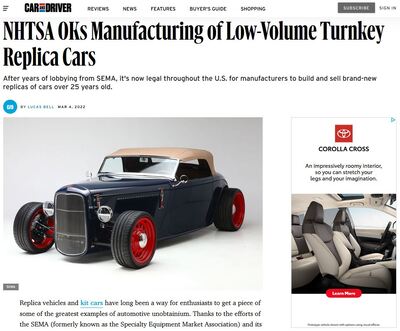
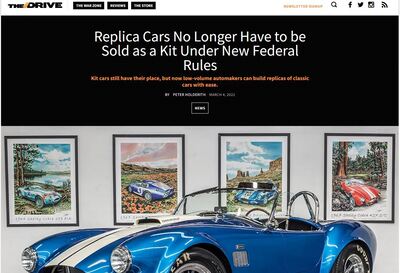
Replica Vehicle Law: SEMA worked with Congress to enact a 2015 law allowing low-volume motor vehicle manufacturers to begin selling replica cars that resemble vehicles produced at least 25 years ago—from 1930s roadsters to 1960s muscle cars and more. Each company could produce up to 325 replicas a year for the U.S. market. The program has been on hold until the National Highway Traffic Safety Administration (NHTSA) issues a regulation to implement the law. The agency completed the rule in early January 2021, but it was not officially published in the Federal Register before the presidential transition. While the rule is scheduled to be reviewed and published in January 2022, SEMA has urged the agency to expedite the process so that companies can begin hiring workers and producing cars for eager customers.

Automotive Cybersecurity: SEMA submitted comments to NHTSA on its updated guidance document entitled “Cybersecurity Best Practices for the Safety of Modern Vehicles.” First published in 2016, the NHTSA document identifies recommended best practices for motor vehicle and equipment designers, manufacturers and suppliers. The updated document incorporates recent agency and industry research and focuses on best practices that have safety implications. SEMA supports cybersecurity controls that also safeguard the ability to modify vehicles and install specialty auto equipment.

Automated Driving Systems: SEMA submitted comments to NHTSA on its advanced proposed rule to begin creating a framework for regulatory oversight of automated driving systems (ADS). The framework is intended to define, assess and manage ADS performance-safety issues while providing flexibility for continued design innovation. Although wide-scale deployment of autonomous vehicles may be several years away, the technology is being actively developed and tested—from cameras, radar and LIDAR to global-position satellite data, vehicle-to-vehicle communications, and vehicle-to-everything devices. The technology is being included in new crash-avoidance safety systems such as automated braking and lane-departure warnings.

Collector Car Appreciation Day: The 12th annual Collector Car Appreciation Day (CCAD) took place on Friday, July 9, 2021. Both the U.S. Senate and the House of Representatives introduced resolutions (H. Res. 491/S. Res. 292) to focus attention on the vital role automotive restoration and collection plays in American society. Thousands of Americans gathered at car cruises, parades, and open houses at SEMA-member companies to celebrate the nation’s automotive heritage. The day is also international in scope, as many Canadian provinces passed resolutions and hosted events. The next CCAD is set for July 8, 2022.

E15 Ethanol: SEMA submitted comments opposing a proposed rule by the EPA to modify or remove the current E15 warning label requirement for gasoline that contains 15% ethanol. Ethanol, especially in higher concentrations such as E15, can cause metal corrosion and dissolve certain plastics and rubbers in older automobiles that were not constructed with ethanol-resistant materials and certain specialty high-performance equipment installed on newer vehicles. The EPA’s proposed new label at the gas pump would weaken the warning message and be smaller in size. SEMA argued that these changes would increase the likelihood of E15 gasoline being used in incompatible vehicles. In a separate action, a federal appeals court found that the EPA had overstepped its authority by issuing a 2019 rule allowing gasoline with up to 15% ethanol to be sold year-round. The court ruling reimposes a summertime restriction for certain E15 sales due to fuel-volatility concerns that higher blends of ethanol combined with warmer temperatures may lead to increased smog.

Recreational Trails Program: The Federal Highway Administration (FHWA) released a study which concludes that the Recreational Trails Program (RTP) should be receiving nearly $300 million annually rather than the $84 million currently allocated from its portion of federal gas tax receipts. The amount is based on an analysis of fuel used for non-highway recreation from the 18.4-cents-a-gallon federal taxes collected at the pump. RTP funds are used to construct and maintain trails for all types of activities, including motorized, non-motorized and mixed-use trails (off-roading, snowmobiling, hiking, biking, cross-country skiing, etc.). SEMA is urging Congress to enact legislation to increase the RTP funding to the FHWA study estimates.

National Monument Boundaries: President Biden issued Executive Orders to restore the size of Grand Staircase-Escalante and Bears Ears National Monuments to their original boundaries. They had been reduced in size under the previous administration.

“Made in USA” Rule: The FTC has consolidated its longstanding policy on enforcing unqualified “Made in USA” claims within a new regulation, “Part 323—Made in USA Labeling.” The regulation does not impose any new requirements but is intended to make it easier for businesses to understand claim conditions and, for the first time, to allow the FTC to seek civil penalties for violations. Companies may still make qualified Made in USA claims for products that include U.S. content or processing but do not meet the threshold for an unqualified claim. Qualified claims include “Made in USA of U.S. and imported parts,” “75% U.S. content,” and “Assembled in USA.” The FTC rule does not supersede state rules that are consistent or would provide greater protection.

Duties on Tires From Southeast Asia: The U.S. International Trade Commission ruled that U.S. industry is being harmed from imports of passenger and light-truck tires at less than fair value (“dumping”) from South Korea, Taiwan and Thailand and that Vietnamese tire producers have received unfair subsidies from the country’s “undervalued currency.” The assessed dumping duties are 14.72% to 27.05% for South Korea, 20.04% to 101.84% for Taiwan, and 14.62% to 21.09% for Thailand. The subsidy rates for tires from Vietnam range from 6.23% to 7.89%.

STATE UPDATE

OceanoCalifornia—Oceano Dunes OHVs: SEMA and several other organizations sued the California Coastal Commission over its decision last March to terminate all off-highway vehicle (OHV) activity at the Oceano Dunes State Vehicular Recreation Area (SVRA) within three years. The California State Superior Court for San Luis Obispo County was asked to issue an injunction and vacate the commission’s decision. Since 1974, Oceano Dunes SVRA has been a state-designated OHV park managed and operated by the California Department of Parks and Recreation. The SVRA comprises 3,500 acres, of which less than 1,350 acres of dunes and 3.5 miles of beach provide open riding access for OHVs. It is the only opportunity for motorized recreation at a state park along California’s Pacific coast. The lawsuit petitioners include SEMA and Ecologic Partners Inc., which is comprised of the Off-Road Business Association, the American Sand Association and the American Motorcyclist Association District 37. The suit challenges the commission’s claim that there are environmental concerns requiring closure despite decades of OHV access.

Idaho—Custom Vehicles: Idaho Governor Greg Little signed into law SEMA-supported legislation to add a vehicle registration classification for custom vehicles. The bill defines a custom vehicle as a replica vehicle that is at least 30 years old and designed and manufactured to resemble a vehicle that would qualify for classic license plates.

Kansas—Antique Vehicles: Kansas Governor Laura Kelly signed into law SEMA-supported legislation to redefine the vehicles eligible to be registered as antique vehicles. Previously, the Kansas Highway Patrol defined an antique vehicle as being “more than 35 years old and as close to the original as possible, without any significant alterations to the major component parts.” The new law requires only that the vehicle be more than 35 years old, regardless of the age of the component parts installed.

Kansas—Military Vehicles: Kansas Governor Laura Kelly signed into law SEMA-supported legislation to allow for the registration and on-road use of surplus military vehicles. Military surplus vehicle is defined as a vehicle with three axles, is less than 35 years old and was manufactured for use by the U.S. military or any country that was a member of NATO at the time the vehicle was manufactured.

Michigan—Military Vehicles: Michigan Governor Gretchen Whitmer vetoed SEMA-supported legislation that would have allowed for the titling and registration of historic military surplus vehicles. Currently, such vehicles can not be titled or registered for use on highways in the state. In announcing her veto, Gov. Whitmer explained that, while the bill provides an additional safeguard by requiring a safety inspection, it does not provide for any implementation of that requirement.

Mississippi—Vehicle Titling: Mississippi Governor Tate Reeves signed into law SEMA-supported legislation that allows for the titling of vehicles at least 30 years old and missing documents on oath of ownership. Under previous law, there was no such exemption.

Montana—License Plates: Montana Governor Greg Gianforte signed into law SEMA-supported legislation mandating that the state issue waivers for vehicles unable to display a front license plate. Current law permits the display of a single rear-mounted plate for motor vehicles registered as a street rod or a custom vehicle, and a waiver may be issued for vehicles unable to display a front plate. The new law requires the waiver to be issued.

Nevada—Classic Cars: The Nevada House of Representatives failed to pass prior to a key legislative deadline SEMA-opposed legislation that would have significantly impacted the owners of old timers, classic rods, street rods and classic vehicles. Vehicles would have been forced to pass a smog check upon initial registration and be subject to in-person odometer checks at registration and subsequent renewals.

Nevada—Exhaust: The Nevada Senate failed to pass prior to a key legislative deadline SEMA-opposed legislation that would have banned most exhaust modifications. The proposal would have outlawed any modifications that amplified the vehicle’s noise output.

Virginia—Imported Vehicles: Virginia Governor Ralph Northam signed into law SEMA-supported legislation to allow the Department of Motor Vehicles to issue a title for an imported foreign-market vehicle manufactured at least 25 years ago. Previous law allowed for only a negotiable title to be issued to such vehicles manufactured prior to 1968.

Virginia—Vehicle Modifications: Virginia Governor Ralph Northam signed into law SEMA-supported legislation which includes provisions that change certain traffic infractions from primary to secondary offenses. A secondary offense is one for which a citation can be issued only if the driver is stopped for another, separate offense. Beginning March 1, 2021, the following traffic infractions were changed to secondary offenses: operating a motor vehicle without an exhaust system that prevents excessive or unusual levels of noise, without a light illuminating a license plate, or with certain sun-shading materials and tinting films.

West Virginia—OHV Trails: The West Virginia legislature passed SEMA-supported resolutions calling for the creation of a semi-contiguous OHV trail that would run parallel to the Appalachian Hiking Trail. The resolutions are part of an effort to create an interstate OHV trail system that would allow enthusiasts to drive from Alabama to Maine via OHV.

Wyoming—Antique Vehicles: The Wyoming Senate defeated SEMA-opposed legislation that would have significantly restricted the eligibility of antique vehicle registrations. If passed, antique vehicles would have been required to be at least 50 years old, and registration would have been required to be renewed annually. Antique vehicles must currently be at least 25 years old, and registration requires only an initial fee.

IllinoisIllinois—Antique Vehicles: Illinois Governor J.B. Pritzker signed into law SEMA-supported legislation to allow expanded-use antique vehicles to be driven without limitation for two additional months. Previously, expanded-use antique vehicles were defined as being more than 25 years old “or a bona fide replica” and were limited to traveling to and from auto shows, exhibitions, service stations and demonstrations during the colder months (November 1 through March 31) but can be driven without limitation during the warmer months (April 1 through October 31). The new law expands the months without driving limitations to March 1 through November 30.

Wed, 12/01/2021 - 12:25


SEMA News—December 2021

REQUIRED READING

By Juan Torres

A Motorsports Extravaganza

Every December, the worldwide racing industry gathers in downtown Indianapolis for the three biggest business days in motorsports at the Performance Racing Industry (PRI) Trade Show. Industry professionals navigate through the halls of the Indiana Convention Center and Lucas Oil Stadium in search of the hottest racing parts and to learn about the latest technology, trends and services. Attendees also have unprecedented access to manufacturers and their products, unlimited networking opportunities with industry leaders, and numerous conferences and seminars unique to the PRI Trade Show that they can attend. The following are some of the publications that report on the annual event.


Drag Illustrated

Drag Illustrated

In addition to discussing PRI’s brand-new Membership Program and the success of the organization’s Road Tour, editor Nate Van Wagnen asked PRI President Dr. Jamie Meyer about the 2021 PRI Trade Show. Dr. Meyer mentioned some of the new elements that would be added to this year’s Show and why connecting in person is so valuable.


BangShift

BangShift was among the media outlets that quickly informed its readers when registration for the 2021 PRI Trade Show opened. Editor Chad Reynolds’ excitement for this year’s show was evident when he wrote, “The PRI Trade Show will be in the house with all the cool race parts, race cars and racers you love to see.”


Race Pages Digital

Editor Steve Baur attends the PRI Trade Show every year in search of racing parts and machinery that his readers will find interesting. Among the articles he has written is one that focused on the engines displayed at the Show. He wrote, “It’s the epicenter of new horsepower and speed parts, and many companies show these off with an engine.”

HEARD ON SOCIAL MEDIA

We cover the Performance Racing Industry Show to find the latest parts, cars, racing & motorsports equipment and much more!—Speed Academy, via YouTube

“With less than 100 days until the 2021 Performance Racing Industry Trade Show, exhibitors are preparing to connect with attendees in person.”—Motorsports Videos, via Twitter

“More highlights of best engines from a previous Performance Racing Industry show. This time we take a look a the first Ford Sprint Car race engine in years and a couple of ridiculous diesel race engines.”—Horsepower Monster, via Facebook

BangShift
Wed, 12/01/2021 - 12:00

SEMA News—December 2021

INTERNATIONAL

Get First-Hand Insight Into the Australian Market

SEMA to Host Overseas Trip to the Aftermarket-Friendly Nation in 2023

By Linda Spencer

This article focuses on the Australian automotive specialty-equipment market and, more specifically, on the vehicles on the road in Australia that provide the greatest opportunity for U.S. manufacturers.

Australia

A number of local Australian companies are converting fullsize pickups to right-hand drive. Pictured here, participants on a past SEMA Australia trip visited a Melbourne-based vehicle development company which converts and certifies Ford F-Series trucks for use on Australian roads.

The Australian market was ranked as the second most important export market for U.S. companies in a survey of SEMA-member manufacturers, trailing only Canada. While Australia is roughly the same size geographically as the United States, the population for the entire country—25.7 million—is less than that of Texas. Even so, the following factors have led to an impressive car culture in Australia and great opportunities for U.S. companies:

  • A passion for customizing. (Industry experts put the per-capita spending on customizing even above the generous spending levels for vehicle upgrades in the United States).
  • A love of vehicles baked into the DNA of Australians as it is for Americans as part of a lifestyle fueled by readily available open land to explore with individuality and performance.
  • A sizable pool of potential customers.
  • Sufficient disposable income to purchase specialty products.
  • A legal framework for allowing customization.

There are over 18 million registered vehicles in Australia (more than 1 million sold annually, with 1,062,867 sold in 2019), according to the Australian Bureau of Statistics. Australia’s geographic size but relatively small population helps explain the reliance of Australians on their vehicles. Australia has one of the highest vehicle ownerships per capita in the world: 769 vehicles per 1,000 residents in 2019. That figure is steadily rising—up from 746 per 1,000 Australians in 2015.

So What do Australians Drive?

In terms of sheer volume of vehicles on the road, the most important platform for customizing sales is smaller pickups, known as utes (an abbreviation for “utilities”). The Toyota HiLux and Ford Ranger are not only the first- and second-best selling utes in Australia (with the Ranger at times taking first place) but are also the best-selling vehicles overall. Four of the top seven vehicles sold in Australia over the past several years are utes, with the Isuzu D-Max and Mitsubishi Triton in sixth and seventh place, respectively.

The United States and Australia share a common trait in that pickups are used for both work and play, and the heavy prevalence of customization is easy to spot. Utes made up a 20.6% share of the Australian new-vehicle market between January 1 and June 30, 2021, and of the 567,468 new vehicles sold in Australia this year, 101,597 were 4x4 utes and 15,263 were 4x2 utes. Four-wheel drive ute sales performed better than the overall market, growing 34.1% compared to a market recovery growth of 28.3% for the rest of the market from the lows of the early COVID-19 days.

Fullsize pickups also have their consumer base in Australia. Americans will be pleased to know that Australians drive vehicles well known in the United States, such as large pickups that include the Ram 1500, the Silverado and F-Series trucks. Most are converted to right-hand drive in Australia.

The ’20 HSV Silverado 1500 and DS-series Ram 1500 (formerly known as the Dodge Ram) are imported and sold officially in Australia by the vehicle manufacturers, but they are converted in Australia by the Walkinshaw Group. Ram sold almost 2,700 of its 1500-Series trucks in 2019 alone, and it has been reported that the local Ram conversion line at Walkinshaw is working around the clock, five days a week, to keep up with demand.

A number of smaller independent companies that convert other brands of U.S. pickups such as the Ford F-Series and other fullsize pickups also report strong sales. As those vehicles are not officially imported by the vehicle manufacturers, the numbers are not included in the official new-vehicle sales reports to the Federal Chamber of Automotive Industries, which produces those statistics. For those vehicles, the local companies handle the right-hand-drive conversions and certifications to make them Australian street-legal. It is expected that the next-generation F-150 will be built as both left-hand and right-hand drive and will be officially imported into Australia.

Enthusiast favorites such as the Jeep Wrangler and Gladiator can also be readily be found. Those vehicles are sold by the manufacturer as right-hand-drive vehicles straight from the factory and have excited a passionate niche of the Australian market. The JK and JL have captured the hearts of a small but dedicated group of Down-
Under enthusiasts and have generated a strong demand for a wide range of interior, exterior and underhood products to upgrade the beloved vehicles. Managing Director and CEO FCA Australia Kevin Flynn was recently quoted in the media as saying that Chrysler is committed to right-hand-drive vehicles and that there is an effort to grow the number of Jeeps sold in the market to right a recent slide in sales.

Australia is a strong niche market regarding products for U.S. vehicles that include the iconic Ford Mustang. A full 25,854 right-hand drive pony cars have been sold since they went on the market in Australia in 2015. Ford has even teamed up with Australian-based Herrod Performance to produce the fast-selling R-Spec version of the Mustang. Ford has set up a small-scale production line in its Campbellfield facility (in the Melbourne area), staffed by Ford-trained Herrod Performance workers. The Mustang GT manual R-Spec version has an upgraded exhaust, springs, swaybar and supercharger added by Herrod. Following the overwhelming success of the Mustang, musclecar enthusiasts will be treated to the new eighth-generation Corvette Stingray (expected later this year or early 2022), which will be built as a right-hand-drive vehicle out of Chevrolet’s factory in Bowling Green, Kentucky. The right-hand-drive Mustang is also built in the United States.

While this article has focused on new-vehicle sales, SEMA members selling restoration products for classic cars or products for racing will also find extensive opportunities. “My guess is that they have more hot rodders in Australia per capita than we do at home in the United States,” said Classic Industries owner John McLeod, who has traveled to Australia with SEMA.

Said a representative from Comp Performance Group who participated on one of the SEMA Australia trips: “I was impressed with the enthusiasm and passion for high-
performance automobiles and racing that folks have in Australia. I knew the passion was there before heading over, but being there opened my eyes to just how big it is.”

SEMA hosts low-cost overseas trips to top global markets to foster export opportunities for SEMA members. Australia was added to the list of venues in 2016, with 60 companies having since traveled to Melbourne with SEMA to network with pre-vetted overseas buyers and to exhibit at the most important consumer automotive specialty show in the region. The next trip to Australia will be in the spring of 2023. Additional upcoming trips include the SEMA Middle East trip over March 22–29, 2022, with stops in Dubai, United Arab Emirates, and Riyadh, Saudi Arabia; and SEMA Nordic over August 24–28, 2022, to Stockholm, Sweden.

For more information on upcoming international programs, visit www.sema.org/international, or contact Linda Spencer at lindas@sema.org.

Wed, 12/01/2021 - 12:00

SEMA News—December 2021

BUSINESS

The Rise of the Overlanders

Who Are They and What Are They Searching For?

By Mike Imlay

They say it started in South Africa and Australia, spread rapidly through South America, and now has gripped North America. We’re talking, of course, about the overlanding phenomenon, an outdoor addiction that many aftermarket companies have become keenly aware of—so much so that the SEMA Show added an Overland Experience feature dedicated to the trend in 2019. But who exactly are these overlanders? What do they seek, and how is the industry discovering opportunities in helping them find it?

Overlan ding

Pop-up tents on 4x4 rigs like this one built by Dixie 4 Wheel Drive have become a ubiquitous hallmark of overlanding. However, the growing overland phenomenon goes far beyond camping and trail riding.

The fact is, while closely associated with the truck and off-road segment, overlanding is evolving into its own market space embracing a dynamic consumer mix. However, defining the phenomenon isn’t so easy—perhaps because it’s largely a state of mind for true enthusiasts.

“They identify as campers, they identify as adventure travelers, they identify as off-roaders, they identify as explorers, so really there’s a lot of different ways they see themselves,” said Lindsay Hubley, managing partner for Lodestone Events LLC, which presents the popular Overland Expo event series. “Overlanding is really a self-sufficient vehicle or adventure mode of travel where it’s all about the journey. At its real core, overlanding is about exploration.”

That exploration has historically been accomplished through dedicated off-
roading vehicles ranging from Land Rovers to 4WD trucks and Jeeps, but even that is changing, said Andrew Funk, president of Cap-it International, which operates an expanding franchise of truck-and-adventure accessory outlets throughout Western Canada.

“What this market has brought to us is new manufacturers and better-quality products,” Funk said. “There are new ‘glamping’ and creature comforts that are nice while you’re out in the bush off-roading, but it has really become more mainstream to where you’re sometimes putting tents on really small SUVs—and cars, for that matter. It’s becoming so mainstream now that your average consumer is seriously looking into it as an option.”

As a result, manufacturers and retailers have had to think beyond traditional camping and off-roading paradigms to fully engage overlanding consumers. Overlanders tend to see the serendipity of expeditioning as their goal and enjoy immersing themselves in the environments and cultures they encounter. Some enthusiasts even ship their vehicles to other continents for more exotic treks.

“It’s camping, but it’s a lifestyle, so you need bigger tires and a lift kit to get into some of the places you want to go,” Funk explained. “The solar technology that’s now available means you can carry more electronics, so you’re bringing fridges along with you. Rooftop tents are obviously great, but then you’ll need lighting as we come into fall, so it’s more than just camping equipment. It’s more about the journey to get there than it is about just sitting at the destination.”

However one defines the phenomenon, its popularity shot up during the 2020 pandemic.

“COVID put a massive focus on the ‘staycation,’ at least up here in the Pacific Northwest and British Columbia,” Funk said. “Everybody’s going camping—and as the campsites closed down, people started going deeper into the backwoods.”

“I think it’s blowing up quite a lot, especially recently,” agreed Patrick Heiner, a sales spokesperson for Dixie 4 Wheel Drive, which operates off-roading shops in both St. George and Moab, Utah. “Obviously, everyone’s had a lot more free time on their hands this last year, so they’re getting out a little farther than they generally used to on just a weekend trip. Now it’s full weeklong trips and hundreds of miles.”

According to Dixie 4 Wheel Drive General Manager Tara Thompson, the company’s overlanding customer demographic reflects a variety of backgrounds and needs.

Overalnding

The “van life,” made possible by conversions like this one done by the Van Speed Shop, is an important offshoot of the overlanding market. It screams “California” and echoes the “bohemian travel” culture of the ‘60s and ‘70s.

“I would say it’s a very broad customer base, because you do have that ‘just overnight’ guy who wants an easy pop-up tent, and then you have the guy who’s building a whole van to live in and actually travel across the country for a year or two,” Thompson said. “But it tends to be a younger crowd, because most of our overlanders like to explore. They still want to get out and hike, and most of it’s getting them to those areas to do that, so they tend to be younger to mid-40s, [with] probably 50s being the oldest that we usually help in our stores.”

Thompson added that newcomers to overlanding may start with some typical off-roading mods such as wheel, tire and suspension upgrades and maybe a rooftop tent, but whatever they buy, their purchasing decisions are deliberate and well-researched.

“One of the best parts about our two locations is that we get people who actually use their vehicles,” she said. “It’s a lot more fun to do the builds for people who understand what they’re putting on and actually use it. We have true enthusiast-lifestyle customers who are primarily down-to-earth people. They’re into a lot of outdoor hobbies, so most of them are off-roaders, hunters, fishers—anything outdoors-related they usually have on their hobby lists.”

Of course, large consumer events always offer direct insights into markets, and Overland Expo has positioned itself as a primary event series for do-it-yourself adventure-travel enthusiasts. All the regional Expos offer a high degree of interaction through hundreds of session-hours of classes for four-wheelers and adventure motorcyclists, along with demonstrations, a film festival and a huge exhibitor-vendor contingent representing travel equipment, camping gear, bikes, vehicles and services.

Overlanding

Headquartered in South Africa, SmartCap has found success in the North American market by offering truck caps and bed storage solutions—not to mention cooking and other gear—to consumers embracing a compact, adventuring lifestyle.

According to the Expo’s own market research, its demographics skew toward a solid base of high-earning professionals who travel frequently and spend the time and resources to learn the skills and acquire the equipment they need. Among age groups, 26% of the event’s audience falls between ages 25 to 44, and 28% between 45 to 54. By contrast, people aged 25 to 34 and 55 to 64 make up 15% and 20% of the Overland Expo audience, respectively.

Key activities enjoyed by these demographics include exploring (4%), photography and videography (5%), hunting and shooting (7%), fishing and fly fishing (15%), biking (22%) and hiking (26%).

“The interesting part about overlanding is that we’re seeing growth from all levels of the demographic spectrum, but what they’re buying is definitely trending differently,” Hubley said. “An older-demographic couple—probably higher up into their 50s and 60s—have more disposable income, so traditionally they’re looking at Sprinter Van conversions and some of the higher-end Unimog-type vehicles, Earth Roamers and so forth. Then the younger generation we’re seeing coming into the market is your Jeep Gladiator or Toyota 4Runner-type audience.”

Consequently, the overlanding phenomenon presents the automotive aftermarket with a vast array of crossover market opportunities, Hubley said. The emphasis with off-roading is often how one builds a vehicle to take on a trail, but overlanding is different, she explained.

“With a lot of [overlanders], the way they got into the sport was from the outdoor-recreation side,” Hubley observed. “They were maybe birdwatchers, mountain bikers or climbers interested in life off the grid during travel, so they sourced the off-road products needed to do that journey. What I would say to aftermarket manufacturers is that it’s not only a trend that’s here to stay but also developing an entirely new audience of buyers who maybe have never even thought about outfitting their vehicles for off-road travel.”

That means they’ll be turning to the aftermarket for solutions to tackling rough terrain, surviving and staying connected while off the grid for prolonged periods, and carrying and stowing gear for kayaking, backpacking, biking, cooking, sleeping and more. In fact, refrigerators, solar panels and generators, communications technologies and even showers are especially sought-after, both as freestanding purchases and as integrated parts of vehicle builds.

“It mostly depends on where they want to start,” Heiner said of consumers. “We have some who just want to start with the tents and basic weekend campout stuff. They don’t worry about suspensions and things like that. Some work the other way. They worry about off-road capability first and then start adding the overland accessories after they know that their vehicles are good and capable of getting them out farther.”

Retailers might also want to rethink how they brand their outlets and present products. This is a demographic that likes to visualize how products can enhance their odysseys. The opportunity to see, touch and experience products factors into purchase decisions, and spouses, family or friends can also influence choices.

“It’s a male-dominated industry, there’s no doubt about that,” Funk said. “But the style and the demographic that we’ve always been going after is based on the idea that a woman should be comfortable shopping at our store. It’s not a mechanic’s shop; it looks nice.”

He added that Cap-it underwent a rebranding in the early to mid-’00s that helped it better engage with the then-emerging overland sector, among other customers.

Given the sales opportunities, even OEMs are now tapping the aftermarket to develop accessory packages for overland-capable vehicles. A case in point is GMC’s Canyon AT4 Concept truck, which debuted at the recent Overland Expo Mountain West event held in late August 2021.

“We wanted to showcase the GMC Canyon with this concept and punctuate GMC’s commitment to premium, off-road capable vehicles. Consumer reaction to this concept’s design will help us further serve the growing market of buyers leading authentic outdoor lifestyles,” said Buick and GMC Global Vice President Duncan Aldred.

Among the build’s many features was a SmartCap EVOa truck cap. Headquartered in South Africa, SmartCap specializes in a broad range of truck bed products, that primarily center around their EVO range of truck caps and their system of accessories that seamlessly plug-and-play with the cap. As a part of that system, the company also offers a Kitchen-Bin that includes a camp-stove and other related outdoor-kitchen items.

According to SmartCap Vice President of Global Marketing Jason Ehrlich, “The EVOa can support more than 700 lbs. while delivering versatile storage and organization capabilities that overlanders look for when wanting to not just survive, but thrive in their outdoor adventures. Hunters, fishermen, tradesmen, photographers, people into overlanding—there are all sorts of ways people tend to use their trucks, and they’re taking our product and configuring a setup exactly as they need it,” said Ehrlich.

Overlanding

The Overland Expo has become a popular series of consumer-based events for adventure-travelers. Focusing on education, demonstrations, vendors and more, the Expo speaks to a wide-ranging market that has only grown since the recent pandemic.

Versatility is, in fact, a defining word for overlanders, since the way they chase their dreams can take on many distinct forms depending on geography and culture. A prime example can be found in Costa Mesa, California, where Van Speed Shop CEO Duran Morley is addressing another distinctive offshoot of the overland craze dubbed “the van life.” In the past several years, his shop has exploded doing high-end Mercedes-Benz Sprinter Van conversions. (The enterprise also operates The Van Mart, which specializes in affordable parts and accessories for van owners doing their own builds.)

“Maybe this is their exchange for a truck,” Morley said of his customers. “In Southern California, it’s become dad’s trade for a minivan. It’s a vehicle that can store things, bring the kids up from school, and go to the beach as a family getaway vehicle. We also have a lot of customers who use it during the week as a work truck that can fit ladders, construction gear and whatever. Then, on the weekend, they shift everything out, throw in a cabinet and a bed, and have a full-on conversion rig.”

For adventure travelers, the vans have become a popular alternative to the traditional 40-ft. RV. They boast kitchen setups, electronics and entertainment conveniences, along with space to spare for mountain bikes and snowboards.

“I want to give everybody the opportunity to explore and enjoy van life as much as I do,” Morley said.

He added that for him there are no “typical” customers. They could be young people in their 20s working nine-to-five jobs or making their way as YouTube influencers, or they could be thirtysomethings with families, or retirees looking to explore. He’s even built vans as less-expensive housing alternatives to college dorm rooms. The one distinction he sees is that truck-based overlanding customers tend to be individuals or couples, while his customer base tends toward bigger families with disposable income.

“We offer luxury conversions that are nice and definitely scream ‘California original lifestyle,’” he said.

If anything, Morley’s work underscores how wide-ranging overlanding can be, as well as the numerous ways every segment of the aftermarket—from manufacturers to retailers to builders—has rushed in to meet the expanding needs of a rapidly growing enthusiast base. But where will the phenomenon take the aftermarket as we turn the corner into 2022?

Overlannding

Cap-it International has long catered to overlanding customers, who tend toward experiential purchasing. They like to see, touch and imagine how products will work on their journeys, and listening to them is crucial to expanding retail sales.

“I think the industry has exploded,” Funk said. “I see a lot of small manufacturing shops—especially in the United States or North American-based—that have just grown out of nowhere in the last 12 months and are just doing phenomenal now. My complaint would be no different from the rest of the world—waiting for products to come out of China. The prices are going sky-high only because of freight and shortage of supply.

“The consumer will only put up with those price increases for so long. Everything will shift backward, and I think it’ll resettle them appropriately. But the encouraging thing is that I’m seeing more and more manufacturing coming back to North America. There are quality issues overseas, but not with the products we’ve been bringing in. We focus on the good-quality product, [and so] why not build local?”

In the end, Funk said, continued growth will depend as it always does on listening to the customer and accompanying them on their journey, wherever they may want to go.

Wed, 12/01/2021 - 11:35

SEMA News—December 2021

EDUCATION

How to Beware of Ransomware

Expert Tips to Hackproof Your Business

By Douglas McColloch

Companies in the 21st century enjoy a wide range of competitive advantages that were unavailable to previous generations of businesses. The use of the internet to automate ordering and billing, to manage inventory or to process payrolls can increase productivity, reduce waste and maximize efficiencies across departments.

Ransom

According to the FBI, the cost of ransomware attacks was $250 billion in 2020, with an average downtime of 19 days for the affected entities. As hackers’ tools grow more varied and sophisticated, expect that number to escalate in the coming years. Photo courtesy: Shutterstock

But all of that connectivity comes with its downsides, too—one of which is “ransomware,” which can be loosely defined as the practice of hacking into a company’s digital assets to “trap” the victim’s data by means of encryption. That can cause an irretrievable loss of assets—and even whole enterprise systems, depending on the size and scope of the hack—unless a ransom is paid, generally in an untraceable form of cryptocurrency such as Bitcoin.

The costs to businesses from ransomware are mounting. According to a recent study from the Federal Bureau of Investigation (FBI), ransomware costs were an estimated $250 billion in 2020, with an average downtime of 19 days for impacted companies.

In fact, the FBI study noted, a company’s downtime costs averaged 20 times more than the amount of ransom being extracted. An example of that occurred in 2019, when the municipal government of Baltimore, Maryland, was targeted by ransomware hackers. The amount of ransom the city paid—around $75,000—paled in comparison with the costs of the city’s downtime, which lasted more than a month at an expense of more than $18 million. And the threat is growing.

According to a paper published earlier this year by insurance giant Beazley Group, ransomware attacks increased 120% in 2019 over the previous year, with more than 60% of targets comprising small and medium-size businesses. According to the FBI, an attack occurs every 11 sec., so it’s clear that companies need to factor in the threats posed by ransomware when assessing the strength of their online data and security systems and make plans to fortify those potential targets against future attacks.

A recent SEMA Education webinar, “Ransomware—What SEMA Manufacturers, Retailers and WDs Can Do to Mitigate Threats,” aimed to demystify the subject, with a panel of industry experts providing guidance into best practices that can minimize if not eliminate the threat of a ransomware attack.

Identifying Modes of Attack

Nearly 90% of IT professionals and 75% of the owners of small- and medium-size businesses agree that cyber threats such as ransomware attacks represent a significant and growing risk, according to a 2021 Malware Report published by Cybersecurity Insiders. So while there’s near-unanimity on the nature of the threat, many business owners remain unaware of the source of the greatest—and most preventable—causes of cyber attacks.

  • Email hacks: “You’ve all heard of ‘phishing’ or ‘spear phishing’ or ‘business email compromise,’ but it’s really all the same thing,” said Bruce Grant, president and CEO of Estes Group, a managed IT company that works with mid-market businesses on building and strengthening their Enterprise Resource Planning systems. While other, more sophisticated forms of hacking have become more widely used in recent years, common email-compromising attempts still constitute more than 80% of malware attack vectors. While an email hack represents the most prevalent form of attack, it’s also one of the most preventable. Ways for businesses to minimize the chance of an email hack include implementing greater use of email filters and added authentication layers; regular changes of employee passwords and blocking reuse of previous passwords; and educating employees to identify and report suspicious emails to their company IT departments.
  • Fake domains: Another frequent means of entry used by hackers involves so-called “domain spoofing,” some form of which is used in up to 45% of all cyber attacks. It occurs when hackers use a counterfeit or “spoofed” web domain or email address to give the false impression of a legitimate company or individual. Generally, emails are the preferred mode of entry, but sometimes whole websites with slightly altered domain names are used. Even cybersecurity consulting companies aren’t immune from it. “Someone literally bought a similar domain to our company and tried to get access to some of our key employees through domain spoofing,” Grant said. Grant provided a little old-school advice here: “A few years ago, attacks were simple. There was a Nigerian prince trying to give you money, and you just didn’t click on that. But while the attacks have gotten much more sophisticated, the thinking is the same: ‘If you don’t trust it, don’t click on it.’”

Other Vulnerabilities

If email were the only attack vector hackers could exploit, the problem of ransomware could be greatly minimized with the simple fixes mentioned previously, but there are numerous ports of entry that hackers can exploit now, as Brad Feakes, Estes Group senior vice president, reminded the panel. The internet, for one, is a potential source of “infiltration dressed as information.”

  • Apps and e-commerce: A related source of infiltration via malware is in applications—especially the apps needed to run an e-commerce site. “One subject that doesn’t get as much press as it probably should is the idea of applications,” Feakes said. “You should think of every application or program that you use for business purposes as a potential threat. Installing each application has its own limitations and risks in ways in which it can be hacked, whether it’s web-based or whether it’s installed onto a device within your network. The integrating of core systems to those devices can be especially challenging. Everybody likes e-commerce, right? E-commerce is a really big thing in the automotive industry. Customers want an easier experience, but those e-commerce sites create new entry points to your network.”
  • IoT security challenges: Another factor that facilitates hacking is the interconnectivity of devices, which creates many portals of entry for would-be hostage takers. “We talk about the IoT or the ‘Internet of Things,’” Feakes explained. “This is the basic notion that we increasingly want to connect our devices. If you’re in an automotive industry, you have a bunch of different devices that might be serving a purpose functionally, and you want to connect to those that you can monitor and control them.” But he warned that those devices themselves become risk points. “I heard the other day about someone who got his network hacked from a refrigerator,” he said. “Whoever thought that you could get hacked from a refrigerator? But now, as refrigerators get smarter and people start connecting them to their networks, suddenly your fridge is a potential point of entry.”
  • Employee browsing habits: If that’s not enough, companies also need to consider what’s referred to as “BYOD,” or Bring Your Own Device, when implementing cyber-security policies. “You have employees coming to work and using their PCs or smartphones to contact customers, suppliers and other employees,” Feakes said. Employees surfing social-media sites such as Facebook and YouTube on company computers create another potential opening for hackers. Employees’ own smartphones can also be used as hacking devices if they are logged into their company email accounts via a VPN. “You can see how this overlap can create potential risks,” Feakes concluded.

Basic Hackproofing Tips

All of the panelists agreed that one essential ransom-proofing protocol is the frequent use of backups—particularly off-site, cloud-based backups.

“I was having dinner with this fellow the other day,” Feakes recalled. “He said, ‘We’ve been ransomed twice this year.’ I asked him, ‘How did it go?’ He said, ‘We have well-tested, off-site backups, so both times we got ransomed, and they told us the ransom amount, we brushed it off. We rolled back to the previous day before the attack took place and went back to business as usual.’ So the company felt some pain, since missing a day of business is never fun, but it was spared the challenges that other companies have—basically by having off-site backups in place.”

Another way to help prevent malware attacks is to set clearly defined company policies governing the use of the internet on company devices.

“Most people think of the internet now as a right and not a privilege,” said Daryl Sirota, Estes Group vice president of managed services. “I would argue that we might need to reverse that thinking. The internet is a privilege. Only folks who have been properly trained and have appropriate equipment are allowed to surf the internet. You arguably might say that unless your job is researching parts and policies—or watching YouTube videos on how to install a carburetor, for instance—you probably shouldn’t have users on the internet, because they’ll eventually find the stupidest things out there and treat them as fact.

Ransomware

To keep data safe and secure in the case of a ransomware hack, regular backups to a remote (i.e., cloud-based) server as well as periodic firewall and penetration tests are recommended for businesses. Photo courtesy: Shutterstock.com

“When COVID hit, there were 14 million domains registered that looked like COVID information sites. Then the bad guys started spamming people with emails that said, ‘Hey, you need more information on COVID? Click here and we’ll take you to a site that looks like Johns Hopkins.’ If you didn’t properly patch your workstation, you got hacked, and it was a bad day. While social media isn’t necessarily bad, it can be a vehicle for malware, so defining your company’s internet-use policy is step number one.”

On a related note, Sirota advised against employees who work remotely using their own devices to access their employers’ networks, instead opting for company-issued devices that have the necessary firewalls and security extensions installed.

“If you are letting employees work from home, buying a Chromebook and letting them use a company device at home is more secure,” he said.

Another technique to minimize hacking could be referred to as “securing your perimeter.”

“Most of you have Wi-Fi,” Sirota said. “How far does that Wi-Fi signal travel? Maybe there’s a guy with a laptop sitting in a car in your parking lot. He might be hacking your Wi-Fi, which is a perimeter of your network. Don’t assume that just because it’s got WPA encryption, it’s safe. That encryption is only as good as the password. What if your password is your company name?”

Companies that use guest networks also need to take care to set up the necessary security systems to keep their proprietary data secure.

“We’ve seen cases where the guest network is just an extension of a corporate network,” Sirota said. “Sure enough, if you’re on the guest network, you can get in on corporate resources. You want to make sure that there’s a very strong firewall between your guest network and your real network.”

Finally, for companies that have the wherewithal, using more than one source for their cybersecurity needs is advisable.

“By definition, heterogeneous systems are more resilient,” Sirota noted. “You can’t rely on just a single technology to protect your business. You can’t just say ‘I’ve got a firewall, so I’m good,’ because many firewalls are set up improperly or are less secure. So maybe you use one vendor for the firewall and you have a different vendor for the antivirus tool. Maybe use a different vendor for doing penetration tests. Try to see everything from an outside perspective, because having an ‘outside’ set of eyes is going to be really valuable in this way.

“If you have only one set of eyes looking at the whole thing, you’re likely to catch what I call the fox watching the hen house.”

QRAbout SEMA Education

Accessing SEMA’s industry-leading education is easier than ever. With dozens of live and on-demand offerings—and more debuting during the year—SEMA Virtual Education includes comprehensive presentations, insightful discussions, and short videos that teach, inform, inspire and entertain automotive specialty-equipment professionals. From builders and engineers to marketers and sales staff, participants will become more educated and prepared for success. To learn more, visit www.sema.org/virtual-education.