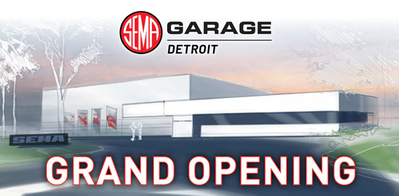
The grand opening of the SEMA Garage Detroit will be held Thursday, August 18, from 5:00 p.m.–8:00 p.m. (EDT), in the new facility at 14655 Jib St., Plymouth, MI 48170.
Be one of the first to view this state-of-the-art facility that will bring automotive aftermarket products to market even faster. Attendees will have the opportunity to explore all the innovative services the new SEMA Garage Detroit will offer and tour the brand-new facility while enjoying food, drinks, music, giveaways and more.
(L–R): Jim Fornear, Jeff Kritzer, Don Henthorn, Javier Arias and Rudy Diaz.
Effective August 3, Don Henthorn will step down as president and CEO, taking on a more limited role in the day-to-day operations as chairman emeritus. Jeff Kritzer, who has been an integral part of the company for more than 40 years, will succeed Henthorn as president and CEO, effective August 3. At the same time, Rudy Diaz will step up from vice president of information technology to executive vice president and COO. Jim Fornear will move from financial controller to CFO. Javier Arias will continue in the role of vice president of operations. Henthorn will remain active in an advisory capacity to ensure a seamless transition of leadership.
Brembo and Gold Phoenix Join Forces to Create a Leading Friction Technology Player
Brembo and Gold Phoenix have signed a 50/50 joint venture agreement (subject to the local and antitrust usual fulfilments) establishing a new company, Shandong BRGP Friction Technology Co. Ltd., to create the first large-scale Brembo manufacturing facility fully dedicated to produce aftermarket pads. The newly formed company will bring together Brembo’s leadership in braking systems with Gold Phoenix’s high-tech friction solutions, and it will focus on product quality and innovation, especially in terms of performance, comfort, durability and sustainability, with the aim of anticipating the challenges of electrification and autonomous driving, according to the companies.
The Joint Venture will serve the segments of passenger cars, light commercial vehicles and heavy-duty trucks, leveraging on new opportunities arising from a growing market. Shandong BRGP Friction Technology Co. Ltd. is expected to start operations in early 2023 in Jinan, the capital of Shandong province in Eastern China. The overall investment from both companies is approximately € 35 million over the next three years.
Cummins Announces Jennifer Rumsey as CEO
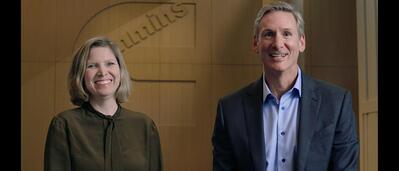
Jennifer Rumsey, left, and Tom Linebarger.
Columbus, Indiana-based Cummins has announced Jennifer Rumsey, president and COO, will assume the role of president and CEO. She replaces CEO Tom Linebarger, who ends his term with the diesel and alternative fuel engine and component manufacturer on August 1.
Rumsey will be the seventh CEO and first woman to lead the company since it was founded in 1919. Linebarger will continue to serve as chairman and executive chairman of the board of directors, working directly with Rumsey on specific initiatives, including the pending acquisition of commercial vehicle aftermarket manufacturer Meritor.
Since taking on the role of COO in March 2021, Rumsey has overseen Cummins’ global operations. In February, she was elected to the Cummins board of directors. She will continue to maintain her seat on the board.
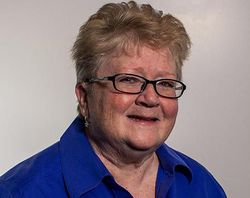
Julie Blankenship
LSI Promotes Julie Blankenship to Chemical Business Development Manager
Lubrication Specialties Inc. (LSI) has promoted Julie Blankenship to chemical business development manager. Blankenship will be the primary support to international distributors authorized to sell LSI Chemical-branded additives and Hot Shot’s Secret products. She will coordinate sales and marketing for LSI Chemical’s current 12 distributors in nine countries in Central America and Europe. She will also manage LSI Chemical’s trade show and conference event schedule and coordinate all educational and promotional materials.
Blankenship has more than 30 years of experience with non-profits, corporate, trade associations and public policy. Before this position, she served as LSI’s operations manager for the research and development department since December 2020.
K&K Insurance Names New President, CEO
K&K Insurance, the Fort Wayne, Indiana-based motorsports insurance company, has announced Ron Norton as its new president and CEO. He replaces Todd Bixler, who retired after 12 years with the company.
With 36 years at K&K, Norton began as an associate underwriter in 1986, according to published reports. He would later manage programs, including leisure camps, campgrounds and more before being promoted to vice president of the leisure division in 2007. In 2019, he was promoted to chief underwriting officer.
Have some company news you would like to share? Let us know and the news may appear in an upcoming issue of SEMA News. Send your items for consideration to editors@sema.org.
The SEMA Hall of Fame award honors those who built the specialty-equipment market into the $51 billion powerhouse it is today. Since 1969, SEMA has inducted some 170 pioneers. Tomorrow, in Anaheim, California, it adds three more: Walker Evans, Jack Roush and Gene Winfield.
It seems simple enough to elect three industry leaders from an organization that boasts more than 6,500 members. But as the SEMA Board and its Hall of Fame Task Force members will testify, it’s no easy job. How does one—much less a group of many—choose just a handful of people to induct into its annual Hall of Fame? It’s an unenviable task, to say the least.
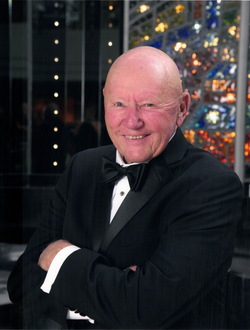
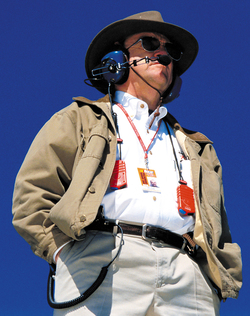
Jack Roush
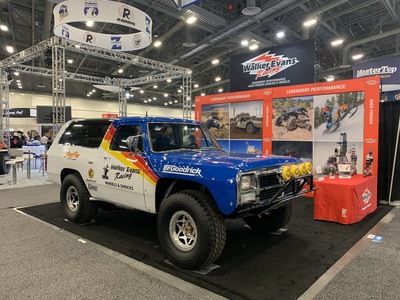
If you love trucks, you owe a debt of gratitude to Walker Evans. Before he won the 1979 Baja 1000 in a ’78 Dodge pickup, trucks were largely relegated to towing the buggies and bikes that won the event every year prior. Starting as a driver for famed builder Bill Stroppe, Evans eventually set up his own shop building some of the most competitive trucks in off-road motorsports. At the turn of the millennium, he switched gears to develop and manufacture a line of performance products. Today Walker Evans Racing is a fixture across the off-road spectrum from Jeeps to snowmobiles.
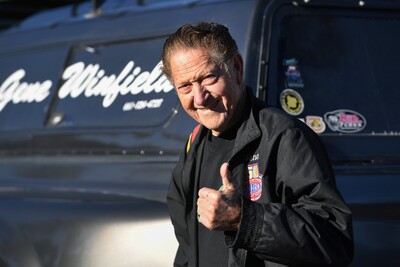
Gene Winfield
It’s impossible to describe Jack Roush with any single title. His parent company has three units. Roush Performance develops and sells performance vehicles and aftermarket performance parts. Roush CleanTech develops clean-fuel solutions for fleet vehicle applications. Roush Industries designs, engineers, prototypes, tests and even manufactures across industries the mobility, aerospace, defense and theme-park industries. But it all began with OEM engineering jobs that morphed into a brief stint as a multi-
championship drag-racing enterprise. If Jack Roush hasn’t done it, it’s probably not worth doing.
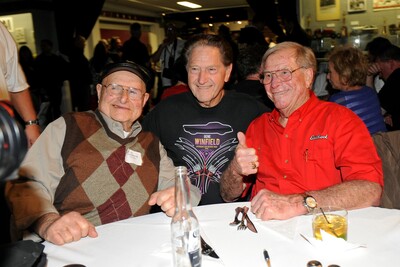
Few people have inspired a more diverse array of automotive enthusiasts than Gene Winfield. A customizer of the first order, his career spans more than seven decades to include the golden age of the custom car. Scale-model manufacturers rendered his creations in miniature and, after recognizing his widely ranging talents, ultimately hired him to create full-scale examples. Soon the entertainment industry caught on to Winfield’s magic, giving him yet another career building for Hollywood—a professional arc that culminated in his shop building the automotive props for big-budget productions like Blade Runner and Back to the Future II.
Walker Evans: All-Terrain Ambassador
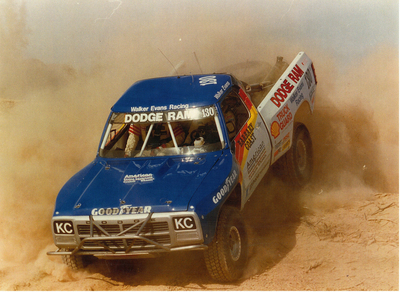
In 1979 Evans almost singlehandedly changed the way people thought about trucks by winning the Baja 1000 in one, the first in the event’s history. The current crop of long-travel rear suspensions can trace their ancestry to the novel cantilever design that helped make this truck so competitive. Fun fact: Evans did it with all the windows in place and the air conditioning blasting. Courtesy Walker Evans.
Today the light truck represents one of the preeminent and most lucrative divisions within the automotive market. But until 1979, the pickup represented little more than a support vehicle, something that would facilitate activities rather than spearhead them.
But that year a pickup did something unprecedented in the field of motorsports. In the hands of team owner, builder and driver Walker Evans, it beat a field of the most competitive dune buggies and motorcycles to win what’s arguably the most grueling auto-racing event in North America: the Baja 1000. It’s a win that transformed not just the off-road racing industry but the modern truck market as we know it.
In 2000, Evans quit driving full-time to transform his enterprise into a bona fide manufacturer. The first product line included wheels and shocks, but under his guidance and with the help of SEMA and its affiliates, Walker Evans Racing expanded to include parts and accessories for Jeeps, ATVs and snowmobiles. Courtesy Walker Evans.
Evans began racing in 1967, two years before actor James Garner and Fleetwood RV’s John Crean hired him to build engines for their American-Motors off-road race team. Though designated ride-along mechanic at 1969’s Baja 500, Evans found himself behind the wheel when driver Crean fell ill. His third-place finish inspired him to build an entry of his own, a Ford pickup prepped by legendary builder Bill Stroppe.
The Stroppe relationship led to a 1974 contract with teammate and event promoter Mickey Thompson, who a year prior founded the SCORE off-road sanctioning body. Though known now as Southern California Off Road Enterprises, Mickey initially branded it as Short Course Off Road Enthusiasts and hired Evans to build the organization’s flagship track at Riverside International Raceway, a course that served as a test bed for what became Mickey Thompson Entertainment Group’s successful short-course racing series.
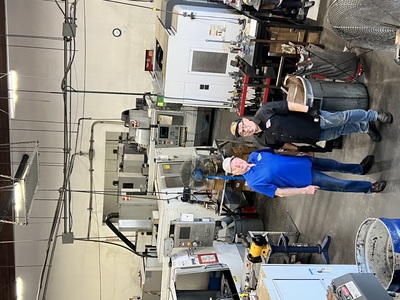
In 2000, Evans (left) quit driving full-time to transform his enterprise into a bona fide manufacturer. The first product line included wheels and shocks, but under his guidance and with the help of SEMA and its affiliates, Walker Evans Racing expanded to include parts and accessories for Jeeps, ATVs and snowmobiles. Courtesy Walker Evans.
Evans raced with Stroppe until he founded his own team, Walker Evans Racing, in 1976. But it was a 1978 deal struck with Chrysler’s Dick Maxwell that changed everything. With factory backing, the team built a D100 pickup with innovations like a cantilever rear suspension and amenities like air conditioning. After only the briefest test session at Riverside, the team took the truck to the 1979 Baja 1000 where Evans proceeded to win not just Class 8, but the overall race—a first for a truck in the event’s history and an accomplishment that heralded the future of trucks in the motorsports and enthusiast markets.
Over the decade that followed, Evans oversaw the shop’s operations and either participated—and, in some cases, played instrumental developmental roles—in numerous sanctioning bodies. These included Short-Course Off Road Driver’s Association (SODA), Championship Off Road Racing (CORR) and High Desert Racing Association (HDRA). He also competed in NASCAR’s SuperTruck Series in 1995 and 1996. In a driving career that spanned 31 years, he amassed a whopping 142 overall and class victories, nine of those at SCORE Baja 1000 events.
“Ever since 1967 I raced full-time right up to 2000,” Evans recalls. “I had like 18 to 19 full-time employees manufacturing trucks, preparing them for almost all the races put on by whatever promoter. That was my full-time living.
“Right about that time is when I made a trip to China with a group of SEMA guys,” he recalls. “At the time I told them that I needed to go right away to put together a deal to meet with people in China to have some wheels made. Well, they said, ‘we’re going next week!’ I asked if they minded some company. ‘Mind? No! We’re wide open!’”
The China Expedition, a delegation formed to explore business opportunities, changed Evans’ focus. Inspired by the prospect of competing in a more global market, he began manufacturing wheels and shock absorbers, naturally promoting his products at SEMA’s annual Las Vegas trade show. “My company literally took off from that point.
“It was one of the greatest things that happened to me,” he continues. “If you accompany them, you’ll wind up meeting the right people and making great parts over there. They were excited to help me do it!”
For more than 50 years, Walker Evans has led the pack at every level of the off-road racing industry, first as driver, then as constructor, team owner and, ultimately, manufacturer. His career follows the arc of the industry’s grassroots model: He began as a young racer who leveraged his successes on the track into a prosperous business, becoming a legend in the process.
He excelled at every level of the performance industry. As a racer, he’s one of the most accomplished drivers, builders and team owners in off-road. As an entrepreneur, he excelled in promoting whatever activity that he participated in. As an employer, he mentored employees who went on to join SEMA and establish successful businesses of their own. And as a person, he facilitated some of the strongest working relationships the industry has known.
SEMA owes a large part of its identity and prestige to Walker Evans’s achievements and exuberant personality. And the world at large owes the popularity of the pickup in a sporting rather than supporting role to his endeavors on the track.
Jack Roush: The Engineer of Enterprise
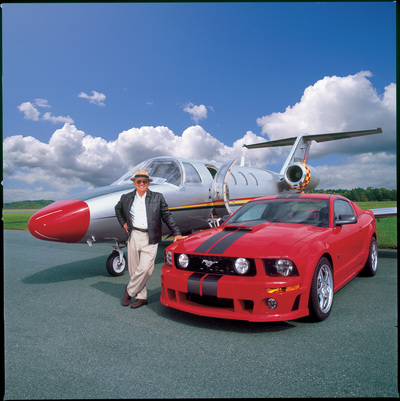
In 1995 Roush began manufacturing parts and accessories for Ford vehicles. Later that year, the company began modifying Mustangs sold exclusively through Ford dealers. The Enhanced Ford Vehicles program now includes pickups. He pursues his other passion, aircraft, through the aerospace division of Roush Industries and through Roush Aviation, which supplies parts and certification services for vintage aircraft. Courtesy Roush.
Make no mistake: the automotive industry has produced its fair share of titans. But few have ascended the ranks quite as meteorically as Jack Roush. His various companies have produced more than 30,000 special-edition vehicles, won more than 400 national motorsports events and 30 championships, employ more than 5,000 people in five states and 19 countries, and generate nearly half a billion dollars in revenue annually.
Roush graduated from Berea College in 1964 with a mathematics major and a physics minor. He moved to Detroit that year and took a job in quality control at Ford’s Dearborn plant. Drawn by Ford’s extensive motorsports activities, he joined a group of fellow racing enthusiasts, The Fastbacks, in 1966.
He left Ford to work for Chrysler in 1969 but maintained relationships with former Ford colleagues. In 1970, he earned his master’s in Scientific Mathematics at Eastern Michigan University and left Chrysler to teach physics and automotive classes at Monroe County Community College. That year, he also teamed up with one of his former Ford colleagues, engineer Wayne Gapp. Roush attended his first SEMA Show in 1971, securing sponsorship for the 1972 Gapp and Roush Pro Stock Drag Racing Program. The team campaigned in NHRA, IHRA and AHRA events and won the NHRA Pro Stock championship in 1973. Gapp and Roush won three more championships over the two years that followed.
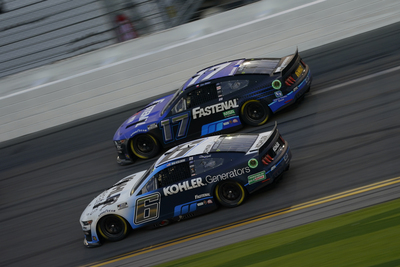
Since entering NASCAR in 1988, cars campaigned by Roush and his partners have covered nearly 2 million mi. and won more than 325 events. Most recently, Roush and partner Fenway Sports Group added driver Brad Keselowski to create RFK Racing. Keselowski drives the No. Ford Mustang GT. Chris Buescher fields the No. 17 Mustang. Photo courtesy: Roush.
Recognizing that domestic manufacturers were finding ways to rein in spending by minimizing the thing he excelled at—engineering—Roush ventured out as an independent consultant, founding Jack Roush Performance Engineering in 1976. He personally hired the firm’s first 100 employees, cultivating an organization of highly creative and divergent thinkers.
While Roush stopped operating a race team in the late ’70s, his company remained in motorsports by building engines for teams throughout the early ’80s. In 1982, he partnered with German firm Zakspeed to develop road-racing vehicles for Ford. In 1984, Roush returned to racing as a team owner in the Sports Car Club of America (SCCA) and International Motor Sports Association (IMSA) road-racing series. Through the remainder of the decade and into the following, Roush’s drivers won 119 races, 24 national championships and 12 manufacturer’s championships. Roush also captured 10 consecutive sedan-class wins at the 24 Hours of Daytona, an unbeaten record.
Roush formed his first NASCAR Cup Series team in 1988, with future hall-of-famer Mark Martin behind the wheel of the #6 Thunderbird, and in the following year Roush Racing won its first NASCAR Cup Series victory.
An engineer at heart, Roush created numerous technological and safety features. He co-developed roof flaps to prevent stock cars from taking flight while spinning, a lifesaving feature required by all NASCAR entries since 1994.
In the early ’90s, Roush bought a pre-production SN-95 Mustang from Ford to develop a line of products under the Roush Performance banner. The venture culminated with a special-vehicle program where select Ford dealers sold Mustangs modified by Roush Performance. Over the decades that followed, Ford and Roush expanded the special-vehicle program to include the Focus and F-150. Roush Performance modifies Ford products to the extent that the company is listed as Manufacturer of Record, some models bearing warranties serviced by Roush rather than Ford.
Roush and Doug Yates partnered to form Roush Yates Engines in 2005. The Mooresville, North Carolina, shop supplies engines to Roush Fenway Racing, Team Penske and numerous teams in the NASCAR Cup, XFINITY, Truck and ARCA Series. Sister company Roush Racing joined Fenway Sports Group (FSG) to form Roush Fenway Racing in 2007.
Under Roush’s guidance, Roush Fenway won its first Daytona 500 trophy and the team’s 2,500th NASCAR Cup Series start in 2009. In 2021, Brad Keselowski joined the organization as owner/driver under its new name, Roush Fenway Keselowski (RFK) Racing.
Though known for his participation in the automotive industry, Roush and the companies he formed play pivotal roles within the electronics, entertainment, aviation and aerospace industries. He began developing propane-fuel systems in 2008 and in 2010 formed Roush CleanTech to convert fleet vehicles. Roush Industries built the Firefly network of vehicles for Waymo, Google’s autonomous-vehicle program, and converts the Chrysler Pacifica vans that replaced the Firefly upon its retirement in 2017. The company is also designing engines for NASA’s so-called space-taxi program that promises to make space exploration more accessible. Another subsidiary, Roush Entertainment Services, designs and builds theme-park rides.
Though active in so many industries, Jack Roush remains a significant presence in SEMA activities. He’s participated as attendee, exhibitor, celebrity guest of various manufacturers, including Ford Motor Company, and by preparing concept vehicles for numerous automakers. He still consistently employs SEMA’s Global Platform to launch new products.
Gene Winfield: The Ace of Fades
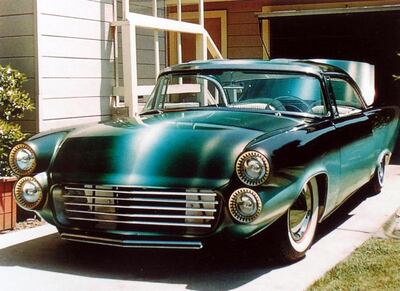
The car that Winfield restyled in the late ’50s emerged unrecognizable from the ’56 Mercury that it started as. “Jade Idol” showcased the customizer’s metalshaping chops and its distinctive fade paint job put it at the forefront of the custom-car movement. Winfield owes much of his recognition to his promotional abilities; he and his crew toured the country attending car shows with “Jade Idol” for several years. Courtesy Gene Winfield.
There’s probably no better way to light a fire in potential consumers’ hearts and minds than to show the potential in a company’s goods or services. And few people have done it better than custom-car pioneer Gene Winfield.
In 1942 a 15-year-old Winfield bought his first car, a ’28 Ford coupe, for $75. The antenna he installed was more an array for the foxtail that topped it, for the car had no radio.
In 1946, inspired by the photos of custom cars he and his pal Bart Bartoni took and exchanged, Winfield converted an oversized chicken coop behind his family’s home in Modesto, California, into Windy’s Custom Shop, a dirt-floor auto salon. That year he also co-founded the Modesto Century Toppers car club, a group made of mostly by friends who brought their cars to Winfield for modifications. They elected him the club’s first president.
Winfield closed his shop when he enlisted in the U.S. Army in late 1949. While deployed to Japan, he and three other GIs rented a small shop, hired a local metal-shaping craftsman and began modifying cars.
Winfield returned to his converted chicken coop in 1951, reopening as Winfield’s Custom Shop. Whereas he once buried crudely welded seams in heaps of lead, Winfield now could shape, hammer-weld and metal-finish modified panels thanks to the mentorship of his former Japanese employee. To represent his new venture, he bought a ’50 Mercury that he’d previously restyled for a customer and modified it to a greater degree.
Initially working on a dirt floor in the converted chicken coop, Winfield expanded the shop several times, at one point installing a paint booth. But in 1955, to meet greater demands, he bought a former radiator shop in downtown Modesto. The finer work conditions attracted a finer grade of clientele. In 1958, Leroy Kemmerer brought his ’56 Mercury for a complete redesign. With a real budget, free rein and the license to show the finished product for the year following its completion, Winfield had his first complete commission.
He sectioned the car, essentially slicing a 4-in. band out of the body’s beltline. He reshaped the front fenders to fit stacked headlights in the style of the recently released ’58 Lincoln. He replaced the quarter panels with those from a ’57 Chrysler New Yorker, creating taillights and a rear grille every bit as radical as those in the front. He finished the body in a design where one color gently transitioned or “faded” into another. The two years he spent touring the “Jade Idol” around the country made Gene Winfield a name, its novel fade-paint design becoming his design signature. “That car made Gene a name,” recalls Russ Meeks, who worked for Winfield from 1962 to 1967.
Now a known entity in the custom-car world, Winfield appealed to the Custom Car Caravan. A joint venture between Aluminum Model Toys (AMT) and Ford Motor Company, the Caravan traveled the car-show circuit. It showcased Ford vehicles modified by prominent custom-car restylists, the premise being that the model company would produce the designs in 1:25 scale for the youth market. Winfield built two Caravan vehicles, one an asymmetrically styled Ford Econoline pickup dubbed “Pacifica.”
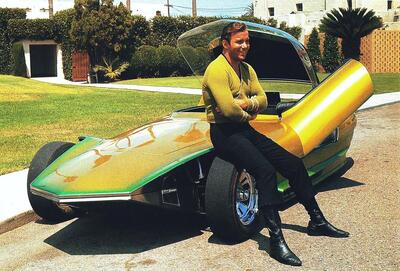
”Jade Idol” opened doors for Winfield, including a show-car project for an indoor car show promoter. After he fulfilled his touring obligations with “Reactor,” Winfield presented it to entertainment executives who used it in some of the era’s most significant TV productions. This outtake was from a photo session used to promote the “Bread and Circuses” episode in “Star Trek.” Photo courtesy: Gene Winfield.
In 1963, Promotions Inc., promoters of the famed Detroit Autorama among other events, commissioned Winfield to build a hand-formed asymmetrical body around a 427 Ford engine. “Strip Star” later appeared in Back to the Future II as a car from 2015.
Two years later, Hartford Autorama promoter Joe Kizis paid Winfield $20,000 to build a show rod based on a design by ArtCenter College of Design student Ben Delphia. The “Reactor” was an ambitious mid-engine, front-drive, aluminum-bodied sports car based on a Citroën DS suspension and powered by a turbocharged Corvair engine. The hydropneumatic suspension raised and lowered Reactor at driver’s will. “He always had an open mind,” Russ notes. “He wasn’t afraid to try anything.”
After completing the show circuit, Winfield promoted Reactor in entertainment circles. It appeared as the “Super Car” in “Bewitched,” as the “Jupiter 8” in the original “Star Trek,” “Catmobile” in “Batman,” and “The Freeze” in Mission: Impossible.
Reactor made Winfield a name among studio executives, who hired him to modify a Sunbeam Tiger for star Don Adams to drive in the “Get Smart” series. He gave Agent 86’s Tiger a cigarette lighter that doubles as a grenade and a car phone, an explosive throttle pedal, a poison-emitting radiator, a passenger-side ejector seat, a tailpipe that doubled as a machine gun and an oil slick dispenser, and a 50-caliber machine gun that emerged from a door in the hood.
In 1966, AMT hired Winfield to run its Speed & Custom Shop in Phoenix. Drawing upon his Hollywood credentials, AMT secured license to design and build the shuttlecraft for the first season of “Star Trek.” AMT also bought the rights to the Cycolac Research Vehicle (CRV), a concept car intended by Borg-Warner to explore the use of ABS plastic in automotive design. Winfield modified fullsize examples which AMT promoted as “Piranha” among car shows to sell scale-model variations. One Piranha appeared in “The MAN from U.N.C.L.E.” starting in 1967. Winfield oversaw numerous builds for commercial advertising projects, including splitting an Impala Super Sport down the middle for Chevrolet.
Recognizing the potential building for the entertainment industry, Winfield opened another California shop. Winfield’s Special Projects in North Hollywood built vehicles for Robocop, The Last Starfighter and—probably most notably—the 25 vehicles for Blade Runner and the flying DMC DeLorean for Back to the Future II.
You know you’ve got some clout when SEMA founders Ed Iskenderian (left) and Vic Edelbrock Jr. (right) lean in and give thumbs-up when they have their photo taken with you. With his, well…genial personality, Winfield makes friends across industries. His willingness to invest in the people who work for or around him has a ripple effect across the automotive industry. Courtesy Gene Winfield.
Winfield relocated to Mojave, California after leaving the entertainment industry. But one could hardly call it a retirement; he began hosting classes to teaches enthusiasts tricks of the trade, including how to apply his trademark Winfield Fade. At 95, he still travels the globe showing students how to unlock the potential in automotive designs.
SEMA Show exhibitors and attendees preparing for the 2022 SEMA Show can lock in the guaranteed lowest hotel rate now by booking in the SEMA Show block.
Making hotel reservations in the block provides you with the most affordable and convenient options for a wide range of hotels located on and off the Strip.
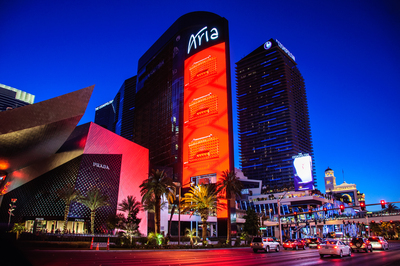
Showgoers can save more than $200 per night at several Las Vegas hotels, including Aria, by booking through the SEMA Show block.
All of the hotels available through the SEMA Show block come with a low-price guarantee. To help ensure that your price remains the lowest, SEMA will price-match lower advertised rates, even after your reservations are set. Whether you're looking for your favorite place to stay, or for a hotel within close proximity to the Show, you can book with confidence knowing you will get the rooms you need at the the most affordable price available.
The SEMA Show also provides shuttle service to and from the Show for the hotels listed that are not within walking distance to the Las Vegas Convention Center.
There are more than 45 hotels available in the block. For more information on the hotels listed below, including rating, price per night and distance from the Las Vegas Convention Center, visit www.SEMAShow.com.
SEMA has negotiated exclusive, discounted nightly rates at the best hotels in Las Vegas. However, you can only get the discounted rates when you book through the SEMA Show’s official hotel provider. Save more than $200 a night at the following SEMA Show hotels:
Exhibitors of the 2022 SEMA Show are invited to expand their reach, product exposure and Show-floor presence by offering products to builders through the Products for Project-Vehicle Builders list. The list connects manufacturers with builders looking to create or complete a vehicle project.
The list, which will be updated in SEMA eNews, features product offers and contact information provided by confirmed SEMA Show exhibitors. Builders interested in obtaining a product use the information to contact exhibitors directly. With each project vehicle required to be supported by a current 2022 SEMA Show exhibitor, all product-placement decisions, negotiations and agreements are the responsibility of the exhibiting manufacturer and the builder.
The list is open to exhibitors of the 2022 SEMA Show only. To be included in the list, complete the form.
Exhibitors: Each submission will appear on a first-come, first-served basis. As participation increases, all submissions will also be archived on www.SEMAShow.com.
Note: For verification purposes, the Project-Vehicle Builders form must be used to participate in the program; email submissions will not be included in the list. Participation in the list does not guarantee product or vehicle placement at the 2022 SEMA Show.
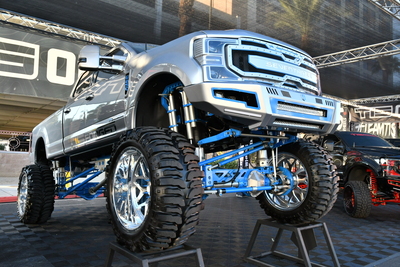
Each year, the SEMA Show displays hundreds of vehicles throughout the Las Vegas Convention Center as part of the Show’s Feature Vehicle Program.
All vehicles on display are sponsored by an exhibiting company, allowing manufacturers to expand their footprint at the SEMA Show beyond their booth.
All vehicles on display are sponsored by an exhibiting company, allowing manufacturers to expand their footprint at the SEMA Show beyond their booth.
Each vehicle accepted will also be featured in the SEMA Show app, which displays each vehicle’s image, make, model, year, color, the products used as part of the build, the builder’s name and the name and booth number of the sponsoring exhibiting company.
When completing the Feature Vehicle application, you may also select the option of having your vehicle enrolled for consideration in the SEMA Battle of the Builders competition. The competition is judged by industry experts with top honors presented to individuals who have demonstrated extreme talent, creativity and craftsmanship in modifying cars, trucks and SUVs.
Anticipation is building for the 2022 SEMA Show, to be held November 1–4 at the Las Vegas Convention Center—and perhaps a few pre-Show exhibitor jitters, too. For newcomers and veterans alike, creating a successful SEMA Show exhibit takes dedication and planning. There is no abracadabra formula for a profitable Show, but there are tried and true strategies that winning businesses routinely employ to accomplish their goals, many with minimal or no cost.
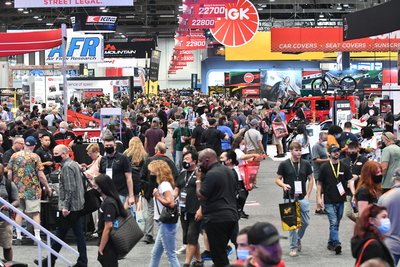
Returning live after COVID, the 2021 SEMA Show in Las Vegas was the nation’s largest and most successful trade event. This year’s Show at the Las Vegas Convention Center again promises to be a massive exhibitor opportunity. Take some tips from successful exhibitors to stand out in the crowd.
“We understand that our exhibitors invest a lot of time, effort and money in their booths and Show marketing, but there are many simple, straightforward steps that they can take to maximize their return on those investments,” said SEMA Vice President of Events Tom Gattuso. “As an association, our passion is to offer all exhibitors the resources and tools needed to help control costs, develop effective Show plans, and generate quality leads to grow and prosper. Leveraging many of the Show’s built-in features lays the groundwork for a great Show.”
In fact, by using these tools, many exhibitors—both small and large—have catapulted their businesses forward. With the 2022 SEMA Show looming, SEMA News reached out to several past exhibitors who not only have enjoyed success but also view the Show as a continued driver for growth. In true industry spirit, they were eager to share their experiences and tactics with others.
Branding and Marketing: Harbor Freight Tools
Headquartered in Calabasas, California, Harbor Freight Tools first exhibited at the 2019 SEMA Show with a 30x40-ft. booth. This year, the tool manufacturer will return to the 2022 Show with a 30x90-ft. booth—more than double the size. According to Alon Mahller, Harbor Freight senior product marketing manager, the 2019 SEMA Show proved a highly effective venue for reaching the company’s market: tool users of all types.
“We don’t just sell automotive tools,” Mahller explained. “Although that’s a huge portion of our business, the guys who are in the shop Monday through Friday are cutting their grass on Saturday and Sunday, or they’re painting their house or building a deck.”
To leverage those crossover audiences, Harbor Freight will construct a booth that recreates the brand’s retail outlets. The displays will include the company’s professional automotive lines as well as a variety of other tools not so typical of the SEMA Show.
According to Mahller, the company has invested heavily in both the quality and breadth of its product lines. The result is a tool lineup designed to appeal to users at every level and price point, and that diversity will be on full display for SEMA Show attendees.
“We’re planning to bring a large portion of our store,” he said. “It’s going to look like a Harbor Freight store, with some experiences and opportunities for people to get their hands on our tools and to try them. Many people have been hesitant to try or use certain tools from us, and this is a good opportunity for us to put them in their hands and say, ‘Pull the trigger on this product and see how you like it. See how it stands up to the competition.’”
But Mahller knows that a large, interactive booth alone is no guarantee of success. His marketing team plans to add plenty of pre-Show publicity through its website, email and social-media channels to connect with Show attendees ahead of time. That publicity will also extend throughout the Show and include video features and a full event recap afterward. The idea is to share Harbor Freight’s brand not only with those on the Show floor but also with industry pros and consumers who can’t otherwise be there.
“While we’re [at the Show], we’re going to be doing announcements that ‘we’re here, come see us,’” Mahller said. “We’ll also do a landing page, where we’ll have interviews with our customers, with influencers, with our engineers and with our merchant leadership about the tools. So even if you’re not able to attend, you can still get that same experience. You’ll see some of the tool demos and customer reactions to using the tools on our website and our social channels.”
DRAWING A CROWD:
Hinckley Overlanding
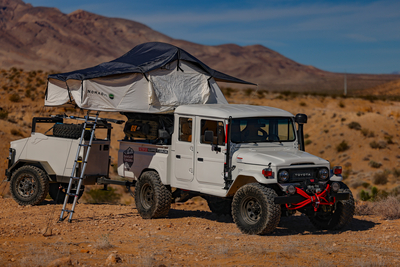
Hinckley Overlanding introduced its GOAT trailer at last year’s SEMA Show. Supplying its products for feature-vehicle builds in different Show locations proved an effective way to lead dealers back to its booth. The company is now growing rapidly.
While Harbor Freight is enlarging its Show footprint, the experience of Hinckley Overlanding proves that the Show can be big for smaller exhibitors, too. According to Hinckley Overlanding Owner and Operator Matt McIntosh, it’s all in the strategy. Last year his team aimed for a 20x20-ft. first-time exhibit space near a large, well-known off-roading manufacturer. That thinking paid off.
“We had been to the Show [as attendees], and we knew that it’s where we could get in front of buyers,” McIntosh said. “We had six individuals staffing our booth, and we were literally buried the whole time. We didn’t really get to see the rest of the Show because our exhibit was so well received. We were just piling into our rooms at the end of the day, and we weren’t going out to dinner. We were all hammered.”
Of course, having an exciting product with a story to tell doesn’t hurt either. Based in Salt Lake City, Utah, Hinckley Overlanding supplies, installs and designs products for the state’s growing overlanding community. But its biggest claim to fame is the GOAT, a compact “Go Over Any Terrain” trailer for smaller (including powersports) vehicles venturing into the backcountry. The product is based on the tough, solar-powered security and surveillance trailers deployed by the U.S. military.
Highly customizable, the units feature heavy-duty steel construction, 2,000-lb. half-axle torsion suspension for greater ground clearance, 8,000-lb. stabilizing corner jacks, heavy-duty mounting racks for tents or gear, and 64,638ci storage capacity. Add-ons can include water tanks, a road shower, a fully modifiable kitchen unit, a refrigerator and more.
“The Australians say that they started overlanding, and, of course, South Africans say that they started it, but that’s neither here nor there,” McIntosh said of the exploding market segment. “I think we’ve all been doing it our whole lives. We didn’t term it, but it’s a combination of remote travel, off-roading and camping. For us, it’s all about the journey.”
Being a first-timer, McIntosh admitted that the 2021 SEMA Show was a learning experience. The company didn’t take advantage of all the Show features and programs that veterans tap into to drive booth traffic. However, Hinckley Overlanding did supply some of its tents and products for feature-vehicle builds in key Show sections. QR codes on those vehicles guided attendees back to the company’s booth. That led to several conversations with dealer principals who expressed interest not only in the GOAT but also other Hinckley Overlanding products.
“We actually signed on a handful of dealers between Salt Lake to Las Vegas, to New Mexico, Idaho and Oregon,” McIntosh said. “And we just signed on another dealer in Spokane, Washington, since the Show last year. We’re growing rapidly.”
Taking a first-time dive into the SEMA Show “isn’t for the faint of heart,” he joked. “It’s a chunk of change for the unknown, especially for the first go—and yet I immediately signed back up for this year. Of course, we’re going to take full advantage of the Show this year. We’re going to have several trailers there, including possibly a Jeep-branded trailer.”
The company also plans to make use of the New Products Showcase, pre-Show publicity and more highly visible feature-vehicle builds this time around.
Going With a Game Plan:
Universal Air Suspension
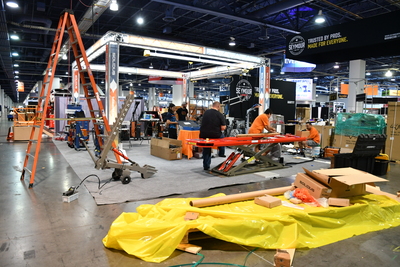
For first-timers and veterans alike, move-in day at the SEMA Show can be exciting and, admittedly, hectic. Mocking up your booth at your own facilities ahead of time and rehearsing for the Show yields confidence. Adhering to Exhibitor Services Manual policies and deadlines will minimize move-in anxieties.
When Universal Air Suspension first exhibited at the 2019 SEMA Show, the company had a specific goal in mind.
“One of our biggest holdups had always been exposure,” said Universal Air Suspension President Zack Ratcliff.
Although the air-spring manufacturer began business in 2000 and had sizable orders from existing customers, Ratcliff felt that his company needed broader recognition.
“When we did the Show in 2019, we got a lot of exposure and definitely saw a huge increase in sales and customer base because of it,” he noted.
When the live SEMA Show returned in 2021, Universal eagerly signed on again.
“We got a really nice spot and even more customers,” Ratcliff recalled. “Just the booth location alone and all the advertisement we did outside our booth helped drive people to where we were. We were cranking busy the entire week.”
Ratcliff believes that success hinges on a solid promotional gameplan.
“If you just sit at your booth and expect people to come to you, you’re going to have a disappointing Show,” he said. “You have to go out and do the work and get people to come over to you.”
For Universal that meant press releases and taking advantage of some Show sponsorship opportunities as well as some feature vehicle builds. Placing product in the New Products Showcase also resulted in buyer traffic, not to mention some SEMA Show Global Media Awards, which raised the company’s international standing. Most importantly, when the buyers flocked to their booth, the Universal team was prepared.
“When we take leads, we actually notate how serious they are,” Ratcliff explained. “If it’s someone looking for a specific product that’s coming out in the future, we’ll contact them once it becomes more available or when we have more information on it. As far as the leads looking to buy our existing products, as soon as we get back [from the Show], we start contacting them. We’re also going to start mass emailing and directly following up and sending out flyers once new items become available.”
Controlling various costs also helps Universal maximize its return on investment.
“The ironic part is that everyone thinks booth space is the expensive part, but it’s not,” Ratcliff asserted. “The expensive part is building displays, transporting them to Las Vegas, your staff at the Show, your hotels, your food and all that kind of stuff.”
To save on expenditures, Universal produces all its own displays and transports them itself.
“And then, of course, it’s our own labor to set up the booth and break it down, so we don’t have those expenses,” he added.
The company also scrutinizes food and housing deals.
Building on Success:
Bubba Rope
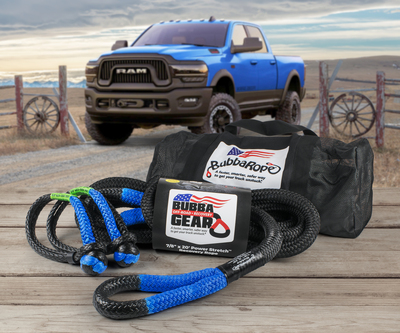
Bubba Rope first came to the 2010 SEMA Show with a simple 10x10-ft. booth and a unique story to tell. The recovery rope won a New Product Award for packaging, and the rest is history. The highly successful company is now using the 2022 Show to debut several new recovery gear sets.
Jim Flowers, president of Florida-based Bubba Rope, attributes much of his company’s growth over the past decade to the SEMA Show—so much so that the Show now figures prominently in Bubba Rope’s annual marketing plan.
As the economy was souring back in 2009, Bubba Rope was bringing an unusual product to market: surplus coated helicopter rope re-adapted and packaged as off-road recovery gear. (The rope was humorously named after the “Bubba” moniker that’s bandied about in the company’s home state.) But would the off-roading community embrace it? Someone in the automotive press suggested that Flowers try introducing it at the 2010 SEMA Show.
“It was just incredible,” he said. “The Show was a Mecca of off-road vehicles. It had so much energy with everything that was going on, so we put our 10x10-ft. booth together. People started coming in and filling it on day one. Rather than just hanging a bunch of rope around, we wanted to demonstrate how it worked, so we spent a lot of time in our booth showing people what the rope could do.”
Bubba Rope also displayed in the New Products Showcase. To Flowers’ surprise, it won a best new packaging award at the New Products Awards Breakfast.
“We went back to the booth, and it was like magic,” he said. “I think it just captivated a lot of people’s minds and imagination. All of a sudden, we realized not only did we have a product but also a story to tell.
“You can have a 10x10-ft. booth and be up against booths that are 100 times bigger, but in the New Products Showcase, you’re the same size. If you come up with something great, it’s going to get noticed there.”
Like the others interviewed here, Flowers said that you need to have a plan to truly succeed at the Show, and that plan shouldn’t underestimate the power of the Show’s media presence.
“You want to launch your product, tell people about it, and get people excited about it, especially the press,” he said. “Their job is to find and tell stories, so fashion your product so it has a story. That’s huge.”
Now, more than a decade after its Show debut, Bubba Rope will turn another page at the 2022 SEMA Show.
“We’ve gotten to the point now where we have a really good array of products and we know where we want to be,” Flowers explained. “Our vertical category is off-road recovery, and that’s where we live, so we’ve come up with three different types of gear sets.”
Each set of gear is optimized for powersports, Jeeps or Broncos, and large trucks such as the Ford F-150 or Ram 1500.
In regards to the entire SEMA Show, Hinckley Overlanding’s McIntosh believes it to be the ideal place to showcase a product while discovering new trends.
“You’re always evolving as a company and as a builder,” he observed. “As things change over the next few years, we’ve got to stay ahead of the times. The Show allows us to go to market with all the other builders that are out there and get ideas on how we can make our product better. And you’re making connections you can’t make any other way. Honestly, we’re in the people business. We just happen to make, build and sell cool stuff. At the end of the day, it’s about the relationships that you build with buyers and customers.”
For Flowers, those relationships go far beyond the Show itself. He sees the trade event as the gateway to other SEMA services and connections that keep a business growing the rest of the year
“As we got to know SEMA better, we realized that it wasn’t just a trade show,” he said. “There’s so much more that goes with it. The people who go with it helped us learn not just how to project our product but also how to come up with the price list, how to manufacture, how to deal with the wholesalers, how to deal with the resellers, the jobbers, public relations and all those other important things.”
Some Proven Exhibitor Strategies at-a-Glance
Have pre-rehearsed “elevator pitches” ready. Make sure they include an interesting and memorable story about your company and product.
Don’t just display product in your booth. Demonstrate it. Make your booth interactive.
Submit at least one new or featured product in the New Products Showcase before the October 7 deadline. The first product is free. Each additional entry is just $75.
Utilize your SEMA Show sales representatives. They can connect you to many free or cost-saving SEMA Show programs designed to boost your success.
Begin submitting press releases now about your product, company and Show activities to the SEMA Online Media Center [www.SEMAshow.com/press-release].
If you can’t place a feature vehicle in your own booth, get your product on a vehicle build elsewhere at the convention center. Its QR code will lead buyers to your booth.
Use social media to build buzz about your SEMA Show presence before, during and after the event. Post regularly, and use images and even live videos throughout Show Week.
The Exhibitor Service Manual is your go-to guide. Reviewing its policies and deadlines contains costs and delivers a smoother Show experience.
Plan Now for Success
For registration and complete exhibitor, attendee and media information for the 2022 SEMA Show, visit www.SEMAshow.com.
First-time exhibitors will especially want to check out the website’s special resources, including the Exhibitor Service Manual.
In addition, every exhibitor is assigned a SEMA Show representative who can offer guidance and help arm you with the key tools for success. To contact SEMA Show staff, call 909-396-0289.
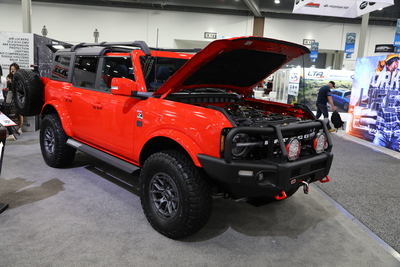
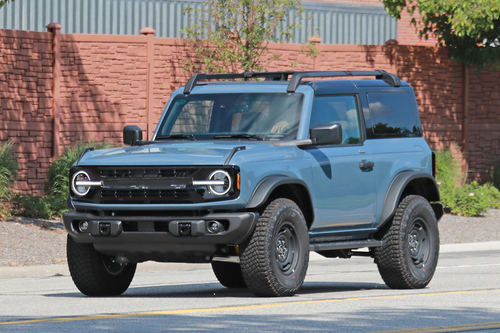
Here’s the upcoming Ford Bronco Heritage Edition testing with not a single drop of camo.
The Bronco Heritage will remove the Bronco grille and instead, replace it with a Ford script grille like the original ’66 Bronco. From there, the overall appearance of the Heritage Edition will keep things simple, taking the grille from the Base or Black Diamond trims.
A set of black wheels wrapped are presented and accounted for, along with 35-in. Goodyear Wrangler tires from the Sasquatch package.
It also looks like this model will be equipped with the long-travel position-sensitive dampers from Bilstein, also part of the Sasquatch package.
Given the lack of camo on this model, it’s safe to say that a debut is imminent, likely for the ’23 model year.
Advanced Accessory Concepts Retains Marketing, Sales Services of R&R Marketing Consultants for Premium Motorsports Brands
Advanced Accessory Concepts (AAC), manufacturer of premium motorsports brands, has announced a new partnership with R&R Marketing Consultants Inc. (RRMCI). RRMCI will work with AAC and their Trigger Wireless Accessory Control Systems, AFN 4x4, Allied Expedition and Allied Powersports brands in several marketing and sales initiatives in the automotive aftermarket.
With this new partnership, AAC and their brands joins a list of automotive aftermarket manufacturers represented by R&R Marketing Consultants Inc. The Kansas City-based firm provides a variety of business services, including prospecting, market strategy and planning, sales calls and pipeline inventory management.
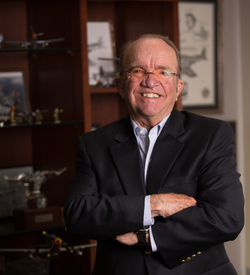
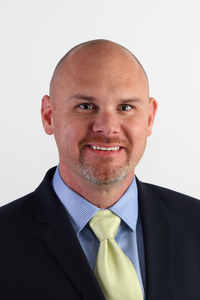
Mike Timmons
EGR USA Names Michael Timmons Vice President of Sales and Marketing, Aftermarket Division; Hires Martin & Co. as Agency of Record
Automotive aftermarket and truck accessory leader Mike Timmons has been selected to serve as the new vice president of sales and marketing, aftermarket division for EGR USA.
Timmons, as the former executive vice president for AXC Inc., was a key member of the leadership team responsible for creating a new brand and building customer loyalty for AXC fender flares and truck accessories, developed pricing policies and pricing structures for all sales channels, and strengthened customer service. Recognized for his business development skills, he managed all content creation, social media platforms, email strategies, promos and coordinated rep agency sales efforts. Entrenched in truck aftermarket accessory experience, Timmons also formerly worked for Truck Hero Inc., now branded as RealTruck, as vice president of Jeep and off-road. There, he implemented effective new sales and product development strategies to grow key accounts—growing their top and bottom-line business for multiple brands. Timmons was hired in June and will work remotely from his home in Washougal, Washington.
In other news, EGR recently named Martin & Company as agency of record. Martin & Company, a Nashville-based marketing firm that specializes in the automotive aftermarket will assist with both B2B and B2C branding, communications, events and marketing strategies and provide trade show support for the 2022 SEMA Show.
Dakotal Digital Acquires W.I.D.E. Contact Brand
Dakota Digital Inc. has announced that it has agreed to purchase the W.I.D.E. Contact brand of products. Developed in 1995 by Dave Kopser, the W.I.D.E. Contact brand of door contacts has become a staple in the custom vehicle market. Dakota Digital has been a distributor of these products since the inception, using the trade name of Magnum Shooters, but has since purchased the product line completely. The acronym of W.I.D.E. Contact summarizes the idea of Wires in Doors Eliminated, allowing the user to showcase a tidy door jamb location, while maintaining electronic connections for up to five conductors with the door closed. The W.I.D.E. Contact models are offered in a range of number of contacts, both with and without pin switches for dome-light activation.
Carlisle Chrysler Nationals Weekend Sets New Show Car Record
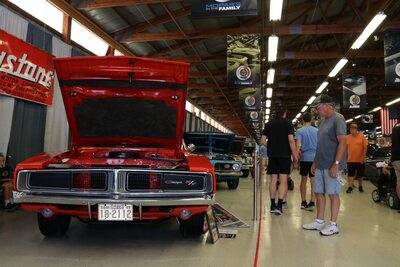
This year’s Carlisle Chrysler Nationals event (July 15–17) at the Carlisle, Pennsylvania, Fairgrounds set a new Showfield mark for the second straight year, topping 3,000. Special guests included Cristy Lee, Herb McCandless, Paul Rossi, the Ramchargers, Golden Commandos, Miss Direct Connection 1984, Claudia Abel and more. A handful of cars were unveiled at the stage of the State of the Hobby Address, including one from ExoMod; a ’68 Charger carbon-fiber body, positioned atop a brand new ’21 Challenger Hellcat Redeye. In the autocross shootout, a modified Jeep Cherokee topped a Dodge Viper on the final run of the night. Saturday included an all-new rolling burnout and donut contest. Trucks and cars of all eras participated, culminating in a win by a Massachusetts attendee and his ’69 Charger.
The 2023 Carlisle Chrysler Nationals will be held July 14–16, and include displays focused on the Malaise Era, High School Mopars and more. Visit CarlisleEvents.com for more information.
Have some company news you would like to share? Let us know and the news may appear in an upcoming issue of SEMA News. Send your items for consideration to editors@sema.org.
Press releases can be an easy and effective way for exhibitors to generate buzz about their 2022 SEMA Show news. In addition to sending it out to targeted journalists, exhibitors are encouraged to post their Show-related news and announcements to the SEMA Show Online Media Center—a destination where media go to obtain exhibitor-related news and information regarding the latest products, hottest vehicles and activities at the upcoming Show.
Exhibitors are encouraged to post their Show-related news and announcements to the SEMA Show Online Media Center.
Exhibitors can post releases at no cost, and attach photos and select the market segments that are relevant to their news. Whether exhibitors are announcing new products, a booth demonstration, vehicle unveiling or celebrity appearance, there are best practices when drafting a release and posting in the SEMA Online Media Center to get maximum exposure. Here are some tips for exhibitors to keep in mind:
Have a strong headline: Make it concise and compelling to grab the attention of your reader.
Stick to the facts: Avoid embellishing or opinions. Reporters are looking for news and will not report on the “best” or “greatest” products. They will, however, report on products that result in specific outcomes.
Tag your Show category: The Online Media Center allows exhibitors the ability to select which show categories their news falls under. Journalists can then filter press releases by their market segment.
Include a photo: Editors like to run photos with their news stories. Many editors will only use releases that have photos. JPEGs are preferred, and print publications will insist on high-resolution 300-dpi images.
Write like an editor: Most publications follow the Associated Press (AP) format. Become familiar with this style of writing to help you craft your message in a way that makes it easy to read and easy to use.
Include your contact info: Whether you’re inviting your reader to an event or introducing your new product, make sure you include your SEMA Show booth number and media contact information should a journalist have any questions or want to drop by your booth.


 The grand opening of the SEMA Garage Detroit will be held Thursday, August 18, from 5:00 p.m.–8:00 p.m. (EDT), in the new facility at 14655 Jib St., Plymouth, MI 48170.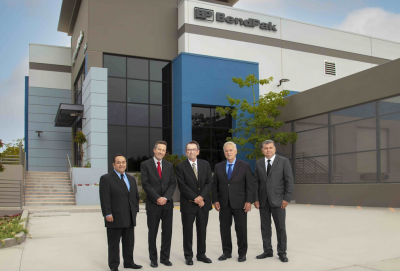

 Carlisle Chrysler Nationals Weekend Sets New Show Car Record