Tue, 02/01/2022 - 11:04

SEMA News— February 2022

EVENTS

AutoMobility 2021

New EVs Dominate the 2021 Los Angeles Auto Show

By Douglas McColloch
AutoMobility

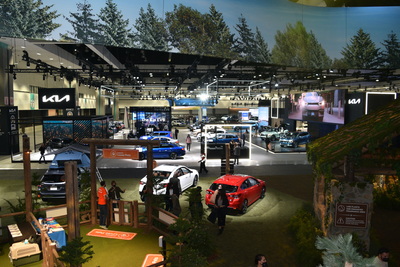
Now officially known as AutoMobility, the L.A. show still uses the same general format as a conventional auto show but with a much greater emphasis on the latest cutting-edge developments in electrification, autonomy, vehicle sharing and connectivity.

In the world of international auto expositions, the L.A. Auto Show was considered for many years as something of a red-headed stepchild—neglected, maligned and often ignored. That was due in part to the Show’s timing. For years, it was held during the week between Christmas and New Year’s Day, a time of year when many in the automotive industry are on vacation and only two weeks before the annual North American International Auto Show in Detroit. Industry perceptions began to change in 2006, when the Show moved its dates to late November, and again in 2013, when the Show hosted the Connected Car Expo, a special exhibit of the latest advances in alternative propulsion systems and autonomous technology.

Now officially known as AutoMobility, the L.A. show still uses the same general format as a conventional auto show but with a much greater emphasis on the latest cutting-edge developments in electrification, autonomy, vehicle sharing and connectivity.

Cancelled in 2020 due to COVID-19, AutoMobility returned to the Los Angeles Convention Center last November with a variety of new-vehicle unveilings—nearly all of them showcasing electric and other alternative powertrains. Here are some of the vehicles that made their debuts in L.A. last November.

Subaru Solterra

Subarus have become a common sight at the SEMA Show in recent years, particularly in the overlanding/lifestyle travel arena, and we imagine we’ll be seeing examples of Subaru’s first-ever EV at future Shows.

A joint venture with Toyota, which provided the battery and powertrain, the five-passenger Solterra utilizes two electric motors to provide power to Subaru’s symmetrical X-Mode all-wheel drive system, which controls throttle response, transmission shift points and torque transfer to optimize traction on wet or uneven terrain. The system also incorporates Subaru’s Grip Mode, a sort of “off-road cruise control” that handles hill ascent and descent duties.

Rated power for the Solterra is 215 hp and 248 lb.-ft. of torque, and the battery is said to accept an 80% charge in under an hour. It’s the first Subaru to come equipped with a 360-degree-view camera, and it sports a respectable 8.3 in. of ground clearance. Based on the E-Subaru Global Platform architecture that will serve as the framework for additional EVs, the Solterra goes on sale this year.

Hyundai Seven Concept
Hyundai

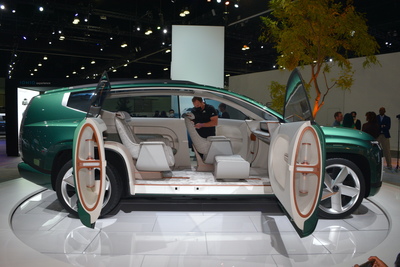
Billed at the Show as a “living space on wheels,” Hyundai’s newest EV concept, the Seven, is envisioned as being capable of fully autonomous operation.

Billed at the Show as a “living space on wheels,” Hyundai’s newest EV concept, the Seven, is envisioned as being capable of fully autonomous operation and is likely to see production in 2024 in a somewhat different form as the Ioniq 7, a three-row fullsize SUV based off the same E-GMP platform that serves as a foundation for the Ioniq 5 hatchback and the upcoming Ioniq 6 sedan.

The Seven features an asymmetrical door design—one on the driver’s side, two on the passenger’s side—which open to reveal a pair of swiveling lounge chairs up front and a sofa-like rear seat in the back. (When the vehicle is operating in full autonomous mode, the driver and front passenger can both swivel around to converse with passengers in back.)

Available in rear-wheel or all-wheel drive, the Seven touts a 300-mi. cruising range and is said to accept a 70% charge utilizing an 800V charging system in less than 20 min. With COVID in mind, the vehicle’s interior is designed with hygiene features such as antimicrobial seat fabrics and airline-grade air filtration.

Kia Sportage HEV
Kia

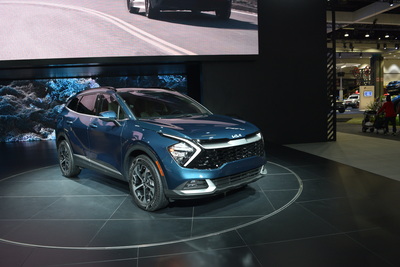
Longer and wider than the previous model, the KIA Sportage HEV built on the same N3 platform as its big-brother Sorento.

The fifth generation of Kia’s compact SUV, the all-new ’23 Sportage now boasts a hybrid electric powertrain that’s shared with the Hyundai Tucson. Longer and wider than the previous model, it’s built on the same N3 platform as its big-brother Sorento, and its 1.6L turbocharged four-cylinder is supplemented by a 44kW permanent magnet motor to deliver an estimated 226 hp and 258 lb.-ft. of torque. A six-speed automatic transmission is standard, and the vehicle can be had in front-wheel or Active all-wheel drive, which uses a center diff-lock to optimize front-to-rear torque transfers.

Mileage for the Tucson hybrid is 38 mpg combined; Kia says it is aiming for 39 mpg and a 500-mi. combined cruising range for the Sportage. Riding on a 108.5-in. wheelbase, the Kia boasts 8.3 in. of ground clearance. Inside, twin 12.3-in. view screens are available, and Apple CarPlay and Android Auto interconnectivity come standard.

Edison Future EF1-T Concept

China-based SPI Energy unveiled its electric/solar pickup truck at AutoMobility, and its exterior design (reminiscent of Tesla’s Cybertruck) attracted quite a bit of interest. The EF1-T is said to be offered in three trim levels, with battery capacities ranging from 120 to 180 kWH, which in turn offer 300 to 450 mi. of cruising range.

The retractable tonneau utilizes an integrated mosaic-design solar panel that can be locked in place to recharge the truck’s single battery. But this truck is built to work as well, with eight tie-down points in the 6.5-ft. bed and estimated towing capacities ranging from 7,500–11,000 lbs., depending on trim level.

Inside, an additional mosaic solar panel provides extra charging power, and aluminum toolboxes are built into the inner door panels for secure storage. Outside, motion-activated electric side steps improve ingress and egress, and beefy 37-in. Yokohama Geolandar tires provide ruggedness for off-road forays.

SPI Energy executives have announced their intent to bring the truck to market “in the coming months,” but no further details have been disclosed.

VinFast VF e35 and e36
VinFast

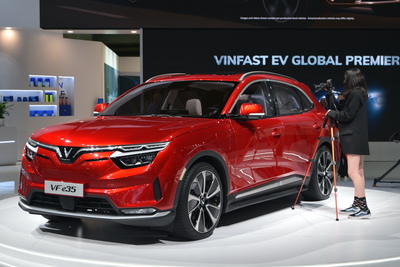
The e35 will be available with either a single- or a dual-motor configuration that produces 200 or 400 hp, respectively.

Four-year-old Vietnamese automaker VinFast debuted a pair of all-electric SUVs, and while the vehicles will be imported for the short term, the company said that it plans to break ground on a U.S.-based assembly plant by 2024.

The compact e35 (pictured) and the midsize e36 both utilize the familiar skateboard design, with batteries and motors mounted beneath the floors. The e35 will be available with either a single- or a dual-motor configuration that produces 200 or 400 hp, respectively. (The e36 will come standard with dual motors.) Estimated cruising range will be approximately 300 mi.

Both utes’ stylish exteriors were penned by Pininfarina, with the smaller e35 sporting split headlights and silver trim, and the boxier e36 featuring V-shaped front and rear light bars. The e36 is additionally equipped for Level 3 self-driving.

Both vehicles are expected to go on sale this spring, with a network of showrooms initially located in southern California.

Fisker Ocean

Making its world debut at L.A. was Fisker’s all-new midsize SUV, which is based on an existing chassis architecture provided by Magna-Steyr. Starting at $37,500, the Ocean comes in three trim levels with either single or dual electric motors, including front-wheel or all-wheel drive. Base horsepower is 275, but the top-level 540hp dual-motor configuration is said to be good for a 0–60 time of 3.6 sec.

The Ocean’s retractable sunroof sports an integrated solar panel that can supply an additional 2,000 mi. of range per year, and the vehicle supports bidirectional charging, which means that it can be used as a power source during periods of high demand.

Numerous eco-friendly touches abound inside, such as carpeting made from recycled fish nets and plastic bottles. The Ocean even offers a “Doggie Window Mode,” which partially lowers the rearmost side glass so your shaggy best friend can get a better view of the road.

Production of the Ocean is scheduled to begin in late 2022 at the Magna-Steyr assembly plant in Graz, Austria.

Mullen Five

California-based Mullen Automotive enters the luxury SUV market with the all-electric Five. Penned by Thurner Design, which includes veterans of Bugatti and Rolls design teams, the Five offers a 95kWH lithium-sulphur battery pack that’s capable of a 325-mi. range and a 0–60 time of 3.2 sec. at a (governed) top speed of 155 mph. The battery is also said to accept an 80% charge in slightly more than 20 min.

Pirelli P-Zero tires are wrapped around 23-in. wheels outfitted with Brembo brakes with carbon-ceramic calipers. The Five features facial recognition technology with a “Sentry” mode, which unlocks the vehicle when the owner approaches and inhibits would-be thieves, and it is equipped with Level 2.5 driver assistance (i.e., semi-autonomous) drive technology.

The Five will be built at Mullen’s brand-new assembly plant in Tunica, Mississippi, and is scheduled to arrive in mid-2024.

Brembach Premium 4x4
Bremach

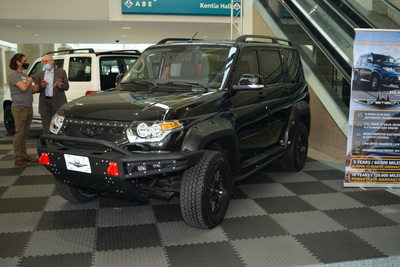
Starting at $26,400, the Brembach will appear at franchised dealerships starting in early 2022.

A throwback to a simpler time, this Russian UAZ-built 4x4 is defiantly old school. That starts with body-on-frame architecture, solid front and (Eaton-lockable) rear axles with 8.3 in. of ground clearance, and coil springs in front and leaf springs in the back. Add a two-speed transfer case with a 2.54:1 low range and Bosch active safety system that includes Hill Hold, and you have the makings of a capable out-of-the-box off-roader.

A 16V 1.4L gas engine sends 154 hp to either a six-speed automatic or a five-speed manual transmission, and the vehicle can operate in either rear-wheel or four-wheel drive. Ten paint colors are available, and a full range of factory options includes heavy-duty bumpers, fender flares, roof racks and additional skidplating.

Starting at $26,400, the Brembach will appear at franchised dealerships starting in early 2022.
Tue, 02/01/2022 - 10:50

SEMA News— February 2022

BUSINESS

Meeting Electrification Head-On

How Leading-Edge Innovators Are Sparking New Opportunities in the EV Market Space

By Mike Imlay

Electrification

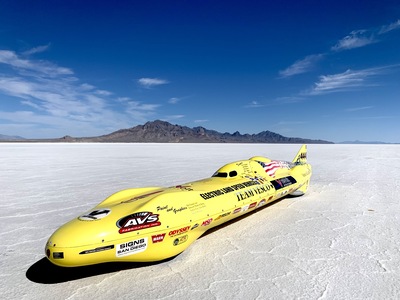
The Team Vesco 444 reVolt Systems “Little Giant” EV streamliner recently conquered the National Electric E3 record at the Bonneville Salt Flats, setting a 353-mph average. EV proponents see electrified performance as the aftermarket’s next frontier.

The automotive industry’s trend toward vehicle electrification continues to make headlines, with OEMs announcing bold new initiatives at a quickening pace. Of the top 20 global automakers, which together represented around 90% of new-car registrations worldwide in 2020, 18 are already at work widening their portfolios of alternative-power platforms and scaling up production of electric vehicles (EVs). This trend is obviously a hot-button topic for the aftermarket, with many asking how it will ultimately impact the industry.

But the specialty-equipment industry has never been one to shy away from a challenge. In fact, numerous innovators are already seizing opportunities in the EV space, and their entrepreneurial spirit was on full display at the 2021 SEMA Show in Las Vegas. Throughout Show week, exhibitors proudly unveiled EVs, electric conversions and related new products to Show attendees, and an expanded SEMA Electrified section showcased key companies making their names known in the market. In addition, the Show was the venue for special OEM announcements relating to vehicle electrification and alternative-power platforms, notably from Ford Motor Company and Chevrolet.

“We’ve been excited to see the growth and increased interest in the SEMA Electrified section of the SEMA Show since the feature first debuted several years ago,” said Tom Gattuso, SEMA vice president of events. “This year, SEMA Electrified included a number of electric-vehicle projects showcasing emerging technologies and the amazing strides the aftermarket is making in building, modifying, converting and accessorizing alternative-power platforms. Moreover, the SEMA Electrified feature at the Show demonstrated the association’s commitment to helping the industry understand and leverage cutting-edge technologies and stay ahead of trends.”

Throughout the Show, electrified builds and electrification projects garnered significant media attention (see “Required Reading,” p. 18). But most important of all, the palpable interest of industry attendees demonstrated that the trend is no longer considered a flash in the pan. Builders and product developers alike are seeing a profitable future in electrification and are ready to embrace the enhancements to vehicle design and performance that it can offer.

Although alternative powertrains currently represent just 1% of light vehicles in operation on American roads, those numbers are rising each year. In fact, SEMA Market Research has identified several areas of opportunity for the aftermarket, including the development of parts and products to aid in the conversion of older internal-combustion vehicles; building or modifying new project, racing and purpose-built vehicles; and expertly accessorizing new OEM electric offerings.

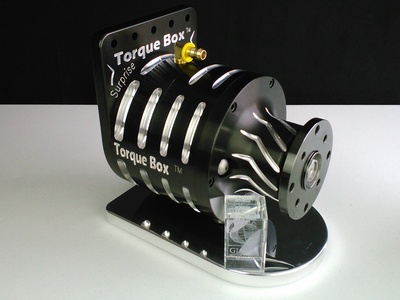
Torque Trends, based in Arizona, is an example of a new breed of manufacturers that are supplying products to aid in vehicle conversions—in this case, EV reduction gearboxes.

Electrification

Torque Trends, a supplier of gear-reduction boxes for builders and installers making EV conversions, returned to the 2021 SEMA Show with its Torque Box and related products. The Torque Box also had the distinction of winning a SEMA Global Media Award at a prior SEMA Show.

“We’ve definitely seen this space grow,” observed Torque Trends CEO Mitchell Yow. “It’s been more than 120 years with the internal-combustion engine (ICE), so electrification brings something new and exciting to the marketplace.”

Torque Trends first debuted at the 2013 SEMA Show, and its signature Torque Box product showcased at the 2021 trade event was a prior winner of a SEMA Global Media award. The company’s gearboxes are principally employed in restomod hot rods and classic cars.

“They’re used in things as small as Triumphs and MGs and as big as Ford F-550s and Econoline vans,” said Yow, adding that Torque Trends’ products also have marine, air and other applications. Builders converting older vehicles to electric propulsion especially rely on the reduction gearboxes to multiply and harness the torque of smaller electric motors.

Yow has also been connecting with others in the industry to develop plug-and-play electrification solutions aimed at commercial fleets. He said converting service vehicles powered by ICE systems to electric drives can lower maintenance costs, save on fuel expenses and even extend the life of the fleet. He sees it as a financially appealing alternative to purchasing an all-new replacement line of vehicles.

Lest anyone think electrification is a market space dominated by large-scale ventures and enterprises, Yow’s business is literally a garage startup.

“We’re a home-based business,” he said. “I took over our family room and our 21/2-car garage, and that’s where we build and test gearboxes and do consulting work.”

Still, since the company’s founding in 2013, sales have grown from just one gearbox a month to 1,200 or more per year. Yow keeps overhead low and engages engineers from Arizona State’s master’s program for CAD and related product-development tasks.

“Our growth initially was Europe, and we still sell more product there today than we do in North America,” Yow said. “But North America is starting to come on commercially with the classics and hot rods. It’s been slow but steady growth—actually perfect. What an out-of-pocket startup company needs is slow, steady growth.”

Yow expects the ever-present drive for performance to spark further growth in electrification.

“For one, everybody’s seen many, many videos of a stock Tesla Model S spanking people at the dragstrip,” he said. “It’s not a golf cart, and the fact is that this new technology is different. I’ve been doing car shows as a hobbyist and builder for many years, and it’s time for something new.”

Electrifying Motorsports

Electrification

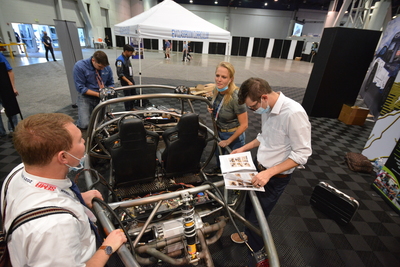
Switch Vehicles has developed an EV kit and curriculum to teach the basics of EV building. The company presented a live kit assembly by students right on the 2021 SEMA Show floor.

The Team Vesco 444 reVolt Systems “Little Giant” electric-powered streamliner illustrates the drive for performance and novelty. The land-speed vehicle twice conquered the National Electric E3 record at the Bonneville Salt Flats this past October. Driven by Eric Ritter, Little Giant clocked a 322-mph mark, followed 24 hours later by a 353-mph average—12 mph faster than the current world record. The vehicle was among the various car builds assembled at SEMA Electrified.

“Little Giant parked some big records on the salt,” said Team owner Rick Vesco. “We are excited about the future of electric vehicles and happy to be a part of shattering the notion that electric cars are slow.”

Ritter was euphoric about his experience at the wheel.

“What an incredible ride!” he said. “The torque off the starting line—it’s a monster. It bolts without hesitation and keeps pulling nonstop. Our time slips tell the story: With the 357-mph top speed, 400 is now a reality, no longer just a dream.”

To achieve its goal, Team Vesco partnered with reVolt systems. Based in Oceanside, California, the company was founded by Eddy Borysewicz and has been gaining a builder following with its CR-43 Tesla motor swap kit. However, the Little Giant project broke new ground with 1,152 prismatic lithium-ion batteries and a heavily modified pair of Tesla motors. Greg Peek, owner of American Track Roadsters, handled the design and build of the complex powertrain section that combined the motors and delivered their energy to the driveline.

“Nobody got paid in dollars, only satisfaction,” Borysewicz said of the venture. “We worked equally on the powertrain as we did good team communication to function together, recognizing there was no time for major mistakes.”

Motorsports has always been the proving ground for new trends and technologies, so it’s significant to see electrification gaining a foothold in a variety of racing venues. For instance, Hypercraft manufacturers turnkey EV drive systems for motorsports applications, including off-road and rally car racing. Founded in 2020 and headquartered in Provo, Utah, the company used its 2021 SEMA Show debut to showcase an electric Trophy Truck built in partnership with Geiser Brothers. The vehicle was purpose-built to race in the SCORE Baja 1000 unlimited class.

“If you look at engine manufacturing companies such as Evinrude, Cosworth or Cummins, we’re essentially that for electric,” Hypercraft CEO Jacob Hawksworth explained. “We come from powersports and motorsports with a product-development and marketing mindset, so we understand the need for the EV drive system to become a product, not a project.”

The end goal, he added, is to ease the adoption of EV drive systems within the racing industry while making them safer and less cost-prohibitive.

“This market is going to grow very quickly, and there is a lot of room for a lot of companies that are solving problems in many different ways,” Hawksworth said.

Eric Hutchinson, co-founder of Electric GT in Huntington Beach, California, agreed that the traditional one-off nature of EV conversions has hindered builders. After doing several expensive and time-consuming EV conversions, he and fellow Electric GT founder Brock Winberg decided there must be a better way. That led to their development of a “modular EV ecosystem swap” that encompasses powertrains and EV components.

“The conversion industry basically morphed from garage-salvaged vehicles and people doing garage-style builds with salvaged parts,” Hutchison explained. “There was no tier-one components modular solution, if you will, so the amount of engineering that went into every vehicle was just crazy.

“What we’ve done is put a ‘crate motor’ together that essentially incorporates an adapter plate, the clutch assembly, the batteries, the battery enclosure, thermal management, BMS chargers, inverter motor—everything in a package that weighs 700 lbs. It drops in and can replace an F2 in a Toyota FJ, or it could take the place of a Coyote in a Bronco, and keep that weight in a classic where it’s meant to be.”

At the SEMA Show, the company exhibited several EV conversions and a modular, self-enclosed battery unit that can be stacked and combined with others, reducing the need for custom enclosure work.

“We can basically give someone a variety of these batteries for the range and voltage calculations they need for a self-installation,” Hutchison said.

He conceded that cost is often a big hurdle for builders when considering Electric GT’s solution against a traditional ICE swap, but the comparison is not apples to apples. “It’s not just switching a motor,” Hutchison pointed out. “You’re switching out an entire ecosystem.” And although the company is not yet in mass-production mode, demand for its EV ecosystem has been high. “We’re overloaded with orders,” Hutchinson said. “Literally our phone rings all day.”

Given the popularity of trucks among American vehicle owners, experts say electrified pickups, SUVs and CUVs will be key to a growing acceptance of alternative-power platforms—and aftermarket builders are already at work breathing new life into iconic favorites in the category.

With official licensing from Ford Motor Company, Tennessee-based Kincer Chassis specializes in custom 4WD early Bronco chassis fabrication and is an innovator in early Bronco restoration.

For the 2021 SEMA Show, the company demonstrated its technological prowess with an electrified ’66 Ford Bronco roadster. The Bronco was one of the centerpiece feature vehicles at SEMA Electrified, drawing many admirers.

Armed with a three-phase 200kW AC motor, 85kWh of battery capacity and mounted on a Kincer EV Freeway Series rolling chassis, the vehicle was designed to demonstrate “the sustainability of the classic-car markets as emissions laws evolve,” said Thomas Kincer, president of Kincer Chassis. “This build showcases our flexibility and capabilities while proving to Show attendees that classic cars can be electrified while maintaining original aesthetics and functionality.”

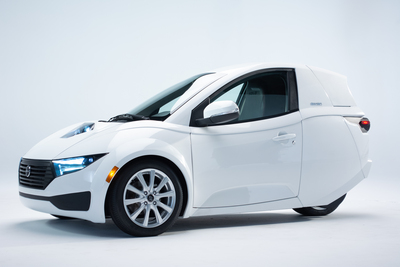
Major OEMs often use the SEMA Show to debut new products and stoke aftermarket interest in their vehicles. In similar fashion, EV startup ElectraMeccanica brought its new Solo vehicle to the 2021 Show in search of industry partners to accessorize its platform. Produced through manufacturing partner Xiaotian (Zhongshan) Industrial in China, the one-person vehicle is specifically designed for the urban driving experience.

“We are solving urban commuting problems,” said ElectraMeccanica CEO Kevin Pavlov. “The whole idea was to create an EV that’s easier to drive and park. It’s very eco-efficient, green, and it has the right footprint. About 76% of commuters—which equates to about 120 million—drive alone to work and back and forth on small errand runs, grocery shopping, coffee runs or visiting friends.”

The company has a unique direct-to-consumer sales strategy through a series of kiosks located in 20 targeted locations across Arizona, California, Oregon and Washington. Consumers can visit the kiosks to view the vehicle and schedule test drives. Ordering is then completed online.

“I really don’t think that the entire market has really been able to explore the electric vehicle platform and all of the things you can achieve with it,” Pavlov said. “There’s opportunity for electrified answers, mechanical answers and space answers. Electric vehicle platforms are just an open canvas.”

Education and Training

Electrification

ElectraMeccanica recently introduced its Solo EV to the market. The company came to the SEMA Show in search of aftermarket solutions to enhance the vehicle’s appeal to urban commuters.

Of course, for electrification to truly take hold in the aftermarket, there’s also an urgent need for education and training. Switch Vehicles manufacturers “a fun, sporty and safe” EV kit designed to teach the basics of electrification. Founded in 2013 and based in Sebastopol, California, the company has also rolled out the Switch Lab companion program to junior and senior high schools and colleges across the United States as a hands-on curriculum for student builders. However, according to Switch spokesperson Jennifer Filzen, many shop professionals have also embraced the kit and program to gain experience with an EV build before attempting their own electric conversions.

Switch’s presence at SEMA Electrified included a live kit assembly throughout Show week. The completed EV then joined in the SEMA Cruise parade of Show vehicles when the trade event wrapped up.

“There’s a ton of people at the Show who are coming over here saying they want to learn, because you do not want to mess up a client car,” Filzen said as the build progressed. “This is a great, safe way to learn. You’ll reduce your frustration because the class teaches all the functionality of the different parts and systems, how to wire them, and so forth.”

Switch EV kits range in price from $29,000–$50,000 and can be assembled in as few as 25 hours. The vehicles can support Level 1 or Level 2 charging. They can attain a range of 25 mi. in 11/2–3 hours, depending upon the selected charging option. Performance parameters can be dialed in for freeway speeds, and many states require no special driving license. In California, Switch EVs are licensed as motorcycles, making them eligible to drive in HOV lanes.

“It is truly a STEM curriculum on wheels, and we’re finding that students get to learn how to do the science, the technology, the engineering and the math,” said Filzen. “But they’re also learning the soft skills—how to work in a team, how to communicate with each other. People taking our class are getting hands-on experience with building an EV, but they also can get L3 and N6 certification.”

As a trade association, SEMA is stepping up its own education programs to help members navigate the growing electrification phenomenon.

“We dedicated a track for electric vehicle technology at the 2021 SEMA Show,” noted Gary Vigil, SEMA senior manager of professional development. “SEMA members have always found a way to leverage opportunities presented by new technologies. Some of today’s industry pioneers are converting internal-combustion engine classic vehicles into electrics, while others are leading the way to develop aftermarket parts and packages for electric-powered cars and trucks. Our goal is to give them the educational tools they need for all these endeavors.”

Evans Dodds, CEO of IMRAmerica in Garland, Texas, was one of the many product developers who came to the SEMA Show eager for exactly that sort of education.

“We’re actually a company that designs, manufactures and fabricates parts for sports cars,” he said. “We make sports cars into super cars and make them go faster, so we’re focused primarily on turbocharged applications, but we ship around the globe to customers for some niche-market platforms, and we see that the future is EV.

“I come from the RC car background, and I’m really excited about the EV technology. One of the cars we focus on is the Mitsubishi 3000GT, and we want convert it to EV. We’re also going to do EV conversions for a few different types of customers: the auto crosser, the drag racer and then the Sunday driver who just wants a different cool car that has been restored and converted.”

Last December, SEMA Education began making SEMA Show seminars available for on-demand viewing. Members interested in deepening their understanding of electrification and other leading-edge industry topics should regularly check SEMA eNews and related publications for information on the latest video releases. SEMA Education is also at work developing future seminars and expert-led panel presentations on electrification and related emerging technologies.

Tue, 02/01/2022 - 10:43

SEMA News—February 2022

HERITAGE

Flatheads at Bonneville—Timeless

By Drew Hardin

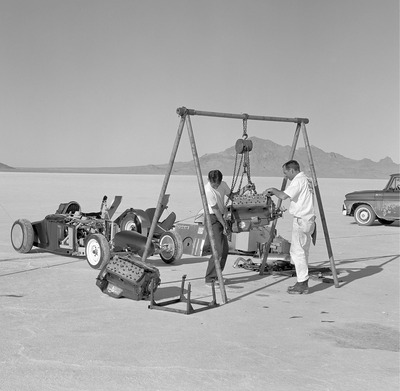
Photography Courtesy: Eric Rickman, Petersen Publishing Company Archive

BonnevilleThe 1968 running of the Southern California Timing Association’s (SCTA) Speed Week at Bonneville marked the 20th time hot rodders had gathered at the Salt Flats to see just how fast their roadsters, lakesters, streamliners and other wheeled creations could go. Hot Rod dispatched Photo Editor Eric Rickman, himself a 20-year Salt Flat veteran, to cover the event. He opened his story in the January 1969 issue with this timeless image of Bob Westbrook swapping Flathead engines right on the lakebed.

The anniversary meet almost didn’t happen. Rain forced the cancellation of the original August dates, but the alternate days the SCTA booked in October were blessed with “clear skies, brisk mornings and shirt-sleeve afternoons,” Rickman wrote. “Brisk, in this case, is a euphemistic way of saying ‘below freezing.’”

Just “57 cars and 20 cycles” turned out in October—nearly 150 had planned to go in August—but this “rather exclusive group was able to rack up some 26 car records and 13 cycle records,” Rickman noted, and saw three new members join the 200 MPH Club.

Among the record-setters was Westbrook, who had previously set the FI/Modified Roadster class record of 157.859 mph in 1966. He and one other FI/MR entrant, Tom Windgate, found themselves in a “really close race,” Rickman said, as they qualified at speeds just .28 mph apart.

“Experience will tell, and Bob took the record at 162.241 mph—on a borrowed engine yet,” a loan that set the stage for Rickman’s iconic photograph. That speed, Rickman said, “was really hauling for the nearly extinct Flathead.”

Tue, 02/01/2022 - 10:38

SEMA News— February 2022

Racing Matters to Us All–Join PRI!

By Chris Kersting

Chris K

It may seem like yesterday to some of us, but next month will mark the 10th anniversary of the transaction that brought the Performance Racing Industry (PRI) trade show and publications to the SEMA organization. Since then, PRI has expanded its mission to become the leading advocacy organization to help protect and grow racing for the future.

Racing, it should be noted, is important to practically every automotive business, whether directly involved in motorsports or not. Competition motorsports demand commitment and intensive R&D investment, resulting in innovations in function, durability and performance—which eventually lead to innovative products that benefit enthusiasts in a wide array of sectors. Racing also strongly influences styling trends and other forms of personalization that play out far from the racetrack. If there is a common thread through all the various ways enthusiasts enjoy cars and trucks, it’s performance! That’s why protecting racing in all its forms is one of SEMA’s strategic priorities.

The PRI acquisition made possible a long-term strategic partnership with the racing industry, with the intention of supporting PRI as the leading trade show and voice of the racing community while giving it new resources to become something much more and to protect, preserve and grow motorsports.

In the initial years following the transaction, we were able to provide support to the PRI community in the areas of market research, infrastructure upgrades and government affairs. However, with SEMA’s commitment to racing as a strategic priority, the PRI organization has now been positioned to expand on its leadership role through new tools and initiatives designed specifically to support motorsports.

Over the last two years, PRI has launched a series of targeted programs to assist racing businesses and operations impacted by the pandemic. One was PRI’s Ambassador Program—an aggressive campaign aimed at helping racetrack operators navigate local, state and federal rules required to reopen safely.

Another initiative was the PRI Road Tour—an unprecedented cross-country content-generating blitz to support motorsports companies large and small. That content is currently accessible on the PRI website, www.performanceracing.com.

Stories from the PRI Road Tour have generated a huge social-media groundswell. Year to date, PRI social-media channels have generated more than 140,000,000 impressions reaching more than 100 million unique people across all PRI social channels.

PRI video content has been viewed more than 1.1 million times on YouTube alone, while Reels and TikTok edits of that content have generated another 2.5 million views. This work is creating enthusiasm for racing and the industry’s great products, and it’s also introducing those who love racing to the rallying call: It’s time to participate in PRI and especially its government affairs efforts to help protect and grow racing.

A key element in building PRI’s influence is the new PRI Membership program, which enables year-round advocacy, educational seminars, legal support and more. Since the program was announced, thousands of individuals and members have joined and explored new benefits, not to mention discounts and an enhanced experience at the 2021 PRI Trade Show in Indianapolis.

PRI Membership has a business division that provides benefits tailored to racing industry professionals—much like SEMA membership. There is also an Individual Membership division open to everybody, including racers, enthusiasts and fans.

We are excited about the potential of PRI to unite and support those who love racing. Whether you join as a business or as an individual member, or you help other racing enthusiasts to join, you’ll be doing something to unite the entire motorsports community.

I urge you to take that step and join now as we work to preserve and grow the American tradition of motorsports! To find out the details, check out www.performanceracing.com/membership.

Thu, 01/27/2022 - 22:21

By Ashley Reyes

FLNChris Nelson is the SEMA Future Leaders Network’s (FLN), formerly Young Executives Network (YEN), newest spotlight member. Nelson is the chief marketing officer at Driven Lighting Group, a designer, marketer, influencer and online retailer of aftermarket enthusiast automotive lighting products.

Get to know Nelson in his interview with SEMA below.

SEMA: What is the best advice you have ever received?

Chris Nelson: One of the best pieces of advice I’ve ever received was from the first day of a business management class in college. My professor asked the room to explain “why you go into business...” and the answers were mostly money-driven. To make a profit, to make money, to accomplish great things, etc. They were all wrong. My professor insisted that the reason to be in business was to help people and to solve a problem. That shift in perception as a young entrepreneur has shaped how I operate as a business owner and leader.

A lot of what I do in business today is geared toward the customer experience, and if we are not actively making people’s lives better, I don’t think we’re doing a good job. We are not here to just make money, or to ‘beat’ our competitors. We are here to make a difference and solve problems. I employ this philosophy with my teams by frequently encouraging them to think about the customer experience, and how what they are doing, what they are building, affects the end-user. Did you solve a problem? Did you make their life easier? Did you make them happier? What I’ve found is when you start from that point of view, it becomes very clear how to win in business because that’s all our customers really want. It’s not all that there is, and it’s not an easy thing to accomplish, but I’ve found that the companies that do this the best find success the easiest.

SEMA: What keeps you in the industry?

CN: I’m obsessed with cars and trucks because I grew up around them. My dad had his own high-performance engine shop, and then he taught the current generation of engine machinists and builders the trade before retiring. I’ve been elbows-deep in many engines over the years, and the idea of building something that most people take for granted gets me jazzed up. Today I’m in automotive lighting, but it’s a similar experience to engines. Everyone has a car, with an engine, wheels and lights—it's just that mine is faster, with cooler wheels, and better lighting than most!

SEMA: Where can you be found on a Saturday?

CN: In my free time, I am either at car shows, racing events, working on the house, at the beach or hanging out with my family at home.

SEMA: How do you prepare for an important meeting?

CN: I spend time drilling down into the parts of the meeting that affect me and try to identify the main things I need to communicate. It’s really easy sometimes to get lost in the weeds of a complex idea, and a skill I’m working on is to communicate more powerfully. I find that it’s important to have a heavy-hitting single idea that is “easy to digest” in a room full of decision makers and let the conversation go from there. The conversation will automatically uncover the need to go into details if you do a good job communicating the important ideas off the bat.

SEMA: If you could go to lunch with one industry leader, living or dead, who would it be?

CN: Not sure he would exactly be called an industry leader, but he definitely made a major impact. I would love to go to lunch with Smokey Yunick and get a sense for his personality and energy in real life. His stories are wild and I love how he lived his life, truly independent and challenging what’s normal.

If you are a current FLN member, fill out an FLN member spotlight form. Selected candidates may be featured on FLN’s social media, SEMA eNews and FLN member updates.

Thu, 01/27/2022 - 22:09

By Ashley Reyes

Loan ForgivenessIf you are employed by a SEMA-member company, you may qualify to receive up to $2,000 to pay off an existing student loan.

As part of the SEMA Loan Forgiveness program, employees of SEMA-member companies are invited to apply for a Loan Forgiveness Award between now and March 1. The Loan Forgiveness program runs in conjunction with the SEMA Scholarship program. Combined, the programs have awarded more than $3 million since their founding in 1984.

The Loan Forgiveness program is open exclusively to SEMA-member companies and their employees as a benefit of membership. The program provides funds to help pay off education loans from a college, university or career technical/trade school. Last year, 22 employees of SEMA-member companies received loan-forgiveness awards to help pay off student loans.

To learn more about the Loan Forgiveness Program or to apply, visit www.sema.org/loan-forgiveness  before the March 1 deadline.

Thu, 01/27/2022 - 15:58

By Ashley Reyes

SEMA Launch Pad, the automotive industry’s product-pitching competition that has propelled inventors and entrepreneurs to successful, thriving businesses since 2013, will be featured for the first time in a nationwide television special on February 13 on the History Channel.

Launch Pad

The SEMA Launch Pad program features 15 semifinalists who competed live in Las Vegas, where they pitched their products and ideas to a panel of industry experts and icons that included Chip Foose (Foose Design), Jared Hare (Addictive Desert Designs), Myles Kovacs (DUB) and Alex Parker (Redline Detection).

The 2021 competition included a record high 200-plus competitors vying for the program’s largest grand prize ever, valued at $100,000. The program features 15 semifinalists who competed live in Las Vegas, where they pitched their products and ideas to a panel of industry experts and icons that included Chip Foose (Foose Design), Jared Hare (Addictive Desert Designs), Myles Kovacs (DUB) and Alex Parker (Redline Detection).

“We’re excited to bring the SEMA Launch Pad to a nationwide television audience,” said Ted Wentz, SEMA Board member and chair of the SEMA Launch Pad Task Force. “For years, the SEMA Launch Pad has encouraged and supported product innovation and new ideas. The television program will give a new audience the opportunity to see the depth of the industry’s innovation.”

The automotive industry has been following the 2021 competition through a five-episode YouTube miniseries, which generated almost half a million views. The upcoming television special includes brand-new, exclusive coverage of the finale, with the top two finalists competing in front of thousands of industry professionals at the world-renown SEMA Show in Las Vegas. Viewers will watch as competitors both triumph and falter along the way, with judges asking hard questions and providing candid feedback.

“The Launch Pad is a competition designed to help aspiring entrepreneurs succeed and grow,” said Wentz. “To see the competition unfold on television is inspiring. We hope that it encourages others to bring new products to the marketplace as well.”

To learn more about the SEMA Launch Pad, visit www.sema.org/launchpad.

Thu, 01/27/2022 - 15:18

By Ashley Reyes

FLNAs businesses struggle to maintain quality employees, managers are finding greater value in investing in existing staff and providing greater opportunities and support.

The SEMA Future Leader Network (FLN), formerly SEMA Young Executives Network (YEN), introduced a program that may help businesses retain and invest in their employees. Through the Professional Development Training Program presented in partnership with Dale Carnegie, a limited number of emerging team leaders will be able to participate in the program designed specifically for up-and-coming leaders in the automotive aftermarket. The training program from Dale Carnegie is typically $1,600, but is available to FLN members at 50% of the cost and includes complimentary hotel and food for the two-day program in Southern California.

“The Dale Carnegie program is among the best that is available,” said FLN Chair Nick Caloroso. “We’re proud to be able to bring such a high-quality program to the industry and help aspiring leaders grow their skills. This is a proven program that has shown demonstrated results.”

Another great benefit of taking the course through the FLN is that participants will connect with other aspiring leaders in the automotive aftermarket. Complete details:

When/Where: March 24 and 25, 2022 in Diamond Bar, California
Who Should Apply: FLN members (employee-level, including junior level executives and those from small businesses). Please note emerging leaders under 40 in the automotive aftermarket who work for a SEMA-member company can apply for FLN membership at no cost.

Attendees will learn how to:  

  • Communicate professionally and confidently in business situations.
  • Engage others by building rapport, asking pertinent questions and listening.
  • Build relationships and deal effectively with people in a multitude of scenarios.
  • Gain cooperation and influence people, including direct reports, laterally and upward.
  • Use emotional controls to sustain success.

Cost: The program is available for $800 or half of Dale Carnegie’s regular fee, and includes complimentary meals and hotel accommodations for two nights. Participants will also need to arrange their own travel to the event.

The program is limited to 25 FLN members, but any SEMA-member company employee aged 40 and under can apply for FLN membership at no cost. Businesses are encouraged to send their star employees to the conference and take advantage of the cost savings and unique opportunity.

Interested individuals can learn more or contact Denise Waddingham, FLN director, at deniselw@sema.org.

Thu, 01/27/2022 - 14:41

By Ashley Reyes

Many SEMA members make products exclusively for increasing performance of internal combustion engines (ICE). While the current trajectory of OEMs focusing on EV technology threatens the potential applications for their products, the promise of zero-emissions ICE technology provides hope and insight into future possible markets and applications for their products.

SEMA members are invited to a live webinar on February 23 to hear from Mike Copeland of Diversified Creations as he discusses their latest project—a hydrogen-fueled internal-combustion engine built from a supercharged LS and installed in a ’48 Chevy truck. Codenamed Zero, this truck produces zero tailpipe emissions.

By joining this webinar, attendees will learn about:

  • Hydrogen ICE technology and the viability of hydrogen as a fuel.
  • The difference between hydrogen ICE and fuel cell technology.
  • The applicability of hydrogen ICE in the performance segment.
  • The hydrogen infrastructure and performance potential of hydrogen ICE.

Learn more and register for the webinar here.

Thu, 01/27/2022 - 13:59

By Ashley Reyes

Trade buyers and media from Central and South America discussed what’s hot and what’s not in their respective markets during a roundtable held as part of the 2021 SEMA Show Education program.

Latin America

Roundtable viewers will learn the product lines various countries, such as Chile, Uruguay and Mexico, are looking to expand and what is currently in demand.

SEMA members can now access a recording of the roundtable at www.semashow.com/education, and listen in as Latin American businesses share details about the local market and opportunities for manufacturers in the country.

Viewers will learn the product lines various countries, such as Chile, Uruguay and Mexico, are looking to expand and what is currently in demand. They will also hear from U.S. manufacturers about opportunities and challenges when selling into Latin America, and how SEMA’s International Department can assist with export opportunities and resources. For additional information on SEMA’s International programs including the upcoming trip to the Middle East and Europe contact Linda Spencer at lindas@sema.org or visit sema.org/international

New recordings of seminars from the SEMA Show are added weekly at www.semashow.com/education. Other recently added seminars include:

  • Pandemic Pivots—Business Innovations and the Role Product Information Played.
  • How Mobile Electronics Skills Certifications Can Benefit You and Your Business
  • How to Successfully Manage Your Shop’s Multi-Project Production Schedule
  • Why the New UV Is EV

Users of the SEMA Education website will need to create a personal profile upon their first visit, which will then provide access to all recordings in the library.