Thu, 09/01/2022 - 13:52

By Ashley Reyes

HRIAStaying in tune and ahead of trends is one of the most important things any business can do. As the hot-rod market changes and evolves through different styles, capabilities and technology, it’s critical for businesses to have in-depth, inside knowledge of what they can do to position themselves to capitalize on trends.

After an exciting year and car show season, the SEMA Hot Rod Industry Alliance (HRIA) is bringing together industry leaders to look back and highlight the trends that got the hot-rod market where it is today and what will be changing business, design and fabrication in the year ahead.

Taking place on September 7, at 10:00 a.m. (PDT), the virtual panel discussion will be led by Amy Fitzgerald of Cool Hand Customs and feature panelists Jonathan Goolsby, Goolsby Customs; Stacey David, Rattletrap Productions; and Scott Parker, Power Automedia.

Participants will hear the panel’s insight on what trends led the way this past year, what they should expect to see at the 2022 SEMA Show, and what’s in store for the future of the hot-rod market.

Register here.

Thu, 09/01/2022 - 13:36

SEMA News—September 2022

FROM THE HILL

Lawmakers Love Formula Drift

Key Congressmen Take in Formula D, Which Seeks Certainty Provided by RPM Act

By Eric Snyder

Formula D

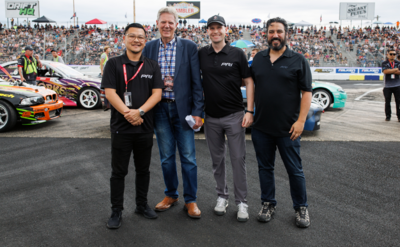
(From Left): Jim Liaw from PRI; Rep. Frank Pallone (D-NJ), Chairman of the House Energy & Commerce Committee; and SEMA’s Eric Snyder and Daniel Ingber pose for a picture on the track after opening ceremonies for the Formula DRIFT Pro Series race in Englishtown, New Jersey.

When the average person thinks of racing, they usually picture an oval track or a dragstrip. While it’s true that these two types of racetracks dominate the hobby, motorsports today encompasses so much more. From off-road racing to land-speed racing, rock crawling, drifting and even donk racing (big-wheel vehicles), it’s clear that motorsports today is a big tent with something for everyone.

SEMA and PRI are committed to shining a light on all the exciting things taking place on four wheels, recently hosting two key members of Congress, U.S. Representatives Frank Pallone (D-NJ), the Chairman of the U.S. House Energy & Commerce Committee (E&C), and Darren Soto (D-FL), an E&C Committee member and RPM Act co-sponsor, at Formula Drift events in New Jersey and Florida. Both lawmakers had a chance to see firsthand the importance of racing in their districts, and their time at the track reinforced the need to pass the Recognizing the Protection of Motorsports Act (RPM Act), which would provide legal certainty to thousands of racers who compete in modified production vehicles and to the businesses that produce and sell racing products used exclusively on the track.

U.S. Rep. Frank Pallone Visits Formula Drift Event in Englishtown, New Jersey

Rep Pallone

Rep. Pallone (left) and Jim Liaw (center) talk to Brian Mabutas, owner of Eat Sleep Race in North Brunswick, New Jersey.

Rep. Pallone is one of the most important and influential policymakers in Washington, D.C. As chairman of the E&C Committee—which has one of the broadest jurisdictions of any congressional committee, including automotive, health care, energy, environment, commerce, food and drug safety, consumer protection, telecommunications and the internet—he is a leading voice in Congress when it comes to making public policy surrounding the vehicles we love to drive, including street vehicles and race cars. Chairman Pallone is very familiar with the RPM Act and his support is critical to our efforts to pass the bill in 2022.

Rep. Pallone’s visit to Old Bridge Township Raceway Park in Englishtown, New Jersey, for the Formula Drift event reinforced his support for the motorsports community. In addition to watching PRO Series drivers compete, Chairman Pallone met with Mike Napp, Owner of Old Bridge Raceway Park, members of the U.S. Air Force, racing businesses from New Jersey, and PROSPEC Drivers from the Garden State, including Ricky Hoffman, Alex Jagger and Matthew Bystrak. Chairman Pallone was honored during the PRO Series opening ceremonies for his efforts to support motorsports.

“It was great to visit Formula Drift at Raceway Park and meet with fans, the teams, and hardworking crew who are so committed to this sport,” said Rep. Pallone. “I especially enjoyed having the chance to check out one of the cars on my own. I wish everyone the very best of luck in their competitions this year.”

As a native and lifetime resident of Long Branch, located along the northern part of New Jersey’s picturesque coastline, Chairman Pallone grew up listening to the music of the Garden State’s favorite son, Bruce Springsteen. For those of you less familiar with The Boss, his love of musclecars and speed is well documented in his music. That same passion for cars and modifying vehicles is still a vibrant part of the culture in and around Rep. Pallone’s district, which includes Monmouth and Middlesex Counties. Chairman Pallone looks back fondly on the many afternoons he spent taking in races at Wall Speedway with his children as they were growing up.

U.S. Rep. Darren Soto Visits Formula Drift Event in Orlando, Florida

Rep Soto

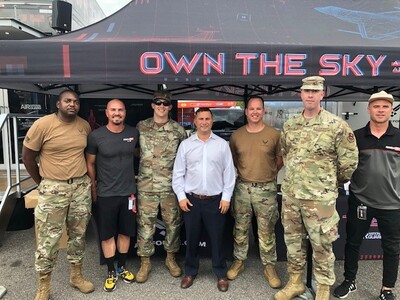
U.S. Representative Darren Soto (D-FL) [center], members of the U.S. Air Force, and Formula DRIFT’s president, Ryan Sage [second from left], and sponsorship director, Bryan Olfert [right], at the event in Orlando, Florida.

When the Formula Drift series came to Central Florida, Rep. Soto jumped at the chance to take in the competition at Orlando Speed World. While Rep. Soto will modestly tell you that he is not a car guy, my conversations with him would beg to differ. The Congressman has great insight on the automotive trends and vehicles he prefers. Rep. Soto also happens to be the owner of an ’11 Ford Mustang convertible that he enjoys taking out when he’s back home.

Rep. Soto has been a strong advocate for the RPM Act, using his position on the E&C Committee to advocate for the bill’s passage. He is also a sponsor of the Right to Equitable and Professional Auto Industry Repair (REPAIR Act), a bipartisan bill that would ensure enthusiasts, aftermarket businesses and repair shops have access to the information and tools that are needed to maintain and modify vehicles.

In addition to watching Pro Series drivers qualify, he accompanied Ryan Sage, president of Formula Drift, on a tour of the event that included meetings with racers, exhibiting businesses from Florida and members of the U.S. Air Force. Rep. Soto met with representatives from BC Racing, Drift HQ and LZMFG along with ProSpec driver Richard Advani and the race team for ProSeries driver Dan Burkett.

“It was great to see so many local businesses working hard to make exciting drift racing events happen,” said Rep. Soto. “Events like Formula Drift not only promote safe, legal racing, but they also bring visitors from all over to Central Florida.
I am happy that our region was chosen to hold this event and hope it continues to happen every year.”

Rep. Soto has lived in Orlando for nearly 20 years, although he is a native New Jerseyan. While studying economics as an undergraduate at Rutgers University in New Brunswick, New Jersey, he did some volunteer campaign work for his local Congressman, Rep. Frank Pallone. After graduating, he worked in the insurance industry before attending the George Washington University Law School. Rep. Soto followed his family to Orlando after graduating law school, opening a legal practice that included family law, civil litigation and real-estate law. He was elected to the Florida House of Representatives in 2007, served in the Florida Senate (2009–2016) and was elected to Congress in 2016. Rep. Soto’s congressional district includes all of Osceola and parts of Orange and Polk Counties. He is running for a fourth term in November.

Formula Drift Events:

  • Grand Prix of Long Beach–Long Beach, California (2006–present)
  • Road Atlanta–Braselton, Georgia (2004–present)
  • Lake Erie Speedway–Erie, Pennsylvania (2021–present)
  • Evergreen Speedway–Monroe, Washington (2006–present)
  • Orlando Speed World–Orlando, Florida (2015–present)
  • Old Bridge Township Raceway Park–Englishtown, New Jersey (2008–present)
  • Irwindale Speedway–Irwindale, California (2004–present)
Formula Drift Background

While drifting’s roots are firmly planted in Japan, this form of motorsports competition has grown in popularity all over the world. Formula Drift (also known as Formula D) is the premier North American professional drifting championship series featuring eight events each year. Each event consists of an eight-round championship where competitors are judged based on their line, angle and style, rather than who finishes the course in the fastest time.

Formula Drift features production vehicles that are either rear-wheel-drive or all-wheel-drive cars that have been converted to rear-wheel drive. The series is known for having an open engine rulebook, as drivers can also swap engines from manufacturers other than the company that made the vehicle. Formula Drift Drivers can also modify the engine, transmission, ECU, and/or final drive modifications, resulting in a huge variety of engine/chassis combinations as well as power outputs of 800 hp or more. Suspension tuning is also a vital part of any successful Formula D team.

Formula Drift blends traditional racing and extreme sports, which has made the series incredibly popular with the under-35 crowd, bringing a diverse group of young men and women into the world of motorsports and modifying cars.

Formula Drift features licensed drivers competing in the PRO and PROSPEC series. Drivers in North America can also compete in regionally sanctioned PRO/AM organizations for licensing. Winners and high finishers of these feeder series are then able to enter the Formula DRIFT PROSPEC series, a secondary national tour where they compete to move up to the main series.

RPM Act Background

Modifying vehicles is a tale as old as time. Ever since the birth of the automobile, gear heads and automotive businesses ranging from small businesses to automakers have been working to make vehicles faster and more efficient for motorsports competition. Formula Drift represents a segment of the hobby that personifies this rich tradition and its constant evolution. SEMA is inspired by the creativity of industry businesses and organizations like Formula Drift that rely on converting street vehicles for the track, which is why the association is at the forefront of the effort to pass the RPM Act and protect the right to modify.

Based on U.S. Environmental Protection Agency’s (EPA’s) interpretation of the Clean Air Act (CAA), the modified production cars used in Formula Drift are a violation of the 1970 law even though they are trailered to and from the track in the same way that purpose-built vehicles are transported to races. The EPA maintains that purpose-built race cars are not subject to the CAA because they were never street-legal and thus can never be driven on the road. However, the agency’s position is that race cars that have been converted from previously street-legal vehicles can never have their emissions system modified from their original, EPA-certified configuration. This is where Congress comes in, as lawmakers can pass legislation to clarify that it is not a violation of the CAA to convert a street vehicle into a dedicated track vehicle, which would protect racers and businesses that produce, sell and install performance parts for motorsports competition.

SEMA is working closely with members of Congress to pass the RPM Act and override the EPA’s position on modifying street vehicles for the track. While much of our advocacy takes place on Capitol Hill, the most important thing we can do is bring lawmakers to motorsports events to see firsthand what is at stake and why the right to modify vehicles for racing must be protected in federal law.

Thu, 09/01/2022 - 12:54

SEMA News—September 2022

REQUIRED READING

SEMA Members in the Media

By Juan Torres, Rachel Tatum and Carr Winn

The SEMA Launch Pad program, the ultimate product-pitching competition for automotive entrepreneurs, returned for the 10th consecutive year to give innovators a chance to establish their product within the automotive industry. “SEMA Launch Pad helps bring these emerging inventors to the forefront, providing a platform for them to potentially take their new creations to the next level,” said RJ de Vera, SEMA vice president of marketing.

Through the program, selected applicants are hand-picked to receive brand exposure, access to business resources, and the chance to win a grand-prize package valued at $92,000 to launch their product or service into the marketplace. Additionally, the Launch Pad competition will be featured in a nationwide television special that will give competitors added exposure. To learn more about SEMA Launch Pad, visit www.sema.org/launchpad.

FenderBender

FenderBender

FenderBender editors informed their readers that the 2021 Launch Pad competition would air on national television. Last year’s winner, Dustin Woolf, owner of Woolfpack Racing, took home the grand prize for his product Natural Nitrous—a stand-alone intake cooling system.


EngineLabs

EngineLabs

EngineLabs, which provides readers with coverage of performance engine technology, ensured that the entrepreneurs in its audience were aware when registration opened for this year’s program. Editor Greg Acosta shared that 15 hand-selected applicants would be given exhibitor space at the 2022 SEMA Show.


Aftermarket News

AMN

Aftermarket News editors reported on the five Launch Pad finalists last year. Jonathan Hurley (Toolbox Widget), Brendan McGrath (Dyme Performance Systems Inc.), Kevin Robinson (TRAC LLC), Tom Sawarynski (Off-Road Research) and Dustin Woolf (Woolfpack Racing) vied for the grand prize at the 2021 SEMA Show.

The RPM Act—Make Your Voices Heard!
RPM

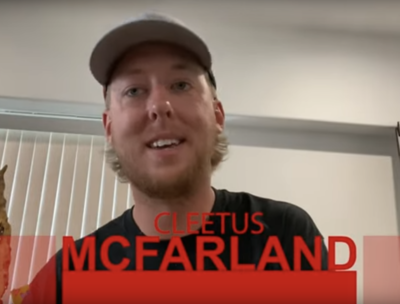
What if there was no racing? Join Cleetus McFarland and the rest of the motorsports community and tell your elected officials to sign the RPM Act of 2021 (H.R. 3281) to protect the motorsports that you love. McFarland explains how to do it.

Allies of Auto Enthusiasts: U.S. Senator Jon Tester
Tester

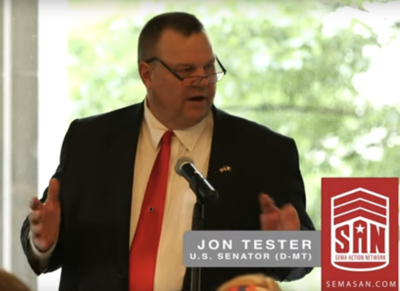
When he’s not in D.C., Sen. Tester and his son Shon can be found on their Montana farm working on their many collector cars, such as a Ford Model T, Ford Model A, ’38 Chevy, ’48–’53 Willy’s Jeep, ’56 Buick Century, ’55 Chevy Stepside pickup, and ’70 Buick Electra.

Help Fight Unfair Automotive Laws—Join the SAN Today
RPM

The SEMA Action Network’s (SAN’s) efforts have resulted in positive outcomes on a wide range of issues, from vehicle scrappage laws to equipment standards, registration classifications, emissions-test exemptions and hobbyist rights. Join for free at https://bit.ly/3M65Mff.

Faces in the Crowd

Wendy HuynhWendy Huynh
@gtrwendy

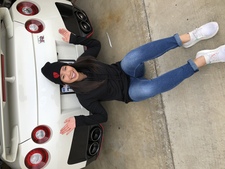
Wendy Huynh is a content creator who shares build updates and event coverage on her ’15 Nissan GT-R. Many of her social shares feature SEMA members, including AMS and Mickey Thompson. Huynh is a true enthusiast as she enjoys all aspects of the aftermarket community from building to racing to cruising.

Jacbo DotyJacob Doty
@jacobrdoty

Jacob Doty is a Ford enthusiast builder from Sacramento, California. His content features all of his Ford vehicles and builds, including a ’13 5.0 Mustang and ’22 Ford Bronco. Doty is most active on YouTube, creating install and how-to videos with more than 6 million views. Doty will be making more videos on his new Bronco, featuring a multi-part build series as he prepares for the upcoming SEMA Show.

Kendal KleinKendal Klein
@kendal240sx

Kendal Klein is a young female builder, enthusiast and drifter. She is working on her 240sx and frequently posts build updates and following her driving progression as her top performing content. She also produces an all-female drift event to encourage other women to get involved in the sport and provide learning opportunities.

HEARD ON SOCIAL MEDIA

“SEMA is now accepting applications for the 2022 Launch Pad competition. Find out how to apply.”—The Shop, via Facebook

“SEMA’s ‘State of the Industry–Spring 2022’ report shows sales surpassed pre-“Check out the most recent episode of SEMA Launch Pad, then tune this Sunday for the finale, on the History Channel, check local listings for times!”BCII, via Facebook

“SEMA Launch Pad’s Automotive Entrepreneurs and Inventors Featured on Television Special.”12 Volt News, via Facebook

“Time is quickly running out. Applications to participate in SEMA Launch Pad must be submitted online by Monday, June 13.”Aftermarket Matters, via Twitter

Thu, 09/01/2022 - 12:45

SEMA News—September 2022

BUSINESS

First Impressions

How Three Successful Companies Took Divergent Paths to the 2021 SEMA Show

By Eric Colby
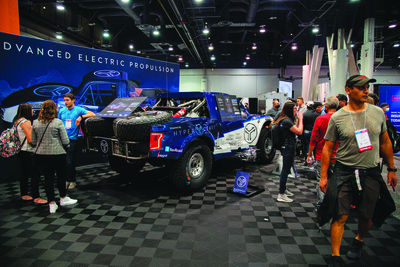
First Time Exhibitor

Because the founding principals all had backgrounds in powersports, they knew they needed to be at SEMA and they wanted to make a big splash. Hypercraft USA partnered with Geiser Brothers to build an electrically powered trophy truck.

In June 2021, Jake Merrick Sr., the owner of Merrick Tool in Hinton, Oklahoma, had a new product for the automotive industry. He was trying to think of ways to get the word out about his innovative new socket for removing stripped lug nuts.

“I said, ‘We need to go to a trade show,’ so I typed it in on the search engine and the first one that came up was SEMA,” said the 77-year-old inventor and entrepreneur.

“I got in touch with a guy named Scott Hartwick [SEMA industry sales director] and he was a gentleman all the way through,” continued Merrick. He put me in touch with Tom Gattuso [SEMA vice president of events], and they got me all hooked up.”

Merrick attended the SEMA Exhibitor Summit in July, which is kind of like a freshman orientation for new companies planning to display at the annual SEMA Show at the Las Vegas Convention Center.

“He became the poster child for the summit,” said SEMA Vice President of Sales Warren Kosikov. “He worked the event and made contacts with everyone at SEMA.”

The SEMA Show is the largest event of its kind for the automotive performance industry, and 2022 marks the 55th anniversary of the event first held in the basement of Dodger Stadium in 1967. Last year’s edition of the Show featured more than 100,000 attendees who checked out products from 1,700 exhibitors, 200 of which were first-timers. We talked to three of them to see what they learned from the experience.

Luck of the Draw

After attending the Exhibitor Summit and enjoying the experience, Merrick made his reservations for the 2021 event, reserving a 20x20-ft. island booth and purchasing a sponsorship package for $22,000 that further promoted his company with billboards and other presentations. Merrick Tool also participated in the New Products Showcase.

“We had $100,000 in the trip, and we’ll have the same in it this time, and it’s totally worth it,” said Merrick. “It’s like anything else you do. It’s only as good as your preparation, your enthusiasm, your marketing plan.”

He admits that Merrick Tool was not quite as prepared as he would have liked to have been for the 2021 SEMA Show, but because the majority of the attendees are knowledgeable about cars, trucks and performance, they quickly picked up on what his company was offering.

“They’re mechanical people and we were far enough along that the attendees saw the product and took it from there,” said Merrick.

The products that Merrick Tool displayed included the company’s CAMLOCK Sockets that are designed to remove two-piece, metal-clad lug nuts without damaging them. They come in three sizes: ¾ in.-19mm, 13/16 in.-21mm and 7/8 in.-22mm. What sets apart these tools is that they are designed to grip every flat on the hexagonally shaped nut or bolt head instead of just the corners. In addition, they are made from high-speed tool steel.

Jake Merrick Sr., has a mechanical background. In 1988, he invented a stud-
removal tool for oil wells. “I broke 90,000 of those studs with a wrench and came up with a tool that gripped the round surface and rotated it right or left,” he explained. With that tool, he went around the country, removing more than 500,000 studs that were more than 2 in. in diameter. He also invented a tool that linked the above-ground pump and the in-ground unit for oil wells.

First Time Exhibitor

Perhaps the biggest exposure from the Show came from a video shot by Koon Trucking at the Merrick Tool booth. When it appeared on YouTube, it called the CAMLOCK Socket the best product of the 2021 SEMA Show and featured interviews with Jake Merrick, Jr., who is a partner in the business and a state senator from Oklahoma, as well as Jake Sr. The video had garnered approximately 9,500 views as of early June.

When Merrick saw the potential for applying the same technology to lug nuts, he set to work refining his CAMLOCK Socket. Response from the 2021 SEMA Show made the tool an unequivocal favorite of attendees. “Sales were in the hundreds but the praise was 100% from the people who bought them,” said Merrick. He even gave a set to car enthusiast and TV personality Jay Leno.

Merrick estimated that between the show’s closing and the end of 2021, Merrick Tool had more than 10,000 inquiries, but he couldn’t turn them into sales because he couldn’t get machine shops to supply what Merrick wanted in terms of quality for the tools. Instead, the company started work on a research and development program that was wrapping up in early June so Merrick could machine its own parts.

Perhaps the biggest exposure from the Show came from a video shot by Koon Trucking at the Merrick Tool booth. When it appeared on YouTube, it called the CAMLOCK Socket the best product of the 2021 SEMA Show and featured interviews with Jake Merrick Jr., who is a partner in the business and a state senator from Oklahoma, as well as Jake Sr. The video had garnered approximately 9,500 views as of early June.

Aside from finding the walk from the Westgate Las Vegas Resort to the convention center challenging because he has bad knees, Merrick Sr., came away with only positive feedback for his first time at the SEMA Show. This year he’s booked at the Renaissance, so the walk is taken care of.

“It’s priceless. We could have paid 10 times more, and I’d still go back,” he said. “We went away from there glassy-eyed with our mouths open and dead tired, but we were smiling.”

The Strategists

While Merrick happened upon the SEMA Show almost by accident, the folks at Horizon Brands in Costa Mesa, California, are industry veterans. They knew that for their spin-off Project X product to grow, they needed to be at the biggest event in automotive performance.

“We knew we needed to be there, and we knew that the people we needed to see were going to be there, and we had a focused plan when we got there,” said Jared Chavez, director of brand development for Horizon Brands.

Horizon supplies automotive parts and accessories to Costco, AutoZone, Wal-Mart and other brands. Chavez and some of his coworkers wanted Horizon to have a presence in the high-performance off-road market. “We needed to create a whole new brand to house this off-road product and needed a different sales channel,” he said. “This wasn’t going to be something that you put into AutoZone.”

Project X began as performance lighting for off-road vehicles. It then morphed into a full ecosystem with a central control box for all functions in an off-road vehicle. Project X launched at the Johnson Valley, California, King of the Hammers event in 2021 and barely made it on time because of material shortages.

For SEMA, Chavez, who has attended the show since 2006, and his team had a specific plan. “Some of the struggles you have at a trade show include not having a focus,” he said. “We weren’t really ready to talk to jobbers or direct shops yet. We really wanted to talk to distributors.”

He continued, “We had a hit list of who we wanted to deal with and a five-year business plan that made sure we communicated our brand and our product well.”

Project X reserved a 20x60-ft. booth with a meeting room as well as three freestanding displays and a custom Ford Bronco as the centerpiece. The company took advantage of the New Product Showcase, introducing a total of nine new products.

While a product like a wrench or supercharger almost explains itself, something like a management system requires more conversation, and Chavez said that the show environment gave his team the opportunity to do that. For the 2022 Show, Project X will have a 30x70-ft. booth and plans to partner with other exhibitors to have products in their builds to get visibility outside its primary display.

“We ended up leaving the Show with commitments from every person that was on our five-year plan,” said Chavez. “The biggest thing I can tell people going into the SEMA Show is you need to have a plan. If you go into SEMA and think you can stand there and it will sell, it won’t go well.”

A Big Splash

In 2019, Jake Hawksworth wanted to build an electrically powered mountain snowmobile. He designed it and quickly found out that there was no electric propulsion system that could provide the power needed to make it perform.

In his previous career, Hawksworth had led the development and launch of more than 100 products in the powersports industry. Something of a serial entrepreneur, he reached out to some friends in the powersports industry and told them of his plans to develop an electric propulsion system that could be scaled to power anything from a snowmobile, motorcycle or personal watercraft up to a yacht. Hypercraft USA was formed with its headquarters in Provo, Utah. A year ago, the company signed on with an accelerator program to get Hypercraft USA moving in the right direction.

“That’s where we pivoted and realized this was a billion-dollar idea,” said Jon Miller, co-founder and chief creative officer for Hypercraft USA. “We’re the first company to do that in an application-agnostic way.”

Because the founding principals all had backgrounds in powersports, they knew they needed to be at SEMA and they wanted to make a big splash. Hypercraft USA partnered with Geiser Brothers to build an electrically powered trophy truck. Geiser Brothers has built more Baja 1000-winning trophy trucks than any other manufacturer.

Hypercraft USA has electric engines that can make up to 1,600 hp and the company put two of them in the trophy truck, dialing them back to improve the range. During the Baja 1000 off-road race, instead of recharging the batteries, the company plans to do complete battery swaps, according to Miller.

“They let us use one of their trucks and we wrapped in their livery and did cutaway renderings and that made our backdrop,” said Miller.

Hypercraft had the truck in the SEMA Electrified section of the Show. A couple of halls away, the company also had a 10x10-ft. booth.

“We thought we were going to go to SEMA and have to convince everyone this was happening,” said Miller. “Instead we were met with, ‘Where have you been all my life?’”

Like Project X, Hypercraft USA was quite early in its program at the 2021 SEMA Show, and one of the goals for the management team was to meet with interested parties in person.

“We’re still pretty early in this space and there were a couple of companies that we were already partnered with and it was a good place to have in-person meetings,” said Miller. “With electric, you need to look at the system level and not the component level.”

There were other companies at the Show, including OEMs, with electric “crate motors,” designed to be drop-in replacements for gas engines. Hypercraft USA says what sets it apart is that the company can work across diversified platforms. Miller said Hypercraft USA is working on a gas-electric hybrid power system for the military and is replacing a supercharged LS V8 with an electric motor on an airboat. The company currently has 16 different customers in myriad fields.
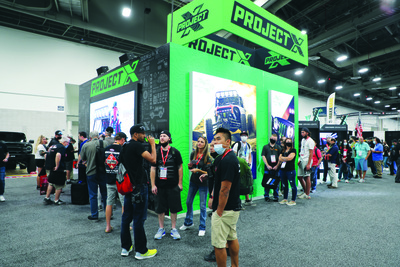
Project X

Project X reserved a 20x60-ft. booth with a meeting room as well as three freestanding displays and a custom Ford Bronco as the centerpiece. The company also took advantage of the New Product Showcase, introducing a total of nine new products.

Looking back at 2021, Miller admitted, “I don’t know that we optimized the whole experience the way we could have.”

Coming into the 2022 Show, Hypercraft USA plans a bigger presence than last year.

“We’re scrambling on every customer, and we’re going to show up with whatever we have that’s show-worthy at that time,” said Miller. The company has purchased a 20x10-ft. booth and hopes to the in the SEMA Electrified section again as well.

“Whatever we show up with its going to get a lot of attention,” said Miller. “We look forward to growing our brand in front of the SEMA audience.”

For new exhibitors coming into the 2022 SEMA Show, he offers the following advice: “You definitely want to do some research and look at maps and plan how everything is going to go, give yourself time to get to where you’re going,” said Miller. “SEMA was our coming-out to the world party, and it made a significant impact for us.”

Thu, 09/01/2022 - 12:33

SEMA News—September 2022

HERITAGE

Full Power Treatment

By Drew Hardin

Photography: Eric Rickman, Petersen Publishing Company Archive

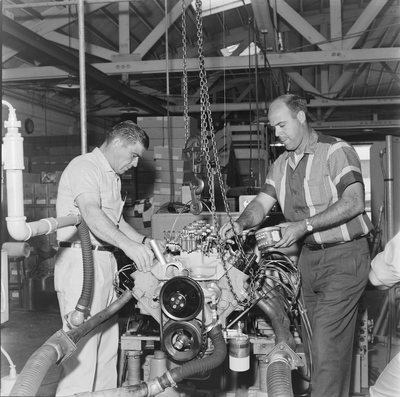
EdelbrockIn 1958, Ford introduced the FE V8 engine series, named for its intended use in Ford and Edsel passenger cars. Vic Edelbrock Sr., who built his namesake speed equipment business engineering parts for Ford’s Flathead V8, “took an immediate interest in the new Ford engine,” said Hot Rod’s Ray Brock. So did Edelbrock’s customers, who asked about the engine’s power potential and modifications needed to get there. Edelbrock bought an Edsel version of the FE, measuring 361 ci and rated at 303 hp and 405 lb.-ft. of peak torque, and embarked on a series of tests to see just what the engine was capable of. He invited Brock to cover the tests, which resulted in a two-part series, “Full House for ’58 Fords,” in the August and September 1958 issues.


“Edelbrock didn’t realize when the test started that they would spend nearly eight weeks on the dyno and perform 30 separate and complete tests before they were through,” Brock wrote.

Out of the crate and in full stock trim, the engine produced 210 hp and 315 lb.-ft. of torque as measured on Edelbrock’s Clayton engine dynamometer.

Thirteen of the 30 tests were covered in the first story, which culminated in the engine making 290 hp. Some changes made just incremental improvements; some changes actually reduced power. The biggest gains were seen when a set of Hedman headers was added, when Edelbrock replaced the 84-lb. (!) stock intake manifold and single Holley four-barrel carburetor assembly with an aluminum Edelbrock intake and triple Holley two-barrels (weighing just 43 lbs.), and when Ed Iskenderian delivered several different camshaft grinds to test. The photo seen here shows Edelbrock (left) and Brock installing the new induction system.

Part 2 began with Edelbrock addressing what he thought was the engine’s weak point: its “puny,” as Brock described them, 1.561-in. exhaust valves. Edelbrock installed a set of 1.750-in. Lincoln valves and did some machine work on the heads to accommodate them. That change alone didn’t net much power, but when combined with headers, bigger Stromberg carburetors and increasingly aggressive camshaft grinds, the engine finally climbed above the 300hp mark. Brock noted, “112 horsepower for an increase of 54% without removing the engine from the car is pretty good.”

But “pretty good” was not what Edelbrock was after. He disassembled the engine, bored the block and had a stroker crankshaft made to increase displacement to 412 ci. Initial tests at the new size retained the bolt-on speed equipment but returned the stock camshaft to the block to better evaluate the more aggressive cams Isky had provided. In its final trim, for test number 30, the engine was fitted with Isky’s EE-400 cam, with .430-in. lift, 264 degrees of intake duration and 272 degrees on the exhaust side. “Above 3,000 rpm the EE-400 supplied the needed extra timing, and the power soared to 341 hp at 5,000 rpm and then remained almost constant with 342 hp registered at both 5,500 and 6,000 rpm,” Brock wrote.

“The results were interesting,” he said, “and did prove that the ’58 Ford (and Edsel) engine can be a good workhorse if properly groomed.”

Thu, 09/01/2022 - 12:06

By Ashley Reyes

Boni Yraguen
Boni Yraguen

The SEMA Memorial Scholarship Fund issued a total of $297,250 in scholarships and loan forgiveness awards to help 119 individuals who currently work for, or are planning to pursue careers in, the automotive aftermarket industry. The winners include 103 students who received scholarships ranging from $1,000 to $5,000, and 16 employees of SEMA-member companies who received loan forgiveness awards to help pay off student loans.

“The SEMA Scholarship Program receives some incredibly impressive applications from students every year,” said SEMA Manager of Recognition Programs Chris Standifer. “This year’s applications were especially noteworthy. The accomplishments, dedication and passion that came through the applications was remarkable. We’re pleased and honor to be able to support so many individuals through the program.”

Langdon Michael
Michael Langdon

The SEMA Memorial Scholarship Program was established in 1984 to help support the future of the automotive aftermarket industry. Since its inception, more than $3 million has been awarded to deserving students. One of the primary criteria for scholarship recipients is that the winner must have clearly demonstrated a passion for the automotive industry.

“There are many career tracks and opportunities in the automotive industry,” said Standifer. “We’re here to support students from all majors. Winners go on to pursue a variety of careers; the common denominator is their love for automobiles.”
The online application for next year’s program will open in January of 2023, at www.sema.org/scholarships.

Janssen Kyle
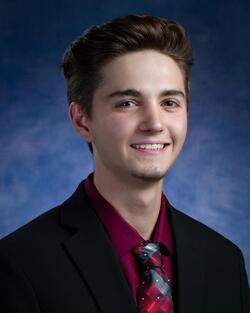
Kyle Janssen

SEMA Scholarship Award Winners
Recipient (Employer, Institution Name, Major)

  • Aaron Bodenham (Iowa State University, Mechanical Engineering)
  • Adam Valentine (Ohio State University-Main Campus, Mechanical Engineering)
  • Allyssa Bryant (The University of Alabama, Engineering)
  • Anthony Carrao (College of Southern Nevada, Autobody Collision)
  • Benjamin Tai (Clark College, Automotive)
  • Boni Yraguen (Georgia Institute of Technology-Main Campus, Mechanical Engineering)
  • Brad Nelson (Brigham Young University-Provo, Mechanical Engineering)
  • Brandan Marhefka (Pennsylvania College of Technology, Welding)
  • Brayden Grimm (University of Northwestern Ohio, Automotive Technology)
  • Brendan Stejskal (Pittsburg State University, Automotive Technology)
  • Brian Gonzalez (The University of Texas at El Paso, Electrical Engineering)
  • Brock Dunkelberger (Pennsylvania State University-Penn State Harrisburg, Mechanical Engineering)
  • Caleb Rogers (Washtenaw Community College, Engineering)
  • Cameron Cocalis (University of Colorado Denver/Anschutz Medical Campus, Business)
  • Carter Cygan (Kansas State University, Mechanical Engineering)
  • Chandler Pagnotta (Virginia Polytechnic Institute and State University, Mechanical Engineering)
  • Chloe Holman (University of Northwestern Ohio, Motorsports Marketing)
  • Christopher Mark (Rio Hondo College, Automotive Technology)
  • Christopher Schell (Iowa State University, Mechanical Engineering)
  • Colby Price (University of Northwestern Ohio, Diesel and Heavy Equipment Technician)
  • Daniel Szurek (The University of Alabama, Computer & Information Sciences)  
  • Darril Baty (McPherson College, Automotive Technology)
  • David Dixon (Wesleyan University, Economics)
  • David Ramos (Arizona State University Campus Immersion, Mechanical Engineering)
  • Davis Dorries (Dallas College, Automotive Technology)
  • Elizabeth Rohrer (University of Notre Dame, Mechanical Engineering)
  • Emily Mitchell (Idaho State University, Autobody Collision)
  • Emma Ricketts (Southern Illinois University-Carbondale, Automotive Technology)
  • Erika Burton (WyoTech, Automotive Aftermarket)
  • Ethan Francis (Harding University, Engineering)
  • Ethan Hubbard (Utah Valley University, Mechanical Engineering)
  • Grayson Kief (University of Wisconsin-Stout, Industrial Design)
  • Hunter Ormond (McPherson College, Automation Technology)
  • Jack Reusch (University of Northwestern Ohio, Marketing)
  • Jacob Beshara (Bethel University, Marketing)
  • Jacob Lesa (Brigham Young University-Provo, Mechanical Engineering)
  • Jacob Matties (California Polytechnic State University-San Luis Obispo, Mechanical Engineering)
  • Jaden King (University of Michigan-Ann Arbor, Industrial Engineering & Design)
  • Jaedyn Imhoff (California Polytechnic State University-San Luis Obispo, Mechanical Engineering)
  • Jamie Sullivan (University of Northwestern Ohio, Automotive Aftermarket)
  • Jennifer Stamboulian (Villanova University, Business)
  • John Clark (University of Northwestern Ohio, Automotive Technology Supervision)
  • John Motter (Southern Illinois University-Carbondale, Automotive Technology)
  • Jonathon Damzyn (Michigan State University, Electrical Engineering)
  • Josiah Hildebrandt (Massachusetts Institute of Technology, Mechanical Engineering)
  • Julian Mathews (Texas Christian University, Business)
  • Kaden Elisaldez (University of Nevada-Las Vegas, Marketing)
  • Kaitlyn Zubia (The University of Texas at El Paso, Mechanical Engineering)
  • Keeley Whitmer (Southern Illinois University-Carbondale, Automotive Technology)
  • Kenton Kyger (Kettering University, Mechanical Engineering)
  • Kinzie Wilson (Belmont Abbey College, Motorsport Management)
  • Kyle Groe (Southern Illinois University-Carbondale, Automotive Technology)
  • Kyle Janssen (Ferris State University, Automotive Engineering & Technology)
  • Kylie Tulley (California State Polytechnic University-Pomona, Mechanical Engineering)
  • Lars Luther (Cuesta College, Automotive Engineering & Technology)
  • Liam Dunsmore (California Polytechnic State University-San Luis Obispo, Mechanical Engineering)
  • Liam Goldthwait (University of Northwestern Ohio, Automotive Technology)
  • Liam Richardson (Southern Illinois University-Carbondale, Automotive Technology)
  • Luke Vilagi (The University of Alabama, Mechanical Engineering)
  • Madyan Khidir (M State, Moorhead Campus, Automotive)
  • Manuel Aldana (San Diego State University, Mechanical Engineering)
  • Marcus Walker (Florida Atlantic University, Marketing)
  • Matthew Bleier (NASCAR Technical Institute, Automation Technology)
  • Matthew McDonnell (Lincoln Technical Institute-Mahwah, Automation Technology)
  • Matthew Traum (Missouri University of Science and Technology, Mechanical Engineering)
  • Matthew Trees (Texas A & M University-College Station, Mechanical Engineering)
  • Maximilian Redfearn (University of St Thomas, Mechanical Engineering)
  • Mehrod Khalili (Southern Illinois University-Carbondale, Automotive Technology)
  • Michael Langdon (Michigan Technological University, Mechanical Engineering)
  • Michael Shinedling (Brigham Young University-Provo, Mechanical Engineering)
  • Michael Ustes (University of Michigan-Dearborn, Materials, Engineering)
  • Molly Poer (Cypress College, Automotive Technology)
  • Nathan Ragsdale (Montana State University, Mechanical Engineering Technology)
  • Nathanael Pierce (Hibbing Community College, Automotive Technician)
  • Nathaniel Martens (University of Washington-Seattle Campus, Mechanical Engineering)
  • Niko Rosell (Cochise County Community College District, Automotive Technician)
  • Noah Dunsmore (California Polytechnic State University-San Luis Obispo, Mechanical Engineering)
  • Owen Yim (University of Southern California, Automotive Engineering & Technology)
  • Payton Lee (Kansas State University, Mechanical Engineering)
  • Philip Moore (School of Automotive Machinists & Technology, Engine & Machine Assembler)
  • Preston Duller (University of Detroit Mercy, Cyber Security)
  • Rachel Garrett (University of Northwestern Ohio, Robotics and Automation Technology)
  • Robert Sandusky (Washtenaw Community College, Autobody Collision)
  • Robert Schonberner (McPherson College, Automotive Engineering & Technology)
  • Ryan Duffy (Ohio State University-Main Campus, Mechanical Engineering)
  • Ryder Lestrud (North Iowa Area Community College, Diesel and Heavy Equipment Technician)
  • Samuel Kohls (The University of Alabama, Mechanical Engineering)
  • Santino Loretta (West Virginia University, Mechanical Engineering)
  • Sebastian Milka (Southern Illinois University-Carbondale, Automotive Technology)
  • Sebastian Pereira (Harvard University, Computer Mathematics)
  • Shay Saarie (Dakota Wesleyan University, Business Management)
  • Shelly Pineda Franco (Triton College, Automotive Technology)
  • Sloane Miller (North Carolina A&T State University, Computer & Information Sciences)
  • Songa Rugangazi (Indiana University-Purdue University-Indianapolis, Business Administration/General Office Worker)
  • Sophie Owen (Clemson University, Packaging Science)
  • Tess Roberts (Concordia University-Saint Paul, Computer & Information Sciences)
  • Tyler Udy (Utah Valley University, Automotive Engineering & Technology)
  • Vance Weber (Kansas State University, Mechanical Engineering)
  • Victoria Bruno (McPherson College, Automotive Technology)
  • Wyatt Smith (Brigham Young University-Idaho, Automotive)
  • Xavier Ruano (University of Northwestern Ohio, Automotive Aftermarket)
  • Zachary Dosey (Wayne State University, Electrical Engineering Technician)
  • Zachary Mosier (Pennsylvania State University-Main Campus, Mechanical Engineering)

SEMA Loan Forgiveness Award Winners
Recipient (Employer, Institution Name, Major)

  • Brian Fair (MAHLE Motorsports, Tennessee Technological University, Mechanical Engineering)
  • Cameron Bigelow (Roush, University of Northwestern Ohio, Automotive Technician)
  • Collin Mikottis (Atturo Tire Corp., Northwood University, Automotive Aftermarket)
  • Dante Brown (Trade Union International, University of La Verne, Information Technology)
  • Elizabeth Niemi (MagnaFlow, Northwood University, Automotive Aftermarket)
  • Emily Glass (K&N Engineering Inc., Riverside City College, Humanities)
  • Gahre Scudder (Keystone Automotive Operations Inc., Western Governors University, Business Administration/General Office Worker)
  • Hubert Celinski (4 Wheel Parts, Southern Illinois University-Carbondale, Automotive Technology)
  • James Stray (Hennessey Performance Engineering, School of Automotive Machinists & Technology, Automotive Technology)
  • Janelle McDermott (Decal Applicators, Northwest University, Communications)
  • Kirstin Backes (Derive Systems, University of Redlands, Business Administration/General Office Worker)
  • Mark Mollica (Thyssenkrupp Bilstein of America, University of San Diego, Mechanical Engineering)
  • Shauni Greene (Kontio's Automotive Service and Sales, Eastern Maine Community College, Automotive Technology)
  • Sophia Dancel (Ford Motor Co., Kettering University, Mechanical Engineering)
  • Timothy King (Baer Inc., California State University-San Bernardino, Marketing)
  • Troy Lemuel Magpantay (General Motors, University of Illinois Urbana-Champaign, Mechanical Engineering)
Thu, 09/01/2022 - 11:15
Antron Brown
Antron Brown

NHRA Top Fuel champion and superstar Antron Brown will testify before the Senate Environment and Public Works Committee as it considers passage of the Recognizing the Protection of Motorsports (RPM) Act on Wednesday, September 7, 2022, in Washington, D.C.

Brown—a professional NHRA driver-team owner who has won three Top Fuel Championships—began his racing career about 40 years ago by modifying street-legal motorcycles into dedicated race motorcycles. Today, this ability to compete in modified street-legal vehicles is at risk. The Environmental Protection Agency (EPA) issued a draft ruling in 2015 stating that it is not legal to convert production vehicles into dedicated race vehicles. Although the ruling was never finalized, the EPA maintains its position that such conversions are not legal and continues to enforce against the production and sale of high-performance parts.

“The RPM Act is essential to the racing community, particularly for grassroots racers who are just getting started,” said Brown. “It’s imperative that we protect the ability for young men and women to be able to compete at the track. The RPM Act will give racers the assurance they need to continue this American tradition.”

Most of America’s 100,000-plus racers began competing in modified street vehicles. It is a cost-effective way to get started in motorsports. Passage of the RPM Act would enshrine in Federal law the right to modify street vehicles into dedicated race vehicles, thereby giving the racing community the certainty it needs to continue a long-standing practice without fear of EPA enforcement.

“Passage of the RPM Act will bring clarity to grassroots racers and businesses that manufacture, sell and distribute motorsports parts,” said Mike Spagnola, SEMA president and CEO. “We’re grateful to the elected officials who strongly support and advocate for Congress to pass the RPM Act. The industry has been in limbo and in a state of uncertainty for far too long; it’s time to pass the RPM Act!”

Brown’s testimony before the Senate Environment and Public Works Committee will showcase the positive impact of racing. He will be joined by his sons Adler and Anson, who compete in NHRA’s Junior Drag Racing Series, and his wife Billie Jo. Brown will share details about his family’s personal journey in motorsports, which includes four generations of Brown family members competing on the track.

“I owe a lot to motorsports; there are many great lessons that come from racing,” said Brown. “I’m urging Congress to help protect motorsports and ensure that it remains a viable pastime for all Americans by passing the RPM Act.”

The hearing will stream live on September 7, at 10:00 am (EDT). To learn more about the RPM Act and the threat to motorsports, visit www.saveourracecars.com.

Thu, 09/01/2022 - 10:35

SEMA News—September 2022

INDUSTRY INSIDER

10 Questions for Daryl Sampson

By Douglas McColloch

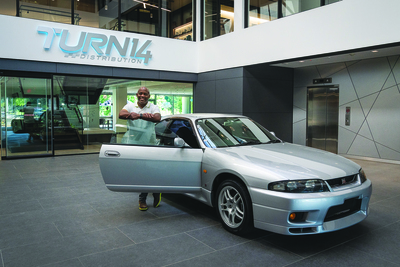
Industry InsiderWith a two-pronged strategy of catering to niche markets and maintaining a full range of partner-manufacturer product lines, Turn 14 Distribution has emerged as a major player in the warehouse distributor space, and few have been as responsible for the company’s success as Daryl Sampson, who joined Turn 14 Distribution in 2009 as the company’s business development manager. As a relatively new player in the WD arena, the company needed to establish a strong national brand identity, and Sampson was tasked with the assignment of building Turn 14 Distribution’s marketing department. Under his guidance over the ensuing decade, the company launched numerous initiatives across print, digital, and social media, combined with event marketing and motorsports sponsorships.

The results have been impressive. In little more than a decade, Turn 14 Distribution has grown to a WD powerhouse, sporting 730,000 sq. ft. of distribution-center space across three facilities in Texas, Pennsylvania and Nevada. The industry has taken notice as well, and Turn 14 Distribution was awarded SEMA’s Warehouse Distributor of the Year award in 2016, in 2018 and again in 2021. For his efforts, Sampson has risen within the company from marketing manager to director of marketing and, in 2021, to his present role as vice president of marketing.

Over the course of a 20-year career, Sampson has worked in a variety of positions across the industry. Prior to joining Turn 14 Distribution, he worked as sales manager of Turbonetics and prior to that as the sales and marketing manager of Advanced Clutch Technology. A native of Trinidad who has spent considerable time living in New York, California and now in Pennsylvania, Sampson relies on his experiences of living in a multitude of environments to inform the brand strategies that are the cornerstone of the company’s marketing.

We spent a few minutes chatting with Sampson at his home in Pennsylvania recently, and what follows is edited for clarity and length.

SEMA News: What’s your latest project? What’s in your garage?

Daryl Sampson: I just picked up a ’13 E92 M3 in January. It’s a car that I’ve always wanted since they were new, so I’m excited to have one. Apart from that, I have a new M5, an E46 3-Series and an ’84 Mazda RX7.

SN: What keeps you passionate about your work?

DS: I love the challenge of developing new and out-of-the-box marketing strategies to accomplish company goals. I’m also passionate about mentorship, helping and developing others to push past their preconceived notions of what they can do to be the best version of themselves.

SN: What achievement in life would you say are you proudest of?

DS: I can’t say that there’s one. As a kid growing up in Trinidad, I always wanted to work in the automotive field, and I’m proudest of the sacrifices and dedication I’ve made to get here.

SN: What’s the car you dreamed of owning as a kid, and did you ever get one?

DS: I’m passionate about cars, and I’ve been fortunate to own several of my dream cars. I was enamored with the E30 M3 when it was released in 1987. I promised myself that I’d own an M3 in my life, and I’ve done so a few times.

SN: How do you unwind at the end of the day/work week?

DS: I work out after work, and on weekends, I enjoy cooking, watching Formula 1 and road racing. During the warmer months, I like to go for a long drive on some of the beautiful back roads of eastern Pennsylvania.

SN: What’s the most significant change(s) you’ve seen in the industry since you started working in it?

DS: The advancements in technology over the past 20-plus years with internal combustion engines. The rise of the electric-vehicle market and how marketing has changed to the current influencer, lifestyle-based content prevalent everywhere.

SN: If you went back to school, what would you study?

DS: Business management.

SN: What’s your daily driver, and why?

DS: A ’22 BMW M5 Competition. It’s the perfect combination of performance and luxury in an understated package.

SN: When you’re not working, where can we find you?

DS: Enjoying the comforts of my home. I travel a fair amount, so time at home is something I look forward to.

SN: To a young person looking to break into the industry, what advice would you give?

DS: Determine what aspect of the automotive industry appeals to you. Don’t be afraid to ask questions and take chances. Believe in yourself and take advantage of every opportunity presented to you, even if you’re not sure where it will lead.

Thu, 09/01/2022 - 10:14

SEMA News—September 2022

BUSINESS

Transition Planning

Preparing Your Business to Successfully Transition on Your Terms

By Chris Shelton

Tranisition Planning

What does your exit plan look like? If you’re like most of your peers, you’ve probably considered selling or transferring your business one day.

If you run a successful business, you know the power of planning. And if you started that business, you know that power intimately.

But what does your exit plan look like? If you’re like most of your peers, you’ve probably considered selling or transferring your business one day. And if you’ve done that, you’ve certainly dreamed about what you’d do with all the capital you’d reap.

Now for the sobering part: according to the Exit Planning Institute, only 20% to 30% of businesses that go to market will sell. Also, according to the institute, 66% of current American businesses belong to Baby Boomers, the majority of whom will sell or transfer their businesses within the next decade.

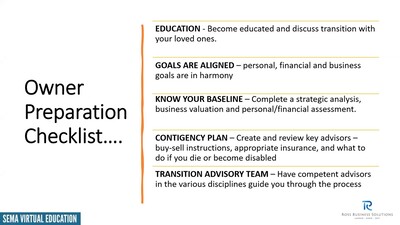
So, we’ll ask again…what does your exit plan look like? Recently, Gayle and Chuck Ross from Ross Business Solutions hosted a SEMA Virtual Education webinar. In “Preparing My Business to Successfully Transition on My Terms,” they explain how a well-coordinated exit plan looks.

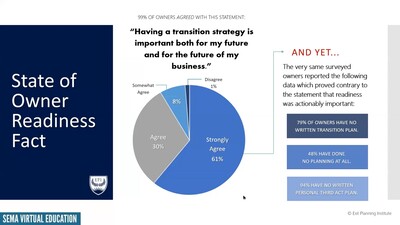
“We really don’t have a problem with business owners realizing the importance of having a good plan in place,” Gayle says. “But what are we doing about that? I mean, 79% of owners have no written plan. They may have thought about it. It might be in their head. But it’s not something that they have a strategy to pursue.” She says that approximately 40% have done no planning at all. “Those are pretty alarming statistics.”

Transition Planning

According to the Exit Planning Institute, 91% of business owners either agree or strongly agree that a transition strategy makes sense. However, nearly half of business owners do no planning at all. Gayle and Chuck Ross point to the absence of a formal third-act plan as the leading cause of poor transition strategy.

Though alarming, statistics aren’t inevitable. In their webinar, the Rosses outline strategies to not only increase a business’ potential to transfer to new ownership, but also increase the value of that transaction. What follows is a summary of that
presentation.

Determine What You Want

According to Gayle and Chuck, a successful transition begins not with preparing the business for sale but preparing its operator. “[Most business owners] cannot imagine what life looks like if they don’t have their business to go to every day,” Gayle notes. “And if that’s the case, then there’s a lot of fear involved, and fear prevents us from doing a lot of things. So making sure that you have a plan in play to know what life looks like without your business is probably one of the most critical things.”

To do that, she recommends exploring what a future without the business could look like. “You do that by asking yourself ‘what do I value most?’ It’s got to be more than just, ‘well, I’m going to golf’ or ‘I’m going to work out more, spend time with the grandkids, or travel.’ I mean those are great things and a lot of fun. But there’s got to be some substance behind it that fuels your passion.

Transition Planning

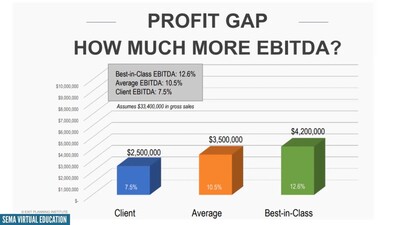
The profit gap has immediate implications for a business. Case in point: the swing among a hypothetical client’s earnings before interest, deductions and amortization (EBITDA) and the average and best-in-class represent a difference of a million to $1.7 million. That’s the plain benefit of bringing a business up to industry standards.

“Let’s say part of your dream is to buy a professional sports team, or maybe just a cabin in the woods that you can rent out on Airbnb or VRBO. You’re going to need money to do that. You may have funds already, but the big part of your investment is going to come from [the sale of] your business.”

More than mitigating the fear of unknown, developing a clear vision of your future life establishes a roadmap to transition. And Chuck defines three points on that map: the wealth gap, the profit gap and the multiplier.

“The wealth gap is the additional wealth that a business owner might need…to reach their goal for the next phase of their life,” he says, citing an example of John and Jane, a theoretical couple that has $36-million dreams but only $10 million in hand. The $26-million swing represents the wealth gap. “How do we bridge that gap?” he asks.

“To start, we’re going to go back to those profits and sales. We’re going to look at the profit gap, which is how much a business is sacrificing by not operating at a best-in-class level.

“So back to John and Jane. Their profit on $33 million in sales was $2.5 million [and] the average for their industry [for $33 million] is about a $3.5 million. But best-in-class in this example is about $4.2 million.

“Now, if we look at our present client at $2.5 [million] and we look at the best-in-class company, there’s a $1.7-million swing in profit [the profit gap]. Can you imagine what a business might be able to do if they had that additional $1.7 million?”

Transition Planning

But improving a business’ profit gap pays greater dividends than increased annual income. Most markets formulate a business’ value by multiplying its EBITDA income by a multiplier. Better-run businesses tend to justify greater multipliers, and that combined with the increased EBITDA can make a profound difference in a business’ sale price.

But the profit gap represents more than just the difference in profit. It influences, among other things, industry multipliers.

Industry multipliers are factors used to establish a business’ true value based on its earnings before interest and taxes, depreciation and amortization (EBITDA). Grossly oversimplified, multipliers represent the financial integrity of a company. Higher numbers represent greater perceived integrity.

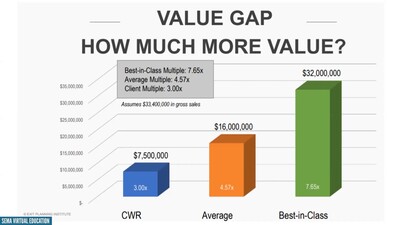
“The current client has $2.5 million in EBITDA or profits. And under these circumstances, a buyer might offer them three times earnings—that’s the multiplier,” Chuck says. “So they might expect to get an offer of $7.5 million.”

But remember the best-in-class operating at a $4.2 million profit? “[Based on] industry studies and historical data, we know that this best-in-class company would probably be offered seven to eight times that amount,” Chuck reveals. “When that’s extrapolated out, you can see the swing gets much bigger. John and Jane might expect a $7.5 million buyout, but a best-in-class company might possibly receive $32 million.”

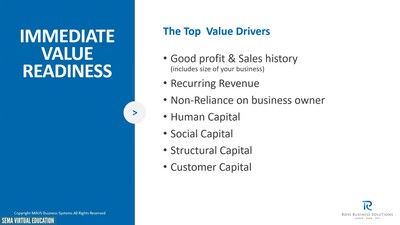
Gayle and Chuck listed an array of ways to improve the multiplier beyond maximizing profit. They referred to the first as the Four Cs of Capital: Human Capital, Social Capital, Structural Capital and Customer Capital.

“The first two have taken center stage with COVID,” Gayle notes. “Many of you can’t find people, right? And if you do, you are paying an exorbitant amount just to get them in the door.

“Social capital, it’s really about your brand. It’s the way the employees work together, the way you communicate. You have managers on board but are they really leaders? The other thing is, initially you were the business, you were what made that business run. If you are still in that place, then you need to…work toward relinquishing some of those operational roles and put people in place who can do them. That new buyer wants to make sure that business can run without you. So having a strong social capital is critical to differentiating your business from others in your industry. Your culture is what’s going to drive those core values. And it’s really the way that communication takes place.

Transition Planning

Profit gap and efficiency aren’t the only things that influence multipliers. Things like repeat customers, the ability for a company to operate at its peak efficiency in the absence of its current owner, and ability to maintain a workforce and clientele make big differences.

“We talked about processes…but are those processes in your head or are they written down? If somebody comes in, could you give them a manual so they could jump right in and take care of those things? It takes a lot of effort to document [those processes], and someone must make sure that they’re up to date.

“But, you know, structural capital is more than that. It’s about your vision and your mission. And [does that] really play out in your business or is it just hanging up on the wall in the lobby?

“And then last is your customer capital. [Can your customers] imagine doing business without you being a part of it? Are your customers looking at you like that? If you were to leave and a new buyer stepped in, are [your customers] going to switch because someone could offer them a better price?

“So those things—human, social, structural and customer capital—add value and increase that multiplier.”

Gayle also underscores the significance of detractors. “We look at [these] as low-
hanging fruit because it takes a little bit of time to identify them, and the solutions are easy to implement.” She groups them as the five Ds: Divorce, Disagreement, Death, Disaster and Disability. “Obviously, we had disaster with the COVID thing, but what about a divorce or a partnership disagreement? What we encourage people to do is consider ‘what if my partner and I got into a dispute?’ or ‘what if one of us died?’ or ‘what would happen if one of us got a divorce from our spouse?’ What would happen?

“That’s when you [call] your insurance agent and you look at your buy-sell agreements. Dig those out, blow the dust off ’em, and say, ‘Okay, I’ve got to get these up to date.’ Because if we learned one thing over the last several years, it’s that nothing is off the table.

“The other things that I want to bring up is the financials,” Gayle continues. “What would happen if someone were to lift that hood, look at those books and have a full forensic audit done?” she asks. “What do you think they would find? I mean, are your agreements up-to-date? What about your contracts? What do your financials look like? Most business owners have not done the necessary steps to prepare their business. And that means that maybe sometimes we’re not spending as much attention to the financial side of things. We were working with a client at $70 million in revenue who had no idea what his break-even point was. If you’re not comfortable with your finances, get with your CPA to learn what ratios you need to track.”

Explore Transfer Options

“There may be as many as 10 or more different ways to transfer your business, but there are two general pathways: external and internal,” Chuck says. External can be a third party, a strategic competitor or an outside investor. Internal options oftentimes include family members, the employees or even an employee-stock-option plan. “They call that an ESOP. Your management, your leadership could buy you out. A lot of machine shops and engineering firms have partners, and partners get bought out and brought in on a regular basis.”

Transition Planning

As part of their webinar and their consultancy, Gayle and Chuck Ross outline the tasks business owners face and their best-practice solutions. They also offer a list of resources including books that benefit any business owner looking to achieve maximum return on their investment.

Chuck recommends building a team of the value advisors, CPAs, attorneys and financial advisors who can get things done efficiently. He cites another list of professionals from family advisors to merger-and-acquisitions advisors. “These individuals come in as needed. They could be your insurance broker, an estate planner—some families even bring in a personal coach for family members. They all could all come in from time to time.

“Okay. Here’s the key takeaway that I’d like for you to have regarding your advisors: It’s really not a do-it-yourself project. We had a CPA recently tell us that he’s now required to have a hundred hours of continuing ed. And boy, that’s tough if you’re a business owner and you’re trying to stay up on every aspect of transitioning your business. And you’re still trying to run your business at the same time and work with your leadership team and your customers and your vendors.”

Gayle adds, “Regardless of where you are in the process, this is something that we always could have some additional information on. We always encourage people to become educated on the source. There is a wealth of information out there. We have a list of books that we’d be happy to share. You can brush up on that and learn from what others have experienced, really become a student of this because, you know, you have one chance to get this right. And knowing more about it just really helps you prepare for those things.”

Naturally this process won’t happen overnight. “That’s a question we get—how much time do I need to put a good plan together?” Gayle notes. “You really need about three to five years because that is necessary to establish the sales history and to improve profitability and to close that profit gap that Chuck talked about.”

But she says the results more than pay for themselves. “There’s going to be a lot of supply and demand is going to come into play as Baby Boomers look to exit at the same time. So, it’s more important than ever today, even if you’re not interested in transitioning out for another, you know, 10 or 15 years. There are things you can do to maximize your value, to become more appealing and to really stand out from all the others, not just in your industry, but from other businesses across industry that are going to be selling.

“There is a lot of money on the table right now with private-equity firms. And they’re really looking for well-run, well-managed businesses that they can invest in. Now’s the time to really get your business in shape and to have that planned so you can take advantage of those opportunities and exit when and how you want.”

Chuck and Gayle Ross of Ross Business Solutions have specialized in guiding businesses through all phases of existence, from initial startup to final exit planning, for more than 20 years. They can be contacted by calling 574-727-0641 or by visiting
www.rossbusinesssolutions.com.

Thu, 09/01/2022 - 09:53

SEMA News—September 2022

SEMA DATA

By Gigi Ho

SEMA Data Product News

The products featured below are from SEMA Data member companies that have attained Gold- or Platinum-level data, which means that their product data is robust and complete—likely to drive customer purchase decisions. SEMA Data members meeting data scorecard requirements are invited to submit product releases for consideration to enews@semadatacoop.org.

Aldan
Injen
PRP
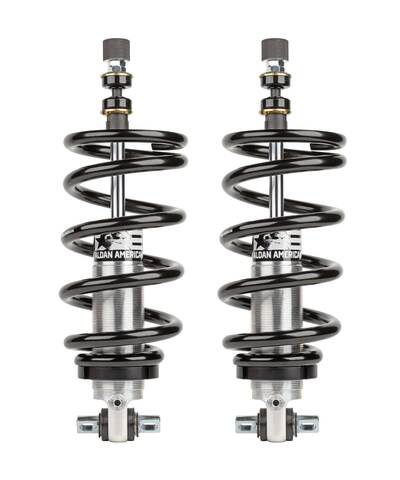
Aldan American

Coilover Kit for ’74 Buick Century

Front–450 lbs./in. Front– 0.0–2.0 in. lowered Front

For the ’73–’77 GM A-Body, ’78–’88 GM G-Body and ’75–’79 GM X-Body, ’82–’04 GM S10/S15 trucks and other GM vehicles, the Aldan RCX, Double Adjustable Coilover Kits offer a bolt-on solution to convert your factory front suspension to fully adjustable coilovers. Made in the U.S.A., the coilovers offer a wide range of adjustability to get the best handling and on-road performance. Aldan coilovers are ride-height adjustable, making it possible to achieve the exact stance you’re looking for.

Information: www.aldanamerican.com

PN: 300229

The products featured below are from SEMA Data member companies that have attained Gold- or Platinum-level data, which means that their product data is robust and complete—likely to drive customer purchase decisions. SEMA Data members meeting data scorecard requirements are invited to submit product releases for consideration to enews@semadata.org.

Injen

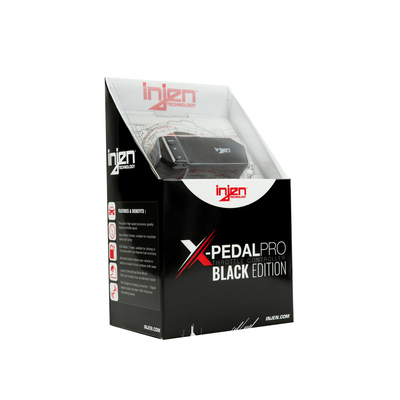
X-Pedal PRO Black Edition Throttle Controller

The Injen Technology X-Pedal Pro Black Edition is the next step in customizable throttle response controllers. Quickly and easily tune out the delayed throttle response from the factory with Injen’s X-Pedal Pro Black Edition for a completely new driving experience. A plug-in module that requires less than 5 min. to install and delivers immediate, customized performance for your vehicle. Specifically, the X-Pedal Pro Black Edition controls the throttle signals going into your stock ECU so that your vehicle instantly responds faster and accelerates swifter...or slower and more economically?

Information: www.injen.com

PN: PT0013B

PRP

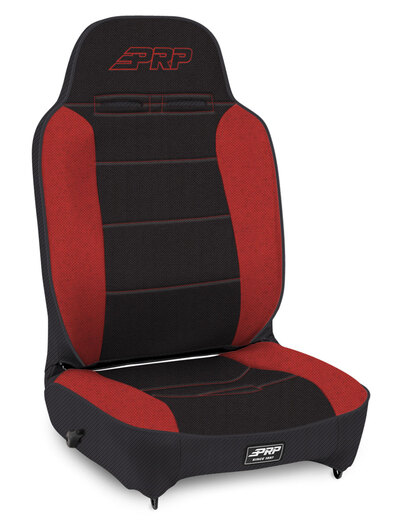
Enduro High-Back Reclining Suspension Seat

The Enduro Recliner was designed to replace stock Jeep Wrangler, Jeep XJ or truck seats, and supplies additional comfort for taking your daily driver off-roading. The reclining mechanism can fold the seat forward to allow access to your back seats or recline all the way back for enjoying the stars. With a flat bottom cushion, the Enduro allows for maximum rider compatibility and also makes it easy to climb in and out of your rig. PRP’s original reclining suspension seat with a strong, locking reclining mechanism.

Information: www.prpseats.com

PN: A13011045-57