SEMA News—April 2023
SEMA Member News
By SEMA Editors
 Automotive Restoration Market Organization (ARMO)
ARMO Presents Hot Products Showcase, Webinar Series
Every year, collector car aficionados and restoration pros gather at Spring Carlisle, the world-renowned classic car swap meet, car corral and auction. Spread across the 150-acre fairgrounds in Carlisle, Pennsylvania, the event is a magnet for gearheads and enthusiasts.
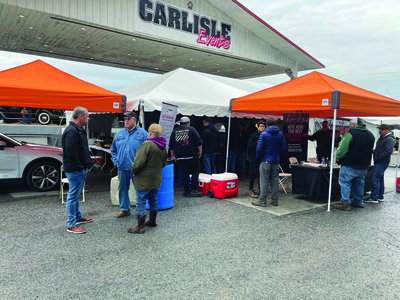
ARMO’s Hot Products Showcase returns to Spring Carlisle, April 19–23.
This year’s event is on tap for April 19–23. For members of SEMA’s Automotive Restoration Market Organization (ARMO), Spring Carlisle marks the return of the ARMO Hot Products Showcase.
The Showcase is an exclusive ARMO-member benefit. The annual activity affords participating member companies a singular opportunity to spotlight new innovative products to a vast enthusiast audience and vie for awards in various categories.
Showcase participation is simple, economical and high value. Any restoration product from a member company may be displayed. Members are responsible for shipping costs, but there is no entry fee. Brand-new products are eligible to receive an award provided they’re available for sale and demonstrate unique or innovative technology and/or significant value to the restoration market.
The Showcase tent is situated in a high-traffic area. SEMA staff and ARMO select committee members will be on hand to answer questions. Enthusiasts get to vote for their favorite new product in each category. Award winners will be recognized at the ARMO Industry Reception during the 2023 SEMA Show.
Chair Randall Bates predicted another successful venture. “Carlisle is always a huge success for ARMO. I cannot say enough about the help and support we receive from Carlisle Events and it’s a huge benefit to our members.”
Emphasis on Education
To help members navigate and adapt to changes in the automotive landscape, from social-media protocols to car show best practices and beyond, ARMO has hosted webinars and Live Chats, including “How to Navigate Swap Meets and Car Shows,” moderated by Chair-Elect Joanna Agosta Shere.
To round out last year’s webinars, ARMO presented the “Three Cs of Social Media: Content, Calendar and Channels,” moderated by David Alkire of Restoration Parts Unlimited with panelists Dan Kahn of Kahn Media and Barry Alt of Motorhead Digital.
Three webinars are lined up for this year. Topics include “Supply Chain: Facing Domestic and International Challenges,” “Sponsorship Tips: Making Sponsorships Exceed Your Expectations” and “What Can ARMO Do for Your Business: An Overview of Membership Features and Benefits.”
“We put a lot of time and effort into finding the most knowledgeable people in the industry to speak to these subjects on behalf of ARMO,” said Bates. “The sessions are free and for just one hour of your time, you’ll get valuable information to help grow your business.”
 Emerging Trends & Technology Network (ETTN)
ETTN Spotlights Symposium, Education, Recognition
Listen up, engineers and product developers! Emerging Trends & Technology Network’s (ETTN’s) N.E.R.D. Symposium is returning to the SEMA Garage in Detroit, August 16–18.
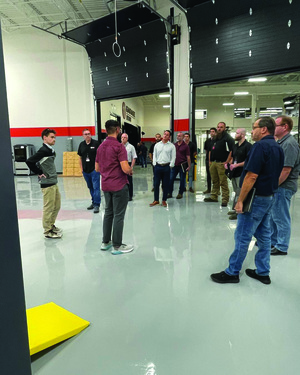
ETTN’s N.E.R.D. Symposium is returning to the SEMA Garage in Detroit, August 16–18.
Debuted last year by ETTN, the event—whose acronym stands for Networking, Education, Resources and Development—is designed to facilitate the continued development of innovative aftermarket products.
“Our focus is on helping engineers in our industry improve product-development processes,” said Chair Rob Simons. “Because there aren’t many opportunities to bring engineers together, the Symposium was well received. Feedback was phenomenal and we’re excited to bring the event back to Detroit.”
Tech Talk
Both days are devoted to attendee meetings with product and service providers and subject-matter experts, high-level educational content, technical training and networking opportunities.
Last year, seminars were held concurrently, requiring attendees to choose between two sessions. Seminars will be held both in the morning and afternoon on Thursday and Friday and available to all attendees.
Stay tuned for program and registration details. Questions? Email SEMA Council Director Nicole Bradle at nicoleb@sema.org.
Online Learning
To provide members with knowledge of emerging vehicle trends and new technologies, ETTN is again preparing a webinar lineup. Each session will dive into a specific area of interest.
Proposed topics include battery management systems, functions and calibration, an introduction to CAN network debugging, plus two ADAS-centric sessions. Details to be announced.
Rewarding Innovation
Numerous new products earn awards during the SEMA Show, from packaging design and electric vehicle product to exterior product and engineered new product. But there’s never been an award that recognizes engineering quality of a specific vehicle. Until now.
Thanks to a recently approved ETTN proposal, the SEMA Best Engineered Vehicle Award will be presented during this year’s Show. The award was established to recognize a vehicle displayed at the Show for the quality of engineering of the entire vehicle or an aspect of the vehicle that goes beyond outward appearance.
As a prime example of design and engineering ingenuity, Simons cited a custom build by Dave Kindig, Kindig-it Design. The radical conversion transformed a ’67 Chevy C10 pickup into a power-operated convertible.
“We want to build early awareness of this award so that people who are in the process of vehicle builds in preparation for the Show can think about incorporating features that might qualify for this award,” said Simons.
Program details to be announced. Advance registration is recommended to ensure judges can locate eligible candidates on-site at the Show.
 Future Leaders Network (FLN)
FLN and Dale Carnegie to Present Skill-Building Professional Development Program
When the Young Executives Network (YEN) was rebadged as the Future Leaders Network (FLN) early last year, the new name more accurately reflected FLN’s goal of cultivating future industry leaders through networking and learning experiences. In a bold move aligned with its vision, FLN partnered in March 2022 with Dale Carnegie to present its first-ever Professional Development Program at the SEMA Garage in Diamond Bar, California.
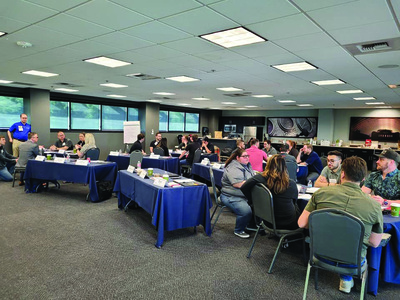
This year’s FLN Professional Development Program is slated for May 11–12 at the SEMA Garage in Detroit. It will be facilitated by Dale Carnegie trainers.
The concept was inspired by Chair Nick Caloroso’s experience as an enrollee in a Dale Carnegie leadership training course. The two-day inaugural FLN program—an abridged version of a 12-week course—was open to network members only and limited to 25 attendees. The interactive format, which included a networking component, was designed to introduce concept with practice and coaching for workplace application.
“As much as people think of Dale Carnegie as a public speaking course, it’s not,” noted certified Dale Carnegie Trainer Brett Campbell, who facilitated the program. “It’s a leadership course. It’s about building confidence, becoming an effective communicator, how to lead through change and how an individual can be the best possible representative of their company, both internally and externally.”
Given the success of the inaugural event, the program has been greenlighted for 2023.
Leadership Skills to Advance Careers
This year’s program is slated for May 11–12 at the SEMA Garage in Detroit. It will be facilitated by Dale Carnegie trainers. Once again, attendance has been capped at 25 FLN members, creating an intimate environment conducive to networking and engaging discussions.
Program content covers multiple leadership skills essential to career
advancement and high achievement. Core learnings include sharpening communication skills, confidence building, nurturing and sustaining relationships and using emotional control to sustain success. The event also features an evening networking activity.
“Our mission has always been to support our members in their career-advancement journey,” said Caloroso. “There has been a lot of buzz in advance of the program. We’re excited at how quickly the event is filling up and have every expectation it will be successful.”
As Caloroso’s chairmanship draws to a close, he is proud of his role in shepherding the program and optimistic for its future. “Our goal has always been for people to see this as a value add for our members and for the companies that invest in their employees’ future. I’m really pleased that my legacy will be this program and that Chair-Elect Matt Beenen is very engaged in and committed to the continuity of the program.”
 Hot Rod Industry Alliance (HRIA)
Advocating the Benefits of HRIA Membership
Since its inception, the Hot Rod Industry Alliance (HRIA) has concentrated on ensuring the future of the industry by providing resources, tackling challenges and raising awareness of the hobby. To this end, HRIA addresses industry-specific issues, creates networking and marketing opportunities and offers in-person and virtual education.
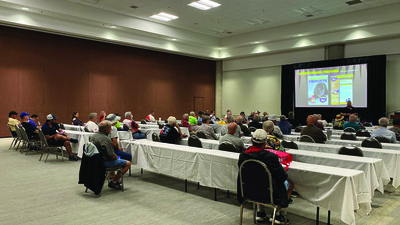
HRIA Education Days offer member manufacturers a chance to present seminars, interact with consumers and give enthusiasts a chance to learn from, and connect with, top manufacturers.
HRIA also works with SEMA’s legislative office on regulatory and legislative matters, which may impact the hot-rod industry—such as a new federal regulation that allows replicar businesses to produce limited-production turnkey vehicles.
These benefits and others, said Chair Danny Agosta, provide value. To help current members and prospects gain a better understanding, HRIA presented a webinar on March 7 titled “Exploring Your Member Benefits.”
“We want HRIA to be the go-to resource for members, getting into the nuts and bolts of business education and operational topics for small shops,” said Agosta. “You can take a business class anywhere. But when it comes to what our folks do, it’s niche—how to fill jobs, compete for talent, deal with inventory and supply challenges.”
Furthermore, he added, “People get a lot of benefits through SEMA they’re not aware of—group insurance, freight discounts, research data that we’ll dive into and be that beneficial resource for our members.”
Future webinars are scheduled for May 9, October 10 and December 14. Topics to be announced.
Encouraging Engagement
Last year, HRIA hosted its first council mixer at Back to the Fifties Weekend in Minneapolis. The event, produced by the Minnesota Street Rod Association (MSRA), is slated for June 23–25.
“Last year was phenomenal. I was blown away by the number of cars and the vibe, and we’re excited to return,” said Agosta. “For our select committee, it’s a networking opportunity, a recruiting opportunity and a thank you to our members.”
HRIA has participated in the National Street Rod Association (NSRA) Nationals for years, where it hosts two events: Education Days seminars and a networking mixer. Education Days offers dual benefits: it allows member manufacturers to present seminars and interact with consumers. It gives enthusiasts a chance to learn from and connect with top manufacturers.
Prior to both mixers, the select committee walked the shows and invited HRIA members and nonmembers. “The Back to the Fifties mixer was the best event we’d ever done. We did the same [outreach] in Louisville and had another record attendance. Just another way to engage members and for them to experience being part of HRIA.”
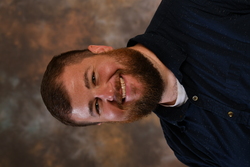
“We want HRIA to be the go-to resource for members, getting into the nuts and bolts of business education and operational topics for small shops.” —Danny Agosta, HRIA Select Committee Chair
 Motorsports Parts Manufacturers Council (MPMC)
MPMC Salutes Hall of Famer, Schedules Webinars
The Motorsports Parts Manufacturers Council (MPMC) ended 2022 on high note at the Performance Racing Industry (PRI) Trade Show, where the group hosted the MPMC Hall of Fame Reception in collaboration with the Future Leaders Network (FLN).
During the Show, select committee members visited 60 exhibiting member companies to thank them for their support and to hand out goodie bags. Chair Melissa Scoles also noted that PRI business members are now eligible to join MPMC.
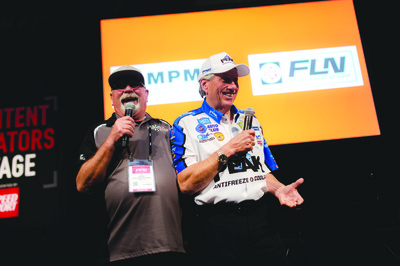
MPMC Hall of Famer Vic Wood (left) and John Force at the 2022 PRI Trade Show.
“PRI is part of the SEMA organization, so we’re happy to extend the benefits of MPMC membership to PRI business members that are motorsports parts manufacturers.”
Toast of the Town
The awards reception is always a big draw. “It was well attended,” said Scoles, with attendance estimated at about 300. “We were excited to host the reception with FLN. We wanted to bring in the younger demographic and introduce them to some industry legends.
The awards ceremony honored industry luminaries. In recognition of contributions to the council and the motorsports community, Immediate Past Chair (IPC) Rob Fisher received the MPMC IPC Award. “It was an honor to thank and recognize Rob for his leadership and support of MPMC,” said Scoles.
Vic Wood, who began his motorsports career more than 40 years ago in his native Australia, was inducted into the MPMC Hall of Fame in tribute to his dedication to, and passion for, racing and the aftermarket industry. To Wood’s delight, a surprise guest, famed drag-racer John Force, presented the award and entertained the audience.
“We couldn’t think of a more deserving person to induct into our hall of fame than Vic,” she added. “We were delighted to surprise Vic with his longtime friend John Force, who introduced the award and told some colorful stories.”
Continuing Education
To help keep members informed of relevant issues, MPMC has lined up three webinars. The January session, held before the MPMC Media Trade Conference, was titled “Working With Content Creators and Social-Media Influencers.” The session focused on how manufacturers and content creators can best work together for mutual benefit.
A webinar on emissions control is slated for the second quarter, with the third-quarter session to address product prototyping. “It’s important to emphasize we’re creating these webinars to add additional value to our members,” said Scoles. “We’re always looking for relevant topics important to motorsports parts manufacturers.”
 Professional Restylers Organization (PRO)
Professional Restylers Organization Hosts PRO Cup Challenge Styling Competition
Voted Best of Show, Built2Wanders’ ’22 Jeep Wrangler Rubicon 392 XR was displayed outside the South Hall minus one wheel and tire assembly to allow Showgoers to look underneath the vehicle.
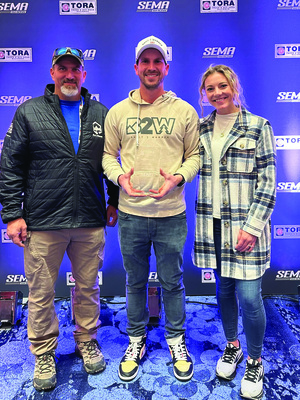
Matt Thompson, owner of 3D Off Road, joined Built2Wander’s Collin and Jessica Coates in celebrating their win.
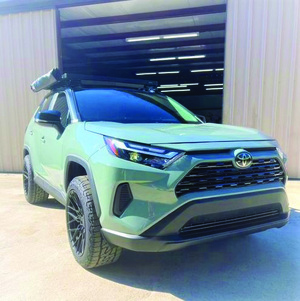
The Weekender, Hannah Coulter’s modified Toyota RAV4 XLE, took the top prize in the 2022 PRO Cup Challenge.
With seven customized vehicles vying for awards at last year’s SEMA Show, the stage was set for the Professional Restylers Organization (PRO) Cup Challenge. To qualify, accessory packages had to be easily replicated, have broad consumer appeal and designed for dealership display.
Restylers Hannah Coulter of Automotion Customs Inc. and Top Coverage’s Courtney Pahlke earned bragging rights. The Weekender, Coulter’s modified Toyota RAV4 XLE, won the Challenge. The fan favorite award went to Pahlke’s Legacy Edition all-electric Ford F-150 Lightning.
Built for Mass Appeal
Coulter’s father, Shane, established Automotion Customs Inc. in Warner Robbins, Georgia, in 1998. “I’ve been around the business my entire life and always knew it was what I wanted to do,” she said. She now manages the company, having earned a business management degree from the University of Georgia.
Last year, Crush Customs’ Chelsea Allen, a PRO select committee member, urged Coulter to attend a membership meeting. “I learned a lot about PRO and wanted to be in the PRO Cup Challenge. It snowballed from there.”
After conferring with her dad and shop Manager Tyler Nelms, they settled on the RAV4. “My dad had a huge influence on the decision. I wanted to do a Toyota 4Runner. He said we needed a vehicle that would appeal to the masses.
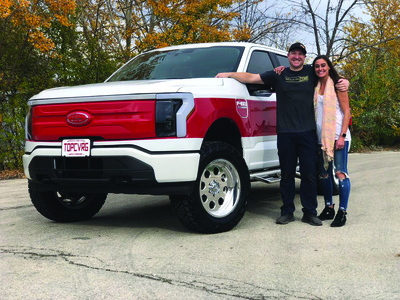
Garrett and Courtney Pahlke with their retro-styled Legacy Edition Lightning, voted fan favorite.
“I knew my team could crush it. We have a great relationship with the dealer, so it was easy to sell our idea. I was super excited when we won and proud of the phenomenal work my team put into the build.
“It’s important for the public to know when they buy a [customized car] that there are companies behind the scenes that do the work. The Challenge does an extraordinary job of showcasing that. It’s boosted our business in more ways than one.”
Honoring Heritage
Pahlke and her brother Garrett co-own Top Coverage with their father Henry, who founded the Chicago-area shop in 1975. As a youngster and college student, she worked there part-time, then majored in journalism at the University of Iowa.
When the Great Recession hit and business slowed, Pahlke shifted gears. “I saw everything my dad had built and the hard work he’d put into it. I wanted to keep it going and growing.” She now oversees a new satellite facility in Oconomowoc, Wisconsin.
The decision to enter the Challenge was driven by the shop’s location. “We had a fresh start. We wanted to specialize in showroom cars and design. We knew from our Illinois shop that our designs were getting noticed and was a way to get dealer business here.”
To test those design skills and public reaction, Pahlke’s team conceived a throwback theme honoring the F-150’s heritage. “We wanted the public’s vote. We knew it was risky to take an EV and give it a retro look of a truck with an ICE engine.
“So much thought went into the build. We put our design skills to the test. Winning the fan favorite award was amazing and affirmation that our research paid off.”
 SEMA Businesswomen’s Network (SBN)
From Hosting a Leadership Forum to Forging New Alliances, SBN Takes the Lead
Women have been making their mark in the aftermarket industry for decades. But while many have achieved significant success, the journey has been—and continues to be—fraught with challenges. Whether it’s attaining work-life balance, forming sustaining relationships with other professional women, mastering leadership skills or being one of a handful of women in a corporate boardroom.
These and other issues are at the heart of the SEMA Businesswomen’s Network’s (SBN) mission to provide female professionals with resources to advance their careers. And SBN has a track record of presenting multi-faceted networking and educational opportunities.
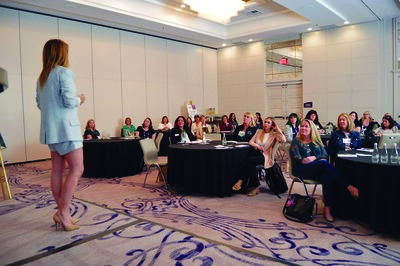
SBN held the 2023 Women’s Leadership Forum March 1–3, during International Women’s Month.
Determined to provide a more immersive experience, SBN launched its Women’s Leadership Forum last year. The inaugural event, held at the Avenue of the Arts Hotel in Costa Mesa, California, gave industry women opportunities to improve their skill sets through education, mentorship, breakout sessions and networking.
SBN held the 2023 Women’s Leadership Forum March 1–3, during International Women’s Month. The event, held in the same locale as last year, featured the theme “Dare to Lead.” The content centered on inspiring leadership, encouraging women to elevate their professional impact and fostering community among SBN members.
“Our mission has always been to help women in our industry advance their careers,” said Chair Cathy Clark. “We are excited by the opportunities we’ve created for our members to expand their knowledge and leadership skills.”
Bridging the Gap
As important as it is for women to lift each other up, serve as mentors to young female professionals and sharpen their own leadership skills, ultimate success also depends on building bridges to others who can provide support and champion women—especially in what is still a male-dominated industry.
Male allies are critical to advancing gender equality. With this thought in mind, SBN has embarked on a new initiative to nurture and cultivate male allies. The goal, said Clark, “is to provide resources to educate men on how to be that ally or mentor to women in their company or the industry.”
To kick start the initiative, SBN scheduled three male ally-centric webinars from April through September. Each interactive session includes a panel discussion. Discussion points covered a range of topics: why it’s important to be an ally, why supporting women can attract talent and improve employee retention, how females can support the program and real-world examples of successes and failures when supporting women.
In formatting the webinars, SBN teamed with male colleagues known for championing women. “Men are a driving force in the program,” said Clark. “There are men on the Male Ally Subcommittee who are helping to determine the content. It’s a joint effort. Having men who have been champions for women share examples of how they’re doing that is an essential part of the program.”
 Truck & Off-Road Alliance (TORA)
TORA Feature Vehicle Program
The TORA Feature Vehicle Program is a centerpiece of the Truck & Off-Road Alliance’s (TORA’s) SEMA Show activities. The customized trucks that make the cut are judged by Showgoers whose votes determine which vehicle will win an award.
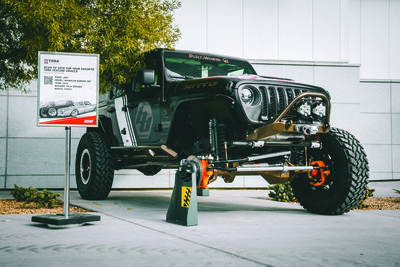
The Wrangler Rubicon 392 XR was named TORA Best in Show.
Collin Coates’ ’22 Jeep Wrangler Rubicon 392 XR was named TORA Best of Show, surpassing nine competitors. “When I started building Jeeps, my dream was to have a vehicle at the Show. It was very exciting to win, because it showed our dedication to quality components and the attention to detail we put into our project vehicles.
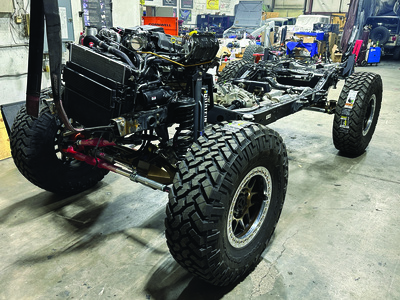
The rolling chassis after the body had been removed from the frame. The build took three weeks and more than 200 hours to complete.
“It’s one thing to have the vision. Fortunately, I had the help of Matt Thompson at 3D Off Road, Baja Designs that displayed our Jeep, plus all the partners that supported the build, to bring that vision to life.”
From Four Wheelers to 4x4s
Coates has been building project vehicles, displaying at consumer shows and creating marketing content and video assets for aftermarket product sponsors for a decade. A passion fueled at a young age.
As a youngster, he road dirt bikes and four-wheelers. At 19, he modified his first Jeep. After relocating from Ohio to California, Coates orchestrated a trade-off with an off-road shop, whereby they sourced products in exchange for displaying his newest Jeep builds at car shows.
Coates and his wife Jessica now reside in Denver. He teams with 3D Off Road, which specializes in custom fabrication. To help build a brand identity for each unique build, he launched Built2Wander in 2018.
Each build is a collaboration. Coates designs the build, sources the parts, helps at the shop and provides marketing services. 3D Off Road handles the fabrication and assembly. Coates chose the Wrangler Rubicon 392 XR for its factory V8.
“I wanted to build something more extreme. That platform made sense because it’s the only Jeep that can go fast in the desert, do rock crawling and has the power to turn a 42-in. tire.”
The build took three weeks and 200 hours to complete. It features products from 30-plus sponsors and required 3D Off Road to remove the body from the frame and rebuild the vehicle from the frame up.
In reflecting on the project, Coates said, “I enjoy the process of taking a factory vehicle and fully modifying it. Matt and I were proud to have the vehicle on
display and to win the award. It gives us credibility and our partners are proud their components were displayed and recognized.”
 Wheel & Tire Council (WTC)
Education, Networking Add Value for WTC Members
Resources to expand members’ knowledge, improve their business practices and grow their networks are essential elements of the Wheel & Tire Council’s (WTC’s) mission. “I believe that everything we do should bring value to our members through education and networking,” said WTC Chair Todd Steen.
To help members gain an understanding of key issues pertinent to the aftermarket wheel and tire sector, WTC lined up four webinars.
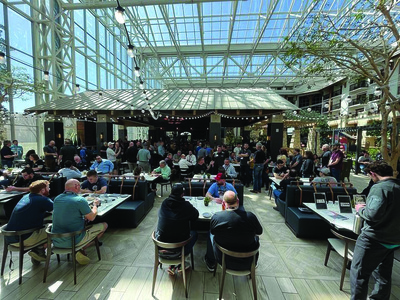
WTC members caught up with friends and made new connections at the cross-council mixer held at the Keystone Big Show in Aurora, Colorado, last February.
To prepare for an influx of electric vehicles and the implications for aftermarket wheel and tire fitments and processes, WTC will tackle “The Hows and Whys of Bringing Aftermarket EV Wheels and Tires to Market.” Two other sessions are also on tap.
Steen also noted the importance of trends, specifically wheel design, fashion and the influence of consumer preferences. The topic will be explored in “How to Design the Latest Wheel Fashion.”
The fourth session addresses “Data Is the New Oil: How the Tire and Wheel Industry Can Benefit From Being More Data Driven and Save Billions of Dollars.” Steen said the webinar will dive into how data drives the industry for wheel and tire manufacturers and how to use data to prepare for critical matters, such as supply-chain interruptions and inventory challenges.
“The biggest takeaway from a class or professional development is what you make of it,” said Steen. “We’re sharing information that we believe is valuable to our members and their businesses.”
Growing Members’ Net Worth
WTC recently hit the road. In February, at the King of the Hammers in Johnson Valley, California, the council teamed with the Future Leaders Network (FLN), TORA, Truck & Off-Road Alliance and SEMA Businesswomen’s Network (SBN) to co-host a networking mixer.
WTC members had a chance to catch up with friends and make new connections at another cross-council mixer. The February event, held during the Keystone Big Show in Aurora, Colorado, also included co-hosts FLN, TORA, SBN and the Professional Restylers Organization (PRO).
Helping members expand their personal and professional networks is top of mind for both Steen and WTC. “I’m a firm believer that your net worth is determined by your network,” he stated. “With that, WTC offers value to members by providing opportunities to grow their network and make their business cards work for them.”


 West Virginia Governor Jim Justice signed into law the SEMA-supported Motorsport Responsibility Act, which defines areas of responsibility and assumed risks for both participants and recreational and commercial motorsports facilities. This key legislation was spearheaded by State Automotive Enthusiast Caucus members, including Del. Paul Espinosa and Sen. Mark Maynard. Caucus Chairman Emeritus Del. Gary Howell also served as a cosponsor of the bill.
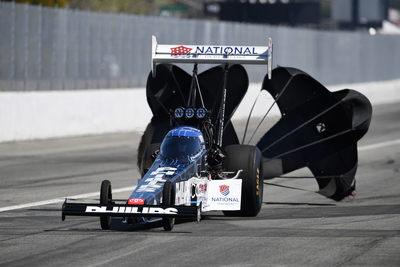 In a rematch of last year’s Top Fuel final round at the Lucas Oil NHRA Winternationals, Justin Ashley picked up his second straight win at the storied event, powering past Austin Prock last Sunday at In-N-Out Burger Pomona Dragstrip. Matt Hagan (Funny Car) and Dallas Glenn (Pro Stock) also won the third of 21 races during the 2023 NHRA Camping World Drag Racing Series season.
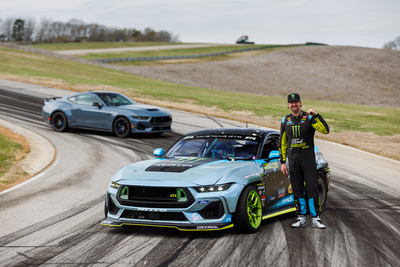 Sharing DNA with the all-new, seventh-generation ’24 Ford Mustang, Ford, Vaughn Gittin Jr. and RTR Vehicles revealed the newest Formula DRIFT Spec 5-FD competition Mustangs. Two-time Formula DRIFT Champion, Gittin Jr., also announced his return to the sport after a year’s absence. Working in parallel with Ford, RTR has been developing three Mustang RTR Spec 5-FDs with entirely new exteriors based off the Mustang production car.
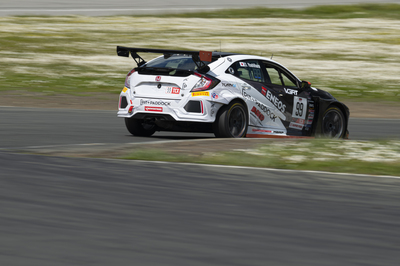 Daijiro “Dai” Yoshihara’s first wheel-to-wheel racing effort in TC America has created a splash with Pit+Paddock, ARP and ENEOS as early supporters of his campaign. Yoshihara made his official race debut with the Florida-based Victor Gonzalez Racing Team (VGRT) at Sonoma Raceway last Saturday. Pit+Paddock, ARP, and ENEOS represent a significant trio of title sponsors for Yoshihara’s SRO campaign, while Turn 14 DistribuIon, PowerStop and MBRP bolster this inaugural effort as supporIng sponsors.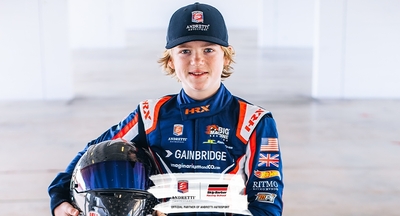

 2023 marks the 100th anniversary of Carroll Shelby’s birth. The milestone will be celebrated in a number of ways, from a Centennial-Edition Mustang by Shelby American to a tribute to his life and cars at the Goodwood Revival in England this fall.
 Along with SEMA’s work in government affairs, trade events, and professional advancement programs, it’s long been a top priority to help businesses make data-driven business decisions by means of targeted research. The goal is to help members understand the size and scope of the industry, and help define investment opportunities, segment by segment.