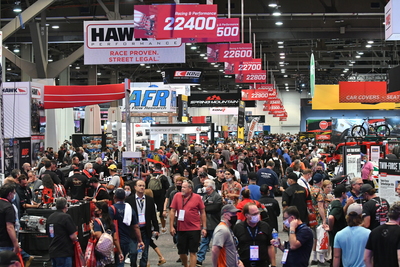
Here's a look at some of the 2021 SEMA Show's Ford Bronco custom builds, rugged and ready overlanding vehicles, and classic machines with electric motors.
Ford Broncos
Saying that there was a stampede of new Ford Broncos at this year’s SEMA Show isn’t just a clever pun because they were everywhere. With Bronco availability still limited and aftermarket parts just hitting the market, a lot of that herd looked similar. Most only had wheels, tires and a couple of other modifications as companies that were lucky enough to get a Bronco rushed to build them. While there is nothing wrong with a Ford Bronco off the factory floor, the SEMA Show isn’t known for lightly-built vehicles. Check out these eight highly modified Broncos from the 2021 SEMA Show.
Track Attack Bronco
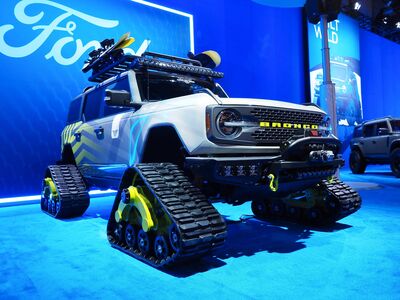
Tucci Hot Rods started with a ’21 Ford Bronco Badlands and went to work transforming it into a showstopper. First to go on was a Fox coilover suspension that clears the way for the attention-grabbing Mattracks 88 Series tracks. We doubt a Bronco on mini-tank tracks would ever get stuck, but a Warn Zeon 10-S winch mounts to a custom front bumper just in case. A mixture of Rigid Industries Adapt and E-Series lights also reside in the front bumper. On top of the Bronco sits a Yakima rack with Exo Snowback mounts for four snowboards and more Rigid Lights. A custom vehicle wrap makes finding the Bronco in a parking lot even easier.
Maxlider Brothers Customs Bronco
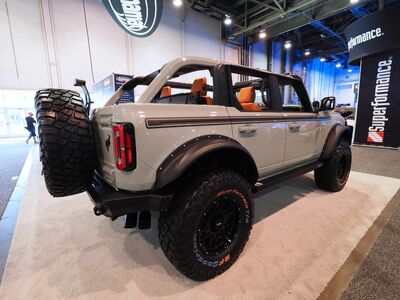
Maxlider Brothers Customs is well-known for making extremely clean, functional and absolutely beautiful early Broncos. It took that same approach with this ’21 Ford Bronco Wildtrack, tastefully modifying it without going overboard. Providing extra altitude is a BDS 4-in. suspension system with Fox 2.5-in. Performance Elite Series reservoir shocks. The new suspension system and Maxlider’s Vintage fender flares clear the way for 37-in. BFGoodrich KM3s on 18-in. Maxlider wheels. Guarding the front of the clean Bronco is a Maxlider bumper that incorporates the factory sensors and houses a Warn Zeon 10-S winch. Additional protection comes from Rock Slide Engineering sliders and a rear Maxlider bumper that carries a full-size spare. Other unique modifications include an Advanced Fiberglass Concepts cowl hood, a backlighted grille, Maxlider’s windshield-mount light bar and a custom leather interior.
DelFab Solid-Axle Swap Bronco
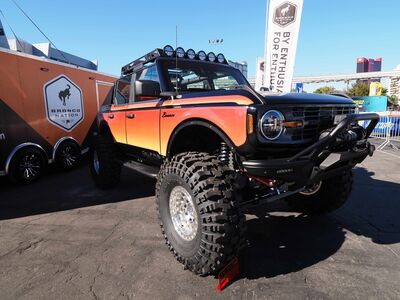
Using an independent front suspension hard in gnarly terrain can result in lots of broken parts. With hard use in mind, DelFab Fabrication decided to ditch the Ford Bronco’s IFS to gain more strength and extra articulation. With limited space to work with, a new radius-arm suspension was fabricated front and rear with Fox coilover shocks. Axles from a ’08 Ford Super Duty with 5.38 Yukon gears and lockers are attached to the flexy suspension. Screwed to the ends of the axles are bulbous 40-in. Mickey Thompson Baja Pro XS tires wrapped around 17-in. KMC beadlocks. The rest of the big Bronco features a 4WP front bumper with a Smittybilt winch, 4WP sliders, and a Racktec roof rack with Rigid Industries lights. And, you have to dig that retro-themed paint job, too.
Ultra4 Bronco
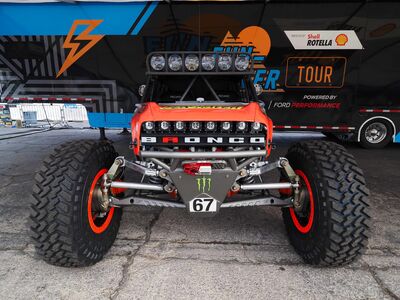
Calling Loren Healy’s full-tilt, tube-frame Ultra4 racer a Bronco might be a bit of a stretch, but it does use a Bronco-inspired body and is damn awesome, so it’s included on this list. Underneath that fiberglass hood rests a very healthy Ford V8 big block that pumps out 780 hp and enough torque to reverse the rotation of the Earth. A Holley fuel injection feeds the beast of an engine race gas while twin Optima Yellow Top batteries make sure it always cranks over. Like the rest of the chassis, all the suspension is custom fabricated (including the sexy billet upper A-arms) using Fox coilovers and bypass shocks for 20 in. of front wheel travel and 25 in. in the rear. Massive 42-in. Nitto Trail Grappler M/T tires on 20-in. Weld beadlocks attempt to put all that power to the ground.
BDS Fire Command Bronco
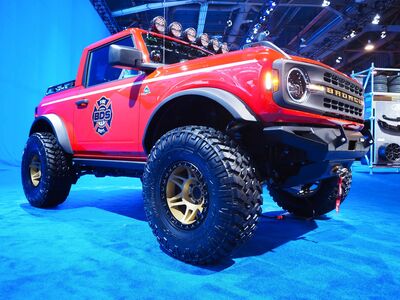
Built by BDS Suspension, the Fire Command Bronco’s mission is to get rescue and fire personnel into remote areas and rugged terrain. BDS started with a two-door Bronco and then converted it to a half-cab as a nod to the original Broncos. Other custom touches include a drop tailgate conversion, a fabricated roll cage, and a one-off tonneau cover. A CargoGlide tray provides easy access to gear, first-aid equipment and radios, while a chainsaw, axe and ARB Jack reside in a Yakima basket. Helping the Bronco go anywhere is a BDS Suspension 4-in. suspension with Fox 2.5-in. Performance Elite Series coilovers. The extra altitude clears 37-in. Nitto Trail Grappler M/T tires on 17-in. Method beadlock wheels. A full suite of armor includes Crawltek bumpers and sliders to protect the Bronco wherever it responds.
Havoc Off-Road Bronco
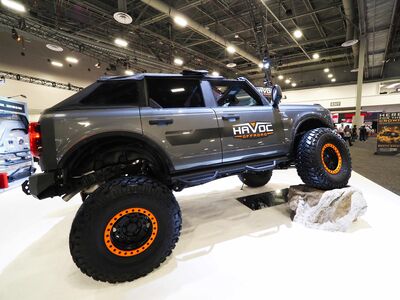
With massive 40-in. Nitto Trailer Grappler M/T tires on 17-in. Black Rhino wheels, the Havoc Off-Road Bronco turned lots of heads. A 6-in. Superlift Suspension Black Diamond system makes room for the big tires while adding flex. N-Fab sliders with built-in steps help the vertically challenged climb into the big Bronco and protect its rocker panels. Additional protection comes from Havoc Off-Road front and rear bumpers with Bushwacker Trail Armor guarding the corners. The Bronco’s very clean looks come courtesy of a Bushwacker Fender Delete system, an AVS light shield, a Rampage Fastback soft top and a Havoc Off-Road Spare Tire Delete.
Fun-Runner Bronco
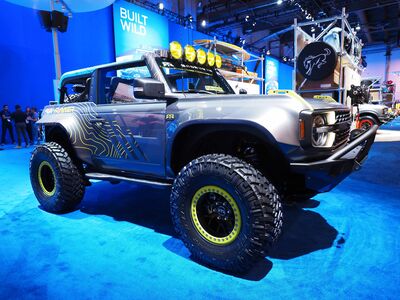
The Fun-Runner is the result of a collaboration between RTR Vehicles and the Fun-Haver off-road team of Vaughn Gittin Jr. and Lorean Heally. Fun-Haver composite front and rear fenders give the Fun-Runner an aggressive look and provide clearance for 37-in. Nitto Trail Grappler M/T tires on 17-in. RTR wheels. Other visual upgrades include an RTR grille with integrated lighting and an RTR graphics package. The Fun-Runner isn’t just for show as a Dana Ultimate 60 rear axle and Spicer Extreme CVs add lots of strength. Rock sliders and a rear bumper from RTR along with a Fun-Haver front bumper allow the Fun-Runner to cruise the trails without crunching its unique body.
Camburg Bronco
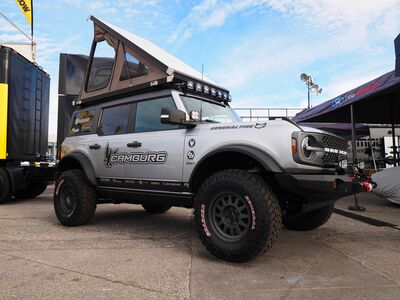
Camburg is known for its high-quality suspension systems but has a knack for building clean and functional project vehicles. With just the right amount of mods, Camburg’s Ford Bronco follows that trend. Fox 2.5-in. Performance Elite Series shocks and coilovers paired with Camburg’s swanky billet upper control arms help absorb the bumps. Providing additional traction and puncture resistance are 35-in. General Grabber X3 tires on 17-in. Methods. Two Baja Designs LP9 lights on the front Warn bumper and 7 XL lights on the roof allow the Bronco to keep exploring after dark. Extraction from any stuck is possible via the Warn Evo 10-S winch. After a long day on the trail, the Go Fast Camper deploys rapidly for a comfortable place to spend the night.
Electric Vehicles
While the thousands of vehicles and sea of people can be overwhelming, it is easy to spot trends. One of the biggest this year is the rise of EVs. These aren’t factory Teslas or Fords, but completely custom vehicles that use electric drivetrains. Never before have we seen so many battery packs and motors replacing gas engines in old-school rides, hot rods, slammed trucks and sports cars. While the death of the V8 isn’t at hand, more builders are embracing going electric than ever before. Here are seven wild EVs at the 2021 SEMA Show.
James Marsden’s Electric Electra
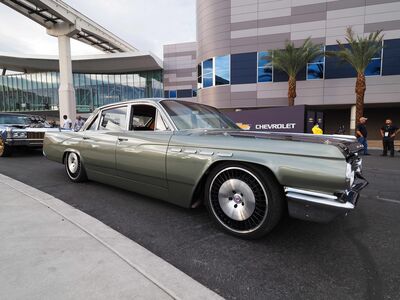
A massive luxury car from the ’60s might seem like an odd choice for electrification, but for actor James Marsden, the choice was all about giving back. Marsden’s brother-in-law and longtime friend Will had recently been forced to sell his grandmother’s prized Buick Electra. Teaming up with Ant Anstead from Discovery’s new show, “Celebrity IOU: Joyride,” Marsden tracked down a ’63 Buick Electra to restore and give to Will.
Electrifying the Electra was a gigantic project. The closest electric vehicle in dimensions to the extremely full-size Electra was a Karma Revero. After a trip to the local Karma dealer, the team quickly went to work removing most of the structure of the brand-new Revero. If mating the body of the old Electra to the new Karma sounds complicated, that’s because it was. Once fitted, the Karma Electra headed into the paint booth for a beautiful application of Aston Martin Sage Green. A custom carbon-fiber hood and trunk lid, one-off 21-in. HRE wheels, and a gorgeous interior completed the Electra. The build was an insane amount of work, but the result is one of the most unique electric vehicles out there.
Porsches Powered By Electric GT
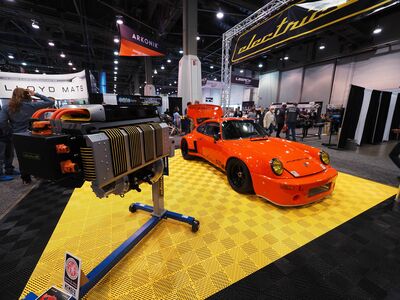
On the opposite side of the size and performance spectrum from a bulbous Buick is this Porsche 911 built by Electric GT. Rather than being a custom one-off, Electric GT makes packages to convert any 911, 912 or 964 into a fully electric P-Car. The heart of the package is a Tesla motor paired with Electric GT’s own unique liquid-cooled batteries. A host of other Electric GT components create a plug-and-play installation that is non-destructive and relatively straightforward.
Ditching Porsche’s gas engine for electric might seem like a head-scratcher to some, but it nets 435 hp and 450 newton meters of near-instantaneous torque. Improving handling is a 60/40 weight distribution with minimal weight gain. One-hour fast charging is also part of the Electric GT package with a 160-mile range. Two different battery power levels are available, but either will produce an extremely fast and capable Porsche.
Salvage to Savage ’85 Chevy Truck
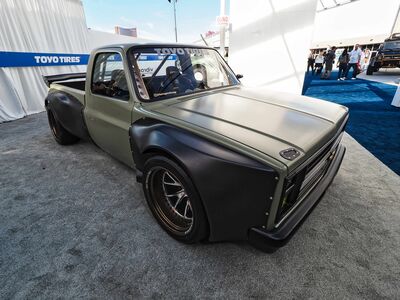
Easy to work on with tons of aftermarket parts availability, old Chevy trucks are a dream for any builder, but Salvage to Savage (YouTube Channel) decided to take a completely unique path with its ’85 Chevy C10. Instead of using the tried-and-true V8 engine, the team yanked the electric drivetrain out of two Teslas to create a twin-motor, all-wheel-drive beast.
If that wasn’t enough work, a fabricated frame houses the new drivetrain and utilizes an aftermarket C5 Corvette suspension. The interior is completely custom with a tablet that mimics the Tesla’s, but with an interface built specifically for the truck. A lever allows instant engagement of the regenerative braking system to help slide the truck around corners. Salvage to Savage made its own carbon fiber widebody kit for a wide-and-mean look and to fit larger tires. Extra-thick Toyo Proxes tires wrapped around Finspeed wheels attempt to put all that torque to the ground. The amount of detail and work that went into the Chevy is as mind-blowing as its acceleration.
Plymouth Satellite by Kevin Erickson
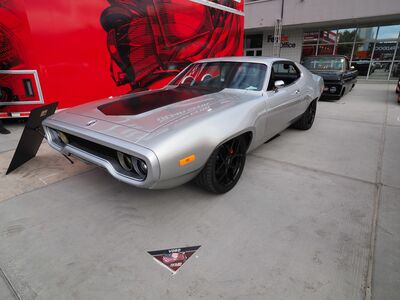
Want to create controversy and possibly make a few enemies in the Mopar community? Build a Plymouth Satellite and put a modified Tesla powertrain in it. That is exactly what Kevin Erickson did with this beautiful ’72 model. Some may call it blasphemy, but gobs of torque, 600 hp, and lightning-quick acceleration might change a few minds.
Making the big Plymouth move quickly is a modified Tesla Large Sport Drive Unit paired to a Tesla 102 kWh battery. The Tesla motor is liquid-cooled while air-conditioning keeps the battery’s temperature in check. Even without the aerodynamics and skinny tires of a Tesla, the Satellite has a 250-mile range and can accelerate to 60 mph in under four seconds. Not bad for an almost 50-year-old car.
Electric Snake
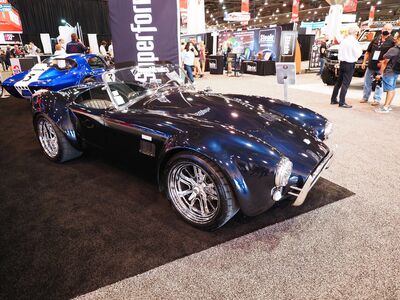
Shelby Cobras are known for waking up whole city blocks, and Superformance is known for building high-performance continuation Cobras under license from Carroll Shelby. The new MKIII-E is a very different snake. Gone are the signature side-pipes, rowdy V8 engines, and blown eardrums usually associated with Cobras. Instead, a Tesla motor resides in the trunk with a custom battery unit under the hood.
An electric version of one of the most iconic V8 muscle machines ever made might seem like a stretch, but Superformance says it made the car in response to customer demand. With 1,500 lb.-ft. of torque on tap, it is easier to understand that demand. Acceleration is staggering, and Superformance is even evaluating a twin-motor setup to offer more performance and all-wheel drive. The dimensions of the electric Cobra are the same as Superformance’s other Cobra offerings with the same suspension and handling characteristics, just in a much faster and quieter package.
Gateway Bronco
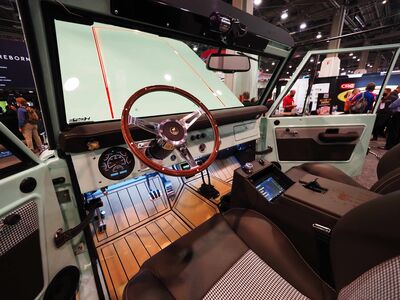
This year the new Ford Bronco was all the rage at the SEMA Show, but old school has always been cool. Proving that point is this early Bronco from Gateway Bronco that skillfully blends old with new. Known for its custom and ground-up builds, Gateway Bronco decided to take the Luxe-GT even further and electrify it.
To create an EB EV, Gateway enlisted the help of Legacy EV using their 108 kWh battery pack and a Danfoss electric motor. The combination produces the horsepower equivalent of a high-performance V8 with a 0-to-60 mph time of 4 seconds. Low-end torque is perfect for off-road, and the electric setup makes loads of it along with a 300-mile range. Modern touches like heated and cooled seats, Apple CarPlay, and Gateway’s ride control bring the Early Bronco into the modern era. The Luxe-GT even comes with a seven-year bumper-to-bumper warranty and 24/7 next-day Field Service Concierge, making it a hassle-free vintage EV.
Rywire S2000
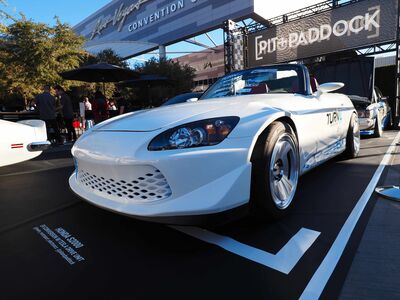
The Honda S2000 has achieved cult-like status among car enthusiasts for its legendary handling and lack of weight. Converting one to an electric vehicle without upsetting that delicate balance is a challenge. Ryan Basseri knew it would be even more of a challenge since he had never built an electric car. As the owner of motorsports electronic company Rywire, Basseri is no stranger to wiring and electronics, but decided it was time to push himself with an EV build.
Basseri started with a Honda S2000 and replaced its drivetrain with a Tesla Large Performance Drive Unit powered by battery packs from a Chevy Volt. Packaging everything into the tight confines of the S2000 was one of the biggest challenges. Basseri extended the frame 8 in. to help make room but kept the wheelbase stock. Instead of using a Tesla subframe, Basseri made custom A-arms to keep the width of the S2000 stock. Once completed, only an additional 200 lbs. were added to the Honda for a sleeper S2000 that is surprisingly fast.
Overlanding
Many people thought that overlanding was just a fad when Toyotas and Jeeps equipped with roof-top tents, traction boards, roof racks and fridge/freezers first appeared at the SEMA Show. Much like the double-row light bar, some thought overlanding would fade away, but those predictions have proven to be wrong as overlanding is now more popular than ever. Proof of that popularity was the staggering amount of overland builds at this year’s SEMA Show. Here are a few that caught our eye with their extensive modifications and attention to detail.
Lance Enduro Overland Camper Trailer with Custom VW Atlas
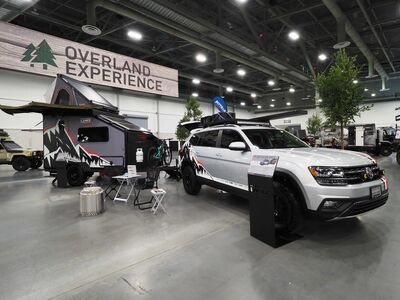
Long known for high-quality truck toppers and travel trailers, Lance Camper enters the overland space with its new Enduro overland camper trailer. The concept trailer rides on a Timbren independent suspension setup with beefy all-terrain tires for better ground clearance. The single-axle design and length of 18 ft. makes it compact and maneuverable, while composite construction gives it a weight of just 2,700 lbs.—light enough for even modest SUVs to tow. The Enduro sleeps up to six with its king-size bed, two bunk beds and a Roofnest Falcon XL roof-top tent. An exterior galley with Truma fridge-freezer and Camp Chef stove is the perfect spot to cook meals. The Enduro even includes a shower and cassette toilet with heated water and air. Two 100AH lithium batteries and twin 190-watt solar panels provide power for the comfortable self-contained camper.
For SEMA, the Enduro was paired with a custom VW Atlas. The Atlas is ready to hit the dirt with an H&R suspension clearing Maxxis AT tires wrapped around Black Rhino wheels. KC HiLites Flex lights provide plenty of illumination. Extra storage comes from the Front Runner Slim Line II roof rack equipped with Front Runner storage boxes. In the rear, a Truma dual-zone fridge-freezer keeps things cool.
EarthRoamer LTi
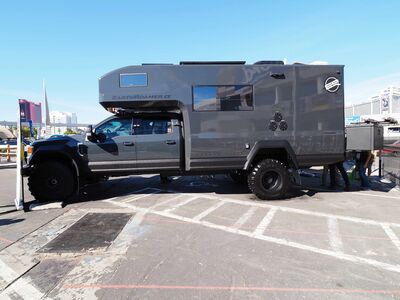
Many are familiar with the original EarthRoamer. Based on Ford’s beefy F-550 Super Duty chassis, the OG EarthRoamer was gigantic in proportions, capabilities and price tag. For its latest model, EarthRoamer decided to turn it up to 11 with the new EarthRoamer LTi. The major innovation of the LTi is that it uses a camper body that is made entirely of vacuum-formed carbon fiber. Using what may be the largest carbon-fiber structure known to humanity shaves off an estimated 1,500 lbs. over the previous model.
EarthRoamer didn’t just switch to carbon fiber and call it a day. The new shell is taller for more room and features frameless windows for a sleeker look. EarthRoamer expanded the capabilities of the LTi as well with a massive 1,320-watt solar array and an 11,000-hour lithium-ion battery system. With its huge dimensions, the LTi can carry 95 gallons of diesel, 100 gallons of fresh water, and 40 gallons of grey water along with all your friends and their friends, too. It cost as much as a house, but the LTi is as big as one and can take you to a lot cooler places.
Ford Raptor Prelander
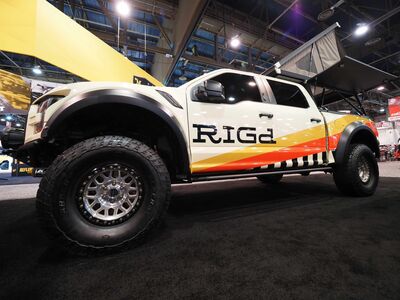
With the Instagram handle Tacodust, you might think that Jason Denney likes Toyota Tacomas or tacos. You would be right on both, but Denney recently ditched his overland Toyota Tacoma for a Ford Raptor. Wanting to combine the go-fast capabilities of the Raptor with the camping setup of his Tacoma, Denney merged a prerunner with an overlander to create a prelander.
Raptors are capable in the rough in stock form, but a Camburg long-travel system with King shocks dramatically increases the speeds in the bumps. A host of KC HiLites lights allows the party to continue after sunset, with 37-in. General Grabber AT tires wrapped around KMC wheels providing traction. The bed of the Raptor uses an SDHQ Chase Rack to secure a full-size spare, a Dometic fridge, and a Pro Eagle jack. Once at camp, Denney can pop open the Go Fast Camper, hop in his jammies, and be ready for bed in under five minutes.
Land Cruiser Bandeirante FJ-45 Crew Cab
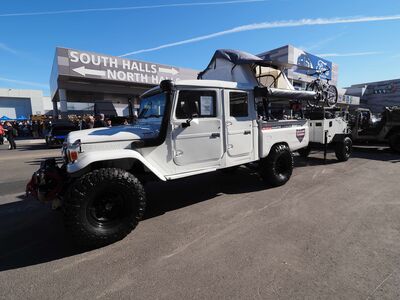
Crew cab FJ-45 Toyota Land Cruisers are not easy to find, and the Bandeirantes are even rarer. Toyota ceased production of the venerable FJ-40 Cruisers in 1984. But, Brazil didn’t get the memo and kept producing the FJ-40 and 45 all the way until 2001, calling them Bandeirantes. Many Bandeirantes came with Mercedes-Benz engines because things work differently in Brazil.
This FJ-45 Land Cruiser Bandeirante is ready for any overland adventure with an Old Man Emu suspension clearing 35-inch Maxxis Razr MT tires. In the unlikely event that it ever gets stuck, a Warn Zeon 10-S winch is ready to pull the big Cruiser free. A Nomadic roof-top tent mounted on a Freedom Bed Rack from Overland Vehicle Systems provides a comfortable place to sleep. The Bandeirante also pulls a Goat Overland Trailer for extra room for gear and bikes. It might not have all the creature comforts of a modern vehicle, but the Bandeirante more than makes up for that with style.
Toyota Land Cruiser FJ-75 Troopy
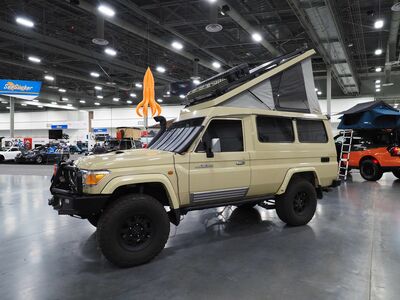
Overlanders are dreamers by nature and this sweet Land Cruiser FJ-75 Troopy has us dreaming of hitting the road and possibly never coming back. The Old Man Emu suspension and BP-51 shocks would make that long journey a smooth one and BFGoodrich All-Terrain tires on Method wheels should keep things flat-free. Up front, the beefy ARB bumper with a stout Warn winch is ready to pull the rig out of any sticky situation.
Unique to this FJ-75 Troopy is its Mulgo Pop Top conversion. Instead of simply mounting a tent on the roof, the Mulgo replaces the entire roof. With the top popped, there is plenty of room to stand up, move around, and change clothes, making for a comfortable camping experience. A lower profile also produces less drag for better fuel economy. All of the tasteful modifications help make this Troopy capable of spending lots of time off-grid or on a very long road trip.
Toyota 4Runner
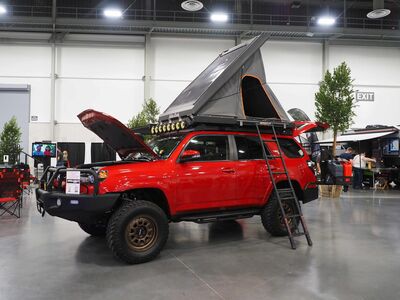
Building an extensively modified overland vehicle without going overboard is a delicate balance. But, this ’20 Toyota 4Runner has everything it needs for remote travel and camping while still being clean and functional. The most visible modification is the AluCab roof-top tent equipped with low-profile Sunflare XPLOR solar panels mounted on a Prinsu roof rack. An array of KC HiLites Pro 6 lights illuminates the darkest nights. Protection comes from an ARB Summit front bumper, CBI rear bumper, and Westin sliders. Handling the bumps is a Total Chaos suspension system with Radflo shocks that clears the way for the 33-in. Firestone tires on 17-in. Mayhem wheels.
Organization and storage for long trips are vital, so the 4Runner uses a Dobinson drawer system. Mounted to the top of the drawers is a Dometic fridge freezer on an Easy Slide slideout. Additional AluBox boxes offer more storage. There is even a QuietKat RidgeRunner E-bike mounted on a Thule rack if you want to zip around camp.
’64 Jeep M677
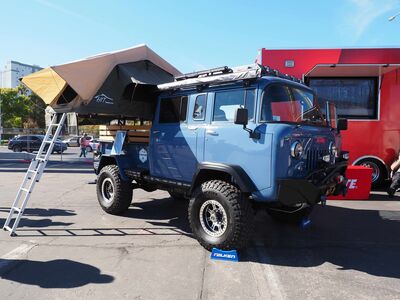
With only 500 made for the USMC and Navy, this Jeep M677 is one unique overland build. Instead of bolting on a slew of readily available aftermarket parts, almost everything had to be hand-built for the Jeep Forward Control. The modification list seems endless, but powering the Jeep is a Chevy 350ci V8 with a Holley fuel-injection system. Custom leaf springs with Sway-A-Way shocks make enough room for 37-in. Falken Wildpeak tires on Raceline wheels. The original interior was junk and replaced with a new one using seats from a Jeep JK. Giving the M677 overland cred is the mandatory roof-top tent and awning from HIT.
There are lots of other modifications that are hard to spot on the M677. Hidden away in a hand-built storage panel is a remote welder, and a York onboard compressor hides under the cab with an air storage tank behind the rear bumper. The amount of thought and time that went into building the Jeep M677 is staggering, but the result is a rare overlander that turned lots of heads at the 2021 SEMA Show.
Ford Tremor
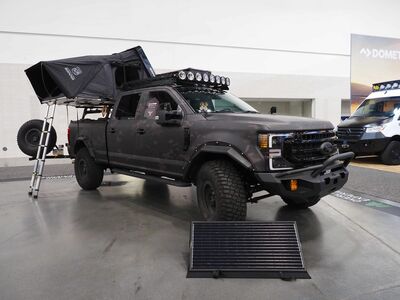
Full-size builds are definitely trending in the overland community as the larger trucks offer more cargo capacity and cabin room than any mid-size platform can match. From the popular YouTube channel Last Line Of Defense, Matt Pfieffer is well-known for his Toyota Tacoma, but he super-sized his latest overland build with this Ford F-250 Super Duty Tremor. The result of his effort is a big truck that can go almost anywhere while hauling plenty of friends and gear.
Instead of lifting the truck, Pfieffer went with a Fab Fours fender system, making enough room for 39-in. BFGoodrich Mud Terrains on Black Rhino wheels. Bumpers from Fab Fours protect the nose and tail of the big Ford and hold a full-size spare in the rear. Getting into the iKamper roof-top tent involves a bit more climbing than his Tacoma, and we are not sure how anyone reaches the Pelican storage boxes on the Front Runner roof rack, but a Cargo Ease bed slider makes access to the Dometic fridge easier. The Tremor is capable in stock form, but Pfieffer expanded upon that capability with the right modifications while making the Super Duty more versatile.





 At a gathering of state lawmakers during the 2021 SEMA Show in Las Vegas, Maryland Delegate Kevin Hornberger was named chairman of the State Automotive Enthusiast Leadership Caucus. Del. Hornberger was appointed to the post after West Virginia Delegate Gary Howell’s term as Caucus chairman was completed. Del. Howell served in the role for eight years and will remain involved with the Caucus as Chairman Emeritus.