Fri, 05/01/2026 - 13:11

By Michael Imlay

An exterior shot of the SEMA Garage in Diamond Bar, California.


Launched in 2014, the SEMA Garage Program Continues to Evolve, Keeping SEMA Members at the Forefront of Innovation


When the SEMA Garage first opened in Diamond Bar, California, in 2014, attendees came to new-vehicle measuring sessions toting items like cardboard, tracing paper, calipers, yardsticks and pencils. Today, they come armed with laser scanners.
 

Held regularly throughout the year, these SEMA Garage gatherings offer aftermarket businesses of all sizes first-hand access to new OEM vehicles, enabling them to design, develop, prototype and speed new parts to market early in a vehicle's production cycle. And while the purpose of these sessions hasn't changed over time, the tools that today's attendees utilize underscore not only the rapid technological advancements transforming the automotive space, but the SEMA Garage's ongoing mission to keep the aftermarket at the leading edge of the tech evolution.
 

"Our mission is no different now than it was back then in 2014," says Jim Moore, SEMA vice president, OEM and product development. "We support companies that manufacture products so they can put the best possible products they can make into the market and give end users the best possible experience that they can have with their vehicles. We view the SEMA Garage as a sort of 'member skunkworks' where all SEMA-member companies can leverage modern research and development assets quickly, easily and affordably."
 

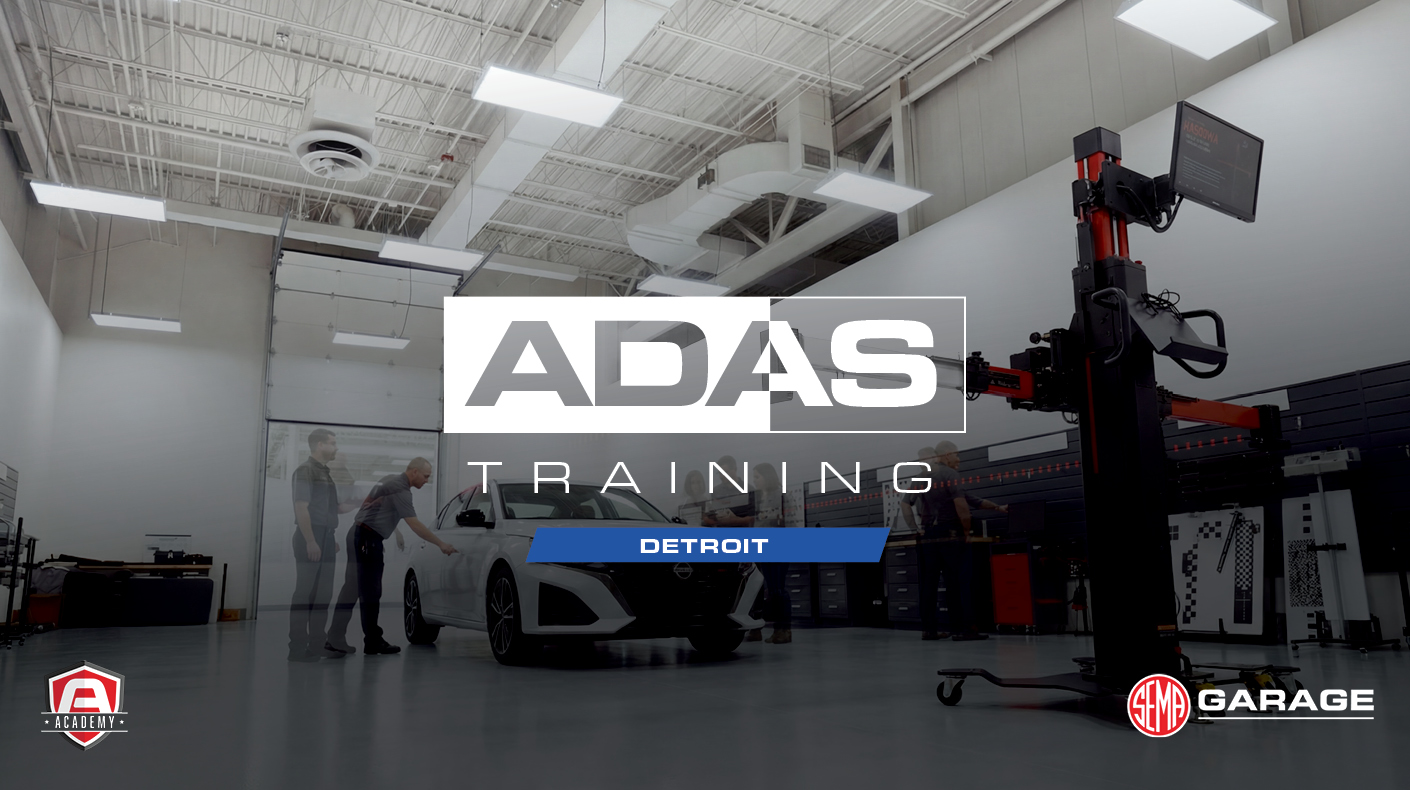
What has evolved are the tools in SEMA's arsenal. The Garage program now encompasses two facilities—the original 15,000-sq.-ft. Diamond Bar Garage at SEMA's headquarters, and a second, 45,000-sq.-ft. facility that opened four years ago in Detroit. Both locations offer a large array of services to SEMA members, including Tech Transfer, 3D scanning and printing, emissions-compliance testing, measuring sessions, and installation and training centers (see sidebar, p. 75). Additionally, both SEMA Garage facilities are equipped with ADAS Research Centers, where experts explore the implications of advanced driver assistance systems and their interplay with aftermarket vehicle modifications.
 

An exterior shot of SEMA Garage Detroit

The 45,000-sq.-ft. Detroit SEMA Garage facility was added in 2022. Its close proximity to major American OEMs assists collaboration on the transformative technologies and issues that are rapidly reshaping the automotive space.


Moore notes that a key goal of the SEMA Garage program is to anticipate and identify new automotive trends and technologies to help SEMA members stay ahead of the curve and future-proof their businesses.
 

"We're creating a portfolio of tools that's expanding at the rate at which our market is demanding new access, new tools and new pathways," he explains, adding that exposure to the latest innovations can also accelerate their adoption among SEMA-member businesses.
 

Take, for example, laser scanners and 3D printers. When the first SEMA Garage opened, many smaller aftermarket parts makers were unfamiliar with such tools, let alone their capabilities and value for even a small operation. But after experiencing their potential through the Garage, more and more shops and companies began investing in these devices. Today they're common tools of the trade for builders, garages and parts manufacturers alike.
 

FROM ANALOG TO SOFTWARE-DEFINED


Yet these innovations pale in comparison to what's coming down the pike. According to Moore, the automotive industry is on the verge of a "macro technology shift" that will soon transform the "analog" cars and trucks of yesterday into the "software-defined vehicle [SDV] platforms" of tomorrow. From emissions-controlled internal-combustion engines (ICE) to electric powertrains and autonomous systems, "technology is going to redefine how we build, modify, enjoy and interact with our vehicles," he observes.
 

"What we're seeing now is really a radically new interpretation of what a vehicle can be," continues Moore. "All of the inputs in the vehicle are effectively becoming software-driven systems. What was once primarily an ecosystem of hardware upgrades is quickly expanding to include entirely new software-generated performance and user experiences."
 

And that radical shift is coming faster than perhaps any previous development in the automobile's 140-year history, requiring equally rapid adaption from SEMA and its members. As a critical hub in the association's response, the SEMA Garage is now working to expand its tools, research expertise and policy influence to ensure that aftermarket manufacturers can continue to innovate safely, legally and profitably as they navigate this evolution.
 

Meanwhile, Moore says the Garage also continues to build on the successes of existing services. Notably among them is the SEMA emissions compliance program, which has helped product developers achieve nearly 1,000 California Air Resources Board (CARB) executive orders (EOs) over the past 12 years.
 

This is no small achievement. The passage of the federal Clean Air Act in the '70s presented a major challenge to automotive parts manufacturing. Any product that might adversely impact vehicle emissions became illegal unless it could demonstrate compliance with clean-air standards. The main path to doing so meant undergoing CARB-prescribed emissions testing and documentation to obtain a CARB EO, effectively clearing a part for legal sale. The stakes were high: fines for noncompliance before sale could reach tens of thousands of dollars per part.
 

But many aftermarket manufacturers found CARB testing complicated, expensive and time consuming. The uncertainties around the entire process threatened to stifle the performance industry. Launched with the opening of the first SEMA Garage and expanded with the addition of the Detroit facility, the SEMA Garage emissions testing and certification program helped streamline the process, rein in costs and offer a surer path to compliance.
 

A car undergoing emissions testing at SEMA Garage.

Both SEMA Garage locations also include state-ofthe- art emissions testing labs. SEMA's emissions compliance program has become a game-changer for performance parts makers, streamlining the process of obtaining a CARB EO.


More recently, the SEMA Garage also introduced the SEMA Certified program, an EPA-accepted process for "49-state legality" that further fast-tracks the certification and sale of parts in all other states while a manufacturer awaits a final CARB EO for California. This has been a tremendous boon for speeding new parts to market, with approximately 200 certifications approved to date. Moreover, thanks to SEMA Garage testing and awareness programs targeted to the industry, aftermarket emissions compliance has grown dramatically.
 

"Our industry has made incredible progress in, frankly, a short amount of time," says Eric Snyder, SEMA senior director, federal government affairs. "The amount of demonstrated compliance has risen dramatically over the last 15 years, and SEMA has been at the forefront of that. The association has made significant investments to make it easier for SEMA member companies to do the testing to demonstrate emissions compliance, and that has given us tremendous credibility when we advocate for the industry in both Sacramento and Washington, D.C."
 

Moore is quick to underscore that SEMA Garage's emissions and other programs help level the playing field for smaller aftermarket businesses which might otherwise lack the resources for emissions testing and costly research and development efforts.
 

"We're one of the largest, most diverse communities of small-business manufacturers in the world," he explains. "We have some 3,500 companies that are making, innovating, creating and following dreams—doing things that normally only larger companies could do. By democratizing innovation across such a large base, we're empowering these small businesses to find new pathways and scale. That's one of our duties as an association—to connect people to resources, socialize ideas and give them a voice at the table."
 

FUTURE-PROOFING AN INDUSTRY


According to Moore, emissions compliance was a defining issue for SEMA, which learned a major lesson from its experiences safeguarding the industry's right to modify. "We were somewhat reactive on emissions. It taught us we need to be more proactive going forward," he observes, especially with the urgent challenge of addressing ADAS.
 

"ADAS systems are going to reshape the automotive experience and will have significantly greater impact on our industry than emissions did," Moore predicts.
 

Utilizing cameras, lidar and radar, these systems automate such vehicle safety functions as emergency braking, lane-keeping and adaptive cruise control, among others. And while OEMs are rolling them out rapidly in their new vehicles, the systems have yet to be standardized across automakers. Moreover, government regulators have adopted a cautious approach to setting blanket standards, preferring to see how many of these technologies shake out before mandating them.
 

3D scanning a vehicle in the SEMA Garage.

The SEMA Garage helped accelerate small-business adoption of laser scanning within the aftermarket. For those that still lack the technology, both Garage locations offer scanning services.


Regardless, these technologies have vast implications for vehicle modifications. As vehicles become further "software defined," ADAS is certain to become more deeply integrated within vehicle platforms. Even now, lifting, leveling or lowering a vehicle can interfere with ADAS sensors and their calibration. An aftermarket bumper or winch or a new wheel/tire combo can easily throw off ADAS features, rendering a vehicle unsafe. The wrong mods can void OEM warranties and raise huge liability issues.
 

"Many aftermarket manufacturers don't yet realize they're even affected," adds Luis Morales, SEMA director, vehicle technology and product development. "There's going to be a spike in urgency as ADAS features become federally mandated or undefeatable."
 

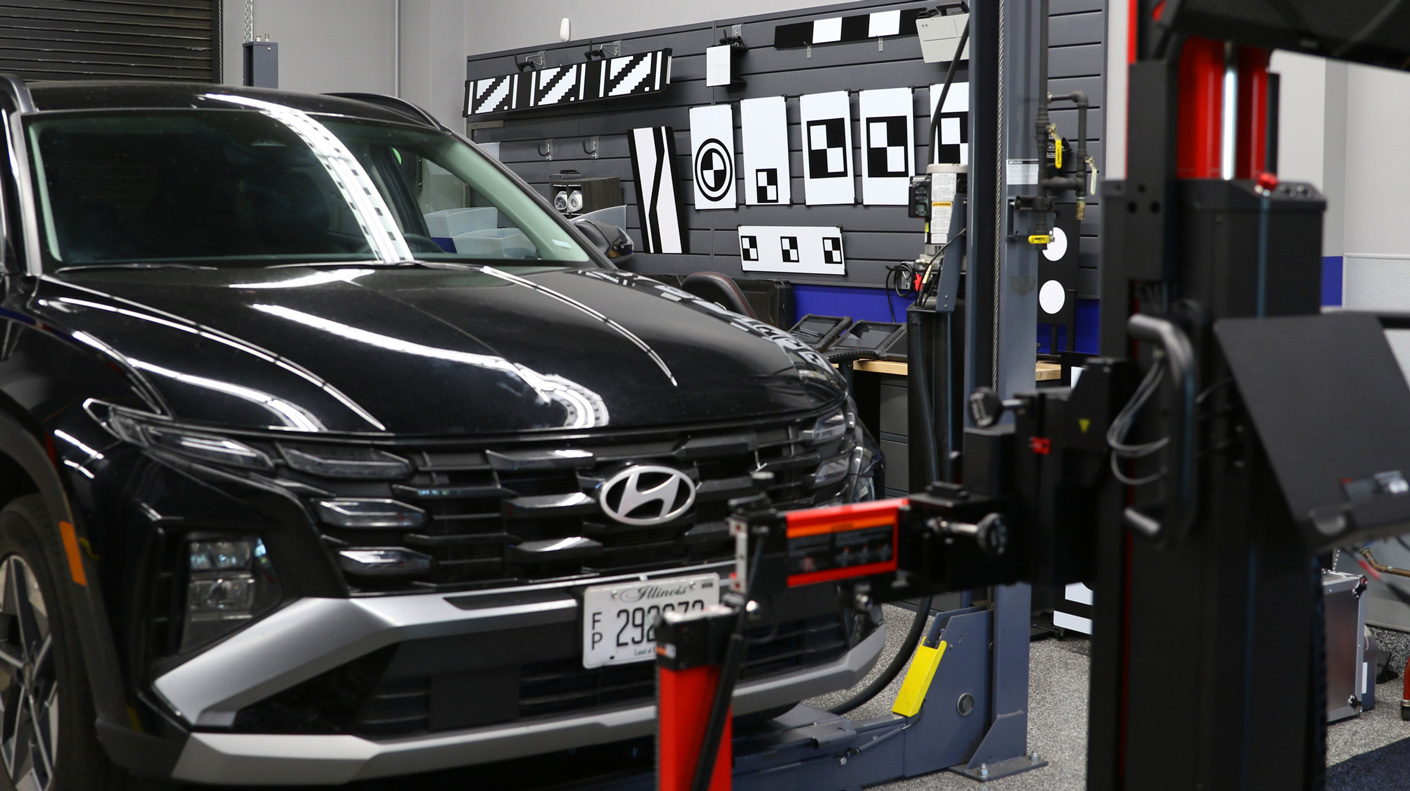
The SEMA Garage's response is the ADAS Research Centers located in both facilities. As ADAS "think tanks," the centers feature purpose-built environments, calibration systems and OEM scan tools so SEMA members can test, recalibrate and validate the fitment and function of their parts with ADAS features. The centers also research and produce white papers to help the aftermarket safely navigate these new technologies.
 

"We need to translate these concepts and educate our members so they can validate that their products aren't going to negatively impact how these systems work," explains Morales.
 

Keeping pace with propulsion technologies, the SEMA Garage has also been adding support for electrified vehicle (EV) and hybrid electrified vehicle (HEV) systems, including the specialized tools, safety and charging equipment required to work with such platforms. These updates will assist companies in developing parts for new- tech vehicles as well as the rapidly expanding EV conversion market.
 

But according to Morales, these additions are just the beginning of a larger range of programs the Garage is developing to help future-proof the aftermarket.
 

"EVs and HEVs are not the only vehicle propulsion solutions out there," he explains. "There are also new ICE opportunities emerging in hydrogen, gaseous fuels and commercial platforms. We're addressing this diversity to help assure our members that their product development won't just hit a dead end in five years. These technologies make the overall landscape of our industry much more colorful and present us with a lot more options."
 

From his vantage point in the SEMA government and public affairs office, Snyder views the SEMA Garage program as a vital pillar of the association's policy and advocacy work, lending credibility to discussions with regulatory agencies and lawmakers.
 

"One of our top legislative priorities right now is getting Congress to pass the ADAS Functionality and Integrity Act, a bill that would require the federal government to create guidelines for ADAS tolerances that would address calibration information gaps that currently exist," he notes, adding that SEMA Garage research and data is also crucial when engaging with the EPA, CARB, DOT, NHTSA and other agencies. Ultimately, he says, policy certainty reduces business risk and accelerates industry innovation.
 

STAYING AGILE, FINDING SOLUTIONS


A SEMA Garage staffer looking at 3D scans of a vehicle.

SEMA Garage plans to remain agile, investing in the right tools and talent for the drive forward while deepening relationships with OEMs and policymakers to protect aftermarket access.


Moore, Snyder and Morales all agree that the future of the automotive space will remain fast-moving and unpredictable—but most of all exciting. "It would be irresponsible to try to project that we know everything that's coming with precision, but we do know that technology is going to be moving quickly," Moore emphasizes.
 

Still, whatever twists and turns lie ahead, the SEMA Garage plans to remain agile, investing in the right tools and talent for the drive forward while deepening relationships with OEMs and policymakers to protect aftermarket access in the emerging SDV landscape.
 

"If we don't have those conversations," cautions Morales, "the aftermarket will find itself shut out very quickly." But as Snyder also hastens to add, through the SEMA Garage and association advocacy efforts "we now have a seat at the table, not just at local, state and national levels, but at a global level as well."
 

In the end, concludes Moore, "technology is about solving problems, and our job is to make sure the right people are paying attention to the right problems." 


Fri, 05/01/2026 - 13:11

By Michael Imlay

An exterior shot of the SEMA Garage in Diamond Bar, California.


Launched in 2014, the SEMA Garage Program Continues to Evolve, Keeping SEMA Members at the Forefront of Innovation


When the SEMA Garage first opened in Diamond Bar, California, in 2014, attendees came to new-vehicle measuring sessions toting items like cardboard, tracing paper, calipers, yardsticks and pencils. Today, they come armed with laser scanners.
 

Held regularly throughout the year, these SEMA Garage gatherings offer aftermarket businesses of all sizes first-hand access to new OEM vehicles, enabling them to design, develop, prototype and speed new parts to market early in a vehicle's production cycle. And while the purpose of these sessions hasn't changed over time, the tools that today's attendees utilize underscore not only the rapid technological advancements transforming the automotive space, but the SEMA Garage's ongoing mission to keep the aftermarket at the leading edge of the tech evolution.
 

"Our mission is no different now than it was back then in 2014," says Jim Moore, SEMA vice president, OEM and product development. "We support companies that manufacture products so they can put the best possible products they can make into the market and give end users the best possible experience that they can have with their vehicles. We view the SEMA Garage as a sort of 'member skunkworks' where all SEMA-member companies can leverage modern research and development assets quickly, easily and affordably."
 

What has evolved are the tools in SEMA's arsenal. The Garage program now encompasses two facilities—the original 15,000-sq.-ft. Diamond Bar Garage at SEMA's headquarters, and a second, 45,000-sq.-ft. facility that opened four years ago in Detroit. Both locations offer a large array of services to SEMA members, including Tech Transfer, 3D scanning and printing, emissions-compliance testing, measuring sessions, and installation and training centers (see sidebar, p. 75). Additionally, both SEMA Garage facilities are equipped with ADAS Research Centers, where experts explore the implications of advanced driver assistance systems and their interplay with aftermarket vehicle modifications.
 

An exterior shot of SEMA Garage Detroit

The 45,000-sq.-ft. Detroit SEMA Garage facility was added in 2022. Its close proximity to major American OEMs assists collaboration on the transformative technologies and issues that are rapidly reshaping the automotive space.


Moore notes that a key goal of the SEMA Garage program is to anticipate and identify new automotive trends and technologies to help SEMA members stay ahead of the curve and future-proof their businesses.
 

"We're creating a portfolio of tools that's expanding at the rate at which our market is demanding new access, new tools and new pathways," he explains, adding that exposure to the latest innovations can also accelerate their adoption among SEMA-member businesses.
 

Take, for example, laser scanners and 3D printers. When the first SEMA Garage opened, many smaller aftermarket parts makers were unfamiliar with such tools, let alone their capabilities and value for even a small operation. But after experiencing their potential through the Garage, more and more shops and companies began investing in these devices. Today they're common tools of the trade for builders, garages and parts manufacturers alike.
 

FROM ANALOG TO SOFTWARE-DEFINED


Yet these innovations pale in comparison to what's coming down the pike. According to Moore, the automotive industry is on the verge of a "macro technology shift" that will soon transform the "analog" cars and trucks of yesterday into the "software-defined vehicle [SDV] platforms" of tomorrow. From emissions-controlled internal-combustion engines (ICE) to electric powertrains and autonomous systems, "technology is going to redefine how we build, modify, enjoy and interact with our vehicles," he observes.
 

"What we're seeing now is really a radically new interpretation of what a vehicle can be," continues Moore. "All of the inputs in the vehicle are effectively becoming software-driven systems. What was once primarily an ecosystem of hardware upgrades is quickly expanding to include entirely new software-generated performance and user experiences."
 

And that radical shift is coming faster than perhaps any previous development in the automobile's 140-year history, requiring equally rapid adaption from SEMA and its members. As a critical hub in the association's response, the SEMA Garage is now working to expand its tools, research expertise and policy influence to ensure that aftermarket manufacturers can continue to innovate safely, legally and profitably as they navigate this evolution.
 

Meanwhile, Moore says the Garage also continues to build on the successes of existing services. Notably among them is the SEMA emissions compliance program, which has helped product developers achieve nearly 1,000 California Air Resources Board (CARB) executive orders (EOs) over the past 12 years.
 

This is no small achievement. The passage of the federal Clean Air Act in the '70s presented a major challenge to automotive parts manufacturing. Any product that might adversely impact vehicle emissions became illegal unless it could demonstrate compliance with clean-air standards. The main path to doing so meant undergoing CARB-prescribed emissions testing and documentation to obtain a CARB EO, effectively clearing a part for legal sale. The stakes were high: fines for noncompliance before sale could reach tens of thousands of dollars per part.
 

But many aftermarket manufacturers found CARB testing complicated, expensive and time consuming. The uncertainties around the entire process threatened to stifle the performance industry. Launched with the opening of the first SEMA Garage and expanded with the addition of the Detroit facility, the SEMA Garage emissions testing and certification program helped streamline the process, rein in costs and offer a surer path to compliance.
 

A car undergoing emissions testing at SEMA Garage.

Both SEMA Garage locations also include state-ofthe- art emissions testing labs. SEMA's emissions compliance program has become a game-changer for performance parts makers, streamlining the process of obtaining a CARB EO.


More recently, the SEMA Garage also introduced the SEMA Certified program, an EPA-accepted process for "49-state legality" that further fast-tracks the certification and sale of parts in all other states while a manufacturer awaits a final CARB EO for California. This has been a tremendous boon for speeding new parts to market, with approximately 200 certifications approved to date. Moreover, thanks to SEMA Garage testing and awareness programs targeted to the industry, aftermarket emissions compliance has grown dramatically.
 

"Our industry has made incredible progress in, frankly, a short amount of time," says Eric Snyder, SEMA senior director, federal government affairs. "The amount of demonstrated compliance has risen dramatically over the last 15 years, and SEMA has been at the forefront of that. The association has made significant investments to make it easier for SEMA member companies to do the testing to demonstrate emissions compliance, and that has given us tremendous credibility when we advocate for the industry in both Sacramento and Washington, D.C."
 

Moore is quick to underscore that SEMA Garage's emissions and other programs help level the playing field for smaller aftermarket businesses which might otherwise lack the resources for emissions testing and costly research and development efforts.
 

"We're one of the largest, most diverse communities of small-business manufacturers in the world," he explains. "We have some 3,500 companies that are making, innovating, creating and following dreams—doing things that normally only larger companies could do. By democratizing innovation across such a large base, we're empowering these small businesses to find new pathways and scale. That's one of our duties as an association—to connect people to resources, socialize ideas and give them a voice at the table."
 

FUTURE-PROOFING AN INDUSTRY


According to Moore, emissions compliance was a defining issue for SEMA, which learned a major lesson from its experiences safeguarding the industry's right to modify. "We were somewhat reactive on emissions. It taught us we need to be more proactive going forward," he observes, especially with the urgent challenge of addressing ADAS.
 

"ADAS systems are going to reshape the automotive experience and will have significantly greater impact on our industry than emissions did," Moore predicts.
 

Utilizing cameras, lidar and radar, these systems automate such vehicle safety functions as emergency braking, lane-keeping and adaptive cruise control, among others. And while OEMs are rolling them out rapidly in their new vehicles, the systems have yet to be standardized across automakers. Moreover, government regulators have adopted a cautious approach to setting blanket standards, preferring to see how many of these technologies shake out before mandating them.
 

3D scanning a vehicle in the SEMA Garage.

The SEMA Garage helped accelerate small-business adoption of laser scanning within the aftermarket. For those that still lack the technology, both Garage locations offer scanning services.


Regardless, these technologies have vast implications for vehicle modifications. As vehicles become further "software defined," ADAS is certain to become more deeply integrated within vehicle platforms. Even now, lifting, leveling or lowering a vehicle can interfere with ADAS sensors and their calibration. An aftermarket bumper or winch or a new wheel/tire combo can easily throw off ADAS features, rendering a vehicle unsafe. The wrong mods can void OEM warranties and raise huge liability issues.
 

"Many aftermarket manufacturers don't yet realize they're even affected," adds Luis Morales, SEMA director, vehicle technology and product development. "There's going to be a spike in urgency as ADAS features become federally mandated or undefeatable."
 

The SEMA Garage's response is the ADAS Research Centers located in both facilities. As ADAS "think tanks," the centers feature purpose-built environments, calibration systems and OEM scan tools so SEMA members can test, recalibrate and validate the fitment and function of their parts with ADAS features. The centers also research and produce white papers to help the aftermarket safely navigate these new technologies.
 

"We need to translate these concepts and educate our members so they can validate that their products aren't going to negatively impact how these systems work," explains Morales.
 

Keeping pace with propulsion technologies, the SEMA Garage has also been adding support for electrified vehicle (EV) and hybrid electrified vehicle (HEV) systems, including the specialized tools, safety and charging equipment required to work with such platforms. These updates will assist companies in developing parts for new- tech vehicles as well as the rapidly expanding EV conversion market.
 

But according to Morales, these additions are just the beginning of a larger range of programs the Garage is developing to help future-proof the aftermarket.
 

"EVs and HEVs are not the only vehicle propulsion solutions out there," he explains. "There are also new ICE opportunities emerging in hydrogen, gaseous fuels and commercial platforms. We're addressing this diversity to help assure our members that their product development won't just hit a dead end in five years. These technologies make the overall landscape of our industry much more colorful and present us with a lot more options."
 

From his vantage point in the SEMA government and public affairs office, Snyder views the SEMA Garage program as a vital pillar of the association's policy and advocacy work, lending credibility to discussions with regulatory agencies and lawmakers.
 

"One of our top legislative priorities right now is getting Congress to pass the ADAS Functionality and Integrity Act, a bill that would require the federal government to create guidelines for ADAS tolerances that would address calibration information gaps that currently exist," he notes, adding that SEMA Garage research and data is also crucial when engaging with the EPA, CARB, DOT, NHTSA and other agencies. Ultimately, he says, policy certainty reduces business risk and accelerates industry innovation.
 

STAYING AGILE, FINDING SOLUTIONS


A SEMA Garage staffer looking at 3D scans of a vehicle.

SEMA Garage plans to remain agile, investing in the right tools and talent for the drive forward while deepening relationships with OEMs and policymakers to protect aftermarket access.


Moore, Snyder and Morales all agree that the future of the automotive space will remain fast-moving and unpredictable—but most of all exciting. "It would be irresponsible to try to project that we know everything that's coming with precision, but we do know that technology is going to be moving quickly," Moore emphasizes.
 

Still, whatever twists and turns lie ahead, the SEMA Garage plans to remain agile, investing in the right tools and talent for the drive forward while deepening relationships with OEMs and policymakers to protect aftermarket access in the emerging SDV landscape.
 

"If we don't have those conversations," cautions Morales, "the aftermarket will find itself shut out very quickly." But as Snyder also hastens to add, through the SEMA Garage and association advocacy efforts "we now have a seat at the table, not just at local, state and national levels, but at a global level as well."
 

In the end, concludes Moore, "technology is about solving problems, and our job is to make sure the right people are paying attention to the right problems." 


Fri, 05/01/2026 - 11:45

By Cristian Gonzalez

2025 Battle of the Builders winner 'Fenderless' driving on a rural road.


Troy Trepanier Secures His Second Win at the 2025 Battle of the Builders Presented by Mothers Polish


There's something to say about those who keep winning, but what is it? Is it that they are that skilled in their trade? Or is it that they know themselves? Do they know their product and the market well enough to know when it's time to shine? For Troy Trepanier and his exceptionally talented team at Rad Rides by Troy, the answer is yes to all the above.
 

Trepanier started his custom shop in 1995 in partnership with his now late father. Since then, his shop has risen to industry fame through seamless fabrication and land-speed performance, garnering massive accolades and awards, including now two overall wins with the SEMA Battle of the Builders (BOTB) Presented by Mothers Polish—SEMA's custom-vehicle competition that takes place at the SEMA Show.
 

Builders can compete in one of the contest's four categories: 4 Wheel Drive & Off-Road; Hot Rod & Hot Rod Truck; Sport Compact, Import Performance, Luxury & Exotic; and BFGoodrich Young Guns (builders 29 and under). Industry judges narrow down the field each day until there are four categorical winners crowned as class champions.
 

A graphic detailing the Fenderless build.

A fender-less '36 Ford had to be planned and finessed carefully. Adam Bank's sketch of the early Fenderless solidified their plan for going forward.


For the 2025 iteration of BOTB, Rad Rides brought a coach-built '36 roadster coined Fenderless that was commissioned by collector and hot-rod historian Ross Myers. Trepanier and company rolled into Las Vegas for the SEMA Show to compete against 39 other top-shelf builds. Day by day, the competition whittled down to 12 builders, three from each class. The 12 finalists judged each other, and their votes not only determined the four class champions, but also the overall BOTB winner which went to Trepanier and his '36 roadster.
 

In true SEMA fashion, we had to break down and study the anatomy of this success. We reached out to Trepanier and Adam Banks—designer and lead fabricator for Fenderless—to better understand the inspiration behind the build, the details that make this roadster special and what they think the future of custom car-building holds.
 

STAYING TRUE TO TIME


Like most builds, Fenderless began with an idea and a relationship between the owner and the shop. Myers had entrusted Trepanier with previous projects before and came to him and Banks on the possibility of building a roadster around the '36 Ford.
 

Myers proposed a fender-less style and Trepanier thought it would be a hot idea. "If [Ford] would have made a fender-less roadster in '36, it'd have been awesome. The '36 is one of the prettiest cars that Ford had done back then. So the challenge was then 'game on,'" says Trepanier; that challenge being making the fender-less look work.
 

Banks had some concerns with the initial idea. "They're beautiful cars, but doing one as sort of a highboy style, it's very difficult because when you take the fenders off, it doesn't lend itself to that look very well. I always describe it as sort of looking like a bumblebee," he explains.
 

But Banks was confident he could bring Myers' vision to life, and Trepanier had equal confidence in Banks' design. "The way that Adam designed and reproportioned everything. I felt it was spot-on, and it really just came to fruition. It's our best work by a mile," says Trepanier.
 

OEM QUALITY, AFTERMARKET FASHION


While nearly everything on this vehicle would be built in-house from the frame up, the philosophy behind Fenderless was to aesthetically build a car that could look like it came off Ford's 1936 assembly line.
 

"We spent a lot of time trying to make things look like they were appropriate for this car. And while it's not necessarily a themed car or a traditional hot rod, we wanted all the pieces we made for it manufactured to look like they belonged with this car and were possibly manufactured at some point by Ford. So there's a lot of nuances to that and how we designed wheels, suspension components, steering and everything else," says Banks.
 

Trepanier would get admirers who, upon seeing the custom hot rod, would take it for a lightly fabricated Ford. While some might take such remarks as an insult, Trepanier took them as compliments—signals that they achieved what they were after.
 

Trepanier believes a simpler, more fitted look will always move more people than something more extravagant or eccentric. "If it blends in and looks natural when looking at it, then I believe you've done it right," he says.
 

A detailed look at the dashboard of the Fenderless roadster.

A complete custom interior was done almost entirely in house at Rad Rides—along with the rest of the build. The only exception was any chrome plating.


The build shines in its simplicity and elegance, but its construction was far from simple, as the Rad team designed and constructed everything in-house: the frame, the dash, the upholstery, the wheels and suspension components. Short of molding their own tires and chrome plating, Trepanier kept nearly everything under his roof.
 

"We do everything right here. We don't rely on anybody," he explains. "And I always say there's guys that build car bodies. They might say, 'We built the body.' And that's cool, right? There's not very many that do it [all under one shop]. We did all the machining on all the suspension, all the wheels. We made the door hinges, the door handles, the steering column, the radiator tanks, and we made a lot of other parts."
 

He continues, "As I've done this for 30 years, each time maybe we didn't do a certain part of [the build]. The next time we're like, 'Alright, what's the equipment we need to do that? And we [need] people that can do it.' We try to control our own destiny that way—by doing everything here."
 

HELLO FROM THE UNDERSIDE


Among the many winning features, Trepanier thinks a large part of his win came from the unique perspectives the BOTB event offered to judges and the audience. With a vehicle lift as part of the stage, the builders were able to showcase the well-thought-out craftsmanship that went into the underside. "When we raised it, and the guys went under, it was, like, jaw-dropping for them… I think it caught them off guard," expresses Trepanier.
 

Lifting the vehicle allows the judges to get a full 360-degree view of it, and it lends the builders the chance to create something unique that only a few would be able to see and appreciate.
 

Fenderless' underside matched its roadside view—unique and simple. What caught everyone off guard was just how well every component complemented the other. The matching oil pans, the control arms, even the brake drums all pay homage to other components with familiar fin features. It's the kind of attention to detail that demands your gaze.
 

Once you study the vehicle's underside, you begin to better understand Troy's philosophy on building—less is more, and more can sometimes feel "like drinking out of a fire hose." Something simple like the fin design, coupled with artistic vision, can still draw eyes.
 

"Just try to keep it simple," asserts Trepanier. "When I look at the bottom of the car, everything looks like it's very in order and very simple, [almost] like it's missing something, but it's just the stuff you don't need. The stuff that it needs to work is there, and that's it."
 

OLD AND NEW ENGINEERING


While the body was made to stay close to a Ford '36 Roadster, the engine told a little different story, one of perfect synthesis between old and modern engineering.
 

The Rad team fitted a '57 Ford 312ci Y-block into the fabricated engine bay, and it boasts a few unique parts blending old and new technologies. Bringing power into the old motor is the McCullough VR57 supercharger. In the spirit of "from factory," the finned supercharger was an available add-on for the '57 Thunderbird, which according to Hemmings, brought the 312-equipped Thunderbird up to 300 hp.
 

Exhaust manifolds on Fenderless

The exhaust manifolds were 3D printed by Beehive Industries. They are a representation of advanced technology that may soon fill the aftermarket landscape.


What really tied the engine together aesthetically was the in-house machined air plenum, which Banks said many believed the supercharger was machined around. "A lot of people think that we machined [the supercharger] case to match the air plenum and some of the other things on the car, but it was the other way around. We just cleaned it up, and then we made the air plenum look like it belonged with the supercharger," he explains.
 

Exhibiting the future of aftermarket building technology were the exhaust manifolds. Banks and Trepanier were approached by an old peer who jumped from the automotive industry into defense and aerospace. He came to them saying he now worked for Beehive Industries, manufacturing 3D-printed metal parts for jet and helicopter engines, and offered to build something unique for this project.
 

What came off the print bed were custom intake manifolds 3D printed from Inconel. Banks explains, "From what I understand, it [came from] the only printer in the United States, at least at the time, that was able to print those in one piece where you didn't have to weld multiple components together… Brian Ferguson, who works for us in the shop here, deburred and polished them. That's what we ended up with. The corrosion resistance is very similar to stainless steel, but Inconel has better heat characteristics as far as expansion than stainless steel. So it's used for a lot of high-performance applications and way overkill for this car."
 

A GOOD HAND TO PLAY


Rad Rides had previously won the BOTB back in 2017 with their '29 Ford Model A Tudor, but despite building incredible vehicles since, they've held back from throwing their hat in the ring, but why?
 

To put it simply, "I figured that eight-year span was a pretty good time frame to give it another shot and this was the right car," said Trepanier. But as he explored and divulged his answer, he became more esoteric in his reasoning.
 

"It was the right car," he said. He believed he and his team had built "top-shelf" builds—all capable of garnering accolades and all with the same quality as Fenderless. "But it's not the same feel. Maybe [because they were] more driven towards that customer? I call them artsy-fartsy builds sometimes, and they're a little more elegant, but it's just not the right feel."
 

Trepanier had forged a career around building some incredibly well-engineered cars, and with the full creative freedom that Myers had entrusted him, he and his team built something worthwhile that could create buzz and drop jaws onto the Show floor.
 

It's a skill and trade that he has spent more than 20 years developing. Trepanier has carried this philosophy of continually improving, striving to grow and build upon what's there. Twenty years of developing skills and purchasing tooling enabled the shop to build a vehicle from scratch, and it gave him the foresight to know when it was the right time to compete against the aftermarket's best builds. "We're constantly getting better. We're constantly pushing ourselves to get better each time and make it easier to work on and make it work better," says Trepanier.
 

WHAT THE FUTURE MAY HOLD


Fenderless from the rear quarter.

Everything on Fenderless was uniform and followed certain style.


While we had Trepanier's and Banks' brains to pick, we asked the two industry pacesetters where they see the building trends headed from their positions in the industry.
 

Both mentioned that with the rise of accessible technology, we could see much more advanced builds on an elevated scale. "It just keeps elevating," says Trepanier. "There were, who knows, probably hundreds of cars there that were $1,000,000 or more—easy. Hundreds, maybe more? It's crazy where it's come to. But the money's out there. The industry is strong, and it just keeps getting better."
 

Trepanier's sentiments echoed those of SEMA Vice President of OEM and Product Development Jim Moore in our previous article "Trends Unboxed" (SEMA magazine January/February 2026), which evaluated trends seen at the SEMA Show. Moore argued that build quality is improving exponentially and will continue as access to advanced technologies increases.
 

Banks added that he also sees a rise in imported cars making their way into the building scene, a foreshadowing that aligns with the recent prevalence of Japanese imports showcased at the 2025 SEMA Show. But he also agreed with Trepanier that elevated builds on the level of OE quality are around the corner, enabled by improved scanning tools and 3D-printed components.
 

He says, "I personally think that all the technologies are going to help facilitate that we're going to get things closer and closer to OE quality, but as a one-off. And so I think there's a number of cars that were at SEMA this year that are pretty good representations of the next step in that sort of evolution."
 

While we wait for what's in store for this coming 2026 BOTB with a new line of skillfully crafted cars and trucks, we are left with Trepanier's notice for those patiently waiting to see what's brewing in the Rad Rides garage and their next BOTB entree, "It's going to be over the top… and just lights out."
 

BFGoodrich YOUNG GUNS CLASS WINNER: THOMAS DICKERSON


BFGoodrich Young Guns Class Winner: Thomas Dickerson.

Thomas Dickerson accepts his award among the other young guns.


Each categorical winner of the Battle of the Builders (BOTB) Presented by Mothers is a champion in their own class. And while each has gone up against a fleet of stellar entries and has been crowned a category winner, there's something special to be said about the BFGoodrich Young Guns winner.
 

The BFGoodrich Young Guns class is for up-and-coming builders under age 29. Created to highlight the emerging generation of builders making headway in the industry, it encourages newcomers to show their talents in the competitive yet supportive environment that is BOTB.
 

While short on experience, the builds these young men and women produce are nothing short of extraordinary, and they cast a bright light on our industry's future.
 

Shining brightest was this year's winner of that category, Thomas Dickerson from Lexington, Georgia, and his refined '67 Chevy C10.
 

Dickerson is no stranger to the BOTB battlefield. In 2021, he entered the Young Guns division with his '67 Shelby GT350 Mustang. To his surprise at age 22, he made his way into the top 40. Following the competition, the experience ignited a new sense of inspiration in him.
 

Returning from Las Vegas, he decided to return to the BOTB stage with a truck platform, specifically his grandfather's old C10. "I got to see many builds from industry professionals and made it a target to hit. I wanted the truck to push me out of my boundaries and solidify my spot in the industry as I get my start," says Dickerson.
 

With this new fire in him, he got to work planning this C10 build. Dickerson was inspired by a pro-touring car he saw paired to a C10 truck. He wanted a performance-based build, yet still emanated the class of a C10. "I worked on a rendering with Tavis Highlander through Art Morrison and we came up with the perfect design to merge the performance aspects with a pro-touring look in a C10," explains Dickerson.
 

A METAL CANVAS


Thomas Dickerson's C10 Young Guns build.

Powering the Chevy is a GM Performance LT4 motor.


The C10 was Dickerson's canvas but also his training module. With no customer to work with, he was able to completely fabricate and mold the truck to his vision—from the new metal body to the fabricated, modernized dash and interior. But building the truck himself meant stepping out of his comfort zone and entering new territory, including interior design and upholstery.
 

Equally as impressive is the elegant wooden bed he constructed with an actuating lift, allowing eyes to spectate the bronze-painted and smoothed Art Morrison frame and differential. The bed was custom-fabricated and made with Brazilian ironwood. The best part—it automatically drops back down when the engine turns over.
 

Speaking of that engine, the Chevy's custom engine bay cradles a GM Performance LT4 motor—generating 650 hp—paired with a 10L90 10-speed transmission.
 

Dickerson regularly updated social-media followers on Facebook and Instagram, garnering significant anticipation and the final product put Dickerson at the head of the field—putting him in the same league with industry professionals for the overall winning title. While Troy Trepanier came out best in Show, Dickerson still carved his name in SEMA history. "Having received the top award for Battle of the Builders Young Guns is definitely surreal to me still. I definitely feel like the truck earned its spot every step through the competition and it was cool hearing the responses from industry professionals," says Dickerson.
 

OPENING DOORS


Thomas Dickerson's C10 Young Guns build.

Dickerson's C10 drives onto the lift to show off the hidden craftsmanship and flair riding underneath.


Dickerson is a true believer in the Young Guns portion of BOTB, having competed in the category twice now. He believes it instills inspiration to younger, greener industry hopefuls, showing them what is possible for someone at 25-years-old with passion and hard work.
 

Motivating the next generation to get involved in the industry has been a mission priority for SEMA, as it ensures the specialty-equipment market's future vitality. And it's why BFGoodrich has partnered with SEMA to help elevate the Young Guns division of the competition.
 

It's a move that even has Dickerson excited. As he puts it, "I believe with BFGoodrich joining the fight, I think [Young Guns] will only continue to grow with support like theirs as a proven name in our industry. Young Guns gives the chance for a young builder to be placed in the event and gives the builder the opportunity to network and connect."
 

With BFGoodrich now a proud sponsor of Young Guns, it brings a new lens of legitimacy to the platform as well as increased audience reach through their media channels. More companies and entities will see a tier-one name attached to the Young Guns competition, and pay attention to what these youngsters have to offer.


An image of the underside of the C10.

Dickerson's C10 drives onto the lift to show off the hidden craftsmanship and flair riding underneath.


Getting these young builders and their vehicles out to the Las Vegas Show floor offers them incredible opportunities. Dickerson himself experienced this during his first BOTB run. According to an interview he did with ScottieDTV, many of the companies he networked with at the 2021 SEMA Show followed up and partnered with him on the C10 build. "These companies allowed me to push the boundaries as a young gun and it really shows," says Dickerson. "Their unwavering support allowed me to produce an extremely high-quality build and familiarize myself with professional high-quality products used by many industry [members]."
 

Dickerson feels the industry could always do more to showcase and promote career opportunities within the aftermarket, especially in schools. It's a matter that resonates deeply with him, and he is doing his part locally: "Personally, going through technical college is where I got my foot in the door, but I did not have a path to follow. I have been helping lay a path for those local to me to follow if they truly have a passion to get into this industry."
 

With a Young Guns trophy under his belt, Dickerson's mission remains relatively unchanged. With his new shop, Thomas Performance Engineering, he plans to continue building pre-'90s classic vehicles. Currently, he's working on a client's '63 split-window Corvette with an LT4. He also works closely with Art Morrison Enterprises, finessing and outfitting special-ordered chassis with drivetrain assemblies.
 

"This entire business endeavor has been the result of years of proper planning along with guidance from my industry mentors, who have made this industry what it is," says Dickerson.
 

Regarding future BOTB events, "I do plan to compete again one day soon," says Dickerson.
 

"I can't compete in Young Guns as I have won, but I do plan to compete in the Hot Rod Class as an up-and-coming professional."
 

Dickerson has proven his creative talent and has established himself as a top-tier builder, and the industry awaits to see how he'll fare next to the big dogs with his next project. "The future is bright, and Thomas Performance Engineering will continue to grow and leave a path for those who are interested in making a career in this amazing industry," he concludes.
 

To learn more about him, Dickerson recommends checking out his self-titled episode of the "Oil and Whiskey Podcast" where he sits down to talk about his business, his build and thoughts on the industry. 


Fri, 05/01/2026 - 11:45

By Cristian Gonzalez

2025 Battle of the Builders winner 'Fenderless' driving on a rural road.


Troy Trepanier Secures His Second Win at the 2025 Battle of the Builders Presented by Mothers Polish


There's something to say about those who keep winning, but what is it? Is it that they are that skilled in their trade? Or is it that they know themselves? Do they know their product and the market well enough to know when it's time to shine? For Troy Trepanier and his exceptionally talented team at Rad Rides by Troy, the answer is yes to all the above.
 

Trepanier started his custom shop in 1995 in partnership with his now late father. Since then, his shop has risen to industry fame through seamless fabrication and land-speed performance, garnering massive accolades and awards, including now two overall wins with the SEMA Battle of the Builders (BOTB) Presented by Mothers Polish—SEMA's custom-vehicle competition that takes place at the SEMA Show.
 

Builders can compete in one of the contest's four categories: 4 Wheel Drive & Off-Road; Hot Rod & Hot Rod Truck; Sport Compact, Import Performance, Luxury & Exotic; and BFGoodrich Young Guns (builders 29 and under). Industry judges narrow down the field each day until there are four categorical winners crowned as class champions.
 

A graphic detailing the Fenderless build.

A fender-less '36 Ford had to be planned and finessed carefully. Adam Bank's sketch of the early Fenderless solidified their plan for going forward.


For the 2025 iteration of BOTB, Rad Rides brought a coach-built '36 roadster coined Fenderless that was commissioned by collector and hot-rod historian Ross Myers. Trepanier and company rolled into Las Vegas for the SEMA Show to compete against 39 other top-shelf builds. Day by day, the competition whittled down to 12 builders, three from each class. The 12 finalists judged each other, and their votes not only determined the four class champions, but also the overall BOTB winner which went to Trepanier and his '36 roadster.
 

In true SEMA fashion, we had to break down and study the anatomy of this success. We reached out to Trepanier and Adam Banks—designer and lead fabricator for Fenderless—to better understand the inspiration behind the build, the details that make this roadster special and what they think the future of custom car-building holds.
 

STAYING TRUE TO TIME


Like most builds, Fenderless began with an idea and a relationship between the owner and the shop. Myers had entrusted Trepanier with previous projects before and came to him and Banks on the possibility of building a roadster around the '36 Ford.
 

Myers proposed a fender-less style and Trepanier thought it would be a hot idea. "If [Ford] would have made a fender-less roadster in '36, it'd have been awesome. The '36 is one of the prettiest cars that Ford had done back then. So the challenge was then 'game on,'" says Trepanier; that challenge being making the fender-less look work.
 

Banks had some concerns with the initial idea. "They're beautiful cars, but doing one as sort of a highboy style, it's very difficult because when you take the fenders off, it doesn't lend itself to that look very well. I always describe it as sort of looking like a bumblebee," he explains.
 

But Banks was confident he could bring Myers' vision to life, and Trepanier had equal confidence in Banks' design. "The way that Adam designed and reproportioned everything. I felt it was spot-on, and it really just came to fruition. It's our best work by a mile," says Trepanier.
 

OEM QUALITY, AFTERMARKET FASHION


While nearly everything on this vehicle would be built in-house from the frame up, the philosophy behind Fenderless was to aesthetically build a car that could look like it came off Ford's 1936 assembly line.
 

"We spent a lot of time trying to make things look like they were appropriate for this car. And while it's not necessarily a themed car or a traditional hot rod, we wanted all the pieces we made for it manufactured to look like they belonged with this car and were possibly manufactured at some point by Ford. So there's a lot of nuances to that and how we designed wheels, suspension components, steering and everything else," says Banks.
 

Trepanier would get admirers who, upon seeing the custom hot rod, would take it for a lightly fabricated Ford. While some might take such remarks as an insult, Trepanier took them as compliments—signals that they achieved what they were after.
 

Trepanier believes a simpler, more fitted look will always move more people than something more extravagant or eccentric. "If it blends in and looks natural when looking at it, then I believe you've done it right," he says.
 

A detailed look at the dashboard of the Fenderless roadster.

A complete custom interior was done almost entirely in house at Rad Rides—along with the rest of the build. The only exception was any chrome plating.


The build shines in its simplicity and elegance, but its construction was far from simple, as the Rad team designed and constructed everything in-house: the frame, the dash, the upholstery, the wheels and suspension components. Short of molding their own tires and chrome plating, Trepanier kept nearly everything under his roof.
 

"We do everything right here. We don't rely on anybody," he explains. "And I always say there's guys that build car bodies. They might say, 'We built the body.' And that's cool, right? There's not very many that do it [all under one shop]. We did all the machining on all the suspension, all the wheels. We made the door hinges, the door handles, the steering column, the radiator tanks, and we made a lot of other parts."
 

He continues, "As I've done this for 30 years, each time maybe we didn't do a certain part of [the build]. The next time we're like, 'Alright, what's the equipment we need to do that? And we [need] people that can do it.' We try to control our own destiny that way—by doing everything here."
 

HELLO FROM THE UNDERSIDE


Among the many winning features, Trepanier thinks a large part of his win came from the unique perspectives the BOTB event offered to judges and the audience. With a vehicle lift as part of the stage, the builders were able to showcase the well-thought-out craftsmanship that went into the underside. "When we raised it, and the guys went under, it was, like, jaw-dropping for them… I think it caught them off guard," expresses Trepanier.
 

Lifting the vehicle allows the judges to get a full 360-degree view of it, and it lends the builders the chance to create something unique that only a few would be able to see and appreciate.
 

Fenderless' underside matched its roadside view—unique and simple. What caught everyone off guard was just how well every component complemented the other. The matching oil pans, the control arms, even the brake drums all pay homage to other components with familiar fin features. It's the kind of attention to detail that demands your gaze.
 

Once you study the vehicle's underside, you begin to better understand Troy's philosophy on building—less is more, and more can sometimes feel "like drinking out of a fire hose." Something simple like the fin design, coupled with artistic vision, can still draw eyes.
 

"Just try to keep it simple," asserts Trepanier. "When I look at the bottom of the car, everything looks like it's very in order and very simple, [almost] like it's missing something, but it's just the stuff you don't need. The stuff that it needs to work is there, and that's it."
 

OLD AND NEW ENGINEERING


While the body was made to stay close to a Ford '36 Roadster, the engine told a little different story, one of perfect synthesis between old and modern engineering.
 

The Rad team fitted a '57 Ford 312ci Y-block into the fabricated engine bay, and it boasts a few unique parts blending old and new technologies. Bringing power into the old motor is the McCullough VR57 supercharger. In the spirit of "from factory," the finned supercharger was an available add-on for the '57 Thunderbird, which according to Hemmings, brought the 312-equipped Thunderbird up to 300 hp.
 

Exhaust manifolds on Fenderless

The exhaust manifolds were 3D printed by Beehive Industries. They are a representation of advanced technology that may soon fill the aftermarket landscape.


What really tied the engine together aesthetically was the in-house machined air plenum, which Banks said many believed the supercharger was machined around. "A lot of people think that we machined [the supercharger] case to match the air plenum and some of the other things on the car, but it was the other way around. We just cleaned it up, and then we made the air plenum look like it belonged with the supercharger," he explains.
 

Exhibiting the future of aftermarket building technology were the exhaust manifolds. Banks and Trepanier were approached by an old peer who jumped from the automotive industry into defense and aerospace. He came to them saying he now worked for Beehive Industries, manufacturing 3D-printed metal parts for jet and helicopter engines, and offered to build something unique for this project.
 

What came off the print bed were custom intake manifolds 3D printed from Inconel. Banks explains, "From what I understand, it [came from] the only printer in the United States, at least at the time, that was able to print those in one piece where you didn't have to weld multiple components together… Brian Ferguson, who works for us in the shop here, deburred and polished them. That's what we ended up with. The corrosion resistance is very similar to stainless steel, but Inconel has better heat characteristics as far as expansion than stainless steel. So it's used for a lot of high-performance applications and way overkill for this car."
 

A GOOD HAND TO PLAY


Rad Rides had previously won the BOTB back in 2017 with their '29 Ford Model A Tudor, but despite building incredible vehicles since, they've held back from throwing their hat in the ring, but why?
 

To put it simply, "I figured that eight-year span was a pretty good time frame to give it another shot and this was the right car," said Trepanier. But as he explored and divulged his answer, he became more esoteric in his reasoning.
 

"It was the right car," he said. He believed he and his team had built "top-shelf" builds—all capable of garnering accolades and all with the same quality as Fenderless. "But it's not the same feel. Maybe [because they were] more driven towards that customer? I call them artsy-fartsy builds sometimes, and they're a little more elegant, but it's just not the right feel."
 

Trepanier had forged a career around building some incredibly well-engineered cars, and with the full creative freedom that Myers had entrusted him, he and his team built something worthwhile that could create buzz and drop jaws onto the Show floor.
 

It's a skill and trade that he has spent more than 20 years developing. Trepanier has carried this philosophy of continually improving, striving to grow and build upon what's there. Twenty years of developing skills and purchasing tooling enabled the shop to build a vehicle from scratch, and it gave him the foresight to know when it was the right time to compete against the aftermarket's best builds. "We're constantly getting better. We're constantly pushing ourselves to get better each time and make it easier to work on and make it work better," says Trepanier.
 

WHAT THE FUTURE MAY HOLD


Fenderless from the rear quarter.

Everything on Fenderless was uniform and followed certain style.


While we had Trepanier's and Banks' brains to pick, we asked the two industry pacesetters where they see the building trends headed from their positions in the industry.
 

Both mentioned that with the rise of accessible technology, we could see much more advanced builds on an elevated scale. "It just keeps elevating," says Trepanier. "There were, who knows, probably hundreds of cars there that were $1,000,000 or more—easy. Hundreds, maybe more? It's crazy where it's come to. But the money's out there. The industry is strong, and it just keeps getting better."
 

Trepanier's sentiments echoed those of SEMA Vice President of OEM and Product Development Jim Moore in our previous article "Trends Unboxed" (SEMA magazine January/February 2026), which evaluated trends seen at the SEMA Show. Moore argued that build quality is improving exponentially and will continue as access to advanced technologies increases.
 

Banks added that he also sees a rise in imported cars making their way into the building scene, a foreshadowing that aligns with the recent prevalence of Japanese imports showcased at the 2025 SEMA Show. But he also agreed with Trepanier that elevated builds on the level of OE quality are around the corner, enabled by improved scanning tools and 3D-printed components.
 

He says, "I personally think that all the technologies are going to help facilitate that we're going to get things closer and closer to OE quality, but as a one-off. And so I think there's a number of cars that were at SEMA this year that are pretty good representations of the next step in that sort of evolution."
 

While we wait for what's in store for this coming 2026 BOTB with a new line of skillfully crafted cars and trucks, we are left with Trepanier's notice for those patiently waiting to see what's brewing in the Rad Rides garage and their next BOTB entree, "It's going to be over the top… and just lights out."
 

BFGoodrich YOUNG GUNS CLASS WINNER: THOMAS DICKERSON


BFGoodrich Young Guns Class Winner: Thomas Dickerson.

Thomas Dickerson accepts his award among the other young guns.


Each categorical winner of the Battle of the Builders (BOTB) Presented by Mothers is a champion in their own class. And while each has gone up against a fleet of stellar entries and has been crowned a category winner, there's something special to be said about the BFGoodrich Young Guns winner.
 

The BFGoodrich Young Guns class is for up-and-coming builders under age 29. Created to highlight the emerging generation of builders making headway in the industry, it encourages newcomers to show their talents in the competitive yet supportive environment that is BOTB.
 

While short on experience, the builds these young men and women produce are nothing short of extraordinary, and they cast a bright light on our industry's future.
 

Shining brightest was this year's winner of that category, Thomas Dickerson from Lexington, Georgia, and his refined '67 Chevy C10.
 

Dickerson is no stranger to the BOTB battlefield. In 2021, he entered the Young Guns division with his '67 Shelby GT350 Mustang. To his surprise at age 22, he made his way into the top 40. Following the competition, the experience ignited a new sense of inspiration in him.
 

Returning from Las Vegas, he decided to return to the BOTB stage with a truck platform, specifically his grandfather's old C10. "I got to see many builds from industry professionals and made it a target to hit. I wanted the truck to push me out of my boundaries and solidify my spot in the industry as I get my start," says Dickerson.
 

With this new fire in him, he got to work planning this C10 build. Dickerson was inspired by a pro-touring car he saw paired to a C10 truck. He wanted a performance-based build, yet still emanated the class of a C10. "I worked on a rendering with Tavis Highlander through Art Morrison and we came up with the perfect design to merge the performance aspects with a pro-touring look in a C10," explains Dickerson.
 

A METAL CANVAS


Thomas Dickerson's C10 Young Guns build.

Powering the Chevy is a GM Performance LT4 motor.


The C10 was Dickerson's canvas but also his training module. With no customer to work with, he was able to completely fabricate and mold the truck to his vision—from the new metal body to the fabricated, modernized dash and interior. But building the truck himself meant stepping out of his comfort zone and entering new territory, including interior design and upholstery.
 

Equally as impressive is the elegant wooden bed he constructed with an actuating lift, allowing eyes to spectate the bronze-painted and smoothed Art Morrison frame and differential. The bed was custom-fabricated and made with Brazilian ironwood. The best part—it automatically drops back down when the engine turns over.
 

Speaking of that engine, the Chevy's custom engine bay cradles a GM Performance LT4 motor—generating 650 hp—paired with a 10L90 10-speed transmission.
 

Dickerson regularly updated social-media followers on Facebook and Instagram, garnering significant anticipation and the final product put Dickerson at the head of the field—putting him in the same league with industry professionals for the overall winning title. While Troy Trepanier came out best in Show, Dickerson still carved his name in SEMA history. "Having received the top award for Battle of the Builders Young Guns is definitely surreal to me still. I definitely feel like the truck earned its spot every step through the competition and it was cool hearing the responses from industry professionals," says Dickerson.
 

OPENING DOORS


Thomas Dickerson's C10 Young Guns build.

Dickerson's C10 drives onto the lift to show off the hidden craftsmanship and flair riding underneath.


Dickerson is a true believer in the Young Guns portion of BOTB, having competed in the category twice now. He believes it instills inspiration to younger, greener industry hopefuls, showing them what is possible for someone at 25-years-old with passion and hard work.
 

Motivating the next generation to get involved in the industry has been a mission priority for SEMA, as it ensures the specialty-equipment market's future vitality. And it's why BFGoodrich has partnered with SEMA to help elevate the Young Guns division of the competition.
 

It's a move that even has Dickerson excited. As he puts it, "I believe with BFGoodrich joining the fight, I think [Young Guns] will only continue to grow with support like theirs as a proven name in our industry. Young Guns gives the chance for a young builder to be placed in the event and gives the builder the opportunity to network and connect."
 

With BFGoodrich now a proud sponsor of Young Guns, it brings a new lens of legitimacy to the platform as well as increased audience reach through their media channels. More companies and entities will see a tier-one name attached to the Young Guns competition, and pay attention to what these youngsters have to offer.


An image of the underside of the C10.

Dickerson's C10 drives onto the lift to show off the hidden craftsmanship and flair riding underneath.


Getting these young builders and their vehicles out to the Las Vegas Show floor offers them incredible opportunities. Dickerson himself experienced this during his first BOTB run. According to an interview he did with ScottieDTV, many of the companies he networked with at the 2021 SEMA Show followed up and partnered with him on the C10 build. "These companies allowed me to push the boundaries as a young gun and it really shows," says Dickerson. "Their unwavering support allowed me to produce an extremely high-quality build and familiarize myself with professional high-quality products used by many industry [members]."
 

Dickerson feels the industry could always do more to showcase and promote career opportunities within the aftermarket, especially in schools. It's a matter that resonates deeply with him, and he is doing his part locally: "Personally, going through technical college is where I got my foot in the door, but I did not have a path to follow. I have been helping lay a path for those local to me to follow if they truly have a passion to get into this industry."
 

With a Young Guns trophy under his belt, Dickerson's mission remains relatively unchanged. With his new shop, Thomas Performance Engineering, he plans to continue building pre-'90s classic vehicles. Currently, he's working on a client's '63 split-window Corvette with an LT4. He also works closely with Art Morrison Enterprises, finessing and outfitting special-ordered chassis with drivetrain assemblies.
 

"This entire business endeavor has been the result of years of proper planning along with guidance from my industry mentors, who have made this industry what it is," says Dickerson.
 

Regarding future BOTB events, "I do plan to compete again one day soon," says Dickerson.
 

"I can't compete in Young Guns as I have won, but I do plan to compete in the Hot Rod Class as an up-and-coming professional."
 

Dickerson has proven his creative talent and has established himself as a top-tier builder, and the industry awaits to see how he'll fare next to the big dogs with his next project. "The future is bright, and Thomas Performance Engineering will continue to grow and leave a path for those who are interested in making a career in this amazing industry," he concludes.
 

To learn more about him, Dickerson recommends checking out his self-titled episode of the "Oil and Whiskey Podcast" where he sits down to talk about his business, his build and thoughts on the industry. 


Thu, 04/30/2026 - 16:17

By SEMA News Editors

A graphic with the SEMA logo and Board candidates headshots.


The following candidates are vying for a seat on the SEMA Board of Directors:
 

Board Seat Candidates (1 Seat)

  • Mike Anderson, Collision Advice
  • Jeff Hermann, MagnaFlow Group


Voting will take place online May 4 through May 26 and is open to current SEMA-member companies. Votes must be cast by each company's primary contact. Details on the upcoming election will be sent to the member company's designated primary contact. Winners will be announced by June 9.


Learn more about the candidates.


Thu, 04/30/2026 - 16:14

By Ashley Reyes

Graphic for the ETTN Webinar on Using AI for Engineering.


As engineering teams across the automotive aftermarket generate massive amounts of data, one challenge remains constant: how to turn that data into clear, confident decisions.
 

To address this issue, the Emerging Trends & Technology Network (ETTN) will host the virtual education session, "Using AI to Turn Engineering Data Into Clear Decisions: Reducing Iterations Across Design, Testing and Calibration" on Tuesday, May 19, 2026, at 12:00 p.m. PT/3:00 p.m. ET.

Tailored to engineers, product developers, calibration specialists and technical professionals, this webinar will cover how artificial intelligence (AI) is being applied to help technical teams reduce noise, identify meaningful patterns and support confident decisions across design, testing, tuning, calibration and customer tech support workflows.
 

Attendees will learn where AI provides practical value in engineering analysis, where its limitations must be understood and how teams are using AI-assisted insights to reduce rework and unnecessary development iterations while maintaining performance, safety and compliance standards.
 

Attendees will leave the session knowing how to:
 

  • Identify which engineering data signals matter most during product development and validation.
  • Use AI-assisted analysis to reduce noise and uncover meaningful trends.
  • Improve alignment between engineering and product teams through clearer data interpretation.
  • Understand practical limitations and validation requirements when applying AI to engineering data.
  • Reduce rework and iteration cycles without compromising technical rigor.
  • Utilize AI tools and bots to assist customer technical support.
     

Moderated by Kannan Parekh, founder and CEO of Allion Tech, this session will feature speakers Bob Morreale, president at The Tuning School, Inc.; and Kelleigh Shankel, ChEO at Limelight Logic.

Button to register for the webinar.


If your engineering team is looking to work smarter with the data you already have, this is a session you won't want to miss. Register.


Feed image courtesy of Shutterstock | StudioProX


Thu, 04/30/2026 - 15:04

Story and photos by Andreas Conradt, Automedia


Mercedes Brings an Electric-Only C-Class EQ


An image of the Mercedes C-Class EQ testing.


In 2027, Mercedes will again raise the bar with the launch of its highly anticipated next-generation all-electric compact sedan. The new Mercedes C-Class EQ will embody cutting-edge technology, sustainability and the brand's commitment to a greener automotive future.


The Mercedes C-Class EQ features a sleek, aerodynamic design that seamlessly blends elegance with functionality. The exterior showcases distinctive LED lighting elements, a sculpted front grille and a futuristic silhouette, signaling a clear departure from conventional combustion-engine designs.


Powered by advanced electric drivetrain technology, the C-Class EQ delivers exhilarating performance without compromising efficiency. The electric powertrain provides instant torque, enabling rapid acceleration and a near-silent driving experience. The '27 C-Class EQ will be equipped with a state-of-the-art battery system capable of delivering an impressive range on a single charge, making it a practical choice for both daily commuting and long-distance travel.


In line with Mercedes-Benz's commitment to sustainability, the electric C-Class incorporates eco-friendly materials throughout its interior. The cabin features responsibly sourced wood accents, recycled textiles and other environmentally conscious materials, setting a new standard for luxury vehicles that prioritize the planet.


An image of the Mercedes C-Class EQ testing.


The new Mercedes C-Class EQ will be equipped with the latest generation of the Mercedes-Benz User Experience (MBUX) infotainment system. A large touchscreen interface, intuitive voice controls and seamless smartphone integration provide a futuristic, user-friendly driving experience. Additionally, the vehicle will offer advanced driver-assistance features, including autonomous driving capabilities for a safer and more relaxed journey.


Mercedes has also invested heavily in expanding electric charging infrastructure, ensuring C-Class EQ owners have convenient access to a robust network of charging stations. With fast-charging capabilities, the vehicle can recharge a significant portion of its battery in a short amount of time, minimizing downtime and enhancing the overall ownership experience.


With competitive pricing, the electric Mercedes C-Class aims to make sustainable luxury accessible to a broader market. It will be available in multiple trim levels, allowing customers to select features that best suit their preferences. The vehicle is set to roll out in key global markets through a phased release plan designed to meet growing demand.


An image of the Mercedes C-Class EQ testing.


Still Electric-Only: Facelifted Renault Megane E-Tech Arrives Later This Year


An image of the Renault Megane E-Tech testing.


Renault expects an all-new Megane generation to launch "before the end of the decade," as Francois Provost, the new CEO of Renault Group, confirmed to members of the press at the Twingo launch. It may also bring back ICE power––though in a different form. Renault does not intend to phase out the Megane’s electric drivetrain but instead plans to give customers more choice in the future. In addition to fully electric versions, a hybrid variant is in the works.


Fabrice Cambolive, Renault brand director, favors a range extender over a plug-in hybrid. In this setup, an efficient gasoline engine operates solely as a generator to charge the traction battery, while the electric motor continues to drive the wheels.


An image of the Renault Megane E-Tech testing.


Until the Megane with a range extender arrives, a facelift is intended to keep the current electric version competitive. A prototype of the refreshed model was recently spotted in France. Alongside cosmetic updates, the primary focus is on technology. The current battery, with a maximum capacity of 60 kWh (up to 459 km WLTP range), is seen as a limiting factor.


A larger battery pack––modeled on the Renault Scenic E-Tech Electric (87 kWh, up to 615 km WLTP) or a 75 kWh version from a related Nissan platform––is expected to expand the lineup’s upper range and improve real-world usability.


All-Electric and All-Sporty: The Opel Corsa GSE


An image of the Opel Corsa GSE testing.


Stellantis' new Opel Corsa GSE prototype was recently spotted in action at the Nürburgring. The previous performance version of the Opel Corsa, the Corsa OPC, was powered by a 1.6L turbocharged gasoline engine––complete with a throaty exhaust note. The future range-topping model of the compact car, however, is set to accelerate in near silence.


According to Stellantis, order books are expected to open before the end of the year. The Corsa GSE follows the Opel Mokka GSE and is expected to share key technical components. The compact performance model is based on the current Corsa and rides on the CMP platform. A next-generation Corsa is not expected until 2027.


Visually, the Corsa GSE is likely to stand apart from the standard production model. Early teaser imagery highlighted a bold, expressive wheel design, and recent spy shots captured the vehicle in early-morning testing. The colorful camouflage enhances its dynamic appearance, though it remains a deliberate disguise. If Opel follows cues from the Mokka GSE, a distinctive new color scheme could also play a role.


Stellantis has not yet released detailed technical specifications. However, if the Mokka GSE serves as a benchmark, the Corsa GSE could deliver similar performance. The Mokka GSE produces approximately 277 hp (mechanical horsepower) and 254 lb.-ft. of torque, with a 0–62 mph time of 5.9 seconds.


An image of the Opel Corsa GSE testing.


Eurig Druce said, "The Corsa GSE is designed to combine everyday practicality with performance and dynamism."


Pricing is expected to come in slightly below the Mokka GSE, which starts at approximately $55,528 in Europe. On paper and on the road, the Corsa GSE could emerge as a serious rival to Volkswagen's GTI models, sources indicate. The GSE badge dates back to the '70s, when it appeared on models like the Opel Commodore A GS/E. At the time, the designation stood for "Grand Sport Einspritzer" (German for "injection").


In 2022, Opel reintroduced the GSE label, repurposing it as "Grand Sport Electric" to distinguish plug-in hybrid variants of the Astra, Astra Sports Tourer and earlier Grandland models. The next evolution arrived in 2025, when the badge was reserved exclusively for fully electric Opel vehicles. Under this strategy, all GSE models combine sporty styling with more dynamic chassis tuning, with the Opel Mokka GSE serving as the first example.


Opel also unveiled the Corsa GSE Vision Gran Turismo concept in 2025. The show car debuted at the IAA Mobility show in Munich and later appeared in the PlayStation game Gran Turismo 7 in fall 2025. In virtual form, the concept boasts approximately 811 hp and 590 lb.-ft. of torque––figures unlikely to carry over to production. Still, it raises the question of how much of that bold concept DNA will influence the final Corsa GSE.


An image of the Opel Corsa GSE testing.


Thu, 04/30/2026 - 12:06

By SEMA News Editors


An image of the Las Vegas Strip.


If you're planning your 2026 SEMA Show trip and want to stay on budget without sacrificing convenience, now's the time to act. 


SEMA Show and its housing provider, onPeak, have negotiated exclusive, discounted nightly rates at the best hotels in Las Vegas.


Showgoers can only get the discounted rates when they book through the official online hotel portal.


Available right now, Showgoers can save more than $100 a night at these hotels:

  • Aria 
  • Bellagio 
  • Caesars Palace 
  • Circa 
  • Cosmopolitan
  • The Cromwell 
  • Encore 
  • Fontainebleau 
  • Four Seasons
  • The LINQ 
  • The Palazzo 
  • Renaissance 
  • Resorts World Conrad 
  • Resorts World Hilton  
  • SAHARA 
  • Trump 
  • Vdara 
  • The Venetian
  • Waldorf Astoria 


*All rates include the mandatory hotel fee and are subject to change.


With rates this low during one of the busiest weeks in Las Vegas, demand is high. Booking early is the best way to lock in these prices before they're grabbed up by savvy Showgoers.


A red book here button.


The 2026 SEMA Show is set for November 3-6, in Las Vegas. Interested exhibitors can buy a booth and learn more at semashow.com/exhibitor. Attendee and buyer registration opens on May 4th; to sign up for notifications, visit here. For more information, visit semashow.com


Thu, 04/30/2026 - 12:04

By SEMA News Editors


French President Emmanuel Macron Attends Groundbreaking at Sage Automotive Interiors Facility

French President Emmanuel Macron at a groundbreaking.


Sage Automotive Interiors, a provider in the automotive interior materials industry, recently celebrated the groundbreaking of a new geotextile collaboration between the French government, Occitanie Géotex and Sage at the company's Laroque d'Olmes, France, plant site.


The groundbreaking event was attended by French President Emmanuel Macron, executives from Sage and Occitanie Géotex, plus other government officials and community leaders. Occitanie Géotex, a French manufacturer developing a local and sustainable alternative to synthetic geotextiles and imported natural fibers, is building its new facility at a site contributed by Sage.


"Sage is proud to partner with Occitanie Géotex and the French government on this innovative project, and we are honored by the presence of the President of the Republic," said Dan Russian, president and CEO, Sage Automotive Interiors. "As a global leader in automotive interiors, this natural fiber geonets project marks a strategic and fundamental step for our future. This project is perfectly aligned with our values and commitments, particularly in terms of corporate social and environmental responsibility."


As a foundational component of this project, Sage sold the brownfield site at their Laroque facility for the symbolic price of one euro. This helped pave the way for today's groundbreaking of the geotextile production unit, which will help shape the future of the Pays d'Olmes region and beyond.


"I would like to extend my sincere thanks to Sage Automotive Interiors and its representatives who are here today for their invaluable assistance," said Victor Lamego, CEO, Occitanie Géotex. "This project, with which we have partnered since its inception, is the result of close and constructive local, human, technical and industrial collaboration with Occitanie Géotex, even before the company was officially established."


Occitanie Géotex is a French manufacturer based in Ariège, specializing in the design of biodegradable geotextiles and geonets from natural fibers, mainly hemp grown in the Occitanie region. The company is developing a local and sustainable alternative to synthetic geotextiles and imported natural fibers, with applications in multiple industrial sectors.


"It is important to remember that this factory will be built on a former SAGE industrial site," added Lamego. "This close partnership, which began during the development of our products, aims to continue within a framework of industrial and commercial synergy."


For more information, visit sageautomotiveinteriors.com.


Polestar: Emissions Per Sold Car Cut by 31% in Five Years

A lineup of Polestar cars.


Polestar, the Swedish electric-vehicle (EV) manufacturer, announced that the company has reduced its greenhouse gas emissions per sold car by 31% since 2020, according to data published in its "2025 Sustainability Report."
 

The reduction in emissions per sold car since 2020 reflects the company's focus on increasing renewable energy use related to battery production and manufacturing, and use of low-carbon materials. Over the past year, increased volumes of Polestar 4, the company's lowest carbon footprint car to date, has also been a significant factor, alongside the expansion of renewable energy across key European markets, which drives down use-phase emissions. Europe remains Polestar's largest market, representing more than 75% of sales. Polestar continues to stay below its emissions reduction curve, heading towards its goal of becoming a climate-neutral company by 2040.
 

"If you are not reducing emissions while growing, you are choosing not to," said Polestar CEO Michael Lohscheller. Electrification delivers clear value for customers: lower running costs, lower emissions and greater peace of mind, as volatile oil prices and fuel scarcity mean pump anxiety is increasingly replacing range anxiety. As clean electricity scales, electric vehicles are becoming not just the sustainable choice, but the smarter, more reliable one."
 

For more information, visit polestar.com.


Smart Eye Secures Additional Interior Sensing AI Order with Major Japanese OEM


Smart Eye, a developer of driver monitoring system (DMS) and interior sensing software for the automotive industry, has secured an additional order with a major Japanese vehicle manufacturer to add interior sensing artificial intelligence (AI) to two existing vehicle programs. 


The order was secured in collaboration with a global Tier 1 supplier and builds on the vehicle programs announced in April 2025, when Smart Eye was selected to deliver DMS software for two new vehicle models. The new agreement adds interior sensing AI to both of those vehicle models, further expanding Smart Eye's role within the program. 


Interior sensing AI combines driver and occupant monitoring capabilities, enabling the vehicle to better understand activity and occupant status throughout the cabin. The new order reflects growing demand for solutions that combine driver monitoring with broader in-cabin sensing, and expands Smart Eye's role within an existing customer program. 


Production of the models featuring Smart Eye's interior sensing AI is scheduled to begin in mid-2027.


"This is the third OEM choosing cabin monitoring from Smart Eye" says Martin Krantz, CEO and founder of Smart Eye. "We are once again upselling interior sensing to our DMS customers. This is a solid trend that we expect will accelerate"


With this additional order, Smart Eye's Interior Sensing technology has been selected for a total of 12 car models by multiple OEMs.


Visit smarteye.ai for more information.

Thu, 04/30/2026 - 11:47

 By SEMA News Editors


A graphic about the 2026 SEMA Market Trends and Industry Update.


The automotive aftermarket is entering a new phase––less volatile than the pandemic years, but no less complex.


The "2026 SEMA Future Trends and Industry Update" offers a clear-eyed look at what's changing across the economy, vehicle landscape and consumer behavior––and what it all means for automotive aftermarket businesses.


This article highlights some key takeaways, but it only scratches the surface. The full report dives deeper with data, forecasts and analysis designed to help businesses plan what's next.


Red button with the words View Report.


A Return to "Normal"––But a Different Normal


After years of disruption, the specialty-equipment industry is stabilizing. Sales have reached $52.65 billion, with growth expected to settle into a more typical 3%–4% annual pace.


That doesn’t mean things are going back to the way they were.


Consumer demand remains strong, but it's navigating higher prices, elevated borrowing costs and ongoing uncertainty around tariffs and inflation. For aftermarket businesses, this creates a more balanced––but more competitive––environment.


What it means: Companies that focus on value, differentiation and service will be better positioned as the market normalizes.


The Consumer Balancing Act


Today's consumers are still spending––but not evenly.


On one end, affluent buyers continue to invest in premium upgrades and personalization. On the other, cost-conscious consumers are prioritizing essential maintenance and lower-cost improvements.


What it means: Successful businesses will need to serve both sides––offering premium innovation alongside practical, value-driven solutions.


Trucks, CUVs and an Aging Fleet Drive Opportunity


The vehicles Americans drive continue to define the aftermarket.


  • Light trucks and CUVs now account for more than 80% of new-vehicle sales.
  • The total vehicle on the road has surpassed 295 million vehicles––and continues to grow.
  • Vehicles are staying on the road longer than ever.


That combination is powerful.


A larger, older fleet translates directly into increased demand for repair, maintenance and personalization––core strengths of the aftermarket.


What it means: Product development and fitment strategies that align with trucks, crossovers and aging vehicles will remain critical.


EVs Slow, Hybrids Surge, ICE Stays Relevant


Electrification is still evolving––but not as quickly or as predictably as once expected.

  • Electric vehicle (EV) adoption is slowing amid cost concerns and infrastructure challenges.
  • Automakers are recalibrating investments.
  • Hybrids are gaining traction as a practical middle ground.


Meanwhile, internal combustion engine (ICE) vehicles will remain a dominant force for years to come.


What it means: The aftermarket doesn't need to pivot overnight. ICE products remain essential, hybrid opportunities are growing and EV strategies can be more measured.


Financing Is Changing Ownership Cycles


Higher interest rates are reshaping how––and whether––consumers buy vehicles.

  • New-vehicle rates hover around 7.6%.
  • Used-vehicle rates are even higher, around 11.4%.
  • Monthly payments exceeding $1,000 are increasingly common.


At the same time, tighter lending standards are pushing more buyers out of the new-vehicle market.


What it means: Vehicle owners are holding onto vehicles longer—creating sustained demand for aftermarket parts, upgrades and services.


ADAS: Opportunity Meets Complexity


Advanced driver assistance systems (ADAS) are no longer optional––they’re becoming virtually standard.


From automatic emergency braking to lane-keeping systems, these technologies are rapidly expanding across the vehicle fleet, with additional regulations on the horizon.


But they also introduce new challenges. Even small modifications––lift kits, bumpers, lighting––can affect sensor performance, and there's still no universal standard across OEMs.


What it means: Aftermarket companies must invest in understanding ADAS integration, calibration and testing. Resources like SEMA Garage in Diamond Bar and Detroit are becoming essential tools for navigating this complexity.


A Market Full of Opportunity––If You Know Where to Look


Despite economic pressures and industry shifts, the fundamentals remain strong. Key opportunities include:

  • A growing truck and CUV market.
  • An aging vehicle fleet.
  • Continued enthusiast engagement––especially among younger consumers.
  • Expanding hybrid adoption.
  • New product categories shaped by ADAS.


At the same time, challenges––from tariffs to technician shortages––require strategic planning and adaptability.


Get the Full Picture


The "2026 SEMA Future Trends and Industry Update Report" delivers far more than high-level insights. Inside, you'll find:

  • Detailed charts and forecasts.
  • Consumer behavior analysis.
  • Segment-specific data.
  • Deeper dives into the trends shaping your business.


In a market defined by change, staying informed isn't optional––it's a competitive advantage.


Access the full report to see what's next for the automotive aftermarket––and how to prepare for it.


Red button with the words View Report.


SEMA's Market Research team provides information and insight to help SEMA members and the specialty auto aftermarket industry make better business decisions. Its focus is on providing reports, data and consultation to help companies understand the current market and state of consumers. Learn more at sites.sema.org/market-research.