Part of the SEMA Show preparation process for many exhibiting companies includes identifying which products they will enter into the New Products Showcase. As the number-one destination at the SEMA Show, the New Products Showcase provides companies with an opportunity to highlight their latest offerings and generate foot traffic to their booths.
Exhibitors that participate in the New Products Showcase also have a chance of winning a Best New Products award. These awards are given to the most cutting-edge automotive aftermarket products based on a variety of factors, including superiority of innovation, technical achievement, quality and workmanship, consumer appeal, and marketability.
The following is a sample of the different media that wrote about new products at the 2021 SEMA Show.
MOTOR TREND
Editor K.J. Jones ensures that he spends some time in the New Products Showcase every year. In his article highlighting 15 top new products at the 2021 SEMA Show, he wrote, “The New Products Showcase is one of the most important areas at the SEMA Show. It’s an area you do not want to miss.”
CarAUDIONOW
Brian Jones’ SEMA 2021 coverage included a report on the Best New Products Award winners in the Mobile Electronics category. His article highlighted Sony’s winning product as well as products from Cube Tracker and Vias Technology, which were runners-up.
“It won’t be long before SEMA Shows are filled with speakerless immersive systems and more AI,” he wrote.
REPAIRER DRIVEN NEWS
Dana Caldwell’s article on Keco winning the Best New Products-Collision Repair & Refinish award included coverage of Keco President Chris White’s acceptance speech.
“To be voted as the best new product is truly something that so many have put effort into at Keco,” White said.
Drift Spec Nissan Z
@Chris Forsberg got his hands on a ’23 Nissan Z and made it into a drift car. Debuting at @Formula DRIFT Streets of Long Beach, SEMA caught up with Chris to see what he did and what the aftermarket might want to consider.
F-150 Lightning Rolls Into SEMA Garage
For the first time in SEMA Garage history, they hosted a measuring session featuring an electric vehicle: the F-150 Lightning. Luis Morales, director of vehicle technology, talks us through it.
Fredric Aasbø Shares Why Supra Is Built For Tuning
Reigning @Formula DRIFT Champion Fredric Aasbø talks about his Toyota Supra and why it is built for tuning.
Faces in the Crowd
Bri Lynch
@helmethairr
Lynch is a 26-year-old professional stunt driver, business owner and hobby mechanic. Working on the big screen since 2014, Lynch has more than 50 film and TV credits under her belt. In addition to her driving adventures, Lynch is behind Chasing Checkers Racing, an enthusiast brand creating unity in motorsports. You can follow along as she tears down, rebuilds and races her own project cars—especially the Nissan Z.
Brooke Berini
@brookeberini
Berini is a builder, racer and influencer known as the “Alpha Princess” and you can’t miss her hot-pink ’09 GT-R. Brooke is a huge advocate for female empowerment in the automotive industry and uses her platforms to highlight women in motorsports and share opportunities for young girls to become involved in the industry. With one of the fastest female-driven GT-Rs in the world, she loves to share her partners’ newest products and upgrades to stay on the top of import drag racing.
Kyle Kuhnhausen
@kckuhnhausen
Kuhnhausen is a familiar face with SEMA and its Battle of the builders program, being named Top Young Gun in 2018, Top 3 Hot Rod placement in 2020, and our Young Guns judge at the 2021 SEMA Show. Since his SEMA debut, Kuhnhausen has dedicated his social platforms to promoting his own business, Kuhnhausen Metal Concepts, and documenting his future SEMA builds while highlighting brand partners. Kuhnhausen does an incredible job of incorporating his audience into his builds so make sure you’re following along.
Garrett Reed
@americanmusclehd
Reed is one of the most recognizable names on social media with more than 2.2 million followers, sharing all things automotive to connect builders and enthusiasts to show what is happening worldwide in the automotive community. He is focused on what the future holds and how he can contribute to the next generation to support the automotive industry, frequently appearing on SEMA programming like Young Guns Takeover and FLN’s Live Chats.
HEARD ON SOCIAL MEDIA
“SEMA’s annual New Product Awards competition recognizes outstanding achievements in the development of products being introduced to the automotive specialty-equipment market at #SEMA2021.”—Racing Equipment News, via Twitter
“Cooper Tire & Rubber Co. swept the Best New Products Awards in the tire categories at the 2021 SEMA Show.”—TireBusiness, via Facebook
“SEMA announced its Best New Products Award winners Tuesday. In the Performance-Street Product category, the winner was the ZZ632/1000 Crate Engine by General Motors.”—Vette Vues Magazine, via Twitter
“We are checking out some of the new off-road and 4WD products at SEMA.”—Gone-Gpn, via Facebook
The SEMA Board of Directors approved the council concept in 1993, elevating the status of three committees: the Automotive Restoration Market Organization (ARMO), the Professional Restylers Organization (PRO) and the Street Rod Market Alliance (SRMA), now the Hot Rod Industry Alliance (HRIA). SEMA then hired its first council director. There are now nine councils and networks and three SEMA council directors.
Denise Waddingham
Each director pursued a different career pathway. Collectively, they bring a wealth of knowledge, experience and passion to their roles. Nicole Bradle has 20-plus years of association management experience. Marcy Yanus, the newest team member, came from the nonprofit sector. Industry veteran Denise Waddingham once served as a SEMA volunteer leader.
What led them to shift gears and join the organization? These are their stories.
The Pull of Volunteers
Nicole Bradle serves as SEMA’s liaison to the Emerging Trends & Technology Network (ETTN), the SEMA Businesswomen’s Network (SBN) and the Wheel & Tire Council (WTC). She’s a certified meeting planner, certified association executive and recipient of the Association Forum’s 40 Under 40 Award. While earning a master’s degree from Eastern Illinois University, she became interested in meeting planning.
“I liked planning events and started out as a conference manager, where I learned about conference and association management,” she said.
She later served as executive director for up to nine subspecialties at the American Society of Anesthesiologists and, more recently, was member relations director for the American Academy of Physical Medicine and Rehabilitation. In spring 2020, Bradle was working from home during the pandemic when Nathan Ridnouer, SEMA vice president of councils and membership, reached out after seeing her association experience online.
“I wasn’t looking for a new job,” she recalled. “Nathan was looking for a new council director and recruited me because of my association background. I know nothing about cars but what pulled me in was working with volunteers. That’s my passion.
“My groups are animated and passionate about helping to make a difference. The SEMA team I work with has great ideas and works hard on solutions to help members. It’s been an amazing two years.”
From Volunteer to Director
Denise Waddingham was chair-elect of SBN when Ridnouer asked for her advice.
“He wanted to know what type of person he should hire as council director,” she recalled. “I jokingly said I could work for him remotely. I didn’t think it would go anywhere.”
It did. She started in May 2020, working with PRO, the Future Leaders Network (FLN) and the Truck & Off-Road Alliance (TORA). Waddingham had worked for Dee Zee for 15 years. She started there after graduating from the University of Northern Iowa and was corporate relations manager, so moving to SEMA wasn’t a snap decision.
“It took some soul searching,” she said. “My entire career has been in the industry. It was an opportunity I couldn’t pass up, but I wouldn’t have had this opportunity if it weren’t for Dee Zee.”
She credits Dee Zee’s Troy Wirtz and Les Rudd of Bob Cook Sales.
“Troy was active in SEMA,” she said. “He and Rose Kawasaki encouraged me to get involved in SBN. Les nominated me for the Custom Automotive Network Board. I ran, was elected, and it was a good experience. I got to see the association side I hadn’t seen as a volunteer. It helped me move into staff with an understanding of how associations work to benefit their members. It also helps that I came from the volunteer side. I can see things from their standpoint and help move projects to fruition. It’s exciting and very gratifying.”
The Perfect Fit
Marcy Yanus grew up around cars. Her dad’s shop restores antique and classic car engines. He’s a former Formula V race-car driver, and she used to time races. Although immersed in car culture, she followed a very different path. After graduating from John Carroll University, Yanus worked for a public relations firm and a TV station.
“I wanted more of a team atmosphere, and I found that in the nonprofit sector,” she said.
She landed her first position as membership director at a Cleveland-area YMCA. Over the years, Yanus held executive positions throughout the United States and worked with YMCA’s international partners. She also led courses on leadership and fundraising. Most recently, she was vice president of operations, managing a group of YMCAs in Columbus, Ohio, but the pandemic gave Yanus time for reflection.
Automotive Restoration Market Organization (ARMO)
ARMO Hot Products Showcase Shines at Spring Carlisle
Spring Carlisle showgoers browse dozens of ARMO-member products at the Hot Products Showcase.
Overcast skies and the chance of April showers did little to dampen the excitement at this year’s Spring Carlisle Collector Car Swap Meet, where hordes of enthusiasts gathered at the sprawling Carlisle Fairgrounds in Pennsylvania to celebrate car culture.
For the Automotive Restoration Market Organization (ARMO), Spring Carlisle signals the opportunity to present its popular Hot Products Showcase. An exclusive ARMO-member benefit, the Showcase provides a premier platform for members to spotlight their hottest products and vie for awards in five categories.
As in past years, the Showcase tent was situated between the grandstands and the event stage. The high-traffic spot ensured that enthusiasts would pass through during the four-day event to view the displays, vote for favorite products and learn how SEMA and ARMO help to preserve and perpetuate the restoration hobby and the industry.
In the run up to the event, ARMO Chair Ben Tucker said signups were running ahead of prior years, with a goal of securing about 50 companies and 100
products.
“Carlisle is always a huge success for ARMO, and I know it’s going to be a great event,” Tucker said.
On the Legislative Front
“It is absolutely good news,” Tucker said when queried about the recent National Highway Traffic Safety Administration (NHTSA) ruling that allows for small-volume automakers to build and sell turnkey vehicles.
In finalizing the regulation, NHTSA greenlit the SEMA-led Low Volume Motor Vehicle Manufacturers Act. The act, which actually became law in 2015 as part of the Fixing America’s Surface Transportation Act, enables replicar businesses to build and market replicas of vehicles produced at least 25 years ago. Production is limited to 325 vehicles per year.
“SEMA applauds NHTSA’s final rule allowing companies to market classic-themed cars,” said SEMA Vice President of Government Affairs Daniel Ingber. “This is a hard-fought victory for enthusiasts, small-volume manufacturers and all who will be hired to fill new jobs.”
In recalling his experiences at SEMA’s rallies in Washington, D.C., Tucker noted that the replicar issue was a hot topic for ARMO.
“Even though the law had already been passed, it was in limbo so, of course, it was an important issue for our members,” he said. “SEMA did great work in getting it done. Many of the companies we do business with will now have a chance to sell parts to manufacturers that build replicars. It’s a real boon to the restoration industry.”
“The great thing about SEMA’s emissions-compliance program is that it makes it easy to achieve compliance.”
—John Lambert
Emerging Trends & Technology Network (ETTN)
ETTN Stages Career Fair, Revs Up Tech Symposium
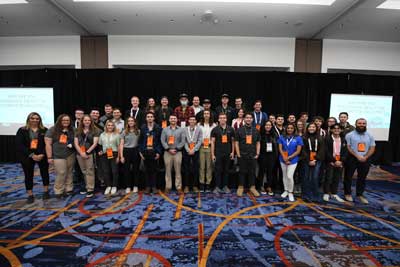
Society of Automotive Engineers students at the SEMA Garage on April 3, in Diamond Bar, California, during a recent Networking Event and Career Fair.
The Emerging Trends & Technology Network (ETTN) recently co-hosted the SAE/SEMA Garage Career Fair on April 3. The event, a joint venture between SEMA, ETTN and the Society of Automotive Engineers (SAE), was held in Diamond Bar, California.
The program was designed to connect SEMA members, SAE board members and other industry professionals with university students who are part of formula and Baja SAE competition teams. The competitions challenge students to design, fabricate and compete with formula-style race cars.
Besides networking and a close-up look at resources available through the SEMA Garage, the program included a career fair that allowed companies to recruit future graduates. The students also had a chance to gain feedback from industry professionals on their engineering and business presentations in advance of the forthcoming SAE competitions.
“The event was a collaborative effort between SEMA and SAE,” said ETTN Immediate Past Chair Ian Lehn, who spearheaded the project on behalf of the network. “It was refreshing to see the two organizations focus on the future of the next generation.
“To have an opportunity to interact with people in our industry at this level was invaluable. We want these students to see how cool we are and that we do a lot of cool stuff. Credit goes to Mike Spagnola (SEMA CEO) and Luis Morales (SEMA director of vehicle technology) for making us look as cool as we did at this event. To secure the future of our industry, we need to push the boundaries of technology. We have to cultivate the next generation and let them know that there’s an exciting future with our member companies.”
Tools, Technology and Knowledge to Advance Careers
Calling all automotive engineers, programmers and product developers! ETTN’s inaugural NERD Symposium debuts at the SEMA Garage in Detroit on Tuesday, August 16. The multi-day, multi-faceted event—whose acronym stands for Networking, Education, Resources and Development—consists of three core elements: an educational component, interfacing with service providers and subject-matter experts, and networking.
The event kicks off with a sneak peek at the newest SEMA Garage, followed by a get-acquainted cocktail hour. On Wednesday, education sessions presented will dive into the complexities of advanced driver-assistance systems (ADAS), emissions, diagnostics and simulation.
A series of one-on-one meetings with service providers and subject-matter experts is also on tap, and ETTN members will choose from a list of participants who will share their expertise on the technology behind emissions testing, ADAS calibration, intellectual property, machinery manufacturing, 3-D printing and more.
Networking opportunities will abound throughout. From the opening night cocktail hour to daily breakfasts and lunches to the Garage grand opening on Thursday evening, ETTN attendees will have multiple occasions to share ideas, talk shop and build meaningful, long-lasting connections
“This is truly a high-value event loaded with content and resources to help our members and their companies succeed,” said ETTN Chair Rob Simons. “We are excited to provide our members with exceptional educational, networking and career-growth opportunities.”
Future Leaders Network (FLN)
FLN Leadership Program Sharpens Skills
The Future Leaders Network (FLN; formerly the Young Executives Network) is committed to cultivating industry talent through education and networking by providing value-added resources and learning opportunities—which brings to mind the 14th-century English proverb, “Mighty oaks from little acorns grow.”
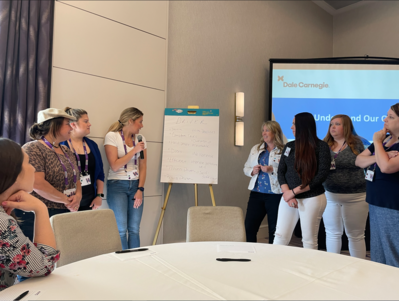
The saying still has significance in today’s world. How might it apply to FLN? Its members are aspiring young leaders intent on achieving a greater level of success. To help in their career-advancement journeys, the network recently partnered with the world-renowned Dale Carnegie training courses on a new program aimed at improving members’ individual and professional growth and development.
The two-day interactive professional development program was held at the SEMA Garage in Diamond Bar, California, on March 24 and 25. Following a kickoff networking mixer the evening before, the program itself focused on mastering essential skills to nurture and grow personal and business capabilities. Core learnings included confidence building, sharpening communication skills, strengthening relationships and building rapport.
“It was one of the most valuable programs I’ve been part of,” said Ian Lehn, founder of BOOSTane and immediate past chair of the Emerging Trends & Technology Network. “It was two-pronged. It not only created camaraderie, which SEMA does well, but we also all walked away with some valuable tools. The course didn’t necessarily give me new tools, but it sharpened the tools I already have and showed me how to use them in different ways. That’s where the real value lies.”
“The program was very successful,” added FLN Chair Nick Caloroso. “We hope that it really catches on and can take place in other locations. We want people to see it as a value add and for SEMA-member businesses that value their employees to invest in their future by sending them to this program. It’s about planting the seeds to help our member achieve greater
success.”
Council & Network Leadership–Council Highlights
FLN’s Professional Development Program recently involved a partnership with world-renowned Dale Carnegie, the first of which was recently held at a two-day interactive program on March 24–25 at the SEMA Garage in Diamond Bar, California.
Hot Rod Industry Alliance (HRIA)
HRIA Hails NHTSA Ruling, Champions Education Days
The announcement that the National Highway Traffic Safety Administration (NHTSA) had finalized a regulation enabling replicar businesses to produce and market turnkey vehicles was met with enthusiasm by the Hot Rod Industry Alliance (HRIA).
“It’s definitely a legislative win,” said Marcy Yanus, SEMA council director on many legislative issues important to our industry is big. It reaffirms that these efforts in Washington are meaningful and pay off to the benefit of our industry and enthusiasts.”
The ruling was long overdue. The SEMA-led legislation, known as the Low Volume Motor Vehicle Manufacturers Act, passed into law in 2015 as part of the Fixing America’s Surface Transportation Act. Under the law, small-volume automakers can market replicars that resemble vehicles produced at least 25 years ago. Annual production is limited to 325 replicars per manufacturer.
“SEMA applauds NHTSA’s final rule allowing companies to market classic-themed cars,” said SEMA Vice President of Government Affairs Daniel Ingber. “This is a hard-fought victory for enthusiasts, small-volume manufacturers and all who will be hired to fill new jobs.”
Engaging Members, Sharing Knowledge
HRIA kicked off an ambitious event schedule with a virtual membership meeting and a panel discussion moderated by Cool Hand Custom’s Amy Fitzgerald. The discussion, called “Preparing for the 2022 Car Show Season,” featured panelists Ben Tucker of Camaro Central; Kelle Oeste of V8 Speed & Resto Shop; and Jon Phillips of Advanced Clutch Technology.
A second virtual event moderated by Fitzgerald addressed the topic of “What’s a Hot Rod? The Answer May Surprise You.” Panelists included Jesse Henke of JH Restorations; Pete Filippo of Filippo Speed Shop; and Tim Strange of Strange Motion Rod & Custom. Another online session, “Hot Rod Trends: Looking Back & Looking Ahead,” is slated for September.
In June, HRIA will host an in-person membership meeting and mixer at Back to the Fifties in Minneapolis. Next stop: Louisville in August for HRIA’s flagship Education Days program at the NSRA Street Rod Nationals.
Launched in 2016, the program this year is a two-day event that is open to the public and includes 10 seminars. Five sessions will be presented daily. Topics run the gamut from wiring and gauges to brake and suspension systems to air conditioning, engines and power steering.
“Because thousands of enthusiasts attend the Nationals, it’s a great opportunity for members to share their expertise and build a rapport with end users,” Agosta said. “The sessions are so popular that we draw upward of 900 attendees. We’re extremely excited to present this year’s Education Days program. We’re expecting another record-breaking year.”
HRIA Education Days returns for 2022 on August 4–5 at the NSRA Street Rod Nationals.
Motorsports Parts Manufacturers Council (MPMC)
MPMC Addresses Opportunities and Challenges
From the Motorsports Parts Manufacturers Council (MPMC) Media Trade Conference (MTC) to the RPM Act and the recent introduction of the SEMA Emissions Certification program, MPMC is focused on matters pertaining to its segment of the industry.
For the second consecutive year, the MTC was virtual rather than in-person. While the conference draws strong support from traditional print, video, TV and radio media, the online format has allowed for increased participation by lifestyle and social-media influencers.
In the lead-up to this year’s event, MPMC organized a webinar aimed at educating it members on the ins and outs of working with new media. The live session was presented by Driveshop.
“This may be new territory for our members,” said John Lambert, Hot Rod Industry Alliance (HRIA) chair-elect. “We wanted to give them an understanding of how influencers increase awareness, how to interface and set up relationships with influencers and the questions they should ask. It was very well received, a lot of interaction, and we’re excited to build on this going forward.”
John Lambert
Revving Up the RPM Act
To ensure that the performance industry can continue providing products used to modify street-certified vehicles into those used solely for racing, SEMA has been working with lawmakers to pass the Recognizing the Protection of Motorsports (RPM) Act. The act has strong congressional support but has yet to become law.
“The U.S. Environment Protection Agency (EPA) has swung the pendulum too far,” Lambert said. “The overreach is so vast that it will have a negative impact on our industry. Last year, the SEMA PAC did a good job of setting up call times for SEMA members to talk to their Senate or House representatives. I had conversations with legislators and explained how the RPM Act will affect our industry and trickle down on local economies. It was eye-opening for them.”
MPMC members can help propel the RPM Act to the finish line. Ideas include posting info on social media, passing out flyers at motorsports events, or sending letters to lawmakers via www.saveourracecars.com.
“We are a passion-driven industry, and the EPA is trying to stop the expression of our passion for motorsports,” Lambert said. “We all need to support SEMA’s efforts to save our race cars.”
Certifying Emissions Compliance
SEMA recently introduced a new program that enables aftermarket parts manufacturers to meet the legal requirements for emissions compliance under the EPA Tampering Policy. SEMA Certified-Emissions (SC-E) gives manufacturers the ability to verify that a product meets the EPA’s “reasonable basis” criteria and is therefore legal in 49 states.
“The great thing about SEMA’s emissions-compliance program is that it makes it easy to achieve compliance,” Lambert said. “I have a lot of experience doing that for Hypertech and with the California Air Resources Board and SEMA, and it can be very challenging for a company that may not know where to start.
“SEMA stepping in with its own certification will take member companies through the process faster. If the EPA comes knocking, members will have everything they need to ensure that their products are in compliance. It’s a big deal and a great opportunity for SEMA members.”
Professional Restylers Organization (PRO)
PRO Rolls Out SEMA PRO Auto Show Tour
Heads up, members of the Professional Restylers Organization (PRO)! The SEMA PRO Auto Show Tour may be coming to a city near you.
Across America, in cities large and small, auto-show organizers have long sought to elevate the in-person experience and ramp up excitement at their events. After all, more than 11 million consumers flock to new-car shows annually, with two out of three attendees planning to purchase a new vehicle within a year.
So what better way to spark consumer enthusiasm than with a firsthand look at a show-stopping array of customized rides. Now, thanks to a proposal crafted by the PRO Select Committee and approved by the SEMA Board of Directors, the council’s innovative car-show initiative will play a key role in building consumer awareness of the benefits of vehicle accessorization.
Aligning Objectives
PRO leadership kicked off the groundwork last year with a presentation to 62 auto-show executives at the Auto Shows of North America (ASNA) Summit. The presentation focused on the benefits of restylers displaying customized vehicles in their respective markets and how these exhibits inspire consumer engagement. ASNA members responded favorably, agreeing to provide complimentary exhibit space along with exhibit-related services.
“PRO Chair Josh Poulson, Chair-Elect Colby McLaughlin and Immediate Past Chair Dino Perfetti did great work when they met with ASNA,” noted Ron Leslie, who chairs the council’s Auto Show Subcommittee. “The auto-show people said this would be an awesome way to promote their shows and bring in more excitement.”
Moving forward, PRO’s objectives aligned neatly with several SEMA Board priorities. At each event, for instance, industry-related consumer issues will be promoted, including awareness of legislative issues such as the RPM Act, youth engagement and career opportunities. The exhibit will also help to promote the automotive lifestyle, raise PRO’s profile and build brand awareness of SEMA and the SEMA Show.
“It’s a perfect marriage of the SEMA Board wanting to reach the consumer market and what we could do as PRO members,” Leslie said.
Hitting the Road
The SEMA PRO Auto Show Tour will kick off at the Denver Auto Show in September. Other likely destinations include Seattle, Charlotte, St. Louis, Austin or Tulsa, Dallas and Columbus, Ohio.
The exhibit will feature a specially designed, high-profile SEMA booth. The display will occupy at least 3,000 sq. ft., providing ample space to showcase vehicle builds and promote awareness of the restyling segment.
As PRO finalizes the show schedule, member restylers in target markets will be invited to feature vehicle builds to help educate consumers about the restyling market and how new vehicles can be transformed.
“We’ve had great success with the PRO Cup Challenge, so we’ve merged the ASNA opportunity with the idea of taking the Challenge concept to regional shows,” Leslie said. “We plan to work with restylers in each market to execute the display, to rebuild some of the award-winning Challenge vehicles and build some vehicles that are market-appropriate. It’s a great way to reach consumers nationally, to reach dealers in a more professional way and build real value for our members. SEMA made a huge investment to bring this about, and we are thrilled to bring the excitement of the SEMA Show and PRO to these shows.”
The SEMA PRO Auto Show Tour will kick off at the Denver Auto Show. Shown here is a sampling of the Automotive Concepts exhibit at last year’s show in Minneapolis, which was featured in PRO’s presentation to ASNA.
The auto-show people said this would be an awesome way to promote their shows and bring in more excitement.
—Ron Leslie
SEMA Businesswomen’s Network (SBN)
SBN Forum Presents Pathways of Opportunity
Women bring a lot of pluses to a workplace environment—empathy for co-workers, a team-oriented mindset, and a variety of communication styles, to name a few—that can be beneficial in any industry, especially one that is traditionally male-dominated. To help women employed in the automotive specialty-equipment industry advance their careers, sharpen leadership skills and amplify their voices within their companies and the industry, the SEMA Businesswomen’s Network hosted its inaugural SBN Women’s Leadership Forum in March at the Avenue of the Arts Hotel in Costa Mesa, California.
Participants of the Women’s Leadership Forum in March at the Avenue of the Arts Hotel in Costa Mesa, California, joined together for education and networking.
The three-day, in-person event focused on providing industry women with opportunities to improve skill sets through education, mentorship, group discussions and networking. To this end, SBN’s Leadership Forum Task Force assembled an impressive roster of immersive and interactive sessions presented by sought-after independent and Dale Carnegie-affiliated speakers, all of whom were women.
The first day kicked off with a keynote titled “Creating Your Community and Finding Inspiration.” An interactive session, “Overcoming, Surviving and Thriving,” was followed by two breakout tracks presented by Dale Carnegie—one centered on personal development, the other on leadership. Other topics covered during the event included “Creating a Culture of Fun,” “The Art of Executive Presence: A Woman’s Guide to Amplifying Your Career,” and concluded with a keynote session, “Pulling it all Together in a Bow.”
“The whole event was inspiring and uplifting,” said SBN Chair Cathy Clark. “We wanted to create an intimate event where women would not only learn and be exposed to new ideas but also feel safe and comfortable to help build a sense of sisterhood. The intimate atmosphere at the hotel created a perfect environment for that through networking.
“Our mission is to help women in our industry develop relationships, develop their skills, advance their careers and to stay in the industry. We want them to build their careers working for SEMA-member companies and to remain part of the SEMA community. I look forward to doing whatever it takes to make that happen, because it was a really great event.”
Cathy Clark
SEMA Council Director Nicole Bradle, staff liaison to SBN, echoed Clark’s
comments.
“It was mind-blowing and very moving to be with women from different levels in the industry, to see their ability to break down their thoughts, look at what they’re doing and try to improve their skills and abilities,” Bradle said. “SEMA is still a male-dominated industry. For these women to find other women they could talk to, work with, learn from and build each other up will help get more women into the field and help the industry
overall.”
Participants of the Women’s Leadership Forum in March at the Avenue of the Arts Hotel in Costa Mesa, California, joined together for education and networking.
“We wanted to create an intimate event where women would not only learn and be exposed to new ideas but also feel safe and comfortable to help build a sense of sisterhood.”
—Cathy Clark, SBN Chair
Truck & Off-Road Alliance (TORA)
TORA Mingles With Members, Promotes Feature Vehicle Participation
The Truck & Off-Road Alliance (TORA) recently co-hosted successful cross-council/network mixers. At the Keystone Big Show, TORA teamed with the SEMA Businesswomen’s Network (SBN), the Professional Restylers Organization and the Wheel & Tire Council. During the Easter Jeep Safari, TORA hosted a day of off-roading with a “Behind the Rocks Tip-Toe Trail” run, followed by a mixer in conjunction with SBN.
“We always get a good turnout,” said Chair Troy Wirtz. “It’s a great opportunity to bring our community together.”
Builder Growth Opportunities
Imagine the thrill of seeing your accessorized truck or off-road vehicle at the 2022 SEMA Show. If your company is a TORA member, the council is seeking builder participants for its Feature Vehicle Program.
The program has long been a council mainstay. The exhibit features six vehicles—five positioned outside the West Hall and one in the TORA booth. Eligibility centers on specific categories, including diesel, off-road, Jeep, lowered, lifted, overland or UTV. Candidates must apply and pay a feature vehicle fee of $1,500, of which $500 is donated to SEMA Cares.
According to Wirtz, TORA aims to raise awareness of the program and highlight the value of participation while securing a mix of vehicles emblematic of the truck and off-road segment.
“We need to bring more attention to the program, and we encourage more people to submit applications,” he said. “It’s more than just four days at the SEMA Show. For builders, the recognition, having their vehicles displayed and the networking creates enormous opportunities.”
Seth Ravndal concurred. His company, Blacklake Research and Development, displayed a Silverado 1500 in the lifted/off-road category last year.
“Being chosen as a feature vehicle was a great compliment and endorsement of our company and its capabilities, and it was a great opportunity to showcase this segment of the market,” he said. “The increased exposure helped us engage and build relationships with many peer companies, potential suppliers and customers. If it fits your company’s marketing strategy, it’s a no-brainer.”
“It’s a thrill and an honor to have a vehicle at the SEMA Show,” added Seth Gortenburg, co-owner of Defco, which built two lifted Ford trucks (an F-250 and an F-450) made for street and towing. “Besides the invaluable exposure, we received many leads from potential customers. We met current and potential vendors and established new
relationships.
“The aftermarket is all about networking. When you have a feature vehicle at the SEMA Show, you have the opportunity to showcase your talents. It’s not just bragging rights. It’s a truly unique opportunity to grow your business.”
Wheel & Tire Council (WTC)
WTC Webinars Deliver Value
Since the start of the pandemic, online learning has taken on a more important role. As many organizations adapt to an evolving workforce environment, virtual education is an effective way to deliver information and knowledge to a wide audience and keep colleagues connected, no matter where they may be.
This is true for the Wheel & Tire Council (WTC), which has made virtual education a top priority and last year experienced success with its webinar tracks for tire and wheel professionals. Beginning in February of this year, WTC launched a new webinar series. The sessions are live and run monthly through September.
The new series, “Wheel and Tire Insights, Powered by WTC,” is targeted specifically to wheel and tire manufacturers, equipment suppliers, dealers, retailers and service providers. Each session targets a specific topic and is presented by industry experts sharing insights into issues relevant to the wheel and tire segment.
The first webinar, for instance, centered around the Recognizing the Protection of Motorsports Act and the impact on the wheel and tire segment if street-certified vehicles cannot be modified for racing. Presenters included Tire Rack’s John Rastetter; Garry Ruede of Discount Tire; Eric Snyder, SEMA director of congressional affairs; and Ryan Fuller of Standards Testing Lab. During the webinar, they shared their knowledge of the issue and how the Environmental Protection Agency ruling would jeopardize future sales of race wheels and tires.
The March webinar, “PAC Membership From a WTC Membership Perspective,” was presented by SEMA Director of Government Affairs Christian Robinson and John Hotchkis of Hotchkis Performance, chair of the SEMA Political Action Committee (PAC). During the session, they explained how the SEMA PAC helps to ensure that elected officials support the aftermarket industry. They also talked about the importance of the new SEMA Individual Membership and how WTC members can work with elected officials.
Future webinars will tackle other topics. Among them: “Building Your Business Through Profit Sharing,” “Future of Wheels and Tires in Five, 10, 20 Years,” and “Staffing, Training, Retainment of Tire Shop Employees.”
From WTC’s perspective, the sessions are a valuable member benefit.
“We want to help our members become stronger in their end of the business in our industry,” said Chair Todd Steen. “We’re not here to tell them how to modify autonomous vehicles. We want our members to understand what’s coming down the pike and to see the challenges and opportunities and be their education resource. I can think of no better way to bring value to our members than by helping them with their businesses through education.”
Easter Jeep Safari cross-council networking event with the Truck & Off-Road Alliance and SEMA Businesswomen’s Network.
SEMA Members Explore the Middle East Customizing Market
By Linda Spencer
The delegation spent a day in each of the two countries visited—Dubai, UAE, and Riyadh, Saudi Arabia—calling on performance and off-road shops. The owners of each shop briefed the group on the facility and current projects underway.
Fifty SEMA members from 27 companies participated in the ninth SEMA Middle East Business Development Program (BDP) trip to Dubai, United Arab Emirates (UAE), and Riyadh, Saudi Arabia. The March 2022 trip—the first since the beginning of the COVID pandemic and the 24th overall SEMA BDP—represented two firsts: It was the first program to showcase two countries on one trip (the United Arab Emirates and Saudi Arabia), and it was the first trip to Saudi Arabia.
Jacob Hawksworth (white shirt), CEO of Hypercraft, and Shaun Hill (blue shirt), Hypercraft’s CRO, enjoyed the 70 vehicles participating in a Cars and Coffee organized in Riyadh in honor of the SEMA delegation.
SEMA News asked the participating U.S. suppliers to provide their main takeaways from the seven-day trip. Coming in-person to the targeted market despite the time, effort and expense was deemed critical. Among the benefits were invaluable market intelligence and the opportunity to meet many pre-vetted buyers within a short period and to use this time abroad to begin to develop relationships with these potential business partners.
Dr. Nasser Almasary (center) shares a laugh with members of the SEMA delegation at the Cars and Coffee. From left: Joe Valentich, BlackLake Research and Development Co. owner; Nathan Ridnouer, SEMA vice president of councils and membership; Dr. Nasser; Jacob Hawksworth Hypercraft CEO; and Shaun Hill, Hypercraft CRO. Dr. Nasser, as he is affectionately known, organized the Cars and Coffee in honor of the visiting SEMA delegation. He owns about 50 antique vehicles, including a prized ’29 Cadillac. He was quoted in a recent press article about the ’29 Caddy: “I’m really proud of owning this car, and I have spent a lot of time and effort to bring it to Saudi Arabia…this car (was) built in the great depression or just before the depression.”
“My biggest reason for going was to get intel from enthusiasts to really see firsthand what vehicles they customize and why,” explained first-time SEMA BDP participant Theresa Contreras, lead designer and vice president of Baja Forged. “The show [the delegation exhibited at Dubai-based Custom Show Emirates] and especially the shop tours really helped me to see where our business fits into their market currently and where we could make some minor adjustments to have even a bigger impact.”
The delegation spent a day visiting performance and off-road shops both in Dubai and Riyadh.
“Once again we learned that being there is important,” concurred veteran SEMA BDP traveler Bob Scheid, vice president of McLeod Racing. “McLeod has always had a great presence in the Middle East, but we see the market evolving. The market for our Adventure Series Jeep products and Tremec transmission is much greater than I would have ever expected. If we had not gone, we wouldn’t have known. Because of this trip, we’ve already seen orders for parts we have never sold to the UAE before.”
Pictured from left are Peter Mehravari, IPR attaché for the U.S. Embassy in Abu Dhabi, and Lu Zhou of the economic office of the U.S. Consulate in Dubai. Mehravari and Zhou participated in a briefing in Dubai along with Bruce Ellsworth (not pictured), commercial attaché for the U.S. Consulate in Dubai; Nasreddine Gouami, commercial specialist for the U.S. Consulate in Dubai; and Xavier Muthu, commercial specialist for the U.S. Embassy in Kuwait. Gary Rand, deputy senior commercial officer for the U.S. Embassy in Riyadh, also briefed the delegation in Riyadh.
Todd Payne, director of sales for Magnuson Superchargers, added: “We have had a strong market following in the Middle East for many years, so attending this year’s SEMA trip was a fantastic opportunity to explore new vehicle application interest, installer proficiency, and the strength of the distribution channels.”
Pictured here (from left) are U.S. Consul General Meghan Gregonis accompanied by Lu Zhou, economic officer for the U.S. Consulate in Dubai. They visited the SEMA delegation’s booths and are show with (from center left) Joseph Comiskey, CEO of Raglan; Ryan Tillman, COO of Raglan; and Keith Holland, CMO of Raglan.
The opportunity to network with buyers was a top priority for David VanVoorhis, sales representative for Westin/Superwinch in Europe, Russia and the Middle East.
“The most important part of the trip for us was the connection to the buyers in the region and the chance to talk with them, VanVoorhis said.
“Although we’ve been selling to the GCC region for some time, the region is rapidly growing, and that growth is ripe for the picking,” said Aaron Mercer (right), international account manager for Bestop. “Saudi Arabia, especially, is making moves to more easily do business in the kingdom and [enact] laws more friendly to consumers to modify their vehicles without repercussions.”
“In addition to using the opportunity of the BDP to conduct market intelligence, it is just as important to build those face-to-face relationships even with long-standing customers,” Scheid pointed out. “We are in a relationship industry, and that is no different abroad.”
Injen Technology President Ron Delgado (center, facing camera) and Jay Crouch, director of global business (fourth from right) talk with trade and enthusiast buyers at Custom Show Emirates. This is Injen’s seventh trip to the Middle East with SEMA and their 20th overall on SEMA’s Business Development Programs around the world.
“From a buyer’s perspective in this market, the notion of a strong relationship between them [enthusiasts] and who they buy from will remain in place for the foreseeable future,” said David Reyna, international accounts manager of DeatschWerks Fuel Systems.
“We have had a strong market following in the Middle East for many years, so attending this year’s SEMA trip was a fantastic opportunity to explore new vehicle application interest, installer proficiency, and the strength of the distribution channels,” said Todd Payne (right), director of sales for Magnuson Superchargers.
“Trust and personal relationships are paramount,” according to Yury Lyalko, CEO of Wiring Specialists. Lyalko was on his second trip to the Middle East with SEMA. “Our team is able to build these personal relationships through the SEMA international trips, which make them a key component of our market outreach and business-building relationships.”
The SEMA delegation exhibited at the Dubai-based Custom Show Emirates as part of the 2022 SEMA Middle East program. Seth Ravndal (center) is the owner of BlackLake Research and Development Co.
Participants were pleased with how receptive the region is to American vehicles and aftermarket products.
“They really love their U.S. brands, and I saw how important that was while walking the show and talking with enthusiasts,” Contreras said. “Demand for product to fit U.S. vehicles was strong.”
The SEMA overseas programs are supported by the U.S. Department of Commerce’s International Trade Administration. In addition to providing funds to defray the cost of participating for qualified U.S. suppliers, officials from the U.S. government briefed the delegation and spent time during the week meeting individually with companies. Pictured here are Bruce Ellsworth (left), commercial attaché with the U.S. Consulate in Dubai, and Bob Scheid, vice president of McLeod Racing.
“A large portion of the vehicles sold in the area are U.S.-made. The people are very passionate about their cars and have the disposable income to support that passion,” noted Joshua Abbott, global sales manager for Borla Performance Industries Inc.
The first evening included a briefing by top regional buyers, followed by a dinner.
The 2022 program included five days in Dubai and an additional two days in Riyadh, Saudi Arabia. The trip featured site visits to performance and off-road shops in both markets as well as various networking events and panel discussions. The low-cost business development program also arranged for the SEMA delegation to exhibit at Custom Show Emirates, a three-day trade and consumer show held in the Dubai World Trade Center, and the participants attended a special edition of Cars and Coffee in Riyadh, held in honor of the visiting U.S. delegation.
The SEMA Middle East trip opened with a dinner and a discussion with top local buyers. Pictured on stage here is Maher Abdalla, Stellantis’ director for MOPAR service, parts, customer care and supply chain.
Business resulting from the trip is expected, with companies looking at the prospect for sales opportunities for their particular products and niches.
“Dubai and Saudi Arabia represent strong growth opportunities for Magnuson Superchargers in both the off-road and street performance markets,” Payne said, noting that area enthusiasts “expect dependable, efficient and prodigious horsepower.” Other companies investigating the potential for their products were also optimistic.
The delegation enjoyed a night out on a boat ride on the Dubai Mariana. Pictured from left to right are Brennan Scully, sales manager for Baja Designs; Greg Foster, dealer account manager for Dirt King; Rufus Keller, IP/MAP Enforcement for Baja Designs; and Aaron Mercer, international account manager for Bestop.
“We certainly see potential for our product in the Middle East,” Lyalko said. “We have seen an uptick in LS and Japanese engine conversions in the local Gulf market and see immediate need for supporting products, which is what we make.”
Greg Foster (second left), dealer account manager for Dirt King Fabrication.
“The off-road sector is growing quickly in the region, with consumers focusing heavily on what is done in the United States,” said Aaron Mercer, international account manager for Bestop.
“We have been selling to the GCC [Gulf Cooperation Council, a political and economic alliance of six Middle Eastern countries—Saudi Arabia, Kuwait, the United Arab Emirates, Qatar, Bahrain, and Oman] region for some time,” he said. “The region is rapidly growing, and that growth is ripe for the picking. Saudi Arabia, especially, is making moves to more easily do business in the kingdom and [enact] laws more friendly to consumers to modify their vehicles.”
“They really love U.S. brands, and I saw how important that was walking the show and talking with enthusiasts,” said Theresa Contreras (right).
It was also a positive experience for first-time exhibitor Rocco Caporaso Jr., president and CEO of Gliptone.
“Gliptone is an appearance care company that caters to higher-end car enthusiasts,” he said. “The Dubai and Saudi aftermarket appearance care business is on the rise, and Gliptone will be doing its best to grab the biggest market share we can.”
“The 2022 SEMA Business Development trip was once again a success,” said Joshua Abbott (center), global sales manager for Borla Performance Industries Inc. “We have been doing business in the region for more than four decades now, and thanks to these trips, we are still able to find new distributors every time we visit.”
Utah-based Hypercraft also saw potential for its products, which include complete electric-vehicle drive systems for motorsports and powersports.
“Even with the region being known for gas and oil resources, there is still a lot of local interest in the performance offered through electric motors,” said Shaun Hill, the company’s CRO. “There is always an early adopter segment, and they are interested in the latest and unique technology. Electric propulsion has some of both.”
Trade buyers from eight countries had preregistered for their SEMA credentials and traveled to Dubai to meet with the U.S. delegation. Pictured here are Adam Weisner (second left), chief commercial officer; Tom Bateman (second right), director of marketing; and Miguel Angel Casas (right), international sales consultant for SuperSprings International, which participated in its first ever SEMA overseas business trip.
One hundred percent of the participating companies that completed post-trip surveys reported that they traveled back to the States with new customer leads and more than 90% expected to see sales within the next 12 months. That tracks with the overall stats of the 169 companies that have traveled one or more times with SEMA to the Middle East, reporting $89 million in export sales to the region for the 12 months following the receipt of a U.S. government grant.
“I love that motorsports connect us around the world, and their enthusiast scene really is just like ours,” said Theresa Contreras (center), vice president and lead designer for Baja Forged. “I met members from the UAE Raptor Club, and we share some of the same friends in the off-roading community from the United States. They love customizing their vehicles to use them just as much as we do.”
The SEMA Middle East trip and the other SEMA overseas programs are supported by the U.S. Department of Commerce’s International Trade Administration. In addition to providing funds to defray trip costs for participants, U.S. government officials provided briefings in each market and spent time with the delegation, providing the opportunity for one-on-one.
“We certainly see potential for our product in the Middle East,” said Yury Lyalko (third from right), president of Wiring Specialties LLC. “We have seen an uptick in LS and Japanese engine conversions in the local Gulf market and see immediate need in supporting products, which is what we make. Accompanying Lyalko was Vadim Belogorodsky (left), the company’s vice president of product development.
“This region provides an opportunity for U.S. companies to expand. However, as with any new market, it has unique characteristics. That makes it crucial to become well-informed and obtain expert advice in order to be successful there. SEMA facilitation with U.S. trade commerce officials and other government offices really helps to complement a visit to the region for the Custom Emirates Show,” according to Andy Lamus, vice president of international sales for Dynocom Industries Inc.
“Mustang Dynamometer has been attending the SEMA Middle East event since its beginnings, and we plan on continuing that trend,” said Michael Caldwell (right), sales manager for Mustang Dynamometer. “The event has really paid off for us, and it is always professionally managed. The hotel is close to the event, and the event itself is the best in the Middle East for the custom car market.”
“The SEMA trade mission to the Middle East was an eye-opener and a fantastic learning experience for Ultra1Plus,” said Carmine Colarusso, CEO of Ultrachem LLC. “It is a market where we want our products to be a significant competitor. We now have a completely different view from my previous market perceptions. The delegation’s network, the government and the local entrepreneurs gave us factful insights drawn from many years of prior experience. The result was a learning curve flattened by the information shared.”
“Passion for the engine sound and horsepower experienced at wide-open throttle seems to be universal,” said Andy Lamus (right), vice president of international sales for Dynocom Industries Inc. “The Middle East reflected the scene we have in the United States with its own specific identity, especially in the sand sports and the strong SUV participation in all auto racing sports practiced in the region.”
“Missing out on the market would have been like missing out on the U.S. market as it was beginning its rapid growth,” Scheid concluded.
Counterfeit Issues: Who to Contact
“McLeod has always had a great presence in the Middle East, but we see the product that we offer changing,” said Robert Scheid (right), vice president for McLeod Racing LLC. “The market for our Adventure Series Jeep products and Tremec transmission is much greater than I would have ever expected. If we had not gone, we wouldn’t have known.”
Peter Mehravari, IPR attaché for the Middle East and North Africa and based in the U.S. Embassy in Abu Dhabi, urged U.S. companies to notify the appropriate U.S. IPR regional attaché based on where the violation was discovered. He then outlined positive developments in Saudi Arabia and Kuwait on how to file notice (www.uspto.gov/ip-policy/ip-attache-program/regions) of counterfeiting found in those countries. He also briefed the group on updates on IPR filing fees in the UAE upon becoming aware of any counterfeit issues regarding their products.
“I had really two major takeaways from the trip,” said David VanVoorhis (right), Westin/Superwinch sales rep for Europe, Russia and the Middle East. “One was the general acceptance and even strong enthusiasm for American brands, and also the need for face-to-face meetings to move things forward with people in that region.”
In Saudi Arabia, the U.S. company should go to www.saip.gov.sa/en, click the button that says “Report Infringement,” and then send in all the details of the counterfeit products discovered.
“There are many similarities in the passion of the enthusiasts in Dubai and surrounding countries and those in the United States,” said David Reyna (left), international accounts manager for DeatschWerks Fuel Systems. “Although automotive tastes vary, it appears that the underlying theme of more horsepower and better performance and the spirit of winning is about equal.”
To report in counterfeits in Kuwait, go to the Ministry of Commerce and Industry website (https://trademark.moci.gov.kw) accessed from within Kuwait.
UAE’s new trademark law (which passed in 2021) and UAE’s accession to the Madrid Protocol will reduce fees by allowing applicants to file multi-class applications (instead of having to pay a separate application fees for each trademark class).
“This trip represented an excellent opportunity for Gliptone to connect with our existing Dubai distributor and help him grow his business while expanding Gliptone’s market share throughout the entire Middle East,” said Rocco Caporaso Jr. (left), president and CEO of Gliptone.
Companies Participating in the 2022 SEMA Middle East Trip:
Atomic Shop LLC
Baja Designs Inc.
Baja Forged
BlackLake Research and
Development Co.
Bestop
Borla Performance Inc.
DeatschWerks
Dirt King Fabrication
Dynocom Industries Inc.
Gliptone
Hypercraft
Injen Technology
K&N Engineering
Linear Logic LLC
Magnuson Superchargers
McLeod Racing LLC
Mustang Dynamometer
Performance Analysis
Pittman Outdoors “AirBedz”
Raglan Motors
SuperSprings International
Ultrachem LLC
VMP Performance
Westin/Superwinch
Wilwood Disc Brakes
Wiring Specialties LLC
“The SEMA trade mission to the Middle East was an eye-opener and a fantastic learning experience for Ultra1Plus,” said Carmine Colarusso (right), CEO for Ultrachem LLC. “It is a market where we want our products to be a significant competitor. We now have a completely different view from my previous market perceptions.”
Officials gathered at an event to destroy counterfeit products. Rufus Keller, IP/MAP enforcement for Baja Designs (far left) and Peter Mehravari, the U.S. intellectual property attaché for the Middle East and North Africa (far right) posed for a picture with UAE officials responsible for IPR counterfeit enforcement.
Are Alternative-Fuel Technologies the Future of the Internal-Combustion Engine?
By Mike Imlay
The internal-combustion engine is far from dead, and emerging synthetic and related carbon-neutral fuels are just a few of the advancements offering a cleaner future amid ever-stricter emissions standards. Shutterstock.com
Judging from the headlines, you’d think the internal-combustion engine (ICE) is not long for this world. Europe and U.S. governmental bodies are passing ever more stringent climate measures and incentivizing zero-emissions powertrains. Meanwhile, OEMs are ramping up battery-electric vehicle (BEV) production and shifting resources away from traditional engine development. But dig beyond the headlines and you’ll find that the reports of the ICE’s death are greatly exaggerated.
“Gas-power vehicles will continue to rule the roads in the United States for a long time to come,” said Gavin Knapp, director of SEMA Market Research. “There are over 280 million ICE cars and trucks on the road now, and more are selling each year. While sales of alternative-power platforms, particularly electric cars, are ramping up, they are still a small fraction of new-vehicle sales at this point. Our current forecast shows that it will take more than a decade for electric vehicles to reach even 50% of new-vehicle sales, so ICEs will definitely be a main component of the vehicle mix for the long haul.”
That fact has many industry companies taking a fresh look at synfuels as solutions whose moment has come. Last year, Bosch announced the development of Blue Gasoline in partnership with Shell and Volkswagen. Following on the rollout of R33 Blue Diesel, the new fuel represented one of the latest salvos in the low-carbon fuel market. In its press announcement, Bosch stated that Blue Gasoline “contains up to 33% renewables, ensuring a well-to-wheel reduction in carbon emissions of at least 20% per kilometer driven.”
“This means a fleet of 1,000 VW Golf VIII 1.5 TSIs alone could save more than 230 metric tons of CO2 per year, assuming an annual mileage of 10,000 km each,” the company explained, adding that Shell would offset the remaining carbon emissions from Blue Gasoline usage through certified offset arrangements.
“On the road to climate-friendly mobility, we must ensure that we don’t leave any technical opportunities untapped, starting with electrobility and ending with renewable fuels,” asserted Dr. Uwe Gackstatter, president of the Bosch Powertrain Solutions division.
Bosch, Shell and VW are not alone in bringing new fuels to market. In December
2021, VP Racing Fuels also announced that it was making advanced bio-renewable components available for adaptation with the company’s race fuel portfolio. In its announcement, the company noted that it continues to develop and test race fuels to meet the upcoming renewable fuel requirements of multiple race series, including Formula 1 and IMSA.
“With enhanced concern over the global environment and an ever-increasing demand on the transportation of people and goods, government regulatory authorities continue to push for more stringent regulations on pollutants and CO2 emissions,” explained Mark Walls, VP’s director of R&D and fuel technology. “Auto manufacturers continue to pursue advanced powertrains such as electric and hybrid-electric vehicles to address this problem, but we felt that onboard fuel could play a part.”
But what exactly are synthetic fuels? Known alternatively as synfuels, renewables, biofuels or carbon-neutral fuels, they are usually liquid fuels produced through the hydrocarbonization of coal, natural gas or biomass feedstocks. Although not derived from fossil sources like crude oil, some liquid synthetics can serve as direct “drop-in” fuels—easily substituting for gasoline or diesel in an ICE vehicle with little or no modification.
Closely related, eFuels are produced through a wind or solar electrification process that creates hydrogen, which is then combined with carbon dioxide extracted from the atmosphere or from industrial processes such as iron smelting. The resulting synthetic fuel can then be refined into eFuel gasoline or diesel.
An Ongoing Debate
Eco-friendly as they sound, bio-fuels have their detractors, particularly among stalwart electrification fans. Business media giant Forbes.com, for example, published a March 2021 article by BEV proponent James Morris titled “Synthetic Fuels Won’t Save the Planet, So Don’t Say They Could.” A quick Google search will turn up plenty more articles and videos echoing that sentiment. Nevertheless, synfuels are gaining an enthusiastic following, especially among those with a love for the ICE.
“I’m very passionate about this particular topic, not only being from the oil and gas side of things but also because there’s so much opportunity to move the needle,” said Ian Lehn, founder of BOOSTane, a company and product line that he developed based on his college thesis. Recently BOOSTane formed a partnership with Driven Racing Oils to expand into new products and markets, including fuels, oils and lubrication technologies. Lehn is also a past chair of SEMA’s Emerging Technologies & Trends Network and a voice for alternative fuels and other new technologies that are making ICEs greener and more efficient.
“I think we [in the aftermarket] have had a lot of negativity pointed toward us when in reality we have done more for the advancement of the ICE than any other industry,” he asserted. “Performance and competition have birthed innovation and efficiencies more than economics have. We’re pushing the limits of getting the most out of fuels.”
Synthetic fuels, he pointed out, are nothing new. However, economic factors associated with mass production have greatly hindered their adoption. Historically, producers and consumers alike have found renewable fuels simply too cost-prohibitive.
“It hasn’t been until now, with the advent of the EV and other alternative fuels, that more investment into development, processes and refinements have moved us to the point where people are starting to pay attention,” Lehn said. “Also, the market has shown that it is now willing to pay a premium to make a difference from a ‘green’ standpoint.”
In fact, Lehn envisions several potential markets for synthetic fuels. First among them is overlanding, which tends to attract a relatively affluent and environmentally aware demographic.
“On the other end of the spectrum you have the racing industry, which may not be as concerned about their overall [environmental] impact but would like to be,” Lehn said. “There are going to be a lot of governing bodies pushing motorsports to lower their overall carbon footprint.”
OHV and powersports enthusiasts sit right in the middle. As Lehn sees it, “They have to be conscientious of their impact off highways and on the trails, but they will still need a reliable fuel that’s very high-performance.”
From a supply perspective, synfuels are becoming increasingly feasible to produce and market, said Robert Freerks, vice president of products for Strategic Biofuels, based in Columbia, Louisiana. Freerks, who earned his PhD in synthetic organic chemistry from the University of California, Irvine, is a passionate advocate of renewable synthetics.
“I’ve been working in the fuels and lubricants area since 1981,” he explained. “I had 18 years at Chevron, and then I went into the synthetic area. I’ve made all kinds of hydrocarbons from natural gas, coal, woody biomass, waste materials and anything that’s got carbon in it.”
Now he plays a key role in Strategic Biofuels’ development of a process and plant that can efficiently convert forest waste into hydrocarbon fuels. The goal is to make renewables more economical and available for transportation use. Currently his focus is on renewable diesel, which he said holds distinct advantages over other biodiesel fuels.
“Renewable diesel is the same thing as what’s made from hydro-processing fats and oils,” he said. “The good thing about that process is that the renewable diesel fuel—as opposed to biodiesel—is a drop-in fuel. It’s a 100% replacement for conventional diesel. It burns clean and it’s perfect.”
He added that the jet fuel version of this fuel is certified for drop-in use in all military and commercial aircraft as well as all diesel engines. No blending is necessary.
“From a transportation standpoint, buses, trucks and airplanes run on diesel and jet fuel, which I can make readily,” he said. “Gasoline is harder to replace, but it can be done. It’s just that right now it’s a yield loss.”
Strategic Biofuels is building its processing plant in California, taking advantage of the state’s renewable energy credits to lower costs. The raw biomass stock will be sourced from Louisiana, but the plant could also easily make use of municipal and other solid wastes.
“Woody biomass feedstocks can be had for $20 to $30 a ton because they’re the leftover remains from harvesting timber,” he noted. “When you harvest a tree for wood, you can only keep the long strands—the 30- to 60-ft. sections that are cuttable into 2x4s and other dimensional wood. The rest of it—the bark, the limbs, the stems, the top of the tree, the top 20 to 30 ft.—is too thin to use. It just gets chopped up and left in the forest and either rots or burns. The same thing happens with unmanaged forests where all the debris falls to the floor and just becomes fuel for wildfires.”
In addition, the Strategic Biofuels facility will further decrease its carbon footprint by returning the greenhouse gases it generates into the earth.
“If you believe that sequestration of CO2 is what we need to do—and there’s a lot of government support for that—my process actually removes CO2,” Freerks said. “It’s part and parcel of the process, not an add-on.”
Whether renewable diesel or any biofuel is more eco-friendly than BEVs and other alternative fuels depends on one’s vantage point. Like all hydrocarbon fuels, biofuels produce tailpipe emissions. However, Freerks argues that if one looks at their overall sourcing, production and carbon footprint, hydrocarbon fuels are much more energy-dense, efficient, economical and net carbon-neutral than EV batteries.
“Wind and solar cannot power our transportation industry,” he asserted, and while BEVs may tout zero tailpipe emissions, they carry their own environmental baggage. Mining the raw materials needed for EV batteries and motors merely outsources pollution to third-world countries, he said. Plus the infrastructure required for a nation of personal BEVs and commercial trucks would be an enormous drain on resources.
Freerks likewise believes that growing and harvesting massive amounts of corn for ethanol presents its own set of sustainability dilemmas.
“To take food like corn and convert it into fuel to me is a sin,” he said. “You could feed half of Africa based off the corn that we grow for fuel.”
Like others in the industry, Freerks doubts that transportation’s future lies in electrification alone. Rather than a one-size-fits-all approach to carbon reduction, he advocates a mix of technologies, including ICE vehicles running on carbon-neutral fuels, especially for long-haul trucking.
“Transportation fuels are just going to be there,” he said. “The U.S. Department of Energy shows us actually increasing our crude oil consumption through 2050, so net zero by 2050 physically is not going to happen.”
But beyond scientific concerns, Freerks also has a personal stake in the ICE’s future.
“I’ve got a ’68 Barracuda with a turn plate tank,” he said. “You have to really watch what fuel you put in and how you recycle it.”
Preserving Flexibility
Due to their relative costs and lower carbon footprints, synthetic fuels will likely appeal first to more-affluent consumers with a special interest in the environment, such as powersports enthusiasts. Look also for motorsports organizations and overlanders to be early adopters.Shutterstock.com
Although not synfuels, E85 and other ethanol-gasoline blends are also considered significantly more carbon neutral than gasoline. eFlexFuel Technology Chief of Business Development Juha Honkasalo recognizes the controversies surrounding them but nevertheless views the blends as making valuable contributions to ICEs. To unlock the (sometimes hidden) flex-fuel potential of certain gasoline vehicles, eFlexFuel produces E85 conversion kits.
“About three or four years ago, the current big boom began in Europe to convert to flex fuels because they started to support E85, mostly for environmental reasons,” Honkasalo explained. “Of course, it’s also good for energy security, which is a timely topic right now. In 2018, our company saw just around $400,000 in revenues, but now we are on track toward almost $10 million.”
Based in Pirkkala, Finland, eFlexFuel also sees a growing opportunity in the United States.
“Roughly 50% of all American people live in a place where E85 is available,” Honkasalo said. “There are a lot of cars, a lot of money, and a lot of people who love to modify their vehicles. This is the biggest potential market for a technology like ours.”
The company’s kits are basically piggyback systems installed between a vehicle’s ECU and its fuel injectors. Consisting of a control unit, a wiring harness, an ethanol sensor and a Bluetooth app interface, the kit reads the ethanol content of the vehicle’s fuel, adjusts the injector pulse to optimize engine performance, and provides a real-time data readout through the smartphone app. The product has all the environmental approvals required for European use, and California Air Resources Board certification is pending for the United States.
According to Honkasalo, a surprising number of modern vehicle models will accept an E85 conversion, including plug-in hybrids. A database at the company’s website helps consumers determine if their vehicles are adaptable. Like other alternative fuel proponents, Honkasalo believes a variety of solutions are needed to achieve international and U.S. carbon-neutrality goals.
“If you look at the media, you would think everything’s going to be electric in a few years,” he said. “But when you go out there and drive the streets, you see that there aren’t that many electrics. The average vehicle in the United States is more than 10 years old. Easily all the cars being sold today will still be in traffic in, say, 2040. I think there’s a huge [ICE vehicle] potential for decades to come.”
SEMA Awards Gala Set to Honor 2022 Hall of Fame Inductees
The Annual Celebration Will Take Place July 29 in Anaheim, California
By Mike Imlay
This year’s annual SEMA Awards Gala is slated for Friday, July 29, at the new Westin Anaheim Resort in Anaheim, California. The event will put the 2022 SEMA Hall of Fame inductees front and center in an evening of celebration.
SEMA leadership, volunteers and industry icons are set to honor the association’s new Hall of Fame inductees at the 2022 SEMA Awards Gala on Friday, July 29, in Anaheim, California. Renamed for 2022, the event will take place at the Westin Anaheim Resort.
“The SEMA Awards Gala is among our association’s most anticipated events,” said SEMA CEO Mike Spagnola. “The past two years have demonstrated the importance of in-person celebrations, so we are especially proud to gather this year as an industry to honor our 2022 Hall of Fame inductees.”
Formerly known as the SEMA Installation Banquet & Gala, the SEMA Awards Gala is a long-established tradition where individuals who have made extraordinary contributions to the specialty-equipment industry are recognized. For 46 years, the reception and dinner have served as the formal event where new SEMA Hall of Fame inductees are introduced, the incoming Board of Directors is sworn in, and outgoing directors are thanked. SEMA council, network and industry leaders are also recognized during the event.
“We’re excited that our summer gala is returning to Southern California, and even more excited at the event’s rebranding as the SEMA Awards Gala to amplify our Hall of Fame celebration,” said SEMA Special Events Director Jamie Eriksen. “This year’s venue, the Westin Anaheim, is a brand-new hotel in the city that recalls the roots of past SEMA events, including early SEMA Shows. I feel like this is a homecoming that is bringing together the industry family.”
This gala also represents yet another milestone as the industry continues to put the pandemic lockdowns in the rearview mirror. In 2021, the in-person gathering returned after a year’s hiatus, drawing 400 industry professionals and friends. It was held in the recently completed West Hall of the Las Vegas Convention Center as a show of support for the city and facilities where the 2021 SEMA Show would later be held.
“The 2021 event was actually one of the largest galas we’ve had,” Eriksen said. “People were very excited for the opportunity to reconnect in person, and we expect this year’s gala to follow in that same vein of excitement. The opportunity to connect face-to-face with others is so important, because there’s a lot of deep friendships in our industry. This year I feel like we’re riding on last year’s momentum and continuing to move forward as we look toward the coming year.”
The gala also caps a week of strategic planning sessions for SEMA’s Board of Directors as well as council and network leaders. The high-level meetings serve to identify industry needs and priorities and shape the association’s initiatives to address them. After the week’s business, however, the mood will turn celebratory on Friday afternoon with a private event for the 2022 Hall of Famers prior to the gala. Later, the official SEMA Awards Gala will kick off with an industry reception starting at 6:00 p.m., followed by the awards banquet at 7:00 p.m.
“The main focus will of course be on our Hall of Famers and their lifelong accomplishments,” Eriksen said. “In addition, we will recognize incoming and outgoing Board members as well as our volunteer leaders.”
Honoring Excellence
SEMA friends and family share their common passion for the industry each year during a cocktail reception, followed by a dinner highlighting the lifetime achievements of the incoming Hall of Fame class.
Induction into SEMA’s Hall of Fame is among the association’s highest honors and is reserved to entrepreneurs and enthusiasts who have played crucial roles in the advancement of the association and the industry it serves. Leaders, innovators and creators, they epitomize the essence of ingenuity in action.
To carefully select its honorees, SEMA designates a Hall of Fame Task Force whose leader is appointed by the association’s Chairman of the Board. The task force accepts nominations from industry peers, then narrows down the slate to one to four names through several rounds of voting. Ultimately, the finalists are presented to the SEMA Board of Directors for approval.
“This year, for the first time ever, the second round of voting was opened electronically to all existing Hall of Famers,” noted Chris Standifer, SEMA project manager for recognition programs. “The participation of these veterans was incredibly special. Among them was Ed Iskendarian, the founder of Isky Racing Cams, who turned 100 last July and was honored with a birthday tribute at the 2021 gala. His daughter-in-law Norma helped him go over all the nominee documentation and cast his Hall of Fame votes digitally, and I’m told he really enjoyed that opportunity.”
Racing for Charity
The Pinewood Drags in support of SEMA Cares, the association’s charitable arm, represent a time-honored gala tradition. Race participants sponsor a Pinewood race car or challenge industry colleagues in head-to-head competition to help raise funds for children’s causes.
Another cherished gala tradition is the annual SEMA Cares Pinewood Drags fundraiser in support of SEMA Cares, the association’s charitable arm. Returning for 2022, the races offer industry participants the chance to sponsor a child-built Pinewood race car or challenge industry colleagues in head-to-head competition. The races will run throughout the Friday reception and into the evening.
SEMA Cares helps to significantly improve the lives of many in need through donations to the Austin Hatcher Foundation for pediatric cancer, Childhelp for the prevention and treatment of child abuse, and Victory Junction camp for children with serious medical conditions.
Sponsorships for a race car in the Build-It-For-Me category are just $95. Of course, the peak of the Drags competition is the annual Industry Cup Challenge (ICC), where boasting rights run high. Entry in the ICC competition set at $1,000 per company.
“The many children that SEMA Cares supports need our help more than ever,” said Kathryn Reinhardt, SEMA Cares chairperson. “It’s been extraordinary to see the SEMA membership step up and provide donations that translate into opportunities for children in need. I am proud of what the SEMA Cares committee has done this past year by raising more than $250,000. I can’t wait to top that record again this year.”
With the 2022 SEMA Awards Gala’s heightened focus on SEMA Hall of Fame inductees, friendly but spirited Pinewood Drags competition and the promise of industry camaraderie, Eriksen believes all the elements are in place for an unforgettable experience.
The gala is open to every SEMA member, but tickets go quickly. With anticipation for the Anaheim event running high, now is the time to reserve your place at the table.
“We have every anticipation that this event will be another testament to people’s enthusiasm for being together again,” she said. “The gala is one of our association’s most important gatherings, and engagement always runs high. It’s an event that every association member can enjoy, and we look forward to seeing a lot of new faces alongside the familiar ones.”
Join the Celebration!
Tickets to the 2022 SEMA Awards Gala are available to all SEMA members and can be purchased by visiting www.sema.org/gala. (Please note that, although the gala is open to the entire association, seating is limited.)
If you’d like to sponsor a SEMA Cares Pinewood Drags race car or challenge a colleague, please make your donation today. Visit www.sema.org/semacares for more information.
Space-Age Tech and Retro Styling: An Ever-Diversifying Industry
By Douglas McColloch
For the 2021 SEMA Show, the Car Care & Restyling section was relocated to the all-new West Hall at the Las Vegas Convention Center. Dozens of companies exhibited their latest offerings with product demonstrations throughout Show week.
For builders, car-care and restyling products are an essential tool for customization and maintenance. They can provide upgrades to OE paint, glass and chrome. They can dress up an interior or refine an exterior, often at a reasonable cost. And they’re available in a wide range of parts, applications and price points, offering useful products and services to nearly any enthusiast.
The segment was a bright spot during the pandemic. The market registered double-digit point-of-sales gains in 2020 over 2019, with pickup accessories leading the way. For 2021, the market saw steady if not spectacular growth. By itself, the car-care treatment segment represents a $1.86 billion market, according to the “2021 SEMA Market Report.” Considering that many products in the category are relatively inexpensive and can be installed or applied without the need of special tools or training, it’s likely that enthusiasts sheltering at home took advantage of extra downtime to treat their vehicles to some sprucing up.
We contacted several industry experts for this article. The following is a compilation of their insights and observations on the current state of the market and its outlook going forward, edited for clarity and length.
Trends & Products: What’s Moving The Market
After seeing a decline in sales in 2020, car-care products bounced back in 2021, and global sales are projected to increase at a 4.3% compound annual growth rate through 2028. (Source: Grandview Research)
A recent study by market research firm Grand View Research valued the global car-care market at $11.23 billion in 2021, with a forecast to grow at a compound annual growth rate of 4.3% from 2021 to 2028. The biggest sales drivers in the segment were car cleaning products and waxes. According to the report, growth is attributable to increased global auto sales, an expected rise in consumer incomes, and innovations in car-care product development.
“The state of the car-care industry is incredible right now,” said Michael Pennington, director of training, events and consumer relations for Meguiar’s. “Through COVID, we’ve seen a huge growth in the category as people stayed at home and had more time to work on their projects.”
“The overall state of the restyling industry is very healthy,” said Cristina Jorge, vice president of Specialty Automotive Treatments. “There was a rough patch with inventory in 2020, so those restylers with wholesale businesses who sold direct to retailers suffered a bit. From what I’m hearing, though, retail business has been going up, and a lot of restylers who used to sell 80/20 wholesale/retail are now doing 50/50.”
Nick Griot, executive vice president of product development and brand for Griot’s Garage, agreed in general while adding a mild caveat: “Worldwide cost increases are touching nearly every part of our market, in particular raw materials and increased transit costs of sourced components. This will invariably lead to price increases that may bring demand back down to earth.”
He added that most companies will probably still see growth as more consumers own their cars longer and do more to preserve them.
David Korvah, marketing manager for Avery Dennison Graphics Solutions, expressed similar caution. Due to a variety of external factors, he said, “People who normally would be spending on auto restyling may be holding off more now than they have in the past six years.”
Many of the products most favored by consumers in recent years continued to exert a strong pull in 2022. Herrington said that there are two distinct paths in car care.
“The first is ‘quick and easy,’” he said. “That covers your spray detailers and interior spray products for people whose vehicles are in good shape and who don’t spend an excessive amount of time keeping them looking good.
“The second path is new technology—specifically ceramic coatings. The technology has been around 15 years or so for professional detailers and installers, but it started to enter the DIY market around three years ago. Now, people who can’t afford to pay $1,000 or $2,000 to apply a coating want to take advantage of the Si02 technology and apply it themselves.
“Think ‘car waxes.’ The first generation was carnauba. Then came polymers in the ’80s and ’90s, and now we’re in the ceramic realm where you get even better protection and better longevity. The people who use these products want the latest technology and the best protection, and they’re willing to pay good money for it, so they’re kind of the opposite of the ‘fast and easy’ demographic.”
Jorge said that vinyl wrapping is something she’s seen quite a bit over the last few years.
“I also see ceramic coating really starting to take off now, particularly in terms of consumer awareness,” she said. “My customers in general would never typically ask for that, but I have people asking for it by name now.”
Ceramic coating applicators are also faring well.
“The large-scale adaptation of machine polishing as a prerequisite for superior ceramic results has helped the polisher market grow at an explosive rate,” Griot said. “Our purpose-built machine polishers have done very well as a result of this shift to ceramic surface protection.”
“Strong areas [in restyling] include paint protection film, wrapping film and window tint,” Korvah said. “We’re also seeing more shops doing both vehicle graphics and window film. Those used to be separate specialties.”
An increase in purpose-built vehicles has likewise increased interest in idiosyncratic styling applications—in a word, “retro,” said Courtney Pahlke, owner of Top Coverage Ltd.
“With a lot of Jeep and truck builds over the past few years, we’ve noticed a lot of retro color schemes and wheel packages,” she said. “Now, with the new Bronco appealing to the ‘retro’ market, we’re seeing even more of it, so I think we’ll see a lot of ’80s and ’90s grunge-type colors in the future.”
Consumer Outreach in the Post-Pandemic Age
All-in-one car-care and detailing kits such as this package from Stoner Car Care exert a strong appeal, since they don’t require buyers to spend extra time hunting for various products from multiple sources. Instead, it’s all in one bundle.
With shelter-in-place orders came increased consumer reliance on digital (i.e., online) shopping resources, and with that also came the need for companies to reinvent the way they market themselves to the public.
“Social media is huge right now,” Pennington said. “For a company like ours that’s been around for five generations with a big audience to reach, we look at a variety of avenues, including TV, print and even radio as well as social media, and we look at each platform and try to make sure we’re delivering the right message to that specific audience.
“We had to make a pivot during the pandemic. With a lot of car shows being locked down and all of the in-person training we had to discontinue, we had to turn really quickly to webinars, so we built a brand-new studio and started producing live videos on a variety of platforms.”
“Social media is extremely important,” Jorge concurred. “I don’t think that many of us as restylers use it as well as we could sometimes. I think we could learn a lot from some of the car guys who are in the restyling industry who use social media a lot better than many of us do. It’s really important for establishing that connection to your customers—particularly dealer customers.”
“People in the restyling market are very tech-savvy,” Korvah noted. “They’re fast adopters of social media as channels to share their latest creations and grow their client base. The restyling market is a tight-knit community, and social media especially allows us the opportunity to connect and engage with this community—and we learn from our installers too.”
Griot emphasized the educational value of social media.
“We put a lot of effort into our educational efforts, generally through video form,” he said. “That may be a YouTube video explaining a process or even a Live Broadcast via YouTube that allows for a long-form deep dive into specific processes and immediate, real-time interactions with our customers.”
Social media continues to evolve at a rapid pace, and companies need to constantly stay abreast of the latest user trends, Jorge noted.
“Instagram is great, and Facebook is great, but then you start to see a generational shift where the younger generation likes TikTok or Snapchat, so there’s always something that you have to keep up with,” she said.
Digital marketing can also be leveraged to increase efficiency and drive sales.
“Restylers are really focused on digital marketing direct with dealerships right now so we can get our product to the client before the car is even purchased,” Jorge added.
The COVID disruption also gave restylers the extra time they might have needed to hone their business skills.
“We opened a new location during COVID,” Pahlke said. “We utilized the extra time with our dealer reps, while dealerships had the time, to train everybody on product knowledge so when they’re filling that one vehicle, they know everything on the different trim levels. You can’t necessarily get the items that you want—it might take eight months for you to get the exterior color you want—so we’re training people to add accessories to increase profit and to save the customers money.”
Challenges and Opportunities
While not quite as prevalent as they were a few years ago, vinyl wraps such as this example at the Mutoh booth at the 2021 SEMA Show are still popular, as they allow vehicle owners to apply a personal protective touch to their vehicles at a user-friendly price.
Our panel of experts pointed to a number of short-term challenges that companies in the segment are likely to face in the near future, and supply-chain issues were near the top of everyone’s list.
“They’re a huge challenge right now,” Jorge said. “One of the biggest challenges we [restylers] face is the growing consumer trend of buying cars online. When consumers buy vehicles directly online, they just look up a stock number at a dealership, contact the dealer, and then walk in and take delivery. The opportunity for accessories now has to shift more toward resale, for restylers to sell direct to consumers.”
One challenge facing the car-care market is the need to confront lingering public perceptions that have built up around the industry over decades.
“There’s a lot of noise out there between the manufacturers, distributors, retailers and consumers—and with the internet, everyone’s an expert,” Pennington said. “For us, one of the biggest challenges is simply shattering a lot of myths. When I started out in this business, you had a lot of ‘miracle cures’ that didn’t deliver what they promised, and that turned off a lot of consumers. If we can break that pattern of thinking, we can get consumers to understand that car care can be easy with a premium brand. If you’re working too hard, you’re using the wrong products.”
The current relative scarcity of new vehicles on dealer lots may inhibit consumer spending on other items.
“Consumers are overspending on cars because prices are so ridiculously high,” Jorge noted. “What’s going to happen four years from now when you go to return that lease or try to sell that car? You’re going to be underwater because you don’t have enough equity in it—and I think that’s going to affect spending in general.”
Another problem is accessory inventory.
“Dealers aren’t keeping a 90-day supply,” Pahlke said. “They’re keeping maybe a 30-day supply, if that, and they’ve realized that it’s more profitable for their business model now.”
Ceramic coatings such as this paint coating from Gliptone have been one of the hottest tickets in car-care products in recent years. They’re easy to apply and provide the ultimate in long-term protection from the elements.
Darrell Reed, commercial director for Eastman Performance Films, also pointed to a shortage of qualified installers as a current challenge.
“The automotive films market has experienced constraints across the entire value chain, creating a need for more agility and transparency,” Reed said. “We’ve seen the industry adjust accordingly. Strong communication with resources and customers has also become paramount, and it now gets more focus than ever before. Additionally, post-pandemic shifts in workforce needs have encouraged the industry to reexamine organization design and how to better meet the needs of talent for better retention.”
Inflation remains a pressing concern as well.
“The industry’s biggest risk is undoubtedly the inflationary environment we find ourselves in and how that impacts the consumer’s discretionary spending,” Griot said. “Appearance chemicals are very much a discretionary expense, even though a car’s value can be improved with routine maintenance of its appearance. With cost pressures coming from everywhere, prices will have to rise as well, potentially creating an even larger incentive for consumers to spend their dollars on other essentials.”
Still, an inflationary market could yield unexpected bonuses.
“This situation presents opportunities for everyone throughout the value chain to potentially reset their customer mix and improve margins on what might end up being fewer installations,” Griot said.
Despite the many challenges, our experts saw opportunities for growth, though most expected a slowdown from early pandemic levels when the specialty-equipment market gained millions of new customers. Korvah remained optimistic.
“We expect to watch the restyling market grow and develop by expanding its offerings,” he said. “And we also expect consumers to continue personalizing and protecting their vehicles in the future.”
Retro restyling cues are coming back in vogue, and the “Tacozilla” Tacoma camper that exhibited at the Toyota booth at the 2021 SEMA Show was a case in point. It looks like a mid-’80s factory graphics package, but it’s actually a custom paint application.
“Growth is always going to be around, as long as you let people know that car care is easy,” Pennington said. “Once you show people how much better their car can look—and it’s easy to do when you use the right products—they get excited. It’s just simple education.
“People love to take care of their cars, whether in good times or challenging times. The products are affordable, and people can do it themselves. Sometimes, spending time working on your vehicle in your garage takes you away from reality for a little while and puts you in a happy place.”
Griot concurred.
“If times get tougher, people will be seeking relief in their hobbies,” he said. “We’re going to continue to be a fun outlet that helps people check out for a bit, and we believe that is something we communicate incredibly well.”
“We may be slowing down a little bit, but we think we’ll still see positive growth,” Pennington concluded. “Once you fall in love with your car, you never stop loving it.”
Oceano Dunes Lawsuit: A California Superior Court judge ruled against six environmental and community groups that requested to intervene on behalf of the California Coastal Commission (CCC) in a lawsuit challenging the CCC’s authority to ban off-roading at the Oceano Dunes State Vehicular Recreation Area (SVRA). The SVRA is California’s only OHV park on the Pacific Ocean and has been under threat of closure for many years, primarily by groups that object to motorized recreation based on environmental arguments that off-roading causes more airborne particulate matter (dust) and/or threatens plants and animals. The CCC’s March 2021 decision to ban OHV use in the SVRA within three years triggered multiple lawsuits seeking to protect OHV access at Oceano Dunes by SEMA and Ecologic Partners Inc., a nonprofit group comprised of the Off-Road Business Association, the American Sand Association, and the American Motorcyclist Association District 37, along with Friends of Oceano Dunes. The groups that filed a motion to intervene in the case, including the Sierra Club and Oceano Beach Community Association, were attempting to defend the CCC’s decision to end OHV recreation at the Dunes. The motion was denied, as the Judge agreed with arguments by the off-road groups that the lawsuit focuses primarily on whether the CCC had exceeded its authority in banning OHV use, for which the environmental and community groups “have no special expertise.”
FEDERAL UPDATE
RPM Act: Support for the Recognizing the Protection of Motorsports Act (RPM Act; H.R. 3281 and S. 2736) in the U.S. House of Representatives and Senate continues to expand, as the bill has more than 150 co-sponsors. The RPM Act clarifies that it is legal to make emissions-related changes to convert a street vehicle into a dedicated race car under the Clean Air Act (CAA). The bill would also confirm that producing, marketing and installing racing equipment on track vehicles does not violate the CAA. While the RPM Act enjoys strong bipartisan support in the 2021–2022 session of Congress, it is imperative that SEMA members and the racing community continue to apply pressure on their lawmakers to pass the bill.
Below are four things you can do right now to help to pass the RPM Act:
Invite your members of Congress to visit your business or participate in a virtual meeting with your lawmaker and SEMA staff. Email erics@sema.org for a template and more information.
Call and send a letter to your lawmakers at www.saveourracecars.com. A letter has already been drafted. It takes less than a minute.
Sign a letter to your lawmakers on company letterhead. Email erics@sema.org for a template and more information.
Post about the RPM Act on your company’s social-media accounts using the digital assets toolkit at www.sema.org/rpmtools.
Learn more about SEMA’s Political Action Committee (SEMA PAC) at www.SEMApac.com. SEMA PAC allows SEMA members to support the lawmakers who stand up for our industry in Washington, D.C.
Year-Round Sale of E15: The U.S. Environmental Protection Agency (EPA) announced that it will issue a temporary waiver to allow for the summertime sale of gasoline with up to 15% ethanol (E15). Currently, E15 cannot be sold between June 1 and September 15 due to fuel-volatility concerns that higher blends of ethanol combined with warmer temperatures may lead to increased ground-level ozone formation and smog. The agency will review the waiver every 20 days to determine if it is necessary for it to remain in place. SEMA opposes the expansion of E15 gasoline sales, as there may not be enough protections to guard against misfuelling. Under the Trump administration, the EPA issued a ruling to permanently allow year-round sale of E15; however, the U.S. Court of Appeals for the District of Columbia found that ruling unlawful. The Biden administration said that the decision is based on its authority to pursue a temporary emergency action.
CAFE Standards: The National Highway Traffic Safety Administration (NHTSA) issued stricter Corporate Average Fuel Economy (CAFE) standards for new vehicles for model years ’24–’26. The new standards increase fuel efficiency 8% per year for cars and light trucks in 2024 and 2025 and 10% for 2026. The CAFE standards now require an industry-wide fleet average of approximately 49 mpg in the 2026 model year. The new rule comes after the EPA last December issued a final rule to set more stringent new-vehicle greenhouse gas emissions for model year ’23–’26. The NHTSA and EPA rules have been harmonized in some areas to give automakers guidance and flexibility in meeting both standards.
Steel and Aluminum Tariffs: U.S. and U.K. officials agreed to a trade deal that went into effect June 1 to end U.S. tariffs on steel and aluminum. In return, the United Kingdom will lift levies on American products such as motorcycles, farm products and other consumer goods. The United Kingdom will be permitted to ship up to 500,000 metric tons of steel annually, which must be melted and poured in the UK. The agreement allows for quotas of 900 metric tons of unwrought aluminum and 11,400 metric tons of semi-finished aluminum, which must not contain “primary aluminum” from China, Russia or Belarus. The metal tariffs of 25% on steel and 10% on aluminum were initially imposed on various countries in 2018 under Section 232 of the Trade Expansion Act of 1962 on national security grounds. The U.S.–UK agreement comes after the United States reached similar deals with the European Union and Japan.
OSHA Requirements for Tracking Workplace Injuries: The Occupational Health and Safety Administration (OSHA) issued a proposed rule to amend the current procedures for reporting workplace injuries and illnesses. Under the proposed rule, establishments with 100 or more employees in the highest-hazard industries would be required to electronically submit Forms 300 and 301 once a year to OSHA, along with the already required submission of Form 300A. This rule was previously amended in 2019 to require that only Form 300A be submitted instead of the two more detailed forms. Establishments with 20 or more employees in certain high-hazard industries must continue to electronically submit Form 300A yearly; however, the proposed rule removes the Form 300A submission requirement for certain establishments with over 250 employees that are not in high-hazard industries. (The term “high hazard” includes auto parts manufacturers and retailers.) As background, OSHA requires employers with more than 10 employees in most industries to keep records of occupational injuries and illnesses. The information is recorded on Form 300 (Log of Work-Related Injuries and Illnesses), with a supplemental Form 301 if providing additional details about the injury or illness. At the end of each year, employers are required to complete OSHA Form 300A (Summary of Work-Related Injuries and Illnesses) and post the form in a visible location in the workplace.
Ban on Chrysotile Asbestos: The EPA issued a proposed rule to ban all manufacturing, processing, importation and commercial distribution of six categories of products containing chrysotile asbestos, which covers all of its current uses in the United States. This includes sheet gaskets, brake blocks, aftermarket automotive brakes/linings and other vehicle friction products. Chrysotile asbestos is the only known form of asbestos currently imported into the United States. The proposed prohibition of asbestos use in brake blocks, aftermarket automotive brakes and linings, other vehicle friction products and other gaskets for commercial use would take effect 180 days after the EPA issues a final rule.
Prop 65: California’s Office of Environmental Health Hazard Assessment (OEHHA) published a second modification to its proposed amendments to the Proposition 65 short form warning regulations first issued in January 2021 and revised in December 2021. Although the amendments include some welcome changes, SEMA and many other companies and organizations continue to oppose the overall proposal, since it would require companies to revise their short-form labels, catalogs and websites. Among other considerations, the new regulations would mandate that at least one chemical associated with cancer and/or one chemical known to be a carcinogen be identified on the short form.
The current short-form warning does not identify a specific chemical(s), while the long-form warning requires identification of a specific chemical(s):
Long-Form: WARNING: This product can expose you to chemicals, including [name one or more chemicals], which is (are) known to the State of California to cause cancer or birth defects or other reproductive harm. For more information, visit www.P65Warnings.ca.gov.
The initial OEHHA proposal in January 2021 was met with overwhelming objections from SEMA and other organizations, as it would have limited the availability for companies to put the short-form warning on their products. OEHHA issued a modified proposal in December 2021 and a second modification on April 5, 2022. Of note, the modifications removed label size and packaging shape limitations when using the short-form warning; the proposed font type size requirement was removed; and the date for businesses to comply with the regulation was extended to two years instead of one. While these are positive changes, SEMA continues to oppose the overall measure, since companies would still be required to revise their existing short-form labels and update catalogs and websites to identify at least one chemical associated with cancer or reproductive harm.
The current 2018 regulation provides the short-form warning option as an acceptable alternative to the revised requirements for consumer product exposure warnings. Many companies use this option, since the warning fits more easily on product packaging and in advertising materials and the company does not have to identify at least one chemical listed under Prop. 65 that triggers the warning. In proposing the change, OEHHA expressed concerns about an overuse of the short-form warning label. OEHHA will now review public comments and decide whether it will implement the proposed short form changes.
STATE UPDATE
Arizona Restoration: Arizona Governor Doug Ducey signed into law SEMA-supported legislation to allow full restoration of pre-’81 vehicles, including temporary removal of the vehicle identification number (VIN) when necessary. The new law allows for the removal and reinstallation of a VIN if the vehicle was manufactured before ’81 and if the removal and reinstallation is reasonably necessary for repair or restoration.
California Combustion Engine Ban: The California Air Resources Board (CARB) issued a proposal to implement Governor Newsom’s SEMA-opposed 2020 executive order to phase out the sale of new diesel- or gas-powered cars in the state by 2035. The sale of used cars would not be affected under the proposal, and it would not force the current fleet of diesel- or gas-powered vehicles off the road. If adopted, the regulations could lead the way for at least 15 other states that have pledged to follow California’s standard for previous clean-car rules to adopt similar proposals. CARB is expected to vote on the proposal in August.
California ZEV Conversions: The California Assembly Transportation and Natural Resources Committees each unanimously passed SEMA-sponsored legislation that would incentive the aftermarket conversion of diesel- or gas- powered vehicles into zero-emissions vehicles. The bill awaits consideration by the Assembly Appropriations Committee.
Georgia Exhaust Noise: The Georgia House of Representatives failed to consider prior to adjournment SEMA-model legislation to protect enthusiasts from unfair exhaust noise citations. The bill would have allowed the use, sale, alteration or installation of car mufflers that meet a 95-decibel noise limit.
Illinois License Plates: The Illinois legislature failed to pass prior to adjournment SEMA-supported legislation to allow the display of only a single, rear-mounted license plate for all passenger vehicles. Under current law, vehicles must display two license plates.
Kansas Antique Vehicles: Governor Laura Kelly signed into law SEMA-supported legislation to allow antique vehicles that are 60 years old or older the ability to forego a VIN inspection when applying for a title. The new law expands eligibility of these vehicles for certain titling procedures by allowing only a bill of sale as proof of ownership and an application. Prior to the new law, only antique vehicles with a model year of ’50 or earlier could forego the VIN inspection when applying for a title.
Kansas Restoration: Governor Laura Kelly signed into law SEMA-supported legislation to allow full restoration of antique vehicles, including temporary removal of the vehicle identification number (VIN) when necessary. This bill allows for the removal and reinstallation of a VIN if it is reasonably necessary for repair or restoration. Previously, restorers who intentionally removed or altered a VIN, regardless of reason, were guilty of a felony and the vehicle was subject to seizure and destruction by law enforcement.
Maryland Emissions: The Maryland legislature failed to pass prior to adjournment SEMA-opposed legislation to enact a biennial $14 fee on motor vehicles that are exempt from the state’s Vehicle Emissions Inspection Program, including historic vehicles and street rods.
Maryland Military Vehicles: The Maryland legislature failed to pass prior to adjournment SEMA-supported legislation to allow for the registration of military surplus vehicles.
Michigan Registration: The Michigan House of Representatives introduced SEMA-supported legislation to reduce the total registration fee for most vehicles by 20%. This bill applies to all vehicles other than those registered as historic. Historic vehicles already have a significantly reduced registration, where a $30 fee is due every 10 years. The bill currently awaits consideration in the House Transportation Committee.
New Hampshire Exhaust: The New Hampshire legislature passed SEMA-supported legislation to allow the use of side-mounted exhaust on antique vehicles. The bill is pending before Governor Chris Sununu.
New Hampshire Inspections: The New Hampshire legislature failed to pass prior to the required legislative deadline SEMA-supported legislation to exempt antique vehicles from the state’s annual equipment inspection.
New Hampshire License Plates: The New Hampshire legislature failed to pass prior to a key legislative deadline SEMA-supported legislation to allow the owner of a motor vehicle to apply for a waiver to display only a single rear-mounted plate. This waiver would have been considered only if affixing a front license plate would alter the vehicle’s historic character, its collectability, or devalue the vehicle.
New Hampshire Registration: The New Hampshire House of Representatives failed to consider prior to the required legislative deadline SEMA-supported legislation to allow vehicles seven or more model years old to be exempt from needing a current certificate of title to register the vehicle.
New Jersey License Plates: The New Jersey Senate introduced SEMA-supported legislation to allow the display of only a single, rear-mounted license plate for all passenger vehicles. The bill awaits consideration in the Senate Transportation Committee.
Oklahoma Antique Plates: The Oklahoma legislature failed to pass prior to the required legislative deadline SEMA-supported legislation to create a new antique license plate specifically for vehicles at least 45 years old. This bill would have added the new plate offering while continuing to allow the current classic vehicle license plate option for vehicles 25–44 years of age.
Oklahoma Military Vehicles: The Oklahoma House of Representatives passed SEMA-supported legislation to allow the registration and titling of former military surplus vehicles. Under the bill, a military surplus vehicle is defined as a vehicle less than 35 years old and manufactured for use in either the United States Armed Forces or any country that was a member of the North Atlantic Treaty Organization at the time the vehicle was manufactured. The Senate Finance Committee passed the bill, and it now awaits consideration by the full Senate.
Utah Military Vehicles: Utah Governor Spencer Cox signed into law SEMA-supported legislation to exempt military vehicles from displaying a license plate. The new law requires a license plate to be carried inside the vehicle and ready for inspection by law enforcement upon request.
Virginia Exhaust Noise: Governor Glenn Youngkin signed into law SEMA-opposed legislation to reform enforcement of its exhaust noise laws. The new law repeals a 2020 law that prevented law enforcement from stopping motorists solely for exhaust noise violations. Virginia prohibits mufflers that use an “excessive or unusual level of noise” and mandates that mufflers must be identical to their factory setting, comparable to factory equipment, approved by the superintendent, or meet or exceed standards of SAE International, ANSI, or the U.S. Department of
Transportation.
Virginia YOM Plates: Virginia Governor Glenn Youngkin signed into law SEMA-supported legislation to expand allowed year-of-manufacture (YOM) license plates for vehicles registered as antiques to include plates manufactured in ’73 or thereafter. Prior to the new law, only vehicles manufactured in ’72 or earlier could display YOM plates with DMV approval.
Washington Military Vehicles: The Washington legislature failed to pass prior to adjournment SEMA-supported legislation to allow for the registration of former military surplus vehicles. “Military surplus vehicle” was defined in the bill as a vehicle that is not operated using continuous tracks, was originally manufactured and sold directly to the United States Armed Forces and is no longer owned by the United States Armed Forces.
West Virginia Antique Fleet: The West Virginia legislature failed to pass prior to adjournment SEMA-supported legislation to create an antique fleet program. Under the proposal, the owner of five or more antique vehicles would be able to use a single registration plate.
West Virginia Antique Plates: The West Virginia legislature failed to pass prior to adjournment SEMA-supported legislation to allow antique vehicle license plates for vehicles weighing more than 10,000 lbs.
West Virginia Collector Vehicles: The West Virginia House of Representatives failed to consider prior to adjournment SEMA-supported legislation to limit the amount a county tax assessor may increase the assessed value of an antique or classic car each year for annual personal property taxes.
West Virginia Motorsports Incentives: The West Virginia legislature failed to pass prior to adjournment SEMA-supported legislation to aid and incentivize the construction of motorsports complexes.
West Virginia Foreign-Market Vehicles: The West Virginia House of Representatives failed to consider prior to adjournment SEMA-supported legislation to exempt any foreign-market vehicle that is 25 years or older from the state’s annual safety inspection if the vehicle has liability insurance.
West Virginia Motorsports Protection: The West Virginia legislature failed to pass prior to adjournment SEMA-supported legislation to protect motorsports venues that have been in operation for more than one year from nuisance claims.
Software users have a raft of tools they can use to automate everyday tasks—no coding required.
Software users have a growing raft of tools they can use to automate the everyday tasks they perform and free up more time to be more creative and innovative on the job. All of these automation tools work on an easy trigger-then-action format, which enable users with no coding skills to get the programs they use to work together more efficiently, often in five minutes or less.
Automating the Software You Use
For example, industry pioneer Zapier is already automating thousands of interactions between software packages, as are its many competitors. With Zapier, you can set up an automation in about five minutes that auto-posts the titles of the RSS feeds from your favorite news sources right to your company’s Wordpress blog. Or you can use Zapier to automatically send your company newsletter distributed by Mailchimp (or other popular newsletter services) every time someone signs up for a Zoom meeting your company is hosting.
Now that’s efficient.
Looking to automatically track videos of special interest to you that pop up on YouTube? No problem. Not only will Zapier do that for you, but it will also automatically create a post about that new video on your company blog, if you’d prefer.
Or perhaps you’re interested in following Tweets posted by your favorite authors on Twitter or keeping a close watch on all the Tweets published by your numerous competitors. Again, that’s no problem for Zapier and its many competitors. Simply set up automatic monitoring on Twitter once, and you’ll receive notifications of all the Tweets you’re looking to track forevermore.
Still other automations you can program with no coding experience include:
Auto-save all email attachments you receive to your Google Drive, Dropbox or other cloud storage account.
Auto-post any video your company puts up on YouTube to your company’s Facebook account as well.
Auto-download all the responses you receive to a SurveyMonkey survey your company is hosting to an Excel spreadsheet for easy study.
Auto-add Zoom meetings you’ll be hosting or attending to your Google Calendar.
Automatically email followers of your company’s blog every time you add a new post to that blog.
Essentially, virtually any automation you can imagine that can fit into a trigger-then-action format can be created with these tools. And once you’re comfortable with the concept, you’ll probably find yourself creating long strings of trigger-then-action processes, which can cause one action to trigger another action in one piece of software, then another, then another and so on.
You’ll also appreciate the fact that many commonly used automations have already been designed with Zapier or one of its many competitors, making the use of these tools even simpler.
For example, stop by Zapier’s collection (https://zapier.com/roles) of prefabricated automations based on the role you play in your company and you’ll find hundreds of already designed automations you can simply copy for your own use.
Many competitors in the no-code automation genre (including Zapier, Automate.io, Integromat, Actiondesk and ZigiOps) are Swiss Army Knives, designed to handle virtually any automation you can imagine—but others specialize.
LeadsBridge, for example, is no-code automation software specifically designed to create helpful automations between ad platforms and sales funnels. Microsoft Power Automate is great for users looking to automate interactions between commonly used Microsoft packages, and IFTTT is a free-to-use automation software for developers and individuals who are looking to experiment with the concept of trigger-then-action automations without having to worry about a free trial expiring and monthly billing kicking in.
At the bottom line, these automation solutions are definitely worth checking out for anyone looking to spend less time repeating the same task and more time on less rote work.
There is a caveat, however: Despite the ad blurbs you’ll come across in this space, there is often a bit of a learning curve with these solutions. Some simple automations that you might think would work instantly, for example, may require some massaging before they’re off and running. But it’s worth the effort.
The following is a representative sampling of what you’ll find in this software space:
Zapier (https://zapier.com; $0–$250/month): Zapier is a pioneer and industry standard in this space, and it has thousands of prefabricated automations already available for your use. The solution offers a dashboard where you create and store your automations (or Zaps, as they’re called), many of which ideally can be set up with a few clicks.
Leads-Bridge (https://leadsbridge.com; $31/month and up): Leads-Bridge is built for marketing and sales people looking to automate interactions between their advertising and the sales funnels they create to shepherd sales. The solution offers more than 370 preconfigured automations for marketing and sales as well as the ability to author your own. Anyone working with Facebook Lead Ads, Google Lead Form Ads, LinkedIn Lead Gen forms or newsletter email marketing will want to take a closer look at this solution.
Microsoft Power Automate
(https://powerautomate.microsoft.com/en-us; starts at $15/month): If you’re looking to create automations between various Microsoft apps, it only makes sense to at least try automation software designed by the same company. With Power Automate, you’ll be able to get Outlook, Share Point, OneDrive, Word, Excel and the like working more efficiently together. Plus, Power Automate will also create automations with thousands of third-party apps, including Instagram, Facebook, numerous Android solutions and numerous IOS solutions.
IFTTT (https://ifttt.com; free for developers and individuals, call for pricing on enterprise use): An abbreviation for IF This Then That, IFTTT is great for people looking to freely experiment with software automation as long as they’d like. Commonly used IFTTT applications include automations with social media apps and alert services.
Meanwhile, other Swiss Army Knife solutions that share a quest to offer universal automation among all software packages include:
Automate.io (https://automate.io; starts at $9.99/month): Like many competitors, Automate.io promises to help you create trigger-then-action automations in just a few minutes. You can also string together a number of automations for more sophisticated integrations, and you’ll find that the software has been pretested with numerous commonly used software packages.
Integromat (www.integromat.com; starts at $9/month): Integromat also strives for universal automation and offers a number of built-in routers, error handlers, aggregators, iterators, live execution apps, scheduling apps and templates to get the job done.
Actiondesk (www.actiondesk.io; call for pricing): Actiondesk is designed to help automate virtually any Software as a Service (SaaS) application, excluding enterprise SaaS. Many users turn to Actiondesk to import data, transform or manipulate that data in some way, and then export the results.
ZigiOps (https://zigiwave.com/zigiops; call for pricing): This is another “automation-in-minutes” no-code solution that offers a template library of a number of preconfigured automations. It’s designed to handle untold numbers of queries per day and can work as either a cloud installation or an installation on-site.
Joe Dysart is an internet speaker and business consultant based in Manhattan. 631-438-1142
Rep. Patrick McHenry (R-NC), lead sponsor of the Recognizing the Protection of Motorsports Act, and John Hotchkis (right), owner of Hotchkis Sport Suspension in Mooresville, North Carolina, address local members of the industry.
Do you want Congress to pass bills that protect our automotive freedoms and enable the specialty automotive aftermarket to thrive? Do you wish that policymakers in Washington, D.C., understood our industry and the thousands of jobs that it has created in communities throughout the United States? If your answer to those questions is yes, now is the time to get involved with SEMA’s efforts to connect your business with members of Congress.
Whether in Washington or in state capitals around the country, public policy battles are won by building relationships with lawmakers. The organizations that are most effective in shaping public policy are comprised of businesses and individuals who know their lawmakers. More importantly, their lawmakers know them.
Senator Tim Scott (R-SC) and John Pruitt (left), Trucks USA owner, chat during a tour of the business facilities in Abbeville, South Carolina.
SEMA members have been hosting members of the U.S. House of Representatives and Senate at their businesses for over 20 years. Congressional site visits are an integral part of SEMA and its members developing meaningful relationships with lawmakers. Visiting your business will help them understand and appreciate our industry so that they can advocate for policies that defend and grow it. If you would like to get to know your members of Congress, we stand ready to help!
U.S. Representative Jake Ellzey (R-TX, fourth from right) toured Summit Racing’s Arlington, Texas, distribution and order fulfillment center.
The first step in developing a relationship with your members of Congress is to introduce yourself and invite them to your business. SEMA staff will draft an invitation, send it to your lawmakers, and coordinate with their staffs to schedule the visit. Once the lawmaker is confirmed to visit your business, we will work with you to plan the event and manage day-of logistics in coordination with you and your company. Our government relations team is ready to do the heavy lifting. If you would like to host your elected officials, please email SEMA Director of Congressional Affairs Eric Snyder at erics@sema.org.
SEMA CEO Mike Spagnola (right) provides Rep. Norma Torres (D-CA) a tour of the SEMA Garage in Diamond Bar, California.
Given that 2022 is an election year, Congress is spending less time in session, which means that lawmakers are back in their districts and have more time to meet with their constituents. Now is the time to invite them to your business!
In addition to hosting your lawmakers at your business, there are many other ways to get involved and advocate for the industry. SEMA members will be gathering in our nation’s capital on September 22 for the 2022 SEMA Washington Rally. During the Rally, you will have the opportunity to meet face to face with your lawmakers to discuss the issues that matter most to you and your business.
Truck Covers USA President NilsForssman (right) provides U.S. Representative Scott Peters (D-CA) a tour of his San Diego, California-based company.
To register or for more information, please contact Christian Robinson at christianr@sema.org. Also, we encourage you to get prior approved for SEMA’s Political Action Committee (SEMA PAC), which allows SEMA members to support the campaigns of lawmakers who stand up for our industry. To learn more about SEMA PAC, go to www.SEMApac.com or contact Samantha Large at samanthal@sema.org.
U.S. Representative Kurt Schrader (D-OR) poses next to a vintage Jeep Willys during his visit to Warn Industries in Clackamas, Oregon.
(From left) Braden Liberg, Edelbrock’s director of compliance and calibration engineering, Rep. Richard Hudson (R-NC) and Todd Belcher, Edelbrock’s general manager of east operations, pose for a picture at Edelbrock’s Sanford, North Carolina, facility.
Microsoft has a new solution for chart and graph loathers: Simply click on the chart or graph to get a text explanation of what it’s trying to say.
Legions of workers stumped by company charts and graphs that make no sense to them can take heart: A new, dirt-cheap artificial intelligence (AI) software tool from Microsoft enables you to trigger a text explanation of a chart or graph with just one mouse click.
The new tool also enables you to string together text explanations of multiple charts and graphs tracking your company’s performance to create a short, written report that’s completely and automatically written by your computer.
One of the biggest draws of Smart Narratives is that it’s so intuitive to use. For example, if you’re looking at a chart that you don’t understand in Power BI, one mouse click on the chart brings up a pop-up text box that explains what’s going on, according to Ancy Philip, an AI specialist at Microsoft.
You can see for yourself how the Smart Narratives tool works—and how it makes sense of a sample scatter chart with a plain English explanation—in a four-minute video from Microsoft at www.youtube.com/watch?v=01UrT-z37sw. The video will show you firsthand how sales in the hypothetical cities of Crystalcastle and Esterwyn are doing, as illustrated by the scatter chart. And then it will show you how to get a plain English explanation of those sales by simply clicking on the chart.
Not surprisingly, the Smart Narratives tool is expected to be a boon to a wide swath of workers who embrace business charts and graphs with all the enthusiasm of an impending root canal.
It’s also emblematic of a number of software solutions growing in popularity at businesses that are using AI-generated writing to either explain what’s going in a chart or to simply bypass the business visuals altogether and auto-write a completely text-based report on company trends.
These AI-generated writing solutions are able to bypass the chart and graph approach to business analysis by drilling directly into company databases, crunching the data they find, and then rendering the resulting insights in plain English. The result is company reports that write themselves—or, to be precise, produce instantly understandable analyses of company trends, performance and similar insights that are auto-written by a machine.
Until recently, this kind of techno-magic—auto-generating written company reports from raw data—used to cost big bucks. But as with most things tech, the price has dropped dramatically. These days, a subscription to Microsoft Power BI (which includes the new Smart Narratives tool) goes for as little as $20 per month per seat.
“Narratives (simple to understand sentences) can be better decision aids than visuals, in part because they deliver focused and powerful insights,” observed Ehud Reiter, chief scientist at Arria NLG, a pioneer in AI-generated writing that’s being used to auto-write company reports.
In contrast, Reiter added, charts and graphs can actually be a deterrent to understanding, given that many people looking at graphs get distracted by patterns that aren’t actually significant or relevant. Generally, the companies that pioneered this approach to auto-report writing use a “report template” to auto-generate their reports. The templates work on the same principle as the old Mad Libs game you may have played in grammar school.
Back in those days, Mad Libs furnished you with a template story—for instance, how pizza was invented. You asked your friends for random nouns, verbs and adjectives to plug in to blanks that were deliberately left in the story template. And because all your friends at the time were still in pigtails or chewed bubble gum for a living, everyone roared at the non sequiturs.
Auto-report templates work the same way. They use the skeleton of a story—for instance, a daily sales report featuring blanks that are left to be filled with updates on your latest sales numbers, sales computations and the like. Then they auto-
populate the skeleton template with the latest sales data, which tells the new story on company sales for the current day.
“Such accurate analyses and insight generation minimizes the possibilities of data misinterpretation and makes decision-making effective and fast,” said Akanksah Ramchandani, an associate product manager at vPhrase.
The big difference with the new Smart Narratives tool in Microsoft Power BI and other AI-generated writing software is that the software still generates a chart or graph depicting change and analysis of sales over a certain time period, but then it goes on to enable users to auto-generate a written analysis of that chart or graph with a simple mouse click.
It’s a clever move in that it preserves the importance of the charts, graphs and similar illustrations that Microsoft Power BI creates (the bread-and-butter of the analytics program, really) while simultaneously offering graphics-averse users plain-English descriptions of what the charts and graphs are trying to say.
In a phrase, the Smart Narratives tool and similar AI-generated writing software tools can be a game-changer for companies that use business analytics software such as Microsoft Power BI. That’s especially true given that you don’t need to write the templates needed to explain charts and graphics that are commonly used in Microsoft Power BI. Microsoft has already done it for you, off the shelf.
Yet another powerful feature of the Smart Narratives tool is its ability to simultaneously auto-generate text explanations of multiple charts and graphs. That’s a capability that will prove especially handy for users who have programmed Power BI to open to a dashboard that tracks, say, six different kinds of charts and graphs on company performance at the same time.
Another benefit: If you need custom templates to auto-generate text explanations to chart insights currently not available with the Smart Narratives tool, it’s no problem. Expert users of the tool find that they have the ability to create highly customized templates to generate the kind of insights they’re looking for on a regular basis.
Once users get comfortable with the Smart Narratives tool, yet another powerful feature they find is that they can customize the style of writing that Smart Narratives uses to auto-generate plain-English explanations of charts and graphs. In the hands of a professional writer, that capability can be a game-changer in its own right.
The reason is that while the plain, barebones text descriptions of charts and graphs that Smart Narratives offers get the job done, if you punch up that writing style with some sparkle and wit from a pro writer, you’ll find that the text reports Smart Narratives generates grab a worker’s attention much more forcefully, hold it longer, and better ensure that the key insights your employees need in order to make informed decisions stay top of mind.
Put another way: You wouldn’t hire Hemingway to paint the Sistine Chapel, and you wouldn’t hire Michelangelo to write The Sun Also Rises, so don’t task your graphics pro to punch up the writing that you find in Smart Narratives unless that person also happens to be a crack writer. Instead, hire or task a pro writer (preferably one who has a background in business feature journalism) who can work with your business analytics people to truly make the AI-generated templates behind your auto-generated reports sing.
Feature journalists are trained to engage and entertain, and they’re trained to do so without resorting to hype, distortion or fabrication. Those are the key traits you’re looking for in the template author behind your company reports.
The bottom line on the advent of the Smart Narratives tool? For companies looking to get a taste of how AI-generated company reports work and how auto-written analysis of company insights can turbocharge the speed at which business analysis can be communicated throughout a business, Microsoft’s Smart Narratives tool is a great place to start.
These companies have been working at commercialized AI-generated writing much longer than Microsoft, and they may have solutions that are more to your liking, including AI-generated writing add-ins of their solutions that work with a number of business intelligence programs, including Microstrategy, Alik, Spotfire, SAP, Tableau and Microsoft Power BI.
Joe Dysart is an internet speaker and business consultant based in Manhattan.