Mon, 05/01/2023 - 19:37

SEMA News—May 2023

LEGISLATIVE AND TECHNICAL AFFAIRS

Law & Order

By Christian Robinson

California ZEVCalifornia—Aftermarket ZEV Conversion: California Senator Anthony Portantino introduced SEMA-sponsored legislation to create a financial rebate program for converting gas- and diesel-powered motor vehicles into zero-emissions vehicles (ZEVs). If enacted, the bill will offer Californians up to $2,000 for converting their car or truck into a ZEV. Currently, the state’s existing rebate program offers $1,000–$4,500 toward the purchase of a new vehicles, but none assist with ZEV conversions of gas-powered vehicles that started their life with an internal-combustion engine.

SEMA opposes the government choosing winners and losers in the marketplace, including California’s 2035 ban on new gas- and diesel-powered cars and trucks. SEMA remains committed to protecting the automotive community’s rich heritage while also embracing innovations with emerging technologies.

STATE UPDATE

California Oceano Dunes: The California Coastal Commission is seeking to abolish all off-road access to the Oceano Dunes State Vehicular Recreation Area (SVRA) by 2024, claiming environmental damage by motorized recreation. SEMA has joined with EcoLogic Partners—a legal collaboration between the Off-Road Business Association
(ORBA), American Sand Association, and American Motorcyclist Association District 37—to challenge the Commission’s decision. The California Superior Court for San Luis Obispo County has scheduled a June 15 hearing on the lawsuit, which contends that the Commission lacks authority to terminate OHV use and failed to present evidence regarding environmental harm.

For more than 100 years, recreationists have enjoyed driving their motorized vehicles along the Pacific coastline near Pismo State Beach. Oceano Dunes is the state’s only oceanside OHV park and it has been managed since 1974 by the California Department of Parks and Recreation. The lawsuit notes that the California Coastal Commission did not come into existence until later and that it has never had authority to manage the park, let alone shut down OHV use.

Connecticut—License Plates: The Connecticut Senate introduced SEMA-supported legislation to allow the display of only a single, rear-mounted license plate for all passenger vehicles. If enacted, the bill would protect the aesthetic contours of collector cars and prevent vehicle owners from having to drill mounting holes in bumpers.

Connecticut—Composite Vehicles: Connecticut has introduced SEMA-supported legislation that will allow composite vehicles to be registered as an “antique, rare or special-interest” vehicle. Composite vehicles are defined as any motor vehicle assembled from parts of other motor vehicles or which has been modified as not to resemble another motor vehicle. By being allowed to register as antique, rare, or special-interest vehicles, composite vehicles, such as replica cars, may display license plates reflective of the time they represent.

Hawaii—Special-Interest Vehicles: Hawaii has introduced SEMA-supported legislation to allow the titling and registration of special-interest vehicles that are at least 35 years old or modified to resemble a vehicle that is at least 35 years old. Currently, the term “special-interest vehicles” includes street-rod and street-rod replica vehicles, which were manufactured before ’68 or manufactured after ’67 to resemble a vehicle manufactured before ’68. The bill amends these definitions to be based on the age of the vehicle or the parts used, rather than a certain year. Such vehicles would be required to meet the safety standards that were in effect at the time of manufacture.

Maryland—Exhaust Noise: Maryland has introduced SEMA-supported legislation to reform the state’s existing exhaust noise laws. If passed, the bill will set an upper limit for vehicle noise based on SEMA’s model legislation (95 decibels) and make grant money available to local police departments to purchase sound measuring equipment to objectively determine whether a car or truck is too loud. Maryland’s current law prohibits vehicle modifications that make the vehicle louder than its original stock configuration and provides no standard on which to determine compliance.

Maryland—Military Vehicles: Lawmakers in Maryland introduced a version of SEMA’s military vehicle model bill which will allow owners to register and operate former military vehicles on public roads. If passed, the bill will allow such vehicles to be used for occasional transportation, exhibitions, veterans’ events, club activities, parades, tours and similar uses.

Minnesota—ZEV Mandate: Minnesota lawmakers have introduced SEMA-supported legislation to prevent the state from adopting California’s new motor vehicle emission standards. Under current law, sales of new gas- and diesel-powered vehicles may be banned starting in 2035 if the existing ties to California’s policy remain in place. Democrats currently maintain control of the state legislature and governor’s mansion, making enactment of such legislation a challenge. However, Governor Tim Waltz has indicated that Minnesota will not blindly follow California’s ban.

Nebraska—License Plates: The Nebraska legislature introduced SEMA-supported legislation to allow the display of only a single, rear-mounted license plate for all passenger vehicles. If enacted, the bill would protect the aesthetic contours of collector cars and prevent vehicle owners from having to drill mounting holes in bumpers.

New Mexico—License Plates: Lawmakers in New Mexico introduced SEMA-opposed legislation to require the display of both a front and rear-mounted license plate for all passenger vehicles. The state currently only requires a rear plate to be displayed.

Tennessee—Exhaust Noise: Tennessee lawmakers introduced SEMA-opposed legislation that states it is unlawful to operate a motor vehicle that produces excessive or unusual noise or annoying smoke. The bill would not implement a fair testing procedure and decibel limit for vehicle owners accused of unreasonable exhaust noise violations.

Vermont—Exhaust Noise: Lawmakers in Vermont have introduced SEMA-supported legislation to reform the state’s existing exhaust noise laws. The bill, which includes elements of SEMA’s model legislation, would implement a fair and objective method for determining compliance with the law.

FEDERAL UPDATE

REPAIR Act Reintroduced in U.S. House of Representatives: U.S. Representative Neal Dunn (R-FL) has introduced the “Right to Equitable and Professional Auto Industry Repair (REPAIR) Act,” H.R. 906, as the result of the efforts of SEMA, MEMA Aftermarket Suppliers, the Auto Care Association, and the CAR Coalition. The REPAIR Act seeks to protect consumers’ rights to decide where and with what parts to repair and maintain their vehicles.

New barriers to working on your own vehicle, independent automotive repair, and manufacturing replacement parts are emerging as vehicle technology evolves. While many aftermarket businesses and automotive enthusiasts rely on access to diagnostic data through the OBD-II port, they also need access to telematic data and information that is wirelessly transmitted directly to vehicle manufacturers. The REPAIR Act ensures that vehicle owners and repair businesses have access to this information, which is critical to maintaining a competitive repair market.

Below are key provisions of the REPAIR Act:

  • Prohibits manufacturers from imposing technological or legal barriers that block aftermarket replacement part manufacturers from accessing critical information and tools necessary to develop interoperable products with emerging vehicle technology.
  • Establishes the right for replacement part manufacturers and independent repair shops to access critical information, tools, and equipment needed to maintain vehicles.
  • Requires companies producing vehicles equipped with telematics to make any critical repair information and tools available to replacement part manufacturers and repair facilities at a fair and reasonable cost.
  • Provides vehicle owners with data and information wirelessly generated by their vehicles.
  • Establishes a right for vehicle owners to securely share their vehicle’s repair and maintenance data with their repairer of choice.

SEMA is also committed to protecting the right to modify vehicles by prohibiting automakers from locking down ECUs and ensuring aftermarket companies have access to the information needed to recalibrate vehicles with Advanced Driver Assistance Systems after they have been modified. There is more work to be done on behalf of the aftermarket industry; stay tuned for additional information on this front.

Maryland ZEVMaryland—ZEV Mandate: Lawmakers in Maryland, including State Automotive Enthusiast Leadership Caucus Chair Delegate Kevin Hornberger, have introduced SEMA-supported legislation which would prevent the state from adopting California’s 2035 ban on the sale of new gas- and diesel-powered cars and trucks unless certain conditions are met. If approved, the bill would require the state to study the economic impact of such a ban on consumers and small businesses, as well as the electrical grid, and require authorization from the legislature to move forward. Democrats currently control the legislature by large margins, making passage an uphill battle.

Mon, 05/01/2023 - 18:40

SEMA News—May 2023

INDUSTRY INSIDER

10 Questions for Alex Taylor

By Douglas McColloch

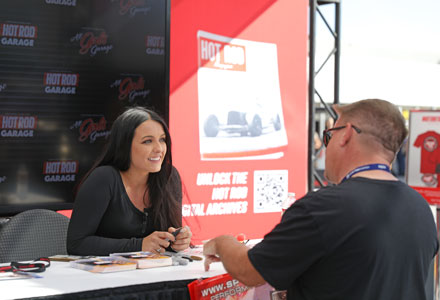
Alex TaylorStarting at her father’s shop as a child, Taylor learned the craft of building race cars at a young age. While still in high school, she began building her first car, a ’68 Camaro that she raced the following year at Hot Rod Drag Week; at 16 years of age, she was the event’s youngest competitor. In the 10 years since then, she’s managed to earn a bachelor’s degree in marketing, run a 6-sec. quarter in her ’55 Chevy 210, won back-to-back Roadkill Nights Hellcat Grudge Matches, and launched another career as the co-host of “Hot Rod Garage.” Her business has recently expanded to an 8,000-sq.-ft. facility in Booneville, Arkansas.

We chatted with Taylor recently to learn more about this multitalented individual. What follows has been edited for clarity and length.

SEMA News: What’s your latest project? What’s in your driveway/garage/studio?

Alex Taylor: My latest project isn’t a car—it’s the shop I just purchased! I am currently in the process of remodeling it and setting up a space that will allow for race car storage, an area for content creation, and room for the ATR brand to grow.

SN: Describe your first race. What do you remember most about it?

AT: I was 16. My dad, mom and I had built my first car that I was originally just going to drive to high school—a ’68 Camaro. I had wanted to do Hot Rod Drag Week since 2007, and as we were building it, Dad said we could build it for me to take on Drag Week if I wanted to.

I raced it in the Daily Driver class. I started the week running high 12s and ended up running 11.70s by the end of the week. When it was all said and done, Dad came and picked us back up, and I drove the car back to high school the following Monday.

SN: You started working in your dad’s shop at a very young age. What’s the very first job you remember doing?

AT: My parents owned a business building production fiberglass Fords and Willys. When I was probably seven or eight, I started helping lay up fiberglass after school for fun. They would hand me a roller, and while they would work, I would help roll the bubbles out.

SN: How steep was the learning curve to become a co-host for Hot Rod Garage? How is it different from, say, producing a YouTube video?

AT: It wasn’t that bad. The biggest adjustment was getting used to working in someone else’s garage at first—learning what tools we had and where they were. I’m thankful to work with an incredible crew that made me feel welcome from day one. YouTube, for me, is a lot more drawn out. I like to show details and tell stories and explain things, whereas on Hot Rod Garage, everything is a lot more summarized and fast-paced.

SN: You’ve also been a judge for SEMA’s Battle of the Builders competition. How did you approach the assignment, and what did you learn from it?

AT: It was a really cool experience. I was nervous going into it because out of the other influencer judges, I had the smallest following, I was the youngest, I had the least equipment, and I had never done anything like it. I learned there that confidence is key, and the thing that matters most is how you present yourself.

SN: You’re the two-time defending champion at Roadkill Nights’ Hellcat Grudge Match. Are you planning for a three-peat in 2023?

AT: I think the Dodge/Motor Trend crew may be going a different route this year on the grudge match, so I don’t know if I will be competing in that part. I will be at RKN, though, with the ’55.

SN: Between wrenching, racing, hosting a TV show, staying active on social media and running your own business, how and where do you find time to unwind?

AT: I don’t really. I get to work with my family and friends for almost everything I do, though, so even when we’re gone on “work trips,” we still find ways to squeeze in a nice dinner or some fun here and there. I feel like now is the time to work hard and grow and I can unwind more later. But don’t get me wrong—I still stop and enjoy the moments I’m living.

SN: What advice can you give to young women who might want to get involved in racing but who don’t have any family connections to the sport?

AT: Enjoy the process. Find something in the industry that interests you (racing, building, welding, painting, photography, business, etc.) and start researching it online. Knowledge is your best friend. Find people you look up to or trust and ask questions. Learn and absorb, and you will naturally grow and evolve.

SN: Describe a perfect day in the life of Alex Taylor.

AT: It depends on the day! Some days I’m behind the laptop, some days are on the road, some days are out in the shop, and some days are just spent on a random adventure. I like having that mix, and if I had any kind of redundancy, it would drive me nuts. Routine can be good—but too much routine kills my creativity.

SN: What’s your next goal as a racer/builder?

AT: I really want to grow the ATR brand. I want to get my shop finished so I can get more into the business side of selling stuff like private-label parts and filling areas that I see gaps.

“You can never go fast enough.” That’s the motto of Alex Taylor—racer, builder, influencer, TV personality and successful business owner.

Mon, 05/01/2023 - 18:21

SEMA News—May 2023

BUSINESS

2023 Powersports Market Trends

Sport UTVs Still Set the Pace; New Aftermarket Players Enter the Market; E-Bikes Gain in Popularity

By Douglas McColloch

Powersports

New players continue to enter the powersports market. Atturo Tire has recently launched two new tires for UTVs, the Trail Blade X/T SXS (pictured) and the Trail Blade Boss SXS. Photo courtesy: Atturo Tire

The vehicular market segment that industry-watchers refer to as the “powersports” market is, in a way, easier to label than it is to define. What, after all, is the connective tissue that joins such disparate market segments as ATVs and side-by-sides, motorcycles and dirt bikes, snowmobiles and personal watercraft—especially considering that very few of these vehicles are ever used in a “sporting,” i.e., competitive venue?

Whatever it is, one thing is certain: the powersports market is growing. The U.S. market experienced an unprecedented surge in demand in the first year of the COVID-19 pandemic, and combined with low levels of inventory, the market enjoyed record profitability at the dealership level. Likewise, the global powersports market grew by a record-setting 10% in global unit sales in the year 2020, according to a 2022 study from Stratview Research. And while sales have cooled gradually since then, more growth is the outlook going forward.

How much? The global powersports market, currently valued at $37 billion, is forecast to reach a valuation of $69 billion by 2032, with a 6% compound annual growth rate (CAGR) during the period, according to a 2023 survey published by Allied Global Insights. This expected surge is ascribed to several factors, including the increased popularity of larger side-by-side UTVs in the North American market; the lingering impacts of COVID-19 and its stimulative effect on backcountry travel; increased allocations from government entities for military use; increased consumer demand in South America and the Middle East; and increased demand for electrification, particularly in the European market.

In any event, the powersports market presents considerable growth opportunities for companies that currently serve this sector, as well as for others that can innovate new technological advancements for these vehicles and bring them successfully to market.

For this article. we consulted several industry experts for their assessments of the powersports market. What follows has been edited for clarity and length.

Powersports Trends

According to the latest “SEMA Market Report,” owners who accessorize their vehicles are nearly twice as likely to own a second, recreation-oriented vehicle than non-accessorizers.

The State of the Market

Overall, our sources felt the state of the market was solid, though most cautioned against the likelihood of another growth surge as was the case in 2020.

“I would say the market is in recovery,” said Jason D’Armond, director of sales and marketing for PRP Seats. “COVID was a big boom for the off-road industry, and last year we saw the pendulum swinging back a bit. We expect it to contract a bit more this year but stabilize.”

On the other hand, Josh and Matt Martelli, owners of motorsports marketing group Mad Media, are seeing more optimism from their industry partners. “Most [supply-chain] issues have been resolved, but there seems to still be a greater demand than supply for both sport-model UTVs. Overall, the market appears to be strong, and the companies we are speaking to are excited for 2023 and the events we have planned for consumer-facing activation.”

Glenn Hansen, editor of Powersports Business, related his experience at the Parts Unlimited NVP Product Expo, held in Louisville, Kentucky, last January. “I talked to dozens of aftermarket companies and interviewed and listened to Parts Unlimited executives,” he said, “and there’s a lot of optimism with a little bit of hesitation behind it—but on the whole, optimism and excitement moving forward.”

In any event, there appears to be plenty of room for growth within the segment. As proof, companies that hadn’t previously been a presence are now entering the space with powersports-specific products. Pennzoil, for one, has introduced a new line of lubricants for quads, UTVs and watercraft. “Whether it’s enjoying the backcountry on an ATV or enjoying time boating with the family, we’re excited to bring this new line to outdoor enthusiasts to give them peace of mind during their adventures,” said Bree Sandlin, Shell vice president of lubricants marketing.

Similarly, Wilwood has recently launched its first-ever UTV disc-brake conversion kits for the Polaris RZR, Honda Talon and Can-AM X3. “UTVs are bigger than anyone would think,” said John Grieco, Wilwood marketing manager.

And Atturo Tire has entered the powersports market with two new tires designed for UTVs, the Trail Blade X/T SXS and Trail Blade Boss SXS. “Atturo may be new to the powersports market, but we will be a familiar name to the UTV consumer,” said Michael Mathis, president of Atturo Tire. “Nearly every side-by-side owner already owns a truck and will be familiar with the Atturo brand from our years in the market.”

The OE manufacturers themselves are similarly diversifying their product lines to meet a growing demand from consumers seeking more varied uses for their vehicles. Polaris, for one, has reintroduced its Ranger UTV series aimed at farmers and ranchers, and re-engineered the Sportsman ATV line for extreme terrain such as mud and snow.

“We are constantly learning from the unique ways customers use our products,” said Steve Menneto, president of Polaris Off Road. “From mudding to property maintenance, these vehicles are purpose-built with enhanced features that enable our customers to make the most of their day, and we’re excited to bring them back for 2023.”

“The sport side gets the glamour,” Hansen added, “but there’s such a bigger marketplace for the whole utility and professional or ‘prosumer’ side, such as small-time landscapers who use their vehicles for work during the week and then go hunting on the weekends.”

Powersports

Gauging The Market: What’s Hot

Our panel of experts generally agreed that UTVs continue to set the pace, and among these, the Polaris RZR Pro XP/Pro R/Turbo R platform were cited as continued sources of growth, though D’Armond noted lower adoption rates from what was typically the case with new models in the past. “There are still a lot of the previous platform on the trails,” he explained, “and Can-Am has been gaining greater market share with the X3 platform.”

Hansen points to a growing diversification of the market, as more players enter more market niches. “Polaris continues to do well. A company like BRP continues to innovate and draw attention to their unique products, and they’re talking about electric motorcycles under the old Can-Am name. Triumph is doing amazing things. Their sales have done quite well, and now they’re talking about getting involved in off-road and supercross racing.”

As with late-model trucks and SUVs, consumer preferences in the North American market seem to lean towards “bigger is better.” The Martellis see “the increase in the size and power of sport UTVs driving the growth of the market. The new faster, stronger, more powerful UTVs are attracting new customers that might have otherwise opted for custom-built trucks with large motor packages—further expanding their market reach.”

The powersports market has always held a strong appeal for accessorizers. According to the latest “SEMA Market Report,” owners who accessorize their vehicles are almost twice as likely to own off-road recreation equipment—in particular ATVs, RVs and motorboats—in addition to their primary vehicle(s).

“In the UTV segment, tires and wheels, radios, fresh-air helmets, aftermarket bucket seats, additional light bars and light pods, and race-quality harnesses remain strong market leaders,” said Josh Martelli. “OEMs like Polaris, Can-Am and Kawasaki have done a great job improving the accessories that now come standard with most sport-model UTVs, but for the more advanced UTV riders, there is still a need for these additional features and creature comforts.”

“The tire market is always good across the board since they are a highly consumable product,” Hansen concurs. “Gear is another big item, whether it’s fashion-related or performance-related or providing protection for off-riders.”

“Storage is always a need for UTV enthusiasts,” D’Armond said. “It’s why we R&D and launch complete suites of storage options for every new sport UTV to hit the market. Our Kawasaki KRX suite did particularly well in the last couple of years and we’ve expanded into the crossover UTV market.

“Seats also continue to be strong. People want to be comfortable on their long rides, and stock seats just don’t do it for most.”

Another new market driver is the emergence of women in the segment. According to a 2018 survey conducted by the Motorcycle Industry Council, nearly one in five motorcycle owners are women, double the number from 10 years earlier. “Adventure-bike riding gear is expanding on the side for women riders who want something more than just a motorcycle jacket that fits a smaller man,” Hansen notes. “That’s a growing market for sure,”

Sport UTVs

Sport UTVs may get the most enthusiast attention, but many UTV owners use their vehicles primarily for work. Polaris recently re-introduced its Ranger line with farmers and ranchers in mind. Photo courtesy: Polaris

Consumer Trends and Marketing Opportunities

Most of our sources continued to be bullish on the subject of overlanding, at least for the near term.

“Overlanding is definitely top of the list when talking about growth in off-road,” said D’Armond. “Our concern is the longevity of the trend, so the products we’re looking at developing will serve a wider audience.”

The Martellis agree. “The overlanding market is on fire. The pandemic gave it a huge boost because folks had less to do locally and time to get out and explore nature and trails and parks in the United States. In every product sector—from portable power stations to solar auto packages to camping trailers, you name it—it’s all up.” Hansen likewise concurs, adding that overlanding “opens up a door for all kinds of companies that make the right products to get you to places where you can do some off-road camping.”

Most of our sources agreed that racing is still a potent marketing tool, though some of our experts suggested that its true value lies in the racers themselves and the credibility they bring to their products via social media.

“The audience for off-road racing is limited,” D’Armond said. “It’s not always spectator-friendly and there’s not a lot of coverage like you see for things like rally racing in the European Union.

“For us, the opportunity centers more around using the athletes as influencers via social media. We look for people who have a dedicated race program and know how to communicate well. The days of slapping a sticker on the side of a car seem to be over. There’s a lot more required of racers now to help promote their sponsors.”

Still, racing’s potential power as a market mover can’t be overlooked completely. “Marketing at race events provides the best opportunity for proof of concept, on-site activation, and social reach,” Josh Martelli explained. “Marketing messages today get lost in the noise. But when paired with engaging content, they can track up to 600% more effectively in viewer
engagement. “

Hansen points to MotoAmerica’s King of the Baggers racing series, which began as a single event in 2020 but which has since expanded into a multi-race circuit nationwide, as an example of how a small niche can drive interest at the dealership level: “It’s basically V-twin Harley-Davidson and Indian touring bikes that literally have hard bags on them. They had a whole race season last year, and it got great TV attention and it drew a bunch of interest. The series is expanding with a lot of publicity and promotion behind it, and savvy dealers are taking advantage of it.”

Another potential growth market for powersports manufacturers is the defense sector. Polaris was awarded a seven-year, $100 million contract in 2020 to produce the MZR Alpha light-tactical vehicle, and more recently, GM Defense has delivered its larger, nine-passenger, Chevy Colorado-based Infantry Squad Vehicle (ISV) for analysis and testing. Additionally, the Army is looking to increase the number of hybrid-electric and all-electric troop transporters for the future to meet its 2022 Climate Strategy Implementation Plan, which opens another potentially lucrative market for manufacturers in the future.

On the subject, electrification is a growing trend, though not across every segment of the market. Segway’s powersports division has released an industry-first hybrid-electric ATV and UTV, and Polaris made a splash with the 2021 debut of its all-electric Ranger XP Kinetic, the first fruits of a 10-year joint venture with Zero Motorcycles to produce a full line of electric ATVs, UTVs and snowmobiles; Polaris is aiming to electrify its entire vehicle line by 2025.

“Electrification is making an impact in powersports,” Hansen said. “It’s happening in some segments more than others, but it’s happening for powersports dealers who are open-minded enough to say, ‘Hey, there’s a place for this.’ On the UTV side, there’s lots of opportunity from Polaris to new players on the youth vehicle side, from small ATVs to motorcycles. Look at Greenger partnering with Honda to put the CRF label on electric dirt bikes. There’s a lot going on there, and it’s exciting to be a part of it.”

But given continued concerns over vehicle range and battery life, some of our experts still maintained that the impact of electrification would be gradual for the near term. “We’re keeping our ear to the ground, though,” D’Armond adds.

Powersports

A new entry to the racing scene, the MotoAmerica King of the Baggers series, which features Harley-Davidson and Indian touring bikes, began as a one-off two years ago and has expanded into a nationwide multi-race series. Photo courtesy: Harley-Davidson

The View Ahead

Most of our panelists took a guardedly optimistic attitude toward the coming year, citing higher interest rates and ongoing supply-chain issues as causes for concern. While D’Armond forecasts a slight a drop in sales, the Martellis see long-term growth fueled by a devoted enthusiast base: “Off-roading is a culture—meaning that people just don’t stop being off-roaders when times get tough. They just get selective about their spending habits.

“We’re still in a post-pandemic space where consumers want to customize their vehicles, explore with them, and turn them into mobile offices equipped with solar power solutions­—and now, even remote internet access thanks to products like Starlink. There are no real indicators that any of that excitement and energy will taper off, especially since gas prices have largely returned to normal.”

“I don’t think we’re headed for a deep recession like a lot of people might want to think,” Hansen observed, “though we can force our own errors if we’re not careful.”

Hansen also noted that a term such as “growth” can be difficult to quantify at times. “Some of it is hard to measure. As an example, I think that consumers are still going to buy a lot of used motorcycles in their communities, but those dollars and those sales aren’t counted as ‘growth.’

“I think if we’re flat, we’re good,” Hansen concluded. “But I think there will be continued activity that allows aftermarket companies and dealers to have success in their markets.”

Mon, 05/01/2023 - 17:56

SEMA News—May 2023

BUSINESS

Minority Rules

For Various Specialty Manufacturers, Go-Fast Marine Performance and Automotive Power Go Hand in Hand

By Eric Colby

Marine

For many aftermarket companies, a presence in the marine performance and the specialty automotive markets spurs product development, strengthens OEM relationships, and opens new opportunities. Photo: Shutterstock.com

Millions if not billions of dollars are spent each year on aftermarket automotive products like superchargers, intake systems, carburetors, fuel injectors and more. While the numbers aren’t as big, many of these accessories are purchased for marine use, too.

“Our favorite kind of customer has a ProCharger in the truck he uses for towing his boat that has a couple on it, too,” Ken Jones, CEO of Accessible Technologies Inc., which makes ProCharger superchargers. “Customers love turning up the power level on our automotive kits and on their boats.” The company is based in Lenexa, Kansas, and has an office near the Sonoma Raceway in Sonoma, California, which Jones says is ATI’s biggest market.

For companies like ATI, Whipple Industries, Holley and Edelbrock Performance, maintaining a presence in the marine aftermarket is important for a few reasons. First, for most of them, the go-fast boat market is an untapped opportunity that many want to explore. Second, if a product can last in the harsh marine environment, it should fare well in a car or truck—meaning marine can be a proving ground. Finally, for bigger companies like Edelbrock, the marine market provides opportunities for developing OEM relationships with companies like Mercury Marine, Indmar Marine and Volvo Penta.

“The guy who put an Edelbrock manifold on his musclecar is likely to put one on his boat or put a supercharger on his truck to tow his boat,” said David Page, product manager for the forced induction division at Edelbrock Performance, which is based in Olive Branch, Mississippi, after being in California for decades.

Echoing what most accessories manufacturers estimated, Jones said, “Automotive is about 70% of the business and marine is about 5%.” ATI also makes blowers for aircraft ground support and clean-water systems.

Marine

Dual Whipple chargers enhance the power of a twin-engine, 43-ft. Outerlimits powerboat. The Outerlimits brand is known in the boating world for its mixture of performance and luxury.

Proving Ground

ProCharger makes belt-driven turbochargers that are popular because they’re easy to install, take up minimal space and produce some big numbers. The company’s largest supercharger helps create nearly 4,000 hp and the most popular ProCharger kit is for a Ford Mustang. ProCharger also has developed a kit for the new mid-
engine Corvette. A C8 ’Vette makes 495 hp from the factory and ProCharger’s kit boosts that to 720 hp on 93-octane fuel and the consumption basically stays
the same.

Following the company’s strategy of trying to get as broad a fit as possible, on the marine side, ATI focused its program on the Mercury Racing HP525EFI sterndrive, developing a kit for it about two years ago. The 525EFI is popular because it can be used in single-engine applications for boats ranging from 25–30 ft. and for twins in boats ranging from 35–40 ft.

“Part of what’s made our automotive superchargers so good was our marine knowledge,” said Jones. “If it’s going to live in a marine environment, it’s going to live in an automotive market. It helps improve our automotive division.”

After fighting to keep the company moving forward during the pandemic, Jones said he is interested in getting back into the marine market.

“We haven’t focused on marine engine builders lately because we’ve been growing so much and COVID was a challenge to manage through,” he explained. “We need to find growth in markets we haven’t shown enough love to.”

While automotive customers have been prone to doing their own work, Jones says that marine customers have their work done by a rigging shop or engine builder. “The cost of downtime is so high,” said Jones. “You only have so much time to boat, so you want to get it right.”

Marine

Holley’s Sniper EFI is an aftermarket product for both automotive and marine applications, the latter with Coast Guard approval.

The Right Partners

Whipple Superchargers in Fresno, California, may be better known to the offshore-performance-boat crowd because Teague Custom Marine (TCM), a popular high-performance marine-engine builder, exclusively uses Whipple products for all its higher-output engines. Additionally, Shonda Whipple, the daughter of company founder Art Whipple, was married to Mike Fiore, the founder of Outerlimits Offshore Powerboats, which is based in Bristol, Rhode Island. (Fiore passed away after a 2014 crash in one of his boats at the Lake of the Ozarks Shootout, a high-performance-powerboat competition.)

Whipple Superchargers Vice President Dustin Whipple said that the brand still offers re-flashing services for the engine control modules on Mercury Racing fuel-injected engines, but Whipple’s most popular marine products are superchargers for the Mercury Racing HP525EFI and HP500EFI.

The company estimates that marine makes up about 5% of its business and that there is carryover with automotive as well. “Our main business is emissions-legal supercharger systems for today’s musclecars,” said Whipple. “I can’t say we know which way they go, but we have customers with multiple vehicles, including boats. One customer, Buddy Thomas, had an Outerlimits offshore powerboat with Whipple-charged engines, and he had them on his car and tow vehicle.”

Most Whipple marine kits are for big-block GM products and the intake manifold, intercooler and other components are built to withstand the marine environment with parts made from aluminum, copper-nickel and other materials that can better resist corrosion from saltwater. Rotors are manufactured in-house, and Whipple is currently on its fifth generation with the sixth just around the corner. “We’re continuing to push the boundaries and find better ways to supercharge,” he said.

One of the few companies that builds the majority of its components for marine is Superchiller, which Bob Teague, the founder of TCM, purchased 23 years ago. “We do sell some to the car guys, but it’s mostly boats,” he said. “We make the Superchillers for every type of Roots blower system from B&M to Weiand, Blower Shop and all the 8-71-, 10-71- and 14-71-style blowers.”

The company has also partnered with various subsidiaries of Edelbrock and Holley for components for its custom engines. The majority of TCM engines have MSD ignitions, which are a Holley product, and cylinder heads that are a proprietary design provided by Air Flow Research. Springs are mostly Isky, although some applications have Comp Cam products, too.

“There are many automotive products that cross over,” said Teague. “We only use the best of what’s available.

Marine

Knowing that many truck customers own boats requiring hefty towing power, Edelbrock offers truck supercharger kits to significantly boost the horsepower and torque needed for the task.

One-Stop Shop

Holley Performance has been making marine carburetors for decades. As noted above, the company also owns MSD ignitions, which is arguably the most popular system used by custom engine builders in the discipline, and Holley offers Sniper fuel-injection kits as well.

“We’ve been offering marine carburetors for decades, but we also offer EFI, ignitions and marine hose ends—we want to be the one-stop shop,” said Bryan
McTaggart, technical writer at Holley.

Holley’s marine-specific carburetors range from 450-cfm to a 1,050-cfm Dominator four-barrel. Quick Fuel has a dedicated marine series with an M designation ranging from 600 to 850 cfm. The company also offers flame arrestors and rebuild kits for the carburetors, plus a technical support staff. “Holley wants to support the end customer regardless of what they’re buying from us,” he explained.

Beyond performance, people want their tow vehicles and boat trailer to look good, too. Holley has custom wheels form
Carroll Shelby, Detroit Speed, Diamond, HK Wheels, Halibrand and more. The company also offers custom lighting.

“I built this beautiful truck to haul this boat; give me something that doesn’t look like your standard aluminum trailer wheel or stamped-steel wheel,” explained McTaggart.

Mercury

The Mercury 525EFI Racing Sterndrive engine is renowned for its racing performance, so naturally, Whipple makes an upgrade kit for racers and enthusiasts alike.

Hands-On Experience

In the ’80s, Vic Edelbrock Jr., founder of Edelbrock Performance, raced a 38-ft. Wellcraft Scarab in offshore powerboat competition, and the company has offered go-fast boat engine components for decades. Today, Edelbrock makes superchargers, intakes, carburetors and more for performance-marine applications.

“We’re very familiar with manufacturing marine-specific parts for automotive-based engines,” said Edelbrock’s Page. “We are intertwined with the marine power
industry.”

Edelbrock Performance’s marine intake manifolds have integrated bronze castings and other upgrades for improved corrosion resistance and its carburetors remain some of the most popular aftermarket products for performance boats. Like most of the other companies in this story, Edelbrock realizes that the marine segment may be small, but the potential for growth is there. Edelbrock also provides OEM parts for Mercury, Volvo Penta and Indmar Marine.

“All the guys who walk into the SEMA Show, I’m going to say 90% of them, have a boat,” said Page. “The customer who’s going to level his vehicle and put on bigger tires or better exhaust is the same guy who’s going to upgrade his boat’s carburetor or intake.”

Part of the Edelbrock Group, Comp Cams also lists dedicated marine products in its catalog. Page explained that they’re manufactured just like the automotive versions, but that they’re designed to make the power where it’s needed. While a car or truck engine benefits from a transmission with many gears to keep the rpm lower, a boat engine is said to be always running uphill at higher rpm because of the resistance created by water.

For an owner looking to get more towing power, Edelbrock offers supercharger kits for GM trucks that can boost horsepower by as much as 200 and add up to 45% more torque. “We offer a full powertrain warranty and for three years with the kits,” said Grant. “We have that much confidence that the supercharger is not going to affect reliability that we take on that responsibility.”

While many people involved in the automotive aftermarket performance world are likely enthusiasts, a handful like to play on the water, too. Jones owns a 40-ft. Formula performance boat that has twin ProCharged Mercury engines. Page has a Baja 212 performance boat powered by a Mercury engine with a Whipplecharger. “All the people I’ve ever met on the water, none of them view their boat as a way to get from point A to point B,” he said.

One-Off Wonders

In mid-January, Pat Weismann, the president of Weismann Marine and vice president of Traction Products, was shivering on a pontoon boat in Florida as he ran trials on one of four lower units on a 180hp e-Motion electric outboard from the Canadian company Vision Marine Technologies. VMT commissioned Weismann to develop a gearcase for its electric outboard, and he came up with four different prototypes that he needed to test.

Marine

In addition to ICE innovations, the performance marine industry is advancing electric-propulsion technologies, which often pose unique challenges for performance developers.

Weismann Marine has been around for decades and has worked with such motorsports celebrities as Parnelli Jones and Jack Brabham. “We probably did 10 to 12 boat projects for him,” said Weismann. Among Weismann Marine’s industry firsts were the dry-sump stern drive and multi-speed transmission for offshore raceboats.

Electric outboards provided a unique challenge for Weismann. For example, there’s no need for exhaust passages to run from the engine down through the propeller shaft, and you don’t need a left- or right-hand drive. “Nothing has ever been geared toward an electric propeller,” he explained. “It doesn’t care which way it turns. He worked with noted naval architecture firm Donald L. Blount and Associates in Virginia on the propeller calculations. “Everything is designed to be super hydrodynamic and efficient,” said Weismann.

While Traction Products’ day-to-day projects include two-speed transmission for ATVs and UTVs, the company that is run by Weismann’s mother Michelle and brother Chris, is also building a car for Bonneville Salt Flats competition. “We’re shooting for the world’s fastest piston-engine vehicle,” said Pat. “Right now, it’s held by a P-51 Mustang.”

The car has a 12-speed four-wheel drive transaxle with the engine in the nose and the four-wheel drive setup in front of the pilot. “It’s the contrary of what everyone else is doing,” said Weismann. “It doesn’t make any sense to have a driveshaft next to your leg spinning at thousands of rpm.”

The design has been proven with turbine power and now he hopes it will work with piston power as well.

The company also makes transaxles for off-road racing trucks, but with such unique projects, the financial side also becomes challenging. “For, Bonneville, for instance, you’re only making one-offs and it seems like it’s the same thing with boats,” said Weismann.

Mon, 05/01/2023 - 12:31

SEMA News—May 2023

RESEARCH

Charting Growth and Headwinds

The “SEMA Future Trends 2023” Report Can Help Make Sense of a Shifting Market

By Mike Imlay

Market Research

The “SEMA Future Trends 2023” report bundles key economic and industry metrics to assist companies with their planning and decision-making.

Shifts in the automotive industry and the overall U.S. economy greatly impact the specialty-equipment industry. To stay competitive, aftermarket businesses need to know what’s trending now and where markets are headed. The latest “SEMA Future Trends 2023” report provides industry planners a detailed analysis of key metrics for 2023 and beyond.

Released in the first quarter of 2023, and available at www.sema.org/research, the report is the most recent installment in an ongoing series of SEMA Market Research forecasts designed to help specialty-equipment businesses plan not just for the year ahead but for the longer haul.

“Our ‘SEMA Future Trends’ reports are designed to help aftermarket companies of all types make informed decisions,” said SEMA Market Research Director Gavin Knapp. “Like others in the series, this report presents an industry outlook while taking a look at the economic factors, vehicle trends and emerging technologies that are driving short- and longer-term market shifts.”

U.S. specialty-equipment market size forecast
Market Research

Over the course of the pandemic, the aftermarket not only recovered but thrived, with specialty-equipment sales reaching a record high of $50.9 billion—a growth of 6% over 2020. Projected growth into 2025 is less sharp, but positive nonetheless.

Industry Outlook

According to the report, the specialty automotive industry found itself well positioned going into 2023. Despite the early shock of the pandemic, most aftermarket businesses managed to thrive. Bolstered by stimulus money and left idle from lockdowns, consumers embraced all the freedoms their automobiles could offer. Many turned—or returned—to wrenching, while others went recreating, off-roading, or off the grid altogether through overlanding. The result was a tremendous spike in industry sales, which reached a record $50.9 billion.

“In 2021, we saw a gigantic jump of 6%, thanks to a lot of the continued spending,” observed SEMA Market Research Manager Kyle Cheng. “But a lot of the extra stimulus and spending money that was out there has now dried up, so we estimate that spending on our industry will only grow about 2% this year. Typically, we see about 3% to 4% growth each year, and after 2023 we anticipate things will move back toward our normal range of about 4% in 2024.”

The report’s survey of industry businesses found general optimism for 2023. Among manufacturers, 47% predicted growth, with 35% expecting their growth to remain about the same. Those figures are roughly similar for industry distributors, while most retailer/installers remaining equally split in their predictions of growing (44%) or holding steady (44%). While acknowledging the increased costs of doing business, all industry sectors reported that demand for their products remained solid overall.

business metric expectations for 2023
Market Research

Industry companies expect revenue, number of customers and customer demand to remain solid this year. However, business and production costs are expected to be expensive. Concerns around inventory and supply chains also linger.

Economic Forces

Of course, the industry doesn’t operate in a vacuum, so the “SEMA Future Trends 2023” report also takes a look at key indicators in the wider U.S. economy. “There are a number of forecasts in our report,” said Knapp. “We should mention that the forecasts we share are not our own, but forecasts sourced from some of the nation’s leading banks and institutions.”

“Basically, the data we sourced reveals a lot of strength right now,” added Cheng. “We have good signs that the labor force is tight. The unemployment report that came out in early 2023 showed an unemployment rate at its lowest point since 1969. So we have a lot of things going for us, but there are some obvious headwinds.”

With the Federal Reserve continuing to raise interest rates, a potential recession remains top of mind. While the report delves into economic data that might signal a recession, it stops short of making any definitive pronouncements. As of press time, the recessionary tea leaves were still too difficult to read with any precision.

“Forecasting is always more art than science, and it’s really difficult to predict what’s going to happen in the future,” said Knapp. “Again, we aren’t trying to be economic prognosticators with this report. Instead, we’re gathering the relevant information that is out there and bundling it together into the metrics that we think are germane to our industry. We’re presenting the data to help our industry understand what’s trending for their businesses.”

U.S. economic growth forecast
Market Research

Despite uncertainty, the U.S. economy entered 2023 with momentum. At press time, however, economic indicators were still mixed, with a dip in growth projected into 2024.

Take for example U.S. consumer spending, which held solid into 2023 despite any concerns consumers might be harboring over a recession. In fact, going into last year’s fourth quarter, consumer spending had hit $45.2 trillion—its highest level in U.S. history. In large part, this was due to stimulus-built savings and disposable income.

Consequently, U.S. retail sales saw strong growth in 2021 and 2022, which also reached a record high of $2.05 trillion by the third quarter 2022. However, by November 2022, with stimulus money waning, consumer spending fell back toward normal levels. So far, spending on goods and services has remained resilient, but moving forward, retail sales will likely fall further in the later half of 2023. After this leveling off, they are expected to resume their upward trajectory in 2024. (It’s worth noting that despite any temporary dip, sales still end up exceeding their pre-pandemic levels.)

“Again, the overall takeaway is that some of these indicators are really good,” observed Knapp. “For example, low unemployment would traditionally be considered a really good indicator for the economy. But the economy is giving off mixed signals right now. We had a big jump in inflation, although it’s coming down.”

Cheng added, “We think that inflation has peaked and is still going down. But a drop from 9% to 7% still means that prices are up about 7% versus last year. So that’s also something to keep an eye on.” Plus, he added, data shows consumers increasingly turning to their credit cards for purchases.

“At this point, the most favorable factor is that consumers are still spending money,” said Knapp. “When you think about the Great Recession from about 2007 to 2009, there was a real scare put into consumers, and people stopped spending. That’s not happening right now. They’re not feeling the need to pull back.”

The pandemic also left other lingering headwinds for specialty-automotive businesses. According to the report, more than 90% of specialty-automotive companies say that supply-chain issues had a moderate to significant impact on their operations in 2022. The good news is the vexing bottlenecks have largely dissipated. American ports—especially those of Los Angeles and Long Beach, California—are now less congested. The nationwide trucking situation has also noticeably eased, albeit with an ongoing driver shortage. Costs associated with shipping have dropped as well. In general, economists expect world supply chains to continue their recovery this year. Still, it will likely take time for all the creases to iron out.

Among those creases is the semiconductor or “chip” shortage. While average lead times for chips have fallen, they remained high at 25.5 weeks as late as the fourth quarter of 2022. This in turn has slowed new-vehicle production and sales—a situation that’s likely to continue for some time.

“Even if we had as many chips as we did in 2019, we would still not have enough to meet the demand because the cars today actually require more chips than they did back then. It’s something of a challenge that the automotive industry is working to overcome,” observed Cheng.

how industry companies view U.S. Economy and business climate
Market Research

Going into this year, the industry expressed concerns about the U.S. economy even as they continued to report solid sales numbers. Most (60%) viewed the economy as either good or just average.

Vehicle Trends

Meanwhile, the rapid rollouts of new vehicle technologies and platforms continue to reshape every level of the aftermarket. To help industry businesses better understand their implications, the “SEMA Future Trends 2023” report pays considerable attention to new and used vehicle sales trends, developing OEM platforms, and advances in vehicle electrification and advanced driver-assistance systems (ADAS).

“We talk at great length about numerous trends, starting with how sales have been affected since the pandemic,” said Cheng.

The research suggests that U.S. automotive sales are still in a post-pandemic recovery, and probably won’t normalize until 2025. By late 2022, record-high vehicle costs, rising interest rates and supply-chain issues had all contributed to a sales slowdown. In fact, for the first time since early 2021, new light-vehicle inventory has significantly outpaced sales. As a result, OEMs are now tapping the brakes on production.

With an average new-vehicle price tag hitting $49,507 without applied consumer incentives, it’s no surprise that 77% of consumers now think it’s a bad time to buy new. But those turning to the used-vehicle market aren’t finding much solace. Now that owners are keeping their cars longer, used inventory has also tightened, driving up prices. What’s more, interest rates for used-vehicle loans are almost double those of new vehicles (at 9.34% versus 5.16%). Like the new-vehicle market, SEMA market research projects that it will take until 2025 for used sales to return to pre-pandemic levels of 40 million units
per year.

Those sales trends present both challenges and opportunities for the aftermarket. On one hand, owners are most likely to modify their new or used vehicle within the first several months of purchase. On the other, owners who are now holding onto their vehicles longer may be more inclined to freshen up their car’s or truck’s looks and performance.

Even as sales recover, OEMs are making dramatic changes to their platform offerings. Notably, they are abandoning traditional sedan models in favor of light trucks, mainly in the form of crossover utility vehicles (CUVs).

“Twenty years ago, an SUV or a crossover almost didn’t exist,” said Knapp. “Today they are the biggest vehicle segment on the road. For, example, if I were to say that Volkswagen is primarily a truck company, I think that would surprise most people. But 80% of their current sales are in the light-truck space.”

In fact, throughout today’s car market, light trucks outsell cars four to one, but Knapp hastened to add that the statistic doesn’t mean that pickups outsell cars four to one. “Light trucks include pickups, vans, SUVs and CUVs,” he explained.

U.S. New Light-Vehicle Sales, Inventory and production
Market Research

For the first time since early 2021, new light-vehicle inventory outpaced sales by a significant margin. Thanks to their high cost, rising interest rates and limited availability, vehicle sales slowed in the latter half of 2022.

Meanwhile, automakers are aggressively electrifying their vehicle fleets in a drive to meet government goals and reduce manufacturing costs. (Electric vehicles [EVs] require fewer supply chains and parts to produce, increasing their profit potential.)

However, the road to gold isn’t necessarily paved with lithium—EVs bring their own set of conundrums. Consumers still have reservations about the technology, especially when it comes to vehicle cost, range and charging convenience. Plus, there are hidden costs to the environment, including the mining of toxic heavy metals and the disposal of spent battery waste. Charging infrastructure and EV production capacity are also a far cry from what will be required to meet ambitious government and OEM electrification goals.

“Despite all the recent EV mandates, including the vehicle sales mandate in California, we still anticipate that, by 2035, total EV sales will be about 39% of the market, with the entire alternative-power segment being just over half of all new-vehicle sales,” said Cheng. “That’s a lot more conservative than some other sources are saying, but given the challenges and the production levels they’re at right now, we think that there are still a lot of barriers to entry that prevent more aggressive adoption.”

Meanwhile, the aftermarket is still assessing what it can do for EVs, and vice versa. Only 15% of manufacturers and 12% of retailer/installers surveyed see electrification as a high-level opportunity. In contrast, 37% of both manufacturers and retailer/installers characterize the opportunity as low, with sizable numbers saying they simply don’t know enough to make an evaluation (24% and 31%, respectively).

The bottom line? Yes, the march toward EVs is real. But with 300 million gas-powered vehicles currently in use, internal combustion engines will dominate American roadways for decades to come.

What’s also real is the rapid deployment of advanced driver assistance systems (ADAS) in new vehicles—and their broad implications for the aftermarket. More than 80% of ’21 vehicles featured collision-warning or speed-reduction/mitigation systems. Lane-departure warning, blindspot alert and pedestrian detection systems are also increasingly becoming standard features, along with adaptive cruise control and other safety-performance technologies. Such systems are already impacting aftermarket and collision repairs, services and modifications, from wheel and tire combos, to suspension, lift and bumper upgrades, as well as other appearance items.

Going forward, the report also identifies several areas of expanding opportunity for the aftermarket. “Many companies are seeing some pretty strong opportunity in our traditional base categories like off-roading, muscle cars, sporty cars, classics and hot rods,” said Knapp, adding that the overlanding and powersports markets continue to grow as well. “Some companies are also coming around to EVs, but overall they’re expecting opportunity in many categories, which is always a good thing.”

Download Your Report

Download your free copy of the latest “SEMA Future Trends Report 2023” at www.sema.org/market-research. While there, be sure to check out the many other SEMA Market Research reports relevant to your business.

View the “SEMA Future Trends” Webinar

An in-depth discussion of the “SEMA Future Trends Report 2023” and its findings can also be viewed as on-demand video, titled “SEMA Future Trends: Outlook 2023 and Beyond,” at https://learning.sema.org/products/sema-future-trends-outlook-for-2023-and-beyond.

Mon, 05/01/2023 - 11:45

SEMA News—May 2023

By Gigi Ho

NEW PRODUCTS

SEMA Data Product News

The products featured below are from SEMA Data member companies that have attained Gold- or Platinum-level data, which means that their product data is robust and complete—likely to drive customer purchase decisions. SEMA Data members meeting data scorecard requirements are invited to submit product releases for consideration to enews@semadata.org.

Injen EVOLUTION Cold Air Intake System, ’21–’22 Ford Bronco L4-2.3L Turbo
Injen

Injen Technology’s new EVO9300 Cold Air Intake for the ’21–’22 Ford Bronco equipped with the 2.3L EcoBoost engine is here. One look at the stats of this intake system, and you’ll know that it’s the right choice for your new Bronco. The EVO9300 is a true 3-D-designed intake system that simply drops in without any modifications, plus it delivers on those performance gains without the need for additional and expensive engine tuners. Simply install our intake system and you’re set with no “check-engine” lights and no drama!

PN: EVO9300
www.injen.com

KW Coilover Kit V1
KW

The KW V1 INOX-LINE Coilover Kit is our entry point into our street performance lineup. The high-quality INOX-LINE stainless-steel coilover struts, corrosion-resistant springs, bumpstops and dampers are optimally tuned by our engineers. The result is a balanced and sporty feel specific to each vehicle application designed for long-lasting driving pleasure. With KW V1 coilovers, you can achieve maximum lowering within an approved lowering range that ensures a proper-functioning suspension and adequate travel after your car is lowered.

PN: 10210005
www.kwsuspensions.com

Auto Ventshade Side Window Deflector
Auto Ventshade

AVS Ventshade is the original AVS product. Offered for many classic vehicles, it is the standard that created the side window deflector industry. Its ledge profile that is mounted in the window channel, combined with stainless-steel construction, keeps rain out and lets fresh air in. Manufactured from high-quality steel. Available in polished stainless and black finishes. Quick and easy installation. Backed by a limited lifetime warranty.

PN: 14202
www.autoventshade.com

TI Automotive High-Performance Gas Brushless Pump and Controller
TI Automotive

TI Automotive fuel pumps are available for in-tank or in-line needs across a variety of fuels featuring the award-winning 39/50 in-tank pump and the GSS line featuring the popular 255-lph pump. They deliver high-pressure, high-flow performance for engines with more than 500 hp. Pump kits, filters and accessories are available to help you with your installation needs and are designed as direct-fit replacements. Our fuel pumps and modules are never manufactured or assembled by a third party or sourced from an outside company.

PN: BKS1001
https://aftermarket.tiautomotive.com/

SEMA Data is “data central” for the specialty-equipment segment, containing millions of products and vehicle fitments from performance and accessories brands. Created by SEMA, SEMA Data is the definitive, industry-owned and -operated centralized data warehouse, complete with comprehensive online tools, and a team of dedicated data and technology experts to assist manufacturers and resellers with product data needs. Learn more at www.semadata.org.

Mon, 05/01/2023 - 09:52

SEMA News—May 2023

MARKET RESEARCH SNAPSHOT

Vehicles in Operation and New Light-Vehicle Sales Update

By Market Research

Share of Light Vehicle Sales in 2022
Market Research

13.7 Million Vehicles Sold in 2022

Around 46% of new vehicle sales in 2022 were CUV models (6.3 million units). However, pickup sales were also strong at 19% (2.6 million units).

Due to supply issues, high interest rates and component shortages, new-vehicle sales in 2022 dipped below 2021 levels at 13.7 million. This is just over a million short of 2021 levels and around 3 million below the levels seen in 2019. Consequently, it’s projected that new light-vehicle sales won’t return to pre-pandemic levels until 2025. Despite slower than expected sales, there are still a lot of light vehicles on the road today—more than 284 million cars and light trucks. CUVs continue to dominate sales and have a large presence on U.S. roads, however pickups also are strong. Despite all the disruption seen over the last year, consumers continue to spend money modifying and accessorizing their vehicles.

Market Research

New vehicle sales in 2022 finished at just over a million units short of 2021. Delays and shortages mean sales should return to pre-pandemic levels by 2025.

Vehicles Currently in Operation
Market Research

There are more than 284 million light vehicles in operation today. CUVs are now the most common vehicle on the road, followed by pickups and midsize/large vehicles.

To learn more about the specialty-equipment and broader automotive industries, download the “Fall 2022 SEMA State of the Industry” report today at www.sema.org/research.

Thu, 04/27/2023 - 11:29

By SEMA Washington, D.C., Staff

Right to RepairSEMA, the CAR Coalition, MEMA Aftermarket and the Auto Care Association applaud a new group of bipartisan cosponsors of the "Right to Equitable and Professional Auto Industry Repair (REPAIR) Act" (H.R. 906), a bill that will ensure choice, fairness and safety in the vehicle-repair market. In addition to original sponsor Representative Neal Dunn (R-FL), and co-sponsors Reps. Brendan Boyle (D-PA), Warren Davidson (R-OH) and Marie Gluesenkamp Perez (D-WA), eight additional members have signed on in support of the REPAIR Act: Reps. Zoe Lofgren (D-CA), Glenn Thompson (R-PA), Brittany Pettersen (D-CO), Tim Walberg (R-MI), Ro Khanna (D-CA), Carlos Gimenez (R-FL), Ann Kuster (D-NH) and Anna Paulina Luna (R-FL).

New co-sponsor Rep. Gimenez said the REPAIR Act's public safety provisions are critical to his support. "As a career first responder, protecting the American people and our public safety has been one of my top priorities in Congress," said Gimenez (FL-28). "I'm proud to join my colleagues in co-sponsoring the bipartisan REPAIR Act, which ensures that car owners have access to their vehicle’s data and can make informed, cost-saving decisions on where to take their car for repairs."

Specifically, the REPAIR Act will:

  • Preserve consumer access to high-quality and affordable vehicle repair by ensuring that vehicle owners and their repairers of choice have access to necessary repair and maintenance tools and data as vehicles continue to become more advanced.
  • Ensure cybersecurity by allowing vehicle manufacturers to secure vehicle-generated data and requiring the National Highway Traffic Safety Administration (NHTSA) to develop standards for how vehicle-generated data necessary for repair can be accessed securely.
  • Provide transparency for consumers by requiring that vehicle owners be informed that they can choose where and how to get their vehicle repaired.
  • Create a stakeholder advisory committee and providing them with the statutory authority to provide recommendations to the FTC on how to address emerging barriers to vehicle repair and maintenance.
  • Provide ongoing enforcement by establishing a process for consumers and independent repair facilities to file complaints with the FTC regarding alleged violations of the requirements in the bill and a requirement that the FTC act within five months of a claim.

Click here to send a letter to your U.S. Representative that asks them to support the REPAIR Act by cosponsoring the bill.

While the REPAIR Act is important to repair-and-replace businesses, there is still more work to do. The current legislation does not extend to a right to modify. SEMA is committed to protecting the right to modify vehicles by prohibiting automakers from locking down ECUs and ensuring aftermarket companies have access to the information needed to recalibrate vehicles with Advanced Driver Assistance Systems (ADAS) after they have been modified.

For more information, contact Eric Snyder at erics@sema.org.

Thu, 04/27/2023 - 11:29

By SEMA Washington, D.C., Staff

Right to RepairSEMA, the CAR Coalition, MEMA Aftermarket and the Auto Care Association applaud a new group of bipartisan cosponsors of the "Right to Equitable and Professional Auto Industry Repair (REPAIR) Act" (H.R. 906), a bill that will ensure choice, fairness and safety in the vehicle-repair market. In addition to original sponsor Representative Neal Dunn (R-FL), and co-sponsors Reps. Brendan Boyle (D-PA), Warren Davidson (R-OH) and Marie Gluesenkamp Perez (D-WA), eight additional members have signed on in support of the REPAIR Act: Reps. Zoe Lofgren (D-CA), Glenn Thompson (R-PA), Brittany Pettersen (D-CO), Tim Walberg (R-MI), Ro Khanna (D-CA), Carlos Gimenez (R-FL), Ann Kuster (D-NH) and Anna Paulina Luna (R-FL).

New co-sponsor Rep. Gimenez said the REPAIR Act's public safety provisions are critical to his support. "As a career first responder, protecting the American people and our public safety has been one of my top priorities in Congress," said Gimenez (FL-28). "I'm proud to join my colleagues in co-sponsoring the bipartisan REPAIR Act, which ensures that car owners have access to their vehicle’s data and can make informed, cost-saving decisions on where to take their car for repairs."

Specifically, the REPAIR Act will:

  • Preserve consumer access to high-quality and affordable vehicle repair by ensuring that vehicle owners and their repairers of choice have access to necessary repair and maintenance tools and data as vehicles continue to become more advanced.
  • Ensure cybersecurity by allowing vehicle manufacturers to secure vehicle-generated data and requiring the National Highway Traffic Safety Administration (NHTSA) to develop standards for how vehicle-generated data necessary for repair can be accessed securely.
  • Provide transparency for consumers by requiring that vehicle owners be informed that they can choose where and how to get their vehicle repaired.
  • Create a stakeholder advisory committee and providing them with the statutory authority to provide recommendations to the FTC on how to address emerging barriers to vehicle repair and maintenance.
  • Provide ongoing enforcement by establishing a process for consumers and independent repair facilities to file complaints with the FTC regarding alleged violations of the requirements in the bill and a requirement that the FTC act within five months of a claim.

Click here to send a letter to your U.S. Representative that asks them to support the REPAIR Act by cosponsoring the bill.

While the REPAIR Act is important to repair-and-replace businesses, there is still more work to do. The current legislation does not extend to a right to modify. SEMA is committed to protecting the right to modify vehicles by prohibiting automakers from locking down ECUs and ensuring aftermarket companies have access to the information needed to recalibrate vehicles with Advanced Driver Assistance Systems (ADAS) after they have been modified.

For more information, contact Eric Snyder at erics@sema.org.

Thu, 04/27/2023 - 11:14

By SEMA Washington, D.C., Staff

California RallyThe SEMA California Rally is just around the corner, and SEMA members based in the state are invited to register at sema.org/carally. This event is an excellent opportunity for SEMA-member companies to advocate on behalf of the automotive aftermarket industry with key lawmakers.

The Rally will take place on June 8 in Sacramento, and SEMA members will come together to discuss issues, such as supporting new vehicle technologies, manufacturing tax incentives and the CARB Executive Order process. By attending the Rally, SEMA members will have the chance to meet with lawmakers and their staff to advocate for policies that will benefit the industry.

The SEMA California Rally is open to all SEMA-member companies based in California, and registration is now open. Members can register at sema.org/carally, where they will also find lodging information. We encourage all SEMA members based in California to register for this event and take part in the advocacy efforts.

The automotive aftermarket industry is facing significant challenges, and it is crucial that our voices are heard. By attending the SEMA California Rally, we can make our concerns known and advocate for policies that will support our industry's growth and innovation.

Don't miss out on this exciting opportunity to advocate for our industry. Register for the SEMA California Rally today at sema.org/carally. We look forward to seeing you in Sacramento on June 8.