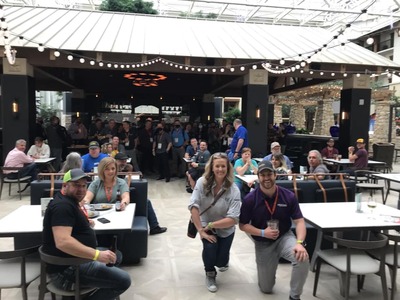
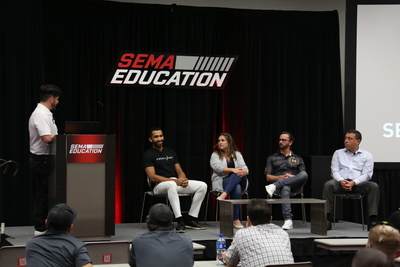
As young industry professionals start planning their 2021 SEMA Show itinerary, they might have questions as to what resources will be available, and what networking opportunities they should attend to further benefit and advance their careers.
Young automotive aftermarket professionals are invited to join the SEMA Young Executives Network (YEN) Select Committee as they go live on the YEN Facebook page to share important updates on the network’s plans for this year’s SEMA Show, taking place November 2–5 in Las Vegas.
Featuring YEN Chair Nick Caloroso and YEN Chair-Elect Matt Beenen, this chat will serve as an opportunity to learn about the YEN Industry Reception, YEN Mixer and General Membership Meeting at Topgolf, located inside the MGM Grand, and be the first to learn about an exciting new program with Dale Carnegie that is slated for late March 2022.
Get your questions ready and tune into the YEN Facebook page on October 13 at 10:00 a.m. (PDT)!
Brent LaLonde is the SEMA Young Executives Network’s (YEN) newest spotlight member. Lalonde is the president of Mechanical Power Inc., a global sourcing company that supplies bearings, sprockets, chains and related industrial products.
Find out what keeps LaLonde in the industry and how he prepares for important meetings in his interview with SEMA below.
SEMA: What is the best advice you have ever received?
Brent LaLonde: Be humble. Be Hungry. This advice has helped me in both my personal and professional lives in leading people by example and generating rapport and respect.
SEMA: What keeps you in the industry?
BL: I'm from metro Detroit and grew up loving the automotive industry. I love manufacturing, global supply chain and am a gearhead at heart. I’ve been to the Woodward Dream Cruise every year, and every year it’s a reminder how thriving the car community is.
SEMA: Where can you be found on a Saturday?
BL: I can be found playing with my kids, at a Cars and Coffee event or golfing.
SEMA: How do you prepare for an important meeting?
BL: I prepare with an agenda, data, script, objectives and being at least five minutes early!
SEMA: If you could go to lunch with one industry leader, living or dead, who it would be?
BL: Chip Foose. He’s a nice blend of old school and new school. I like his demeanor. I’d be very curious to see his take on what the next 20–30 years in automotive aftermarket and the hot-rod industry look like considering what the government and OEMs are doing.
If you are a current YEN member, fill out a YEN member spotlight form. Selected candidates may be featured on YEN’s social media, SEMA eNews and YEN-member updates.
John Kilroy, the former longtime editor of Performance Racing Industry (PRI) Magazine and later general manager of PRI, has passed away after a years-long battle with cancer.
Kilroy, who started his career with PRI in 1990, led the company’s editorial operations for 22 years until he was elevated to GM following PRI’s sale to SEMA in 2012. For the next four years, he oversaw the day-to-day management of PRI and produced the annual PRI Trade Show while guiding the overall direction of PRI’s media and communications efforts.
A graduate of Cal State Fullerton, he was widely known and respected throughout the industry as an honest, hard-working professional with a passion for motorsports and those who made their living in the trade. He maintained countless friendships among PRI staff even after his departure from the company in 2016.
“He [John] was a great ambassador for PRI, SEMA and the industry as a whole,” said Bill Miller, SEMA’s senior vice president, operations. “John and I spent hours talking PRI before the deal [with SEMA] was finalized and worked hand-in-hand in those early years to successful integrate our teams. I always appreciated his upfront and candid demeanor. He was a man of great integrity. I only hope he and Robin Miller are bench racing up in heaven. Cheers to you, John!”
In his final editorial for PRI Magazine titled “The Next Turn,” Kilroy spoke of his pride in having taken the concept of a trade show and business publication for racing professionals to “previously unimaginable heights.”
“I’ve had a great run here at PRI,” he wrote. “Along the way, I had the great fortune to work in an industry that taught me a lot about how to live this life. Thank you all for chasing after it the way you did. You inspired me throughout my 26 years.”
A resident of Orange, California, Kilroy leaves behind a wife and three children. He will be missed by all of us who knew, worked with, and learned so much from him through the years.
Support for the bipartisan Recognizing the Protection of Motorsports Act (RPM Act), H.R. 3281 and S. 2736, continues to expand each day as members of Congress receive an outpouring of support for the bill from racers and the motorsports parts industry. It’s clear the letters that enthusiasts and businesses have sent are being noticed on Capitol Hill and are making a difference (109 members of the House and 18 Senators have cosponsored the RPM Act).
If you’ve already sent a letter to Congress about the RPM Act, please follow up by making a short call to their office to voice your support for the bill. SEMA has made it easy to call your elected officials by clicking here.
Below is a list of things of other things you can do right now to help to pass the RPM Act:
Send a personal letter to your lawmakers at: saveourracecars.com. A letter has already been drafted. It takes less than a minute.
Sign a letter to your lawmakers on company letterhead. Email erics@sema.org for a template and for more information.
Post about the RPM Act on your company’s social-media accounts using the toolkit of digital assets.
Learn more about SEMA’s Political Action Committee (SEMA PAC) at www.semapac.com. SEMA PAC allows SEMA members to support the lawmakers that stand up for our industry in Washington.
Over the past few days, five U.S. Senators have agreed to co-sponsor the RPM Act, including Senators Todd Young (R-IN), Tim Scott (R-SC), Tammy Baldwin (D-WI), Marsha Blackburn (R-TN) and Deb Fischer (R-NE). This is great progress, and it is important that lawmakers continue to hear from constituents about the importance of pass the RPM Act.
The RPM Act must be enacted into law to guarantee your right to modify street cars, trucks and motorcycles into dedicated race vehicles, and ensure that industry can offer parts that enable racers to compete. It is imperative that lawmakers continue to be reminded of the importance of passing the RPM Act.
For details, contact Eric Snyder at erics@sema.org.
If you ask any driver his or her goal in a race, the answer is usually the same—finish first. Encompassing that feeling, the advent of the electric vehicle is now bringing opportunities that were seemingly decades away.
“I’m a racer,” said Steve Huff of Huff Motorsports. “All I cared about was how fast it was going. I didn't care how fast it was going to slow down. I just cared about getting to the finish line first.”
The most notable example may be Volkswagen’s domination of Pikes Peak International Hill Climb in 2018 with its prototype fully electric I.D. R vehicle. Posting a time of 07:57.148, it beat the previous record by over a minute and remains the only vehicle to break the eight-minute mark.
Although it may not have been the first attempt at racing with a fully electric vehicle (EV), it showed the potential of what a fully electric racecar could do if given the right amount of time and resources. That put manufacturers on notice, and it didn't take long for there to be movement from major players in the industry.
“From a Ford Motor Company perspective, electrification is huge to us,” Ford Performance Motorsport Supervisor Brian Novack said. “I think we are spending $11.5 billion over the next few years in improving our electric vehicle lineup.”
OEMs such as Ford have begun investing heavily in the electrification of their lineups. Ford Performance focused on…well, performance. It developed prototypes in the all-electric propulsion Mustang Cobra Jet 1400 and the Mustang Mach-E 1400.
“The seat-of-the-pants feeling of that type of electric power is just unbelievable,” said RTR Vehicles founder, motorsports champion and professional fun-haver Vaughn Gittin Jr. “It’s perspective shattering.”
The Cobra Jet 1400 put down an 8.27-second quarter-mile time, reaching a top speed of 168 mph in its first outing. Ford accomplished that feat with help from the aftermarket.
Cascadia Motion provided motor-inverter packages that run at 800 volts and up to 700 amps for a maximum output of 350kW per motor. With 1,500 peak horsepower came the opportunity for an advanced management system. AEM-EV assisted Ford Performance in developing an advanced data and control system specifically for the Cobra Jet 1400.
“That's part of what those demonstrators are,” Novack said. “It’s to show what Ford Motor Company is capable of. From a Ford Performance standpoint, it's about us learning as much as we can about a super-high-powered electric vehicle and what it takes to get that done.”
The Mach-E 1400 demonstrations showed the ability of an electric vehicle in comparison to that of a gas-powered vehicle. The seven motors in the Mach-E 1400, pushing out 1400 hp, kept up in almost every major racing category with some of Ford’s best vehicles. Again, the aftermarket played a role, with RTR Vehicles assisting with the aerodynamic development of the vehicle.
“If an electric vehicle with similar power and weight shows up to the starting line next to a combustion engine with similar power and weight, the combustion engine has zero chance,” Gittin said.
Electric vehicles are also starting to infiltrate the dragstrip. Huff and his team at Huff Motorsports designed the first all-electric dragster to break the 200-mph mark. The vehicle started life as a four-cylinder EcoBoost-powered dragster that quickly became a fully electric vehicle. The team at Huff Motorsports started with two electric motors and soon realized the difficulty of controlling them and collecting data.
“We were waiting for an industry leader to have a product that we could use to expand and make all the power we wanted,” Huff said.
At that point, the aftermarket came to help in the form of Cascadia Motion and AEM-EV. Cascadia Motion once again provided the motor inverter package for the dragster that now featured four motors. AEM-EV’s PDU-8 and VCU 300 allowed Huff and his team to accurately control the motors and accurately collect data.
“Their products allowed us to do something we couldn't do a year ago, which was accurately control four inverter controllers and subsequently four motors,” Huff said.
A few months ago, electric vehicles landed in the off-road community when Kyle Seggelin entered his 4-Runner that featured a Nissan Leaf powertrain in the King of the Hammers competition. That marked the first time an electric vehicle competed and finished a race at the event. The rig included parts built by Seggelin and his team.
“Hopefully, that will drive some of the OEMs to get involved with it as well, and we will see a handful of electric vehicles out there racing King of the Hammers,” said Loren Healy, a five-time Ultra4 Champion and two-time King of the Hammers winner. “I know it’s piqued our interest.”
The opportunities in developing parts for EVs are starting to arrive, with companies such as AEM-EV getting a head start. For now, the focus is on making the vehicle faster. Who knows what the future holds, but the aftermarket will be there to make it better.
For more information on racing and performance, follow these sources on social media:
· @stevehuffmotorsports
· @vaughngittinjr
· @loren_healy
· @bailey_cole_racing
· @fordperformance
At the 2021 SEMA Show, look for these exhibitors to unveil the hottest builds and latest new products in the EV space. And visit SEMA Electrified in the North Hall, Booth #12475.
The Switch Lab, Booth #25157
Electric GT, Booth #23683
Legacy EV, Booth #23891
Cobera, Booth #24877
Ford, Booth #222000
The Mustang Mach-E 1400 is the culmination of hard work put forth by AEM Electronics, Cascadia Motion, RTR Vehicles and Ford Performance. (Photo courtesy of Ford)
The Cobra Jet 1400’s all-electric motors pushed out an impressive 1500 peak horsepower. (Photo courtesy of Ford)
Steve Huff’s dragster “Current Technology” became the first all-electric dragster to eclipse the 200-mph barrier. (Photo courtesy of Huff Motorsports)
The Mach-E 1400 puts down a remarkable 1400 horsepower. (Photo courtesy of Ford)
The all-electric powertrain of the Cobra Jet 1400 propelled it to an 8.27 quarter-mile time with a top speed of 168 mph. (Photo courtesy of Ford)
The Motorsports Parts Manufacturers Council (MPMC) is excited to reprise its role at the Performance Racing Industry (PRI) Trade Show and have a presence at the SEMA Show. MPMC has typically maintained a low profile at the SEMA Show. This year, however, there’s a new “Motorsports Builders Panel,” powered by MPMC.
The session will feature elite builders sharing insights into how they survived the pandemic, what they’ve learned, and what lies ahead in 2022. It is scheduled for Wednesday, November 3, 9:00 a.m.–10:00 a.m., in room N254 of the Las Vegas Convention Center.
Mix, Mingle, Get Smart
With the PRI Trade Show returning to Indianapolis, Indiana, over December 9–11, MPMC is already gearing up.
“We’re excited to have a Show this year,” said Melissa Scoles, council chair. “PRI is the place to bring all motorsports together. MPMC uses PRI as a forum to gather our members and let others know what MPMC is all about.”
The council’s Happy Hour kicks off on setup day, Wednesday, December 8, 4:00 p.m.–5:00 p.m., in the Featured Products Section. The networking mixer affords members and newcomers a chance to unwind and enjoy refreshments.
“We started the Happy Hour in 2019,” Scoles said. “It was well attended and well received. It’s a great opportunity for members and potential members to connect with one another and the select committee. Everyone’s invited.”
Education is another component at the event, and MPMC has presented seminars at prior shows. Topics included “Crafting a Sponsorship Proposal,” “Opportunities for Women in Motorsports,” and “Rules of the Road for Motorsports Haulers.” Stay tuned for details on this year’s seminars.
Hat’s Off to Hall of Famers
MPMC wraps up the events at the PRI Trade Show with the Performance Industry Reception, to be held Friday, December 10, 5:00 p.m.–7:00 p.m. The festive occasion honors Hall of Fame inductees.
The MPMC Hall of Fame Award was established in 2010. The roster of honorees reads like a who’s who of motorsports—individuals who’ve made significant contributions to the growth and progress of the council and the industry.
“We love to acknowledge those who give back to the industry and to our MPMC community specifically,” Scoles said. “This is an opportunity to recognize and interact with seasoned individuals who’ve had a substantial impact on our industry and who’ve been instrumental in steering the direction of motorsports.”
The Automotive Restoration Market Organization (ARMO) is committed to preserving and promoting the restoration industry, and that objective infuses every aspect of ARMO’s presence at the SEMA Show.
Restoration on Parade
The Restoration Marketplace section of the SEMA Show sits prominently within Central Hall of the Las Vegas Convention Center, close to Hot Rod Alley and the adjacent space known as Central Park (booth #23295), shared with the Hot Rod Industry Alliance.
Each year, each council selects vehicles to display in those spaces for their distinctive style and representation of their respective market niche. To honor its heritage and evolution, at least one of this year’s vehicles will represent a non-domestic brand, and one of the vehicles will be unveiled on Tuesday, November 2.
Central Park is also an oasis. Comfy seating provides a place for members to kick back, talk shop and connect with ARMO select committee members.
Salute to the Industry
Rejuvenate relationships with comrades and colleagues at the ARMO Awards Reception to be held Tuesday, November 2, 5:00 p.m.–7:00 p.m., at the Westgate Resort & Casino, Ballroom B. The annual event pulls together members from all walks of the restoration market in celebration of the industry’s longevity, innovation and progress and also benefits the SEMA Memorial Scholarship Fund through the sale of sponsored tables.
As guests enjoy hors d’oeuvres and beverages, emcee Tim Strange will kick off the awards ceremony. Awards will honor the Person of the Year, the Business of the Year and the student recipient of the Jeff Moses Scholarship. Winners of the 2021 ARMO Hot Products Showcase, held during Spring Carlisle, will also be recognized.
“Come see old friends, meet new friends,” said ARMO Chair Ben Tucker.
It’s a great networking event. I’m super pumped up, and we encourage our members to join us in celebration.”
Star-Studded Builder Panel
The always-popular Builders Panel—Powered by ARMO affords attendees a chance to engage with and learn from the industry’s foremost builders. This year’s program, titled “Restorations to Restomods Builder Panel,” is the culmination of a months-long series of video and live interviews with prominent builders.
The session is slated for Wednesday, November 3, 10:15 a.m.–11:15 a.m., in room N255. The conversation will center on how the restoration segment has evolved and where it’s headed.
Participants include Steve Cook, Steve Cook Creations; Dan Short of Fantom Works; Bob Smith, Bob Smith’s Coachworks; Sabra Johnson, chair of ARMO’s Builders Panel Task Force, will serve as moderator.
“These guys are living legends,” Johnson said. “It’s not just about sharing information to help people build better cars. It’s also about sharing information to help people build more profitable businesses.
For months, the Hot Rod Industry Alliance (HRIA) relied on virtual forums to connect with members. As industry events reopened, HRIA hit the road. Pit stops included a networking mixer at the Minnesota Street Rod Association (MSRA) Back to The Fifties show in Minneapolis, Goodguys Rod & Custom Show in Des Moines, Iowa, site of a general membership meeting, and another networking mixer at a Goodguys show in Columbus, Ohio. At the National Street Rod Association (NSRA) Street Rod Nationals in Louisville, Kentucky, HRIA held another general membership meeting and presented its Education Days program.
Next stop: the SEMA Show.
“There’s been a lot of interest in the council over the past months,” noted Danny Agosta, council chair. “Doing these events created opportunities for people to meet in person and learn about HRIA. Our select committee is excited to get back to the SEMA Show and carry the momentum forward.”
Catch the Action
Hot Rod Alley and the adjacent space shared with the Automotive Restoration Market Organization in the Las Vegas Convention Center (LVCC) are magnets for street-rod aficionados. Situated in booth #23295, the display this year will feature three standout rods.
The exhibit helps to promote awareness of the hobby and highlights member exhibitors whose products are featured on the vehicles. It’s also a gathering spot for council members to mingle and meet with builders and select committee members who will be on hand throughout the Show.
Salute the Industry
The HRIA Awards Reception is set for Wednesday, November 3, at the Westgate Paradise Center. The annual event benefits the SEMA Memorial Scholarship Fund through the sale of sponsored tables.
High points include an honor guard, the national anthem and a display of hot rods. Guests enjoy refreshments,
beverages and an awards ceremony emceed by hot-rod builder Tim Strange, during which HRIA will present four awards. Goodguys, NSRA and Championship Auto Shows will each present one award.
“We’re excited to celebrate in person and highlight the individuals and companies who have made a difference in our industry,” said Agosta.
Learn From the Pros
Want to know what drives the passion for street rods and why the future looks bright? Join leading street-rod builders as they share their knowledge and insights during “Hot Rod Builders Drive the Vintage Segment,” a panel discussion powered by HRIA to be held Thursday, November 4, 9:00 a.m.–10:00 a.m., LVCC Room N258.
Gear up for 2022
In January at the Grand National Roadster Show in Pomona, California, HRIA will present a panel discussion featuring top street-rod builders, with a focus on youth engagement.
Next up is the Deuce’s Wild Competition Car Show in Atlantic City, New Jersey in February. An all-new Hot Rod Alley will highlight 10 member companies whose participation fees will be used to sponsor an award.
“The thought behind our events is to offer more education, have more opportunities to engage with different people at different events, and give people a better understanding of HRIA,” Agosta said.
Changes are afoot at the SEMA Show. Notably, a new West Hall at the Las Vegas Convention Center (LVCC) will house the now co-located Professional Restylers Organization (PRO) in booth #50185 and the Truck & Off-Road Alliance (TORA) in booth #56155. Aligning the Restyling & Car Care and Trucks, SUVs & Off-Road sections under one roof strengthens synergies, said Josh Poulson, PRO chair.
“There’s been a push within the restyling and truck-accessory councils to position these sections side by side,” he noted. “Having restyling next to trucks is a natural fit. We’re very excited and invite everyone to take advantage of what PRO has planned for the Show.”
Restyler-Centric Competition
Looking for new profit opportunities? The second annual PRO Cup Challenge, featuring six to eight vehicles in the council’s booth (#51085) in the LVCC, will showcase profitable and easy-to-replicate styling packages, said PRO Cup Challenge Subcommittee Chair Eric Holmes.
“PRO always tries to bring value to members and the restyling community,” he said. “Seeing the creativity in the different packages opens restylers’ eyes to ideas they can sell in their markets. It encourages them to think about restyling a vehicle with packages they can replicate over and over and that make more money for dealers and create business for restylers.”
Restyling Revelry
Start SEMA Show week at the PRO Awards Reception, to be held Tuesday, November 2, 5:00 p.m.–7:00 p.m., on the third floor deck of the West Hall. The outdoor venue sets the stage for guests to mingle with industry leaders and friends while enjoying hot hors d’oeuvres and liquid libations. The awards ceremony honors industry achievers in four categories.
“It’s a great opportunity to network with members and to celebrate our industry’s successes,” Poulson said.
Career-Advancing Education
Hot topics are on tap during PRO-powered seminars, including sustaining growth in an evolving digital market and the future of modifying electric vehicles. An industry panel will discuss “How the Pandemic Moved Buyers From Your Showroom to Online” on Wednesday, November 3, 9:00 a.m.–10:00 a.m., in LVCC room W235. “EV and the Accessorization Game” is slated for Thursday, November 4, 9:00 a.m.–10:00 a.m., in room N254.
PRO Hospitality
Enjoy a beverage and conversation at the PRO Happy Hour, to be held Wednesday, November 3, 4:00 p.m.–5:30 p.m., in PRO booth #51085. Be on hand as council leadership presents the PRO Cup Challenge trophy and announces the fan favorite winner.
Join the PRO select committee on Thursday, November 4, for the first-ever Lunch With the Pros. The luncheon meeting, open to council members, runs from 11:30 a.m.–1:00 p.m. in West Hall room W219.
“This is where you can find out what PRO has been working on, meet the select committee and like-minded members, and where you can have a voice and get involved,” Poulson said.
Numerous tech companies are coming up with coronavirus
vaccine passports for workers.
Businesses strangled by COVID-19 will soon be able to guarantee a relatively safe return to the workplace with digitized, highly verifiable vaccine passports that prove workers have been vaccinated against the virus. While the requirement for such vaccine certifications (or lack thereof) appears certain to trigger controversy in coming months, their emergence as tools of trust is a certainty.
For example, heavy hitters from the worlds of health and high tech—including the Mayo Clinic, Microsoft and the health insurer Cigna—are already putting one version of a digital passport together. The system is designed to enable workers to show a “certified vaccinated” passport on their smartphones to employers, and paper printouts of the passport will also be available.
The technology is already available at Walmart, where customers who are vaccinated at the store or at Walmart affiliate Sam’s Club can use a store app to connect to a third-party health app that issues a passport. Together, the store and the certification company behind the health app work together to verify and create a digital record confirming that the customer has been vaccinated. Once verified, the customer is issued a proof-of-vaccine passport that can be shown to employers and others on a smartphone or a printout on paper.
“Our goal is to give customers vaccinated at Walmart free and secure digital access to their vaccine record and enable them to share that information with third parties seeking to confirm their vaccination status,” said John Furner, CEO and president of Walmart U.S.
In practice, Walmart or Sam’s Club shoppers looking to secure vaccine passports create a free digital account on the Walmart or Sam’s Club store app and agree to share their vaccination history. While they’re online using the store app, they also choose a third-party health app that they want to issue the vaccine certification—either the Common Pass app, the CommonHealth app, or the Clear app.
After a selection is made, getting a vaccine passport is simply a matter of scheduling an appointment at either Walmart or Sam’s Club, getting injected with a vaccine, and getting issued the passport.
“A secure, convenient solution to verify COVID-19 vaccination will play an important role in accelerating a healthy and safe return to work, school and life in general,” said Joan Harvey, president of care solutions at Evernorth, Cigna’s health services business for the system Walmart is using.
Added Paul Meyer, CEO of The Commons Project Foundation: “We applaud Walmart’s strong commitment to empowering customers with access to their health information using open standards. Not only can this help facilitate a safer return to normal life during COVID, but empowering people with their health data can also help improve the quality of the health services they receive in the future.”
New York State is another early developer of a vaccine passport. There, the government has created the Excelsior Pass—a digital passport that appears on a smartphone in the form of a QR code. Like Walmart’s passport, Excelsior Pass can also be printed out in hard-copy form.
Businesses scanning Excelsior Pass can verify that the owner of the passport has been vaccinated against COVID-19 or has at least tested negative against the virus. Developed by IBM and based on IBM’s own IBM Digital Health Pass, the digital certificate was first used by the general public in February at a Brooklyn Nets game.
“This solution can provide New York and other states with a simple, secure and voluntary method for showing proof of a negative COVID-19 test result or certification of vaccination,” said Steve LaFleche, general manager of IBM Public and Federal Market.
Mastercard is yet another player advancing a vaccine passport solution for businesses. The goliath credit card company announced in March that it’s partnering with the International Chamber of Commerce to come up with its own version of a digitized vaccine passport.
“Delivering a global, interoperable health pass system can happen only if we come together in a way that meets the needs of everyone involved,” said Ajay Bhalla, president of Cyber and Intelligence at Mastercard. “Together with ICC, its member organizations and our partners in the Good Health Pass Collaborative, we can work to get the world moving again and jumpstart the global economic engine.”
Interestingly, the potentially biggest player in the vaccine passport game—the federal government—has so far decided to sit this one out. Instead, it’s deferring to technology and other companies to shoulder the load.
“Unlike in other parts of the world, the government here is not viewing its role as the place to create a passport nor a place to hold the data of citizens,” said Andy Slavitt, acting director of the Centers for Medicare and Medicaid Services. “We view this as something that the private sector is doing and will do. What’s important to us—and we’re leading an interagency process right now to go through these details—is that some important criteria be met with these credentials. Number one is that there is equitable access. That means whether or not people have access to technology. It’s also important that we recognize that there are still many, many millions and millions of Americans who have not yet been vaccinated, so that’s a fundamental equity issue.”
The federal government will also be seeking assurances from passport issuers that systems guarantee information privacy, information security, free access to all individuals, and support for multiple languages, according to Slavitt.
While many businesses and workers will most likely heave a sigh of relief when COVID-19 vaccine passports become commonplace, market research firm Forrester cautions that businesses face some risk requiring passports for a return to work. Specifically, businesses endorsing vaccine passports risk exposure to charges of mishandling of sensitive data, discrimination, protests from labor unions, and diminished cybersecurity—not to mention a backlash from clients and customers who are denied access to a business without a passport.
“Vaccine passports don’t offer the silver-bullet solution that many might hope for easing pandemic protocols and restrictions, and businesses should be planning for life with COVID in the medium to long term,” said Enza Iannopollo, a senior analyst at Forrester and author of the March 2021 Forrester report “The Opportunity, the Unknowns, and the Risks of Vaccine Passports in the Workplace” (https://tinyurl.com/forresterpassport). “Our overarching message to organizations everywhere is one of caution. With the right planning and consideration, the return to work will be smoother and more successful for all involved.”
Specific potential pitfalls Forrester cautions against include:
Vaccines are not a silver bullet. Variants and efficacy of the vaccines mean employers must plan to continue work-anywhere policies and hybrid experiences to balance convenience with well-being.
No-jab-no-job requirements could get tricky. Asking employees to carry proof of inoculation with them to enter the workplace introduces privacy and ethics risks.
Medical data collection should be nuanced. Employers should collect only the minimum amount of data needed to trigger specific policies. They should encrypt medical data and enforce strict access, sharing and deletion policies to ensure fairness and protection.
Some states are against mandatory vaccines. Several state legislatures have challenged the legality of such a requirement.
Even so, Mike Sicilia, executive vice president of Oracle’s Global Business Units, believes that when it comes to the reassurance that the person working next to you has been vaccinated, the benefits outweigh the risks.
“This process needs to be as easy as online banking,” he said. “We are committed to working collectively with the technology and medical communities as well as global governments to ensure that people will have secure access to this information where and when they need it.”
Joe Dysart is an internet speaker and business consultant based in Manhattan.