Thu, 12/07/2017 - 15:45

By SEMA Washington, D.C., Staff
National Monuments
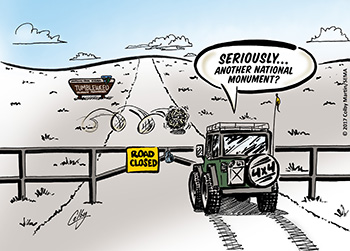
SEMA supports legislation in the U.S. Congress to curtail the President’s power to unilaterally designate national monuments by requiring their approval by Congress and the impacted state legislature(s).

President Trump traveled to Salt Lake City earlier this week, where he signed proclamations to reduce the size of two Utah-based national monuments by more than 2 million acres. The President’s action reduces the borders of the Bears Ears National Monument, which was created in the final days of President Obama’s term, from 1.35 million-acres to 202,000 acres. The proclamation also slashed the size of the 1.9-million-acre Grand Staircase-Escalante National Monument, which dates back to 1996, to just over 1 million acres. U.S. Department of Interior Secretary Ryan Zinke also announced plans to make changes to the boundaries of the Gold Butte National Monument in Nevada, the Castle Mountains National Monument in California and the Cascade-Siskiyou National Monument along the border of Oregon and California.

In response to President Trump’s proclamation, environmental and Native American groups have filed lawsuits to prohibit reductions to the monuments. While U.S. presidents have reduced the size of national monuments 18 times, this marks the first time that the decisions will be subject to judicial review. 

The 110-year-old Antiquities Act provides the president authority to preserve land with significant natural, cultural or scientific features. It has resulted in hundreds of millions of acres being set aside over the decades leading many to question whether the footprints are larger than necessary. The issue is consequential for off-road recreation enthusiasts since national monuments automatically prohibit new roads or trails for motorized vehicles and require a new land management plan be drafted that could lead to more road closures. SEMA supports legislation in the U.S. Congress to curtail the President’s power to unilaterally designate national monuments by requiring their approval by Congress and the impacted state legislature(s). 

For more information, contact Eric Snyder at erics@sema.org.
Thu, 12/07/2017 - 15:45

By SEMA Washington, D.C., Staff

National Monuments
SEMA supports legislation in the U.S. Congress to curtail the President’s power to unilaterally designate national monuments by requiring their approval by Congress and the impacted state legislature(s).

President Trump traveled to Salt Lake City earlier this week, where he signed proclamations to reduce the size of two Utah-based national monuments by more than 2 million acres. The President’s action reduces the borders of the Bears Ears National Monument, which was created in the final days of President Obama’s term, from 1.35 million-acres to 202,000 acres. The proclamation also slashed the size of the 1.9-million-acre Grand Staircase-Escalante National Monument, which dates back to 1996, to just over 1 million acres. U.S. Department of Interior Secretary Ryan Zinke also announced plans to make changes to the boundaries of the Gold Butte National Monument in Nevada, the Castle Mountains National Monument in California and the Cascade-Siskiyou National Monument along the border of Oregon and California.

In response to President Trump’s proclamation, environmental and Native American groups have filed lawsuits to prohibit reductions to the monuments. While U.S. presidents have reduced the size of national monuments 18 times, this marks the first time that the decisions will be subject to judicial review. 

The 110-year-old Antiquities Act provides the president authority to preserve land with significant natural, cultural or scientific features. It has resulted in hundreds of millions of acres being set aside over the decades leading many to question whether the footprints are larger than necessary. The issue is consequential for off-road recreation enthusiasts since national monuments automatically prohibit new roads or trails for motorized vehicles and require a new land management plan be drafted that could lead to more road closures. SEMA supports legislation in the U.S. Congress to curtail the President’s power to unilaterally designate national monuments by requiring their approval by Congress and the impacted state legislature(s). 

For more information, contact Eric Snyder at erics@sema.org.
Thu, 12/07/2017 - 15:39

By SEMA Washington, D.C., Staff

Chris Kersting
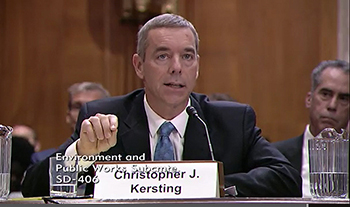
SEMA President and CEO Chris Kersting testified before the U.S. Senate Clean Air Subcommittee on November 14 in support of S. 203, the Recognizing the Protection of Motorsports (RPM) Act.

The Recognizing the Protection of Motorsports (RPM) Act took a major step forward, as the U.S. House Energy and Commerce Committee passed the bill (H.R. 350) with bipartisan support. Approved by a vote of 33 to 20, the bill is now eligible for consideration on the floor of the House of Representatives. The RPM Act clarifies that it is legal under federal law to manufacture, sell, distribute and install race parts that modify the emissions system of a motor vehicle that is used solely for racing. 

SEMA President and CEO Chris Kersting testified November 14 before the Senate Clean Air Subcommittee. The bill is now pending before the Senate Environment and Public Works Committee. 

The RPM Act addresses a problem that did not exist prior to 2015 when the U.S. Environmental Protection Agency (EPA) issued a proposed rule stating that it was illegal to convert street vehicles into racing vehicles if the emission system is taken out-of-compliance from its stock configuration. It would also make it illegal to sell any emissions-related parts for those vehicles. This interpretation was inconsistent with 45 years of previous agency policy, practice and industry understanding of the law as it applies to dedicated race vehicles.

Although the EPA withdrew the proposed rule, the agency still asserts it has authority under the Clean Air Act to regulate emissions modifications to converted vehicles used solely for competition. The RPM Act simply confirms that Congress never intended for race vehicles and parts to be regulated under the Clean Air Act.  

The racing community and the businesses that support it deserve certainty and confidence that the EPA will not go after this American pastime. While significant progress has been achieved, racers, fans and the industry must keep the pressure on their members of Congress to get the RPM Act over the finish line. 

To contact your lawmakers, visit www.sema.org/epa.

Thu, 12/07/2017 - 15:39

By SEMA Washington, D.C., Staff

Chris Kersting
SEMA President and CEO Chris Kersting testified before the U.S. Senate Clean Air Subcommittee on November 14 in support of S. 203, the Recognizing the Protection of Motorsports (RPM) Act.

The Recognizing the Protection of Motorsports (RPM) Act took a major step forward, as the U.S. House Energy and Commerce Committee passed the bill (H.R. 350) with bipartisan support. Approved by a vote of 33 to 20, the bill is now eligible for consideration on the floor of the House of Representatives. The RPM Act clarifies that it is legal under federal law to manufacture, sell, distribute and install race parts that modify the emissions system of a motor vehicle that is used solely for racing. 

SEMA President and CEO Chris Kersting testified November 14 before the Senate Clean Air Subcommittee. The bill is now pending before the Senate Environment and Public Works Committee. 

The RPM Act addresses a problem that did not exist prior to 2015 when the U.S. Environmental Protection Agency (EPA) issued a proposed rule stating that it was illegal to convert street vehicles into racing vehicles if the emission system is taken out-of-compliance from its stock configuration. It would also make it illegal to sell any emissions-related parts for those vehicles. This interpretation was inconsistent with 45 years of previous agency policy, practice and industry understanding of the law as it applies to dedicated race vehicles.

Although the EPA withdrew the proposed rule, the agency still asserts it has authority under the Clean Air Act to regulate emissions modifications to converted vehicles used solely for competition. The RPM Act simply confirms that Congress never intended for race vehicles and parts to be regulated under the Clean Air Act.  

The racing community and the businesses that support it deserve certainty and confidence that the EPA will not go after this American pastime. While significant progress has been achieved, racers, fans and the industry must keep the pressure on their members of Congress to get the RPM Act over the finish line. 

To contact your lawmakers, visit www.sema.org/epa.

Thu, 12/07/2017 - 15:39

By SEMA Washington, D.C., Staff

Chris Kersting
SEMA President and CEO Chris Kersting testified before the U.S. Senate Clean Air Subcommittee on November 14 in support of S. 203, the Recognizing the Protection of Motorsports (RPM) Act.

The Recognizing the Protection of Motorsports (RPM) Act took a major step forward, as the U.S. House Energy and Commerce Committee passed the bill (H.R. 350) with bipartisan support. Approved by a vote of 33 to 20, the bill is now eligible for consideration on the floor of the House of Representatives. The RPM Act clarifies that it is legal under federal law to manufacture, sell, distribute and install race parts that modify the emissions system of a motor vehicle that is used solely for racing. 

SEMA President and CEO Chris Kersting testified November 14 before the Senate Clean Air Subcommittee. The bill is now pending before the Senate Environment and Public Works Committee. 

The RPM Act addresses a problem that did not exist prior to 2015 when the U.S. Environmental Protection Agency (EPA) issued a proposed rule stating that it was illegal to convert street vehicles into racing vehicles if the emission system is taken out-of-compliance from its stock configuration. It would also make it illegal to sell any emissions-related parts for those vehicles. This interpretation was inconsistent with 45 years of previous agency policy, practice and industry understanding of the law as it applies to dedicated race vehicles.

Although the EPA withdrew the proposed rule, the agency still asserts it has authority under the Clean Air Act to regulate emissions modifications to converted vehicles used solely for competition. The RPM Act simply confirms that Congress never intended for race vehicles and parts to be regulated under the Clean Air Act.  

The racing community and the businesses that support it deserve certainty and confidence that the EPA will not go after this American pastime. While significant progress has been achieved, racers, fans and the industry must keep the pressure on their members of Congress to get the RPM Act over the finish line. 

To contact your lawmakers, visit www.sema.org/epa.

Thu, 12/07/2017 - 15:39

By SEMA Washington, D.C., Staff

Chris Kersting
SEMA President and CEO Chris Kersting testified before the U.S. Senate Clean Air Subcommittee on November 14 in support of S. 203, the Recognizing the Protection of Motorsports (RPM) Act.

The Recognizing the Protection of Motorsports (RPM) Act took a major step forward, as the U.S. House Energy and Commerce Committee passed the bill (H.R. 350) with bipartisan support. Approved by a vote of 33 to 20, the bill is now eligible for consideration on the floor of the House of Representatives. The RPM Act clarifies that it is legal under federal law to manufacture, sell, distribute and install race parts that modify the emissions system of a motor vehicle that is used solely for racing. 

SEMA President and CEO Chris Kersting testified November 14 before the Senate Clean Air Subcommittee. The bill is now pending before the Senate Environment and Public Works Committee. 

The RPM Act addresses a problem that did not exist prior to 2015 when the U.S. Environmental Protection Agency (EPA) issued a proposed rule stating that it was illegal to convert street vehicles into racing vehicles if the emission system is taken out-of-compliance from its stock configuration. It would also make it illegal to sell any emissions-related parts for those vehicles. This interpretation was inconsistent with 45 years of previous agency policy, practice and industry understanding of the law as it applies to dedicated race vehicles.

Although the EPA withdrew the proposed rule, the agency still asserts it has authority under the Clean Air Act to regulate emissions modifications to converted vehicles used solely for competition. The RPM Act simply confirms that Congress never intended for race vehicles and parts to be regulated under the Clean Air Act.  

The racing community and the businesses that support it deserve certainty and confidence that the EPA will not go after this American pastime. While significant progress has been achieved, racers, fans and the industry must keep the pressure on their members of Congress to get the RPM Act over the finish line. 

To contact your lawmakers, visit www.sema.org/epa.

Thu, 12/07/2017 - 14:52

In partnership with KIA, the SEMA Garage has announced it will host the ’18 KIA Stinger measuring session. Ushering in a new dynamic era for KIA Motors, the all-new ’18 Stinger is a five-passenger sportback poised to redefine a segment currently populated by European automakers. The Stinger promises to be the highest-performance production vehicle in the company’s history, and is backed by KIA’s industry-leading warranty. The Stinger is offered in five trim levels (Stinger, Premium, GT, GT1, GT2) and luxurious accommodations.

Thu, 12/07/2017 - 14:52

In partnership with KIA, the SEMA Garage has announced it will host the ’18 KIA Stinger measuring session. Ushering in a new dynamic era for KIA Motors, the all-new ’18 Stinger is a five-passenger sportback poised to redefine a segment currently populated by European automakers. The Stinger promises to be the highest-performance production vehicle in the company’s history, and is backed by KIA’s industry-leading warranty. The Stinger is offered in five trim levels (Stinger, Premium, GT, GT1, GT2) and luxurious accommodations.

Thu, 12/07/2017 - 14:52

In partnership with KIA, the SEMA Garage has announced it will host the ’18 KIA Stinger measuring session. Ushering in a new dynamic era for KIA Motors, the all-new ’18 Stinger is a five-passenger sportback poised to redefine a segment currently populated by European automakers. The Stinger promises to be the highest-performance production vehicle in the company’s history, and is backed by KIA’s industry-leading warranty. The Stinger is offered in five trim levels (Stinger, Premium, GT, GT1, GT2) and luxurious accommodations.

Thu, 12/07/2017 - 14:43

By SEMA Editors

Billy Eordekian
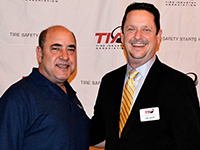
(L–R):CTDA board member Billy Eordekian of 1-800EveryRim – OEM Wheels with TIA President David Martin of ATD.

Tire Industry Association (TIA) President David Martin of American Tire Distributors (ATD) and SEMA Wheel & Tire Council (WTC) Chairman Greg Parker of Wegmann Automotive will be featured speakers at the California Tire Dealers Association (CTDA)/1-800EveryRim - OEM Wheels annual New Year Luncheon, January 17, at The Dal Rae Restaurant in Pico Rivera, California. 

Greg Parker
SEMA WTC Chairman Greg Parker of Wegmann Automotive.

CTDA President Chris Barry of The Independent Tire Dealer Group (ITDG) will be the Master of Ceremonies. Gold sponsors to date are Federated Insurance, Yokohama, Lakin Tire, Pirelli and 1-800EveryRim, along with Silver Sponsors ATV American Tire Depot and Net Driven.

“With all due respect to our important speakers, the best part of our event is the pre-luncheon social period, including refreshments and appetizers. I call it socially networking the old-fashioned way,” said CTDA board member and event underwriter Billy Eordekian of 1-800EveryRim - OEM Wheels.

The event is free to tire- and wheel-related industry vendors and dealers. Those interested in attending, sponsoring or providing door prizes should contact Eordekian at billy@1-800EveryRim.com.