
Thu, 12/28/2017 - 07:49

Compiled by SEMA Editors

Champion Racing Oil to Sponsor NMCA in 2018

Champion Oil has announced that it will be a racing contingency cash-payout sponsor of the National Muscle Car Association (NMCA) and the 2018 season. The NMCA series features six four-day events starting in March in Florida and ending with the World Street Finals in Indianapolis. Each NMCA includes all-American car shows, manufacturer midways, vendors and celebrities. Featured classes include Chevrolet Performance LSX categories, the Nostalgia Super Stock Classic, Street Outlaw Finals, Open Comp and the Super Bowl Shootout.

2018 schedule:

  • March 8–11: 16th Annual NMCA Muscle Car Mayhem, Bradenton Motorsports Park, Bradenton, Florida
  • April 5–8: 10th Annual NMCA All-Star Nationals, Atlanta Dragway, Commerce, Georgia
  • May 17–20: 17th Annual NMCA Blue Grass Nationals, Beech Bend Raceway, Bowling Green, Kentucky
  • July 26–29: 13th Annual NMCA Super Bowl of Street-Legal Drag Racing, Route 66 Raceway, Joliet, Illinois
  • August 23–26: 17th Annual NMCA All American Nationals, Summit Motorsports Park, Norwalk, Ohio
  • September 20–23: 17th Annual NMCA World Street Finals, Lucas Oil Raceway, Indianapolis

Brittany Force
Brittany Force

NHRA Top Fuel World Champion Brittany Force Selected to All-America Team, Wins AARWBA Titus Award

Brittany Force, the first female Top Fuel world champion in 35 years, has been elected to the American Auto Racing Writers & Broadcasters Association (AARWBA) All-America Team and earned the Jerry Titus Memorial Award. Force, who earned votes for her 2017 performance that included four race wins in six final-round appearances and two No. 1 qualifying positions on the way to her first world championship, is joined on the All-America Team by Josef Newgarden (Indy Car), Ricky and Jordan Taylor (IMSA), Donny Schatz (Sprint Car), Martin Truex Jr. (NASCAR), Kyle Kaiser (Indy Lights) and Christopher Bell (NASCAR Truck Series). Force and Truex tied for the most votes to earn them both the Jerry Titus Memorial Award, the AARWBA’s “Driver of the Year” award that remembers the auto racer and journalist.
 

Thu, 12/28/2017 - 07:37

By SEMA Washington, D.C., Staff

As 2017 draws to a close, it is useful to highlight an area of the Trump Presidency that has already had a dramatic impact: deregulation. When he came into office, President Trump immediately issued an executive order directing all federal agencies to review existing regulations and determine whether any should be rescinded or modified. Given the rulemaking process, it normally takes months, if not years, to implement any recommendations. Nevertheless, by last summer, the Trump Administration had withdrawn 457 rulemakings that were in process, including 114 rulemakings listed by the Department of the Interior, 26 before the Department of Labor and 20 before the U.S. Environmental Protection Agency.  

Under the “Congressional Review Act” (CRA), Congress has authority to pass a resolution with a simple majority vote to reject any major rulemaking issued in the previous six months. President Trump and Republicans in Congress used the CRA to repeal 14 Obama Administration regulations already issued. The 14 repealed regulations included the “BLM Planning 2.0” rule, which gave the federal government more authority in land-use decisions, and a Department of Labor regulation that provided a five-year window for citing companies that did not record worker injuries during the first six-month citation period.  

Congress is also pursuing regulatory reform through legislation. Of note, the House of Representatives has passed the “Regulations from the Executive in Need of Scrutiny (REINS) Act,” which would require congressional approval of regulations before they can take effect, and the “Regulatory Accountability Act,” which would require federal agencies to identify the objective of a proposed rule and choose the lowest-cost alternative. It may be difficult to pass these bills in the Senate, however, since a 60-vote super-majority is required for passage.  

For more information, contact Stuart Gosswein at stuartg@sema.org.

Thu, 12/28/2017 - 07:37

By SEMA Washington, D.C., Staff

As 2017 draws to a close, it is useful to highlight an area of the Trump Presidency that has already had a dramatic impact: deregulation. When he came into office, President Trump immediately issued an executive order directing all federal agencies to review existing regulations and determine whether any should be rescinded or modified. Given the rulemaking process, it normally takes months, if not years, to implement any recommendations. Nevertheless, by last summer, the Trump Administration had withdrawn 457 rulemakings that were in process, including 114 rulemakings listed by the Department of the Interior, 26 before the Department of Labor and 20 before the U.S. Environmental Protection Agency.  

Under the “Congressional Review Act” (CRA), Congress has authority to pass a resolution with a simple majority vote to reject any major rulemaking issued in the previous six months. President Trump and Republicans in Congress used the CRA to repeal 14 Obama Administration regulations already issued. The 14 repealed regulations included the “BLM Planning 2.0” rule, which gave the federal government more authority in land-use decisions, and a Department of Labor regulation that provided a five-year window for citing companies that did not record worker injuries during the first six-month citation period.  

Congress is also pursuing regulatory reform through legislation. Of note, the House of Representatives has passed the “Regulations from the Executive in Need of Scrutiny (REINS) Act,” which would require congressional approval of regulations before they can take effect, and the “Regulatory Accountability Act,” which would require federal agencies to identify the objective of a proposed rule and choose the lowest-cost alternative. It may be difficult to pass these bills in the Senate, however, since a 60-vote super-majority is required for passage.  

For more information, contact Stuart Gosswein at stuartg@sema.org.

Thu, 12/28/2017 - 07:37

By SEMA Washington, D.C., Staff

As 2017 draws to a close, it is useful to highlight an area of the Trump Presidency that has already had a dramatic impact: deregulation. When he came into office, President Trump immediately issued an executive order directing all federal agencies to review existing regulations and determine whether any should be rescinded or modified. Given the rulemaking process, it normally takes months, if not years, to implement any recommendations. Nevertheless, by last summer, the Trump Administration had withdrawn 457 rulemakings that were in process, including 114 rulemakings listed by the Department of the Interior, 26 before the Department of Labor and 20 before the U.S. Environmental Protection Agency.  

Under the “Congressional Review Act” (CRA), Congress has authority to pass a resolution with a simple majority vote to reject any major rulemaking issued in the previous six months. President Trump and Republicans in Congress used the CRA to repeal 14 Obama Administration regulations already issued. The 14 repealed regulations included the “BLM Planning 2.0” rule, which gave the federal government more authority in land-use decisions, and a Department of Labor regulation that provided a five-year window for citing companies that did not record worker injuries during the first six-month citation period.  

Congress is also pursuing regulatory reform through legislation. Of note, the House of Representatives has passed the “Regulations from the Executive in Need of Scrutiny (REINS) Act,” which would require congressional approval of regulations before they can take effect, and the “Regulatory Accountability Act,” which would require federal agencies to identify the objective of a proposed rule and choose the lowest-cost alternative. It may be difficult to pass these bills in the Senate, however, since a 60-vote super-majority is required for passage.  

For more information, contact Stuart Gosswein at stuartg@sema.org.

Wed, 12/27/2017 - 20:19

The extent to which a business achieves a return on investment in its patent rights often depends on how the business markets its patent assets.

Wed, 12/27/2017 - 20:11

With the demand for horsepower at its peak in the mid-50s, Ford contacted Paxton Products to produce a blower that could be listed as original equipment.

Wed, 12/27/2017 - 19:50

Developing a backup plan for your systems and data has never been more imperative.

https://www.sema.org/sema-news/2017/12/back-up-or-die

Thu, 12/21/2017 - 15:36

The CEO of Coker Tire sits down to talk about his tire business and his excitement for the SEMA Show.

Thu, 12/21/2017 - 15:09

By Jenny Galvan

SEMA Research ADAS
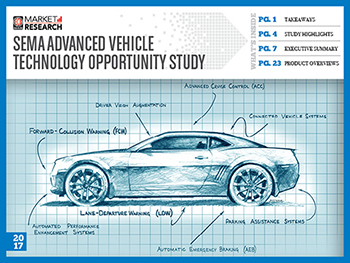
SEMA’s Advanced Vehicle Technology Opportunity Study covers the retrofit opportunities for Advanced Driver Assistance Systems (ADAS) and Connected Vehicle Technologies (CVT).

While technologies such as Advanced Driver Assistance Systems (ADAS) and Connected Vehicle Technologies (CVT) are becoming common on new vehicles, SEMA developed the Advanced Vehicle Technology Opportunity Study to help members produce and sell these products for vehicles not originally equipped with the technology. The study can be used as a resource to guide product and service planning and entry strategies into a burgeoning market.

Download the “SEMA Advanced Vehicle Technology Opportunity Study.”

The developing growth potential for this market is predicted to increase from $977 million to $1.5 billion between now and 2021—a 9.1% annual compound growth rate. With the technological changes happening in the automotive market, these systems represent a significant new opportunity developing in the marketplace.

Visit www.sema.org/market-research to see all of the reports and studies available.

Thu, 12/21/2017 - 15:09

By Jenny Galvan

SEMA Research ADAS
SEMA’s Advanced Vehicle Technology Opportunity Study covers the retrofit opportunities for Advanced Driver Assistance Systems (ADAS) and Connected Vehicle Technologies (CVT).

While technologies such as Advanced Driver Assistance Systems (ADAS) and Connected Vehicle Technologies (CVT) are becoming common on new vehicles, SEMA developed the Advanced Vehicle Technology Opportunity Study to help members produce and sell these products for vehicles not originally equipped with the technology. The study can be used as a resource to guide product and service planning and entry strategies into a burgeoning market.

Download the “SEMA Advanced Vehicle Technology Opportunity Study.”

The developing growth potential for this market is predicted to increase from $977 million to $1.5 billion between now and 2021—a 9.1% annual compound growth rate. With the technological changes happening in the automotive market, these systems represent a significant new opportunity developing in the marketplace.

Visit www.sema.org/market-research to see all of the reports and studies available.