By Ashley Reyes
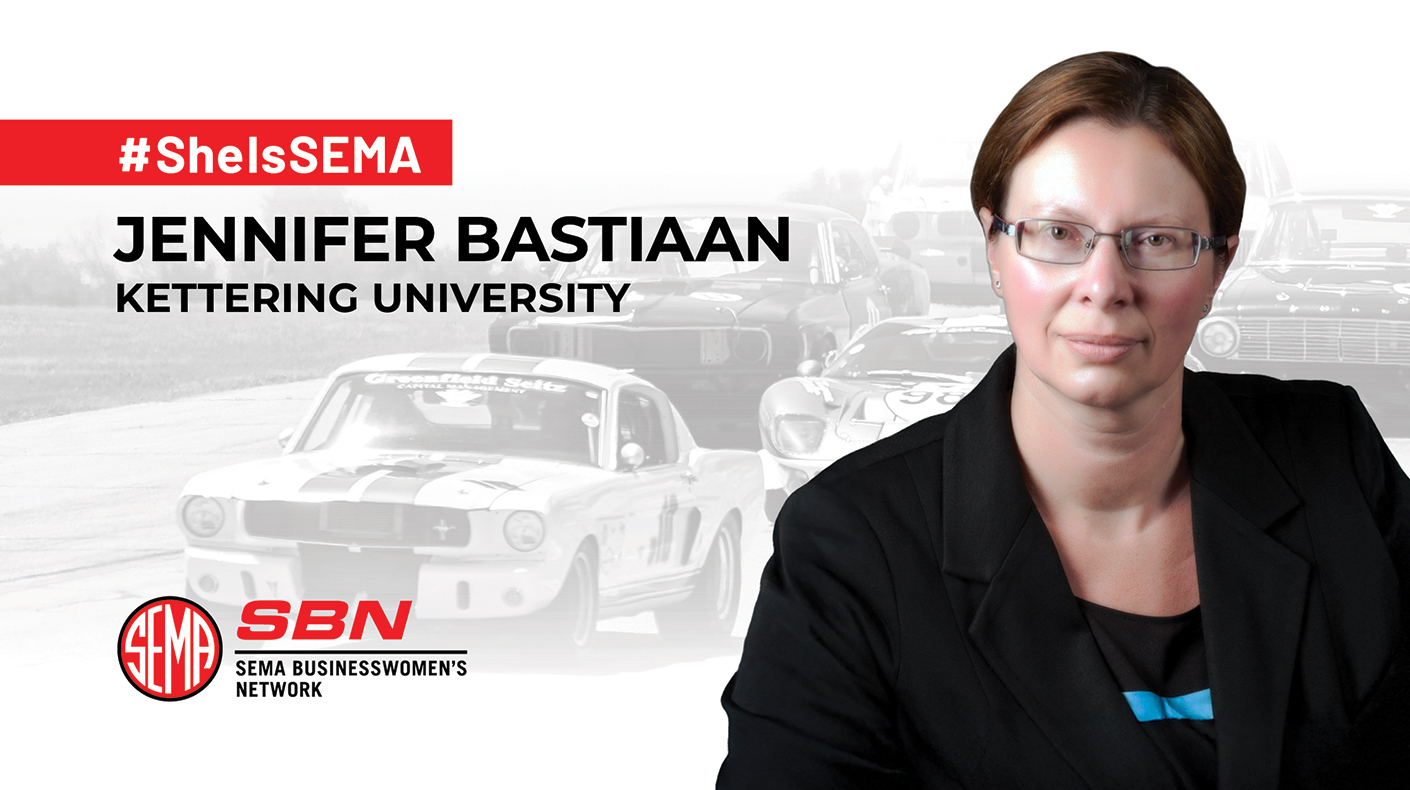
The SEMA Businesswomen's Network (SBN) has named Jennfier Bastiaan, associate professor of mechanical engineering at Kettering University, as the network's newest #SheIsSEMA spotlight member.
Get to know Bastiaan in her interview with SEMA News below.
SEMA News: How many years have you been with your current company and what do you enjoy most about working there?
Jennifer Bastiaan: I have been at Kettering University for 10 years as a professor in the mechanical engineering department. The best part of my job is interacting with the students, especially as a faculty advisor to our student motorsports teams. Before that I worked at Roush Industries for two decades, starting as a co-op student and working in several engineering roles. I was involved in many ground vehicle programs, including the design of military vehicles and iconic American sports cars.
SEMA: What is the most challenging part of running your business or job?
JB: The most challenging part of my current job in education is to continually adjust to the pressures of student enrollment and the demands for change to the traditional educational model.
SEMA: How many years have you been in the industry and what was your first industry job?
JB: I have worked in the automotive industry for more than 30 years. My first industry job was as a co-op student at Roush Industries, where I worked for around 20 years. I have now been working at Kettering University for 10 years. Kettering University, which used to be called the General Motors Institute (GMI), is an educational institution primarily focused on preparing students to work in the automotive industry.
SEMA: What are three qualities that got you to where you are today?
JB: Preparedness, willingness and persistence. Preparedness, because I am continually studying and always learning in preparation for the next project. Willingness, because of never being afraid to take on a task that I have not done before. Persistence, because of refusing to fail or give up on my goals.
SEMA: Being a woman in the industry, what have been your biggest challenges and accomplishments?
JB: In the last 30 years, the representation of women in the automotive industry has changed dramatically. At the start of my career, a woman engineer in the cubical farm was a rare sight. Nowadays it is hardly noteworthy. In the beginning of my career, I had few or no female colleagues. I had no support network. It takes someone with a little extra independence and strength to survive and thrive in that environment. By the time I exited my industry career and started in academia, there were many more female coworkers whom I had formed professional and personal relationships with.
SEMA: Who are your role models or mentors in the industry?
JB: In my early career days, I did not have a role model or mentor inside the industry. There were no female mentors or role models. But there were many good people I worked with that I could count on for support or guidance as needed.
SEMA: What is the best career advice you have received?
JB: The best career advice I ever received was from Dr. Ed Green, a coworker and ally who worked with me for years at Roush Industries: "Never leave a field in a form blank." Which is useful advice taken both literally and figuratively. Taken literally, it means that every part of a form must be completed before submitting it. Instead of leaving a field blank, you should make your best guess at the information that is being requested and provide it. This advice has served me well, both in filling actual forms and more broadly in my career. Every engineering project has "blank fields," for which we need to use our judgement and make good assumptions.
SEMA: Have you always wanted to work in the automotive industry? What keeps you here?
JB: Yes, I have always wanted to work in the automotive industry. I can never remember a time when I was not obsessed with cars. When I was a child, I used to read all the enthusiast car magazines. One day I read an article that said: "The General Motors Institute is the superhighway to a career in the car business." When I read that, I knew I had to enroll in GMI. Automotive is still my passion, even many years later, so I remain connected to the industry.
SEMA: Who was the most influential person on your career/goals?
JB: The early advice that I received from many was that I should not be interested in cars and the automotive industry because I was a girl. Therefore, the most influential people were negative, saying that I should not, or could not, pursue the career path that interested me. I remember once being told that there was something wrong with my brain chemistry since I was interested in cars. Ironically, those experiences galvanized my desire and passion to work in the automotive industry.
Fill out a #SheIsSEMA spotlight form to submit a self-nomination or nominate a colleague and highlight how you or she is contributing to the specialty-equipment industry. Selected candidates are automatically eligible to be considered for SBN's #SheIsSEMA Woman of the Year award, featured on SBN's social media, SEMA News and recognized on the sema.org/she-is-sema website.