Tue, 09/01/2020 - 14:02

SEMA News—September 2020

FROM THE HILL

SEMA News Goes Behind the Scenes With U.S. Senator Mike Braun

By Eric Snyder

Mike Braun
Sen. Mike Braun (center), his wife Maureen, and SEMA President and CEO Chris Kersting (right) toured the PRI Trade Show.

While many lawmakers spend their entire adult lives in government, U.S. Senator Mike Braun (R-IN) chose a different path, entering public service after spending more than three decades working in the automotive aftermarket. His experience in the industry and in dealing with government regulations shaped his views on a range of issues, which is why Sen. Braun is using his platform to make government friendlier to small businesses, taxpayers and automotive enthusiasts.

The past two and half years have been a rollercoaster ride for Sen. Braun, who went from being a long-shot candidate in the Republican primary for U.S Senate to a leading voice in Congress for everything from reforming healthcare to tackling the federal debt. Sen. Braun’s evenhanded approach to policymaking is refreshing, as he provides a much-needed perspective to Congress at a time when partisan grandstanding often overshadows the need to work with colleagues who have a different perspective on a given issue in order to build consensus. While Congress faces many impediments to addressing the most important issues of our time, Sen. Braun’s leadership in growing Meyer Distributing from a local small business into a national warehouse distributor and his role as community leader have helped prepare him to tackle the many challenges that our country faces.

A native Hoosier, Sen. Braun graduated from Jasper High School in 1972 in Jasper, Indiana. It was there that he took his first foray into politics, serving as senior class president. He went on to Wabash College in Crawfordsville, Indiana, where he graduated summa cum laude with an economics degree and served as president of the student body. In 1976, he married his high-school sweetheart, Maureen, and enrolled in Harvard Business School. After earning an MBA degree from Harvard in 1978, Braun took a different path from many of his classmates by choosing to move back to Indiana to start his career.

In 1979, he co-founded Crystal Farms Inc., which became one of the largest turkey operations in the Midwest. Just two years later, he started working for Meyer Body Co. and transitioned its business from manufacturing to distribution, forming Meyer Distributing. Over the following decades, Braun grew the business into a national distribution and logistics company.

While Braun is an automotive enthusiast, he is also a man of many hobbies. In his spare time, he enjoys hunting and fishing, riding ATVs, and forestry-related activities, including tree planting and timber-stand improvement.

In addition to his success in the aftermarket and passion for the automotive performance hobby, Sen. Braun has shown a steadfast commitment to helping in his community. As a former high-school football and basketball player, he used his experience on the field to coach youth sports. Braun also served on the Jasper School Board from 2004–2014, and the Indiana House of Representatives from 2015–2017.

When he stepped down from the Indiana State Legislature to run for U.S. Senate, Braun proved that he was not afraid to go all in. Given the importance of the decisions being made in the nation’s capital, Braun believed that Washington needed people with private sector experience to turn things around.

When he kicked off his campaign for U.S. Senate in 2017, political pundits favored then-U.S. Representatives Luke Messer (R-IN) or Todd Rokita (R-IN) to be the Republican nominee. However, Braun’s record of growing a small business helped to differentiate him from the career politicians in the race, and he won the May 2018 primary by more than 11%. He handily won the general election a few months later, defeating incumbent U.S. Senator Joe Donnelly (D-IN) by a margin of 53% to 43%. Braun’s hard-fought victory was integral in helping Republicans retain and grow their majority in the U.S. Senate.

Since arriving on Capitol Hill in January 2019, Sen. Braun developed a reputation as a pragmatist and someone who injects real-world experience into the public policymaking process. He is a member of the Senate Committees on Agriculture; Budget; Environment and Public Works; Health, Education, Labor & Pensions; and the Special Committee on Aging, and he is one of the strongest voices for small business in Congress.

As a result of his experience as president and CEO of Meyer Distributing, Sen. Braun understands the challenge that businesses face in providing quality healthcare to their employees. Sen. Braun has introduced a bill to require health insurers to disclose the rates they have negotiated and paid for each healthcare service provided to plan enrollees. He has championed legislation to accelerate a pathway for the U.S. Food and Drug Administration to approve drugs that are authorized to be marketed in other countries. Sen. Braun has also drafted common-sense proposals to prohibit members of Congress from being paid until both houses pass budget and appropriations bills for that fiscal year, which does not allow lawmakers to receive retroactive pay, and a bill to prohibit high-income individuals from receiving a federal tax credit for purchasing plug-in electric vehicles.

SEMA News recently had a chance to interview Sen. Braun and talk about everything from cars to political advocacy. Below are some highlights.
Mike Braun
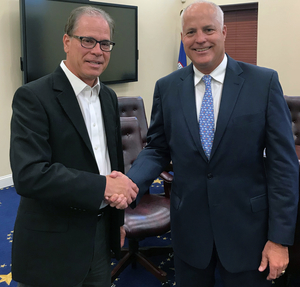
SEMA PAC Chairman John Hotchkis (right) and Sen. Braun pose for a picture after a July 2019 meeting.

SEMA News: What was your first car or truck?

Mike Braun: Let’s go back to 1970; it was a VW Super Beetle with a sunroof. When you like to fish and hunt like I do, and occasionally do outdoor projects, it may not have been the most practical car. I remember I had a dilemma one day. I had an extension ladder for a project and ended up having to stick it out of the sunroof. Back in that age, I don’t think I bothered to put a red flag on it. It really wasn’t a practical vehicle. Soon after that, I owned a ’72 Dodge Charger that I had for several years. It was brown and had a white vinyl top along with a shift on the console and an eight-track tape player. I quickly transitioned into pickups.

SN: How did you take Meyer from a small company to a leading distributor?

MB: In the original business, we had a sideline market where we bought and sold used trucks. Most of the market was farmers. I started in ’81, and that was the year of the farm crisis, so we quickly had to do something else. That’s when I started dabbling in truck accessories. We were a rural dealer. Stand-up bug shields and rollbars were a big deal. Drop-in bedliners had just started, and step bumpers were a big deal, since most pickup trucks came without them. The business was hitting its stride until the ’88 GM came out and they packaged bumpers into the truck. It didn’t take long before Ford and Dodge followed suit.

The business started as an installation facility, and we morphed into a distribution company. That’s when we moved into the first real warehouse, where my office is still tucked into a corner. The warehouse was 25,000 sq. ft. Prior to that, we had stuff stashed in the rafters. We didn’t have a loading dock for 17 years. It was the most hardscrabble of a beginning, and to think of where the industry is today—we’re an amazing industry of entrepreneurs who started businesses that create products that are so broad and so great.

My first office was in a mobile home. When I first came to D.C. about a year ago, they introduced me and said, “When this guy started his business, his office was in a double-wide.” I said, “I want to correct you. It was actually a single-wide.” That humble start turned into 70 locations and 46 states, and Meyer is still running it like a large small business. That’s in the culture. Three of my four children run the business, along with a great young executive team. Many of our employees have been there since the beginning.

SN: What motivated you to run for elected office?

MB: During that long journey, I saw government was not being neutral—a barrier to doing business. As we increased our footprint across the country, there were some states that made it nearly impossible to operate. It was frustrating to hear the news reports about the decisions being made by our elected officials, and I grew tired of being an armchair politician. That’s when I decided to run for state representative back in 2013.

I served in the Indiana State Legislature through 2017. I also served on the local school board for 10 years before that. I wanted to give back and see if I had the temperament to do more. Then everything fell into place. I took on an unlikely task of running for U.S. Senate. It was harder, since the race was compacted into 15 months. When I declared my candidacy for Senate, I started at 1% in the first poll.

The government moves at a very different speed than the way things do for entrepreneurs. Sadly, the government up until a few years ago was doing things that hurt small business. The Trump administration has done an unbelievable job of getting some those regulations down to where they are a little more reasonable. There is a need for regulations, but it was in overdrive. That is part of what is at stake in the election that is coming up.

SN: You have spent some time with President Trump over the past two years on the campaign trail and in official meetings. What is it like to work with the president?
Mike Braun
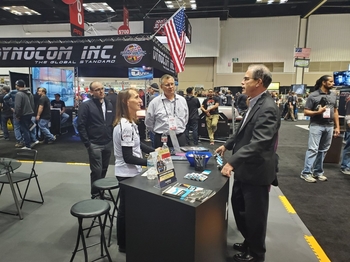
Sen. Braun spoke with representatives from Hurco Companies Inc. at a recent PRI Trade Show.

MB: What you see is what you get. I know it infuriates half the country and elates the other half. The difference is that so much of it gets portrayed through the media lens as we go through this great American crisis of the coronavirus. A lot of this would not have gone so quickly had there been someone more bureaucratic running things.

The president’s agility and thinking outside the box has made a difference. You don’t know how that’s going to be different from a business point of view until you go back to the way it was before. There were rules like Waters of the U.S. that the EPA had put into overdrive—and I’m a conservationist. I’m the first Republican to join the climate caucus. Trump came from the outside and thinks differently.

Congress hasn’t exactly been knocking it out of the park lately. No one seems to think that a $1 trillion deficit is a big deal. Before I started running, $100 billion was considered a big deficit. Things are going to come to a head up here. We weren’t supposed to be $26 trillion in debt until 2023/2024. I’m concerned that some lawmakers just shrug it off and think that there’s no end to what we can borrow simply because rates are very low. We’re the only reserve currency. All of that could change quickly.

Like most things that happen up here, it’ll be solved in a crisis, not preemptively. That’s what I’m here to do during my time in the Senate—speak truthfully about it while most put it off till tomorrow.

SN: What advice do you have for automotive enthusiasts who want to make their voices heard in the public policy arena?

MB: Do what I did. Get off the couch and stop complaining at whatever level, whether it is local government, state government or Congress. I want everybody to stay engaged. If you don’t speak up, if you don’t talk about the enterprise that’s so intertwined with SEMA in other sectors of the economy, you will have bureaucrats creating regulations that dominate the landscape. That’s what evolved over the last few decades, regardless of whether it’s Republicans or Democrats running things. No other entities run an operation in that fashion. Get involved.

SN: What are the most important public policy issues where you believe there is a real chance for Congress to come together and enact meaningful legislation?

MB: When I got here, we were in the middle of a government shutdown. We got through that, and we actually did some committee work on reforming healthcare. That’s still the number-one issue out there, and it’s only been exacerbated by the coronavirus, but we do not have a transparent competitive system.

Most Republicans defend a broken industry. Democrats want more government involved. There were 80 senators who came forward with ideas as to what to do. It’ll still be the number-one issue, whether it’s tackled this year or next year. What are the chances of the Hatfields and McCoys getting together? For healthcare, everyone believes that it needs to be fixed, but it’s a question of how we go about doing it.

The climate is going to be the biggest long-term issue for younger generations. It has a direct impact on our industry, because some of the rules that impact auto parts have a climate component. Republicans have been foot-draggers on the climate discussion, whereas most of the industry that has businesses with a stake in climate are actively willing and wanting to be proactive and preemptive. We have not caught up to that in the Republican conference. The Democrats are on board, but they espouse heavy regulations that are too draconian. There’s a lot of lower-hanging fruit where I think we can work together.


Tue, 09/01/2020 - 13:02

SEMA News—September 2020

INDUSTRY NEWS

Photos courtesy SpiedBilde, Brian Williams. Reuse or reproduction without the copyright holder’s consent is prohibited.

Ford Mustang Mach 1

The Ford Mustang Bullitt is set to be sunsetted after the ’20 model year, and its replacement—the Mustang Mach 1—is set to arrive for 2021. These shots give the most comprehensive look at what to expect when the Mach 1 hits dealers.

This Mach 1 prototype wears thin camo front and rear and matches the recently teased shots of the Mach 1, even down to the rims. Inside, however, sits a Bullitt badge where you’d expect to see a Mach 1 steering-wheel logo. On top of that, the six-speed manual shift knob from the Bullitt is clearly visible. It’s assumed that these are just carryover parts used for the prototype, but it’s still interesting to see that they raided the Bullitt parts bin.
Mustang
Mustang

Land Rover Discovery

Land Rover will launch its first hybrid Discovery as part of a roster of updates aimed at boosting the model’s sale. Considering the amount of disguising for what’s being called a “model-year update,” this could be a hybrid test mule.

Land Rover has yet to confirm which hybrid powertrain it’s going to use for the Discovery. It’s possible that the brand is considering introducing a plug-in with the four-cylinder system used on the Range Rover and RR Sport. However, it’s likely going to be a mild hybrid using the 48V system added to the Range Rover last year. The only current LR system suitable for a car of this size is the latest 3.0L straight-six turbo engine mated to a starter/generator and 48V battery.


Landrover
Landrover

Porsche Cayman GT4 RS

The Porsche Cayman GT4 is about to be usurped as the range-topping Cayman by an even hotter RS model of the mid-engine sports car, pictured here.

Porsche engine guru Markus Baumann said that pilfering the GT3’s parts bin would liberate tech to take the GT4’s flat six even further. Adding a dry sump, new valve gear and titanium internals would “enable this engine for more power and more revs,” he added. Chassis mods would be likely to include new tires, race-spec suspension components and new aero fixtures to create extra grip in corners.

YNACA ducts at the front of the mid-engine GT4 RS snatch air for brake cooling, and Porsche engineers funneled extra air into the upgraded flat six with louvers in the rear side windows.
Porsche
Porsche
Tue, 09/01/2020 - 13:02

SEMA News—September 2020

INDUSTRY NEWS

Photos courtesy SpiedBilde, Brian Williams. Reuse or reproduction without the copyright holder’s consent is prohibited.

Ford Mustang Mach 1

The Ford Mustang Bullitt is set to be sunsetted after the ’20 model year, and its replacement—the Mustang Mach 1—is set to arrive for 2021. These shots give the most comprehensive look at what to expect when the Mach 1 hits dealers.

This Mach 1 prototype wears thin camo front and rear and matches the recently teased shots of the Mach 1, even down to the rims. Inside, however, sits a Bullitt badge where you’d expect to see a Mach 1 steering-wheel logo. On top of that, the six-speed manual shift knob from the Bullitt is clearly visible. It’s assumed that these are just carryover parts used for the prototype, but it’s still interesting to see that they raided the Bullitt parts bin.
Mustang
Mustang

Land Rover Discovery

Land Rover will launch its first hybrid Discovery as part of a roster of updates aimed at boosting the model’s sale. Considering the amount of disguising for what’s being called a “model-year update,” this could be a hybrid test mule.

Land Rover has yet to confirm which hybrid powertrain it’s going to use for the Discovery. It’s possible that the brand is considering introducing a plug-in with the four-cylinder system used on the Range Rover and RR Sport. However, it’s likely going to be a mild hybrid using the 48V system added to the Range Rover last year. The only current LR system suitable for a car of this size is the latest 3.0L straight-six turbo engine mated to a starter/generator and 48V battery.


Landrover
Landrover

Porsche Cayman GT4 RS

The Porsche Cayman GT4 is about to be usurped as the range-topping Cayman by an even hotter RS model of the mid-engine sports car, pictured here.

Porsche engine guru Markus Baumann said that pilfering the GT3’s parts bin would liberate tech to take the GT4’s flat six even further. Adding a dry sump, new valve gear and titanium internals would “enable this engine for more power and more revs,” he added. Chassis mods would be likely to include new tires, race-spec suspension components and new aero fixtures to create extra grip in corners.

YNACA ducts at the front of the mid-engine GT4 RS snatch air for brake cooling, and Porsche engineers funneled extra air into the upgraded flat six with louvers in the rear side windows.
Porsche
Porsche
Tue, 09/01/2020 - 13:02

SEMA News—September 2020

INDUSTRY NEWS

Photos courtesy SpiedBilde, Brian Williams. Reuse or reproduction without the copyright holder’s consent is prohibited.

Ford Mustang Mach 1

The Ford Mustang Bullitt is set to be sunsetted after the ’20 model year, and its replacement—the Mustang Mach 1—is set to arrive for 2021. These shots give the most comprehensive look at what to expect when the Mach 1 hits dealers.

This Mach 1 prototype wears thin camo front and rear and matches the recently teased shots of the Mach 1, even down to the rims. Inside, however, sits a Bullitt badge where you’d expect to see a Mach 1 steering-wheel logo. On top of that, the six-speed manual shift knob from the Bullitt is clearly visible. It’s assumed that these are just carryover parts used for the prototype, but it’s still interesting to see that they raided the Bullitt parts bin.
Mustang
Mustang

Land Rover Discovery

Land Rover will launch its first hybrid Discovery as part of a roster of updates aimed at boosting the model’s sale. Considering the amount of disguising for what’s being called a “model-year update,” this could be a hybrid test mule.

Land Rover has yet to confirm which hybrid powertrain it’s going to use for the Discovery. It’s possible that the brand is considering introducing a plug-in with the four-cylinder system used on the Range Rover and RR Sport. However, it’s likely going to be a mild hybrid using the 48V system added to the Range Rover last year. The only current LR system suitable for a car of this size is the latest 3.0L straight-six turbo engine mated to a starter/generator and 48V battery.


Landrover
Landrover

Porsche Cayman GT4 RS

The Porsche Cayman GT4 is about to be usurped as the range-topping Cayman by an even hotter RS model of the mid-engine sports car, pictured here.

Porsche engine guru Markus Baumann said that pilfering the GT3’s parts bin would liberate tech to take the GT4’s flat six even further. Adding a dry sump, new valve gear and titanium internals would “enable this engine for more power and more revs,” he added. Chassis mods would be likely to include new tires, race-spec suspension components and new aero fixtures to create extra grip in corners.

YNACA ducts at the front of the mid-engine GT4 RS snatch air for brake cooling, and Porsche engineers funneled extra air into the upgraded flat six with louvers in the rear side windows.
Porsche
Porsche
Tue, 09/01/2020 - 13:02

SEMA News—September 2020

INDUSTRY NEWS

Photos courtesy SpiedBilde, Brian Williams. Reuse or reproduction without the copyright holder’s consent is prohibited.

Ford Mustang Mach 1

The Ford Mustang Bullitt is set to be sunsetted after the ’20 model year, and its replacement—the Mustang Mach 1—is set to arrive for 2021. These shots give the most comprehensive look at what to expect when the Mach 1 hits dealers.

This Mach 1 prototype wears thin camo front and rear and matches the recently teased shots of the Mach 1, even down to the rims. Inside, however, sits a Bullitt badge where you’d expect to see a Mach 1 steering-wheel logo. On top of that, the six-speed manual shift knob from the Bullitt is clearly visible. It’s assumed that these are just carryover parts used for the prototype, but it’s still interesting to see that they raided the Bullitt parts bin.
Mustang
Mustang

Land Rover Discovery

Land Rover will launch its first hybrid Discovery as part of a roster of updates aimed at boosting the model’s sale. Considering the amount of disguising for what’s being called a “model-year update,” this could be a hybrid test mule.

Land Rover has yet to confirm which hybrid powertrain it’s going to use for the Discovery. It’s possible that the brand is considering introducing a plug-in with the four-cylinder system used on the Range Rover and RR Sport. However, it’s likely going to be a mild hybrid using the 48V system added to the Range Rover last year. The only current LR system suitable for a car of this size is the latest 3.0L straight-six turbo engine mated to a starter/generator and 48V battery.


Landrover
Landrover

Porsche Cayman GT4 RS

The Porsche Cayman GT4 is about to be usurped as the range-topping Cayman by an even hotter RS model of the mid-engine sports car, pictured here.

Porsche engine guru Markus Baumann said that pilfering the GT3’s parts bin would liberate tech to take the GT4’s flat six even further. Adding a dry sump, new valve gear and titanium internals would “enable this engine for more power and more revs,” he added. Chassis mods would be likely to include new tires, race-spec suspension components and new aero fixtures to create extra grip in corners.

YNACA ducts at the front of the mid-engine GT4 RS snatch air for brake cooling, and Porsche engineers funneled extra air into the upgraded flat six with louvers in the rear side windows.
Porsche
Porsche
Tue, 09/01/2020 - 11:23

SEMA News—September 2020

INDUSTRY NEWS

Fast Facts

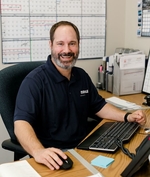
Peterson
David Black
Peterson
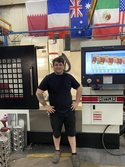
Joseph Shaw

Peterson Manufacturing announced two new and experienced additions to its sales department: David Black and Joseph Shaw. As the new business-development manager of fleets, Black will focus on all fleets in the Eastern and South Central United States. Black’s career began at a Lexington warehouse/trucking company. Shaw joins the company as product sales manager in Canada. He started his career in the trucking industry in trailer fleet leasing and OEM trailer sales. His résumé includes stints with Holland Binkley, Jost International, Pac-Lease, Bose Ride and Sears Seating.

Fastrak Companies International LLC, the parent company for the Fastrak Racing Series and Ultimate Super Late Model Series, hired Tim Packman as the company’s new general manager. Packman brings more than 25 years of racing experience to the position. Prior to Fastrak, Packman was the president of Lancaster (New York) National Speedway & Dragway, where he earned short-track promoter of the year honors in 2016 and 2017. He also has career experience working for Richard Childress Racing, Dale Earnhardt Inc., MRN Radio and NASCAR.com.

Thomas Klukas

Dr. Thomas Klukas assumed the newly created position of COO for Formel D and now heads the group’s operational division. Formel D’s executive management will consist of Dr. Jürgen Laakmann (CEO), Gian Mario Deligios (CFO) and Dr. Klukas. For the past 14 years, Dr. Klukas was employed by SGS SA, holding various international managerial positions. With a PhD in industrial engineering, he was responsible for the transportation division.

Dayco announced several leadership changes. Thomas J. (TJ) Fontana will serve as the director of sales for North America, while Shannon Lara was announced as the director of marketing for the North American aftermarket. Also, Tyler Samagalski was promoted to director of the industrial, fluid power and performance markets in North America. All will report directly to Dayco Vice President of the North American Aftermarket Tom Tecklenburg.

Acme

Acme Manufacturing Co. announced the retirement of Joe Saad, senior vice president of sales and marketing, after 46 years of service. Saad was instrumental in developing polishing automation solutions for automotive trim, truck bumpers, aluminum wheels, plumbing components, hand tools and builders’ hardware.

GearFX Driveline announced its relocation to a new facility in Mooresville, North Carolina, down the street from its current post. The new 18,000-sq.-ft. facility increases the company’s footprint by more than 5,000 sq. ft. It features a larger dyno area and increased warehouse capacity. The machine shop, build shop and fabrication shop are housed in individual climate-controlled spaces to better control dust mitigation. The new physical and mailing address is 114 Infield Ct., Mooresville, NC 28117.

Turn 14 Distribution Inc. and Motovicity Distribution Inc. announced a definitive agreement under which Turn 14 Distribution will acquire substantially all of Motovicity’s assets for an undisclosed price. Turn 14 Distribution will extend employment offers to a majority of Motovicity’s employees. The transaction marks Turn 14 Distribution’s first asset purchase agreement since its formation in 2007. Moving forward, Motovicity’s operations will cease, and the company will operate exclusively under the name Turn 14 Distribution. For more information, visit www.turn14.com.

Mahle

Mahle Motorsport announced the promotion of Joe Maylish to sales and program manager for the company’s North American motorsports division. Maylish will serve as the primary contact for all external sales reps, warehouse distributors and other customers and develop and coordinate sales strategies, goals and missions, direct training and coordinate market research to meet sales goals.

Wrapmate entered a three-year global collaboration agreement with 3M Commercial Solutions to help businesses improve their marketability within the print, signage and vehicle graphics industry. This collaborative agreement, first announced in 2019, will provide customers with a one-stop shop network of professionals and resources on a global scale. Wrapmate’s technology includes an augmented reality app that allows business owners to visualize their vehicle graphics mockups on 3-D digital images placed virtually in their driveways or office parking lots.

Power Test Inc. and Taylor Dynamometer completed the merger of their two heavy-duty dynamometer and test-stand businesses. The combined businesses will employ approximately 160 people, with a majority working in Sussex, Wisconsin, and 30 in Milwaukee. Taylor Dynamometer Vice President of Sales and Service Jeff Brown and Vice President of Engineering Larry Golding will continue to lead the Milwaukee-based facility while reporting to Power Test Inc. President Rick Ruzga. Art Downey, the former owner of Taylor, will continue to collaborate with Power Test CEO Alan Petelinsek.

Borowski

Borowski Race Engines Inc. (BRE) announced that Tim Zapp was promoted from lead technician to shop manager. Zapp, an active drag racer, is described as a “true prodigy,” having assembled his first engine at the age of 14. Zapp most recently completed Holley’s EFI training program as well as an advanced Rottler five-axis CNC course. Zapp first joined BRE while still attending high school.

Masters Entertainment Group Inc. of Bristol, Tennessee, announced that it has added a livestreaming division. Masters plans to break away from the usual video streaming used in motorsports and offer more complete and professional streaming event coverage. Using professional television HD cameras, Masters said it will use boom cam shots, several manned cameras, drone shots, point-of-view cameras, photo-finish cams, live interviews from the pit area and top-end winner interviews. There is no cost for the streaming service for the event. For more information, visit www.masterstvshows.com.

Tue, 09/01/2020 - 11:12

SEMA News—September 2020

INDUSTRY NEWS

By Douglas McColloch

Don Hellwig
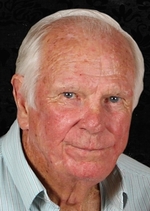
During his tenure at Hellwig Products, Don Hellwig transformed the family business from a door-to-door operation to an internationally marketed brand.

Hellwig Founder Donald Hellwig Passes Away

Hellwig Suspension Products has announced the loss of one of its founders. Don Hellwig, who passed away June 3 at the age of 91, co-founded Hellwig Products in 1946 alongside his late father Rudy Hellwig.

Hellwig helped develop the company’s signature products, helper springs and sway bars, and during his tenure as president of Hellwig Products, he transitioned the company from a father-and-son door-to-door sales operation into a manufacturing company known throughout the world. Hellwig took the company to the inaugural SEMA Show at Dodger Stadium in 1967, and the company has attended every year since. His granddaughter, Melanie Hellwig White, who is president of Hellwig Products, currently serves on SEMA’s Board of Directors.

“He loved our customers and was dedicated to always improving our products to create a better experience for them,” said White. “We look forward to continuing his legacy of love for our customers and our team as well as innovation and passion for the automotive industry.”

Hellwig is survived by his wife of 69 years, three children, 10 grandchildren and 12 great-grandchildren, as well as countless extended family members, friends and colleagues.


Tue, 09/01/2020 - 10:33

SEMA News—September 2020

REQUIRED READING

By Juan Torres

Shifting Data Into High Gear

To help aftermarket companies manage their product data and generate more business, the SEMA Data Co-op (SDC) offers a centralized database that enables manufacturers to author, validate, store and distribute product data to distributors and retailers. With the SDC’s comprehensive set of online data-management tools, businesses can manage data such as descriptions, pricing, images, UPC codes and other information critical for online and in-store sales. For more information about the SDC, visit www.semadatacoop.org.

Below are some of the publications that have reported on the successes that companies have
experienced with the SDC program.
 

The Supply ChannelSupply Channel

With online sales of automotive parts doubling to $12 billion in only five years, online product information and data have never been more important. Among the key factors that lead to more online business are digital assets, distinct product attributes and clear descriptions.


Aftermarket News

AMN

By becoming ACES 4.0 compliant, the SEMA Data Co-op enabled engine-based manufacturers to separate data for engine blocks, bore and stroke into their own tables, allowing users to search more efficiently, particularly when bore/stroke are not relevant to fitment.


The Shop

The Shop

Injen Technology, a manufacturer of cold-air intake and exhaust systems, reached Platinum status with the SEMA Data Co-op by exceeding a range of data requirements. This data makes it easy for sellers to create informative product listings, resulting in more sales opportunities.


Heard on Social Media

“Race Sport Lighting Data Available Through SEMA Data Co-Op.”Cerebral-Overload, via Twitter

“TI Automotive has achieved Platinum status with the SEMA Data Co-op (SDC).”—Auto Care Week/The Greensheet, via Twitter

“SEMA Data Co-op is ACES 4.0 Compliant: Updated data standards target engine-based manufacturers.”Autotestdrivers.com, via Twitter

“SEMA Data Co-op is now ACES 4.0 compliant, making it more efficient than ever for participating parts manufacturers and resellers to communicate details that will help get products to market quickly and easily.”—Custom Automotive Network, via Facebook


Tue, 09/01/2020 - 10:26

SEMA News—September 2020

INTERNET

By Joe Dysart

AI-Powered Writing Assistants

A Genius on Your Shoulder

Internet
New AI-powered writing assistants go far beyond correcting your spelling and grammar.

One of the greatest strengths of writing-assistant software powered by artificial intelligence (AI) is that the packages go far beyond simply correcting spelling and making sure grammar is just right. In many ways, using such assistants is like getting a second opinion on everything you write from a good friend who happens to have a PhD in English from Harvard.

For example, Grammarly Business—one of the most popular assistants of this type—polishes your spelling and grammar, of course, but it also judges anything you write based on its clarity, engagement and delivery. Grammarly will also customize the way it judges your writing based on the writing tone you’re going for, be it confident, joyful, optimistic, friendly, urgent, analytic or respectful.

If you’re looking for a business style of writing one day and then a style that’s more academic, technical, casual or creative the next, Grammarly will adjust its coaching accordingly. In a phrase, Grammarly and its close competitors offer you the ability analyze your writing—nearly down to the molecular level—from all sorts of perspectives. In the end, any one of these types of packages will make you a much better writer.

“Grammarly’s writing assistant aims to help our users learn to be better, more empathetic communicators rather than communicating for them,” said Brad Hoover, Grammarly CEO. “At the end of the day, technology shouldn’t think for you—it should help you think better.”

That added edge comes in especially handy for business users. Many people responding to work emails often view the blank response page with trepidation. In fact, three out of five people said that they’ve been embarrassed by an email they’ve sent while at work, according to a 2019 Grammarly survey (www.grammarly.com/blog/workplace-email-report). And three out of four business users said that they worry the emails they send may be misconstrued.

While there are scores of AI-powered writing assistants on the market to help assuage those fears, the top three packages currently available are Grammarly Business, ProWritingAid and Ginger, according to peer-to-peer review site G2Crowd (www.g2.com/categories/ai-writing-assistant). G2Crowd is known for its impartiality. It bases its ratings solely on the reviews of its users and refuses to allow paid placements on its website from any software makers.

“Rankings on G2 reports are based on data provided to us by real users,” said Michael Fauscette, the company’s chief research officer. “They represent the voice of the user and offer valuable insights to potential buyers everywhere.”

One caveat regarding relying on AI writing assistants if you plan to publish your work professionally: Even though the most powerful of them are now powered by artificial intelligence, they’re still no match for a human editor when it comes to professional publishing.

AI writing assistants are almost frighteningly skilled at catching writing with a muddled tone, pointing out a word that you’re using improperly or finding a period that’s misplaced even by a smidgin in a sea of text. But those same assistants can also occasionally suggest a word replacement that really does not make sense. They also don’t realize when you’re deliberately breaking a rule of grammar for effect, and they sometimes simply strike out when it comes to finding a word that’s being used improperly.

That’s why, even after you’ve used an AI writing assistant, not running your copy by a seasoned, flesh-and-blood human editor before you decide to publish professionally is like showing up at work without pants. It’s just something you don’t want to do.

That said, however, once you start using an AI-powered writing assistant, you will most likely find that you’ll never want to look back. After all, who wouldn’t want a second opinion from a machine possessing the writing depth and perception of a Harvard english professor?

In fact, the author of this article personally began using an AI writing assistant a few months ago. And I have to say that the AI always catches something in my writing—and usually a few things—that needs correcting or could be written more eloquently.

If you’re looking to improve your own writing with AI, here’s how the top three packages stack up, as rated on G2Crowd:

Grammarly (www.grammarly.com), $139.95 per year, 4.6/5 G2Crowd rating: As noted, this is one of the most popular AI writing assistants available. Like its competition, Grammarly is a black belt at finding errors in grammar and spelling, and it’s designed to highlight even the most granular inconsistencies, such as when your quotes appear in two different fonts or when you’re misusing basic words.

But that’s only the beginning.

The software is also superb at pointing out words that you’re overusing and suggesting alternatives. Plus, it will take a close look at the clarity, engagement and delivery in your writing and suggest ways to improve all three.

You can also modulate Grammarly to score your writing based on the audience you’re targeting. For example, Grammarly recommends a set of specific words and phrase choices if you’re writing for an audience already knowledgeable about a specific topic, but those recommendations may change markedly if you calibrate Grammarly to analyze writing geared to an audience with only general knowledge of your topic or to an audience new to your topic.

Grammarly will also adjust its analysis of your writing based on the tone or writing style you’re going for, as noted above.

(Full disclosure: Grammarly happens to be the AI assistant software I use, given that it has the features that I value most. But other writers may favor another top software package, based on their own
preferences.)

Here are excerpts from two reviews of Grammarly on G2Crowd:

  • “It outperformed Microsoft Word in correcting and discovering errors, which makes it worth the investment if you are worried about details on your writing.”
  • “It is impossible to dislike Grammarly.”

ProWritingAid (www.prowritingaid.com), $70 per year, 4.4/5 G2Crowd rating: Another top contender, ProWritingAid also aces all your spelling and grammar concerns, and it makes suggestions about sentence structure, overused words, clichés and repeated phrases.

The package is also a relentless stickler for consistency. It will check very carefully to ensure that your spelling, punctuation and hyphenation adhere to a singular style, and it will continually coach you to use sentences that vary in length—a hallmark of engaging writing.

ProWritingAid also gratefully pulls the covers on bloviators—people who relish the use of overly complex sentences when a simple phrase is the ticket.

The software is also great at red-flagging your use (and overuse) of acronyms, and every piece of writing you run through ProWritingAid is also measured against the Flesch Reading Ease Score, ensuring that your prose stays out of the clouds.

Some users of ProWritingAid complain that the software’s analysis of writing is so complex that it’s overkill, but if you’re a word lover, the software’s enthusiastic analysis of every nook and cranny of your writing may be just what you’re after.

Here are excerpts from two reviews of ProWritingAid on G2Crowd:

  • “As you work, you are able to easily find errors, since the program will let you know if there are any inconsistencies, or if the story isn’t transiting well, or even the level of education the reader must have to comprehend the story.”
  • “ProWritingAid not only suggests repairs to content I’ve already written, but it has also made me a better writer. I now am more conscious of bad habits like passive verbs and long sentences, so I don’t write them in the first place.”

Ginger (www.gingersoftware.com), $149 annually, 4.4/5 G2Crowd rating: A spelling and grammar whiz like the rest, Ginger adds sparkle to your writing by offering synonyms you may want to use for commonly employed words. Ginger is also programmed to offer you alternate, completely rephrased sentences if you’re stuck and wish you had a way to say something a new and different way.

Another major benefit: Ginger will also read your text aloud. It’s a method that has been handed down through the ages as a surefire way to ensure that the expression of your thoughts is natural and accessible.

Ginger is great for people whose second language is English. For example, it comes with an English trainer module that enables you to practice writing in English. You’re given suggestions to strengthen your writing, and you’ll also be pointed to onboard lessons that will help you avoid the same mistakes. Ginger enables you to auto-translate anything you write into 50 languages.

Here are excerpts from two reviews of Ginger on G2Crowd:

  • “There is really nothing I dislike with this software.”
  • “I loved how its recommendations seemed like they came from a human/native English speaker.”

Still other top writing assistant packages you may want to check out according to another software review website, Capterra (www.capterra.com/proofreading-software), include WhiteSmoke (www.whitesmoke.com), Online Correction (www.capterra.com/p/179768/onlinecorrection-com) and Hemingway (www.hemingwayapp.com).

Bottom line: While finding the “best” AI writing assistant, software does hinge on personal preferences, using any top-rated software in this genre is going to make you a better, more confident writer. It’s also fitting to get acquainted with these relatively new AI tools. As the years go by, AI writing assistants will not only get better and more sophisticated but are also going to give you an ever-increasing edge over someone who’s out there writing without a net.

Joe Dysart is an internet speaker and business consultant based in Manhattan.

646-233-4089

joe@dysartnewsfeatures.com

www.dysartnewsfeatures.com

Tue, 09/01/2020 - 10:23

By Ashley Reyes

HRIA

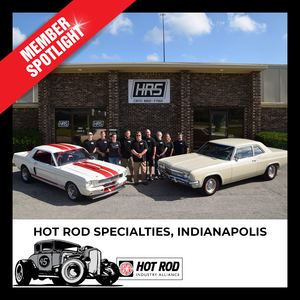
Hot Rod Specialties, Indianapolis company owner Brad Denney is no stranger to building and owning various types of musclecars and street rods. What was once a hobby turned into a rewarding career when he took ownership of the company in 2017.

In this week’s HRIA member spotlight, Denney tells us about the company’s NSRA Nationals-featured ’41 Willy’s Outlaw, what new exciting projects he is currently working on and changes that he sees in the industry.

SEMA: Tell us the story of your business. How did you start?

Brad Denney: I started getting the hot-rod bug back in the early ’70s. I was 14 in 1975 and my first car was a ’67 RS Camaro. One day it started smoking, so my older brother and I pulled the engine, rebuilt it and put headers and a new exhaust on it. That is where this all started. Over the last 40 years, I have owned more than 200 musclecars and street rods. I had a day job running a commercial painting business but was always working nights and weekends in my garage with my son. Three years ago, a buddy of mine was running a hot-rod shop, but had some personal problems that caused him to sell. I bought the business assets from him. We came up with a name and started a new shop in the same location. My son and my buddy Wade joined me, and the rest is history.

We currently have eight full time employees: Wade Sellers, Kenneth Denney, Kelly Yohler, Jarrod Firkins, Tony Spears, Jess Spears, Ron Barker and Mike Bowman who help our business thrive. They deserve just as much credit as I do.  

SEMA: What was your breakthrough moment?

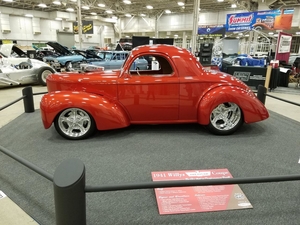
BD: If I had to pick one it would be a ’41 Willy’s Outlaw body that we did. We put a blown fuel-injected Hemi in it, and we took it as a feature vehicle at NSRA Nationals in Louisville in 2018. We exhibited the car out in the lobby, and I feel like we talked to every person at Louisville that year.    

SEMA: Tell us about your business now in 2020 and what projects are you working on?  

HRIA
Brad Denney’s ’41 Willy’s Outlaw featured a blown fuel-injected Hemi, and was a feature vehicle at NSRA Nationals in Louisville in 2018. 

BD: We currently have 10,000 sq. ft. of workspace. The custom interior shop is about 1,000 sq. ft. and the body shop is about 2,000 sq. ft. The rest is divided up between our fabrication, assembly and mechanical areas. We are quickly seeing the need to expand our number of employees and our square footage with our current workload and an ever-growing wait list for everything from minor repairs to full builds. We are also beginning to expand our part sales.

It’s been tough to try and work in the shop and sell parts online and to local customers, but we have gotten to a point where we are going to be able to expand that area as well. The ’41 Willy’s is back in the shop. The blown Hemi was just too much for the street, so the owner decided he wanted us to swap it out for an 800-hp blown LS from Don Hardy.

We have a ’29 Pontiac that I watched being built next door to my wife’s (then girlfriend) house back in the ’70s. I watched the original build and now we are doing the re-build. We also have three other full builds going and an average of 10 other cars at any given time for smaller projects.

SEMA: What changes are you seeing in the industry?

BD: We see the Pro-Touring thing continuing to grow. I am sort of old-school, and I see more and more of the later ’70s Camaros and Mustangs coming in. I have also seen more trucks and square bodies beginning to be more popular. I hope to turn this business over one day to my son Kenneth and continue the legacy. I want him to keep it going and he is totally on board.

SEMA: What advice do you have for young folks contemplating a career in the automotive aftermarket?   

BD: You must have the passion. If you don’t, don’t try to fake it, you can’t.