Thu, 04/09/2026 - 07:22

By Ashley Reyes

Graphic for SEMA MPMC Lunch and Learn on effectively working with lawmakers.


As legislative decisions at the state and federal levels continue to impact the growth and preservation of the motorsports industry, as well as the race tracks on which the sport is discovered, practiced and built, businesses cannot afford to pass on advocacy.
 

To help motorsports businesses understand the key issues impacting the industry and learn how to effectively engage with policymakers to protect and grow their business, the SEMA Motorsports Products & Media Council (MPMC) will host a virtual Lunch & Learn, How to Effectively Work With Your Lawmakers, on Thursday, April 16, 2026, at 10:00 a.m. PDT/1:00 p.m. EDT.

Register button for MPMC Lunch and Learn.


Moderated by Christian Robinson, senior director of state government affairs at SEMA, the discussion will feature panelists Jack Boyd, deputy chief of staff for US representative Claudia Tenney (R-NY);  Leo Delperdang (R), Kansas state representative; Mark Johnson (R), Ohio state representative; Eric Snyder, senior director of federal government affairs at SEMA; and Lauren Wilbor, manager, digital communications and partnership at SEMA.
 

Attendees will learn:

  • How to build relationships with lawmakers
  • How to communicate effectively about industry priorities
  • How to prepare your organization for the upcoming election cycle
  • Actionable advocacy strategies to protect and strengthen your business


The first 25 members to register will receive a $25 Uber Eats voucher to use the day of the event.
 

Don't miss your chance to gain access to lawmakers and SEMA's government affairs team, as well gain insights on how to prepare for what's ahead. Register.

Thu, 04/09/2026 - 07:18

By SEMA News Editors
The SEMA logo.


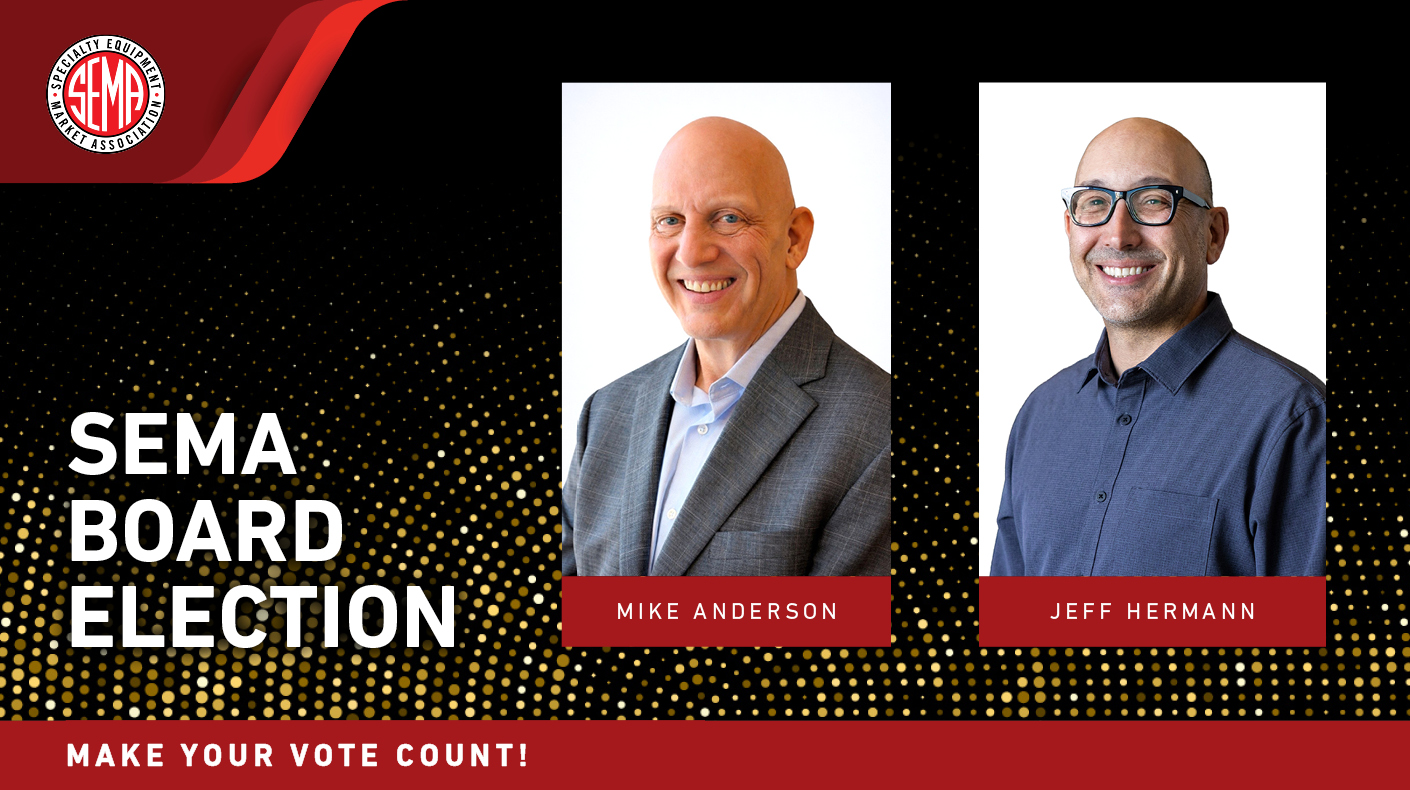
The following candidates are vying for a seat on the SEMA Board of Directors:
 

Board Seat Candidates (1 Seat)

  • Mike Anderson, Collision Advice
  • Jeff Hermann, MagnaFlow Group


Voting will take place online May 4 through May 26 and is open to current SEMA-member companies. Votes must be cast by each company's primary contact. Details on the upcoming election will be sent to the member company's designated primary contact. Winners will be announced by June 9.


Thu, 04/09/2026 - 06:46

From the SEMA Washington, D.C., office

Kansas Right to Race - late model cars racing at 81 Speedway in Kansas.


SEMA and PRI are expanding its Right-to-Race advocacy campaign nationwide. The time to protect race tracks is now, before more long-standing facilities are pushed out of their communities. Learn more at sema.org/right-to-race.
 

Here's the latest on SEMA and PRI's Right-to-Race advocacy campaign:
 

Kansas Puts Right-to-Race Protections in Victory Lane


Kansas has delivered a major victory for grassroots racing. Governor Laura Kelly has signed the Kansas Motorsports Venue Protection Act (HB 2416) into law, providing long-standing racing facilities in the state with important protections against nuisance-based lawsuits filed by surrounding property owners who arrived after the track was established. The measure cleared the Kansas Legislature with overwhelming bipartisan support.
 

The impact of this win extends far beyond the grandstands. Motorsports in Kansas generate more than $743 million annually, support nearly 5,700 jobs, and bring in more than $77 million in state and local taxes each year. SEMA and PRI backed HB 2416 at every step, including testimony from Victor Muñoz, SEMA senior manager for state government affairs, and support from Kansas motorsports leaders such as John Allen of 81 Speedway and Humboldt Speedway, Cindy Bell of Kansas International Dragway and ABATE of Kansas. Racing venues in Kansas boost local businesses, draw fans and competitors into communities and uphold a vital part of the state's motorsports heritage.
 

PRI and SEMA extend their gratitude to Representative Leo Delperdang, the sponsor of HB 2416 and a longstanding advocate for Kansas's automotive community, and to Senator Elaine Bowers, whose leadership was instrumental in the bill's passage. Representative Delperdang was recognized as SEMA's 2021 Legislator of the Year.
 

This new Kansas law also marks another important checkpoint in the growing national Right-to-Race movement. Iowa and North Carolina have already secured similar wins, while several additional states continue advancing race-track protection legislation with SEMA and PRI support. Together, these efforts are helping ensure that race tracks—many of which have operated responsibly for decades—can continue serving as the places where grassroots racing lives, future competitors get their start, and local communities benefit from the commerce, tourism, and tradition that surround the sport.
 

For more information about SEMA and PRI's Right-to-Race campaign or to learn how your race track or motorsports business can help support similar legislation in your state, contact Muñoz at victorm@sema.org.


OHIO: SEMA and PRI Launch the Ohio Motorsports Network
 

Ohio Right to Race Motorsports Network.


From left to right (Bill Bader, Summit Motorsports Park; Ohio State Representative Kellie Deeter; Tierra Hubbard, SEMA/PRI; Tom Deery, PRI; Coby Lobaugh, SEMA/PRI).
 

During the final week of March, SEMA and PRI launched the Ohio Motorsports Network (OMN) in Columbus, alongside a coordinated series of legislative meetings at the state capitol and testimony in support of HB 639, Ohio's Right-to-Race legislation.
 

At the inaugural OMN meeting, Hubbard, SEMA director of government affairs for racing, and PRI Ambassador Tom Deery outlined the network's structure, vision and long-term goals. They also provided a comprehensive legislative update on the progress of Right-to-Race efforts in Ohio. Attendees from across the state came together with a shared purpose: to protect and strengthen motorsports. Participants also had the opportunity to highlight their facilities, events and ongoing initiatives. The group formally established leadership by appointing Bill Bader of Summit Motorsports Park as chair of the network.
 

The following day, SEMA and PRI met with lawmakers in both the House and Senate, engaging members on both sides of the aisle. These meetings focused on educating policymakers about the importance of motorsports, addressing questions about the legislation and ensuring lawmakers are informed before the bill reaches their desks.
 

On the final day, track owners, operators and industry leaders delivered compelling testimony before the House Local Government Committee in support of HB 639. Those testifying included Hubbard (PRI and SEMA), Bader (Summit Motorsports Park), Rich Farmer (Fremont Speedway), Bob Davis (American Motorcyclist Association) and Levi Jones (Eldora Speedway).
 

Are you interested in joining the Ohio Motorsports Network?
 

Be part of a growing, statewide effort to protect and advance motorsports in Ohio.
 

For more information or to get involved, contact Hubbard at tierrah@sema.org.


This story was originally published on April 9, 2026.
 

Main photo courtesy of World Racing Group | Jacy Norgaard


Thu, 04/09/2026 - 06:46

From the SEMA Washington, D.C., office

Kansas Right to Race - late model cars racing at 81 Speedway in Kansas.


SEMA and PRI are expanding its Right-to-Race advocacy campaign nationwide. The time to protect race tracks is now, before more long-standing facilities are pushed out of their communities. Learn more at sema.org/right-to-race.
 

Here's the latest on SEMA and PRI's Right-to-Race advocacy campaign:
 

Kansas Puts Right-to-Race Protections in Victory Lane


Kansas has delivered a major victory for grassroots racing. Governor Laura Kelly has signed the Kansas Motorsports Venue Protection Act (HB 2416) into law, providing long-standing racing facilities in the state with important protections against nuisance-based lawsuits filed by surrounding property owners who arrived after the track was established. The measure cleared the Kansas Legislature with overwhelming bipartisan support.
 

The impact of this win extends far beyond the grandstands. Motorsports in Kansas generate more than $743 million annually, support nearly 5,700 jobs, and bring in more than $77 million in state and local taxes each year. SEMA and PRI backed HB 2416 at every step, including testimony from Victor Muñoz, SEMA senior manager for state government affairs, and support from Kansas motorsports leaders such as John Allen of 81 Speedway and Humboldt Speedway, Cindy Bell of Kansas International Dragway and ABATE of Kansas. Racing venues in Kansas boost local businesses, draw fans and competitors into communities and uphold a vital part of the state's motorsports heritage.
 

PRI and SEMA extend their gratitude to Representative Leo Delperdang, the sponsor of HB 2416 and a longstanding advocate for Kansas's automotive community, and to Senator Elaine Bowers, whose leadership was instrumental in the bill's passage. Representative Delperdang was recognized as SEMA's 2021 Legislator of the Year.
 

This new Kansas law also marks another important checkpoint in the growing national Right-to-Race movement. Iowa and North Carolina have already secured similar wins, while several additional states continue advancing race-track protection legislation with SEMA and PRI support. Together, these efforts are helping ensure that race tracks—many of which have operated responsibly for decades—can continue serving as the places where grassroots racing lives, future competitors get their start, and local communities benefit from the commerce, tourism, and tradition that surround the sport.
 

For more information about SEMA and PRI's Right-to-Race campaign or to learn how your race track or motorsports business can help support similar legislation in your state, contact Muñoz at victorm@sema.org.


OHIO: SEMA and PRI Launch the Ohio Motorsports Network
 

Ohio Right to Race Motorsports Network.


From left to right (Bill Bader, Summit Motorsports Park; Ohio State Representative Kellie Deeter; Tierra Hubbard, SEMA/PRI; Tom Deery, PRI; Coby Lobaugh, SEMA/PRI).
 

During the final week of March, SEMA and PRI launched the Ohio Motorsports Network (OMN) in Columbus, alongside a coordinated series of legislative meetings at the state capitol and testimony in support of HB 639, Ohio's Right-to-Race legislation.
 

At the inaugural OMN meeting, Hubbard, SEMA director of government affairs for racing, and PRI Ambassador Tom Deery outlined the network's structure, vision and long-term goals. They also provided a comprehensive legislative update on the progress of Right-to-Race efforts in Ohio. Attendees from across the state came together with a shared purpose: to protect and strengthen motorsports. Participants also had the opportunity to highlight their facilities, events and ongoing initiatives. The group formally established leadership by appointing Bill Bader of Summit Motorsports Park as chair of the network.
 

The following day, SEMA and PRI met with lawmakers in both the House and Senate, engaging members on both sides of the aisle. These meetings focused on educating policymakers about the importance of motorsports, addressing questions about the legislation and ensuring lawmakers are informed before the bill reaches their desks.
 

On the final day, track owners, operators and industry leaders delivered compelling testimony before the House Local Government Committee in support of HB 639. Those testifying included Hubbard (PRI and SEMA), Bader (Summit Motorsports Park), Rich Farmer (Fremont Speedway), Bob Davis (American Motorcyclist Association) and Levi Jones (Eldora Speedway).
 

Are you interested in joining the Ohio Motorsports Network?
 

Be part of a growing, statewide effort to protect and advance motorsports in Ohio.
 

For more information or to get involved, contact Hubbard at tierrah@sema.org.


This story was originally published on April 9, 2026.
 

Main photo courtesy of World Racing Group | Jacy Norgaard


Wed, 04/08/2026 - 09:34

By SEMA News Editors


TREMEC

Magnum XL Six-Speed Transmission Kit for '19-Plus Ford Mustang GT

Tremec Magnum XL Six-Speed Transmission.


Like the original Magnum, the Magnum XL is an aftermarket version of the TR-6060, which serves as factory equipment in numerous Detroit-based musclecars and sports cars. In order to accommodate the rearward shifter location of modern performance vehicles, the XL’s extension housing moves the shifter more than 8 in. back from the original Magnum’s most rearward location. It is also equipped with a shift isolator that provides dampening and precision shift feel, the company said.

tremec.com


DENIOS

Spill and Leak Response Products

Denios Spill and Leak Response Products


DENIOS provides a broad range of spill and leak response products for a variety of instances or applications, including sorbents, drip trays, spill kits and more. The DENSORB Fine Fiber Sorbents includes a complete lineup of rolls, pads, pillows, socks or booms and are available for universal spills, oil-only and HazMat materials. The company also offers a number of manual containment barriers designed to quickly and efficiently retain and contain liquids.

denios-us.com


Roush Performance

'26 Ford F-150 Nitemare Package

Roush Performance Ford F-150 Nitemare.


Built on '26 Ford F-150 XL or XLT 4x4 trims, the Nitemare Package centers on the company's Advanced Lowered Suspension System, 22-in. gloss black wheels, General Tire G-MAX AS-07 tires, upgraded brakes and a performance cat-back exhaust that Roush says delivers improved traction and responsiveness. Exterior updates include new bedside graphics, an amber-lit grille and functional hood extractors. Inside, upgrades include a full carpet package, red carbon-fiber steering wheel accent and serialized badging. For added power, Roush offers an optional TVS R2650 supercharger for the 5.0L V8, boosting output to more than 705 hp.

roushperformance.com

Tue, 04/07/2026 - 23:24

From the SEMA Washington, D.C., office

Shipping containers stacked at a port.


The Trump Administration recently announced updates to Section 232 tariffs covering steel, aluminum and certain derivative products. Effective April 6, businesses importing products that contain steel and aluminum will be subject to a 25% tariff applied to the full value of the imported product. This replaces the prior system, which imposed a 50% tariff on the value of the embedded steel or aluminum content.

  • The revised approach is intended to simplify compliance while maintaining strong protections for domestic metals producers.
     

Upstream Metals Impact


President Trump's proclamation announced that the existing 50% tariff on upstream, commodity-grade metals will remain in place. Products that are made almost entirely of steel or aluminum may also be reclassified into this category. Products with limited metal content, defined as 15% or less (measured by weight), will no longer be subject to Section 232 tariffs. Instead, those goods will be subject to the Administration's separate 10% global baseline tariff.

  • The practical impact of these changes will vary significantly across sectors and supply chains. Importers of complex manufactured goods may face higher duty burdens despite the reduction in nominal tariff rates. The shift to full-value assessment is expected to generate additional tariff revenue for the federal government and partially offset declines following recent court decisions that invalidated other tariff authorities.


The overhaul follows months of internal deliberations over how to address longstanding industry concerns about the complexity of the existing system. Manufacturers had argued that "Liberation Day" tariffs raised input costs for domestic production while allowing many finished imports to enter the U.S. market with minimal duties. The current revisions are intended to close that gap while making compliance more straightforward for importers who previously struggled to calculate the value of embedded metal content.
 

April 6 Provisions


The updated framework continues to rely on Section 232 authorities under the Trade Expansion Act of 1962, which remain intact despite recent legal challenges affecting other trade tools. The following provisions take effect April 6 through an undetermined date:

  • Articles in Annex I-A will have a 50% tariff. Products from the United Kingdom for which the steel was melted and poured/aluminum was smelted and cast in the United Kingdom will have a 25% tariff. Certain derivative articles for which the steel content is entirely steel melted and poured in the United States or the aluminum/copper content was entirely smelted and cast in the United States will have a 10% tariff.
     
  • Articles in Annex I-B will have a 25% tariff. Products from the United Kingdom for which the steel was melted and poured/aluminum was smelted and cast in the UK will have a 15% tariff. Certain derivative articles for which the steel content is entirely steel melted and poured in the United States or the aluminum/copper content was entirely smelted and cast in the United States will have a 10% tariff.
     
  • Articles in Annex II will no longer face a Section 232 steel or aluminum tariff.


Additionally, articles in Annex III will face, depending on the country, a 15% top-up (i.e., a product with a baseline tariff below 15% gets topped up to 15% and a baseline tariff above 15% faces no additional tariff), 10% (for products for which the steel content is entirely steel melted and poured in the United States or the aluminum content was entirely smelted and cast in the United States) or 25% (countries with no normal trading relations). This provision is to remain in place through December 31, 2026.
 

President Trump reserves the right to revoke this treatment if imports of a product increase in such a way that undermines national security. Revocation would subject Annex III products from the country to Annex I-B tariff rates.
 

Additional Details


  • 200% aluminum tariffs will remain in effect for Annex I-A, I-B and III products that were smelted or cast in Russia.
     
  • Products on Annex I-A, I-B or III that contain some combination of steel, aluminum and copper will only be subject to one tariff rate. In other words, the steel, aluminum and copper tariffs do not stack.
     
  • Products on Annex I-B or III that do not contain any steel, aluminum or copper content (as laid out in Annex IV) will not be subject to tariffs.
     
  • Products that fall under the WTO Agreement on Trade in Civil Aircraft and are civil aircraft or civil aircraft parts will not be subject to the steel, aluminum or copper tariffs.
     
  • The inclusions processes for steel, aluminum and copper are terminated, though the Commerce Department and USTR reserve the right to add more derivative articles to the tariffs.
     
  • Drawback is available to a product on Annex I-B or III that's not subject to an antidumping or countervailing duty order, from a trade agreement partner country (United Kingdom, European Union, Japan, South Korea, Mexico, Canada and others with a final Agreement on Reciprocal Trade (ART)), and the steel is completely melted and poured in the trade agreement partner country (or aluminum/copper smelted and cast).


Questions? Comments? Want to share your tariff story? Contact SEMA Senior Manager for Federal Government Affairs Juan Mejia at JuanM@sema.org.


This article was originally published on April 7, 2026.


Top image courtesy of Shutterstock | Robert V Schwemmer. Feed image courtesy of Shutterstock | Hieronymus Ukkel


Tue, 04/07/2026 - 23:24

From the SEMA Washington, D.C., office

Shipping containers stacked at a port.


The Trump Administration recently announced updates to Section 232 tariffs covering steel, aluminum and certain derivative products. Effective April 6, businesses importing products that contain steel and aluminum will be subject to a 25% tariff applied to the full value of the imported product. This replaces the prior system, which imposed a 50% tariff on the value of the embedded steel or aluminum content.

  • The revised approach is intended to simplify compliance while maintaining strong protections for domestic metals producers.
     

Upstream Metals Impact


President Trump's proclamation announced that the existing 50% tariff on upstream, commodity-grade metals will remain in place. Products that are made almost entirely of steel or aluminum may also be reclassified into this category. Products with limited metal content, defined as 15% or less (measured by weight), will no longer be subject to Section 232 tariffs. Instead, those goods will be subject to the Administration's separate 10% global baseline tariff.

  • The practical impact of these changes will vary significantly across sectors and supply chains. Importers of complex manufactured goods may face higher duty burdens despite the reduction in nominal tariff rates. The shift to full-value assessment is expected to generate additional tariff revenue for the federal government and partially offset declines following recent court decisions that invalidated other tariff authorities.


The overhaul follows months of internal deliberations over how to address longstanding industry concerns about the complexity of the existing system. Manufacturers had argued that "Liberation Day" tariffs raised input costs for domestic production while allowing many finished imports to enter the U.S. market with minimal duties. The current revisions are intended to close that gap while making compliance more straightforward for importers who previously struggled to calculate the value of embedded metal content.
 

April 6 Provisions


The updated framework continues to rely on Section 232 authorities under the Trade Expansion Act of 1962, which remain intact despite recent legal challenges affecting other trade tools. The following provisions take effect April 6 through an undetermined date:

  • Articles in Annex I-A will have a 50% tariff. Products from the United Kingdom for which the steel was melted and poured/aluminum was smelted and cast in the United Kingdom will have a 25% tariff. Certain derivative articles for which the steel content is entirely steel melted and poured in the United States or the aluminum/copper content was entirely smelted and cast in the United States will have a 10% tariff.
     
  • Articles in Annex I-B will have a 25% tariff. Products from the United Kingdom for which the steel was melted and poured/aluminum was smelted and cast in the UK will have a 15% tariff. Certain derivative articles for which the steel content is entirely steel melted and poured in the United States or the aluminum/copper content was entirely smelted and cast in the United States will have a 10% tariff.
     
  • Articles in Annex II will no longer face a Section 232 steel or aluminum tariff.


Additionally, articles in Annex III will face, depending on the country, a 15% top-up (i.e., a product with a baseline tariff below 15% gets topped up to 15% and a baseline tariff above 15% faces no additional tariff), 10% (for products for which the steel content is entirely steel melted and poured in the United States or the aluminum content was entirely smelted and cast in the United States) or 25% (countries with no normal trading relations). This provision is to remain in place through December 31, 2026.
 

President Trump reserves the right to revoke this treatment if imports of a product increase in such a way that undermines national security. Revocation would subject Annex III products from the country to Annex I-B tariff rates.
 

Additional Details


  • 200% aluminum tariffs will remain in effect for Annex I-A, I-B and III products that were smelted or cast in Russia.
     
  • Products on Annex I-A, I-B or III that contain some combination of steel, aluminum and copper will only be subject to one tariff rate. In other words, the steel, aluminum and copper tariffs do not stack.
     
  • Products on Annex I-B or III that do not contain any steel, aluminum or copper content (as laid out in Annex IV) will not be subject to tariffs.
     
  • Products that fall under the WTO Agreement on Trade in Civil Aircraft and are civil aircraft or civil aircraft parts will not be subject to the steel, aluminum or copper tariffs.
     
  • The inclusions processes for steel, aluminum and copper are terminated, though the Commerce Department and USTR reserve the right to add more derivative articles to the tariffs.
     
  • Drawback is available to a product on Annex I-B or III that's not subject to an antidumping or countervailing duty order, from a trade agreement partner country (United Kingdom, European Union, Japan, South Korea, Mexico, Canada and others with a final Agreement on Reciprocal Trade (ART)), and the steel is completely melted and poured in the trade agreement partner country (or aluminum/copper smelted and cast).


Questions? Comments? Want to share your tariff story? Contact SEMA Senior Manager for Federal Government Affairs Juan Mejia at JuanM@sema.org.


This article was originally published on April 7, 2026.


Top image courtesy of Shutterstock | Robert V Schwemmer. Feed image courtesy of Shutterstock | Hieronymus Ukkel


Tue, 04/07/2026 - 23:24

From the SEMA Washington, D.C., office

Shipping containers stacked at a port.


The Trump Administration recently announced updates to Section 232 tariffs covering steel, aluminum and certain derivative products. Effective April 6, businesses importing products that contain steel and aluminum will be subject to a 25% tariff applied to the full value of the imported product. This replaces the prior system, which imposed a 50% tariff on the value of the embedded steel or aluminum content.

  • The revised approach is intended to simplify compliance while maintaining strong protections for domestic metals producers.
     

Upstream Metals Impact


President Trump's proclamation announced that the existing 50% tariff on upstream, commodity-grade metals will remain in place. Products that are made almost entirely of steel or aluminum may also be reclassified into this category. Products with limited metal content, defined as 15% or less (measured by weight), will no longer be subject to Section 232 tariffs. Instead, those goods will be subject to the Administration's separate 10% global baseline tariff.

  • The practical impact of these changes will vary significantly across sectors and supply chains. Importers of complex manufactured goods may face higher duty burdens despite the reduction in nominal tariff rates. The shift to full-value assessment is expected to generate additional tariff revenue for the federal government and partially offset declines following recent court decisions that invalidated other tariff authorities.


The overhaul follows months of internal deliberations over how to address longstanding industry concerns about the complexity of the existing system. Manufacturers had argued that "Liberation Day" tariffs raised input costs for domestic production while allowing many finished imports to enter the U.S. market with minimal duties. The current revisions are intended to close that gap while making compliance more straightforward for importers who previously struggled to calculate the value of embedded metal content.
 

April 6 Provisions


The updated framework continues to rely on Section 232 authorities under the Trade Expansion Act of 1962, which remain intact despite recent legal challenges affecting other trade tools. The following provisions take effect April 6 through an undetermined date:

  • Articles in Annex I-A will have a 50% tariff. Products from the United Kingdom for which the steel was melted and poured/aluminum was smelted and cast in the United Kingdom will have a 25% tariff. Certain derivative articles for which the steel content is entirely steel melted and poured in the United States or the aluminum/copper content was entirely smelted and cast in the United States will have a 10% tariff.
     
  • Articles in Annex I-B will have a 25% tariff. Products from the United Kingdom for which the steel was melted and poured/aluminum was smelted and cast in the UK will have a 15% tariff. Certain derivative articles for which the steel content is entirely steel melted and poured in the United States or the aluminum/copper content was entirely smelted and cast in the United States will have a 10% tariff.
     
  • Articles in Annex II will no longer face a Section 232 steel or aluminum tariff.


Additionally, articles in Annex III will face, depending on the country, a 15% top-up (i.e., a product with a baseline tariff below 15% gets topped up to 15% and a baseline tariff above 15% faces no additional tariff), 10% (for products for which the steel content is entirely steel melted and poured in the United States or the aluminum content was entirely smelted and cast in the United States) or 25% (countries with no normal trading relations). This provision is to remain in place through December 31, 2026.
 

President Trump reserves the right to revoke this treatment if imports of a product increase in such a way that undermines national security. Revocation would subject Annex III products from the country to Annex I-B tariff rates.
 

Additional Details


  • 200% aluminum tariffs will remain in effect for Annex I-A, I-B and III products that were smelted or cast in Russia.
     
  • Products on Annex I-A, I-B or III that contain some combination of steel, aluminum and copper will only be subject to one tariff rate. In other words, the steel, aluminum and copper tariffs do not stack.
     
  • Products on Annex I-B or III that do not contain any steel, aluminum or copper content (as laid out in Annex IV) will not be subject to tariffs.
     
  • Products that fall under the WTO Agreement on Trade in Civil Aircraft and are civil aircraft or civil aircraft parts will not be subject to the steel, aluminum or copper tariffs.
     
  • The inclusions processes for steel, aluminum and copper are terminated, though the Commerce Department and USTR reserve the right to add more derivative articles to the tariffs.
     
  • Drawback is available to a product on Annex I-B or III that's not subject to an antidumping or countervailing duty order, from a trade agreement partner country (United Kingdom, European Union, Japan, South Korea, Mexico, Canada and others with a final Agreement on Reciprocal Trade (ART)), and the steel is completely melted and poured in the trade agreement partner country (or aluminum/copper smelted and cast).


Questions? Comments? Want to share your tariff story? Contact SEMA Senior Manager for Federal Government Affairs Juan Mejia at JuanM@sema.org.


This article was originally published on April 7, 2026.


Top image courtesy of Shutterstock | Robert V Schwemmer. Feed image courtesy of Shutterstock | Hieronymus Ukkel


Tue, 04/07/2026 - 13:36

By SEMA News Editors

Pro Spot Training Director Shawn Collins


Pro Spot International, a manufacturer of welding and collision repair equipment, has announced the appointment of Shawn Collins as its new training director, effective March 30, 2026.
 

The hire signals a strategic expansion of the company's training capabilities as the collision repair industry faces growing demand for advanced technician education, company representatives said.
 

Collins joins Pro Spot from 3M, where he served for 14 years as advanced application engineer and lead structural trainer. In that role, he led the development of repair procedures and application methods for the collision repair industry, including welding and joining technologies, structural adhesive systems and paint, body and equipment (PBE) applications. An ASE Master Technician and I-CAR Platinum-certified collision technician, Collins has served as an I-CAR instructor for more than 25 years.
 

"Shawn is one of the most respected technical trainers in the collision repair industry, and we've wanted to bring him onto our team for a long time," said Ron Olsson, president of Pro Spot International. "As vehicles become more complex and OEM repair procedures continue to evolve, training isn't optional--it's essential. Shawn's experience developing curriculum and working hands-on with technicians across the country makes him the right person to lead this effort for us."
 

In his new role, Collins will oversee the development and expansion of Pro Spot's training programs, working with shops, distributors and industry partners to bridge the gap between advancing repair technology and technician readiness.
 

For more information, visit airsept.com.

Tue, 04/07/2026 - 13:23

Story and photos by Andreas Conradt, Automedia


An AMG So Secret We Can't Name It


An image of a camouflaged Mercedes AMG Coupe on the race track.


The car spotted at the Nürburgring race track in Germany is one of those rare cases where we have to admit: we don't know exactly what we're looking at. What is clear is that it's an AMG-powered Mercedes-Benz two-door coupe, but that's about all we can say with certainty. The rest is pure speculation.


The mystery AMG could, of course, be a GT3 race car. However, it's highly unusual––for Mercedes-AMG or any other manufacturer––to publicly test an all-new model first as a GT3 variant, or even as a full race car, which is what this appears to be. For those who think it might be a GT3 version of the current GT, take a closer look at the much longer hood, the completely different doors and the rear end. This is not a car based on the current Mercedes-AMG GT.


An image of a camouflaged Mercedes AMG Coupe on the race track.


The black, white and yellow machine could also be a still-secret one-off, similar to how the AMG One debuted a few years ago. However, that was a road-legal hypercar with at least some level of practicality, something this prototype clearly lacks. Just imagine climbing out of this one in shorts without burning your legs.


The license plate doesn't offer many clues either. It's a red German plate used for short-distance driving of unregistered vehicles, either because they are not road-legal or not yet registered. For now, there's little more to go on, and we'll likely have to wait for additional information to surface.


An image of a camouflaged Mercedes AMG Coupe on the race track.


Same, Same but Different: The Facelifted BMW 7 Series


An image of the camouflaged facelifted BMW 7 Series.


BMW is moving ahead with a major facelift of its flagship 7 Series, and these latest spy shots suggest the controversial design of the current generation is here to stay. After previewing the update with a shadowy teaser, new images from the Nürburgring in Germany offer a clearer look at what's coming.


Despite widespread criticism, BMW appears committed to its bold styling. The facelifted model retains the split headlight layout, though with vertically mounted headlamps rather than today's horizontal configuration, along with the imposing illuminated kidney grille that defines the current 7 Series.


Subtle but meaningful revisions are expected. New lighting signatures are visible at both the front and rear, while additional sensors integrated into the front fascia and windshield hint at upgraded driver-assistance systems. Notably absent, however, is an evolution of BMW's Level 3 "Personal Pilot" system. The automaker has reportedly dropped the technology for this update, likely due to its high cost, around $6,500, and limited usability, as it was restricted to low-speed highway driving.


Instead, BMW is shifting its focus to a more practical solution. A new Level 2 system, built on the electronics architecture of the "Neue Klasse," will debut in the updated 7 Series. It promises enhanced convenience features such as hands-free highway driving, eye-activated lane changes and future navigation-based assistance in urban environments, while keeping the driver fully responsible at all times.


An image of the camouflaged facelifted BMW 7 Series.


Inside, the changes could be more significant. The facelifted sedan is expected to introduce BMW's next-generation infotainment system, iDrive X, alongside the wide-format "Panoramic Vision" head-up display that spans the base of the windshield. Together, these elements signal a shift away from the traditional instrument cluster toward a more immersive, screen-centric interface.


Powertrain updates will focus on efficiency rather than reinvention. Inline six-cylinder engines with 48-volt mild-hybrid technology are expected to remain the backbone of the lineup, supported by plug-in hybrids. The fully electric BMW i7 is also due for updates, particularly in battery technology, with higher energy-density cells under consideration.


BMW may also use the facelift to expand the range at the top end, with speculation pointing to a revised V8-powered M760 and a new ultra-luxury variant developed under the Alpina name, now fully integrated into the brand.


Production of the updated model is believed to be underway, with a global debut expected in 2026, potentially at IAA Mobility. The current 7 Series (G70), introduced in late 2022, remains one of the most polarizing designs in the segment, and that's unlikely to change anytime soon.


An image of the camouflaged facelifted BMW 7 Series.