Thu, 12/19/2019 - 13:40

By Kyle Cheng

Market Research
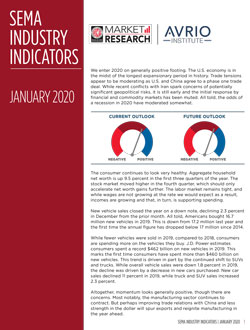
Check out the “SEMA Industry Indicators” report each month to learn how movements in the broader economy may impact your business strategy.

As the year comes to an end, a broad recession does not appear imminent. Despite slowing in the economy, American consumers remain optimistic and underlying fundamentals, such as the labor market, are strong. However, this year has been challenging for manufacturing. While ongoing issues are beginning to resolve, global growth remains slow and trade tensions remain high. These hurdles will continue to be obstacles in 2020.

Want more information on the trends affecting the specialty-equipment industry? Check out the “SEMA Industry Indicators” report each month to learn how movements in the broader economy may impact your business strategy. In this report, published monthly, you’ll get a snapshot of the overall economy and our industry, including:

  • Overall Economic Outlook
  • New Vehicle Sales and Statistics on Auto Parts Production
  • Consumer Sentiment and Spending
  • Economic Growth and Unemployment
  • Other Important Industry Insights

To learn more, download the December “SEMA Industry Indicators” report, now available for free at www.sema.org/research.


Thu, 12/19/2019 - 13:26

By SEMA Washington, D.C. Staff

The U.S. Department of Labor (DOL) updated its rules on what may be excluded when calculating an employee’s regular rate of pay, which then forms the basis for “time and one-half” overtime pay. The DOL’s final rule marks the first update to the Fair Labor Standards Act regulation in more than 50 years. At issue is which perks and benefits may be excluded in the regular rate of pay calculation and, conversely, which must be included.

Under the DOL rules, employers may exclude the following from an employee’s regular rate of pay calculation:

  • The cost of providing certain parking benefits, wellness programs, onsite specialist treatment, gym access and fitness classes, employee discounts on retail goods and services, certain tuition benefits (whether paid to an employee, an education provider or a student-loan program) and adoption assistance.
  • Payments for unused paid leave, including paid sick leave or paid time off.
  • Payments of certain penalties required under state and local scheduling laws.
  • Reimbursed expenses, including cellphone plans, credentialing exam fees, organization membership dues and travel, even if not incurred “solely” for the employer’s benefit; and clarifies that reimbursements that do not exceed the maximum travel reimbursement under the Federal Travel Regulation System or the optional IRS substantiation amounts for travel expenses are per se “reasonable payments.”
  • Certain sign-on bonuses and certain longevity bonuses.
  • The cost of office coffee and snacks to employees as gifts.
  • Discretionary bonuses, by clarifying that the label given a bonus does not determine whether it is discretionary and providing additional examples.
  • Contributions to benefit plans for accident, unemployment, legal services or other events that could cause future financial hardship or expense.

For more information, contact Stuart Gosswein at stuartg@sema.org.

Thu, 12/19/2019 - 13:26

By SEMA Washington, D.C. Staff

The U.S. Department of Labor (DOL) updated its rules on what may be excluded when calculating an employee’s regular rate of pay, which then forms the basis for “time and one-half” overtime pay. The DOL’s final rule marks the first update to the Fair Labor Standards Act regulation in more than 50 years. At issue is which perks and benefits may be excluded in the regular rate of pay calculation and, conversely, which must be included.

Under the DOL rules, employers may exclude the following from an employee’s regular rate of pay calculation:

  • The cost of providing certain parking benefits, wellness programs, onsite specialist treatment, gym access and fitness classes, employee discounts on retail goods and services, certain tuition benefits (whether paid to an employee, an education provider or a student-loan program) and adoption assistance.
  • Payments for unused paid leave, including paid sick leave or paid time off.
  • Payments of certain penalties required under state and local scheduling laws.
  • Reimbursed expenses, including cellphone plans, credentialing exam fees, organization membership dues and travel, even if not incurred “solely” for the employer’s benefit; and clarifies that reimbursements that do not exceed the maximum travel reimbursement under the Federal Travel Regulation System or the optional IRS substantiation amounts for travel expenses are per se “reasonable payments.”
  • Certain sign-on bonuses and certain longevity bonuses.
  • The cost of office coffee and snacks to employees as gifts.
  • Discretionary bonuses, by clarifying that the label given a bonus does not determine whether it is discretionary and providing additional examples.
  • Contributions to benefit plans for accident, unemployment, legal services or other events that could cause future financial hardship or expense.

For more information, contact Stuart Gosswein at stuartg@sema.org.

Thu, 12/19/2019 - 13:26

By SEMA Washington, D.C. Staff

The U.S. Department of Labor (DOL) updated its rules on what may be excluded when calculating an employee’s regular rate of pay, which then forms the basis for “time and one-half” overtime pay. The DOL’s final rule marks the first update to the Fair Labor Standards Act regulation in more than 50 years. At issue is which perks and benefits may be excluded in the regular rate of pay calculation and, conversely, which must be included.

Under the DOL rules, employers may exclude the following from an employee’s regular rate of pay calculation:

  • The cost of providing certain parking benefits, wellness programs, onsite specialist treatment, gym access and fitness classes, employee discounts on retail goods and services, certain tuition benefits (whether paid to an employee, an education provider or a student-loan program) and adoption assistance.
  • Payments for unused paid leave, including paid sick leave or paid time off.
  • Payments of certain penalties required under state and local scheduling laws.
  • Reimbursed expenses, including cellphone plans, credentialing exam fees, organization membership dues and travel, even if not incurred “solely” for the employer’s benefit; and clarifies that reimbursements that do not exceed the maximum travel reimbursement under the Federal Travel Regulation System or the optional IRS substantiation amounts for travel expenses are per se “reasonable payments.”
  • Certain sign-on bonuses and certain longevity bonuses.
  • The cost of office coffee and snacks to employees as gifts.
  • Discretionary bonuses, by clarifying that the label given a bonus does not determine whether it is discretionary and providing additional examples.
  • Contributions to benefit plans for accident, unemployment, legal services or other events that could cause future financial hardship or expense.

For more information, contact Stuart Gosswein at stuartg@sema.org.

Thu, 12/19/2019 - 13:09

By SEMA Editors

Bill Simpson
SEMA Hall of Fame member Bill Simpson passed away Monday, December 16, after suffering a massive stroke.

Bill Simpson, 79, motorsports safety pioneer, died Monday, December 16, after suffering a massive stroke. A class of 1988 SEMA Hall of Fame member and a 2003 Motorsports Hall of Fame inductee, Simpson drove dragsters and Indy cars, finishing 13th in the 1974 Indianapolis 500. After ending his career as a driver, he started Simpson Safety Products in his garage, which grew into an empire and helped reduce the death rate in all forms of racing.

Born in Hermosa Beach, California, Simpson started drag racing in the late ’50s and broke both arms when he was 18 years old. That led to his initial safety idea of mounting a parachute behind the car to slow it down, and soon enough it was adopted by the NHRA. But his big breakthrough came in the ’60s, when astronaut Pete Conrad introduced him to a fire-retardant material called Nomex. At that time, IndyCar, NASCAR and F1 drivers routinely lost their lives to fire because they either drove in a T-shirt or a uniform that was dipped in a chemical that provided minimal protection. Simpson began producing Nomex suits, and by 1967, 30 of the 33 starters at Indy were wearing them. In 1986, Simpson set himself on fire while wearing one of his suits to prove its efficacy.

Bill Simpson
Before founding Simpson Safety Products, Simpson drove dragsters and Indy cars, finishing 13th in the 1974 Indianapolis 500.

From suits, Simpson branched out into gloves, shoes, seat belts and helmets. Simpson Safety Products were used worldwide. However, in 2001, his friend Dale Earnhardt was killed in a crash at Daytona, which changed the course of Simpson’s life. NASCAR blamed Simpson’s seat belts for Earnhardt’s death. His life was threatened by fans, and he resigned from his company to start another company, Impact Performance Products. He ended up suing NASCAR for defamation of character in 2003, settling the $9 million suit out of court.

Simpson was married three times and fathered two sons, Jeff and David. In his spare time, he enjoyed sailing his boat in Mexico.

Funeral arrangements have not been disclosed as of press time. Indianapolis Motor Speedway said a celebration of Simpson's life is being planned for May at the IMS Museum.

Thu, 12/19/2019 - 12:23

By SEMA Washington, D.C., Staff

CCAD

SEMA and the Automotive Restoration Market Organization (ARMO) and Hot Rod Industry Alliance (HRIA) have announced that the next Collector Car Appreciation Day (CCAD) will be celebrated July 10, 2020. The date marks the 11th consecutive commemoration in what has become an annual event to raise awareness of the vital role automotive restoration and collection plays in American society. 

SEMA and its councils will once again seek a Congressional resolution to recognize the day’s significance. The industry endeavors to preserve our nation’s automotive heritage while providing well-paying, high-skilled jobs nationwide. Intended to celebrate the classics of the past and the future, CCAD is a singular tribute to the collector car industry and the millions of hobbyists it supports.

 The U.S. Congress first recognized CCAD in 2010 at SEMA’s request and helped launch this annual event. In preparation for the 11th celebration of the nation’s automotive heritage, enthusiasts and related businesses are already planning open houses, car cruises, club gatherings and educational events to commemorate the day.

The previous resolutions were sponsored by co-chairs of the SEMA-supported Congressional Automotive Performance and Motorsports Caucus. These Congressional leaders are strong advocates for the automotive hobby in Washington and recognize the integral role collector cars have played in fostering our nation’s appreciation for the automobile’s unique historical place in our history. The Caucus is an informal, non-partisan group that pays tribute to America’s ever-growing love affair with the car and motorsports.  

SEMA will maintain and publicize a list of scheduled events to commemorate America’s time-tested passion for the automobile at www.semaSAN.com. Individuals, car clubs and business owners interested in publicizing events can submit the details of their celebration. Individuals, car clubs and business owners interested in publicizing events should contact Colby Martin, director of the SEMA Action Network (SAN), at 909-978-6721 or san@sema.org. If you are unable to celebrate on July 10, SEMA encourages events to be scheduled throughout the month of July 2020.

Thu, 12/19/2019 - 12:23

By SEMA Washington, D.C., Staff

CCAD

SEMA and the Automotive Restoration Market Organization (ARMO) and Hot Rod Industry Alliance (HRIA) have announced that the next Collector Car Appreciation Day (CCAD) will be celebrated July 10, 2020. The date marks the 11th consecutive commemoration in what has become an annual event to raise awareness of the vital role automotive restoration and collection plays in American society. 

SEMA and its councils will once again seek a Congressional resolution to recognize the day’s significance. The industry endeavors to preserve our nation’s automotive heritage while providing well-paying, high-skilled jobs nationwide. Intended to celebrate the classics of the past and the future, CCAD is a singular tribute to the collector car industry and the millions of hobbyists it supports.

 The U.S. Congress first recognized CCAD in 2010 at SEMA’s request and helped launch this annual event. In preparation for the 11th celebration of the nation’s automotive heritage, enthusiasts and related businesses are already planning open houses, car cruises, club gatherings and educational events to commemorate the day.

The previous resolutions were sponsored by co-chairs of the SEMA-supported Congressional Automotive Performance and Motorsports Caucus. These Congressional leaders are strong advocates for the automotive hobby in Washington and recognize the integral role collector cars have played in fostering our nation’s appreciation for the automobile’s unique historical place in our history. The Caucus is an informal, non-partisan group that pays tribute to America’s ever-growing love affair with the car and motorsports.  

SEMA will maintain and publicize a list of scheduled events to commemorate America’s time-tested passion for the automobile at www.semaSAN.com. Individuals, car clubs and business owners interested in publicizing events can submit the details of their celebration. Individuals, car clubs and business owners interested in publicizing events should contact Colby Martin, director of the SEMA Action Network (SAN), at 909-978-6721 or san@sema.org. If you are unable to celebrate on July 10, SEMA encourages events to be scheduled throughout the month of July 2020.

Thu, 12/19/2019 - 12:05

By SEMA Washington, D.C., Staff

Responding to SEMA’s lawsuit to allow production of replica vehicles, the National Highway Traffic Safety Administration (NHTSA) has issued proposed regulations to implement the 2015 Low Volume Motor Vehicle Manufacturers Act. SEMA sued the U.S. Department of Transportation last October for failure to issue required regulations.

“SEMA welcomes NHTSA’s proposed regulations and urges the agency to quickly finalize the rules,” said SEMA President and CEO Christopher J. Kersting. “The replica car law was enacted to much fanfare in 2015, with customers eager to buy classic cars celebrating America’s automotive heritage. Four years later, companies are now poised to hire workers, gear-up for production, and provide consumers the chance to buy turnkey replica cars.”

Prior to enactment of the replica car law, the United States had just one system for regulating automobiles, which was established in the ’60s and designed for companies that mass-produce millions of vehicles. The lack of regulatory flexibility has prevented small businesses from manufacturing turn-key vehicles. The final regulations will allow low-volume automakers to sell up to 325 cars each year that resemble production vehicles manufactured at least 25 years ago. The U.S. Environmental Protection Agency and the California Air Resources Board have issued guidelines and regulations covering the engine packages to be installed in these replica vehicles.  

NHTSA is providing 30 days for public comments on its proposed rule. SEMA will be submitting comments on behalf of the industry to urge the most favorable regulations so that companies can begin production.

Thu, 12/19/2019 - 12:05

By SEMA Washington, D.C., Staff

Responding to SEMA’s lawsuit to allow production of replica vehicles, the National Highway Traffic Safety Administration (NHTSA) has issued proposed regulations to implement the 2015 Low Volume Motor Vehicle Manufacturers Act. SEMA sued the U.S. Department of Transportation last October for failure to issue required regulations.

“SEMA welcomes NHTSA’s proposed regulations and urges the agency to quickly finalize the rules,” said SEMA President and CEO Christopher J. Kersting. “The replica car law was enacted to much fanfare in 2015, with customers eager to buy classic cars celebrating America’s automotive heritage. Four years later, companies are now poised to hire workers, gear-up for production, and provide consumers the chance to buy turnkey replica cars.”

Prior to enactment of the replica car law, the United States had just one system for regulating automobiles, which was established in the ’60s and designed for companies that mass-produce millions of vehicles. The lack of regulatory flexibility has prevented small businesses from manufacturing turn-key vehicles. The final regulations will allow low-volume automakers to sell up to 325 cars each year that resemble production vehicles manufactured at least 25 years ago. The U.S. Environmental Protection Agency and the California Air Resources Board have issued guidelines and regulations covering the engine packages to be installed in these replica vehicles.  

NHTSA is providing 30 days for public comments on its proposed rule. SEMA will be submitting comments on behalf of the industry to urge the most favorable regulations so that companies can begin production.

Thu, 12/19/2019 - 12:05

By SEMA Washington, D.C., Staff

Responding to SEMA’s lawsuit to allow production of replica vehicles, the National Highway Traffic Safety Administration (NHTSA) has issued proposed regulations to implement the 2015 Low Volume Motor Vehicle Manufacturers Act. SEMA sued the U.S. Department of Transportation last October for failure to issue required regulations.

“SEMA welcomes NHTSA’s proposed regulations and urges the agency to quickly finalize the rules,” said SEMA President and CEO Christopher J. Kersting. “The replica car law was enacted to much fanfare in 2015, with customers eager to buy classic cars celebrating America’s automotive heritage. Four years later, companies are now poised to hire workers, gear-up for production, and provide consumers the chance to buy turnkey replica cars.”

Prior to enactment of the replica car law, the United States had just one system for regulating automobiles, which was established in the ’60s and designed for companies that mass-produce millions of vehicles. The lack of regulatory flexibility has prevented small businesses from manufacturing turn-key vehicles. The final regulations will allow low-volume automakers to sell up to 325 cars each year that resemble production vehicles manufactured at least 25 years ago. The U.S. Environmental Protection Agency and the California Air Resources Board have issued guidelines and regulations covering the engine packages to be installed in these replica vehicles.  

NHTSA is providing 30 days for public comments on its proposed rule. SEMA will be submitting comments on behalf of the industry to urge the most favorable regulations so that companies can begin production.