PEOPLE
Compiled by SEMA News Editors
35 Under 35
Next-Gen Talent on the Rise
Since 2012, SEMA News has sought to identify the industry’s young rising stars. In spotlighting talented individuals age 35 and under, we hoped to show both younger and older generations alike that new people with new ideas and drive not only have a home in the industry but also are already achieving great things.
In the following pages, we are again pleased to present 35 young trendsetters representing diverse industry segments. In order to make our “35 Under 35” list, honorees must first be nominated by one or more industry peers. Poring through the nominations, SEMA News looks for candidates from a wide variety of backgrounds who are making significant contributions through their leadership within their organizations or businesses. Entrepreneurship, commitment, insight, innovation, integrity, responsibility, demonstrated skill, involvement and success within the marketplace weigh heavily in our decision-making. The selection process is never easy, since every nominee is a winner in some way or another.
The SEMA News staff thanks all the industry professionals who took time to help us identify deserving young people, and offers our sincere regret that every one of our impressive nominees could not be included. Ultimately, however, only 35 can make our special feature.
We think you’ll agree that our 2020 class of honorees is an inspiring group of people. They’re passionate, capable and on course for bright futures. If nothing else, our “35 Under 35” roster proves that the industry still has what it takes to attract a new generation of enthusiasts and that they, in turn, possess the skills and dreams that will take us in surprising new directions.
Danny Agosta, 29
 Marketing Manager, Steele Rubber Products
Danny Agosta’s first memories are of his father taking him to car shows and naming the year, make and model of every vehicle in sight. His family owned an automotive business, so it seemed natural for him to get involved. Still, it was the history and relationship his family had created with people that most drew him in.
“There were so many times I’d work car shows and people would come up to the space and tell me stories about my grand-father,” Agosta recounted. “Sometimes it was quite surreal. It made me feel like I had a legacy to carry on.”
He started carrying that legacy at 12 years old, absorbing everything he could. Agosta learned about various body styles of classic cars and began developing kits and new product lines for ever-changing customer demands. Mastering the trade, he worked his way up the company to the position of marketing manager, which he still holds.
Agosta most enjoys the teamwork that creates successful projects, and he hopes to take on greater leadership roles in SEMA’s councils.
What’s in His Briefcase: “My phone, Microsoft Office, Adobe Suite, our catalogs, my own personal samples box, calipers, Super Glue, and a Leatherman multi-tool.”
Favorite Pizza Topping: Pepperoni. (“I’m a classic kinda guy.”)
Jeremy Benson, 29
 Project Leader and Tech Support, Affordable Fuel Injection
A builder and welder since age 13, Jeremy Benson is a graduate of the University of Northern Ohio with a degree in high performance and diesel technology. He has worked at Affordable Fuel Injection (AFI) for only slightly more than a year but has already made a big impact.
Within a couple of months of starting his employment there, Benson approached AFI owner Norm Witte with an idea to design, build and market a standalone harness and components for the newer Gen V LT1 Chevrolet engine. Once he received the green light, Benson single-handedly researched, designed, built and began the marketing process for the new product, which will be featured at the 2020 SEMA Show in a ’54 Chevy truck build that he’s currently overseeing. He’s also fabricated rollcages for SCCA cars and recently designed a CNC-bent cage for the Ranger pickup. An avid off-road enthusiast, Benson includes among his future goals “the opportunity for a Baja 1000 podium finish.”
What’s in His Briefcase: “Always a multi-tool and a good knife, plus my laptop and data cable, and sometimes my steering wheel, if I drive my prerunner or sandrail to work.”
Favorite pizza topping: Feta cheese.
Johannes Crepon, 32
 Founder/CEO, PDM Automotive
Johannes Crepon spent most of his early life in Germany, but the one year he lived in the United States during high school had lifetime impact. Crepon spent that year around hot rods, musclecars and anything else the industry offered. He knew then that his career would be in the performance aftermarket, and he started his first company after returning to Germany at 17 years old.
Crepon grew the company but realized that his biggest challenge lay with obtaining consistent product data. Where most people saw a problem, he saw an opportunity and started Paramount Data Management to revolutionize how the automotive aftermarket industry connects, communicates and does business. For him, technology helps drive market growth, and he hopes to lead the way.
“Being able to provide customers with perfect product data that they can share with their business partners is very rewarding,” Crepon said. “It is exciting when manufacturers and resellers come to us and say how much we helped them.”
What’s in His Briefcase: “Technology for sure, but also the good old fashioned pen and paper (notebook). When traveling on business, I carry my laptop, an iPhone, an iPad and essentially my entire office in the cloud.”
Favorite Pizza Topping: Capricciosa.
Matt Avery, 33
 Executive Producer, Mecum Auctions
A 13-year industry veteran, Matt Avery started his career as a factory-trained technician for Mercedes-Benz, but his love of storytelling led him first to film school, then to automotive journalism, and ultimately to his current position as executive content producer for the famed Mecum Auctions house in Wisconsin. Along the way, he served as senior video producer for Cars.com and PickupTrucks.com, has written a weekly Chicago newspaper auto column, “Classic Recollections,” and is the author of COPO: Camaro, Chevelle & Nova: Chevrolet’s Ultimate Muscle Cars, published in 2018 by CarTech Auto Books.
What drives Avery in his work? “Pursuing excellence,” he said. “Automotive enthusiasts crave engaging editorial and entertaining content. Whatever medium, that audience—like all of us—wants to be captivated, compelled and moved by what they see and hear. As a creator, researcher and commentator, I’m always going for the redline to deliver just that.”
What’s in His Briefcase: “A full-frame camera along with wireless mics, an audio recorder, a drone and a few LED lights to round out my remote studio kit. With a Mac laptop as production hub and a willingness to keep asking questions, I’m ready to seek out and share any kind of story.”
Favorite Pizza Topping: Green peppers.
Dustin Dundore, 29
 Vice President, Smash Customs
Dustin Dundore credits his father for instilling a passion for classic cars during his younger years.
“I grew up working on cars with him,” he said, adding that he joined his father’s classic-car restoration business two years ago after a stint in the Marines and a couple years working in a collision shop. As he puts it, “Smash Customs went from my father, myself and a few friends building custom classics to a 20,000-sq.-ft. shop employing 10 technicians, including veterans from the monster-truck racing circuit.”
Dundore also incorporated social media into the company’s brand-building portfolio, and his marketing videos attracted the notice of Dupont Registry, which found them useful for marketing their own vehicles as well. For the next five to 10 years, he aims to “build Smash Customs to be a shop that is known with all of the big-name shops nationwide and to have a custom car at the SEMA Show every year.”
What’s in His Briefcase: “I carry my iPhone and watch. As long as I have those two items, I am good! I also carry a pocketknife and a little good-luck charm my wife gave me.”
Favorite Pizza Topping: Pepperoni.
Paul Feghali, 24
 Accessory Program Manager-Battery Electric Trucks, General Motors
Prior to entering the automotive space, Paul Feghali had already run a six-person landscaping and repair service and had designed two patented devices—one to help direct firefighters out of burning buildings and the other a percutaneous medical feeding tube—before graduating with a degree in mechanical engineering from Virginia Tech in 2018.
Fast forward two years, and he now manages a multimillion-dollar future vehicle portfolio for General Motors, overseeing accessory development for the automaker’s first-gen battery electric trucks. He has also managed internal-combustion engine programs but finds the ever-changing EV landscape much more challenging. “For me, this challenge brings excitement,” he said.
In addition to his professional accomplishments, he is establishing the Next Generation Advisory Board at St. Jude Children’s Research Hospital, where he will provide fundraising leadership for young donors.
“My desire is to be in a position where I can make the most impact on people’s lives,” he explained. “I’ve learned that you do not have to be the smartest person to change the world. You just have to be hungry and passionate enough to do it.”
What’s in His Briefcase: “Paper, pen and my drone.”
Favorite Pizza Topping: “I’ll eat anything.”
Jason Fink, 35
 Product Manager, Lippert Components
Working in the aftermarket is second nature for Jason Fink. “I’m the third generation of my family in the industry, so you could say it’s in my blood,” he explained.
Fink’s involvement in SEMA’s Young Executives Network and his promotions to management levels throughout the various companies where he has worked speak to his industry achievements over the last 17 years.
“My greatest career accomplishment is that I have excelled in each position I have been assigned,” Fink said. “What defines an employee is a constant quest to perform at the highest level so that the organization flourishes long beyond their tenure.”
As product manager at Lippert Components, he finds the constant changes in vehicle platforms and technologies challenging, but in a good way.
“It’s exciting to work with companies that are changing the world,” he said. “Many of my direct customers are vehicle manufacturers who are motivated to offer cool, affordable, value-adding products to consumers.”
As for his future, Fink is striving toward a senior-level management position where he can further help propel the industry forward.
What’s in His Briefcase: Typically, he carries a laptop, a notebook, a pen, “too many chargers,” sunglasses and gum.
Favorite Pizza Topping: Meat.
Joseph Durso, 34
 Director of Sales and Marketing, Pedal Commander
In his position with Pedal Commander, Joseph Durso and his team have implemented unique techniques to increase the company’s brand awareness and sales conversion. Durso is credited with increasing company profits 400% from 2017 to 2019 and is on track to reach eight figures for 2020. In so doing, he has grown the marketplace for sensor-related aftermarket products in general.
“When I first started with Pedal Commander, there was a major roadblock to get over: the misunderstanding of what throttle-response controller technologies actually do for end users,” Durso explained. “We managed to overcome that through direct targeting, capturing niche markets and setting the tone for the brand in a unique but universal, relatable way to consumers.”
A longtime automotive enthusiast, Durso rebuilt his first engine at 14 with his father’s guidance. At 16, he restored his first car—a ’74 Dodge Dart Sport. However, he considers his greatest accomplishment to be raising his daughter. He hopes one day to “be chilling with her at the Mint 400, getting ready to watch her jam out and show up her dad.”
What’s in His Briefcase: A laptop, six cell phones with broken screens, headphones and business cards.
Favorite Pizza Topping: Pepperoni and peperoncini.
Nikki Fulton, 34
 Owner/CEO, Bullet Upfitters—Bullet Liner of Central Ohio
As the owner and CEO of Bullet Upfitters—Bullet Liner of Central Ohio, Nikki Fulton oversees a team of 15 employees. Her busy shop continues to get high reviews and was named the Bullet Liner Nationwide Top Shop in 2019. So what’s behind the operation’s success?
“Let’s start with the most important thing, our people,” she said. “Cultivating a culture of respect for the individual and exceptional service creates a place where people look forward to coming to work. That translates to a positive customer experience.”
And she means it. Amid COVID-19 lockdowns, Fulton worked to maintain 100% of her manpower at full wages.
“I’ve always been a Jeep and truck girl,” she said. “Growing up in rural Ohio, pulling a camper and riding in my dad’s trucks are among my fondest memories. We’re given the opportunity to collaborate with customers and make their dreams a reality. Most recently, we completed several Jeep Gladiator builds and several spectacular truck builds. I enjoy watching our new hires grow into skilled tradesmen and then into leaders.”
What’s in Her Briefcase: A Microsoft Surface Pro, Microsoft 360 Business Standard software, OneNote, an iPhone and her team’s support.
Favorite Pizza Topping: Mushrooms.
Brandon Harding, 27
 Senior Manufacturing Engineer, Vintage Air
Brandon Harding’s route to Vintage Air included work as an environmental engineer, a chemical process engineer and a business-development analyst, all before his 28th year on the planet.
He holds a master’s degree in management science and engineering and a B.S. in chemical engineering—a background that made him a go-to guy for driving process-improvement projects at Vintage Air. He optimized the plant’s safety and environmental programs, fine-tuned the plant production schedule, and made substantial contributions in new-product research and development.
Harding also tackled regulatory compliance for Proposition 65, putting the company ahead of the curve and making himself an industry expert in the process. In previous roles, he was credited with designing and implementing process improvements that saved more than $2 million annually.
“I’ve always enjoyed learning new skills and applying them in different ways,” he told us. As a SEMA Young Executives Network member, he put himself in a position to share. “I also love the people in this industry. This industry has an extremely collaborative culture.”
What’s in His Briefcase: A calculator, caliper, notebook and No. 2 pencil.
Favorite Pizza Topping: BBQ chicken.
Austin Grabowski, 31
 Founder and Owner, Grabowski Speed Shop
Hot rodding is in Austin Grabowski’s blood. He has been working on vehicles since the age of six, helping his grandfather and his father on their projects. His passion led him to obtain a degree in business and a minor in automotive restoration while concurrently working on his own builds. He found employment in the industry working for shops and private collectors. Then, four years ago, he opened Grabowski Speed Shop, specializing in traditional American hot rods.
Slowly but steadily, he began to build notoriety, and his work has been featured on car-magazine covers a few times—Hot Rod Deluxe, among others. Since then, he has continued to build for customers and advance his craft.
“The most exciting part of my business has been creating and reinventing the look, performance and drivability of a traditional hot rod but also being able to tune and work with old technology,” Grabowski said. “I always want to keep evolving and growing, not just myself as a builder, but also my business.”
What’s in His Briefcase: Some 20 tape measures and 200 Sharpies.
Favorite Pizza Topping: Sausage.
Jeremy Headlee, 31
 Marketing Manager, ICON Vehicle Dynamics
Jeremy Headlee loves car culture—the people, the events and the custom rides. As a marketing manager for ICON Vehicle Dynamics, he has created a large network of friends throughout the country—the people he relies on at events and tradeshows to stay connected with the emerging trends and latest news from all of the industry’s many segments.
For Headlee, the most challenging aspect to his current position with ICON is the growing competition within the market. His main focus is monitoring enthusiast trends and working with his team to develop products that cater to those, making ICON a recognized innovator.
“Manufacturing technology and the rise of social media marketing have allowed many more companies to enter the market each offering a different feature, color, or mode,” Headlee said. “It’s the constant ‘sharpening of the sword’ that’s necessary in a company’s marketing and sales efforts that makes things exciting.”
In the near future, Headlee hopes to work with a larger creative team to develop a lifestyle and community around the brand he represents. A member of SEMA’s Young Executives Network, he also plans to expand his industry involvement, devoting his time and energy to key issues.
What’s in His Briefcase: An iPhone, a pen and a notepad.
Favorite Pizza Topping: Pineapple.
Bryan Kiefer, 33
 President/CEO, Kies Motorsports
At 17, modifying his first vehicle piece by piece—a Honda Accord—Bryan Kiefer found his passion. It wasn’t about the vehicle itself; after all, Kiefer’s dream car at the time was a Volkswagen GTI. It’s that he wanted to make a car his own in look and feel. That experience, and the good and poor decisions he made, inspired him to learn all he could about performance and styling upgrades.
Kiefer applied that tenacity to one of his first jobs, at a car dealership, where the techs gave him the nickname “Questions” for the hours he spent absorbing knowledge.
Nowadays, through his company Kies Motorsports, Kiefer and his team produce quality how-to and DIY videos for BMWs, and provide retrofits, performance and aesthetic parts for BMWs. Kiefer has found a livelihood and enjoys having a positive impact on enthusiasts looking to modify their vehicles.
“Our customers have been amazing from the beginning, and we love giving back by providing free tips and tricks of what we’ve learned along the way,” said Kiefer. Without followers, customers and supporters, we wouldn’t be able to do what we love each day.”
What’s in His Briefcase: An iPhone, the Bible App and a MacBook Pro.
Favorite Pizza Topping: BBQ chicken.
Jake Hindes, 31
 Owner, Prism Supply and The Congregation Show
Mechanically inclined from early on, Jake Hindes founded Prism Supply with his brother Zach in 2012 to make high-quality, handcrafted motorcycle components. In 2016, the business added The Congregation Show, now one of the largest traditional automobile and motorcycle events in the United States.
“Getting big was never our goal,” Hindes observed. “Our goal was to stay true to what we like and never try to cater to the masses. We want our events to stay organic and, fortunately, our attendees respect that. I feel like I was born into the motorcycle and hot-rod scene. I love the history of the vehicles and thinking about who has driven them and where.”
Vintage aesthetics has been a winning formula for Prism Supply. “We did an episode on a Discovery Channel’s ‘#Bikerlive’—a build-off competition that we won!” he said. “We’ve also been invited as builders at the Born Free Motorcycle Show for multiple years.” In the future, Hindes plans to grow Prism Supply and expand The Congregation Show to new cities.
What’s in His Briefcase: “Coffee! Plus Microsoft Office, Google Drive, Apple Notes, Shapr3D, Fusion 360, Shopify, an Okuma CNC mill and an Ercolina CNC bender.”
Favorite Pizza Topping: Cheese.
Oksana Ignatova, 30
 Owner, Stitch Girl Inc.
At 23, Oksana Ignatova bought a sewing machine and tried her hand at upholstery. “I fell in love with it and found myself,” she said. Armed with a drive for quality and an eye for creativity, she learned the automotive upholstery trade herself and quickly built a successful enterprise. Her completed projects have since graced the social-media posts of several well-known aftermarket leather suppliers.
Ignatova said that most of her clients are looking for ideas that are fresh and new, not to mention painstaking attention to detail. To that end, she turns to such leading-edge technologies as laser engraving and 3-D printing to achieve one-of-a-kind results individualized for each customer.
“My favorite part is helping clients realize their dreams and ideas,” she said. “It’s exciting to work with the part of a car where an owner will spend the most time. The feel, the smell—my goal is to make sure they enjoy every moment spent inside. When I see other shops or trimmers following my ideas, it shows me that I’m doing everything right.”
What’s in Her Briefcase: “My secret weapon is my husband, who helps me stay focused on the creative aspects.”
Favorite Pizza Topping: Chicken Alfredo.
Matt Kossoff, 33
 Founder and Chief Product Officer, The Retrofit Source
As a young car enthusiast with an idea and an entrepreneurial drive, Matt Kossoff created a successful business that now employs nearly 70 people and sells all over the world. After figuring out how to retrofit modern projector headlights into older cars and sharing the results on an automotive forum, he ended up building an aftermarket automotive lighting company that now includes seven well-recognized brands, all catering to an enthusiast customer base that insists on high-performance nighttime visibility.
His company eventually attracted private-equity investors that allowed him to expand, quadrupling revenue in just two years. Most recently, he brought on a new CEO to enable him to get back to what he is most passionate about: product design and development. He has plenty of ideas in his back pocket.
“I’m on a mission to save manual transmissions in sports cars,” he said. “If you happen to read this and take my business idea before I get to it, please do. I’ll be your customer.”
What’s in His Briefcase: A 27-in. iMac, an ergonomic keyboard, an adjustable 12V power supply—and a single-serve espresso machine.
Favorite Pizza Topping: Pepperoni and green peppers.
Alex Luft, 33
 Executive Editor, Motrolix
As an executive editor in the automotive aftermarket, Alex Luft feels that the main focus of today’s media outlets is to reap the early benefits of being the first to provide breaking news. Unfortunately, he noted, that shift in media priorities has led to decreased levels of accuracy.
“The most exciting part of the job is the balancing act of timeliness and accuracy,” Luft observed. “The challenge is chasing a story and informing the world, but the Motrolix team’s goal is to deliver accurate information that our readers can depend on. In other words, we approach the job as journalists.”
For Luft, hiring a team of talented, passionate pros who enjoy working on publications is one of his greatest accomplishments. Whether it’s rumors about future products, in-depth looks at company services or plans for new engines, the team is dedicated to “getting it out and getting it right.” Perhaps that approach is why Motrolix’s Ford Authority and GM Authority websites have surpassed five million monthly page views.
Luft’s ongoing goal is to take the business to new levels by expanding the amount of automotive news and analysis his team delivers to enthusiasts.
What’s in His Briefcase: A MacBook, an iPhone and AirPods.
Favorite Pizza Topping: “Just cheese.”
Christopher Manfre, 32
 Sales and Marketing Manager, ESCO
Christopher Manfre began working with ESCO, a leading manufacturer of tire service tools and equipment, in 2009 while still completing his bachelor’s degree in marketing at the University of South Florida, Tampa. His first ESCO work revolved around the curation and development of digital media and product videos. Before long, Manfre was taking on the design of ESCO’s tire service tool and equipment catalog. Now, more than 10 years later, he oversees the entire marketing department, assisting with product and sales development, branding and general business operations.
“Reflecting on my career growth with ESCO, I think my proudest achievement was being assigned to lead product development of a line of tire tools and accessories,” Manfre said. “The exciting part of the tire and wheel market really boils down to product development and innovations in tools for mounting and demounting tires and wheels. Our customers range from the DIY automotive enthusiast who wants the right tools to work safely and correctly on his hot rod or project to the skilled professional tire technician replacing the largest of tires on the biggest haul trucks.”
What’s in His Briefcase: An iPhone, a tablet or a MacBook, gum and “way too many pens.”
Favorite Pizza Topping: “Pepperoni or bust!”
Tony Mandella, 34
 CFO, Operations Manager, PMR Enterprises
After graduating from college in the early days of the Great Recession, Tony Mandella entered his family’s race-car-building business, which his father Phil started in the ’80s. Despite the difficulties facing the company during the economic downturn, he managed to grow the PMR Race and Speed Shop Enterprise from a four-person staff to a 10-person operation, in the process tripling revenues since 2008.
But Mandella doesn’t only build and prep drag racers—he also competes in them and has enjoyed considerable success. He’s a three-time NHRA Division 7 Competition Eliminator champion and has finished in the Top 10 nationally in both Comp Eliminator and Super Stock several times. His goal for the next five to 10 years: “To double our sales volume and inventory and to expand our showroom to create that ‘wow’ factor for our customers.”
What’s in His Briefcase: “My tools are my Google Pixel 4XL, a Dell laptop, and pen and paper. I’ve been using Google’s platform, their apps, such as Drive and photo storage, that allows me to keep organized as I manage all of our current projects—22 cars—plus our waiting list of more than 30 cars.”
Favorite Pizza Topping: Hawaiian toppings.
McKenzie Moffett, 30
 Owner/CEO, Mods Hot Rod Shop
Originally introduced to classic cars as a young girl by her enthusiast father, McKenzie Moffett took a leap of faith at age 26 when she launched her own Arizona restoration shop, along with partners Rob Actis and Shawn Smith. Despite having, in her own words, “no training or experience in running a business” and relying on “many situations of trial and error,” she managed in four years to transform her classic-car and restoration business into “a one-stop shop for all things hot rodding, full restoration, custom fabrication, off-roading and overlanding, and maintaining and repairing vehicles and bikes of all years, makes and models.”
“Heck,” she added, “we’re currently restoring a rare World War II gun turret and a giant tour bus.”
Despite a busy shop filled with interesting projects—or perhaps because of it—she recently began hosting a podcast. Entitled “Hot Rods, Mods, Bikes and Babes,” she hopes that it will help to grow a nationwide audience for Mods Hot Rods.
What’s in Her Briefcase: “My notebook, titled ‘Girl Boss,’ which goes everywhere with me. Every note you can think of makes an entry, from project memos to team members’ birthdays. It’s my brain.”
Favorite Pizza Topping: “Everything—supreme pizza all the way!”
Caleb Montez, 26
 Executive Vice President, Coverlay Manufacturing
Because he started as an hourly employee on the Coverlay Manufacturing assembly line, Caleb Montez can say that he has learned the business from the ground up. Early on, he also worked as a marketing coordinator before returning to school to earn a second degree in business. His contributions since then include work as director of human resources and now as an executive vice president who projects an attitude of positive teamwork.
“Managing people is the most exciting and challenging aspect of our business segment right now,” he told us, having played a role in steering the automotive interior replacement parts company through the worst of the COVID-19 pandemic. “Meeting the needs of such a diverse group of employees and customers can be challenging at times, but the smile we put on their faces is what motivates us.”
As dedicated as he is to Coverlay, he also carves out time to lead Life Groups with his wife Casey. He is actively involved in his community, his local church and various outreach activities.
What’s in His Briefcase: An iPhone, a charger, a calculator, red and black pens, a calendar and “a picture of my wife and puppy.”
Favorite Pizza Topping: Mushrooms.
Eri Muca, 34
 Global Aftermarket TPMS Manager, ATEQ TPMS Tools LC
A visit to the 2009 SEMA Show provided Eri Muca with the inspiration to apply his professional skills to the automotive aftermarket.
“I came to ATEQ with an electronic engineering background when the concept of TPMS was first introduced in 2008,” he explained. “I was eager to learn about this new technology and saw it as a challenge due to its novelty. In 2009, I attended my first SEMA Show, which further solidified my interest in the industry.”
Now Muca manages the North American and European aftermarket operations of a $100 million company that sells and services its product line to more than 5,000 manufacturers and suppliers. He is also involved with numerous industry associations, including ETI, the Auto Care Association, AMRA, SEMA and TIA. Looking ahead, he sees almost limitless opportunity for his company and for others in the segment.
“Considering that TPMS was developed in the past 10 years, there’s no telling what will be developed 10 years from now,” he said.
What’s in His Briefcase: “I can’t go anywhere without my trusty iPhone and laptop.”
Favorite Pizza Topping: Capricciosa toppings.
Austin Moore, 26
 Paint and Body Professional, Detroit Speed Inc.
When Austin Moore turned 16, his father bought him a ’68 Charger.
“It was our project build together,” Austin explained. “When I turned 18, I moved to Mooresville, North Carolina, and attended the NASCAR Technical Institute. While there, I met Kyle Tucker with Detroit Speed when I was looking for build parts, and I immediately wanted to be part of their team!”
That wish came true, and now he’s earned a reputation for his many paint and body skills, helping to create head-turning builds for Detroit Speed’s clients.
“We are fortunate with the customers who come to us,” he noted. “They have ideas in their heads for their cars but allow us to use our talents to transform their dreams into reality.”
Moore’s favorite build is the third-generation Camaro “DSEZ.” As he explained, gen-three Camaros are becoming extremely popular and make perfect bases for race cars.
“The ‘DSEZ’ still has a factory look and a factory paint code from 1987, along with subtle interior modifications,” he said. “But underneath the hood and undercarriage, it’s far from factory.”
What’s in His Briefcase: Homemade acrylic sanding blocks, Bondo spreader and a SATA paint gun.
Favorite Pizza Topping: Banana peppers.
Charlotte G. O’Rourke, 35
 Owner/Marketing Consultant, Accelerate Marketing Business Solutions
“I grew up around cars, trucks, motorcycles, racing and car clubs, so to me it was part of my everyday life,” said Charlotte O’Rourke. After completing the Business Marketing and Management Program and earning a diploma at Fanshawe College in London, Ontario, Canada, O’Rourke first broke into the industry with Auto-Guide.com in 2011, then moved onto PASMAG in 2013, among other roles.
In 2019, out of frustration turned motivation, she started Accelerate Marketing Business Solutions to provide aftermarket companies with turnkey marketing, digital and e-commerce website solutions that include comprehensive product data. “Anyone can sell a red shirt in seven different sizes,” she said. “But that doesn’t come close to having the depth and knowledge of dealing with aftermarket parts, ACES and PIES, and the 64 data points that are associated with every single part. I’m focused on making it easier for aftermarket companies to do business online, especially those here in Canada.” In fact, her advocacy for that market was recently recognized when she led a panel discussion on Canada at the 2019 SEMA Export Fair.
What’s in Her Briefcase: Phone, laptop and social-media apps.
Favorite Pizza Topping: Canadian-style, with pepperoni, mushrooms and bacon.
Alex Ortega, 34
 Director of Business Development, Team Allied Distribution
A 16-year industry veteran, Alex Ortega began his career at Driven Performance Brands (B&M, Flowmaster, Hurst, XDR) and rose through the ranks to be promoted, at age 29, to vice president of sales. At Driven Performance Brands, he oversaw domestic and international sales, launched numerous successful programs and managed a talented team during his tenure. He also helped the company break into new markets overseas.
“My greatest accomplishment was when I successfully launched an American-made performance exhaust brand throughout Central and South America,” he said. “The boost in sales certainly felt good, but contributing to American production lines was the ultimate reward.”
Now at Team Allied, a proud 100%-employee-owned company, he oversees the business development of an organization that services multiple distribution channels comprised of online vendors and traditional brick-and-mortar shops.
What’s in His Briefcase: “Either an Apple MacBook or a Dell laptop, along with additional chargers and battery packs. The most valuable item inside my briefcase is the pocket-size family portrait. It serves as a reminder of who I’m truly working hard for.”
Favorite Pizza Topping: Crushed red pepper.
Taylor Perkins, 29
 Marketing Communications, Manager—North America, Apollo Vredestein Tires Inc.
After successfully helping to get Exomotive (a small kit-car manufacturer) featured in several iterations of the Forza Motorsport video game, Taylor Perkins is now helping European tier-one tire maker Apollo Vredestein gain traction in the North American market. It’s a challenge she relishes.
“Tire technology is constantly adapting and changing,” she said. “Even when we win, we have to keep our eyes forward, as the competition is evolving right alongside us. After a successful brand launch, I’m looking forward to working for an even larger Apollo Vredestein network here in the States in the next few years.”
Perkins first caught the automotive bug while tinkering on a Honda del Sol—or her “del Slow” as she affectionately calls it.
“Once I realized that I’d become obsessed with learning all things automotive, I knew I had to translate that into my career,” she explained.
Since then, Perkins has added a couple more cars to her fleet, but she calls the del Sol her “lifetime car.”
What’s in Her Briefcase: A smashed-up, outdated, personal iPhone 7, an immaculate iPhone 8 for work, the keys to her del Sol, NB Miata and NA Exocet, and a camera.
Favorite Pizza Topping: Artichokes.
Garrett Pahlke, 32
 CEO, Top Coverage Ltd.
A second-generation business owner, Garrett Pahlke has always been a creative thinker. At age 21, before the widespread introduction of advanced driver-assistance systems on OE production platforms, he had already designed and installed his own blind-spot detection system for a company car utilizing cameras in the side- and rearview mirrors.
His family restyling company, Top Coverage, has since grown under his leadership into the largest Chicago-area sunroof installer, and it was among the top three nationwide in 2017 in volume of aftermarket sunroof installations for new- and used-car dealerships. (“We couldn’t have done that without the expertise and professionalism of my staff,” he was quick to add.)
What continues to motivate Pahlke in his work is “the ability to design and customize the appearance of vehicles. It’s a really enjoyable feeling to create trends in our market that car buyers favor over the factory appearance.” With two locations currently serving some 350 dealerships, Pahlke continues to strive for growth: “We want to increase the number of our locations.”
What’s in His Briefcase: “Sixty percent of the human body is made up of water. That 60% in me is coffee. Couldn’t function without it.”
Favorite pizza topping: Bacon.
Nick Purciello, 31
 Product Line Director, Whipple Superchargers
A racing aficionado from childhood, Nick Purciello joined Edelbrock as a technical writer in 2016, but his comprehensive knowledge of the company’s supercharger market soon led him to a management position coordinating engineering, marketing, sales and manufacturing and acting as the company spokesperson across all social-media and television channels.
Purciello said that his proudest achievement to date has been taking the lead in transforming what started from a direct message on Instagram into what many now know as the KONG 2650 LSA and LS9 superchargers. His efforts helped to grow the Edelbrock-branded supercharger product category by 35% in a single year and turned the company’s supercharger line from a frequent qualifier to a consistent podium-placer. In fact, one of his project’s latest triumphs was winning the inaugural Eaton TVS Supercharger Throwdown in 2019.
This year, Purciello accepted a new product-line director position at Whipple Superchargers. He’s excited to see what lies ahead.
“When you work hard and love what you do, opportunities present themselves,” he said.
What’s in His Briefcase: “Social media is one of the most important and regularly used tools in my toolbox. Oh, sticky notes are great, too, when you have a chalkboard memory!”
Favorite Pizza Topping: Pepperoni.
Kyle Ringwald, 35
 Engineering, ACME High-Performance Laboratories
A fabrication specialist, Kyle Ringwald said that his interest in automotive building dates back to his childhood. “My maternal grandfather built street rods as a hobby,” he recalled. Today, he said, you can find him working on “anything from a $1-million-plus ’59 Corvette owned by a steel industry mogul to a ’57 Fairlane owned by a local construction worker who autocrosses on weekends.”
Ringwald has also garnered numerous awards, including a 2018 Goodguys Street Machine of the Year award, and he was part of the team at Detroit Speed that built the 2018 SEMA Battle of the Builders Hot Rod winner. His work has graced the cover of Hot Rod, and he helped to develop a system to retrofit modified Jeep Wranglers in a CH-47 Chinook helicopter so that they could be engaged in under a minute for optimal rapid deployment.
What’s in His Briefcase: “CAD software. I wouldn’t be half the fabricator I am today without CAD of some sort. Looking back, I don’t know how I was able to do things without it but am thankful I learned the fabrication side first.”
Favorite Pizza Topping: Pineapple and barbecue sauce.
Bryce Thompson, 29
 Owner, Dixie 4 Wheel Drive
Bryce Thompson fondly recalls childhood trips in the family Willys and helping his dad build trails in the Sandhollow Recreation Area of St. George, Utah. Today, he’s still working to pave the trailways and make the park a must-visit spot. Along the way, he has also added two truck and off-road shops to his portfolio.
“When I joined Dixie 4 Wheel Drive, I had a vision of what we could be,” he said. “Through a lot of hard work, I was able to come on as an owner and help build two of the nicest four-wheel-drive shops in the western United States. There’s nothing more fulfilling than putting your customers behind the wheels of new builds and seeing their faces light up like kids at Christmas.”
Sales, marketing and turning wrenches all energize Thompson, and he’s dived in to revitalizing the Moab area for off-roaders at his location there.
“I want to push the business forward, break into a few new avenues, and raise my two little girls to enjoy the same off-road lifestyle that I have,” he said.
What’s in His Briefcase: Instagram, Facebook Marketplace, five Jeep keys, and his sister on speed dial.
Favorite Pizza Topping: Cheese.
Mike Robins, 30
 Business Planning Analyst, Ford Motor Company
As a vehicle-personalization business planning analyst at Ford, Mike Robins’ mission is to understand the needs of the enthusiast community and help optimize the aftermarket interface at the company. A true enthusiast himself, he looks for win-win opportunities and the best ways for the OEM organization to work with Ford’s loyal customer base.
In seven years at the company, he has managed the Ford Performance Information Center; gotten involved in the Mustang GT350 launch; and assumed responsibility for the Ford Performance Parts engine business. He also had a hand in rolling out a new manufacturing strategy for Ford Performance engines, which resulted in increased production and customer experience.
“My passion for cars attracted me to the industry,” he told us. “But what kept me so engaged over the last several years is the people.”
A past aftermarket student chairperson for Northwood University, he’s also found time to get involved in the SEMA Young Executives Network and has been recognized by the Society of Automotive Analysts.
What’s in His Briefcase: A laptop, two phones, “as many computer monitors as I can fit wherever I’m working,” two calendars (paper and electronic), a gel pen and a highlighter.
Favorite Pizza Topping: Pepperoni.
Richard Thornton, 28
 Auto Restoration, Thornton Muscle Cars
A Philly suburb native, Richard Thornton is a fourth-generation musclecar restoration expert. At 17, he painted a full frame-off restoration at his family’s shop, and that first completed build sold for $150,000 at a Barrett-Jackson auction. At 24, he not only developed his own paint line for classics—Guru Colors—but also went on to purchase a commercial sewing machine and teach himself the craft of custom upholstery to broaden his personal skill set.
Thornton’s drive for further growing and improving the family business is strong. He helped build the business’ website and aside from performing restorations, he’s worked with his father Troy in the design and fitment of GM reproduction parts. Future plans involve investing in 3-D printers and CNC machining equipment “to improve both the parts and our builds,” and joining the custom world.
What’s in His Briefcase: “I carry a backpack with me to and from work. It includes a Microsoft Surface Pro, and I always have a Sharpie in my pocket. You never know when you’ll have to write on a box or label a part.”
Favorite Pizza Topping: Cheese steak with onion and hot peppers.
David Varner, 32
 Regional Manager, Tire Discounters/Owner, Import Drag Solutions
Fifteen years ago, David Varner began work at Tire Discounters as an entry-level technician. After rising through a succession of higher positions, he’s now a regional manager who is responsible for overseeing 10 stores and hundreds of employees. Let’s call that “Accomplishment One.” His second big accomplishment was founding Import Drag Solutions (IDS) five years ago and running it as a second job.
“I love my career, and I’m a proud Tire Discounters employee,” he confessed. “But I’m prouder that I accomplished all that while following my passion for racing and owning my own company these past five years.”
Colleagues vouch for Varner’s talents as a racer and tuner. He has competed all over the country, including in Ultra Street, SCT and FL2k/WCF events. Meanwhile, some of the biggest names in import drag racing use IDS suspensions to win and set records.
“The constant progression of the industry is what interests me the most,” he said. “Technology evolves so quickly. I love learning and being able to pass on what I’ve learned to my employees and watch them grow. That’s exciting.”
What’s in His Briefcase: “My dad was right: Always have a pen in your pocket.”
Favorite Pizza Topping: Peppers.
Kevin Yen, 33
 General Manager, Hansen VTF Labs
At Hansen VTF Labs, Kevin Yen leads the way in establishing a calibration facility for advanced driver-assistance systems (ADAS) under the company’s existing ISO 9001:2015 certification. His job also includes training future ADAS technologists and working closely with SEMA and SAE International to stay on top of trends and best practices in that fast-emerging field.
Along with ADAS, Hansen VTF Labs assists specialty-equipment manufacturers to design and test-fit new products, and Yen takes pride in helping to reduce their costs and time to market.
“The thought of working in this industry didn’t originally occur to me,” he said. “It was reading about vehicle technology such as ADAS that really caught my interest. I’m a person who loves learning how a product works and verifying that it works as designed. Automotive technology is constantly evolving, which keeps things new and exciting.”
Yen sees raising awareness of ADAS technologies, their importance and function as a crucial industry challenge.
“As we race toward autonomous vehicles, we’ll see more advanced sensors,” he observed. “The future is exciting, but everyone needs to adapt to whatever may come.”
What’s in His Briefcase: An iPhone, AirPods and internet access.
Favorite Pizza Topping: Italian sausage.
Matthew C. Witzgall, 28
 Vice President, North American Operations, EMM Specialties
Matthew Witzgall worked several years as a U.S. Defense Department financial manager, but as he tells it, “When presented with the opportunity to switch gears, I was all in. There’s a pace and energy to collision repair that’s irresistible.”
Among other achievements at EMM Specialties, he is credited with taking the company from monthly loss status to net positive territory, yielding a bottom-line improvement of more than 400% year over year. However, Witzgall said that his biggest accomplishment to date is helping maintain EMM’s position amid the COVID-19 climate so that the company could remain a strong resource for its customers.
“I’d been here for a short time, and there was a global pandemic before I got my feet underneath me,” he explained. “As a manufacturer supplying the PBE market and collision-repair segment, we had to pivot, innovate and adapt to the changing landscape and keep trust with our customers to weather the storm. Developing more robust newsletters, adopting video calls and overall better outreach showed we were still here, providing our customers with the necessary products to keep them working.”
What’s in His Briefcase: “An iPhone, simply to stay connected, informed and aware.”
Favorite Pizza Topping: Buffalo chicken.
The Nominations Continue…
Do you know a rising star within the specialty-equipment industry, age 35 or younger? To nominate them for future 35 Under 35 recognition, visit www.sema.org/35-under-35.


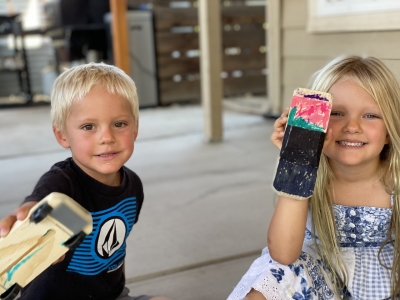 While the Pinewood Drag Races will not take place in person this year, SEMA members are still invited to help make a positive impact in young lives by purchasing and building a Pinewood Car to build at home.