| “This was our second year in a row on the SEMA Australia Business Development Program,” said Dan Voight (center), motorsport sales manager for QA1. “It really showed our commitment to our customers and the market there and further cemented the relationships we started on the first visit. The market information we gained would have been impossible without attending the conference. The traffic at the QA1 booth in the SEMA section of the MotorEX show was excellent. We carefully queried visitors on their brand awareness of QA1, and it showed a sharp increase over the previous year.” |
 | Ramon Barrios (left), international sales manager for Go Rhino, participated in the 2019 SEMA Australia trip for the manufacturer of products for Jeeps, trucks and SUVs. “As in the United States, Australians love to go off-roading and have plenty of land to do so in a country the size of the United States but with a population of under 25 million,” noted Barrios. “Thanks again to SEMA for the good show in Australia and the opportunity to allows us to explore new business in other continents. [We are pictured ] here with our new distributor in New Zealand.” |
 | Consul General Michael Kleine (right) of the U.S. Consulate in Melbourne visited the SEMA section and met with the SEMA companies. Here, he learned about RACE-GAS products from the company’s president and COO, Mark Link (center), and its CEO, Daniel Muldowney (left). Elizabeth Couch, International Economist Office of Transportation & Machinery/Automotive Team from the Department of Commerce’s headquarters and Duncan Archibald, Commercial Specialist U.S. Consulate General, Sydney, spent the week with the SEMA delegation meeting one-on-one with the U.S. companies and providing a briefing on the Australian market. |
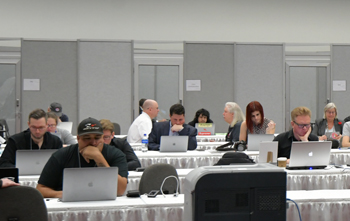
 Buyers visited the SEMA section at the MotorEx show. The 2019 SEMA Australia participants exhibited in turnkey booths during the two-day event, which was open to both trade and consumers. Buyers visited the SEMA section at the MotorEx show. The 2019 SEMA Australia participants exhibited in turnkey booths during the two-day event, which was open to both trade and consumers. |  Road Armor was represented in Australia by Chris Faustmann (second left), director of engineering, and Brandon Varn, (second right), director of Road Armor was represented in Australia by Chris Faustmann (second left), director of engineering, and Brandon Varn, (second right), director of
marketing.
|
 | Iowa-based Dee Zee Inc.—a manufacturer of running boards, toolboxes and step bars, among other products—has traveled to Australia with SEMA several times; this year represented by Jason Mrachina (center), vice president of sales. “The SEMA trip to Melbourne gave Dee Zee a unique opportunity to talk with a variety of customers at every stage of the distribution channel,” noted Mrachina. “While at the MotorEx Show, we were able to match with several viable jobber/distributors for the Australia market. It would be much more difficult, if not impossible, for us to make these connections on our own.” |
 | “As a company that has sold to Australia for many years, we took part in the SEMA Australia trip thinking we knew the market,” said Robert Scheid (right) director of business development for McLeod Racing LLC. “After our trip with SEMA, we realized that not only didn’t we know the current customers we had as well as we should, but we also didn’t have a grasp on the market at all. Now we have a firm game plan and have already opened new distribution directly resulting from our visit with SEMA. That is why we do these trips and recommend participation to any SEMA company wanting to export their products.” |
 | “The SEMA trip to Australia was once more a great success for Borla,” said Josh Abbott (center), global sales manager for Borla Performance Industries Inc. “This was our fourth time with the U.S. delegation, and the program exceeded our expectations every year. There is certainly a need in the marketplace for high-quality, genuine U.S.-made products. Despite the fact that there is no car manufacturing in Australia anymore, the country’s automotive aftermarket parts distribution is witnessing steady growth. Australia is hosting some of the leading aftermarket manufacturers and original equipment suppliers, which are continuously on the lookout for establishing their mark in the region’s aftermarket space. The market is in the mature stage of its cycle, where revenue growth has been plateauing. There are great opportunities for those who are willing to invest money and time to learn about the market and approach it with an open mind. We will most definitely participating in the SEMA trip again next time.” |
 | “SEMA’s international trade programs provide distributors and manufacturers with excellent opportunities to engage with industry professionals and enthusiasts in markets such as Australia and around the world,” said Darren Lane (left), export sales manager for Motor State Distributing. “That allows companies like ours to have real face-to-face interactions with current and potential customers that we might otherwise never meet.” |
 | Each participating SEMA company exhibited at the MotorEx show and visited leading specialty-equipment shops in the Melbourne area. Networking events and panel discussions with top trade buyers and U.S. government officials rounded out the schedule. Pictured is Jay Crouch (left), director of global business development for Injen Technology. |
 | “Professional, profitable and enjoyable are three words I would use to describe the SEMA Australian showcase,” said James McMullan (left), operations manager for Kelford Cams. “This extremely well-organized event not only gave me the chance to be face-to-face with the right types of new clients but also to catch up with old friends. I gained valuable insights into the Australian market but also gathered new contacts, alliances and friendships with genuinely passionate industry innovators. If you are considering attending one of the SEMA showcases like this one, I would recommend just doing it. Victory loves preparation, and the SEMA team definintely put the hard work in and set us up to succeed.” |
 | Dave Beecham (left), OBD Solutions director of business development, and Thomas Myroniak (second left), director of marketing, talked with buyers interested in learning more about the company’s board diagnostics tools. The company traveled with SEMA for the first time in 2019, participating in the March SEMA Middle East trip in Abu Dhabi before joining the delegation to Australia in May. “Our participation in the Australia and MotorEx Show allowed us to connect with key performance and off-road buyers in the region, as well as learn about market-specific needs, challenges and expectations,” said Myroniak. “Like the other SEMA international events, this program helped us uncover opportunities and build relationships we would not have on our own.” |
 | “Considering that this was our second trip to Australia and the MotorEx show, we had an idea of what to expect and were able to focus on solidifying our relationships with the local businesses to promote future sales,” said Yury Lyalko (left), president of Wiring Specialties LLC, who attended the event with Vadim Belegorodsky (second left), the company’s vice president of product development. “Once again, the SEMA international team did a phenomenal job of organizing meetings with pre-qualified buyers, shop trips and introductions that help bridge the gap between the U.S. companies and Australian buyers. Bringing the SEMA name to the trade table helps establish the credibility behind the companies involved on both sides. That arrangement simply does not exist outside the events Linda Spencer and her team put together. I hope we can continue to grow our presence in Australia and other world markets through these international events in years to come.” |
 | Consul General Michael Kleine (right) of the U.S. Consulate in Melbourne visited the SEMA section and met with the SEMA companies. Here, he learned about RACE-GAS products from the company’s president and COO, Mark Link (center), and its CEO, Daniel Muldowney (left). Elizabeth Couch, International Economist Office of Transportation & Machinery/Automotive Team from the Department of Commerce’s headquarters and Duncan Archibald, Commercial Specialist U.S. Consulate General, Sydney, spent the week with the SEMA delegation meeting one-on-one with the U.S. companies and providing a briefing on the Australian market. |
 | The SEMA Business Development Program provides an opportunity for companies to travel to the market for the first time and have the ability to concentrate on developing or growing their buyer network. SEMA arranges the opportunity for participating companies to meet with pre-vetted trade buyers in both the show and in more informal settings. SEMA also handles hotel arrangements and meals, panel discussions and tours of installers, distributors and retailers—allowing U.S. firms to focus on developing business. Louis Floquet (center) and Vernon Dinkel (right) attended the event on behalf of Crower Cams. It was the company’s first overseas trip to Australia. |
 | Edward Hamburger (left) president of Specialty Vehicle Engineering Inc./DBA Hamburger’s Superchargers Inc., met with buyers at the event. “Exhibiting with SEMA at MotorEx in Australia was instrumental for Hamburgers Superchargers to open new vendor channels in a unique market,” said David Hamburger (second left), the company’s vice president. “I strongly recommend that all SEMA members who want to grow their businesses take a look at SEMA’s international programs. |
 | Dynocom was one of 17 companies exhibiting in this year’s SEMA section in turnkey booths at the Melbourne-based MotorEx show. Vice President of Export Sales Andy Lamus (center) met with buyers. “The Australian trip for Dynocom was an incredible experience,” said Lamus. “We were able to get a good understanding of the local market—both by visiting specific shops around the Melbourne area and the interaction with visitors to our booth at the MotorEx show, which resulted in sales down under for us and a new opportunity for the growth of our company. Thanks, SEMA!” |
 | SEMA Immediate Past Chairman/Secretary of the Board of Directors Wade Kawasaki (right) spoke with a retailer/installer of specialty-equipment products for Jeep Wranglers. “I always look forward to visiting Australia—especially when it involves growing the global footprint of the automotive aftermarket,” Kawasaki said. “This is the fourth SEMA Australia Business Development Program, and our mission is to bring SEMA-member manufacturers together with passionate buyers from the region to develop relationships and explore a growing market that is full of enthusiasm for hot rods, racing, off-roading and all things automotive.” |
 | SEMA CEO and President Chris Kersting (left) and SEMA Chairman of the Board Tim Martin (right), chatted with Dee Zee’s Mrachina during the SEMA Australia trip. “Australia has proven to be a desirable country for the automotive aftermarket,“ observed Kersting. “With nearly 20 companies participating in our fourth trip to Australia, members exhibited at the region’s leading industry show and met with new buyers. We’re pleased to see members expanding their markets in a country that provides our industry with such great opportunities.“ |
| To take advantage of the array of resources and programs that can assist SEMA members in growing their global sales, including upcoming trips and the international vehicle measuring program, contact Linda Spencer at lindas@sema.org. |