Compiled by SEMA Editors
Craig Scanlon Named New Transamerican Auto Parts President
Polaris Industries Inc. announced that Craig Scanlon has been named president of Transamerican Auto Parts (TAP). Scanlon will succeed Greg Adler, who is assuming a new role as executive vice chairman for TAP. Scanlon and Adler will both report to Steve Eastman, president of Aftermarket, Parts, Garments and Accessories for Polaris.
“For more than 50 years, TAP has led the 4x4 Jeep and truck aftermarket thanks to the vision, leadership and passion of the Adler family. As executive vice chairman, Greg’s extensive industry knowledge, strategic insight and strong relationships will continue to play a critical role in supporting the long-term success of the business,” said Eastman. “I have full confidence that TAP’s market leadership will continue to grow and flourish with Craig at the helm. Craig has an exceptional track record as a proven leader whose clear, strategic vision has been instrumental in helping to shape and grow Polaris’ largest business segment. His dedication and passion, combined with his experience building brands and delivering results, makes him well equipped to accelerate growth and drive long-term success for TAP and Polaris.”
An experienced leader in the powersports industry, Scanlon most recently served as vice president and chief retail and marketing officer for off-road vehicles (ORV) at Polaris. During his 14 years at Polaris, Scanlon has held positions of increasing responsibility in marketing, sales and general management supporting both the ORV and Slingshot businesses. Prior to his roles at Polaris, Scanlon held various sales and accounting roles at Ingersoll Rand.
In his new role as executive vice chairman, Adler will be responsible for supporting long-range strategy, pursuing inorganic growth opportunities through TAP’s strategic acquisition framework, and serving as a TAP brand ambassador. Adler joined TAP in 1994 and served in various areas of the business before being named TAP’s president and CEO in 2005.
Discovery Inc. Announces Rebrand of Its Auto Enthusiast Joint Venture to Motor Trend Group; Velocity Channel in U.S. Also Renamed Motor Trend Network
Discovery Inc. has announced that its auto-related consolidated joint venture, previously called The Enthusiast Network, will now become Motor Trend Group, effective immediately. As part of this rebrand, Velocity will also be rebranded Motor Trend Network in fall 2018. The JV’s Motor Trend OnDemand digital product will continue to be available to consumers on mobile and connected devices as the Motor Trend app, and available online at Motortrend.com.
“No other global media company has the content, and both the TV and digital platforms, to deliver what auto enthusiasts want than Discovery,” said Michael Lang, CEO of Motor Trend Group and president, digital, Discovery Networks International & Eurosport Digital. “This rebrand of our JV into one, over-arching single brand, Motor Trend, continues Discovery’s long-term digital ambition; underscores our commitment to serve passionate global auto-related superfans with the world-class content they crave; and provides OEMs, buyers and advertisers with an unparalleled one-stop, 360-degree branded environment to reach this coveted audience segment across all screens and platforms.”
Motor Trend Group will now afford advertisers the ability to buy multiple verticals together, including digital and linear, creating a multiplatform 360-degree advertising offering. Fans can still watch their favorite series, including “Wheeler Dealers,” “Bitchin’ Rides,” “Barrett-Jackson Live,” “Fantomworks,” “Speed Is the New Black,” “Iron Resurrection,” “Garage Squad,” “Texas Metal” and more, in addition to new, original automotive programming on Motor Trend Network and stream on the Motor Trend app and Motortrend.com.
Via Motortrend.com and the Motor Trend app, fans can watch these same Motor Trend Network and Discovery Channel motor series, such as “Overhaulin’,” “Graveyard Carz,” “Fast N’ Loud” and “Street Outlaws,” as well as their favorite Motor Trend originals, such as “Roadkill,” “Head2Head,” “Junkyard Gold,” “Dirt Everyday” and more. Discovery’s first direct-to-consumer auto digital product in the United States will also feature exclusive digital programming, both short- and long-form, along with the “New Car Buyers Guide” and live coverage of major auto events, such as Barrett-Jackson. The Motor Trend app is available across millions of connected devices via IOS/Apple TV, Google Play, Roku, Xbox, Chromecast and Amazon platforms.
Motor Trend will launch a free-to-air digital terrestrial TV channel in Italy later this month, providing Italian audiences with new, original content. Last December, the Motor Trend app launched on Amazon Channels in the United Kingdom, offering hundreds of hours of content. Both of these markets are planned for future roll-out of the direct-to-consumer Motor Trend app, with more markets globally planned starting late 2018.
Discovery’s joint venture partner is GoldenTree Asset Management LP, with Motor Trend Group being a portfolio company for them.
Brian Merz |
|
Lubrication Specialties Inc. Names Brian Merz Director of National Account Sales
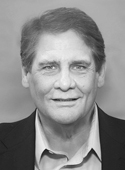
Lubrication Specialties Inc. (LSI) has announced the addition of Brian Merz as the company’s director of national account sales. Merz previously served as senior key account manager for Idemitsu Lubricants America, in Cleveland, Ohio, prior to joining LSI. With two decades of experience in strategic planning, new business development and sales management, he has worked for some of the largest companies in the lubrication industry, including Shell Oil Products and Penzoil-Quaker State Co., both as the senior national account manager. Prior to his position with Idemitsu, he served as the senior national accounts manager for ITW Global Brands in Cleveland. There, he managed several of the company’s largest customers, including AutoZone and Target for the automotive and mass retailer channel, as well as managed five independent sales rep agencies covering territory in the southeastern, northeastern and midwestern United States. The position became effective March 5. Merz reports directly to LSI President Chris Gabrelcik and will work remotely from Cleveland.
Power Automedia Expands Editorial Department; Shawn Brereton Promoted to Editorial Director
Power Automedia has announced recent growth to its editorial department. With Power Automedia’s acquisition of Xceleration Media and its corresponding titles, Shawn Brereton, an avid hot-rod enthusiast and automotive journalist, has joined the team as editorial director. Brereton will oversee several Power Automedia digital magazines, including Street Muscle, OneDirt, Chevy Hardcore, Turnology and Rod Authority. Elizabeth Puckett joins the team as senior associate editor of Power & Performance. Power Automedia’s newly re-acquired dirt-track-racing magazine, OneDirt, will be lead by Group Editor Bobby Kimbrough. The new editor of Rod Authority will be Corvette Online editor Dave Cruikshank.
Brake Parts Inc. Announces Leadership Changes
Brake Parts Inc. (BPI) has announced that Patrick Keane, vice president of global distribution and Dave Sather, vice president of global sourcing, will retire at the end of the second quarter. Al Biemer will take on an expanded role in the company as vice president of supply chain, and Chris Mapes has joined BPI as vice president of global sourcing. Prior to joining BPI, Mapes spent more than 20 years leading supply chain and operations teams. He began his career at Navistar and held similar roles with Behr GMbH and Dover Corporation. Most recently, Mapes served as chief procurement officer at Xylem Inc.
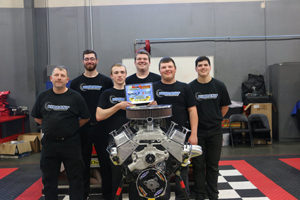
Team Vibrant Performance from Burton Center for Arts & Tech in Salem, Virginia, finished in first place overall with a time of 19:17. |
|
7 Hot Rodders of Tomorrow Teams Qualify at UTI/NASCAR Technical Institute
The Hot Rodders of Tomorrow Engine Challenge’s fifth event of the season was held at the NASCAR Technical Institute in Mooresville, North Carolina, March 31, where a total of four schools from Georgia and Virginia fielding 11 teams competed, with seven new teams advancing to the 2018 Dual National Championship Playoffs, where they will have a chance to win thousands of dollars in college scholarships at the SEMA Show and PRI Trade Show. To qualify for the Dual National Championship, a team must finish disassembling and reassembling a small-block Chevrolet engine in less than 33 minutes, including penalties. The first-place team overall was Team Vibrant Performance from Burton Center for Arts & Tech in Salem, Virginia, with a time of 19:17. Forsyth Central High School from Cumming, Georgia, fielded six teams total, with five qualifying for the playoffs and the sixth just missing out by 50 seconds. Team RHS Heads placed second with a time of 21:18, and Team Allstar Performance placed third at 24:57. Teams Moroso, Scat and McLeod Racing all qualified with times of 26:31, 31:20 and 32:42 respectively. Team MagnaFlow from Burton Center for Arts & Tech #3 qualified with a 26:04 time. Americus Sumter High School from Americus, Georgia, fielded two teams and has one going to the playoffs—Team Aeromotive clocking in with a 32:35 time. For more information, visit www.hotroddersoftomorrow.com.
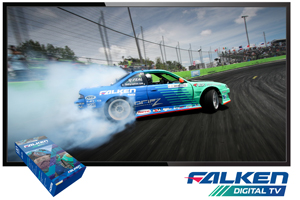
Falken Tires is launching an all-new programming network called “Falken Digital TV” this month. |
|
Falken Tires Set to Launch Falken Digital TV for Screening at Select Tire Retailers
In an effort to further support its dealers and nationwide retail base, Falken Tires is launching an all-new programming network called “Falken Digital TV” this month. It will feature “adrenaline-fueled content” from top networks, and original videos supplied directly from Falken’s on- and off-road racing teams in action. Falken Digital TV will also include programs featuring product overviews and training and general automotive shows and news of interest for dealer personnel and retail consumers. Each morning, during the automotive news and training hour, a feature segment called “Falken Tire Tech” hosted by Falken Product Training Supervisor Bakari Howard will offer relevant information that educates both dealers and retail customers.
Clearlake Capital Acquires Wheel Pros
Clearlake Capital Group L.P. has announced that it has acquired Wheel Pros Holdings LLC in partnership with the company’s management team. Financial terms of the transaction were not disclosed. Founded in 1995, Wheel Pros serves more than 10,000 retailers with a growing global network of 33 distribution centers spanning North America and Australia. The company has a portfolio of 12 proprietary brands with more than 300 custom wheel styles.
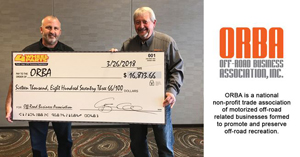
4 Wheel Parts presented a donation of $16,873 to the Off Road Business Association (ORBA) last week. |
|
4 Wheel Parts “Round-Up” Program Raises More Than $16,000 for ORBA
4 Wheel Parts presented a donation of $16,873 to the Off Road Business Association (ORBA) last week at an ORBA board meeting during Easter Jeep Safari week in Moab, Utah. The donation came as part of the 4 Wheel Parts “Round-Up” fundraising initiative, where 4 Wheel Parts customers were encouraged to “round-up” to the next dollar at checkout with proceeds benefiting ORBA.
Tenneco to Acquire Federal-Mogul
Tenneco has announced that it has signed a definitive agreement to acquire Federal-Mogul for a total consideration of $5.4 billion to be funded through cash, Tenneco equity and assumption of debt. Tenneco also announced its intention to separate the combined businesses into two independent, publicly traded companies through a tax-free spin-off to shareholders that will establish an aftermarket and ride performance company and a powertrain technology company. The acquisition is expected to close in the second half of 2018, subject to regulatory and shareholder approvals and other customary closing conditions, with the separation occurring in the second half of 2019.
Rydeen Mobile Unveils New Website
Rydeen Mobile Electronics has unveiled a new website designed for enhanced navigatability and mobility. Rydeen’s new website emphasizes Advanced Driver Assistance Systems (ADAS), and features Rydeen’s new products for 2018.
Ranch Hand Investing $2 Million in Shiner and Beeville Manufacturing Facilities
Ranch Hand Truck Accessories is investing another $1.25 million in its manufacturing facilities in Shiner and Beeville, Texas. This brings capital investment for the past 12 months to more than $2 million. In addition, Ranch Hand has hired more than 50 employees since the beginning of 2018 and is offering signing bonuses to welders.
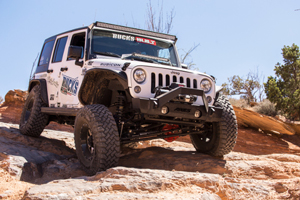
In association with Rebuilding Generations, Team ARIES Pro Builder Bucks 4x4 built a custom off-road ’18 Jeep Wrangler JK Rubicon for the Easter Jeep Safari in Moab, Utah. |
|
Team ARIES Builds Custom Off-Road Jeep for Easter Jeep Safari
ARIES and Team ARIES Pro Builder Bucks 4x4 embarked on another adventure at the recent Easter Jeep Safari in Moab, Utah, sponsored by the Red Rock 4-Wheelers Club. This year marked the 52nd anniversary of the event, and for the occasion, a special Jeep build was completed by Team ARIES Pro Builder Bucks 4x4, in association with Rebuilding Generations, a Team ARIES ambassador. The team collaborated to build a custom off-road ’18 Jeep Wrangler JK Rubicon. Some of the parts that went into the build included BDS Suspension, a WARN winch, Gear Alloy wheels, Falken tires and an Up Down air system. ARIES’ own contribution to the EJS build included its all-new ActionTrac powered running boards, TrailCrusher Jeep bumpers for the front and rear, aluminum fender flares and fender liners, LED lights and roof/hood mounting brackets and a heavy-duty spare tire carrier. Watch a video of Team ARIES at the 2018 Easter Jeep Safari.

David Barbeau |
|
David Barbeau Rejoins Hart Marx Advisors
David Barbeau, an aftermarket business expert, has rejoined Hart Marx Advisors as a vice president and member of the advisory board. Barbeau will contribute to the firm his extensive aftermarket knowledge, ranging from Tier 1 supply to parts distribution and business consulting. Barbeau was responsible for brand growth and increased penetration on a global level for both Tier 1 suppliers Delphi Technologies and TI Automotive. He also co-founded a successful automotive-parts distribution company, which later became part of Advance Auto Parts. In addition to providing his services to major names in the aftermarket industry, Barbeau is a consultant for businesses in the aftermarket as Barbeau Consulting LLC, with a focus on the China aftermarket, in which he has extensive experience. In addition to Barbeau, the Advisory Board includes the following aftermarket leaders: Chip Carlson, John Dehne, Howard Kesten, Lou Merz, Rick Rollins and Denise Rondini.

Samantha Young |
|
Marx Group Promotes Samantha Young to Associate Creative Director and Digital Marketing Manager
Marx Group has promoted Samantha Young to associate creative director and digital marketing manager. Young joined Marx Group in 2015; she previously held the position of marketing manager and designer. In 2016, she led a complete redesign of the Marx Group brand and guided all of the agency’s external marketing. Young has been critical in leading the design of brand elements and designing websites for several of the company’s OE and aftermarket clients since joining Marx Group. In her new role, Young will continue to lead marketing initiatives for Marx Group and its clients, with an increased focus on SEO, SEM and UI design and web development, while taking an expanded leadership role in design for advertising, branding and content development.
Holley Now a Master Distributor of SPAL Fans
Holley/MSD has announced that Holley is now a master distributor of SPAL fans.
Have some company news you would like to share? Let us know and the news may appear in an upcoming issue of SEMA eNews. Send your items for consideration to editors@sema.org.