Compiled by SEMA Editors
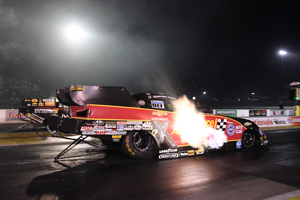
Courtney Force captured her first career back-to-back Funny Car victories last Monday afternoon at the 30th annual Menards NHRA Heartland Nationals presented by Minties at Heartland Motorsports Park. |
|
C. Force, Millican and Kramer Victorious at Menards Heartland NHRA Nationals
Courtney Force captured her first career back-to-back Funny Car victories last Monday afternoon at the 30th annual Menards NHRA Heartland Nationals presented by Minties at Heartland Motorsports Park. Clay Millican (Top Fuel) and Deric Kramer (Pro Stock) were also victorious in their respective categories at the eighth of 24 events on the Mello Yello Drag Racing Series schedule. All three drivers were the No. 1 qualifiers at the event. Force powered her Advance Auto Parts Chevrolet Camaro to a pass of 3.928 seconds at 329.83 mph to defeat defending world champion and teammate Robert Hight in the final round. She was the No. 1 qualifier for the event. Millican clinched his second career national event title after he piloted his Strutmasters/Great Clips dragster to a 3.727 at 332.59 pass to defeat Terry McMillen in the finals. In Pro Stock, Kramer drove to his first career victory in his American Ethanol Chevrolet Camaro with a pass of 6.615 at 209.36 to defeat two-time world champion Erica Enders in the final round. The Mello Yello Drag Racing Series continues May 31–June 3 at the JEGS Route 66 NHRA Nationals at Route 66 Raceway in Joliet, Illinois.
Wayland Campbell Wins 2018 MetalCloak Stampede
Wayland Campbell, the 2017 Nitto National ULTRA4 Champion, once again proved he is the driver to beat at last weekend’s MetalCloak Stampede. In the ULTRA4 4400 main event on Saturday, Campbell won his morning heat earning him a spot in the front row. He established a lead early and spent the remainder of the race with Levi Shirley and Cody Addington (in his newly acquired Red Dragon) in hot pursuit. In the last lap of the main, all three drivers were nose-to-tail with Addington going for the pass on Shirley to claim the second position, and Shirley rounding out the podium in third. In the 4800 G2 Legends race, Jason Bunch claimed the checkered, with David Hartman and Matthew Young claiming second and third respectively on a race weekend that saw the largest 4800 class race outside of King of The Hammers. In the 4500 Rubicon Express Modified class, Dave Schneider earned top spot with Justin Hall less than 1.5 seconds behind him. For the 4600 Pro Comp stock class, Dawson Allington and Josh Atteberry took the first and second spots respectively with Brian Behrend claiming the third podium position. In the Can-Am 4900 UTV Race, Phil Burton’s 944 car earned the top spot with a substitute driver, followed closely by Cole Clark and Jacob Versey claiming second and third respectively in the largest UTV class to date at an ULTRA4 Regional Event. New for 2018 is the Fab School Manufacturers Cup, which is a competition between chassis builders. Each chassis builder can have between three and five drivers compete in the cup. Currently, Miller Motorsports is leading with 46 points with Campbell Enterprises in close second with 43 points, and Jimmy’s 4x4 currently has 27 points after the first three races. The next race in the 2018 ULTRA4 Nitto National Championship series will be the Holley EFI Clash at the Cross Bar Ranch in Davis, Oklahoma, June 15–16.
The next stop on the NMCA E3 Spark Plugs Drag Racing tour is the 13th Annual Nitto Tire NMRA/NMCA Super Bowl of Street-Legal Drag Racing at Route 66 Raceway in Joliet, Illinois, July 27–29. |
|
Race Wrap: 17th Annual NMCA Quick Fuel Technologies Bluegrass Nationals
The 17th Annual NMCA Quick Fuel Technologies Bluegrass Nationals presented by Scoggin-Dickey Parts Center featuring the Chevrolet Performance Challenge Series took place at Beech Bend Raceway Park in Bowling Green, Kentucky, May 18–20.
VP Racing Fuels Xtreme Pro Mod: Jackie Slone Jr. and his nitrous-oxide-injected ’69 Camaro went up against the twin–turbo ’15 Corvette of number-two qualifier Don Walsh Jr, and ran 3.819 at 199.88 mph to surpass Walsh’s 3.989 at 167.03.
Mickey Thompson Radial Wars: Marty Stinnett in his Garrett-turbocharged Fox-body Mustang had James Lawrence at the start, but had to get out of the throttle right after the hit and left the door wide open for Lawrence’s determination to be rewarded with a win going 4.056 at 188.52 mph to make it official.
Vortech Superchargers Street Outlaw: Daniel Pharris in his boosted ’95 Mustang got the holeshot advantage and never trailed as he crossed the stripe ahead of Shawn Ayers with a 4.353 at 175.98 mph to take the win.
Holley EFI Factory Super Cars: Scott Libersher in his ’15 COPO Camaro outran Chuck Watson II with a nice holeshot and a quicker 8.146 at 168.56 mph trip against Watson’s 8.364 at 165.66 mph foray.
ARP Nitrous Pro Street: Matt Salminen in his ’69 Camaro defeated Tricia Musi in her ’00 Pontiac Firebird when he crossed the beams in front and tripped the clocks in 4.676 seconds at 143.84 mph.
ARP NA 10.5: Dwight Ausmus took home the victory over David Theisen with an 8.148 at 168.24 mph trip.
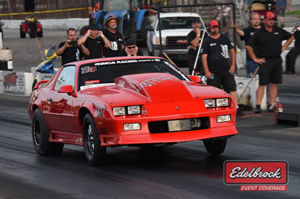
Edelbrock Xtreme Street: Jessie Coulter, in his turbocharged ’91 Camaro, took five round wins in a row, sending number-four qualifier Nick McGrath packing by a big margin in the finals.
Coan Engineering Stock/Super Stock: Ricky Pennington took a trip to the Aerospace Components Winner’s Circle with his ’71 Nova after a double break-out situation put Scott Libersher in the runner-up spot.
ATI Performance Products Nostalgia Super Stock: Doug Wright with his ’64 Belvedere took on Tom Hoffman with his ’63 Plymouth. Hoffman had Wright on the tree, but Wright reeled him in with a top-end charge, and although it was a double-breakout situation, Wright was awarded the win.
Detroit True Trac Nostalgia Muscle Car: Ken Weilbrenner and his ’70 Chevelle brought home the big win with a 0.006-second reaction time and a 9.771 at 129.07 mph run on a 9.75 dial-in over Audrey Baize at the end of eliminations.
MagnaFuel Open Comp: William Jones and his ’68 Falcon defeated Kurt Anderson.
Dave Duell Nostalgia Super Stock: Winning the quick 9-second FX category was Doug Wright as he ran 9.246 at 144.46 mph over runner-up Jeffrey Frees. In the A-group for 10-second cars, Randy Stansbury was successful going 11.135 at 93.28 mph to Justin Geary’s 11.395 at 119.85 mph runner-up effort. In the 11-second B-group, Shawn Johnston ran almost dead-on the money with a winning 11.005 at 121.88 mph hit to defeat Brent Wheeler in the finals. Last, but not least, in the 12- and 13-second C-group, winner Butch Cassary put Al Wilson on the trailer.
Gear Vendors True Street: Running a 7.861-second overall average was Jeff Knox, and he was awarded the top honors as a result. In the runner-up spot was Troy Eaton on an 8.487-second average, while Casey Flora won the 10-second category with a 10.192-second average. For the 11-second group, John Combs was named the winner while Chris Cowles took the title for the 12-second group and Matt Johnson rounded things out with his win in the 13-second section.
Chevrolet Performance Street Car Challenge: Jeff Brady had the quickest Chevy of all, as his ’10 Camaro SS averaged 10.043-second through three passes to take the win outright. Hot on his heels with an 11.105-second average was Kevin Rowand and his ’08 Corvette. Brandon Cardwell won the 11-second average, Dennis Pett won the 12-second title and Jeremy Britt went home victorious in the 13-second group.
Dodge/Mopar Hemi Shootout: Steve Best’s ’18 Dodge Demon was the only car in the 10-second zone and averaged 10.442-seconds in the quarter-mile for the big win. J Orrand’s ’16 Hellcat was crowned the runner-up as it averaged 11.209-seconds, Jenny McClain went home a winner for the 11-second bunch, Trenton Smith won the 12-second honors, Travis McKenne won for the 13-second drivers, Michael Oellrich walked away on top for the 14-second group and Don Fielder finished the weekend on a high note in the 15-second pack.
True Street Bracket 3: The final round paired Chris Cowles in his Chevy Nova on a 12.12 dial-in against Dietrich Bollinger in his Chevy Camaro on a 10.48 dial. When the final numbers were posted on the scoreboard, it was Cowles who got the win light.
The next stop on the NMCA E3 Spark Plugs Drag Racing tour is the 13th Annual Nitto Tire NMRA/NMCA Super Bowl of Street-Legal Drag Racing at Route 66 Raceway in Joliet, Illinois, July 27–29.
General Tire Drivers Polvoorde, Beat Come Up Big in LOORRS Double-Header in Mexico
Christopher Polvoorde earned his first career Lucas Oil Off Road Racing Series (LOORRS) victory in a breakout performance at Estero Beach Resort in Ensenada, Baja California, Mexico, last Saturday afternoon. He won again last Sunday when the series raced for the third time in 2018. Ryan Beat, who claimed the win in the first LOORRS race of the 2018 season, earned podium finishes in both races, finishing third on Saturday and second on Sunday. Beat currently leads the point standings.
For more racing news, visit Performance Racing Industry’s (PRI) website.