A SEMA-supported bill has been introduced in the U.S. Congress that will cap the yearly amount of ethanol to be blended into transportation fuel at 9.7%. The Food and Fuel Consumer Protection Act of 2016 (H.R. 5180) would replace ever-increasing ethanol mandates under the current Renewable Fuel Standard (RFS). The U.S. Environmental Protection Agency (EPA) is relying on expanded sales of E15 (gas that contains 15% ethanol) to meet the expanding RFS targets.
Ethanol, especially in higher concentrations such as E15, can cause metal corrosion and dissolve certain plastics and rubbers in automobiles produced before 2001 that were not constructed with ethanol-resistant materials. SEMA has joined with more than 50 other organizations from the auto/boat industries to the food, energy and environmental community to support passage of the legislation.
For more information, contact Eric Snyder at erics@sema.org.
A SEMA-supported bill has been introduced in the U.S. Congress that will cap the yearly amount of ethanol to be blended into transportation fuel at 9.7%. The Food and Fuel Consumer Protection Act of 2016 (H.R. 5180) would replace ever-increasing ethanol mandates under the current Renewable Fuel Standard (RFS). The U.S. Environmental Protection Agency (EPA) is relying on expanded sales of E15 (gas that contains 15% ethanol) to meet the expanding RFS targets.
Ethanol, especially in higher concentrations such as E15, can cause metal corrosion and dissolve certain plastics and rubbers in automobiles produced before 2001 that were not constructed with ethanol-resistant materials. SEMA has joined with more than 50 other organizations from the auto/boat industries to the food, energy and environmental community to support passage of the legislation.
For more information, contact Eric Snyder at erics@sema.org.
The Occupational Safety and Health Administration (OSHA) requires most companies with 10 or more employees to keep a record of worker injuries and illnesses. The employer has typically kept the information for private reference, but OSHA will now require most larger companies to submit the data electronically to OSHA for posting on the agency’s website. The new rule applies to establishments with 250 or more employees in industries that are already required to keep work-related injury and illness records. It also applies to auto-parts manufacturers, distributors and retailers with 20 to 249 workers. OSHA estimates the rule will impact 476,000 businesses. The rule becomes effective on August 16, 2016, and will be phased-in over two years.
For more information, contact Stuart Gosswein at stuartg@sema.org.
The Occupational Safety and Health Administration (OSHA) requires most companies with 10 or more employees to keep a record of worker injuries and illnesses. The employer has typically kept the information for private reference, but OSHA will now require most larger companies to submit the data electronically to OSHA for posting on the agency’s website. The new rule applies to establishments with 250 or more employees in industries that are already required to keep work-related injury and illness records. It also applies to auto-parts manufacturers, distributors and retailers with 20 to 249 workers. OSHA estimates the rule will impact 476,000 businesses. The rule becomes effective on August 16, 2016, and will be phased-in over two years.
For more information, contact Stuart Gosswein at stuartg@sema.org.
The Occupational Safety and Health Administration (OSHA) requires most companies with 10 or more employees to keep a record of worker injuries and illnesses. The employer has typically kept the information for private reference, but OSHA will now require most larger companies to submit the data electronically to OSHA for posting on the agency’s website. The new rule applies to establishments with 250 or more employees in industries that are already required to keep work-related injury and illness records. It also applies to auto-parts manufacturers, distributors and retailers with 20 to 249 workers. OSHA estimates the rule will impact 476,000 businesses. The rule becomes effective on August 16, 2016, and will be phased-in over two years.
For more information, contact Stuart Gosswein at stuartg@sema.org.
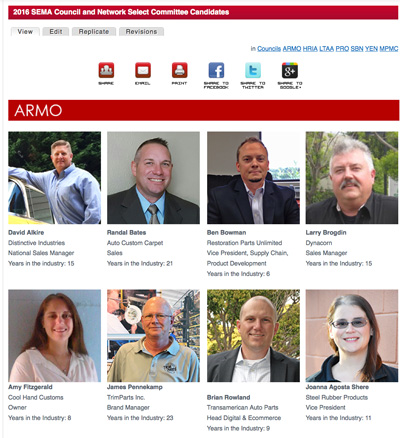
SEMA’s councils and networks are holding elections for open positions on their select committees, where members serve as leaders for the specific automotive aftermarket segment which their council or network represents.
Through monthly, general membership and long-range planning meetings, select committee members identify the current issues the industry is facing and move SEMA resources toward solutions for the membership.
An open nomination period was held in March, where any individual member of a council or network could either be nominated by an industry associate or raise their hand to volunteer and self-nominate.
The slates have been finalized, and now council-member companies are being called upon to elect the industry’s future leaders. The election period closes June 3.
SEMA’s councils and networks are holding elections for open positions on their select committees, where members serve as leaders for the specific automotive aftermarket segment which their council or network represents.
Through monthly, general membership and long-range planning meetings, select committee members identify the current issues the industry is facing and move SEMA resources toward solutions for the membership.
An open nomination period was held in March, where any individual member of a council or network could either be nominated by an industry associate or raise their hand to volunteer and self-nominate.
The slates have been finalized, and now council-member companies are being called upon to elect the industry’s future leaders. The election period closes June 3.
SEMA invites industry professionals to its Town Hall Meeting in Lake Oswego, Oregon, where members and prospective members will gather at Yakima Products Inc. for an evening of tours, shop talk and networking with local industry leaders.
SEMA invites industry professionals to its General Membership and Town Hall Meeting in Lake Oswego, Oregon, where members and prospective members will gather at Yakima Products Inc., Thursday June 23, from 6:00 p.m.–9:00 p.m., for an evening of networking with local industry leaders and discussing the state of the industry.
SEMA's Town Hall Meetings provide both members and prospective members with the opportunity to learn about the association’s current programs and objectives while networking with automotive aftermarket professionals from the same geographic region. These personal interactions give members a chance to share the business challenges and opportunities they face. As SEMA staff interacts with attendees, they also gain valuable feedback, which helps identify how current benefits can enhance members’ business operations to better meet their needs.
“As a new member within SEMA, my experience at the Town Hall Meeting in St. Charles [Illinois] was certainly without regret. I found the topics discussed within the panel very informative. I was able to capture industry-related subjects that are worth discussing within the Mecum organization. Debra Fickler provided me knowledge that will allow me to make an intelligent decision as to which committee to join. Lastly, what an honor it was listening to the legendary Vic Edelbrock tell his story and how he has impacted the industry for so many years.”
—Christine Giovingo, Mecum Auctions
“Hosting the SEMA Town Hall was certainly one of the best events we’ve been involved with. As a warehouse distributor [WD], having the event at our facility allowed us to network with a cross-section of industry people that we normally wouldn’t have the opportunity to. They included customers, retailers, other WDs and manufacturers. The SEMA Town Hall is an asset to our industry. It gives everyone involved the opportunity to learn more about our industry and its members in an intimate setting.”
—Daryl Sampson, Turn 14 Distribution
SEMA has led Town Hall Meetings in several cities across the United States. Attend a Town Hall near you.
SEMA invites industry professionals to its Town Hall Meeting in Lake Oswego, Oregon, where members and prospective members will gather at Yakima Products Inc. for an evening of tours, shop talk and networking with local industry leaders.
SEMA invites industry professionals to its General Membership and Town Hall Meeting in Lake Oswego, Oregon, where members and prospective members will gather at Yakima Products Inc., Thursday June 23, from 6:00 p.m.–9:00 p.m., for an evening of networking with local industry leaders and discussing the state of the industry.
SEMA's Town Hall Meetings provide both members and prospective members with the opportunity to learn about the association’s current programs and objectives while networking with automotive aftermarket professionals from the same geographic region. These personal interactions give members a chance to share the business challenges and opportunities they face. As SEMA staff interacts with attendees, they also gain valuable feedback, which helps identify how current benefits can enhance members’ business operations to better meet their needs.
“As a new member within SEMA, my experience at the Town Hall Meeting in St. Charles [Illinois] was certainly without regret. I found the topics discussed within the panel very informative. I was able to capture industry-related subjects that are worth discussing within the Mecum organization. Debra Fickler provided me knowledge that will allow me to make an intelligent decision as to which committee to join. Lastly, what an honor it was listening to the legendary Vic Edelbrock tell his story and how he has impacted the industry for so many years.”
—Christine Giovingo, Mecum Auctions
“Hosting the SEMA Town Hall was certainly one of the best events we’ve been involved with. As a warehouse distributor [WD], having the event at our facility allowed us to network with a cross-section of industry people that we normally wouldn’t have the opportunity to. They included customers, retailers, other WDs and manufacturers. The SEMA Town Hall is an asset to our industry. It gives everyone involved the opportunity to learn more about our industry and its members in an intimate setting.”
—Daryl Sampson, Turn 14 Distribution
SEMA has led Town Hall Meetings in several cities across the United States. Attend a Town Hall near you.
The U.S. Department of Labor raised the minimum salary threshold required to qualify for the Fair Labor Standards Act’s “white-collar” exemption to $47,476 per year, effective December 1, 2016. Under the current rule, management, administrative and professional employees who currently earn a salary of more than $23,660 per year are exempt from receiving overtime pay when they work more than 40 hours a week. The rule will impact an estimated 4.2 million salaried workers.
For more information, contact Stuart Gosswein at stuartg@sema.org.