

At the recent Exhibitor Summit, SEMA’s Maurice O’Connell talked with exhibitors about utilizing the feature vehicle opportunity at the 2019 SEMA Show.
Wed, 07/03/2019 - 11:11
Wed, 07/03/2019 - 11:11
At the recent Exhibitor Summit, SEMA’s Maurice O’Connell talked with exhibitors about utilizing the feature vehicle opportunity at the 2019 SEMA Show.
Wed, 07/03/2019 - 09:58
https://www.eventbrite.com/e/2019-aston-martin-measuring-session-tickets-62722087452
Wed, 07/03/2019 - 09:58
https://www.eventbrite.com/e/2019-aston-martin-measuring-session-tickets-62722087452
Wed, 07/03/2019 - 09:58
https://www.eventbrite.com/e/2019-aston-martin-measuring-session-tickets-62722087452
Wed, 07/03/2019 - 09:49
By SEMA Editors
Chris Youngs Joins Neapco as National Sales Manager
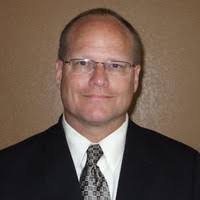 Chris Youngs Chris Youngs |
Neapco recently announced that it has named Chris Youngs as national sales manager for the company's aftermarket group. Youngs' aftermarket experience spans more than three decades, including positions in operations, logistics, and most recently as senior manager—aftermarket sales for Dana Inc. As national sales manager, Youngs will be responsible for the strategic leadership of Neapco’s aftermarket sales group in North America. He will focus on development and execution of sales strategies to bring added value to our customers in their respective markets.
ROXOR Sponsors Justin Moore’s Late Night & Longnecks Tour
ROXOR off-road vehicles announced that the company is the title sponsor for all 50+ shows of Justin Moore’s Late Night & Longnecks Tour, spanning North America, from June to October, 2019. The Valory Music Co. artist is combining two of his favorite passions with this new partnership: country music and rolling through the outdoors in style. For more information on the new ROXOR, visit www.roxoroffroad.com.
Aeromotive Celebrates 25 Years With Open House and Car Show
Aeromotive will host a special open house event to celebrate the company's 25 years Thursday, August 1, from 4:00-8:00 p.m. at the Aeromotive Inc. headquarters, 7805 Barton St. in Lenexa, Kansas. Attendees will enjoy appearances from famous racers and their cars (show up to find out who) and can shop the wares of local parts distributors and enjoy performances by local musician Gary Lincoln. The company will also host tours of their facility. The event will also feature a silent auction to and T-shirt sales benefit Parenting Children with Special Needs Inc., a 501(c)(3) organization dedicated to enhancing the quality of life of local families who have a child with challenges that are associated with a medical diagnosis.
Icahn Automotive Celebrates Final 2019 Technical School Partnership at Orlando Universal Technical Institute
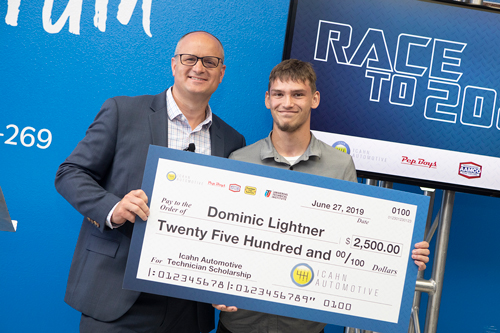 Dominic Lightner (right). Dominic Lightner (right). |
Icahn Automotive Group LLC announced the addition of Universal Technical Institute’s (UTI) Orlando campus to its Race to 2026 efforts, concluding the program’s technical school efforts for 2019. Launched earlier this year, the Race to 2026 initiative encourages more men and women to pursue viable careers in the skilled trades by partnering with technical training schools and offering scholarships and tuition reimbursement. In total, Icahn Automotive has partnered with six Universal Technical Institute and Lincoln Tech locations to reach students enrolled in automotive technology programs across the U.S.
In Orlando, Icahn Automotive, Pep Boys, and RPM leaders and technicians, and UTI administrators, instructors and students came together to unveil classroom designs that incorporated images of the well-known service brands, technicians hard at work and career maps that illustrate the many paths an automotive technician can take. The renovated areas included new furniture and equipment plus inspiring messages on the classroom walls including “Find the tools you need,” “Find your own path” and “Find out how far you can go.” To celebrate the partnerships, Dominic Lightner, an automotive technology student at the UTI in Orlando was presented with a $2,500 scholarship from Icahn Automotive. The event also included the Pep Boys Mobile crew service rig and mobile diagnostic vehicles, unique mobile repair and diagnostic vehicles that provides on-location services as well as a new, dynamic career opportunity for automotive service program graduates.
Bonnier Corp. to Create Auto Festival in Saudi Arabia
Bonnier Corp. announced that it will host an automotive festival featuring hundreds of leading brands in Riyadh, Saudi Arabia, November 21-26, 2019. The company is recruiting leading brands to participate in the event. The festival is part of “Riyadh Season,” which includes a two-month celebration that will feature a blend of consumer-facing specialty automotive displays, activities, and activations, along with trade-only education and networking events. As part of Vision 2030, the Kingdom of Saudi Arabia has embarked on a course to open the country to both new entertainment and business opportunities. Bonnier Corp. has been contracted by the General Entertainment Authority to help build one of the largest auto festivals in the region.
Have some company news you would like to share? Let us know and the news may appear in an upcoming issue of SEMA eNews. Send your items for consideration to editors@sema.org.
Mon, 07/01/2019 - 15:39
SEMA Member News—July 2019
New Directions: Trends in Restoration
Not many years ago, the term automotive restoration typically conjured images of vintage vehicles lovingly restored and brought back to life true to their original condition. Recently, modern technology and innovation have made inroads into the restoration marketplace, spawning a growing interest in restomods upfitted with modern-day modifications yet still retaining their classic look.
So what does this mean for the future of the restoration market? For insights into how this trend and other factors are influencing the restoration industry, SEMA Member News reached out to ARMO select committee members Tray Smith (council chair and president as well as CEO of H&H); Amy Fitzgerald (co-owner of Cool Hand Customs); and Keith Roberts (marketing manager for Distinctive Industries).
 |  |  |
| Tray Smith from H&H, IPC of ARMO | Amy Fitzgerald from Cool Hand Customs | Keith Roberts from Distinctive Industries |
SEMA Member News: Tell us about your involvement in the industry and your company.
Tray Smith: I have been involved in the automotive industry since I was born. I literally grew up in the industry. My father had a full-line auto service center and a full-line jobber parts store before he started H&H. I came back to H&H in 1995. We manufacture 400 items and offer more than 25,000 items. We cover restoration, restomods and custom parts for Tri-Fives, Chevy/GMC trucks, Impalas, Chevelles, Novas and Camaros.
Amy Fitzgerald: Cool Hand Customs is a two-person, full-service auto shop. We specialize in customizing, restoring and restomodifying pre-’80 vehicles. We do everything from the frame up—mechanical, wiring, motor, drivetrain, paint, interiors and so forth. We started our business in 2008. With a toddler at home and our house on the line, we closed our remodeling business and took out a small loan to start [the company] in our 400-sq.-ft. garage. Within 18 months, we purchased our current 4,000-sq.-ft. location.
Keith Roberts: I have worked in the industry for 20 years. I currently work at Distinctive Industries as the marketing manager/sales rep. We manufacture restoration interior products for ’60-and-later Ford and General Motors classic cars and trucks.
SMN: What trends are you seeing in the restoration market/hobby?
TS: We continue to see restomods as the dominant type of restoration being done. The purist is in the minority, for sure. As for types of cars or trucks being built, trucks are the top brand sellers for us, and ’73–’87 square-body trucks are quickly becoming a force in the market.
AF: Our customer base definitely leans toward the restomod build. We build vehicles that still have the old look and feel, but our customers want modern, more reliable and safe motors, drivetrain, lighting and electronic amenities. Our main customer demographic is men over 40. We have very few female customers unless they are spouses. I make a point of trying to bring the wives into the shop and get them involved. And many of them start to take a greater interest in the vehicle and even enjoy car shows more when they have gotten to be part of the process.
KR: The biggest change is the shift from a stock restoration interior to an upgraded stock-like interior. One of our better-performing product lines is our Touring II seats. They come assembled, bolstered and wrapped in restoration upholstery that mimics the stock upholstery and will match the rest of the interior. The seats bolt directly into the car and perform better than a factory seat. I would imagine that other companies in the restoration market have noticed a similar situation in their product offerings, as well. I feel that most restorers are looking for a product that gives a nod to the original stock design but uses modern technology to give you a better-performing product.
SMN: How do you see the restomod fitting into the restoration segment? When does it become a hot rod?
TR: Restomod is the force that is driving the market, so that has really blurred the lines between restoration and hot rod. In my mind, the restomod is more about upgrades to a car or truck that’s restored or being restored: brakes, gauges, A/C systems, maybe wheels. When you start talking about upgrading engines, suspension or airbags, I think it moves into the hot-rod world.
Something that is being left out is the custom car. Some people are going to say that’s in the same class as a hot rod. I disagree. Look at the custom cars that Ryan’s Rod and Custom is building, such as the Lincoln we had in the booth at the SEMA Show last year. That is a custom car—a throwback to the ’60s cars of Gene Winfield and Darryl Starbird—and guys like Chris Ryan are keeping that alive.
AF: My husband and business partner’s definition of a hot rod is a vehicle that’s modified for performance purposes only. He says that if it doesn’t make it go fast and look good, it doesn’t qualify as a hot rod.
When I think hot rod, I think of horsepower but more about custom. I define restomod as taking the old and retrofitting with the new. Restomod is the happy medium between restoration and customizing. Our customers want a daily driver they can drive anywhere and win a few awards at car shows. We have been pretty successful in that segment of the market.
KR: I think the lines between restoration and restomod are getting very blurred. I think a restomod is a form of restoration and has its place in the restoration industry beside a traditional restoration.
SMN: Do you see anything on the horizon that could be the next thing in restoration?
TS: The builders and market will keep pushing the envelope in restomods and hot-rod lines. There will always be the pure restoration with some cars that are unique and very rare. But builders will always look at what is the next thing that the OEMs are doing and how they can stuff it in a Chevelle, a Tri-Five, a truck or whatever they are building. We will start seeing hybrids and full-on electrics at some point in the future. I can’t say that I’m a fan of those, but there will be someone who will try it and build a show car. So I think you have to be tolerant and accepting of new ideas.
AF: I think the restoration segment will continue to grow and flourish. I hope to see the next generation of enthusiasts continuing to incorporate modern safety and performance components into the classics. That is where the market is going.
I also think vehicles that weren’t heavily sought-after—four-doors, wagons, etc.—will make a huge comeback. They are the bulk of what’s left in junkyards and hidden in barns. Regardless of the desire for a vehicle to perform like a modern vehicle, enthusiasts still want it to look and feel like a classic.
KR: With manufacturers offering products that can fit both restoration and restomods, I think this will continue to be a big debate in the restoration industry.
Mon, 07/01/2019 - 15:39
SEMA Member News—July 2019
New Directions: Trends in Restoration
Not many years ago, the term automotive restoration typically conjured images of vintage vehicles lovingly restored and brought back to life true to their original condition. Recently, modern technology and innovation have made inroads into the restoration marketplace, spawning a growing interest in restomods upfitted with modern-day modifications yet still retaining their classic look.
So what does this mean for the future of the restoration market? For insights into how this trend and other factors are influencing the restoration industry, SEMA Member News reached out to ARMO select committee members Tray Smith (council chair and president as well as CEO of H&H); Amy Fitzgerald (co-owner of Cool Hand Customs); and Keith Roberts (marketing manager for Distinctive Industries).
| | |
| Tray Smith from H&H, IPC of ARMO | Amy Fitzgerald from Cool Hand Customs | Keith Roberts from Distinctive Industries |
SEMA Member News: Tell us about your involvement in the industry and your company.
Tray Smith: I have been involved in the automotive industry since I was born. I literally grew up in the industry. My father had a full-line auto service center and a full-line jobber parts store before he started H&H. I came back to H&H in 1995. We manufacture 400 items and offer more than 25,000 items. We cover restoration, restomods and custom parts for Tri-Fives, Chevy/GMC trucks, Impalas, Chevelles, Novas and Camaros.
Amy Fitzgerald: Cool Hand Customs is a two-person, full-service auto shop. We specialize in customizing, restoring and restomodifying pre-’80 vehicles. We do everything from the frame up—mechanical, wiring, motor, drivetrain, paint, interiors and so forth. We started our business in 2008. With a toddler at home and our house on the line, we closed our remodeling business and took out a small loan to start [the company] in our 400-sq.-ft. garage. Within 18 months, we purchased our current 4,000-sq.-ft. location.
Keith Roberts: I have worked in the industry for 20 years. I currently work at Distinctive Industries as the marketing manager/sales rep. We manufacture restoration interior products for ’60-and-later Ford and General Motors classic cars and trucks.
SMN: What trends are you seeing in the restoration market/hobby?
TS: We continue to see restomods as the dominant type of restoration being done. The purist is in the minority, for sure. As for types of cars or trucks being built, trucks are the top brand sellers for us, and ’73–’87 square-body trucks are quickly becoming a force in the market.
AF: Our customer base definitely leans toward the restomod build. We build vehicles that still have the old look and feel, but our customers want modern, more reliable and safe motors, drivetrain, lighting and electronic amenities. Our main customer demographic is men over 40. We have very few female customers unless they are spouses. I make a point of trying to bring the wives into the shop and get them involved. And many of them start to take a greater interest in the vehicle and even enjoy car shows more when they have gotten to be part of the process.
KR: The biggest change is the shift from a stock restoration interior to an upgraded stock-like interior. One of our better-performing product lines is our Touring II seats. They come assembled, bolstered and wrapped in restoration upholstery that mimics the stock upholstery and will match the rest of the interior. The seats bolt directly into the car and perform better than a factory seat. I would imagine that other companies in the restoration market have noticed a similar situation in their product offerings, as well. I feel that most restorers are looking for a product that gives a nod to the original stock design but uses modern technology to give you a better-performing product.
SMN: How do you see the restomod fitting into the restoration segment? When does it become a hot rod?
TR: Restomod is the force that is driving the market, so that has really blurred the lines between restoration and hot rod. In my mind, the restomod is more about upgrades to a car or truck that’s restored or being restored: brakes, gauges, A/C systems, maybe wheels. When you start talking about upgrading engines, suspension or airbags, I think it moves into the hot-rod world.
Something that is being left out is the custom car. Some people are going to say that’s in the same class as a hot rod. I disagree. Look at the custom cars that Ryan’s Rod and Custom is building, such as the Lincoln we had in the booth at the SEMA Show last year. That is a custom car—a throwback to the ’60s cars of Gene Winfield and Darryl Starbird—and guys like Chris Ryan are keeping that alive.
AF: My husband and business partner’s definition of a hot rod is a vehicle that’s modified for performance purposes only. He says that if it doesn’t make it go fast and look good, it doesn’t qualify as a hot rod.
When I think hot rod, I think of horsepower but more about custom. I define restomod as taking the old and retrofitting with the new. Restomod is the happy medium between restoration and customizing. Our customers want a daily driver they can drive anywhere and win a few awards at car shows. We have been pretty successful in that segment of the market.
KR: I think the lines between restoration and restomod are getting very blurred. I think a restomod is a form of restoration and has its place in the restoration industry beside a traditional restoration.
SMN: Do you see anything on the horizon that could be the next thing in restoration?
TS: The builders and market will keep pushing the envelope in restomods and hot-rod lines. There will always be the pure restoration with some cars that are unique and very rare. But builders will always look at what is the next thing that the OEMs are doing and how they can stuff it in a Chevelle, a Tri-Five, a truck or whatever they are building. We will start seeing hybrids and full-on electrics at some point in the future. I can’t say that I’m a fan of those, but there will be someone who will try it and build a show car. So I think you have to be tolerant and accepting of new ideas.
AF: I think the restoration segment will continue to grow and flourish. I hope to see the next generation of enthusiasts continuing to incorporate modern safety and performance components into the classics. That is where the market is going.
I also think vehicles that weren’t heavily sought-after—four-doors, wagons, etc.—will make a huge comeback. They are the bulk of what’s left in junkyards and hidden in barns. Regardless of the desire for a vehicle to perform like a modern vehicle, enthusiasts still want it to look and feel like a classic.
KR: With manufacturers offering products that can fit both restoration and restomods, I think this will continue to be a big debate in the restoration industry.
Mon, 07/01/2019 - 15:35
SEMA Member News—July 2019
By Ellen McKoy
Reaping the Benefits of Member Resources
A quick search of the SEMA website (www.sema.org) reveals an abundance of member benefits covering a range of business resources and solutions. In fact, no matter a company’s membership category—manufacturer, distributor, manufacturers’ rep, retailer or installer—there are tools and resources to help companies make smarter business decisions; be more strategic; save money; and expand their network among like-minded colleagues and industry leaders.
The à-la-carte menu allows any employee of a member company to choose those benefits that best meet individual or business needs. For some, it might be market research reports that offer insights into the latest trends or cost-saving business insurance solutions. For others, it might mean participation in a SEMA council or network or access to product-development opportunities through the SEMA Garage, to name a few.
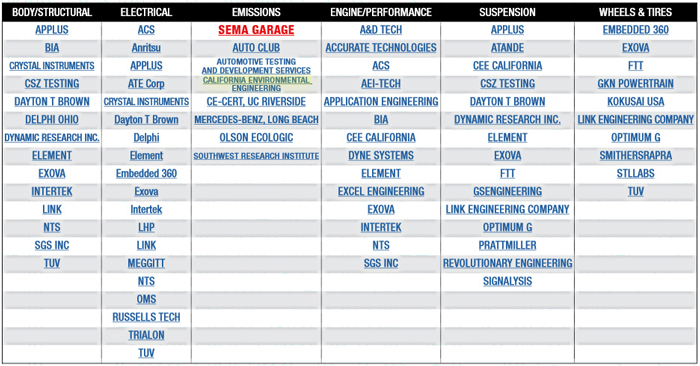 The SEMA Emerging Trends & Technology Network (ETTN), in conjunction with the SEMA Garage, brings you the SEMA “ETTN Design & Validation Resource Guide.” This guide is designed to help manufacturers connect with companies capable of testing and validating products or software. The SEMA Emerging Trends & Technology Network (ETTN), in conjunction with the SEMA Garage, brings you the SEMA “ETTN Design & Validation Resource Guide.” This guide is designed to help manufacturers connect with companies capable of testing and validating products or software. |
But sometimes even the most seasoned members might not be aware of or realize just how much impact a specific benefit might have on their businesses. Which is precisely what happened when Brad Grissom, vice president of JMS Performance Group, learned about the scope of the services offered through the SEMA Garage.
To hear Grissom tell it, it began with a meeting with SEMA Director of Membership Gary Vigil at the 2018 Keystone Big Show. While discussing SEMA’s resources, Vigil mentioned that the Garage has the ability to assist performance-parts manufacturers in securing executive orders (known as EOs) for their emissions-compliant products through the California Air Resources Board (CARB). That got Grissom’s attention.
As a manufacturer and supplier of OEM and aftermarket electronic components and systems designed to improve vehicle performance, Grissom was interested in securing EOs for the firm’s emissions-compliant products, but he was unaware that SEMA could help.
“When I spoke to Gary at the Big Show, he gave me a lot of information about the SEMA Garage that I had never been exposed to, and that was very helpful,” Grissom said. “He followed up with an email and copied Peter Treydte, the compliance center manager at the Garage. We started a dialog and put together a plan for us to start submitting our existing products for CARB executive orders. That’s the primary reason we reached out to the Garage.”
Fast Track to EO Approval
According to the CARB website, California law permits the sale of an aftermarket performance part only after an evaluation by CARB to ensure that the part does not raise emissions. Once CARB approves a part, it is granted an EO that allows the sale and installation of that part on pollution-controlled vehicles. The state law doesn’t apply just to performance-parts manufacturers, however. It also applies to everyone in the chain—distributors, installers and retailers—who are required to understand the legality of parts offered for sale in California and the consequences of failure to comply.
“At the end of the day, you have to have that executive order to ensure compliance,” Grissom said.
Securing an EO can be cumbersome, costly and time-consuming, but because SEMA staff has a working relationship with CARB, the process often moves along quickly and smoothly. As an added benefit, the member cost to utilize the Garage services is more affordable than pursuing an EO through an independent lab.
“The SEMA Garage really helped us navigate the way the data needs to be submitted to CARB,” Grissom said. “In the year since we started, we have received two executive orders, and we are working with the Garage to get executive orders for additional products. Three of those projects are currently ongoing and in the process of being tested.”
The process worked better than Grissom expected.
“To have somebody like Treydte, who is constantly engaging with CARB, help to streamline the process is next to impossible,” he said. “The relationship that SEMA and the SEMA Garage in particular have with CARB is well outside the norm. It’s priceless, and it’s priced right. If we had to go to an independent laboratory, it would’ve cost us twice as much money and taken twice as long. Frankly, more small to large manufacturers should be using the Garage to help them with a streamlined process.”
With a roster of resources that runs the gamut and that can fit any business, large or small, there is no shortage of opportunities to benefit from SEMA membership. This story is but one shining example. To discover what resources can help your business, contact SEMA Director of Membership Gary Vigil at 909-978-6738 or garyv@sema.org.
Mon, 07/01/2019 - 15:35
SEMA Member News—July 2019
By Ellen McKoy
Reaping the Benefits of Member Resources
A quick search of the SEMA website (www.sema.org) reveals an abundance of member benefits covering a range of business resources and solutions. In fact, no matter a company’s membership category—manufacturer, distributor, manufacturers’ rep, retailer or installer—there are tools and resources to help companies make smarter business decisions; be more strategic; save money; and expand their network among like-minded colleagues and industry leaders.
The à-la-carte menu allows any employee of a member company to choose those benefits that best meet individual or business needs. For some, it might be market research reports that offer insights into the latest trends or cost-saving business insurance solutions. For others, it might mean participation in a SEMA council or network or access to product-development opportunities through the SEMA Garage, to name a few.
| The SEMA Emerging Trends & Technology Network (ETTN), in conjunction with the SEMA Garage, brings you the SEMA “ETTN Design & Validation Resource Guide.” This guide is designed to help manufacturers connect with companies capable of testing and validating products or software. |
But sometimes even the most seasoned members might not be aware of or realize just how much impact a specific benefit might have on their businesses. Which is precisely what happened when Brad Grissom, vice president of JMS Performance Group, learned about the scope of the services offered through the SEMA Garage.
To hear Grissom tell it, it began with a meeting with SEMA Director of Membership Gary Vigil at the 2018 Keystone Big Show. While discussing SEMA’s resources, Vigil mentioned that the Garage has the ability to assist performance-parts manufacturers in securing executive orders (known as EOs) for their emissions-compliant products through the California Air Resources Board (CARB). That got Grissom’s attention.
As a manufacturer and supplier of OEM and aftermarket electronic components and systems designed to improve vehicle performance, Grissom was interested in securing EOs for the firm’s emissions-compliant products, but he was unaware that SEMA could help.
“When I spoke to Gary at the Big Show, he gave me a lot of information about the SEMA Garage that I had never been exposed to, and that was very helpful,” Grissom said. “He followed up with an email and copied Peter Treydte, the compliance center manager at the Garage. We started a dialog and put together a plan for us to start submitting our existing products for CARB executive orders. That’s the primary reason we reached out to the Garage.”
Fast Track to EO Approval
According to the CARB website, California law permits the sale of an aftermarket performance part only after an evaluation by CARB to ensure that the part does not raise emissions. Once CARB approves a part, it is granted an EO that allows the sale and installation of that part on pollution-controlled vehicles. The state law doesn’t apply just to performance-parts manufacturers, however. It also applies to everyone in the chain—distributors, installers and retailers—who are required to understand the legality of parts offered for sale in California and the consequences of failure to comply.
“At the end of the day, you have to have that executive order to ensure compliance,” Grissom said.
Securing an EO can be cumbersome, costly and time-consuming, but because SEMA staff has a working relationship with CARB, the process often moves along quickly and smoothly. As an added benefit, the member cost to utilize the Garage services is more affordable than pursuing an EO through an independent lab.
“The SEMA Garage really helped us navigate the way the data needs to be submitted to CARB,” Grissom said. “In the year since we started, we have received two executive orders, and we are working with the Garage to get executive orders for additional products. Three of those projects are currently ongoing and in the process of being tested.”
The process worked better than Grissom expected.
“To have somebody like Treydte, who is constantly engaging with CARB, help to streamline the process is next to impossible,” he said. “The relationship that SEMA and the SEMA Garage in particular have with CARB is well outside the norm. It’s priceless, and it’s priced right. If we had to go to an independent laboratory, it would’ve cost us twice as much money and taken twice as long. Frankly, more small to large manufacturers should be using the Garage to help them with a streamlined process.”
With a roster of resources that runs the gamut and that can fit any business, large or small, there is no shortage of opportunities to benefit from SEMA membership. This story is but one shining example. To discover what resources can help your business, contact SEMA Director of Membership Gary Vigil at 909-978-6738 or garyv@sema.org.