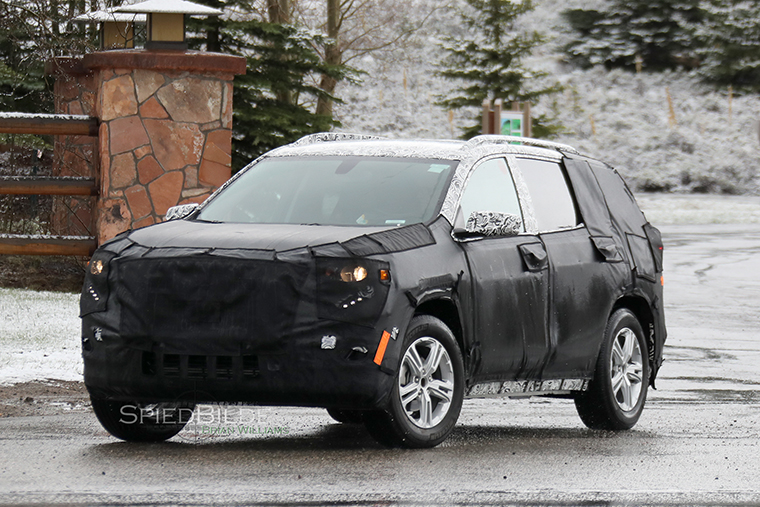
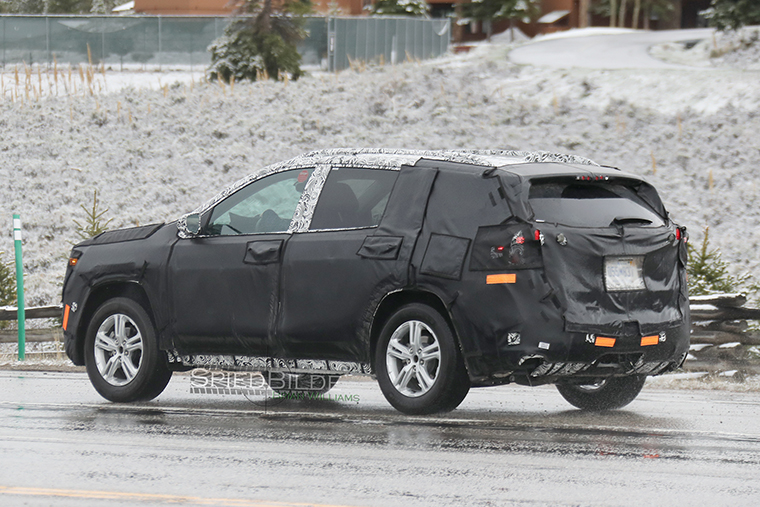
The new GMC Terrain was caught while testing in the Rocky Mountains.
With the midsize Acadia largely occupying the space the current Terrain holds, GMC’s compact crossover (along with the similar Chevy Equinox) will become significantly more compact in order to compete head-on with the Honda CR-V and Ford Escape, among others.
The Terrain continues with a blunter nose that is in line with GMC’s styling of late. It also appears that it will be more truck-like than the Equinox, and have a different greenhouse with less of a negative rake going back. The beltline seems to follow suit with the recently debuted Acadia, where it rises gradually toward the C-pillar. Unique LED strips up front also differentiate it from its platform sharing sibling.
Engines will more likely consist of the 2.5L four-cylinder in the Terrain, and possibly a turbo four or small V6.
The new GMC Terrain was caught while testing in the Rocky Mountains.
With the midsize Acadia largely occupying the space the current Terrain holds, GMC’s compact crossover (along with the similar Chevy Equinox) will become significantly more compact in order to compete head-on with the Honda CR-V and Ford Escape, among others.
The Terrain continues with a blunter nose that is in line with GMC’s styling of late. It also appears that it will be more truck-like than the Equinox, and have a different greenhouse with less of a negative rake going back. The beltline seems to follow suit with the recently debuted Acadia, where it rises gradually toward the C-pillar. Unique LED strips up front also differentiate it from its platform sharing sibling.
Engines will more likely consist of the 2.5L four-cylinder in the Terrain, and possibly a turbo four or small V6.
The new GMC Terrain was caught while testing in the Rocky Mountains.
With the midsize Acadia largely occupying the space the current Terrain holds, GMC’s compact crossover (along with the similar Chevy Equinox) will become significantly more compact in order to compete head-on with the Honda CR-V and Ford Escape, among others.
The Terrain continues with a blunter nose that is in line with GMC’s styling of late. It also appears that it will be more truck-like than the Equinox, and have a different greenhouse with less of a negative rake going back. The beltline seems to follow suit with the recently debuted Acadia, where it rises gradually toward the C-pillar. Unique LED strips up front also differentiate it from its platform sharing sibling.
Engines will more likely consist of the 2.5L four-cylinder in the Terrain, and possibly a turbo four or small V6.
The new GMC Terrain was caught while testing in the Rocky Mountains.
With the midsize Acadia largely occupying the space the current Terrain holds, GMC’s compact crossover (along with the similar Chevy Equinox) will become significantly more compact in order to compete head-on with the Honda CR-V and Ford Escape, among others.
The Terrain continues with a blunter nose that is in line with GMC’s styling of late. It also appears that it will be more truck-like than the Equinox, and have a different greenhouse with less of a negative rake going back. The beltline seems to follow suit with the recently debuted Acadia, where it rises gradually toward the C-pillar. Unique LED strips up front also differentiate it from its platform sharing sibling.
Engines will more likely consist of the 2.5L four-cylinder in the Terrain, and possibly a turbo four or small V6.
The new GMC Terrain was caught while testing in the Rocky Mountains.
With the midsize Acadia largely occupying the space the current Terrain holds, GMC’s compact crossover (along with the similar Chevy Equinox) will become significantly more compact in order to compete head-on with the Honda CR-V and Ford Escape, among others.
The Terrain continues with a blunter nose that is in line with GMC’s styling of late. It also appears that it will be more truck-like than the Equinox, and have a different greenhouse with less of a negative rake going back. The beltline seems to follow suit with the recently debuted Acadia, where it rises gradually toward the C-pillar. Unique LED strips up front also differentiate it from its platform sharing sibling.
Engines will more likely consist of the 2.5L four-cylinder in the Terrain, and possibly a turbo four or small V6.
No matter what niche you're in—rods, restoration, racing, restyling, reps, trucks or wheels and tires—there's a SEMA council or professional network that's right for your company. SEMA councils and networks offer members a variety of market-specific programs and activities designed to provide educational and networking opportunities while promoting their particular industry segment.
The TORA’s Long-Range Planning Meeting included vendor booth lunch delivery, an open meeting for industry professionals and networking events.
TORA Recaps LRP in Dallas
The Truck and Off-Road Alliance (TORA) held their Long-Range Planning Meeting in Dallas at the Renaissance, located across the street from Dallas Market Hall where the 4 Wheel Parts Truck & Jeep Fest was held concurrently. The scheduled events included vendor booth lunch delivery, an open meeting for industry professionals and a couple of networking events. Having multiple events coincide allowed TORA members to collaborate with light-truck professionals and increase awareness of the alliance within the aftermarket truck industry.
Follow TORA on Facebook to get updates and information about what the group has going on.
PRO to Host Long-Range Planning Meeting in Detroit
The Professional Restylers Organization (PRO) is hosting its annual Long-Range Planning (LRP) meeting June 15–16 in the nation’s car capital—Detroit. The annual LRP is an opportunity for council members to address restyling industry issues and challenges and weigh in on the needs of its member companies. Employees of PRO-member companies are encouraged to attend to gain insight into council initiatives, contribute their ideas to push the restyling industry forward and mingle with Select Committee members and SEMA staff to learn how PRO resources can help their businesses grow.
As an added bonus, attendees will tour the innovative Mobility Transformation Facility, more commonly known as Mcity, at the University of Michigan. The 32-acre facility is located on campus and is the first of its kind in testing new automated vehicle technologies and their capabilities to safely maneuver actual roadways. Public access to Mcity is limited, but LRP attendees will enjoy a guided, private tour of the facility.
The meetings kick off Wednesday, June 15, at the Detroit Metro Airport Marriot, and will break late morning for the Mcity tour and lunch. The meeting will reconvene back at the hotel after the tour for a group discussion and breakout sessions. A PRO-hosted dinner will take place that evening. The Thursday agenda includes a continental breakfast, breakout sessions, lunch and group project planning, and is slated to end at 3:00 p.m.
The Young Executives Network (YEN) will hit the road this summer with 10 members to participate in the Hot Rod Power Tour. The YENsters will stop in seven cities, starting in Baton Rouge, Louisiana, with the finish line in Kansas City, Kansas. Each stop attracts hundreds of local car enthusiasts, students and automotive professionals. YEN members will interact with students, showing them around the “traveling car show,” and discussing career paths in the automotive aftermarket industry.
You can follow them along their journey via the hashtag #YENPowerTour.
Let’s meet one of the teams!
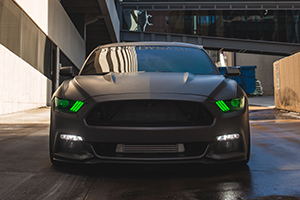
Nick Caloroso will drive the ’15 Ford Mustang he helped build for the Diode Dynamics’ SEMA Show booth.
Driver – Nick Caloroso, Diode Dynamics: Sales Manager
Nick Caloroso is the sales manager for Diode Dynamics—a leader in unique automotive lighting design and manufacturing. After graduating with a business degree from Truman State University in May 2013, Caloroso pursued his passion in the automotive aftermarket industry and has dedicated his career to Diode Dynamics’ mission of improving industry standards for quality automotive lighting products. He oversees the wholesale program and also assists in marketing through generating informative online content.
“Following my passion has led me to work with the most reputable companies in the industry, and educate my fellow automotive enthusiasts about a relatively new segment of the market. Managing more than 130 online automotive forum accounts and traveling to shows all across the country has taught me to appreciate the unique interests of owners with every make and model, from late-model domestics to extreme off-road performance vehicles.
I have a diverse taste in vehicles, ranging from ’60s musclecar classics to mid-’90s Japanese imports and late-model domestics. I am excited to participate in the Hot Rod Power tour, meet with like-minded individuals and, of course, drive the ’15 Ford Mustang we built for the Diode Dynamics’ SEMA booth.”
Passenger – Jason Geathers, Auto Images: Marketing Director
In the beginning, rock and roll pumped the motor-driven gas through Geathers’ veins and, thanks to a great family of garage professionals, he knew he wanted to take it to a professional level. Geathers started drag racing motorcycles at the age of nine once he was big enough to go down the track. As he grew older, he got into cars by helping his father work on his car and learning the mechanics of not only cars and trucks, but also life.
Eventually through the long process of learning his way forward, Geathers decided it was his turn to give back to the car community by opening a performance shop that would educate consumers on the advancements within the industry. Having a physical establishment along with social media and networks, car clubs and affiliations, he has progressed into a leader among the automotive community.
“When I learned about SEMA/YEN and what it continues to stand for, I immediately started to research how I could be a part of this amazing organization,” he said. “In doing so, I have seen more comradeship among those who understand the new generation of the automotive leadership movement. I’m privileged to join some of the best in the industry as a participant in the YEN Power Tour.”
“I want gain experience from a new perspective, network and build relationships, and most importantly, turn around and apply valuable business practices and ideas toward the future of our industry,” he said of attending the YEN Power Tour.
No matter what niche you're in—rods, restoration, racing, restyling, reps, trucks or wheels and tires—there's a SEMA council or professional network that's right for your company. SEMA councils and networks offer members a variety of market-specific programs and activities designed to provide educational and networking opportunities while promoting their particular industry segment.
The TORA’s Long-Range Planning Meeting included vendor booth lunch delivery, an open meeting for industry professionals and networking events.
TORA Recaps LRP in Dallas
The Truck and Off-Road Alliance (TORA) held their Long-Range Planning Meeting in Dallas at the Renaissance, located across the street from Dallas Market Hall where the 4 Wheel Parts Truck & Jeep Fest was held concurrently. The scheduled events included vendor booth lunch delivery, an open meeting for industry professionals and a couple of networking events. Having multiple events coincide allowed TORA members to collaborate with light-truck professionals and increase awareness of the alliance within the aftermarket truck industry.
Follow TORA on Facebook to get updates and information about what the group has going on.
PRO to Host Long-Range Planning Meeting in Detroit
The Professional Restylers Organization (PRO) is hosting its annual Long-Range Planning (LRP) meeting June 15–16 in the nation’s car capital—Detroit. The annual LRP is an opportunity for council members to address restyling industry issues and challenges and weigh in on the needs of its member companies. Employees of PRO-member companies are encouraged to attend to gain insight into council initiatives, contribute their ideas to push the restyling industry forward and mingle with Select Committee members and SEMA staff to learn how PRO resources can help their businesses grow.
As an added bonus, attendees will tour the innovative Mobility Transformation Facility, more commonly known as Mcity, at the University of Michigan. The 32-acre facility is located on campus and is the first of its kind in testing new automated vehicle technologies and their capabilities to safely maneuver actual roadways. Public access to Mcity is limited, but LRP attendees will enjoy a guided, private tour of the facility.
The meetings kick off Wednesday, June 15, at the Detroit Metro Airport Marriot, and will break late morning for the Mcity tour and lunch. The meeting will reconvene back at the hotel after the tour for a group discussion and breakout sessions. A PRO-hosted dinner will take place that evening. The Thursday agenda includes a continental breakfast, breakout sessions, lunch and group project planning, and is slated to end at 3:00 p.m.
The Young Executives Network (YEN) will hit the road this summer with 10 members to participate in the Hot Rod Power Tour. The YENsters will stop in seven cities, starting in Baton Rouge, Louisiana, with the finish line in Kansas City, Kansas. Each stop attracts hundreds of local car enthusiasts, students and automotive professionals. YEN members will interact with students, showing them around the “traveling car show,” and discussing career paths in the automotive aftermarket industry.
You can follow them along their journey via the hashtag #YENPowerTour.
Let’s meet one of the teams!
Nick Caloroso will drive the ’15 Ford Mustang he helped build for the Diode Dynamics’ SEMA Show booth.
Driver – Nick Caloroso, Diode Dynamics: Sales Manager
Nick Caloroso is the sales manager for Diode Dynamics—a leader in unique automotive lighting design and manufacturing. After graduating with a business degree from Truman State University in May 2013, Caloroso pursued his passion in the automotive aftermarket industry and has dedicated his career to Diode Dynamics’ mission of improving industry standards for quality automotive lighting products. He oversees the wholesale program and also assists in marketing through generating informative online content.
“Following my passion has led me to work with the most reputable companies in the industry, and educate my fellow automotive enthusiasts about a relatively new segment of the market. Managing more than 130 online automotive forum accounts and traveling to shows all across the country has taught me to appreciate the unique interests of owners with every make and model, from late-model domestics to extreme off-road performance vehicles.
I have a diverse taste in vehicles, ranging from ’60s musclecar classics to mid-’90s Japanese imports and late-model domestics. I am excited to participate in the Hot Rod Power tour, meet with like-minded individuals and, of course, drive the ’15 Ford Mustang we built for the Diode Dynamics’ SEMA booth.”
Passenger – Jason Geathers, Auto Images: Marketing Director
In the beginning, rock and roll pumped the motor-driven gas through Geathers’ veins and, thanks to a great family of garage professionals, he knew he wanted to take it to a professional level. Geathers started drag racing motorcycles at the age of nine once he was big enough to go down the track. As he grew older, he got into cars by helping his father work on his car and learning the mechanics of not only cars and trucks, but also life.
Eventually through the long process of learning his way forward, Geathers decided it was his turn to give back to the car community by opening a performance shop that would educate consumers on the advancements within the industry. Having a physical establishment along with social media and networks, car clubs and affiliations, he has progressed into a leader among the automotive community.
“When I learned about SEMA/YEN and what it continues to stand for, I immediately started to research how I could be a part of this amazing organization,” he said. “In doing so, I have seen more comradeship among those who understand the new generation of the automotive leadership movement. I’m privileged to join some of the best in the industry as a participant in the YEN Power Tour.”
“I want gain experience from a new perspective, network and build relationships, and most importantly, turn around and apply valuable business practices and ideas toward the future of our industry,” he said of attending the YEN Power Tour.
No matter what niche you're in—rods, restoration, racing, restyling, reps, trucks or wheels and tires—there's a SEMA council or professional network that's right for your company. SEMA councils and networks offer members a variety of market-specific programs and activities designed to provide educational and networking opportunities while promoting their particular industry segment.
The TORA’s Long-Range Planning Meeting included vendor booth lunch delivery, an open meeting for industry professionals and networking events.
TORA Recaps LRP in Dallas
The Truck and Off-Road Alliance (TORA) held their Long-Range Planning Meeting in Dallas at the Renaissance, located across the street from Dallas Market Hall where the 4 Wheel Parts Truck & Jeep Fest was held concurrently. The scheduled events included vendor booth lunch delivery, an open meeting for industry professionals and a couple of networking events. Having multiple events coincide allowed TORA members to collaborate with light-truck professionals and increase awareness of the alliance within the aftermarket truck industry.
Follow TORA on Facebook to get updates and information about what the group has going on.
PRO to Host Long-Range Planning Meeting in Detroit
The Professional Restylers Organization (PRO) is hosting its annual Long-Range Planning (LRP) meeting June 15–16 in the nation’s car capital—Detroit. The annual LRP is an opportunity for council members to address restyling industry issues and challenges and weigh in on the needs of its member companies. Employees of PRO-member companies are encouraged to attend to gain insight into council initiatives, contribute their ideas to push the restyling industry forward and mingle with Select Committee members and SEMA staff to learn how PRO resources can help their businesses grow.
As an added bonus, attendees will tour the innovative Mobility Transformation Facility, more commonly known as Mcity, at the University of Michigan. The 32-acre facility is located on campus and is the first of its kind in testing new automated vehicle technologies and their capabilities to safely maneuver actual roadways. Public access to Mcity is limited, but LRP attendees will enjoy a guided, private tour of the facility.
The meetings kick off Wednesday, June 15, at the Detroit Metro Airport Marriot, and will break late morning for the Mcity tour and lunch. The meeting will reconvene back at the hotel after the tour for a group discussion and breakout sessions. A PRO-hosted dinner will take place that evening. The Thursday agenda includes a continental breakfast, breakout sessions, lunch and group project planning, and is slated to end at 3:00 p.m.
The Young Executives Network (YEN) will hit the road this summer with 10 members to participate in the Hot Rod Power Tour. The YENsters will stop in seven cities, starting in Baton Rouge, Louisiana, with the finish line in Kansas City, Kansas. Each stop attracts hundreds of local car enthusiasts, students and automotive professionals. YEN members will interact with students, showing them around the “traveling car show,” and discussing career paths in the automotive aftermarket industry.
You can follow them along their journey via the hashtag #YENPowerTour.
Let’s meet one of the teams!
Nick Caloroso will drive the ’15 Ford Mustang he helped build for the Diode Dynamics’ SEMA Show booth.
Driver – Nick Caloroso, Diode Dynamics: Sales Manager
Nick Caloroso is the sales manager for Diode Dynamics—a leader in unique automotive lighting design and manufacturing. After graduating with a business degree from Truman State University in May 2013, Caloroso pursued his passion in the automotive aftermarket industry and has dedicated his career to Diode Dynamics’ mission of improving industry standards for quality automotive lighting products. He oversees the wholesale program and also assists in marketing through generating informative online content.
“Following my passion has led me to work with the most reputable companies in the industry, and educate my fellow automotive enthusiasts about a relatively new segment of the market. Managing more than 130 online automotive forum accounts and traveling to shows all across the country has taught me to appreciate the unique interests of owners with every make and model, from late-model domestics to extreme off-road performance vehicles.
I have a diverse taste in vehicles, ranging from ’60s musclecar classics to mid-’90s Japanese imports and late-model domestics. I am excited to participate in the Hot Rod Power tour, meet with like-minded individuals and, of course, drive the ’15 Ford Mustang we built for the Diode Dynamics’ SEMA booth.”
Passenger – Jason Geathers, Auto Images: Marketing Director
In the beginning, rock and roll pumped the motor-driven gas through Geathers’ veins and, thanks to a great family of garage professionals, he knew he wanted to take it to a professional level. Geathers started drag racing motorcycles at the age of nine once he was big enough to go down the track. As he grew older, he got into cars by helping his father work on his car and learning the mechanics of not only cars and trucks, but also life.
Eventually through the long process of learning his way forward, Geathers decided it was his turn to give back to the car community by opening a performance shop that would educate consumers on the advancements within the industry. Having a physical establishment along with social media and networks, car clubs and affiliations, he has progressed into a leader among the automotive community.
“When I learned about SEMA/YEN and what it continues to stand for, I immediately started to research how I could be a part of this amazing organization,” he said. “In doing so, I have seen more comradeship among those who understand the new generation of the automotive leadership movement. I’m privileged to join some of the best in the industry as a participant in the YEN Power Tour.”
“I want gain experience from a new perspective, network and build relationships, and most importantly, turn around and apply valuable business practices and ideas toward the future of our industry,” he said of attending the YEN Power Tour.
Legislation to raise gas taxes and require a study of a road-usage tax died when the legislature adjourned for the year.
Legislation to raise gas taxes and require a study of a road-usage tax died when the legislature adjourned for the year. The bill had been assigned to both the Transportation and Finance Committees, but received no committee consideration. The measure would have required a study of a road-usage tax and potential pilot program. In addition to creating privacy concerns, the bill sought to penalize national efforts to create a more fuel-efficient vehicle fleet by taxing drivers based on vehicle mileage.