Thu, 11/16/2017 - 14:35

By SEMA Washington, D.C., Staff
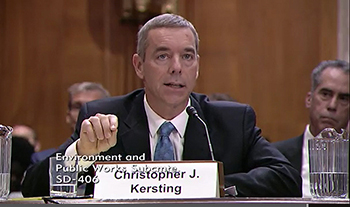
Chris Kersting
SEMA President and CEO Chris Kersting testified before the U.S. Senate Clean Air Subcommittee on November 14 in support of S. 203, the Recognizing the Protection of Motorsports (RPM) Act.

SEMA President and CEO Chris Kersting testified before the U.S. Senate Clean Air Subcommittee on November 14 in support of S. 203, the Recognizing the Protection of Motorsports (RPM) Act. The RPM Act clarifies that it is legal under federal law to manufacture, sell, distribute and install race parts that modify the emissions system of a motor vehicle that is used solely for racing.

In a separate action, the U.S. House of Representatives’ Environment Subcommittee approved a nearly identical version of the RPM Act (H.R. 350) on November 15, and sent it to the House Energy & Commerce Committee for further action.

“The RPM Act is common-sense, bi-partisan legislation that would provide much-needed certainty to the motorsports community,” Kersting said.

Congress never intended for race vehicles, which have minimal environmental impact, to be regulated under the Clean Air Act (CAA). However, the U.S. Environmental Protection Agency (EPA) issued a proposed rule in 2015 stating it is illegal to convert a motor vehicle into a racecar if the vehicle’s emissions system no longer remains in its certified configuration. The EPA also asserted that marketing race parts was illegal if such products were capable of being installed on street vehicles. Although the EPA removed the proposal from the final rulemaking, the agency still asserts it has authority under the CAA to regulate emissions modifications to converted vehicles used solely for competition.  

“The EPA’s interpretation of the Clean Air Act would have a devastating impact on motorsports since most racecars start life as street vehicles,” Kersting said. “It would also decimate small businesses that supply the products used in motorsports, resulting in the loss of thousands of jobs and billions in local revenue for communities.”

The RPM Act would simply clarify the original intent of the CAA, which was never meant to apply to race vehicles. For more information, visit www.sema.org/epa-news.

Thu, 11/16/2017 - 14:35

By SEMA Washington, D.C., Staff

Chris Kersting
SEMA President and CEO Chris Kersting testified before the U.S. Senate Clean Air Subcommittee on November 14 in support of S. 203, the Recognizing the Protection of Motorsports (RPM) Act.

SEMA President and CEO Chris Kersting testified before the U.S. Senate Clean Air Subcommittee on November 14 in support of S. 203, the Recognizing the Protection of Motorsports (RPM) Act. The RPM Act clarifies that it is legal under federal law to manufacture, sell, distribute and install race parts that modify the emissions system of a motor vehicle that is used solely for racing.

In a separate action, the U.S. House of Representatives’ Environment Subcommittee approved a nearly identical version of the RPM Act (H.R. 350) on November 15, and sent it to the House Energy & Commerce Committee for further action.

“The RPM Act is common-sense, bi-partisan legislation that would provide much-needed certainty to the motorsports community,” Kersting said.

Congress never intended for race vehicles, which have minimal environmental impact, to be regulated under the Clean Air Act (CAA). However, the U.S. Environmental Protection Agency (EPA) issued a proposed rule in 2015 stating it is illegal to convert a motor vehicle into a racecar if the vehicle’s emissions system no longer remains in its certified configuration. The EPA also asserted that marketing race parts was illegal if such products were capable of being installed on street vehicles. Although the EPA removed the proposal from the final rulemaking, the agency still asserts it has authority under the CAA to regulate emissions modifications to converted vehicles used solely for competition.  

“The EPA’s interpretation of the Clean Air Act would have a devastating impact on motorsports since most racecars start life as street vehicles,” Kersting said. “It would also decimate small businesses that supply the products used in motorsports, resulting in the loss of thousands of jobs and billions in local revenue for communities.”

The RPM Act would simply clarify the original intent of the CAA, which was never meant to apply to race vehicles. For more information, visit www.sema.org/epa-news.

Thu, 11/16/2017 - 14:35

By SEMA Washington, D.C., Staff

Chris Kersting
SEMA President and CEO Chris Kersting testified before the U.S. Senate Clean Air Subcommittee on November 14 in support of S. 203, the Recognizing the Protection of Motorsports (RPM) Act.

SEMA President and CEO Chris Kersting testified before the U.S. Senate Clean Air Subcommittee on November 14 in support of S. 203, the Recognizing the Protection of Motorsports (RPM) Act. The RPM Act clarifies that it is legal under federal law to manufacture, sell, distribute and install race parts that modify the emissions system of a motor vehicle that is used solely for racing.

In a separate action, the U.S. House of Representatives’ Environment Subcommittee approved a nearly identical version of the RPM Act (H.R. 350) on November 15, and sent it to the House Energy & Commerce Committee for further action.

“The RPM Act is common-sense, bi-partisan legislation that would provide much-needed certainty to the motorsports community,” Kersting said.

Congress never intended for race vehicles, which have minimal environmental impact, to be regulated under the Clean Air Act (CAA). However, the U.S. Environmental Protection Agency (EPA) issued a proposed rule in 2015 stating it is illegal to convert a motor vehicle into a racecar if the vehicle’s emissions system no longer remains in its certified configuration. The EPA also asserted that marketing race parts was illegal if such products were capable of being installed on street vehicles. Although the EPA removed the proposal from the final rulemaking, the agency still asserts it has authority under the CAA to regulate emissions modifications to converted vehicles used solely for competition.  

“The EPA’s interpretation of the Clean Air Act would have a devastating impact on motorsports since most racecars start life as street vehicles,” Kersting said. “It would also decimate small businesses that supply the products used in motorsports, resulting in the loss of thousands of jobs and billions in local revenue for communities.”

The RPM Act would simply clarify the original intent of the CAA, which was never meant to apply to race vehicles. For more information, visit www.sema.org/epa-news.

Thu, 11/16/2017 - 13:06

By Stephanie Martinez

Tech TransferThe SEMA Garage’s Tech Transfer program now has access to the new ’18 Ford OEM CAD data, which includes the newly redesigned Mustang, F-150 and Expedition.

For those who are already Tech Transfer members, browse through the website’s OEM CAD Repository to view all of the available files. If your desired files are not listed, place an OEM CAD request and SEMA will help you obtain the required data.

Interested in becoming a Tech Transfer member? Contact techtransfer@sema.org.    


Thu, 11/16/2017 - 13:06

By Stephanie Martinez

Tech TransferThe SEMA Garage’s Tech Transfer program now has access to the new ’18 Ford OEM CAD data, which includes the newly redesigned Mustang, F-150 and Expedition.

For those who are already Tech Transfer members, browse through the website’s OEM CAD Repository to view all of the available files. If your desired files are not listed, place an OEM CAD request and SEMA will help you obtain the required data.

Interested in becoming a Tech Transfer member? Contact techtransfer@sema.org.    


Thu, 11/16/2017 - 13:06

By Stephanie Martinez

Tech TransferThe SEMA Garage’s Tech Transfer program now has access to the new ’18 Ford OEM CAD data, which includes the newly redesigned Mustang, F-150 and Expedition.

For those who are already Tech Transfer members, browse through the website’s OEM CAD Repository to view all of the available files. If your desired files are not listed, place an OEM CAD request and SEMA will help you obtain the required data.

Interested in becoming a Tech Transfer member? Contact techtransfer@sema.org.    


Thu, 11/16/2017 - 12:28

Jenny Galvan

The Emerging Trends & Technology Network (ETTN) is moving its annual Motorsports & Performance Tech Roundtable event to the PRI Trade Show in Indianapolis, December 8. The network brings together motorsports technology subject-matter experts to lead open discussions on the evolving technological advancements in the performance industry.

Save your seat today!

Featured Topics:

  • Gain performance and drivability with electronically spooled/assisted turbocharging technology. Moderator: Lauren Fix
  • Run higher compression ratios using direct-injection technology. Moderator: D. Rob Prucka
  • Trends in rapid prototyping and R&D tools to enhance engine/vehicle development and performance. Moderator: David Gurrola
  • How advanced simulation tools, such as GT Power and 3D CFD, can accelerate the engine-development process. Moderator: Dan Agnew
  • Advancement in coatings reduce wear and friction and lead to increased performance. Moderator: Florian Rovere

Event questions? Contact SEMA Director of Networks Bryan Harrison at bryanh@sema.org or 909-978-6691.

Thu, 11/16/2017 - 12:28

Jenny Galvan

The Emerging Trends & Technology Network (ETTN) is moving its annual Motorsports & Performance Tech Roundtable event to the PRI Trade Show in Indianapolis, December 8. The network brings together motorsports technology subject-matter experts to lead open discussions on the evolving technological advancements in the performance industry.

Save your seat today!

Featured Topics:

  • Gain performance and drivability with electronically spooled/assisted turbocharging technology. Moderator: Lauren Fix
  • Run higher compression ratios using direct-injection technology. Moderator: D. Rob Prucka
  • Trends in rapid prototyping and R&D tools to enhance engine/vehicle development and performance. Moderator: David Gurrola
  • How advanced simulation tools, such as GT Power and 3D CFD, can accelerate the engine-development process. Moderator: Dan Agnew
  • Advancement in coatings reduce wear and friction and lead to increased performance. Moderator: Florian Rovere

Event questions? Contact SEMA Director of Networks Bryan Harrison at bryanh@sema.org or 909-978-6691.

Thu, 11/16/2017 - 12:28

Jenny Galvan

The Emerging Trends & Technology Network (ETTN) is moving its annual Motorsports & Performance Tech Roundtable event to the PRI Trade Show in Indianapolis, December 8. The network brings together motorsports technology subject-matter experts to lead open discussions on the evolving technological advancements in the performance industry.

Save your seat today!

Featured Topics:

  • Gain performance and drivability with electronically spooled/assisted turbocharging technology. Moderator: Lauren Fix
  • Run higher compression ratios using direct-injection technology. Moderator: D. Rob Prucka
  • Trends in rapid prototyping and R&D tools to enhance engine/vehicle development and performance. Moderator: David Gurrola
  • How advanced simulation tools, such as GT Power and 3D CFD, can accelerate the engine-development process. Moderator: Dan Agnew
  • Advancement in coatings reduce wear and friction and lead to increased performance. Moderator: Florian Rovere

Event questions? Contact SEMA Director of Networks Bryan Harrison at bryanh@sema.org or 909-978-6691.

Thu, 11/16/2017 - 12:21

By Katie Carson

Stephanie Jones
Stephanie Jones

The Automotive Restoration Market Organization (ARMO) has released a new “Digital Matters” article—a resource to help members navigate improving their digital footprint, data standardization and management, and best business practices.

In the latest edition, Stephanie Jones, SEMA Data Co-op (SDC) director of e-business, defines data standardization and provides credible resources to further explore how businesses can improve efficiency through product data sharing.

Read the full article.