By Ashley Reyes
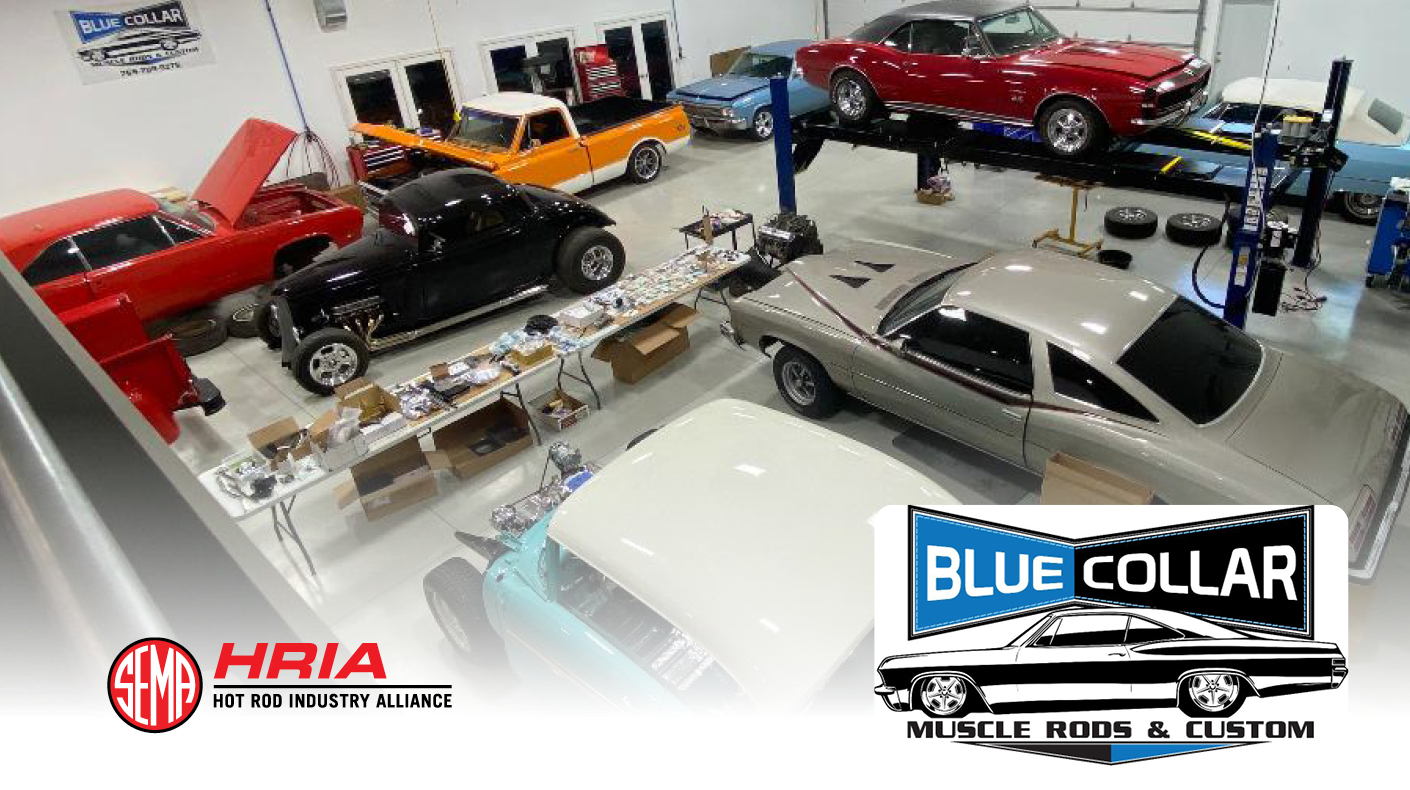
SEMA's Hot Rod Industry Alliance (HRIA) has named Blue Collar Muscle Rods & Custom as the council's newest spotlight member. Get to know the company's story in the SEMA News interview with Blue Collar Muscle Rod & Custom owner Eric Leroy below.
SEMA News: Tell us the story of your business. How did you start?
Eric Leroy: I started working on a business plan in 2018, funding was obtained in November 2019 (finally) and construction started in January of 2020. Through several covid shutdown delays, the construction was completed 99% in December 2020 and we opened for business in January 2021. It's amazing that five years have passed so quickly and our workload has been very consistent.
SN: What are your thoughts on the popularity of the hot rod industry around the world?
EL: It's surprising to see the love of American cars all over the world. It's even more surprising to see people out of the USA plan their vacations (even retirements) around coming to the United States to participate in the HOT ROD Power Tour or HOT ROD Drag Week or attend a motorsports event like the Indy 500, US Nationals or Daytona 500. The machine shop I use has an overseas connection to build American V8 engines, the liaison drops off a bunch of engines, they are rebuilt, and then a carrier shows up and takes them all to export them. It's interesting to see such a strong desire for American vehicles.
SN: What is something that most people don't know about Blue Collar Muscle Rods and Custom you think is interesting?
EL: The variety of work that we do. Not everything we work on is a ground-up build. We work on just about anything 25 years old and older where we have the expertise to provide the vehicle what it needs in a reasonable amount of time. We have worked on Model As, Packards, Avanti's, '30s commercial dump trucks, pro-street and road-course cars. Our location is out of town in a farming area; we have corn, soybean and hay fields in every direction.
SN: Tell us about your business now in 2026 and what you're focused on?
EL: We had a busy winter and now we have nine hot rods that need road testing before going home to their owners in time for cruising season. Those nine vehicles include the following:
- '65 Ford Mustang Convertible
- '72 Oldsmobile Cutlass
- '69 Chevrolet Camaro
- '67 Chevrolet Impala
- '69 Chevrolet El Camino
- '73 Pontiac GTO
- '62 Chevrolet Corvette
- '70 Oldsmobile F85
- '63 Ford Thunderbird
An interesting note about the '65 Mustang and the '72 Cutlass: both cars were purchased new by the parents of the current owners, and both cars were full ground-up builds. A new group of vehicles will come in such as a '69 Chevrolet Suburban, '69 Ford Mustang, '67 Ford Mustang, '69 Chevrolet Corvette, '66 Ford Thunderbird and a '84 Chevrolet S-10 truck. Other cars currently moving through the shop include a '70 Dodge Challenger, '33 Ford 4 Door Sedan, '70 Chevrolet K10 truck, all three ground-up, a '65 Ford Galaxie convertible––a frame-on build, and an automatic transmission to a five-speed standard transmission in a '54 Chevrolet 3100 truck so the owner can tow it behind his motorhome.
SN: Tell us about a project you are proud of.
EL: We have taken on more complex and large projects. Our number of ground-up builds is increasing rather than just offering an overall paint job. Our quality and attention to detail have increased significantly. We fabricate more things when there is no good aftermarket solution and we are refining how we build our vehicles to match how the customer intends to use the vehicle. For example, an owner who wants to one-up his golfing buddies is a different build than a grandpa who wants to attend the Wednesday night cruise-in and take along his grandkids. Some customers have an unlimited budget; they know what they want and can fund it to the end.
Other customers have financial limitations, and we collaborate with them to stretch their budget so that at the end, they have a running and drivable car. They may have to forgo the $8,000 set of wheels, but in the end, we will find a wheel that is a good compromise that leaves money for the air conditioning installation. It will do no good if the paint is perfect, but the interior is so ratty, it keeps the car in the garage or the engine won't run reliably enough to get you home.
SN: What advice do you have for young professionals contemplating a career in the automotive aftermarket
EL: Two things: honesty and communication. Honesty––When a car comes in that has been parked for 57 years and you know it will cost $35,000 to service everything it needs, that's the number you tell your customer, not $20,000 because you don't want to chase them away. As the owner of the shop, you are also the salesman for the shop; explain to the customer why the expense will be $35,000.
Communication––Every invoice that I send to a customer is coupled with a brief update of the progress that has been made and photos, regardless of if you text or email the photos; customers love seeing progress and knowing what their money is paying for. A scope of work contract should detail the work that will be done and in language that the customer understands. The word "restoration" needs to be discussed and detailed on the scope of work because an overall paint job and interior refresh is not the same as a rotisserie build––both customers will use the word "restoration."
Additionally, when the vehicle arrives in the shop, discuss the scope of work with all of your technicians, allow them to clarify things and put the printed scope of work in a clear vinyl envelope and put the envelope in the vehicle so the technicians can refer to it at any time. Sometimes shop owners forget important build information that should be communicated to the technicians working on the vehicle.
Fill out an HRIA-member spotlight form to highlight how your company is contributing to the hot-rod industry. Selected candidates are eligible to be featured on HRIA's social media, SEMA News and future HRIA-member updates.