By Drew Hardin
Photography: Petersen Publishing Company Archives
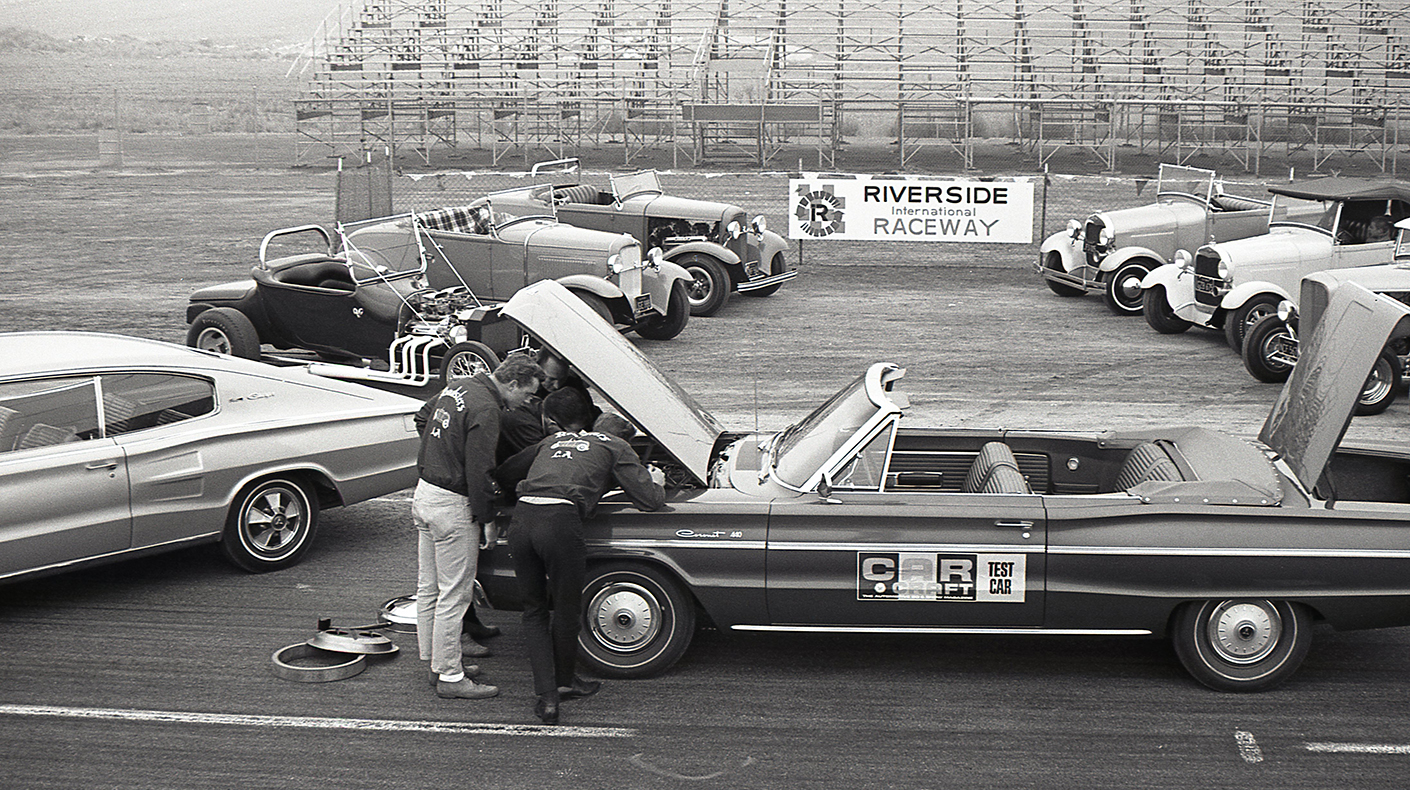
Car Craft magazine gathered members of the LA Roadsters Club at Riverside in fall 1965 to test the then-new Street Hemi in a Dodge Coronet convertible. Note the all-new Charger at left.
In the mid-'60s, Car Craft magazine came up with a novel approach to new car testing: Put the vehicles in the hands of car club members to see what real-world enthusiasts like and dislike about Detroit's latest performance cars.
The car club road test that associate editor Steve Scott wrote for the February 1966 issue was a significant one. The magazine asked members of the Los Angeles Roadsters Club to give their opinions about the new, street-tuned version of Chrysler's 426 Hemi.
Today, the LA Roadsters is one of the premier car clubs in Southern California. Probably its best-known activity is hosting the Father's Day Roadster Show and swap meet at the LA County Fairgrounds. In 1965, the club was just eight years old, yet it had become "almost legendary," Scott wrote, for its "beautiful club cars, touring road cruises, car shows, drags, and all those other good things that really spell out the sport—hot rodding." He said Car Craft "had been saving them for just the right car, and it looked as though the '66 'Street Hemi' was it."
A HEMI-POWERED CORONET
Scott brought the club members together with a Hemi-powered Coronet convertible during a press preview of '66 Dodge models at Riverside International Raceway. With its three-mile road course and quarter-mile drag strip, "What better facility could we have asked for?"
The guys started their day "touring the road course, trading the Hemi off between drivers, yet constantly chaperoned (better yet, surrounded) by a flotilla of roadsters for an escort," Scott said. Darryl Norenberg's photography from that day has several shots contrasting the club's vintage tin with the squared-shouldered lines of the restyled Coronet.
Club members were then briefed about the new engine by Dodge Planning Engineer Chuck Kelly. He walked them through the changes made so the race Hemi could function in a street car. The compression ratio dropped from 12.5:1 to 10.25:1 "for smooth running when using commercially available premium octane gasoline," he explained. Low-speed operation required a camshaft with reduced duration. A pair of Carter four-barrel AFB carburetors mounted inline on an aluminum dual-plane intake—rather than the racing cross-ram—fed the engine. Exhaust exited through "new header-type cast-iron exhaust manifolds with large, 2-1/2-inch pipes and dual exhaust system for lower back pressures," Kelly said. "When you're out there driving it, you'll be surprised with the response it's got."
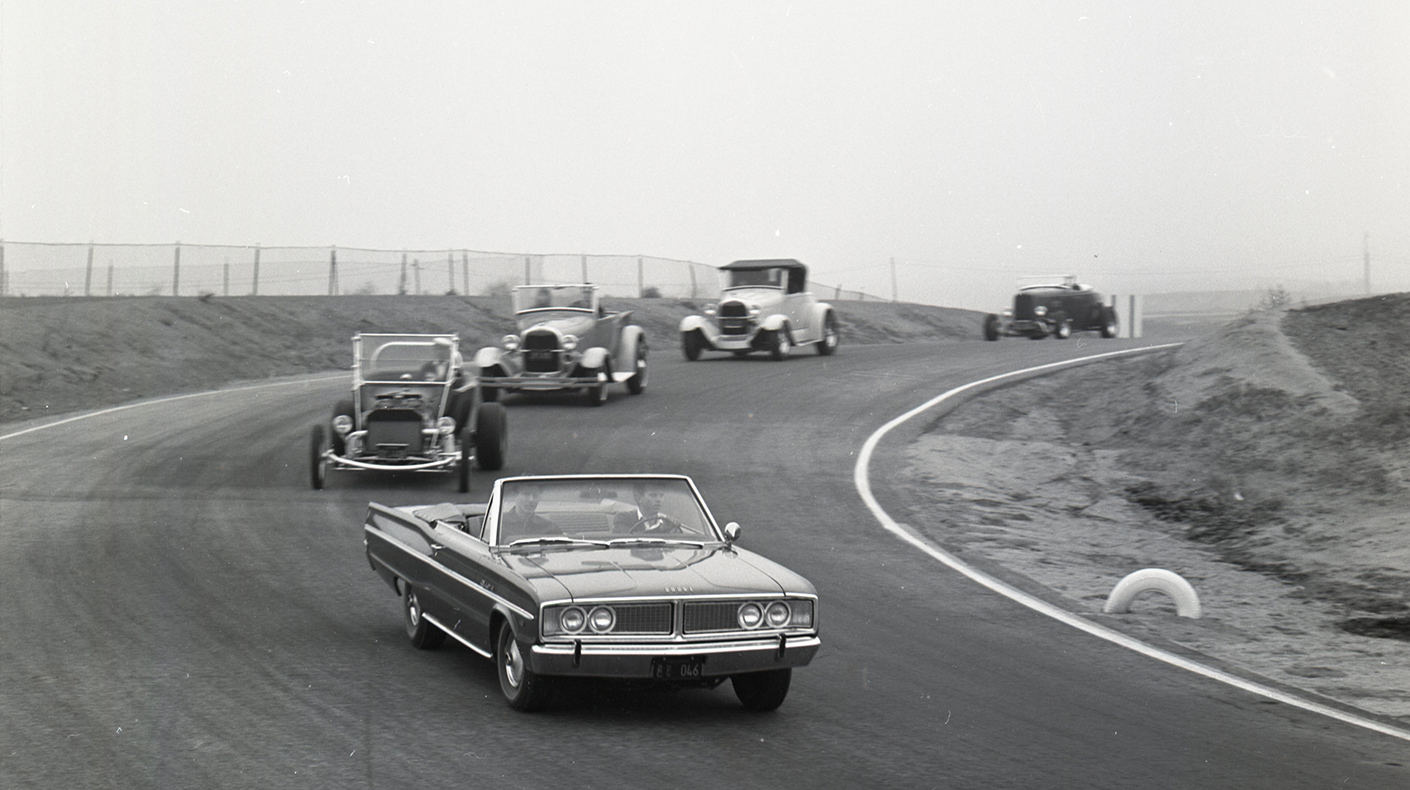
The Coronet leads a group of hot rods through Riverside's S-turns. "Clean body lines and wide grille give the viewer the impression that here is a car with class, but one designed only for transportation," wrote Steve Scott. "Nothing could be further from the truth, though, because this one honks on."
QUICK, HEALTHY THROTTLE RESPONSE
"That's one thing the club remarked about right off, once they were turned loose for runs around the track," Scott said. "Quick, healthy action of the 3,345-pound maroon convertible to every change of the throttle. It was something they didn't expect for an engine with all the power this one had. Usually an engine in the 425-hp neighborhood has a tendency to hesitate slightly before pulling ahead when kicked hard. With all this power and response, engine noise from inside the car was negligible, except for that healthy four-barrel sound that kind of gets you right there!"
Club member Ron Hurd had more drag racing experience than the others, so he drove during acceleration tests. The Hemi was joined to a TorqueFlite automatic transmission and a 3.23:1-geared rearend. Hurd tested the car "very systematically" by making runs shifting the gears manually, and also just leaving it in Drive "where it will shift at a pre-determined point which the factory felt would be best for racing purposes," Scott said. The latter worked the best: The Coronet ran as quickly as 14.17 seconds and as fast as 98.03 mph. When the club bolted on a pair of Mickey Thompson cheater slicks, the ET dropped to 14.11 seconds, and the mph climbed to 98.68.
"It's hard to believe the hard feeling it had coming out of the hole," Hurd said. "With all the ponies this car has at its command for pulling the tires off the line, I had expected a lot of rear-end hop for the first 50 feet or so, especially when you consider there isn't anything in the way of a tangible traction-bar setup at the rear at all."
For Hemi use, Dodge augmented the Coronet's suspension with "extra leaf springs, one on each side, in the rear suspension," Scott noted. "Torsion bar thickness has been increased on the front suspension. The control of the ride is also aided by utilizing heavy-duty shocks and a sway bar greater than the optional unit available for the standard Coronet."
Scott also said sister publication Hot Rod magazine tested the Coronet at Lions Drag Strip after the press event. Technical Editor Eric Dahlquist brought the quarter-mile ETs down to the 13.20-13.40 range and trap speeds up to 106 mph by making some "small alterations on the 426, such as changing the curve on the ignition advance by grinding the weights, installing a set of Doug's headers, and a few other little supertuning goodies."
During their day at Riverside, club members weighed in on other aspects of the new Coronet.
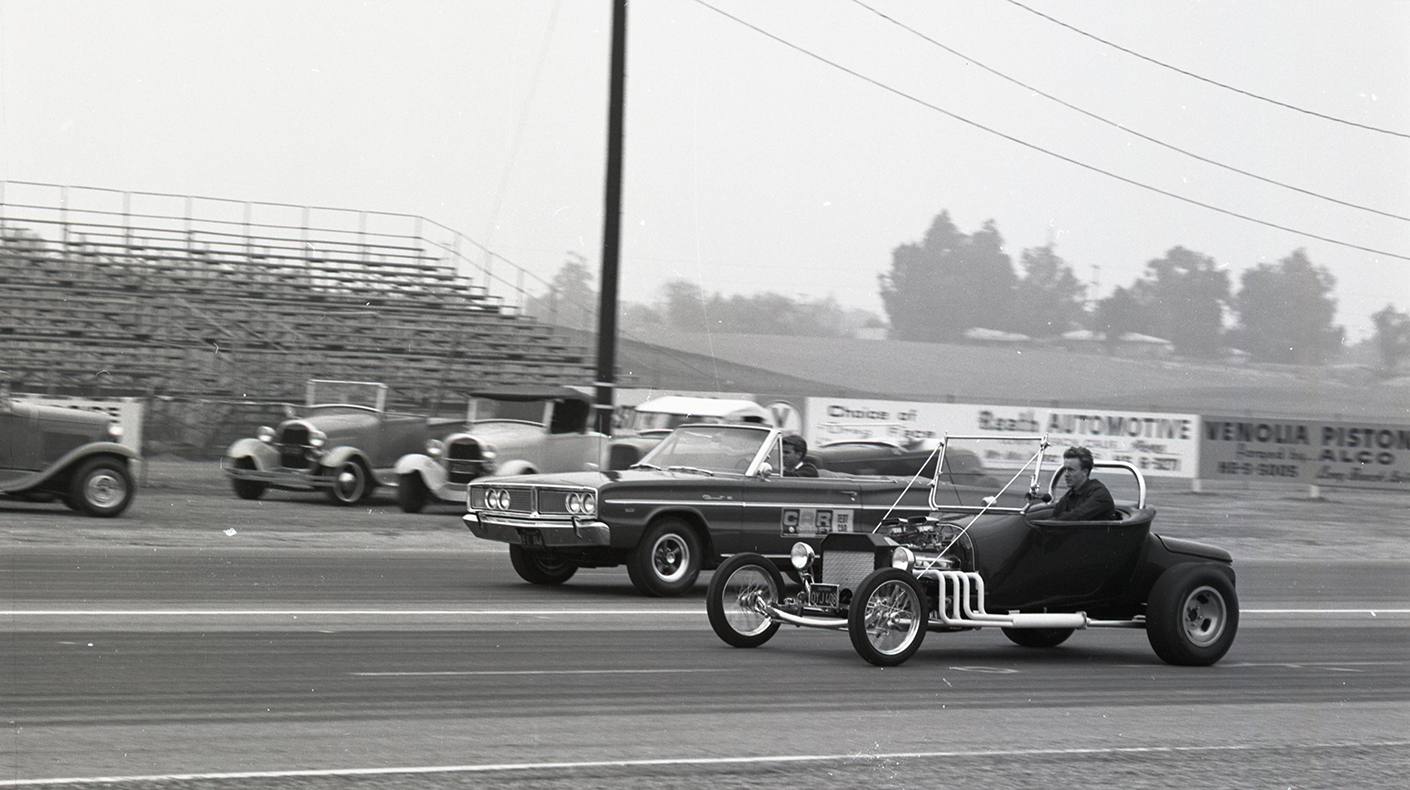
Club members couldn't resist running the new Hemi against their hot rods. Scott "handled the Hemi well but couldn't catch" Ron Hurd's Model T roadster.
A CAR WITH YOUTH APPEAL
"I'm all for the progressive theme of clean lines and functional overall design that Dodge has built into the car," said Ed Aston. "It's definitely directed at the younger set, as was made evident when Dodge dropped in the 426. The dash is really groovy, with gauges instead of 'idiot lights,' and the steering wheel being located lower feels great."
Aston did not care for the Coronet's upholstery "since it carries that 'mail order seat cover,' look," he said. "Of course, with the plusher interior of the Coronet 500, that's a different story. Here you get the swingin' looking buckets and a good combo of pleats that really reach out and grab you. This is the kind of interior that goes with the Hemi."
Tom Booth liked the restyled body lines. "Overall feeling of the body shape is one of a clean, uncluttered theme that is tastefully followed throughout. It isn't an overpowering appearance of goodies and extra frills." He said the "Delta-shaped taillights really identify the car as a Dodge and are individual enough to keep the look strictly that of a Coronet." The "nearly flat, large hood looks wild," he said, "but it's a bit shaky, lacking a feeling of stability while being opened and closed."
Scott ended the story with the thoughts of club president Steve Kelly, who had just landed a job as an assistant editor at Motor Trend and would go on to a lengthy career at Petersen Publishing. Kelly was "impressed with the Street Hemi for another reason that didn't even enter our minds," Scott said.
"The benefits of the dependability and power offered with the high performance go together to form what I can foresee as a very popular tow car," Kelly said. "There are more than enough suds to pull almost anything around, and the extra-beefy suspension would easily handle the problems you run into while towing a car and trailer."
👉 TO READ MORE LIKE THIS FOR FREE, sign up for a digital subscription to SEMA Magazine on Zinio here.
Once you download the Zinio mobile app or are logged into Zinio on a desktop browser, you will gain immediate access to more than a year's worth of content, including "LA ROADSTERS TEST THE NEW 426 HEMI" and more automotive culture-related coverage in the October 2025 issue here.