Thu, 03/24/2016 - 09:06

By SEMA Editors

pinewood
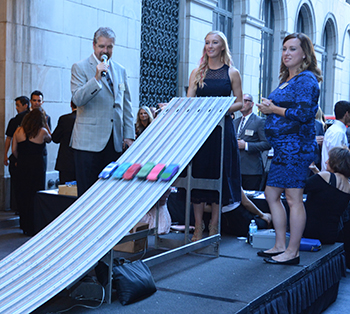
The SEMA Cares Pinewood Drag Races will take place Friday, July 29, 2016, at the Fairplex Conference Center in Pomona, California.

The 2016 Pinewood Drag Races season is now open! Nothing is more Americana than a good old-fashioned pinewood race, and this year’s SEMA Cares-sponsored event promises to be the biggest ever. Each year, hundreds of SEMA-member companies step up to generously sponsor pinewood cars, with 100% of the proceeds going to qualified SEMA Cares charities. To learn more and register, visit www.sema.org/pinewood.

Once again held in conjunction with the SEMA Installation Gala Fundraiser, the SEMA Cares Pinewood Drag Races will take place Friday, July 29, 2016, at the Fairplex Conference Center in Pomona, California. There’s no better location for drag racing than Pomona—home of NHRA’s famed 1/4-mile and the NHRA Museum. The finals will take place during the cocktail reception, shortly before the banquet begins.

SEMA members can race either a car or a truck in three classes: Build It For Me (BIFM), Stock and Unlimited. Members can either sponsor child-built cars and trucks in the Build It For Me (BIFM) or Stock Class, or they can build and enter their own SEMA-supplied stock car or truck. Stock-Class racing usually garners the most entries with a typical speed of 3.2 seconds on a 50-ft. track. For hardcore speed enthusiasts, the Unlimited Class has only one rule—that one item from the stock kit be used. Cars in this class run sub-3 seconds, and many of the past top builders include some of the most recognized names in the industry.

SEMA Cares Pinewood Drag Races special features include the annual HRIA Builders Challenge and Council Cup. Watch as some of the biggest names in hot rodding build state-of-the-art custom pinewoods that will be raced and then auctioned-off, with all of the proceeds going to SEMA Cares. Council members are invited to come out and challenge their peers for the opportunity to win the coveted Council Cup. The more cars or trucks fielded by each council member, the greater their chances of winning.

If you're the hands-on type, SEMA invites you to attend one of several to-be-announced build days where you can help the children sand, paint and assemble cars for the races. Each child will build two cars: one to keep and one reserved for sponsorship by a caring SEMA-member company or individual. Members interested in participating in one of the build days are invited to contact gracielas@sema.org or visit the SEMA Cares Facebook page.

Proceeds from the races will benefit SEMA Cares charities, including Childhelp and Victory Junction. Childhelp assists abused and neglected children by providing counseling and programs in a safe and secure living environment. Victory Junction provides the camp experience for children with chronic medical conditions or serious illnesses who otherwise would not be able to go. Sponsoring a SEMA Cares Pinewood Drag Races car or truck is easy and rewarding. Help a child in need today!  

Thu, 03/17/2016 - 17:08

By SEMA Washington, D.C., Staff

Chris Kersting
Click the image to watch the hearing. Kersting’s opening statement begins at the 46-minute mark. 

Earlier this week, SEMA President and CEO Chris Kersting testified before the U.S. House Science, Space, and Technology Oversight Subcommittee, urging the group to continue allowing street vehicles to be modified and converted for motorsports competition.

Kersting joined President of National Speed Sports News Ralph Sheheen, lawmakers and legislative experts at the hearing, which examined how the U.S. Environmental Protection Agency’s (EPA) proposed rule on converting emissions-certified vehicles into racecars would impact the racing community.

“The EPA’s new interpretation of the law puts racing and the motorsports industry into jeopardy,” said Kersting. “SEMA is urging Congress to adopt a measure that would eliminate any uncertainty now and in the future about how the Clean Air Act is interpreted, and make it clear that the law allows emissions-certified street vehicles to be modified and converted for competition use.”

The bipartisan “Recognizing the Protection of Motorsports Act of 2016” (RPM Act) clarifies the Clean Air Act to explain that it has always been legal to modify a street vehicle into a racecar used exclusively at the track. The bill also confirms that modifying these vehicles for exclusive track use would not be considered tampering. The bill was introduced in the House (H.R. 4715) and in the Senate (S.2659) last week.

Join Chris in urging Congress to save our racecars and support the RPM Act of 2016. Sign the letter today!

Thu, 03/17/2016 - 17:08

By SEMA Washington, D.C., Staff

Chris Kersting
Click the image to watch the hearing. Kersting’s opening statement begins at the 46-minute mark. 

Earlier this week, SEMA President and CEO Chris Kersting testified before the U.S. House Science, Space, and Technology Oversight Subcommittee, urging the group to continue allowing street vehicles to be modified and converted for motorsports competition.

Kersting joined President of National Speed Sports News Ralph Sheheen, lawmakers and legislative experts at the hearing, which examined how the U.S. Environmental Protection Agency’s (EPA) proposed rule on converting emissions-certified vehicles into racecars would impact the racing community.

“The EPA’s new interpretation of the law puts racing and the motorsports industry into jeopardy,” said Kersting. “SEMA is urging Congress to adopt a measure that would eliminate any uncertainty now and in the future about how the Clean Air Act is interpreted, and make it clear that the law allows emissions-certified street vehicles to be modified and converted for competition use.”

The bipartisan “Recognizing the Protection of Motorsports Act of 2016” (RPM Act) clarifies the Clean Air Act to explain that it has always been legal to modify a street vehicle into a racecar used exclusively at the track. The bill also confirms that modifying these vehicles for exclusive track use would not be considered tampering. The bill was introduced in the House (H.R. 4715) and in the Senate (S.2659) last week.

Join Chris in urging Congress to save our racecars and support the RPM Act of 2016. Sign the letter today!

Thu, 03/17/2016 - 17:08

By SEMA Washington, D.C., Staff

Chris Kersting
Click the image to watch the hearing. Kersting’s opening statement begins at the 46-minute mark. 

Earlier this week, SEMA President and CEO Chris Kersting testified before the U.S. House Science, Space, and Technology Oversight Subcommittee, urging the group to continue allowing street vehicles to be modified and converted for motorsports competition.

Kersting joined President of National Speed Sports News Ralph Sheheen, lawmakers and legislative experts at the hearing, which examined how the U.S. Environmental Protection Agency’s (EPA) proposed rule on converting emissions-certified vehicles into racecars would impact the racing community.

“The EPA’s new interpretation of the law puts racing and the motorsports industry into jeopardy,” said Kersting. “SEMA is urging Congress to adopt a measure that would eliminate any uncertainty now and in the future about how the Clean Air Act is interpreted, and make it clear that the law allows emissions-certified street vehicles to be modified and converted for competition use.”

The bipartisan “Recognizing the Protection of Motorsports Act of 2016” (RPM Act) clarifies the Clean Air Act to explain that it has always been legal to modify a street vehicle into a racecar used exclusively at the track. The bill also confirms that modifying these vehicles for exclusive track use would not be considered tampering. The bill was introduced in the House (H.R. 4715) and in the Senate (S.2659) last week.

Join Chris in urging Congress to save our racecars and support the RPM Act of 2016. Sign the letter today!

Thu, 03/17/2016 - 17:08

By SEMA Washington, D.C., Staff

Chris Kersting
Click the image to watch the hearing. Kersting’s opening statement begins at the 46-minute mark. 

Earlier this week, SEMA President and CEO Chris Kersting testified before the U.S. House Science, Space, and Technology Oversight Subcommittee, urging the group to continue allowing street vehicles to be modified and converted for motorsports competition.

Kersting joined President of National Speed Sports News Ralph Sheheen, lawmakers and legislative experts at the hearing, which examined how the U.S. Environmental Protection Agency’s (EPA) proposed rule on converting emissions-certified vehicles into racecars would impact the racing community.

“The EPA’s new interpretation of the law puts racing and the motorsports industry into jeopardy,” said Kersting. “SEMA is urging Congress to adopt a measure that would eliminate any uncertainty now and in the future about how the Clean Air Act is interpreted, and make it clear that the law allows emissions-certified street vehicles to be modified and converted for competition use.”

The bipartisan “Recognizing the Protection of Motorsports Act of 2016” (RPM Act) clarifies the Clean Air Act to explain that it has always been legal to modify a street vehicle into a racecar used exclusively at the track. The bill also confirms that modifying these vehicles for exclusive track use would not be considered tampering. The bill was introduced in the House (H.R. 4715) and in the Senate (S.2659) last week.

Join Chris in urging Congress to save our racecars and support the RPM Act of 2016. Sign the letter today!

Thu, 03/17/2016 - 17:08

By SEMA Washington, D.C., Staff

Chris Kersting
Click the image to watch the hearing. Kersting’s opening statement begins at the 46-minute mark. 

Earlier this week, SEMA President and CEO Chris Kersting testified before the U.S. House Science, Space, and Technology Oversight Subcommittee, urging the group to continue allowing street vehicles to be modified and converted for motorsports competition.

Kersting joined President of National Speed Sports News Ralph Sheheen, lawmakers and legislative experts at the hearing, which examined how the U.S. Environmental Protection Agency’s (EPA) proposed rule on converting emissions-certified vehicles into racecars would impact the racing community.

“The EPA’s new interpretation of the law puts racing and the motorsports industry into jeopardy,” said Kersting. “SEMA is urging Congress to adopt a measure that would eliminate any uncertainty now and in the future about how the Clean Air Act is interpreted, and make it clear that the law allows emissions-certified street vehicles to be modified and converted for competition use.”

The bipartisan “Recognizing the Protection of Motorsports Act of 2016” (RPM Act) clarifies the Clean Air Act to explain that it has always been legal to modify a street vehicle into a racecar used exclusively at the track. The bill also confirms that modifying these vehicles for exclusive track use would not be considered tampering. The bill was introduced in the House (H.R. 4715) and in the Senate (S.2659) last week.

Join Chris in urging Congress to save our racecars and support the RPM Act of 2016. Sign the letter today!

Thu, 03/17/2016 - 16:42

The fight to protect American motorsports is far from over! Tell Congress to support the RPM Act of 2016, which stops EPA overreach and makes it clear—now and in the future—that it is legal to modify a street vehicle for motorsports competition. Sign the letter today!  

Thu, 03/17/2016 - 16:42

The fight to protect American motorsports is far from over! Tell Congress to support the RPM Act of 2016, which stops EPA overreach and makes it clear—now and in the future—that it is legal to modify a street vehicle for motorsports competition. Sign the letter today!  

Thu, 03/17/2016 - 16:42

The fight to protect American motorsports is far from over! Tell Congress to support the RPM Act of 2016, which stops EPA overreach and makes it clear—now and in the future—that it is legal to modify a street vehicle for motorsports competition. Sign the letter today!  

Thu, 03/17/2016 - 13:47

By SEMA Editors

Seven new Jeep concept vehicles, featuring an array of Mopar and Jeep Performance Parts available to consumers, will conquer the challenging trails of Moab, Utah, at Easter Jeep Safari, March 19–27. Thousands of off-road enthusiasts are expected to descend upon Moab this year, as the 50th annual event coincides with the 75th anniversary of the Jeep brand.

The 2016 crop of Easter Jeep Safari concept vehicles utilizes both production and prototype Jeep Performance Parts. The Mopar brand is responsible for developing, building and ensuring that all Jeep Performance Parts meet rigorous specifications and with 4x4 capabilities in mind, allowing Jeep owners to further enhance their stock vehicle.

“These seven vehicles have been modified with Mopar and Jeep Performance Parts to take on the toughest trails, to go beyond where the road ends,” said Pietro Gorlier, head of parts and service (Mopar), FCA – Global. “Mopar’s mission is to provide all FCA U.S. vehicle owners with unique performance parts and accessories to tailor vehicles to their individual lifestyles. Nothing supports that more than demonstrating how we can equip Jeep owners to take on some of the more extreme trails in the world.”

The seven new Jeep concept vehicles built for Moab this year were created by a team of engineers, designers and fabricators who have been customizing production vehicles since 2002, and have introduced more than 50 concept vehicles for the enthusiasts who attend the Easter Jeep Safari.

The 2016 Easter Jeep Safari concept vehicles include:
crew
Jeep Crew Chief 715

Jeep Crew Chief 715

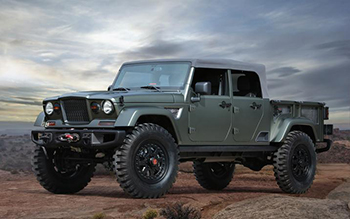
The Jeep Crew Chief 715 concept vehicle was built as a salute to legendary Jeep military service vehicles, in particular the Kaiser M715. This open-air Wrangler Unlimited-based concept vehicle showcases a burly design with heritage styling cues. The Crew Chief 715 utilizes modern-day construction with a rear seat and extra doors for additional passenger capacity while staying close to its classic military roots.

Steel front and rear bumpers, 20-in. beadlock wheels and 40-in. NDT military tires pay homage to the original Jeep military vehicles. The Crew Chief 715 utilizes an on-board air system with a hard-mounted quick-disconnect fitting for airing up or lending assistance to other vehicles on the trail. Other features include a master cylinder brake upgrade, cold-air intake and a modified exhaust.

Exterior features, such as Jeep Performance Parts off-road rock rails, a winch mounted into the front and rear bumpers, Dana 60 front and rear axles and a 4-in. lift kit with Jeep Performance Parts/Fox 2.0 Remote Reservoir shocks, give the Crew Chief 715 increased capability. The Tactical Green color scheme runs from the custom modified M715-inspired front end to the tailgate. The Crew Chief 715 features a military-themed 5-ft. cargo bed.

Interior features include leather bucket seats with canvas inserts, aircraft-inspired control switches and Mopar all-weather mats. The media center features a centrally located navigational compass.

The Jeep Crew Chief 715 is powered by the 3.6L Pentastar V6 engine and is mated to a five-speed automatic transmission.
shortcut
Jeep Shortcut

Jeep Shortcut

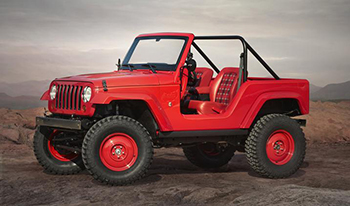
A carefully crafted take on the Jeep CJ-5, this Wrangler-based concept vehicle invokes the spirit of ’50s Americana with a shortened body and functional simplicity.

Exterior styling cues include a unique grille, hood, tailgate, front- and rear-wheel flares and custom chrome front and rear bumpers. A modified exhaust, 17-in. red steel wheels and 35-in. BFGoodrich Mud-Terrain T/A KM2 tires help the Jeep Shortcut maintain the look of an icon.

Jeep Performance Parts featured on the Shortcut include a front and rear Dana 44 axle and a 2-in. lift with Fox shocks. Overall body length has been reduced by 26 in., including bumpers and a spare tire to keep the Shortcut concept vehicle light and maneuverable on the trails.

Inside, the simple, yet functional, interior features low-back leather bucket seats with plaid inserts, a red ball shifter handle, four-point safety cage and Mopar all-weather mats.

The Jeep Shortcut is powered by the 3.6L Pentastar V6 engine and mated to a five-speed automatic transmission.
renegade
Jeep Renegade Commander

Jeep Renegade Commander

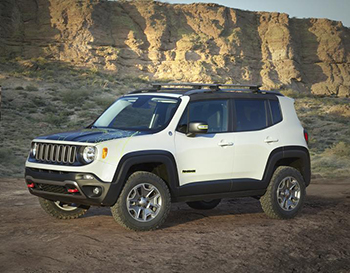
The Jeep Renegade Commander concept vehicle is equipped with an assortment of Mopar and Jeep Performance Parts. A 2-in. lift kit and 17-in. Rubicon aluminum wheels with 29.5-in. BFGoodrich All-Terrain T/A KO2 tires increase the off-road capabilities of the Jeep Renegade Commander.

The Fluorescent Gray exterior features Renegade’s MySky open-air roof with removable panels, custom body decal, Mopar off-road rock rails, skid plates and a modified exhaust. Also featured are the Mopar brand’s trailer hitch receiver and front and rear auxiliary lights.

Inside, the Renegade Commander includes Katzkin seat covers, body color bezel accents, a pedal kit, Mopar off-road kit and Mopar all-weather floor mats.

The Jeep Renegade Commander is powered by the 2.4L Tigershark engine with MultiAir2 mated to a nine-speed automatic transmission with Jeep Active Drive Low.
comanche
Jeep Comanche

Jeep Comanche

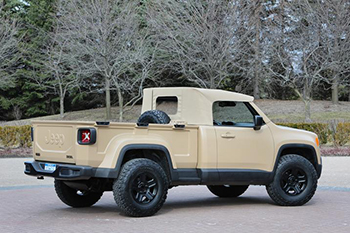
Based on the Jeep Renegade, the Jeep Comanche concept vehicle is designed to be off-road ready with practical utility. A nod to Jeep pickups of years past, the Comanche concept takes styling cues from military and civilian Jeep heritage.

The Comanche’s “Beige Against the Machine” concept exterior paint is accented with a satin black hood, a concept lower front fascia, winch, steel rear bumper, soft top and spare tire in the bed. The wheelbase has been stretched an additional 6 in. versus a production Renegade to accommodate Comanche’s 5-ft. bed.

Inside, the Comanche features custom seat covers, pedal covers, door sill guards and Mopar all-weather mats. Jeep Performance Parts, such as off-road rock rails, a 2-in. lift kit and a winch, bolster the Comanche’s off-road capability. The Comanche rolls on 16-in. painted wheels and 32-in. BFGoodrich All-Terrain T/A tires.

The Jeep Comanche is powered by a 2.0L diesel I-4 engine and mated to a nine-speed automatic transmission with Jeep Active Drive Lock, which includes low range and a locking rear differential.
fc
Jeep FC 150

Jeep FC 150

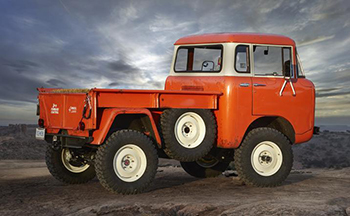
A true American workhorse, this ’60 Jeep FC 150 concept vehicle is rich with heritage and built to tackle both challenging rocky trails and the harshness of a western cattle ranch. Originally built from ’56–’65, the FC 150 is based on the CJ-5 and offers a clever packaging solution by keeping overall length to a minimum for maneuverability, but maintaining a full-length cargo box for utility.

This heritage Jeep vehicle continues to utilize its original steel body that bears battle scars while components underneath have been revamped. The FC 150’s off-road prowess has been enhanced courtesy of a ’05 Jeep Wrangler chassis modified to accept a Dana 44 front axle, Dana 60 rear axle and 17-in. white steel wheels wrapped in 33-in. BFGoodrich Mud-Terrain T/A KM2 tires.

Inside, the FC 150 features vinyl seat covers, a custom headliner wrapped in a vintage duck hunting pattern, CB radio, analog compass and Mopar all-weather mats.

The Jeep FC 150 heritage vehicle is powered by a 4.0L PowerTech I-6 and is mated to a three-speed automatic transmission.
trailcat
Jeep Trailcat

Jeep Trailcat

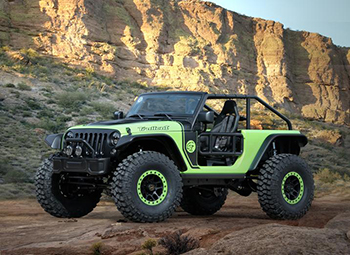
The Jeep Trailcat concept vehicle is the ultimate off-road machine, equally at home on Moab’s rugged trails or a high-speed section. The Trailcat concept utilizes the supercharged 6.2L HEMI Hellcat V8 engine and is mated to a six-speed manual transmission with a custom shifter ball featuring an embossed Hellcat logo.

To get the 707hp Hellcat engine into the Trailcat, designers stretched the wheelbase an additional 12 in. while chopping the windshield 2 in. for a sleeker look. Mopar exterior enhancements include a power-dome vented hood, Satin Black grille, LED headlamps and fog lamps and rock rails.

The robust off-road look is further aided by steel front and rear bumpers, 17-in. beadlock wheels and 39.5-in. BFGoodrich Krawler T/A KX tires, front and rear Dana 60 axles and Fox shocks.

Subtle design cues, such as a Hellcat decal on the front quarter panels and a Trailcat decal on the side of the hood, hint at the horsepower that lurks beneath, making this much more than a typical production Wrangler. The Trailcat’s interior is simple, yet functional, and features sport bucket seats from the Dodge Viper, made from carbon fiber and featuring Katzkin leather seat covers with accent stitching.
trailstorm
Jeep Trailstorm

Jeep Trailstorm

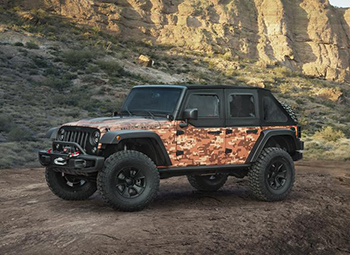
The Trailstorm concept vehicle is the ultimate Jeep Wrangler for exploring off the beaten path. Offering room for extra gear and fuel tanks, it is based on the Jeep Wrangler Unlimited and delivers elevated capability to conquer trails.

Off-road capabilities are enhanced with several Jeep Performance Parts, including 17-in. concept off-road wheels wrapped in 37-in. tires, a 2-in. lift kit with Jeep Performance Parts/Fox shocks, a Jeep Performance Parts Rubicon winch and Dana 44 front and rear axles. Half doors offer a clear view of obstacles ahead and a bedlined interior makes cleaning up after a day on the trails easy.

Mopar exterior enhancements include a winch guard, Satin Black grille, LED headlights and fog lights, high-top fenders, power-dome vented hood, Mopar off-road rock rails with a step, Big Brake Kit, a concept fast-back soft top, taillight guards and a Mopar fuel-filler door. Finishing the Trailstorm’s exterior upgrades are a steel front and rear Rubicon bumper and a Jeep Performance Parts tire carrier. The Trailstorm is wrapped in camouflage allowing it to blend into its surroundings in the Utah desert.

The Trailstorm’s bedlined interior also features Katzkin seat covers and Mopar all-weather floor mats. The Jeep Trailstorm is powered by a 3.6L Pentastar V6 engine and is mated to a five-speed automatic transmission.