By SEMA Editors
The Jeep and Mopar brands have once again joined forces to create seven new, custom-built concept vehicles for the annual Easter Jeep Safari in Moab, Utah, March 24–April 1. For the 52nd year, thousands of off-road enthusiasts will head to Moab for the annual Jeep event to participate in a week of technical off-roading on some of the most picturesque trails that the country has to offer.
A comprehensive assortment of production and prototype Jeep Performance Parts are featured on this year’s concept vehicles. The Mopar brand develops all Jeep Performance Parts with rigorous specifications and 4x4 capability in mind, allowing Jeep owners to further enhance their stock vehicles. Mopar already has more than 200 parts available for the all-new ’18 Jeep Wrangler.
The 2018 Easter Jeep Safari concept vehicles include:
Jeep 4SPEED |
|
Jeep 4SPEED
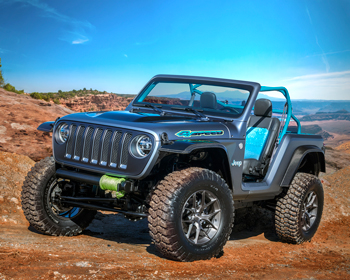
The Jeep 4SPEED concept is the latest in a line of lightweight Easter Jeep Safari concepts. Built “4SPEED,” this latest lightweight concept, following the Pork Chop concept in 2011 and Stitch concept in 2013, bolsters Wrangler’s off-road capability and performance through extensive weight savings, and showcases the all-new 2.0L turbocharged I-4 engine.
On the exterior, the Jeep 4SPEED concept features custom weight-saving measures, including a carbon-fiber hood, high-clearance carbon-fiber fender flares and a carbon-fiber rear tub with perforated aluminum panels. The 4SPEED concept boasts a sleek side profile courtesy of a raked windshield, elongated door openings and an aggressively swept back custom cage. The rear of the concept utilizes custom, lightweight bodywork, and because of the combined weight savings, 4SPEED’s ride height is 2-in. higher than a stock Wrangler.
In addition to being lightweight, overall length has been shortened by 22 in. while leaving the wheelbase at its stock length, resulting in increased approach and departure angles.
For even more capability, Jeep 4SPEED features Dana 44 front and rear axles with a 4.10 gear ratio and 18-in. lightweight monoblock wheels wrapped in 35-in. BFGoodrich Mud Terrain tires.
The interior features a customized instrument panel and re-trimmed front seats, while the rear seats have been removed and a welding curtain has been repurposed as a bikini top. The floor has been bedlined and the foot wells have been replaced with perforated aluminum panels.
The Jeep 4SPEED is powered by a 2.0L I-4 turbocharged engine, mated to an eight-speed automatic transmission.
Jeep Sandstorm |
|
Jeep Sandstorm
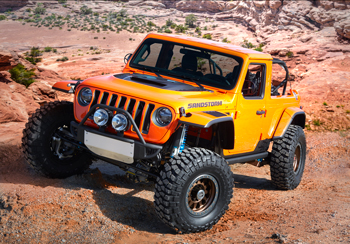
Inspired by Baja desert racers, the Jeep Sandstorm concept is all about blitzing long, sandy straightaways while still being capable of handling the daily driving duties. To accomplish this, the Sandstorm features off-road hardware designed to handle both, including an extreme-duty suspension system and a powertrain with excess power on tap.
To fit the Baja look, the exterior features custom styling cues, including a vented carbon-fiber hood, vented high-clearance front and rear fender flares and a cage that includes a rear-mounted lay-down-style spare tire carrier. The exterior handles and swing gate have been removed while the rear doors have been chopped for a cleaner look.
Other custom Baja-inspired touches include high-clearance front and rear tube bumpers, modified rock rails, an integrated onboard air compressor, race-style fuel filler, KC Carbon series front auxiliary lights and a chase light.
The front axle has been moved forward 4 in. and utilizes a heavy-duty longarm four-link suspension and track bar. The rear axle has been moved back 2 in. and utilizes a triangulated trailing arm four-link suspension. The longer wheelbase allows for increased high-speed stability. Custom coilovers and bypass shocks allow the front wheels to travel 14 in. while the rear wheels can travel up to 18 in.
For even more capability, the Jeep Sandstorm concept includes heavy-duty front and rear Dynatrac 60 axles with a 5.68 gear ratio, 17-in. beadlock wheels and 39.5-in. BFGoodrich Krawler tires.
The Baja race truck theme continues throughout the interior, which features a custom cage that integrates the chassis, leather-trimmed front seats and unique low-back racing bucket seats in the rear. A racing-inspired cluster and 7-in. off-road GPS unit handle navigation while independent rocker switches control on-board electronics, air compressor and axle lockers. The Sandstorm concept sheds all plastic trim and carpet in favor of a bedlined floor.
The Jeep Sandstorm is powered by a 6.4L V8 engine from the Mopar performance catalog and is mated to a six-speed manual transmission.
Jeep B-Ute |
|
Jeep B-Ute
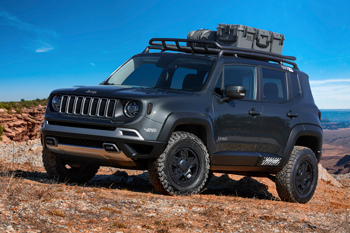
The Jeep B-Ute concept is equipped with a variety of Jeep Performance Parts. The exterior features front and rear fascias and an upper grille area, a hood with heat extractors and wider flares.
Jeep Performance Parts featured on the B-Ute concept include a 1.5-in. lift kit, a roof rack and rock rails. The Jeep B-Ute’s off-road capabilities are increased by using 17-in. wheels with a 30-mm offset, wrapped in BFGoodrich T/A Baja Champion tires.
Inside, the B-Ute features custom trimmed seats with Mineral inserts, a Carbonite finish on the shifter, speaker and vent surrounds, Piano Black inserts, a MOLLE system on the back of the front seats and Mopar all-weather floor mats.
The Jeep B-Ute is powered by a 2.4L Tigershark engine, mated to a nine-speed automatic transmission.
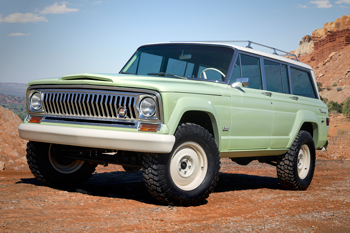
Jeep Wagoneer Roadtrip |
|
Jeep Wagoneer Roadtrip
The Jeep Wagoneer continues to utilize its original steel body, while the chassis and drivetrain have been updated.
The wheelbase has been stretched 5 in., and the body has been updated to accept the additional length, a wider track and custom fender flares. Other subtle exterior styling tweaks include reshaped wheel wells, bumpers and integrated rock rails. A razor grille freshens the look up front, while Bottle Green architectural glass replaces the original pieces.
The Wagoneer’s off-road capability has been bolstered courtesy of a boxed and reinforced frame, Dana 44 front and rear axles with lockers, four-link suspension with coilover springs, and 17-in. steel wheels wrapped in 33-in. BFGoodrich Mud-Terrain tires.
Inside, the Wagoneer features original front and rear bench seats, door panels, kick and rear panels, all trimmed in Oxblood-colored leather. A wicker headliner gives the Wagoneer an open, lighter feel and the floor has been bedlined. Additional interior details include a custom cooler fashioned from period-correct luggage, and a toolbox created from the valve cover of this Wagoneer’s original 230 Tornado OHC-6 engine.
Known as the original luxury 4x4, this ’65 Jeep Wagoneer is built to scale the trails of Moab or cruise the vast highways of the western states. Built from ’63 to ’91, the Wagoneer was the first four-wheel-drive vehicle mated to an automatic transmission, pioneering the first modern SUV.
The Jeep Wagoneer heritage vehicle is powered by a 5.7L V8 and is mated to a four-speed automatic transmission.
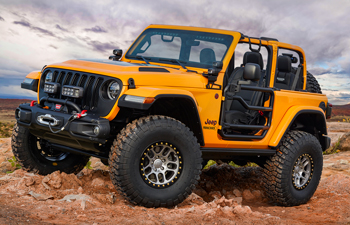
Nacho Jeep |
|
Nacho Jeep
The Nacho Jeep serves as a rolling catalog loaded with selections from the Mopar brand’s Jeep Performance Parts (JPP) menu, offering a blueprint off-roaders can follow to create their own custom trail vehicle.
Before a single part or accessory is added, this ’18 Jeep Wrangler Rubicon already stands out thanks to the rare Nacho yellow color. Jeep Performance Parts featured on the Nacho concept include a brawny hood that is accented with the standard black hood graphic featuring the all-new JPP badge, which is engineered to accommodate a cold-air intake that feeds the 2.0L turbocharged I-4 engine. The satin-black Mopar grille adds contrast to the Nacho exterior, and the sturdy steel Rubicon bumper offers off-road protection and functionality, and includes a Warn Winch kit.
Superior trail visibility, inspired by the Jeep Luminator concept vehicle shown at Moab in 2017, is delivered by A-pillar and brush guard-mounted LED lights from the Automotive Lighting division of Magneti Marelli, that mount via JPP brackets. Automotive Lighting LED header lights seal to the windshield for extra forward illumination, and a rear off-road scouting light uses four-color LEDs to communicate trail conditions: stop (red), 1–3 mph (amber), 3–25 mph (green) and a rear flood light (white).
A 2-in. lift kit elevates the Nacho concept for increased off-road clearance and includes new 2.5-in. diameter aluminum body shocks. Oversized 37-in. tires wrap around 17-in. beadlock-capable wheels, and a satin-carbon finish on the wheels is the sole conceptual touch on the Nacho concept. The beadlock trim rings are finished in high-gloss back and secured with cadmium-plated bolts. Other Jeep Performance Parts include rock rails that are thicker and wider to protect the exterior and carry a grippier coating similar to that used on RAM Truck bedliners, 2-in.-round tube doors, and grab handles embossed with the iconic Jeep grille logo to assist in vehicle ingress.
The spare-tire tailgate hinge reinforcement provides a solid foundation for a spare-tire carrier that mounts to the tailgate with strength enough to handle 37-in. tires. A JPP fuel door in black finish completes the exterior.
Off-road performance is achieved without sacrificing premium interior appointments. Black Katzkin leather seats are dressed up with the Jeep grille logo embroidered in light tungsten stitching on seatbacks, and light tungsten accent stitching on the seat bolsters.
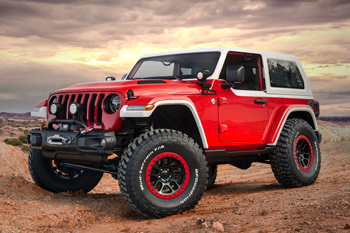
Jeep Jeepster |
|
Jeep Jeepster
Available Jeep Performance Parts concept modifications combine to bring to life the Jeep Jeepster concept. Based on a Wrangler Rubicon, this concept evokes the color palette and speedy styling of the ’66 Jeepster.
The original’s classic two-tone graphic theme is mirrored on its modern-day counterpart with a Firecracker Red body, set off by a Bright White concept hardtop, chopped by 2 in., and a Bright White custom windshield raked back 2.5 degrees to create a cropped, compact appearance. The customized windshield maintains the all-new Wrangler’s convenient fold-down feature. Bright White also accents the perimeter of the Rubicon fender flares, and an upper portion of the concept half doors. Jeep badging is replaced with a tri-color Jeepster hard badge.
The Jeepster balances concept possibilities with a range of presently available Jeep Performance Parts, including a JPP hood and graphic, without the optional cold-air intake or snorkel. LED off-road lights in 5- and 7-in. applications illuminate the trail for the Jeepster, shining bright at up to 8,000 lumens. The LED lights are mounted to the A-pillar via light brackets. The Rubicon steel bumper features premium production LED fog lamps.
A 2-in. lift kit and 2.5-in. diameter aluminum body shocks work with oversized, 37-in. BFGoodrich KO2 tires to raise the Jeepster above off-road obstacles. Beadlock-capable 17-in. wheels are accented by body-color matching Firecracker Red beadlock trim rings. Additional items from the JPP portfolio include a black fuel door, grab handles and all-weather floor mats.
Inside the Jeepster, a concept tubular roll cage replaces the sport bar and an additional 38-in. tire is secured with a custom in-cabin spare tire carrier. The interior meshes off-road functionality with premium features, including black Katzkin leather seats with Rubicon Red Jeep grille logos embroidered on the seatbacks, and Rubicon Red accent stitching on the seat bolsters. The instrument panel inserts are Firecracker Red to tie in with the exterior.
Relocation of the spare tire to the cabin provides an opportunity for another custom touch: concept storage packs mounted to the tailgate for transport of gear and supplies such as food, water and tools. The packs feature a split design to accommodate the rearview camera. A concept rock step—a unique combination of a rock rail/side step—completes the Jeepster.
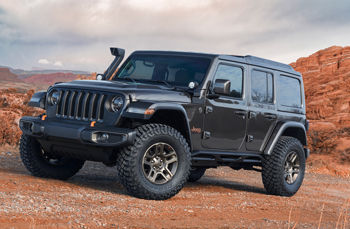
Jeep J-Wagon |
|
Jeep J-Wagon
The Jeep J-Wagon concept is personalized with Jeep Performance Parts to create a premium-styled vehicle equally at home on the trails and urban cityscapes.
Starting as a Wrangler Sahara, the J-Wagon is painted a conceptual Warm Neutral Grey with warm-tinted glass, and complemented with subtle Brass Monkey touches throughout the exterior. The J-Wagon features a version of the JPP hood designed with a cutout kit to work with the available snorkel, an appropriate choice for the sealed-cabin style of the vehicle. The hood latch is Brass Monkey and further embellished with a black Willys logo.
For hardcore off-roaders, new 5-in. LED lights mount with JPP brackets to deliver commercial and military-grade illumination. That trail detail is balanced with the street-appeal of a Mopar black grille pulled from a Wrangler Rubicon, and features body-color matching bezel trim. The premium Sahara bumper aligns with the vehicle’s color pattern via Brass Monkey fog lamp bezels. The J-Wagon concept also features 17-in. slot-design wheels that are also finished in Brass Monkey, a treatment chosen after receiving positive feedback in a sneak peek at the 2017 SEMA Show.
Black metal concept rock sliders guard the J-Wagon’s exterior, and a matching black metal concept JPP roof rack offers utility and functionality to fit any lifestyle. A black JPP fuel door and Orange Crush accents on the Jeep badge and tow hooks add style points. A spare 35-in. KM3 BFGoodrich tire mounts to the spare-tire tailgate hinge reinforcement, and includes the JPP Center High-Mount Stop Light (CHMSL) light relocation kit.
Premium appointments are the story inside. Camel-color Katzkin leather seats give an elite feel and feature stark brown piping and plow-through inserts that mimic the triangulated grille design of the concept rock rails. Eye-level Brass Monkey trim and bezel accents on the HVAC vents, door handles and steering wheel harmonize the interior with the exterior.