

SEMA's Vice President of Vehicle Technology discusses the business opportunities of advanced driver assistance systems.
Fri, 11/03/2017 - 11:22
Fri, 11/03/2017 - 11:22
SEMA's Vice President of Vehicle Technology discusses the business opportunities of advanced driver assistance systems.
Fri, 11/03/2017 - 10:50
SEMA News spoke with Hellwig Products about its Ford Design Award-winning “Operator” F-350 build.
Fri, 11/03/2017 - 10:50
SEMA News spoke with Hellwig Products about its Ford Design Award-winning “Operator” F-350 build.
Fri, 11/03/2017 - 10:11
By SEMA Editors
Here are a few highlights of the numerous new product announcements made at the 2017 SEMA Show.
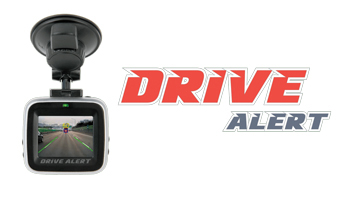 Power Acoustik debuted its new Drive Alert advanced driver assistance system with forward collision-warning system at the 2017 SEMA Show. |
Power Acoustik Debuts Drive Alert Advanced Driver Assistance System
Power Acoustik debuted its new Drive Alert advanced driver assistance system with forward collision-warning system at the 2017 SEMA Show.
The Drive Alert system is easy to install and alerts the driver in the case of a potential forward collision. The lane-departure warning system alerts the driver if the vehicle merges without using a turn signal.
In addition, the unit will make a digital video recording of the forward environment to recall or provide to police or insurance adjusters in the case of an accident.
For further details, visit www.poweracoustik.com.
Roadwire Releases Jeep Wrangler JK Roll Cage Covers
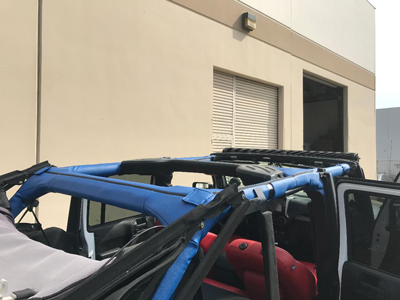 Roadwire Leather Interiors displayed its newly introduced roll-cage covers at the 2017 SEMA Show. |
Roadwire Leather Interiors displayed its newly introduced roll-cage covers at the 2017 SEMA Show.
The new covers, available in vinyl or leather, are offered in all colors in Roadwire’s extensive color pallet, and are available with a unique stich-line for customizing, matching Roadwire’s line of leather interiors.
Manufactured to exacting specifications to ensure a snug fit, the custom covers are available for the ’07–’17 4-door JK. The appearance-enhancing covers are easy to install, durable, weather and sun resistant, and provide protection from scratches, dents and road debris. The roll-cage covers will be on view at the SEMA Show in the New Products Showcase as well as the Roadwire exhibit, booth #12317 in the North Hall of the Las Vegas Convention Center.
“The addition of the JK roll-cage covers allows Roadwire to leverage its manufacturing, design and marketing expertise in the fast-growing Jeep accessory market,” he added. “The covers not only look great and finish the vehicle, they also stand up to the rigors of the off-road lifestyle. We invite our restyler and distributor customers looking for new products and new profit opportunities to discuss distribution avenues at the SEMA Show.”
More information is available at www.Roadwire.com.
Rancho Releases Right-Hand-Drive Jeep Wrangler JK Performance Suspension Kit
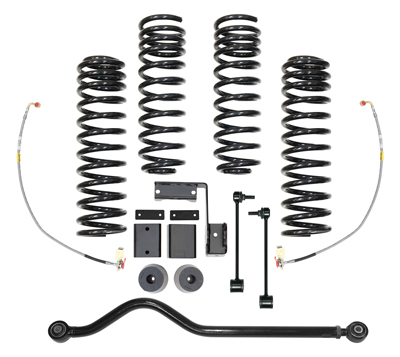 Rancho’s suspension systems for the Jeep Wrangler JK now includes a 3- to 3.5-inch progressive sport kit for right-hand-drive ’07–’17 models. |
The Rancho (SEMA Show booth #25133) brand’s offering of performance suspension systems for the Jeep Wrangler JK now includes a 3- to 3.5-in. progressive sport kit for right-hand-drive ’17-’07 models (Part No. RS66111BEXP). The new Rancho Jeep Wrangler JK kit is on display at the 2017 SEMA Show.
The new Rancho system includes progressive rate front and rear coil springs to provide enhanced on- and off-road ride characteristics; adjustable track bars that allow for precise centering of front axle, easing fit and improving overall performance; and exclusive, maintenance-free Rancho D2 high-articulation bushings that self-center and are completely grease free.
High-strength, heavy-duty steel sway bar links that provide added control and optimal roll and sway characteristics also are included. Track bar relocation brackets and extended length stainless braided front brake lines complete the kit. All Rancho brackets are manufactured using high-strength, low-alloy steel.
To complete the kit, any of the Rancho performance shock absorber series—RS9000XLs, RS7000MTs and RS5000s—are compatible with the system. The Rancho kit was designed for full compatibility with the Jeep Electronic Stability Control System. The system fits 35-in. tires with trimming.
More information is available at www.GoRancho.com.
Fri, 11/03/2017 - 10:11
By SEMA Editors
Here are a few highlights of the numerous new product announcements made at the 2017 SEMA Show.
Power Acoustik debuted its new Drive Alert advanced driver assistance system with forward collision-warning system at the 2017 SEMA Show. |
Power Acoustik Debuts Drive Alert Advanced Driver Assistance System
Power Acoustik debuted its new Drive Alert advanced driver assistance system with forward collision-warning system at the 2017 SEMA Show.
The Drive Alert system is easy to install and alerts the driver in the case of a potential forward collision. The lane-departure warning system alerts the driver if the vehicle merges without using a turn signal.
In addition, the unit will make a digital video recording of the forward environment to recall or provide to police or insurance adjusters in the case of an accident.
For further details, visit www.poweracoustik.com.
Roadwire Releases Jeep Wrangler JK Roll Cage Covers
Roadwire Leather Interiors displayed its newly introduced roll-cage covers at the 2017 SEMA Show. |
Roadwire Leather Interiors displayed its newly introduced roll-cage covers at the 2017 SEMA Show.
The new covers, available in vinyl or leather, are offered in all colors in Roadwire’s extensive color pallet, and are available with a unique stich-line for customizing, matching Roadwire’s line of leather interiors.
Manufactured to exacting specifications to ensure a snug fit, the custom covers are available for the ’07–’17 4-door JK. The appearance-enhancing covers are easy to install, durable, weather and sun resistant, and provide protection from scratches, dents and road debris. The roll-cage covers will be on view at the SEMA Show in the New Products Showcase as well as the Roadwire exhibit, booth #12317 in the North Hall of the Las Vegas Convention Center.
“The addition of the JK roll-cage covers allows Roadwire to leverage its manufacturing, design and marketing expertise in the fast-growing Jeep accessory market,” he added. “The covers not only look great and finish the vehicle, they also stand up to the rigors of the off-road lifestyle. We invite our restyler and distributor customers looking for new products and new profit opportunities to discuss distribution avenues at the SEMA Show.”
More information is available at www.Roadwire.com.
Rancho Releases Right-Hand-Drive Jeep Wrangler JK Performance Suspension Kit
Rancho’s suspension systems for the Jeep Wrangler JK now includes a 3- to 3.5-inch progressive sport kit for right-hand-drive ’07–’17 models. |
The Rancho (SEMA Show booth #25133) brand’s offering of performance suspension systems for the Jeep Wrangler JK now includes a 3- to 3.5-in. progressive sport kit for right-hand-drive ’17-’07 models (Part No. RS66111BEXP). The new Rancho Jeep Wrangler JK kit is on display at the 2017 SEMA Show.
The new Rancho system includes progressive rate front and rear coil springs to provide enhanced on- and off-road ride characteristics; adjustable track bars that allow for precise centering of front axle, easing fit and improving overall performance; and exclusive, maintenance-free Rancho D2 high-articulation bushings that self-center and are completely grease free.
High-strength, heavy-duty steel sway bar links that provide added control and optimal roll and sway characteristics also are included. Track bar relocation brackets and extended length stainless braided front brake lines complete the kit. All Rancho brackets are manufactured using high-strength, low-alloy steel.
To complete the kit, any of the Rancho performance shock absorber series—RS9000XLs, RS7000MTs and RS5000s—are compatible with the system. The Rancho kit was designed for full compatibility with the Jeep Electronic Stability Control System. The system fits 35-in. tires with trimming.
More information is available at www.GoRancho.com.
Fri, 11/03/2017 - 09:56
By SEMA Editors
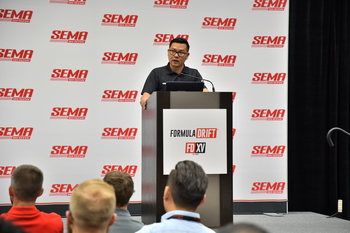 Formula DRIFT President and Co-Founder Jim Liaw announced the 2018–2019 provisional schedule during a press conference at the 2017 SEMA Show. |
Formula DRIFT has announced that ITW Global Brands has extended their support of the Series with Title Sponsor Black Magic and Official Sponsor Gumout for the 2018 and 2019 season. Formula DRIFT also announced the addition of ITW Global Brands, Permatex and Fast Orange as Official Sponsors for the 2018 Pro Championship.
Additionally, Formula DRIFT announced that it had entered into an exclusive relationship with two tire manufacturers, Achilles Radial and Nexen Tire, who will serve as the Official Tire Suppliers of Formula DRIFT PRO 2 Championship. The partnership will help with team cost containment, company inventory management and competition parity. These steps will help continue to serve the development of the next generation of PRO drivers.
Formula DRIFT has announced the provisional schedule for the 2018 Championship Season. Notable changes include moving the final round of the season, which was previously Irwindale Speedway (now closed), to Las Vegas. Additionally, St. Louis and Montreal are in contention for venue prospects for the July event.
The Black Magic Formula DRIFT Championship presented by BlackVue Dash Cameras will begin in April at Round 1: Streets of Long Beach for the 2018 season.
The 2018 Black Magic Formula DRIFT Championship presented by BlackVue Dash Cameras Provisional Schedule*
Round 1: Streets of Long Beach
April 6–7: Long Beach, California
Invitational: Super Drift Challenge at the Grand Prix of Long Beach**
April 13–14: Long Beach, California
Round 2: Invasion
April 27–28: Orlando, Florida
Round 3: Road to the Championship
May 11–12: Atlanta, Georgia, with PRO 2
Round 4: The Gauntlet
June: Wall, New Jersey
Round 5: Throwdown
July: Monroe, Washington
Round 6: TBD
August: St. Louis, Missouri, with PRO 2 or Montreal, Canada
Round 7: Showdown
September 14–15: Dallas, Texas, with PRO 2
Round 8: Title Fight
October 12–13: Las Vegas, Nevada, with PRO 2
*Subject to Change
**Non-Championship Points Competition
For more information visit, www.formulad.com.
Fri, 11/03/2017 - 09:56
By SEMA Editors
Formula DRIFT President and Co-Founder Jim Liaw announced the 2018–2019 provisional schedule during a press conference at the 2017 SEMA Show. |
Formula DRIFT has announced that ITW Global Brands has extended their support of the Series with Title Sponsor Black Magic and Official Sponsor Gumout for the 2018 and 2019 season. Formula DRIFT also announced the addition of ITW Global Brands, Permatex and Fast Orange as Official Sponsors for the 2018 Pro Championship.
Additionally, Formula DRIFT announced that it had entered into an exclusive relationship with two tire manufacturers, Achilles Radial and Nexen Tire, who will serve as the Official Tire Suppliers of Formula DRIFT PRO 2 Championship. The partnership will help with team cost containment, company inventory management and competition parity. These steps will help continue to serve the development of the next generation of PRO drivers.
Formula DRIFT has announced the provisional schedule for the 2018 Championship Season. Notable changes include moving the final round of the season, which was previously Irwindale Speedway (now closed), to Las Vegas. Additionally, St. Louis and Montreal are in contention for venue prospects for the July event.
The Black Magic Formula DRIFT Championship presented by BlackVue Dash Cameras will begin in April at Round 1: Streets of Long Beach for the 2018 season.
The 2018 Black Magic Formula DRIFT Championship presented by BlackVue Dash Cameras Provisional Schedule*
Round 1: Streets of Long Beach
April 6–7: Long Beach, California
Invitational: Super Drift Challenge at the Grand Prix of Long Beach**
April 13–14: Long Beach, California
Round 2: Invasion
April 27–28: Orlando, Florida
Round 3: Road to the Championship
May 11–12: Atlanta, Georgia, with PRO 2
Round 4: The Gauntlet
June: Wall, New Jersey
Round 5: Throwdown
July: Monroe, Washington
Round 6: TBD
August: St. Louis, Missouri, with PRO 2 or Montreal, Canada
Round 7: Showdown
September 14–15: Dallas, Texas, with PRO 2
Round 8: Title Fight
October 12–13: Las Vegas, Nevada, with PRO 2
*Subject to Change
**Non-Championship Points Competition
For more information visit, www.formulad.com.
Fri, 11/03/2017 - 09:08
By SEMA Editors
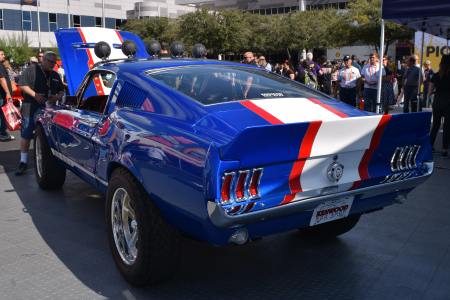 The final onsite bid for the ’67 Ford Mustang Fastback was $55,000. |
Leading up to National Diabetes Month in November, eBay Motors opened bidding in late October on a modern rebuild of a classic ’67 Ford Mustang Fastback. All proceeds from the sale benefit the Juvenile Diabetes Research Foundation (JDRF) through eBay for Charity.
The starting bid price was $1,967, and all bidders pre-qualified at www.ebay.com/motorsontheroad. The charity auction ran through November 2. To celebrate the final sale, a countdown took place at the Ford Out Front area at the 2017 SEMA Show. Attendees were also able to tune in via eBay’s Facebook Live.
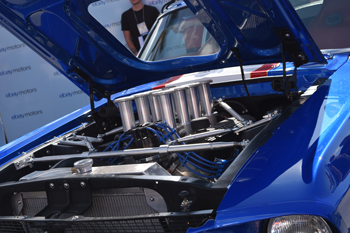 This ’67 Mustang Fastback—nicknamed “Red, White and Rowdy”—boasts more than $140,000 in upgrades. |
The final onsite bid for the ’67 Ford Mustang Fastback was $55,000.
Beginning in May, eBay partnered with TV host and racing analyst Rutledge Wood, automotive artist K.C. Mathieu, and gearhead Mike Finnegan of YouTube’s “Roadkill” to transform the ’67 Mustang, using parts and accessories sourced from eBay Motors.
After teasing the progress all summer long, the team displayed the finished Mustang—nicknamed “Red, White and Rowdy” and boasting more than $140,000 in upgrades—at its final ‘On the Road’ appearance at the SEMA Show.
More information on the car listing can be found at www.ebay.com/motorsontheroad.
Fri, 11/03/2017 - 09:08
By SEMA Editors
The final onsite bid for the ’67 Ford Mustang Fastback was $55,000. |
Leading up to National Diabetes Month in November, eBay Motors opened bidding in late October on a modern rebuild of a classic ’67 Ford Mustang Fastback. All proceeds from the sale benefit the Juvenile Diabetes Research Foundation (JDRF) through eBay for Charity.
The starting bid price was $1,967, and all bidders pre-qualified at www.ebay.com/motorsontheroad. The charity auction ran through November 2. To celebrate the final sale, a countdown took place at the Ford Out Front area at the 2017 SEMA Show. Attendees were also able to tune in via eBay’s Facebook Live.
This ’67 Mustang Fastback—nicknamed “Red, White and Rowdy”—boasts more than $140,000 in upgrades. |
The final onsite bid for the ’67 Ford Mustang Fastback was $55,000.
Beginning in May, eBay partnered with TV host and racing analyst Rutledge Wood, automotive artist K.C. Mathieu, and gearhead Mike Finnegan of YouTube’s “Roadkill” to transform the ’67 Mustang, using parts and accessories sourced from eBay Motors.
After teasing the progress all summer long, the team displayed the finished Mustang—nicknamed “Red, White and Rowdy” and boasting more than $140,000 in upgrades—at its final ‘On the Road’ appearance at the SEMA Show.
More information on the car listing can be found at www.ebay.com/motorsontheroad.