

Held as a virtual event, this meeting is the ideal opportunity for YEN members to network and make new connections with other young professionals in the industry at a time when travel and physical interactions may be limited. Attendees will learn new information about this year’s Launch Pad program and meet the top 5 finalists, as well as have an opportunity to participate in career development programs.
Thu, 09/24/2020 - 08:27
Thu, 09/24/2020 - 08:20
By SEMA Editors
 |
The Jessi Combs Foundation (JCF) plans to issue scholarships annually to women who want to pursue their dreams of a career in the trades, with the first round to be awarded later this year. Additionally, JCF will leverage its extensive network of industry contacts to help applicants and program graduates with the introductions designed to kick-start their first opportunity in the trades industry.
Just over a year ago, SEMA veteran and industry pioneer Jessi Combs established the new land-speed record as the World’s Fastest Woman, according to the Guinness Book of World Records, and passed into legend. Since that time, The Jessi Combs Foundation was formed and the board of directors have launched The Jessi Combs Foundation Scholarship program in her honor.
“From her early start at WYOTech to setting the record as the World’s Fastest Woman, Jessi accomplished so much and has been an inspiration to women (and men) around the world, including me.” said Adel Adams, board member for the Jessi Combs Foundation and events marketing manager at Warn Industries Inc.
The mission of The Jessi Combs Foundation is to “Educate, Inspire and Empower” the next generation of trailblazing and stereotype-breaking women. A guiding principle to this mission is a simple question “What Would Jessi Do?” The long-term vision for the Jessi Combs Foundation is to execute this mission via three pillars:
- Educate: Trades were important to Combs—the very vehicle that provided so many opportunities to her. JCF will distribute individual scholarships and in-kind partner donations to educational institutions and learning centers to continually be a driving force behind the next generation of women in trades. Additionally, JCF plans to support live event workshops that keep alive the one-on-one interactions that Combs loved so much.
- Inspire: This will come to life via in-house projects as the foundation looks to continually set new bars and use its voice to shine light and recognition on those whose achievements, talents and accomplishments inspire others.
- Empower: Grants and sponsorships will be the primary tools to support those women with a dream of achieving their own level of greatness, and that aligns with the barrier-smashing attitude Combs embodied.
Those interested in applying for the Jessi Combs Foundation Scholarship Program can download the application form at www.thejessicombsfoundation.com. Women are encouraged to apply by September 30. Those interested in supporting the foundation or becoming a partner are encouraged to reach out via the contact section on the website. All donations raised will go to The Jessi Combs Foundation and will be used in compliance with the official purpose of the organization.
Thu, 09/24/2020 - 08:20
By SEMA Editors
|
The Jessi Combs Foundation (JCF) plans to issue scholarships annually to women who want to pursue their dreams of a career in the trades, with the first round to be awarded later this year. Additionally, JCF will leverage its extensive network of industry contacts to help applicants and program graduates with the introductions designed to kick-start their first opportunity in the trades industry.
Just over a year ago, SEMA veteran and industry pioneer Jessi Combs established the new land-speed record as the World’s Fastest Woman, according to the Guinness Book of World Records, and passed into legend. Since that time, The Jessi Combs Foundation was formed and the board of directors have launched The Jessi Combs Foundation Scholarship program in her honor.
“From her early start at WYOTech to setting the record as the World’s Fastest Woman, Jessi accomplished so much and has been an inspiration to women (and men) around the world, including me.” said Adel Adams, board member for the Jessi Combs Foundation and events marketing manager at Warn Industries Inc.
The mission of The Jessi Combs Foundation is to “Educate, Inspire and Empower” the next generation of trailblazing and stereotype-breaking women. A guiding principle to this mission is a simple question “What Would Jessi Do?” The long-term vision for the Jessi Combs Foundation is to execute this mission via three pillars:
- Educate: Trades were important to Combs—the very vehicle that provided so many opportunities to her. JCF will distribute individual scholarships and in-kind partner donations to educational institutions and learning centers to continually be a driving force behind the next generation of women in trades. Additionally, JCF plans to support live event workshops that keep alive the one-on-one interactions that Combs loved so much.
- Inspire: This will come to life via in-house projects as the foundation looks to continually set new bars and use its voice to shine light and recognition on those whose achievements, talents and accomplishments inspire others.
- Empower: Grants and sponsorships will be the primary tools to support those women with a dream of achieving their own level of greatness, and that aligns with the barrier-smashing attitude Combs embodied.
Those interested in applying for the Jessi Combs Foundation Scholarship Program can download the application form at www.thejessicombsfoundation.com. Women are encouraged to apply by September 30. Those interested in supporting the foundation or becoming a partner are encouraged to reach out via the contact section on the website. All donations raised will go to The Jessi Combs Foundation and will be used in compliance with the official purpose of the organization.
Thu, 09/24/2020 - 07:56
By Kyle Cheng
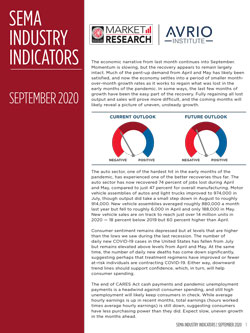 According to the latest “SEMA Industry Indicators” report, the auto sector has recovered 74% of the jobs lost during April and May, compared to just 47% for overall American manufacturing. |
The U.S. economy continues to recover what was lost in the early months of the pandemic. Much of the pent-up demand from April and May has likely been satisfied, and now the economy settles into a period of smaller month-over-month growth as it works to regain what was lost in the early months of the pandemic.
The auto sector, one of the hardest hit in the early months of the pandemic, has experienced one of the better recoveries so far. It has recovered 74% of the jobs lost during April and May, compared to just 47% for overall American manufacturing. Likewise, new vehicle sales are on track to reach just over 14 million units in 2020—18% below 2019 but 60% higher than April.
Consumer confidence is down but remains higher than the lows seen during the last recession from 2007–2009. Right now, the end of stimulus and pandemic unemployment payments are headwinds against this. As the virus situation improves, consumers will gain more confidence and increase their spending.
Want more information on the trends affecting the specialty-equipment industry? Download the September “SEMA Industry Indicators Report”—available for free at www.sema.org/research.
Thu, 09/24/2020 - 07:56
By Kyle Cheng
According to the latest “SEMA Industry Indicators” report, the auto sector has recovered 74% of the jobs lost during April and May, compared to just 47% for overall American manufacturing. |
The U.S. economy continues to recover what was lost in the early months of the pandemic. Much of the pent-up demand from April and May has likely been satisfied, and now the economy settles into a period of smaller month-over-month growth as it works to regain what was lost in the early months of the pandemic.
The auto sector, one of the hardest hit in the early months of the pandemic, has experienced one of the better recoveries so far. It has recovered 74% of the jobs lost during April and May, compared to just 47% for overall American manufacturing. Likewise, new vehicle sales are on track to reach just over 14 million units in 2020—18% below 2019 but 60% higher than April.
Consumer confidence is down but remains higher than the lows seen during the last recession from 2007–2009. Right now, the end of stimulus and pandemic unemployment payments are headwinds against this. As the virus situation improves, consumers will gain more confidence and increase their spending.
Want more information on the trends affecting the specialty-equipment industry? Download the September “SEMA Industry Indicators Report”—available for free at www.sema.org/research.
Thu, 09/17/2020 - 15:22
By SEMA Editors
 Registration for SEMA360 is available at no cost to SEMA-member buyers. Qualified, non-SEMA-member buyers pay $25. |
More than 500 high-quality, specialty-equipment manufacturers are planning for SEMA360, taking place on computers everywhere, November 2-6, 2020. SEMA360 is an online marketplace that connects buyers with companies and products across all markets, from off-road, SUVs and light trucks to hot rods and restoration, racing & performance, and collision repair.
Registration is available at no cost to SEMA-member buyers. Qualified, non-SEMA-member buyers pay $25.
You could spend time researching 500 companies on your own, but why would you? SEMA360 is the one place where you'll find it all—product and feature vehicle debuts, education sessions covering timely topics and, most importantly, company representatives ready to answer your questions.
SEMA Vice President of Events Tom Gattuso explains how getting business done in SEMA360 will be much more efficient than surfing the Internet.
“Its analogous to using the internet to look up individual restaurants versus using a consolidated resource like Yelp or OpenTable,” said Gatusso.
“In one place, you see numerous options and get menus, directions, hours and user reviews. SEMA360 uses similar technology to refine your search for the latest offerings from the best of the industry all organized on a single platform in an easy-to-use format."
Not only will you find top companies and products, SEMA360 will also save you time and eliminate the guesswork of finding the right person with whom to interact.
Gattuso continued: “You’ll be able to easily meet with manufacturers, see new products, view demonstrations, access a feature vehicle gallery, attend seminars and more. Truth is, it would take you months, even years, to find all this rich content and contact as many manufacturer representatives, vehicle builders and educators on your own.”
Find your future best sellers online from the comfort of your home or office with SEMA360. Register today!
Thu, 09/17/2020 - 15:22
By SEMA Editors
Registration for SEMA360 is available at no cost to SEMA-member buyers. Qualified, non-SEMA-member buyers pay $25. |
More than 500 high-quality, specialty-equipment manufacturers are planning for SEMA360, taking place on computers everywhere, November 2-6, 2020. SEMA360 is an online marketplace that connects buyers with companies and products across all markets, from off-road, SUVs and light trucks to hot rods and restoration, racing & performance, and collision repair.
Registration is available at no cost to SEMA-member buyers. Qualified, non-SEMA-member buyers pay $25.
You could spend time researching 500 companies on your own, but why would you? SEMA360 is the one place where you'll find it all—product and feature vehicle debuts, education sessions covering timely topics and, most importantly, company representatives ready to answer your questions.
SEMA Vice President of Events Tom Gattuso explains how getting business done in SEMA360 will be much more efficient than surfing the Internet.
“Its analogous to using the internet to look up individual restaurants versus using a consolidated resource like Yelp or OpenTable,” said Gatusso.
“In one place, you see numerous options and get menus, directions, hours and user reviews. SEMA360 uses similar technology to refine your search for the latest offerings from the best of the industry all organized on a single platform in an easy-to-use format."
Not only will you find top companies and products, SEMA360 will also save you time and eliminate the guesswork of finding the right person with whom to interact.
Gattuso continued: “You’ll be able to easily meet with manufacturers, see new products, view demonstrations, access a feature vehicle gallery, attend seminars and more. Truth is, it would take you months, even years, to find all this rich content and contact as many manufacturer representatives, vehicle builders and educators on your own.”
Find your future best sellers online from the comfort of your home or office with SEMA360. Register today!
Thu, 09/17/2020 - 14:58
By Kyle Cheng
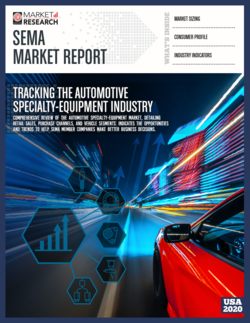 The “2020 SEMA Market Report” provides a comprehensive look at how the products your company sells are purchased and installed. |
Interested in finding out the next hottest trend? Want to see where consumers are purchasing their parts? Whatever your business objectives may be, SEMA Market Research’s reports can help connect you with the information you need to make informed business decisions. All of these reports, and much more, are available for free at www.sema.org/research.
Here are some of the latest reports from SEMA Market Research:
2020 SEMA Market Report: Looking for a deeper dive into the specialty-equipment market? The “2020 SEMA Market Report” provides a comprehensive look at how the products your company sells are purchased and installed. Also included is the most up-to-date information on parts buyers, key industry trends and forecasts and insights into the vehicles currently on the road.
SEMA State of the Consumer Report – July 2020: In this report, the SEMA Market Research team explores the current state of consumers within the United States and their outlook for the future. This quick snapshot looks at how consumers are emerging from coronavirus lockdown—including recent driving patterns, retail behavior and how they are interacting with the specialty-equipment industry.
The SEMA Market Research team is here to help you and your business. If you have any questions or information needs, feel free to reach out to us at research@sema.org.
Thu, 09/17/2020 - 14:58
By Kyle Cheng
The “2020 SEMA Market Report” provides a comprehensive look at how the products your company sells are purchased and installed. |
Interested in finding out the next hottest trend? Want to see where consumers are purchasing their parts? Whatever your business objectives may be, SEMA Market Research’s reports can help connect you with the information you need to make informed business decisions. All of these reports, and much more, are available for free at www.sema.org/research.
Here are some of the latest reports from SEMA Market Research:
2020 SEMA Market Report: Looking for a deeper dive into the specialty-equipment market? The “2020 SEMA Market Report” provides a comprehensive look at how the products your company sells are purchased and installed. Also included is the most up-to-date information on parts buyers, key industry trends and forecasts and insights into the vehicles currently on the road.
SEMA State of the Consumer Report – July 2020: In this report, the SEMA Market Research team explores the current state of consumers within the United States and their outlook for the future. This quick snapshot looks at how consumers are emerging from coronavirus lockdown—including recent driving patterns, retail behavior and how they are interacting with the specialty-equipment industry.
The SEMA Market Research team is here to help you and your business. If you have any questions or information needs, feel free to reach out to us at research@sema.org.
Thu, 09/17/2020 - 13:28
By Richard Hail
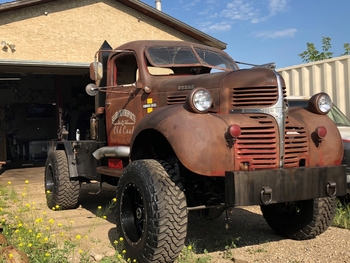 Mattteo Medoro’s winning build was created from the cab and front end of a ’47 Dodge two-ton pickup joined to the frame of a ’92 Dodge Cummins 4x4. |
Matteo Medoro once again joins the ranks of the SEMA Young Guns with a win at the 2020 SEMA Battle of the Builders (BOTB) Young Guns Pacific Northwest virtual regional qualifier. For the second year in a row, he moves on to compete alongside his peers in the BOTB competition this November.
His winning build, which he started working on immediately following the 2019 SEMA Show, was created from the cab and front end of a ’47 Dodge two-ton pickup joined to the frame of a ’92 Dodge Cummins 4x4. After having the frame sandblasted, he gave it a healthy coating of POR-15 rust preventer. Then he lifted the cab into place, making sure the late-model diesel powerplant would fit into the classic’s frame. Once aligned, he designed and created all of the mounts and adapters needed to fuse the two trucks together including a custom bumper and deck with ample storage for tools, a full-size jack and more.
From there, Medoro added a Northern Radiator behind the cab, fabricating all of the radiator lines and intercooler lines himself out of copper. The powertrain includes an upgraded turbo, injection pump, injectors, lift pump and a rebuilt transmission putting out 550 hp and more than 1,000 lb.-ft. of torque. A customized FLO-PRO exhaust runs through the cab and along the running boards.
The interior boasts a headliner sewn together from upcycled old Albertan potato sacks and burlap, while the seats and door panels were created from distressed leather with a pattern stitched into the seats that are based off of Medoro’s cowboy boots. The imposing truck sits on 37-in. tires all around and boasts a finish that is part patina, part fauxtina.
The Battle of the Builders competition celebrates the amazing craftsmanship and talents of people who create and build some of the most unique cars in the world. The Young Guns program is a feeder to the SEMA Battle of the Builders competition, and offers up-and-coming builders who are 27 or under the opportunity to compete to earn a spot in the SEMA Battle of the Builders competition. Furthermore, the Young Guns program recognizes and inspires the next wave of young builders and gets them actively involved within the aftermarket industry.
To see more of this build alongside hundreds of others, register for SEMA360, where you’ll also receive access to Feature Vehicle displays, the latest aftermarket products and industry-leading educational sessions. Manufacturers and buyers can register and connect at www.sema360.com.