Thu, 07/13/2023 - 18:20

By Ashley Reyes

WTCNetworking is not only about trading information; it’s a necessary investment that can help industry professionals build their reputations and establish long-term relationships with mutual benefits. 

SEMA members will not want to miss the next Wheel Tire & Council (WTC) Coffee & Conversation networking event, where they will establish valuable business connections and discuss the state of the wheel and tire industry. 

Taking place on Thursday, August 3 at 9:00 a.m. PDT, the event will feature an open discussion among attendees about the latest trends, innovations and market dynamics happening in the wheel and tire aftermarket. Attendees will gain insight into opportunities and challenges that other businesses are experiencing, share their experiences, exchange ideas and build business relationships that can further their career or company goals. 

Organizers will introduce a discussion topic to start the conversation, but attendees are encouraged to bring a talking point that impacts their business. Register now.

Questions can be directed to Nicole Bradle at nicoleb@sema.org

Thu, 07/13/2023 - 17:14

By SEMA Editors

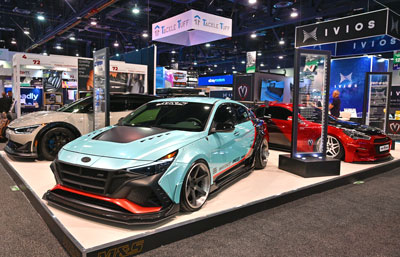
Exhibitors of the 2023 SEMA Show are invited to expand their reach, productVehicles exposure and Show-floor presence by offering products to builders through the Products for Project-Vehicle Builders list.

The list, which will be updated in SEMA News, features product offers and contact information from confirmed SEMA Show exhibitors looking to collaborate with builders. 

Builders interested in obtaining a product should contact exhibitors directly. With each project vehicle required to be supported by a current 2023 SEMA Show exhibitor, all product-placement decisions, negotiations and agreements are the responsibility of the exhibiting manufacturer and the builder.

The list is open to exhibitors of the 2023 SEMA Show only. To be included in the list, complete the form.

Exhibitors: Each submission will appear on a first-come, first-served basis. As participation increases, all submissions will also be archived on the SEMA Show website.

Note: For verification purposes, the Project-Vehicle Builders form must be used to participate in the program; email submissions will not be included in the list. Participation in the list does not guarantee product or vehicle placement at the 2023 SEMA Show.

View the 2023 Products for Project-Vehicle Builders list.

Thu, 07/13/2023 - 16:42

By SEMA Editors

RS Q8

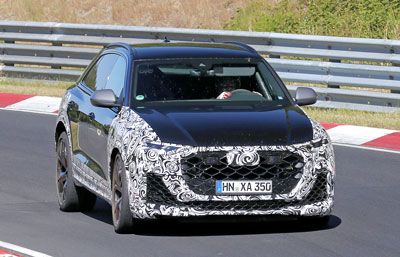
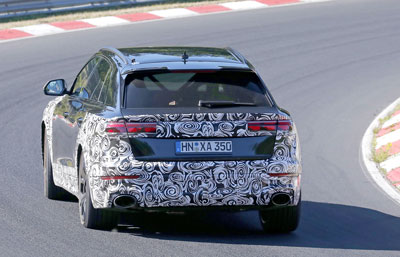
The Audi Q8, the SUV flagship of the brand, was spotted testing on the German Nürburgring race track by our sources, which noticed refreshed bumpers, fenders, side sills, tailgate and lighting units. The most significant change compared to the current Audi RS Q8 is the LED headlights and taillights graphics.

Other notable changes at the front include the honeycomb pattern on the single-frame grille, which now features larger holes. The surfacing on the front and rear fenders appears identical under the camouflage, but Audi may be hiding some trim changes. The same applies to the tail, except for the lighting units and possibly the rear diffuser.

The debut of the refreshed Audi RS Q8 is expected in 2024, six years after its original debut in 2018. In addition, an all-new second generation of the Q8 is rumored for 2026, when Audi will launch its last new internal combustion engine-powered model before going electric-only by 2033.

Audi rear
Thu, 07/13/2023 - 16:40

By SEMA Editors

Stellantis has unveiled STLA Medium, a global battery electric vehicle-by-STLAdesign platform with state-of-the-art features, including a best-in-class range of 435 miles, energy efficiency, embedded power and charging power.
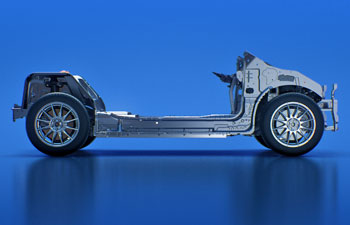
The STLA Medium platform offers long range combined with designed-in flexibility to host a variety of vehicles and propulsion configurations in the C- and D-segments, which accounted for 35 million sales in 2022, nearly half the 78.5 million vehicles sold globally that year. 

Today, Stellantis brands offer 26 vehicle nameplates in those segments on a variety of platforms. Up to two million vehicles per year can be built on the STLA Medium platform in several plants across the world, starting in Europe this year.

STLA Medium is the first of four global battery electric vehicle (BEV) platforms that underpin the company's future products. Read the complete details in the Stellantis announcement.

Craig Scanlon Appointed as New CEO of K&N Engineering

K&N Engineering has announced the appointment of Craig Scanlon as the company's new CEO, effective immediately. He replaces outgoing CEO Randy Bays.

"Over the past 15 months, Bays has played a vital role in driving the business's growth efforts and positioning it for future success. The K&N team expresses its deepest appreciation and will continue to benefit from Bays' insight as he transitions to a board role," said a company rep in a release.

As the new CEO of K&N Engineering, Scanlon will help implement transformational growth strategies, foster high-performance teams with a strong culture of accountability, and showcase exceptional business acumen encompassing sales leadership, brands, operations, R&D and financial management.

Scanlon spent 18 years at Polaris, where he played a pivotal role in building multi-billion-dollar businesses, including the Polaris RZR and Polaris Ranger brands. His general management roles in both the off-road and on-road divisions, as well as his tenure as the chief marketing officer, are said to have contributed significantly to the growth of Polaris.

In addition, Scanlon spent four years as CEO of Transamerican Auto Parts (4 Wheel Parts), where he spearheaded the successful turnaround and eventual sale of the company, a release stated.

Thu, 07/13/2023 - 16:11

By SEMA Editors

Bob AirheartBob Airheart, a 1993 SEMA Hall of Fame inductee and industry innovator, has passed away.
Although Airheart operated his own rep agency, the Airheart name is also well known in the brake industry, notably for industrial and high-speed applications. Trains, buses and race cars have all been stopped by Airheart, a company owned and operated by Bob until it was sold.

PWA (now the Custom Automotive Network) awarded Airheart its Person of the Year Award in 1980 for his outstanding contributions to the warehouse distributors and in appreciation of his conscientious dedication as an individual member of the specialty-equipment industry.

Airheart has also worked for Hurst as well as Cragar as a national sales manager.

Thu, 07/13/2023 - 16:06

By the SEMA D.C. office 

Join SEMA Political Action Committee (PAC) for networking, cocktails and late-SEMA PAC logonight snacks following the SEMA Leaders & Legends Gala, Friday, July 21 in Anaheim, California. While SEMA provides valuable industry resources and services, the PAC adds a critical dimension to public and government affairs by actively engaging with lawmakers, lobbying for favorable legislation, and safeguarding our future through political involvement.

By law, SEMA is not allowed to use association funds to impact the electoral process. This is where SEMA PAC comes in. The PAC is a resource allowing SEMA members to pool their personal funds to contribute to candidates and lawmakers supporting our industry.

Interested in the event or have questions? Contact PAC Manager Alicia Steger at alicias@sema.org or 202-796-2252 to reserve your spot.

The suggested contribution for this event is $125 per individual. If you have already contributed to the SEMA PAC in 2023, this event may be complimentary as a part of your PAC membership benefits. View the complete SEMA PAC membership benefits here.

Thu, 07/13/2023 - 15:19

By the SEMA D.C. office

The House Energy and Commerce Subcommittee on Environment,Technology Manufacturing, and Critical Materials passed H.R. 1435, the "Preserving Choice in Vehicle Purchases Act," and H.R. 4468, the "Choice in Automobile Retail Sales (CARS) Act." These SEMA-supported bills seek to preserve vehicle choice for consumers and prevent the federal government and the State of California from choosing only one form of technology (such as electric vehicles) over the many others to achieve their emission reduction goals. 

U.S. Rep. Tim Walberg (R-MI) and 17 U.S. House Republicans introduced H.R. 4468 in response to the U.S. Environmental Protection Agency's (EPA) proposed federal emissions standards for motor vehicles model years '27 to '32, which is designed to result in electric vehicles (EVs) making up 67% of all new vehicles sales by 2032. The SEMA-supported CARS Act would prevent the EPA from finalizing the proposed emissions standards on light- and medium-duty vehicles. 

The EPA's proposal intends to lower carbon emissions in a way that essentially forces BEVs to become the only option for automakers to produce. Given the subsidies in place for EV purchases and production, EVs become the de facto choice to achieve the rulemaking's climate goals, as other options, such as hydrogen, new synthetic fuels, and multiple renewables, do not enjoy a level playing field of subsidies.

SEMA and more than 100 stakeholder organizations recently sent President Joe Biden a letter expressing concerns about the EPA's Multi-Pollutant Emissions Standards. The letter stated, "EPA's proposals inhibit the marketplace from identifying the most efficient, lowest-cost opportunities to reduce GHG [greenhouse gas] emissions from vehicles and greatly restrict consumer choice." SEMA will continue to engage in any proposed regulatory action that may lead to internal combustion engine (ICE) bans. You can read the joint letter here

SEMA President and CEO Mike Spagnola provided official comments to the EPA in opposition to the agency's proposed new federal emissions standards for motor vehicles model-years 27-'32. In addition, SEMA's grassroots efforts have generated more than 7,700 comments by our member companies and enthusiasts from around the country. 

SEMA has strongly supported H.R. 1435, the "Preserving Choice in Vehicle Purchases Act," a bill prohibiting the EPA from issuing a waiver to California for regulations that would ban the sale or use of new motor vehicles with ICE in the state by 2035. Rep. John Joyce's (R-PA) bill is essential to stopping California's plan to ban new ICE vehicles, which requires the EPA to waive provisions in the Clean Air Act for the mandate to go into effect. U.S. Senator Markwayne Mullin (R-OK), the co-chair of the Congressional Automotive Performance and Motorsports Caucus, introduced S. 2090, a Senate companion bill to H.R. 1435. 

Click here to send a letter to your Congress members asking them to support the Preserving Choice in Vehicle Purchases Act by co-sponsoring the bill.

For more information on these efforts, visit sema.org/advocacy/ice-bans.

Thu, 07/13/2023 - 15:19

By the SEMA D.C. office

The House Energy and Commerce Subcommittee on Environment,Technology Manufacturing, and Critical Materials passed H.R. 1435, the "Preserving Choice in Vehicle Purchases Act," and H.R. 4468, the "Choice in Automobile Retail Sales (CARS) Act." These SEMA-supported bills seek to preserve vehicle choice for consumers and prevent the federal government and the State of California from choosing only one form of technology (such as electric vehicles) over the many others to achieve their emission reduction goals. 

U.S. Rep. Tim Walberg (R-MI) and 17 U.S. House Republicans introduced H.R. 4468 in response to the U.S. Environmental Protection Agency's (EPA) proposed federal emissions standards for motor vehicles model years '27 to '32, which is designed to result in electric vehicles (EVs) making up 67% of all new vehicles sales by 2032. The SEMA-supported CARS Act would prevent the EPA from finalizing the proposed emissions standards on light- and medium-duty vehicles. 

The EPA's proposal intends to lower carbon emissions in a way that essentially forces BEVs to become the only option for automakers to produce. Given the subsidies in place for EV purchases and production, EVs become the de facto choice to achieve the rulemaking's climate goals, as other options, such as hydrogen, new synthetic fuels, and multiple renewables, do not enjoy a level playing field of subsidies.

SEMA and more than 100 stakeholder organizations recently sent President Joe Biden a letter expressing concerns about the EPA's Multi-Pollutant Emissions Standards. The letter stated, "EPA's proposals inhibit the marketplace from identifying the most efficient, lowest-cost opportunities to reduce GHG [greenhouse gas] emissions from vehicles and greatly restrict consumer choice." SEMA will continue to engage in any proposed regulatory action that may lead to internal combustion engine (ICE) bans. You can read the joint letter here

SEMA President and CEO Mike Spagnola provided official comments to the EPA in opposition to the agency's proposed new federal emissions standards for motor vehicles model-years 27-'32. In addition, SEMA's grassroots efforts have generated more than 7,700 comments by our member companies and enthusiasts from around the country. 

SEMA has strongly supported H.R. 1435, the "Preserving Choice in Vehicle Purchases Act," a bill prohibiting the EPA from issuing a waiver to California for regulations that would ban the sale or use of new motor vehicles with ICE in the state by 2035. Rep. John Joyce's (R-PA) bill is essential to stopping California's plan to ban new ICE vehicles, which requires the EPA to waive provisions in the Clean Air Act for the mandate to go into effect. U.S. Senator Markwayne Mullin (R-OK), the co-chair of the Congressional Automotive Performance and Motorsports Caucus, introduced S. 2090, a Senate companion bill to H.R. 1435. 

Click here to send a letter to your Congress members asking them to support the Preserving Choice in Vehicle Purchases Act by co-sponsoring the bill.

For more information on these efforts, visit sema.org/advocacy/ice-bans.

Thu, 07/13/2023 - 15:14

By the SEMA D.C. office

The Automotive Service Association, the Society of Collision Repair Specialists, and Alliance for Automotive Innovation signed a memorandum of understanding (MOU) on the right to repair that updates a 2014 national MOU between automakers and the independent repair industry. The agreement now includes telematics data needed to diagnose and repair vehicles and covers all vehicle technologies and powertrains.

While the MOU is a step in the right direction, it is non-binding and provides access only to telematics and data that is available through the OBDII port. Automakers would provide access through OEM-controlled systems and tools per the agreement. The MOU does not provide vehicle owners and the aftermarket with direct access to telematic and repair data. Simply put, the MOU does not provide the full protections needed to maintain a competitive repair and modification market in the future. Accordingly, SEMA and our coalition partners continue to advocate for Congress to pass the REPAIR Act. Bipartisan support for the REPAIR Act continues to grow, as lawmakers understand the importance of protecting the right to repair in federal law through an enforceable statute. 

The REPAIR Act is important to repair and replacement businesses, although SEMA still has more work to do to ensure that the legislation extends to protect the right to modify. SEMA is committed to protecting the right to modify vehicles by prohibiting automakers from locking down ECUs and ensuring aftermarket companies have access to the information needed to recalibrate vehicles with advanced driver assistance systems (ADAS) after they have been modified.

The REPAIR Act is the only bill that addresses vehicle maintenance and repair restrictions. Specifically, the REPAIR Act will:  

  • Preserve consumer access to high-quality, affordable vehicle repair by ensuring that vehicle owners and their repairers of choice have access to necessary repair and maintenance tools and data as vehicles continue to become more advanced. 
  • Ensure cybersecurity by allowing vehicle manufacturers to secure vehicle-generated data and requiring the National Highway Traffic Safety Administration (NHTSA) to develop standards for how vehicle-generated data necessary for repair can be accessed securely.  
  • Provide transparency for consumers by requiring vehicle owners to be informed that they can choose where and how to get their vehicle repaired. 
  • Create a stakeholder advisory committee and provide them with the statutory authority to provide recommendations to the FTC on how to address emerging barriers to vehicle repair and maintenance.  
  • Provide ongoing enforcement by establishing a process for consumers and independent repair facilities to file complaints with the FTC regarding alleged violations of the requirements in the bill and a requirement that the FTC act within five months of a claim. 

Click here to send a letter to your U.S. Representative that asks them to support the REPAIR Act by cosponsoring the bill. For more information, contact Eric Snyder at erics@sema.org.

Thu, 07/13/2023 - 15:14

By the SEMA D.C. office

The Automotive Service Association, the Society of Collision Repair Specialists, and Alliance for Automotive Innovation signed a memorandum of understanding (MOU) on the right to repair that updates a 2014 national MOU between automakers and the independent repair industry. The agreement now includes telematics data needed to diagnose and repair vehicles and covers all vehicle technologies and powertrains.

While the MOU is a step in the right direction, it is non-binding and provides access only to telematics and data that is available through the OBDII port. Automakers would provide access through OEM-controlled systems and tools per the agreement. The MOU does not provide vehicle owners and the aftermarket with direct access to telematic and repair data. Simply put, the MOU does not provide the full protections needed to maintain a competitive repair and modification market in the future. Accordingly, SEMA and our coalition partners continue to advocate for Congress to pass the REPAIR Act. Bipartisan support for the REPAIR Act continues to grow, as lawmakers understand the importance of protecting the right to repair in federal law through an enforceable statute. 

The REPAIR Act is important to repair and replacement businesses, although SEMA still has more work to do to ensure that the legislation extends to protect the right to modify. SEMA is committed to protecting the right to modify vehicles by prohibiting automakers from locking down ECUs and ensuring aftermarket companies have access to the information needed to recalibrate vehicles with advanced driver assistance systems (ADAS) after they have been modified.

The REPAIR Act is the only bill that addresses vehicle maintenance and repair restrictions. Specifically, the REPAIR Act will:  

  • Preserve consumer access to high-quality, affordable vehicle repair by ensuring that vehicle owners and their repairers of choice have access to necessary repair and maintenance tools and data as vehicles continue to become more advanced. 
  • Ensure cybersecurity by allowing vehicle manufacturers to secure vehicle-generated data and requiring the National Highway Traffic Safety Administration (NHTSA) to develop standards for how vehicle-generated data necessary for repair can be accessed securely.  
  • Provide transparency for consumers by requiring vehicle owners to be informed that they can choose where and how to get their vehicle repaired. 
  • Create a stakeholder advisory committee and provide them with the statutory authority to provide recommendations to the FTC on how to address emerging barriers to vehicle repair and maintenance.  
  • Provide ongoing enforcement by establishing a process for consumers and independent repair facilities to file complaints with the FTC regarding alleged violations of the requirements in the bill and a requirement that the FTC act within five months of a claim. 

Click here to send a letter to your U.S. Representative that asks them to support the REPAIR Act by cosponsoring the bill. For more information, contact Eric Snyder at erics@sema.org.