

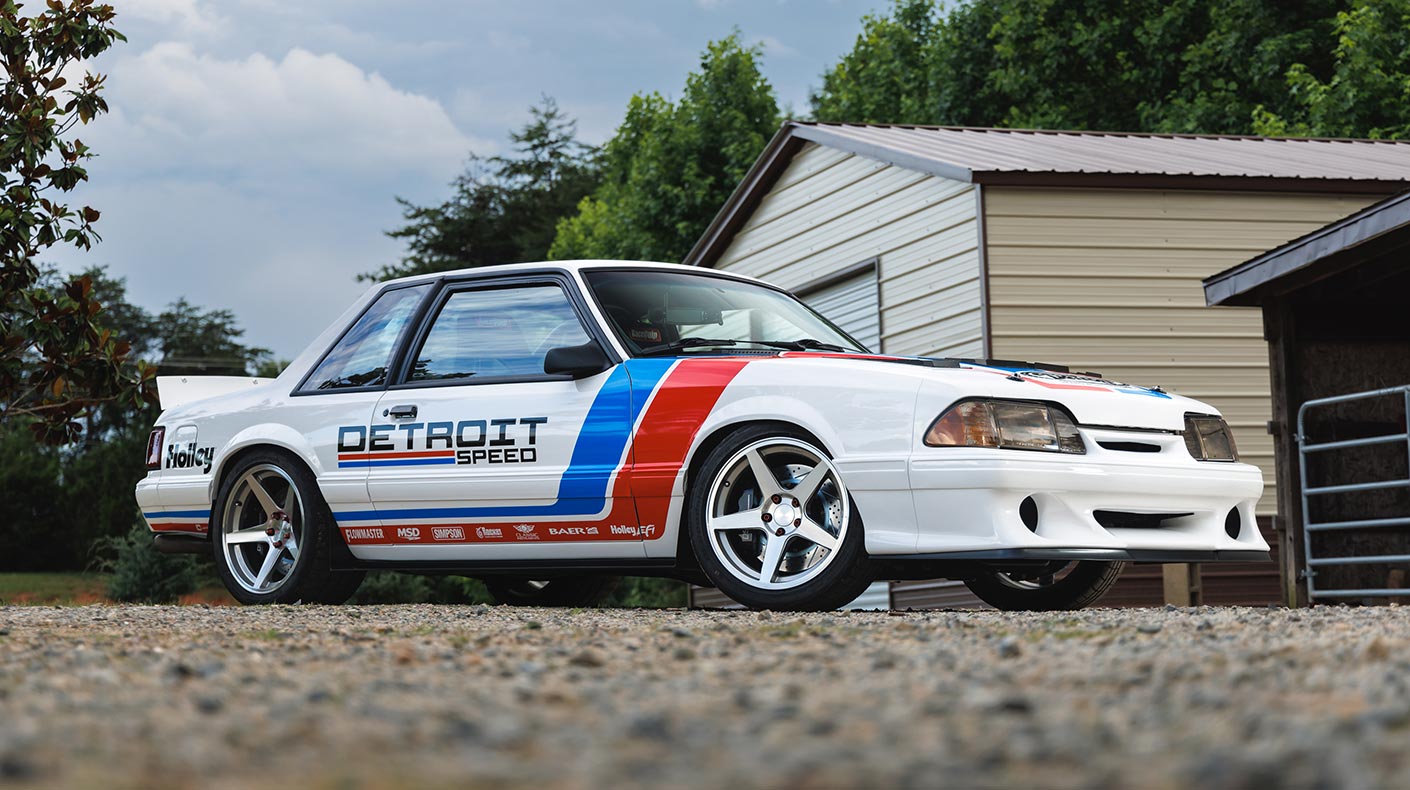
They are so back!
And who would have thought? The iconic Fox-Body Mustang of the ’80s and early ’90s is making a comeback in the restomod arena as well as increasing inroads into pro-touring motorsports.
If you attended the 2024 SEMA Show in Las Vegas or the PRI Show in Indianapolis, you might have noticed a more significant Fox-Body presence, signaling a return of these vehicles to the automotive spotlight amid the cultural zeitgeist for all things retro. They are popular once more—but why, and why now?
A RETURN TO GLORY DAYS
The Fox-Body Mustang is the third generation in the Ford Mustang lineage, following the uncelebrated run of the Mustang II. Its manufacturing years were from ’79–’93, with a significant change to the front end from a "four-eye" design to the more popular and recognizable aeronose in ’87. Rear-end styles encompassed the notchback, hatchback or the less popular convertible. Ford offered such powertrain options as the 2.3L inline-4 Lima and the 3.8L Essex V6; however, it was the 5.0L High Output 302ci V8 that became synonymous with the platform.
To better understand the current market and find out what demographic is restomodding Fox Bodies, we contacted Manir Karim, owner of Our Dream Resto Mod, out of Salsbury, North Carolina. The hot-rod shop never labeled itself a Fox-Body specialty shop, but Karim considers himself a fan of the platform. Owning a few in his lifetime gave him the eye and creativity for some pristine builds. Word got around, and now Fox Bodies are the shop’s bread and butter.
“I would say we've been messing with them on a business level for the last 13 years or so," says Karim. "And definitely from when I first started to now, I'd say the last five years have been crazy as far as popularity."
Karim believes nostalgia plays a significant role in the platform's current revival. Most customers bringing in their Fox Bodies are in their 50s and 60s—either original owners or enthusiasts who recently bought the same model they drove in the ’80s or ’90s to relive the good times with modern upgrades.
The extent of vehicle modification has also paralleled the platform’s popularity. Fox Bodies have always been easily modifiable cars with strong aftermarket support. But where modifiers were previously apprehensive about putting big money into restomodding them, Karim says that's not the case anymore.
"We've done many no-budget Fox-Body builds, which was unheard of because it was almost like you're throwing your money away. People would do it on fastback Mustangs or 'Cudas. Whatever it took, they would fix them, make them nice, but no one would do that with a Fox Body. But we have done quite a few six-figure builds, which in the grand scheme of things in the restoration world isn't much, but for Fox Bodies, it's a lot."
Karim, along with every other source for this article, sees the original targeted demographic for this vehicle now at an age where they are monetarily stable enough to invest in their high-school dream cars.
With more premium Fox Body builds making waves, like Holley's pro-touring notchback at the recent SEMA Show, it’s a green light for others to follow suit and go further.
THE AFTERMARKET
Several factors make third-gen Mustangs so popular within their restomod circles: their abundance in the secondhand market, their low market cost, aftermarket support, and how relatively simple they are to work on.
Modifiers typically start with five-lug conversions, permitting a wider wheel selection, followed by upgrades that enhance stance and handling, such as suspension and brake improvements. "Getting the stance right and putting a nice set of wheels goes a long way on these cars," expresses Karim.
Detroit Speed and Engineering made serious strides in the Fox-Body suspension market at the 2024 SEMA Show as the architect behind Holley Performance’s Fox-Body build. (At that time the Detroit Speed was under the Holley umbrella, but since has been acquired by QA1.) The performance notchback was Holley's booth vehicle promoting domestic muscle products and garnering favorable attention from attendees. Nathan Peterman, senior product design engineer at Detroit Speed, says with the rise in Fox-Body interest, the company wanted a project vehicle for use as a research and development canvas—a way to test new suspension systems.
"They're extremely well supported on a lot of the driveline stuff," says Peterman. "But we saw a hole for high-end-racing and pro-touring-type suspension. There's a lot of suspensions that have been on the market for a long time, but of course, with time you learn new things, and there's ways to improve upon it."
Companies like Detroit Speed are making third-gen Mustangs more prevalent in motorsports. While the vehicles have always been present in the drag-racing world, their unibody flex has hindered their cornering performance in other types of racing. But the aftermarket has been catching up to alleviate that trouble, and Detroit Speed has demonstrated the platform is far more capable than previously noticed.
The company has different levels of suspension conversions for the front and rear systems, but its project notchback utilizes Detroit Speed’s Short Long Arm (SLA) conversion system that incorporates upper and lower control arms with coilovers. According to Peterman, track testing has demonstrated a significant drop in lap times when the front strut setup is exchanged for the new SLA system.
"We got a good chance to do back-to-back, similar weather, fresh tires for both runs on the same racetrack to see how advantageous it is to go to an SLA compared to a max effort strut suspension. We headed up the local track that we use and went from a minute 45 lap to a minute 43, just from the front suspension change."
In racing, 2 seconds can feel like an eternity, and when you add a Ford Performance 363 crate engine with a Holley 4150 intake and a Sniper throttle body, you show the performance world that Fox Bodies can hold their own beyond the dragstrip.
Peterman and the Detroit team "took it on Power Tour and probably put 8,000 to 10,000 miles on it last year, just driving it on the road to different events. We autocrossed it, we drag-raced it, drove on road courses, and all around it turned out to be a good everything vehicle… We saw a big uptick in road racing and autocross and the street pro touring scene. We wanted to jump on that and ride that wave of popularity on those."
The fact that a Fox Body was featured in a Holley Performance Brands booth proves the platform’s growing prominence. But Holley and Detroit Speed weren't the only ones making a buzz at SEMA with a Fox Body.
A NEW FRAMEWORK
More Fox and a little less Body, Roadster Shop's booth featured a remarkable display debuting their new SPEC Chassis for third-gen Mustangs. The display featured the new chassis bolted to a half-skeletonized body to mock up how their new frame would interact and bolt up to the original subframe.
Roadster Shop specializes in aftermarket chassis for both body-on-frame and unibody vehicles, and the SPEC chassis give the unibody cars body-on-frame handling while eliminating the shock towers, allowing more engine bay room and compatibility with popular powertrains.
The display certainly grabbed attention and widened some eyes, but just how responsive was the public to the release? Was there much demand for aftermarket products starting at $15,000 for this platform? According to Roadster Shop Co-Founder Jeremy Gerber, demand has made the chassis a hot commodity.
Gerber explains that when they unveil a new product, it's typically a slow rollout. It's never a floodgate of overwhelming demand. However, "This particular product was the closest thing I could say we've experienced [to instant demand]. Honestly, I was shocked by the reaction and by how many initial sales we got… Right out of the gate, it's a pretty damn good performing product."
Roadster Shop didn't time the market for this release, but Gerber believes this phase in the platform's aftermarket growth was bound to explode based on its history. "It's not like it just came out of nowhere," he says. "It's been a popular car that people modify ever since its inception. It has a huge fan base… So I don't think we necessarily timed it to when the car became popular. I think we timed it so the right demographics are now getting to the point that they're willing to spend a little bit more money than in years past."
A GROWING FUTURE
The aftermarket future looks bright for Fox Bodies. "I think it's just getting started," asserts Gerber, noting that the demand for higher-end level builds will increase. Shops like Our Dream are already making great strides with his new frame.
Karim had ordered the SPEC chassis for a client with an '81 T-top coupe and has big plans for the project. He hopes to show more consumers that a high-end Fox Body build is worth pursuing. "We're going to flush fit all the glass… And then we're going to [build] a pretty wild coyote. Hopefully, [we'll get] a four-digit car with more than 1,000 hp. We have some ideas on the body. We might do some unique engine bay stuff since the Roadster Shop chassis gives us a blank canvas for the engine compartment."
New products like the SPEC Chassis and Detroit's SLA system are opening new opportunities for Fox-Body builders and, as Karim expressed, offering a blank canvas for higher-end builds in a market seeking more from the platform. So, what's next?
Having built numerous Fox-Body Mustangs and being familiar with their stock and modified architecture, Karim hopes to see more support in exhaust systems. "There's tons of exhaust systems for these cars,” he says, “but there's not an exhaust system that goes from the headers back that fits. Usually, this company will make a great header. That company will make a great mid-pipe, and then this company will make a great cat-back. But when you try to put it all together, you have to modify something to get it to fit nicely."
For Gerber, higher-end bodywork is a gap that has yet to be filled in these builds. That could very well change in the coming years as more products are released for the platform, encouraging top-tier, SEMA Battle of the Builders-level vehicles.
Josh Stamper, vice president of marketing and new product development for SS Tubes, is familiar with the platform, having developed a two-piece fuel-line system that works around aftermarket subframe connectors for the third-gen. Stamper agrees we'll see significant movement with the body of these Mustangs in the coming years and predicts the Fox-Body aftermarket will soon mirror that of the first-generation Mustangs in some aspect.
He explained that with companies like Roadster Shop now offering complete chassis, a growing market for reproduction body panels—similar to what exists for late-’60s Mustangs—is likely to follow. Stamper concludes, "I think with Fox Bodies, in the next 10 years, we'll be able to purchase a brand-new shell and custom panels. I think they'll be that popular."