

It’s not often that a mechanic is considered a household name. But having built a subscription army of over 10 million and counting, this man has established himself as the go-to, one-site-fixes-all resource for anyone looking to tackle automotive repair. The recent recipient of SEMA’s Content Creator of the Year award, ChrisFix is passionate about automobiles, fishing, and, perhaps above all, people. We recently sat down with Chris to learn more.
SEMA Magazine: When and how did your passion for cars begin?
ChrisFix: It actually began with boats. I love fishing, and when I was a little kid, my parents decided to get a small boat so we could go fishing, to the beach and, you know, cruise around. To afford the boat, my dad and I would work on it. That was back in second grade. We’d change this and that, and he would show me how to change the spark plugs. He'd show me how to change the water pump. He'd explain how to do it as he watched me. I remember he'd reach down and help me lift the wrench to break the bolt loose. And then I'd do it the rest of the way, or he'd do one spark plug and then watch me do the rest.
I learned all the basics of engines working on that boat. Oil changes, coolant, all that stuff. How it worked, and why this different system worked. And then my boating neighbors would be like, “You mean Chris was able to get in that tight spot? Can he come and do my boat?” And they'd pay me in tools, or they'd pay me like 100 bucks. That’s how I got my start. I was like, “This is cool.”
Although the boat got things started, my dad and mom were car people. My mom had an MGB, and my dad had Mustangs, Cadillacs and cars like that. My family, in general, is full of car enthusiasts. My uncle has a bunch of collector cars, and every Thanksgiving we would go over and check out a new one. So, it was always kind of just in my blood.
SM: How did the <ChrisFix> channel come to be?
CF: It originally started with just me finding a place to post videos that I could share with my friends and family. At the time, I didn't know YouTube was a thing you could share with the public. I could download to the internet and then send the link in an email. I’d make videos of my adventures fishing, going out into nature, whatever I was doing--just fun videos.
Then I got to driving age and realized I needed to learn to fix a car because I couldn't afford a mechanic. We had this old ‘92 Cadillac Deville sitting in the driveway with a bad water pump. My dad said, “If you can fix it, you can drive it to school.” I was like, heck yeah, and took it to a mechanic who wanted like 500 bucks. That wasn’t an option on my Pizza Hut salary.
I could fix it myself, and my dad was encouraging me. I thought, “Worst-case scenario, the car doesn't run, or we end up taking it to a mechanic anyway–go for it. So, I watched a ton of YouTube videos, talked to friends, read books, and took in as much information as I could.
The water pump, I'd done on boats; it's just an impeller, it's pretty simple. I watched something like eight to 12 hours of YouTube videos on different water pumps. I realized that some people are good at explaining stuff, but their videography skills were not there—their videos were dark, out of focus, or whatever it might be. Others’ camera skills were awesome--in focus and lit well, but they blasted music, or they did not explain things well. But after learning all this stuff, I replaced the water pump, the car worked and it felt great.
We drove it to Thanksgiving dinner, and I remember my parents bragging about it at dinner, how I fixed the car, and it just felt really good. I was able to accomplish this on my own limited knowledge and my dad's tools. I thought it would be cool to make videos to show people how to do that--but good-quality, one-stop videos. You watch my video on replacing the water pump and you know how to do it. You don't have to search a million different videos. So I started making videos as things broke or as I worked on things, and it just grew from there.
SM: What does being recognized as SEMA Content Creator of the Year mean to you?
CF: This was a really, really cool thing. I felt like all the hard work, all the videos that I've made, that have helped almost 2 billion people--that's billion with a B! It’s like I’m being accredited for it. I got this award for it. It's cool to be recognized by SEMA because SEMA is just such an amazing organization. I can't even put into words how awesome it is. I've gotten play buttons, you know, for the 100,000, for the million, for the 10 million, and those are awesome. And this is right up there with those play buttons.
SM: What are your thoughts on content creation marketing in the aftermarket space?
CF: I do a lot of that, and I like to do it organically. I don't like to shove products into people's faces. I just have a job that I need to do. If I want to do a video on changing drum brakes to disc brakes, and there's a company that makes the adapter, it's included in the video. It's very organic, it's very necessary. And the viewers trust the products I use. So it's a very easy integration that works well for myself, the viewers and the brand.
SM: How should brands approach it and leverage it?
CF: They should approach it with a budget in mind. If they've never done it before, talk to the content creator and ask what the process is. Everybody has a different process; my process is different from somebody else's. Explain the budget and see what can be done with it. It helps to explain how you want the product to be shown, or if you want to use Facebook, Instagram, YouTube, TikTok, etc. Trusting in the content creator is the most important thing. If you're trying to force the content creator to do certain things, then just hire somebody to create an ad. Just let the content creator do their thing. I know how to make it good for my audience and good for the brand because the idea is it's not an ad, it's an integration. It's a use of your product that viewers are going to see, as well as the quality and all that stuff.
SM: Any specific thoughts on best engagement, particularly towards a younger audience?
CF: Today you have to be quick and snappy. You can't tell long-winded stories. You need to get to the point, be interesting and constantly keep the viewer interested. And that could be with cool things happening or information that they need. Once you get away from those two things, viewers tend to drop off.
SM: What advice would you give a younger version of yourself trying to establish a presence or a content business?
CF: I'd tell myself to do it again. Be true to yourself. Make content that I'm proud of. That's how it all started, right? I was proud to share it with my friends and family because I knew how much work went into it. I knew it was helpful. Do the right thing, keep it honest. Show the actual process and just make content that you're happy about and proud of. That's the biggest thing I say when kids come up to me and ask, “Hey, how can I get started making YouTube videos?”
I’d say the content piece is one thing, but the skills that you learn and acquire leading up to that are another. So, learn as much as you can. I was in the New Jersey State Police. I was a chef. I was a marine biologist. I worked for the Department of Homeland Security. I did all these different things and acquired different skills from each of them. Creating a recipe as a chef? Each video is a recipe. In the state police, it was a very stressful job–not a lot of sleep, and you had to be able to focus. It’s the same thing with content creation. Sometimes, you have to get a project done, a video, and you're editing. There's not a lot of sleep and it can be stressful. You're not worried about somebody shooting you, but you have millions of viewers asking when the next video is? What's going on? Why is it taking so long? They don't know, they're just excited.
That’s stressful in a different way. The state police taught me how to deal with that. And in marine biology and homeland security, you take these complex topics that the public isn't aware of and simplify them so the public can understand. It's the same with videos; taking a seemingly complex job on a car that somebody doesn't know about and making it understandable and digestible for them. So, I took all these aspects that I’ve learned in life and applied them to this one thing, and I feel that's what has made it successful.
SM: Your favorite platform is presumably YouTube. What are your thoughts on others?
CF: YouTube is the best platform. It's also the one I'm most nervous to post to. My content there has to be the cream of the crop. Unlike Instagram, not that I don't care, but I don't mind posting stuff on there that has nothing to do with cars. I show fishing and random house stuff, and you don't have to make this perfectly crisp video on that. You could just show your behind-the-scenes. That's how I use it. It's more to keep the audience engaged while you make that next YouTube video.
SM: How do you work with brands in the automotive aftermarket?
CF: Sometimes brands reach out, and other times, if there's a product that I need, I go and buy it. If a brand approaches me, I assess whether the product or video fits my channel and audience well. If it does, I’ll create a plan for it that we can agree on. Then I send over a contract with my deliverables, their deliverables, and the estimated timeline.
I'm always late. It's unfortunate on my end, but I will not produce or publish content I am not 1,000% happy with. I will go back outside and reshoot shots that I'm not happy with. I've done it on pretty much every video. I'll go back out, disassemble what I put together, get to the point that I need to get to, and then reshoot it. I give the brand updates along the way, such as, “You're next in line,” or “There are two more videos ahead of you.”
I let brands change two things–safety and facts. If I'm not factual or my method isn’t safe, they're allowed to change that. It’s in my contract. I don't want them forcing me to say stuff that I don't want to say or make it an ad.
SM: What, if any, areas of the industry do you see trending or blowing up again?
CF: I don't know, I think a lot of people are really into the hybrid stuff. They're not getting into the electric stuff as much. There's a place for electric cars, but I think people are starting to realize that we want our gas engines. We want that rumble and feel. But the technology for better fuel efficiency and the ability to go 40 miles in a plug-in hybrid before using gas is also good. I think that combination is where the industry is going to end up going in the immediate future.
That’s not the aftermarket, but I don't know if I see anything personally. I think people just want to make cars fun. They want to use cars as an escape. People lower their cars, put wheels on, tires, turbos or an intake. They do little things to make their car their own. And I see that all the time at car meet-and-greets. Because of my videos, fans always show me pictures of their cars and their added dash cameras, brakes or exhausts.
SM: What do you think the future looks like in social media, and more specifically, the aftermarket industry?
CF: Social media is very interesting because back in the day, it was the Wild West, right? You couldn't make money on social media. I didn't know you could make money on YouTube. I just did it because I wanted to help people. Today, when I talk to fans at meet-and-greets, parents sometimes come up to ask if I can talk to their son about being a YouTuber. I'm like, yeah, it's 16 hours a day, seven days a week, nonstop pressure and stress. I boil it down to “it's not easy.” You think it's this glorious thing and, yes, it has its awesomeness, but it's not this simple and you don't see what goes on behind the scenes. I try to explain that to the kids.
Now it's “I want to be a YouTuber.” I try to use the terms “content creator” or “YouTuber.” I hate the word influencer. There are so many people in this content-creation field now, and everybody has a camera on their phone, which takes pretty good videos, shoots 4K, 60 frames a second, and has decent audio. It does all this stuff for you. You don't have to know too much about film and photography. You don't need to know what an aperture is or a frame rate; it just does it for you. So, I think the barrier to entry is very low right now, and I think everybody wants to do it. It's overly saturated.
SM: What are you going to be doing going forward? Much of the same, or are there any plans for anything new?
CF: Moving forward, I have a couple of video ideas, like series ideas. It's a very big undertaking, will be really cool, and I think it’ll do well. The problem is it's a year's worth of work before I even film. Also, I need to fix my fleet of cars! I’ll be working to make sure that the videos are more consistent. I haven't been very consistent since I recently moved. My goal is to get more situated, and that will help with the consistency.
SM: What is the most valuable career lesson that you have learned since you started in this industry?
CF: Be true to yourself. Be kind. Be positive and treat people the way you want to be treated. An example is at meet-and-greets. People line up to meet you and sometimes there’s a cut-off time. Often, the line is still long past that cut off but I always make a point of meeting them all, even if it takes an hour or two after that. If I waited in line and that person just stopped at a set time, I’d have a poor impression, it’s a bad memory. So, I prevent that as much as possible. Treat people the way you want to be treated and create content the way you would want to consume content.
SM: What specific areas of car culture are you drawn to these days?
CF: I just like all of it. Every car is unique and different. I have 15 different cars, from a Prius to an H1 Hummer. Every car has its own feel. When you get into the Hummer, it's this tank. It's this raw, visceral feeling of a diesel engine-like tin can, it just feels this, this certain way. You get into a Prius, it's more refined, it's quiet, it's economical. You play like a fuel-economy game. How much? You know, if I coast here, I'm going to get this much energy, this much energy back, and I'm going to slowly brake so that I can regenerate… And then there's everything else in between. You get into a sports car and it's exciting and fun. You get into a Mustang, it's like you've got this torque and this V8 rumble.
I think it's cool to see how people make their cars unique, and I like the idea of everybody just meeting up, hanging out, talking about cars. These car meets, the Cars and Coffee, it's not a car show where you're trying to make your car nicest. You can appreciate the guy who has his daily driver and just put in this air intake. It's such a simple thing. But for him, that's the first time he did it and it's special to him. It's cool to see that.
I also like going to different countries. I went to Japan and got to see the car culture there. It's so unique and different.
SM: Craziest day at work?
CF: Oh, man, there's so many awesome days, there's so many crazy days. I mean, I've been at the Indy 500 with the Shell team and Shell One, and we celebrated. I've been to Ferrari and had dinner in Ferrari's trophy room. I get to go to all these cool places.
SM: Daily driver?
CF: Whatever car is working! I was daily driving my Corvette for a long time. Then I got my Hummer, and I got the Drift Stang, and I drove the Drift Stang until I started drifting it and modifying it. Then it was the Hummer until I blew the transfer case. Now that needs to get replaced, and I'm like, I need to make a video. So I'm daily driving the Prius, and then the Prius has to get, you know, a wheel bearing video or E85 kit on it, and then I daily drive the Del Sol. I switch cars around a lot.
SM: What projects can we find in your garage?
CF: Every car is a project. Every single one. Right now it’s the Del Sol. Gonna turbo it. So I'm doing a series on building it up to get it turbo. Next, I'm fixing the shifter. It's loosey-goosey, like a wet noodle. You don't know what gear you're in. I'm putting new bushings in, setting it up so it's nice, crisp shifts. Every car is a project, and it's kind of a problem.
SM: Dream car?
CF: My Hummer H1, 1990. In this case, it's the ’96, and that thing is awesome. That's my obtainable dream car. An unobtainable dream car is a Zonda. I always liked the Pagani Zonda, but obtainable is my Hummer. And that's my baby. I love that car. I was playing on my bicycle as a kid, and one passed by, and I told my dad about it. Then they took me to the GM dealership where they had them lined up, and I was like a kid in a candy store. My dad told me, “You work hard, you go to a good school, you get good grades, and you'll be able to afford one of those.” That was like a motivational thing for me. My parents were always there to push me and try to make sure I had a good direction. That was a big part of my life.
SM: When you’re not in or around cars, where can we find you and what will you be doing?
CF: I love fishing and boating. That's why I have the Chris Fish Channel. But I like to explore. Shark-tooth hunting is a big thing, and I enjoy that because takes me back to my marine biology background. Plus, the hunt, in this case, shark's teeth. Boating is a big part of my life. I love being on the water. I just feel at peace on the water. Maybe even more so than in a car. In a car, you have a road that you have to drive on, and there's a lane, but a boat, you could go anywhere, do anything. So fishing, boating, outdoor stuff. I love playing different sports such as baseball, tennis, and any other sports.
SM: Chris Fix in 10 to 15 years. Who and what?
CF: I would say I'd like to just keep going. I need to find a work-life balance. It used to be all work. Recently, it’s been a lot of life, and I need to find that balance. If I can manage that balance, that's my 10-to-15-year goal. Continue producing content that helps people. Brands that are represented in my videos continue to thrive, and the viewers continue to fix their cars, save money, and love the meet-and-greets. I love hearing that. They're like, “Oh man, you got me into the industry. I'm a tech because of you. I'm an engineer because of you.”
My first meet-and-greet ever, this couple--well, this guy and girl--were in line next to one another. They started talking to each other and ended up getting married. I think they have kids now, all because they went to my meet-and-greet. So being able to affect people and their lives positively is a goal, and I hope I can continue doing that. But that work-life balance, that's the thing that I am seriously working on right now. It's not easy, but that's pretty much everything. I'd say the last thing would be doing more stuff in the industry. The tool thing was a cool experiment. The cool thing I always wanted to do. Maybe open an automotive shop.
Also, I started getting tools made with the ChrisFix name, working with different companies in America to make ChrisFix tools. That way you watch the videos, and you use the tools. I thought that was pretty cool. That was more for fun than anything else, but all the money goes to charity. Charity work is a big thing I like to do. I work with a couple of charities, such as Building Homes for Heroes, which is a good one that helps veterans and first responders, and $0.95 of every dollar goes to the cause. Their CEO takes no money. Their employees take regular pay, and everybody's for the cause, which is great. So I've been trying to do more of that.
I also gave away a car to a family that lost their parents. At the time, the 19-year-old daughter took custody of her three siblings, and she was balancing school and work to afford their apartment, which they were getting kicked out of because they couldn't afford it. She just basically got put in this place that was not good. Building Homes for Heroes got them a mortgage-free house, but they had no car. So, I got them a car and I was able to make a video and share it, and we raised over $100,000, plus the car. So, more charity stuff this year. I'm hoping to give three cars away to three different families in need. This is, you know, me giving back.
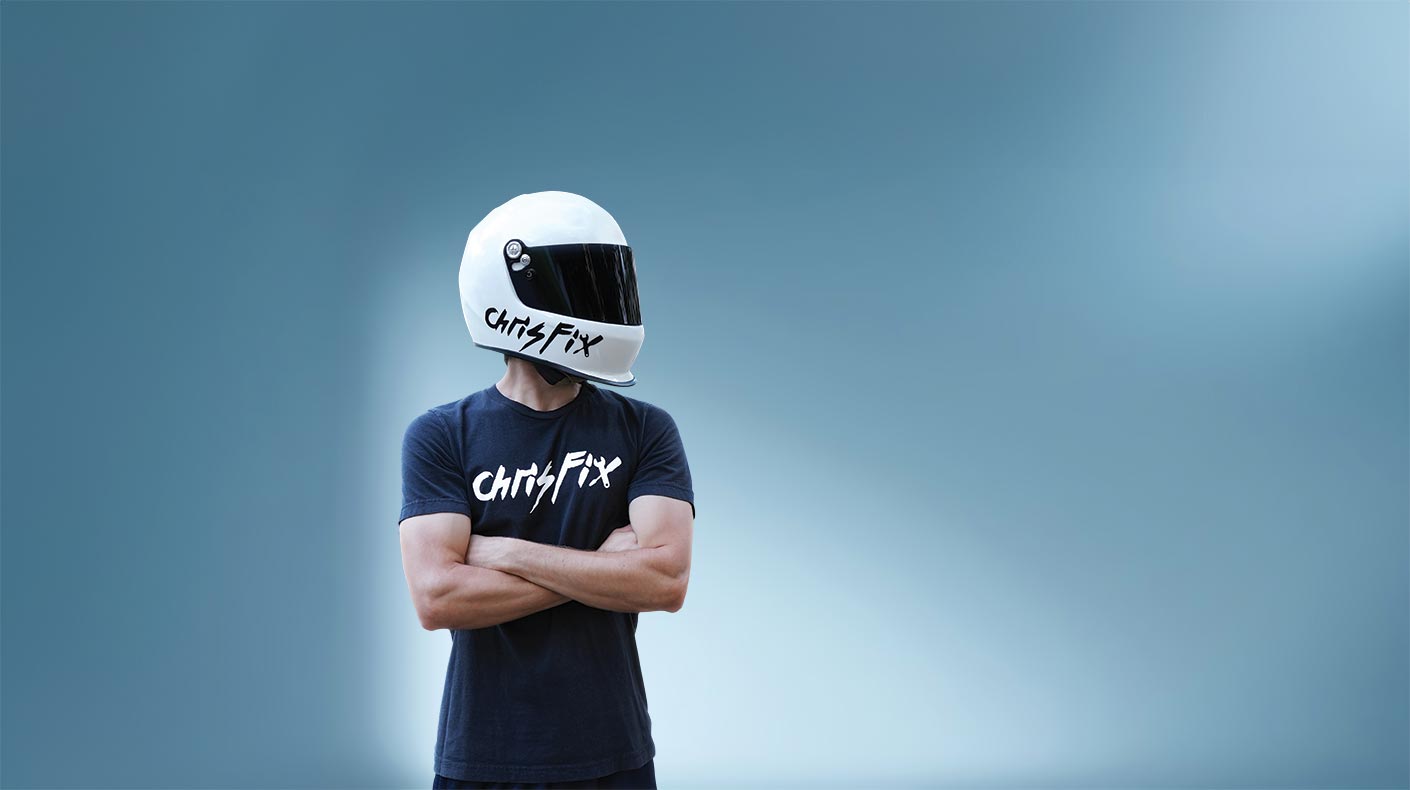
SM: Finally, and it has to be asked, why the helmet?
CF: [Laughs] I never thought of showing myself on camera. The whole point of my videos is to teach people how to fix cars, so I thought that I should just focus on that. It has nothing to do with me being on camera, minus my hands. Then I started getting into motorsports, like drifting and endurance racing, so naturally, I was wearing a helmet and it helped keep my identity hidden. It was never about me; it's about the work that's at hand. I like the idea of how anyone can put some nitrile gloves on and use common hand tools and basically become ChrisFix.