


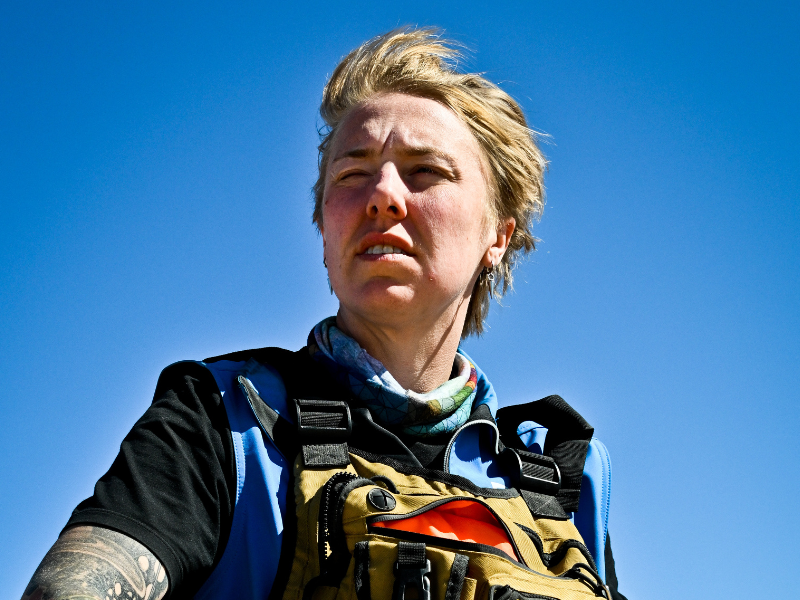
Taking on the Rebelle Rally is no small feat, and for Lauren McCullough, it became far more than a test of skill behind the wheel.
In this candid conversation with the SEMA Businesswomen’s Network (SBN), McCullough shares what the rally demanded, what it gave back and how pushing beyond her comfort zone reshaped her confidence both on and off the course.
SBN: What does participating in the Rebelle Rally mean to you?
Lauren McCullough: The Rebelle became a chance to step into a version of myself I never really had space to meet. Out there, you cannot hide behind busy schedules or polished answers. The desert strips everything down. You see your strengths, your fears and all the places where you still have work to do.
For me, showing up to the starting line felt like reclaiming a piece of myself. And finishing felt like proof that I can handle hard things without losing my sense of self. It meant learning to trust my instincts, trust my teammate and trust that even when I feel off balance, I can still move forward.
SBN: What type of preparation is needed for this competition?
LM: The prep is serious and it touches every part of your life. You have to learn navigation from scratch, get comfortable reading terrain and train your body to handle long days with very little rest. There is constant practice: plotting points, running drills, testing gear, studying maps, learning to drive in sand, rocks, mud and open desert.
But the real preparation is mental and relational. You have to learn how to regulate stress, how to communicate honestly and how to be a steady partner even when you are tired or frustrated. You also have to build trust with your teammate, because neither of you can carry the whole thing alone. It takes humility, patience and a willingness to be wrong and recover fast.
SBN: What was the most challenging part of the race for you?
LM: The hardest part was dealing with the moments where my confidence slipped. The desert forces you into decisions with limited information, and sometimes you second-guess everything. There were times when I felt this tight pressure in my chest, like I was failing or slowing us down. It is a tough feeling to sit with while the clock is running.
There were also moments where I felt overwhelmed by how big the landscape was or how quickly conditions changed. Staying calm, staying focused and not spiraling when a mistake happened took a lot of internal work. I had to learn to quiet the noise in my head and just trust myself, even when it felt uncomfortable.
SBN: What was the most rewarding experience?
LM: The most rewarding part was the moment when everything aligned. We were deep into the rally – tired sunburned and covered in dust – and suddenly our rhythm clicked. My teammate and I were communicating clearly, hitting checkpoints and making decisions with confidence. It felt like all the training and frustration had finally settled into something steady.
Crossing the finish line was emotional too. Not because of rankings, but because I knew how many times I had to push through my own doubt to get there. I did not realize how powerful it would feel to finish something so demanding without abandoning myself in the process.
SBN: What three skills did you use the most?
LM: One – emotional regulation. Keeping myself calm when the pressure spiked made all the difference.
Two – clear honest communication. We would not have made it without being able to talk through stress and decisions in real time.
Three – fast recovery. Mistakes happened constantly. Letting go, resetting and moving forward became a survival skill.
SBN: Was there a point that you wanted to give up? If so, why did you not?
LM: Yes. There was a day where everything felt heavy. We were off track, I was tired and my inner critic was loud. I had a moment where quitting felt easier than staying present.
I did not give up because I knew that decision would follow me long after the rally ended. I wanted to prove to myself that I could stay in the discomfort and still show up. And my teammate believed in me in a way that grounded me. That belief kept me going when my own belief was shaky. In the end, pushing through that low point became one of the defining moments of the whole experience.