


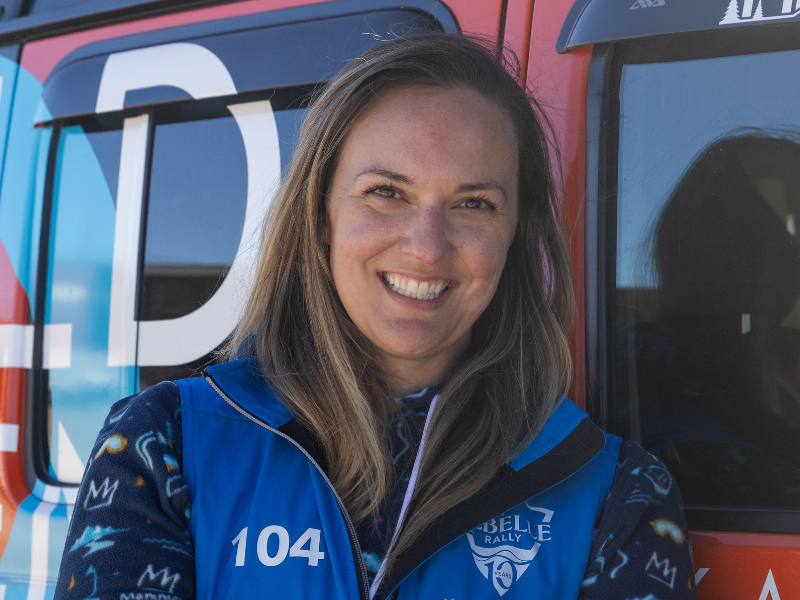
Competing in the Rebelle Rally demands more than off-road driving skills; it requires resilience, precision, teamwork, and the ability to stay focused under extreme pressure.
In this interview with the SEMA Businesswomen’s Network (SBN), Katherine Abraham shares how the all-women off-road navigation rally has shaped both her confidence and path in the automotive and motorsports world.
SBN: What does participating in the Rebelle Rally mean to you?
Katherine Abraham: Participating in the Rebelle Rally is something that has fundamentally reshaped my life. It’s more than a rally; it’s a full-body, full-heart experience that tests your mental toughness, technical skill, emotional resilience, and ability to trust someone else in high-pressure moments.
For me, the Rebelle has been a gateway into my own capability. It pushed me from “I think I can do this” to “this is where I’m meant to be.” It’s also incredibly empowering to share the desert with so many driven, talented women who are all out there pushing their personal limits. That community is rare, and you feel it in every checkpoint, every plot, and every sunrise.
Each year I walk away stronger, more grounded, and more certain of the path I’m on in the automotive and motorsports world.
SBN: What type of preparation is needed for this competition?
KA: The preparation is part technical training, part physical endurance, and part mental conditioning. On the navigation side, I spend months drilling plotting speed and precision, practicing topography reading, and studying terrain through maps and satellite imagery, especially since I live in Kansas City and can’t easily train in the desert.
Physically, you need enough strength and stamina to handle long days, rough terrain, and minimal sleep. Mentally, you have to prepare to be uncomfortable, tired, overwhelmed, and still make good decisions. That means practicing communication, patience, and the ability to reset quickly when things go sideways.
And finally, preparation means knowing your vehicle inside and out. You need to understand how it reacts, what it needs, and how to keep it alive in the middle of nowhere. The more time you spend behind the wheel, the more confident you become when things get tough.
SBN: What was the most challenging part of the competition for you?
KA: The hardest part for me is always managing the balance between my competitive drive and the reality that this is a team competition. My instinct is to push hard, solve problems fast, and stay locked in on performance, but that can come with emotional pressure that not everyone handles the same way.
The mechanical issue with losing 4-Low this year also challenged us in ways I didn’t expect. When something major goes wrong with your drivetrain in the most technical terrain of the event, it shakes your confidence. You have to make fast decisions while staying calm, and sometimes the “right” choice isn’t the one your competitive heart wants to make.
The Rebelle forces you to face yourself, your instincts, your intensity, your fears, and grow through them.
SBN: What was the most rewarding experience?
KA: Without question: dunes day. We placed sixth overall — our highest finish in three years — and everything just clicked. The navigation, the driving, the teamwork, and the energy all aligned in this perfect, exhilarating way that reminded me why I love this sport so much.
It was also the joy of sharing that day with other competitors we’ve become close to. There’s something magical about celebrating each other’s wins out there, even as you’re pushing to earn your own. That moment confirmed that the work, the training, and the growth were all worth it.
SBN: What three skills did you use the most?
KA: One – navigation precision. Plotting accurately and reading topography quickly are the foundation of everything. If your plots are off, your entire day is off. This is where countless hours of training really pay off.
Two – decision making under pressure. The Rebelle doesn’t give you time to hesitate. You have to make calls quickly, confidently, and with limited information. Strategy matters just as much as skill.
Three – emotional regulation and resetting fast. Whether it’s fatigue, stress, mechanical issues, or a mistake, you have to be able to reset instantly. Staying calm and keeping the atmosphere functional inside the vehicle is crucial, especially when emotions are running high.
SBN: Was there a point that you wanted to give up? If so, why didn’t you?
KA: There were definitely moments that stretched me to my limit – moments of mechanical failure, moments of exhaustion, and moments where the emotional weight was heavy for both me and my teammate. But giving up never felt like an option. I didn’t come to the Rebelle to quit. I came to prove something to myself, to honor the years I’ve put into this sport, and to show up fully for the teammate sitting next to me. I also knew that the version of me on the other side of the challenge would be stronger, more capable, and more confident.
When things got tough, I reminded myself: You didn’t come this far to stop here. That mindset, plus the support of our community and the belief in what I know I can do, is what carried me through.