

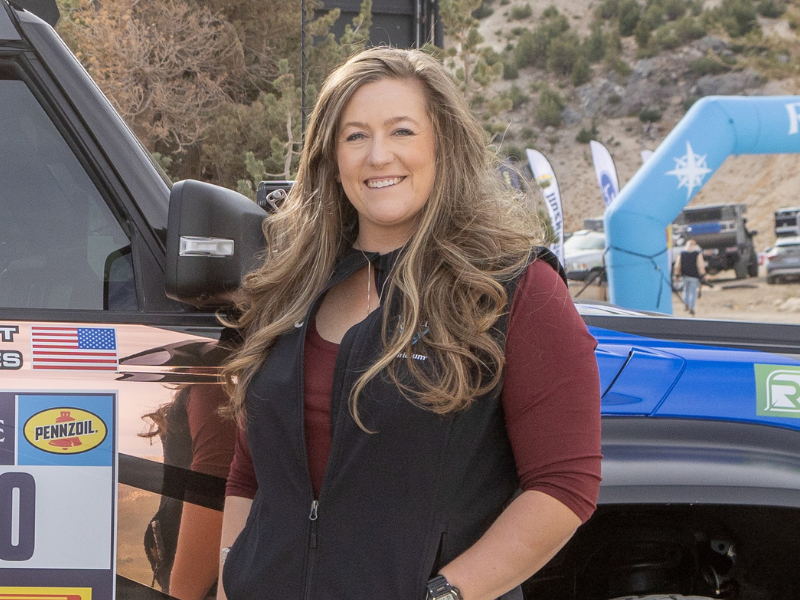
For Kirstin Backes, competing in the 2025 Rebelle Rally was more than a test of navigation and endurance; it was a powerful reminder of why she fell in love with the automotive world in the first place.
In this candid conversation with the SEMA Businesswomen’s Network (SBN), Backes shares what the Rally taught her about preparation, resilience, and decision-making.
SBN: What does participating in the Rebelle Rally mean to you?
Kirstin Backes: The Rebelle Rally is a really unique experience, both as an enthusiast and a professional. It's an incredibly challenging event, and simultaneously one that anyone can do with enough training. For me, it's a chance to re-engage with the things I love about the automotive world. For many of us, we spend our lives working on the business of the aftermarket, and we can wind up removed from what it is to be an enthusiast. For the last few years, this has been my annual reconnection to that. We get to go be surrounded by other enthusiasts (and incredible, smart, driven women), and live in the business of the rally - with zero connection to the business of the business for the duration of the event.
SBN: What type of preparation is needed for this competition?
KB: It depends on the role you're taking on, but for the team, the biggest challenge is typically navigation. You have to get fast and accurate at plotting the checkpoints, but for most people, that's the easy part of navigation. It's much harder to look at the map and connect it to the terrain around you. The way to train that is to get out in the world, and get accustomed to reading the terrain, in the especially difficult locations that we frequently wind up dealing with - think Johnson Valley, where you're in a giant valley, and identifying this pile of rocks from that pile of rocks becomes its own unique challenge. Most days, driving isn't particularly challenging, but knowing your vehicle can be tough. On the driver side of training, the most unique part of the rally is for sure dunes driving. Most people wouldn't think of taking a factory truck out into the biggest dunes in the country, but it's doable, if you know how to drive out there. The prep lots of people don't consider is the storage - you have two people for over a week, in a self-sustained event. So not only do you need camping equipment, navigation equipment, and recovery gear - you must unload and reload a lot of that, almost every day. Figuring out storage can really make or break the mood and morale at the beginning and end of very stressful, very long days. There's nothing worse than needing to deal with recovery, in a hurry, and realizing your recovery gear is buried under clothes, tents, and a heavy tool bag.
SBN: What was the most challenging part of the race for you?
KB: The hardest part of the actual rally is time management, without a doubt. And I think that if you really dug into it, it's true for most teams. Emily likes to present what she calls "decision days," wherein you've got 30-plus checkpoints available, but the routing to some might stop you from getting others that are easier to claim. You're constantly weighing the open and close times for checkpoints, against not only the distance you've got to cover, but the terrain in front of you. What looks like a quick jaunt to claim an "easy" checkpoint, might actually be hours lost to tougher, slower terrain, and before you know it, you're playing catch up, and stressing, for the rest of the day.
And the most challenging not-rally thing is learning to let go and move on - from your mistakes, from your teammates' mistakes. Learning to cut bait is hard, and people who call this event "fun" are already kind of broken. There's an inherent perfectionism for most competitors. We do it because it's hard, and it makes you better every step of the way. But that growth will give you some moment of despair - whether small or large - pretty much every day. Learning what to do with that, and how to recover from those moments, and still keep your head in the game is critical. We joked all year about FUDNT - "Screw" up different next time, and that's really the ticket - make a mistake, absorb the lesson, move on - and then screw up something else different the next time around. The specifics of this kind of navigation, and this kind of time management are Rally skills. FUDNT is a life skill.
SBN: What was the most rewarding experience?
KB: There's no more rewarding experience than nailing a black diamond checkpoint while you're out there. This year, I got one where I was only six meters off the point. For context, most points have 25–50-meter bullseye radii, and you can get diminishing points for hundreds of meters out from there. That means that with an entire desert in front of me, I was able to get less than 20 feet from the invisible point on the earth, with no tools other than (basically) a pencil, some paper, and a compass.
SBN: What 3 skills did you use the most?
KB:
- Map and compass skills - terrain reading is definitely top of the list
- Time management
- Extreme ownership and responsibility - as it applies to skills management, people management, conflict resolution
SBN: Was there a point that you wanted to give up? If so, why didn’t you?
KB: This year was a tough one, and for the first time in three years, I can say that I did want to quit at one point in the dunes. That said, quitting isn't a real option. You don't train for something this hard, for this long, to throw it away in the last hours. The Rebelle can really humble you, and that's what it did to me this year. When things aren't going well, in the truck, on the truck, or in the Rally, you must remember that you don't get to win every day, and you aren't guaranteed success just because you're trying your hardest. In that moment, you have to let go of expectations, let the disappointment go, and set your mind on the accomplishment of just finishing the dang thing. It was tough, but tough is a great teacher if you'll allow it.