


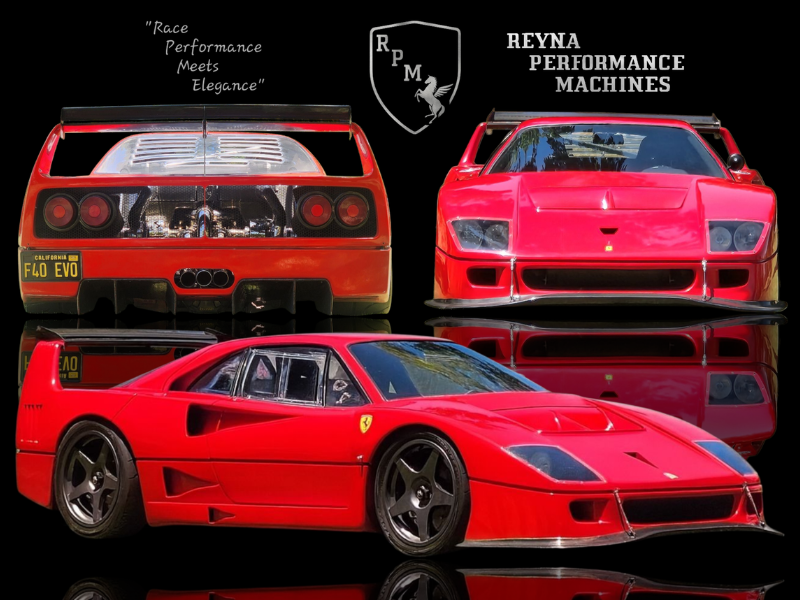
Transforming an icon like the Ferrari F40 demands more than performance upgrades; it requires a deep respect for engineering integrity and an ability to push boundaries without compromise.
The 1997 Ferrari F40 EVO by Reyna Performance Machines exemplifies this balance, earning its place as a standout submission for the 2025 SEMA Best Engineered Vehicle Award.
Engineering was one of the three foundational pillars of this project, guiding every decision from concept through execution. One of the most impressive achievements is the custom-engineered turbo system, designed as a true twin-scroll configuration. This solution delivers improved response, efficiency and power while maintaining drivability—an accomplishment that required advanced thermal management, precise airflow modeling and custom fabrication.
Beyond the powertrain, the build incorporates innovative use of carbon fiber composite materials to structurally bond components while reducing weight and increasing rigidity. These materials were not selected for aesthetics, but for their functional contribution to the vehicle’s performance envelope. Much of this complexity remains hidden, reinforcing that the most impactful engineering decisions are often invisible.
The F40 EVO also demonstrates a holistic approach to vehicle systems. Cooling, aerodynamics and mechanical reliability were treated as interconnected challenges, resulting in a vehicle that performs as a cohesive system rather than a collection of upgraded parts. One of the more complex aspects of the build involved integrating original Ferrari F40 electronic components with a Ferrari F355 wiring harness to create what builder Javier Reyna describes as a true “VintageMod” feel that preserved the raw analog character of the F40 while incorporating modern functionality and reliability.
Equally impressive is the project’s focus on long-term usability and serviceability. The vehicle was engineered to be exceptionally maintenance friendly, including a custom rear subframe design that allows major engine-out service to be completed without the need for a shop lift or engine hoist. The chassis is engineered to split in half, allowing the rear section with the engine and gearbox to roll out from the vehicle for simplified maintenance and accessibility.
What sets this submission apart is its commitment to engineering excellence beyond visual drama. Every solution was purpose-built, tested and refined to enhance performance while preserving the soul of the F40. The result is a modern evolution of a motorsports icon that showcases how advanced engineering can respectfully extend the legacy of automotive history.